The Great Sphinx: The Lion of Giza and Its Legends
No text from the age of the pyramids says who carved the Great Sphinx or what it was called. More than a thousand years later, a prince dreamed in its shadow that the god would make him king if he freed it from the sand.
- Type: monument and legend: a royal lion carved from the bedrock, later worshipped as a sun god
- Culture: ancient Egypt; carved in the Fourth Dynasty of the Old Kingdom (about 2686–2160 BCE), worshipped from the New Kingdom to Roman times, and retold by medieval Arabic writers
- Earliest texts: none from its own age; the Dream Stela of Thutmose IV (about 1400 BCE) between its paws; Pliny the Elder (1st century CE); Abd al-Latif al-Baghdadi (about 1200) and al-Maqrizi (about 1400)
- Key figures: Khafre, Thutmose IV, Hor-em-akhet (Harmachis), Hauron, the Sufi Sa’im al-Dahr
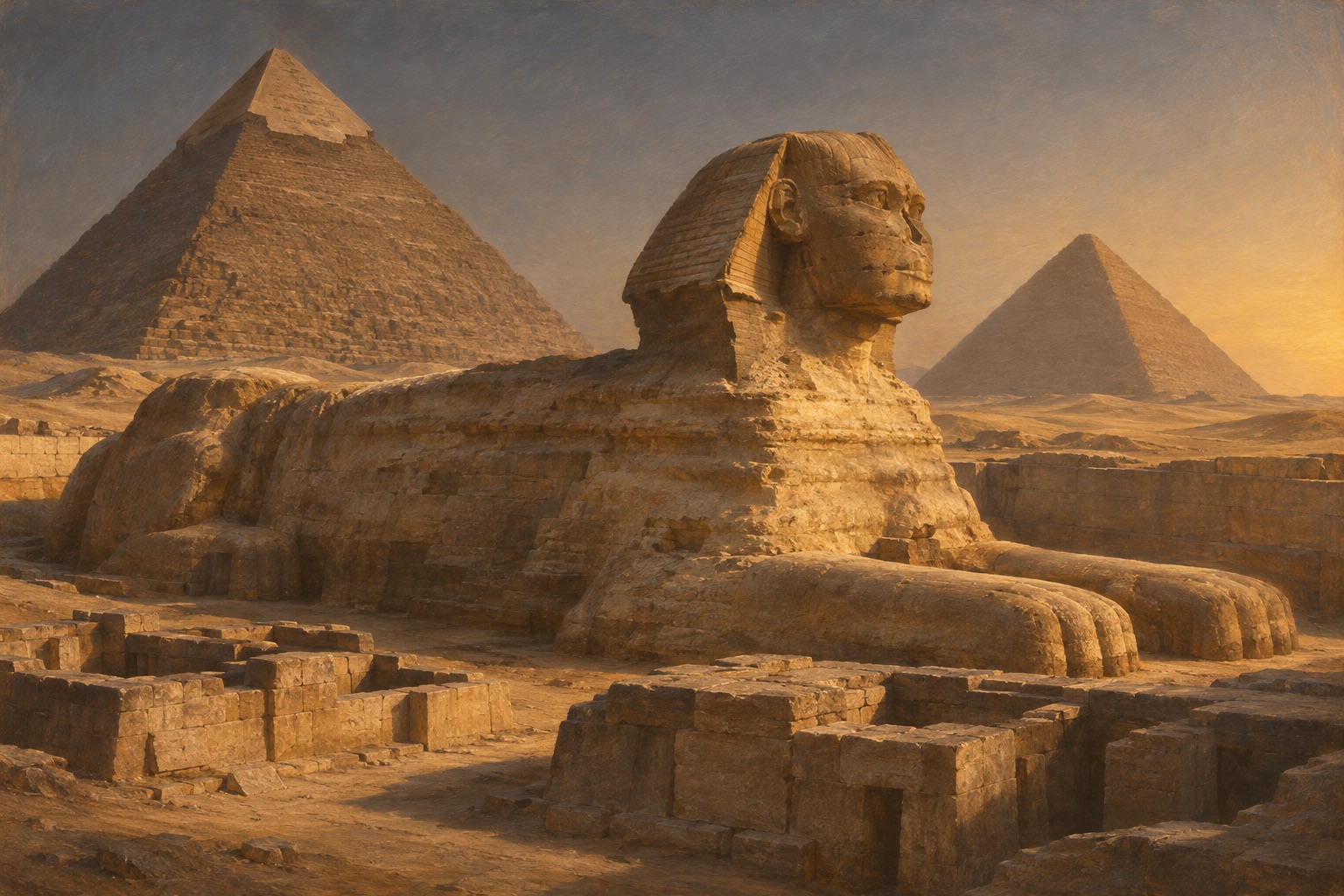
On the edge of the Giza plateau a lion with a king’s head lies facing the sunrise. It is 72.55 metres long and about 20 metres high, and it was not built: it was cut out of the hill. The Egyptians who carved it left no word about it. Everything said of it since, by the priests of a later king, by Roman visitors and by the people of medieval Cairo, is a story told about a stone that was already old.
Who carved the Sphinx? The usual answer is the workers of King Khafre, around 2500 BCE, but no inscription of his reign says so. Mark Lehner, who mapped the monument stone by stone, concludes: “As certain as we can be about such matters, Khafre created most of the Sphinx. However, Khufu might have started it.” Selim Hassan, who excavated it in the 1930s, had already admitted that apart from one broken line on a much later stela, “there is not one single ancient inscription which connects the Sphinx with Khafra”.
1 The Telling
The Sphinx has no myth from the age that made it. This section first gives what archaeology can say about how the stone came to be, then follows the stories told about it, in the order they were written: a prince’s dream on a granite stela, the names and beliefs of Greek and Roman worshippers, and the tales of medieval Cairo.
1-1 A Lion Left in the Quarry
Khafre’s quarrymen cut a U-shaped ditch into the slope below his pyramid, and left standing in the middle a great block of limestone. From that block they carved the Sphinx. The rock is in layers, soft and hard by turns. The best of it, a hard, fine-grained bed, lay at the top, and they kept it for the head; “details like the eyebrows”, Lehner writes, have survived wind, rain and sand for 4,500 years. The softer layers below became the lion’s body.
Nothing was wasted. The blocks cut from the ditch, some of them weighing up to a hundred tons, were dragged east to build a temple in front of the statue. Lehner and the geologist Tom Aigner found the same beds, with the same fossils, in the temple walls and in the Sphinx’s chest and neck, so closely that a thin yellow layer runs on from one block to the next as it once ran through the rock.
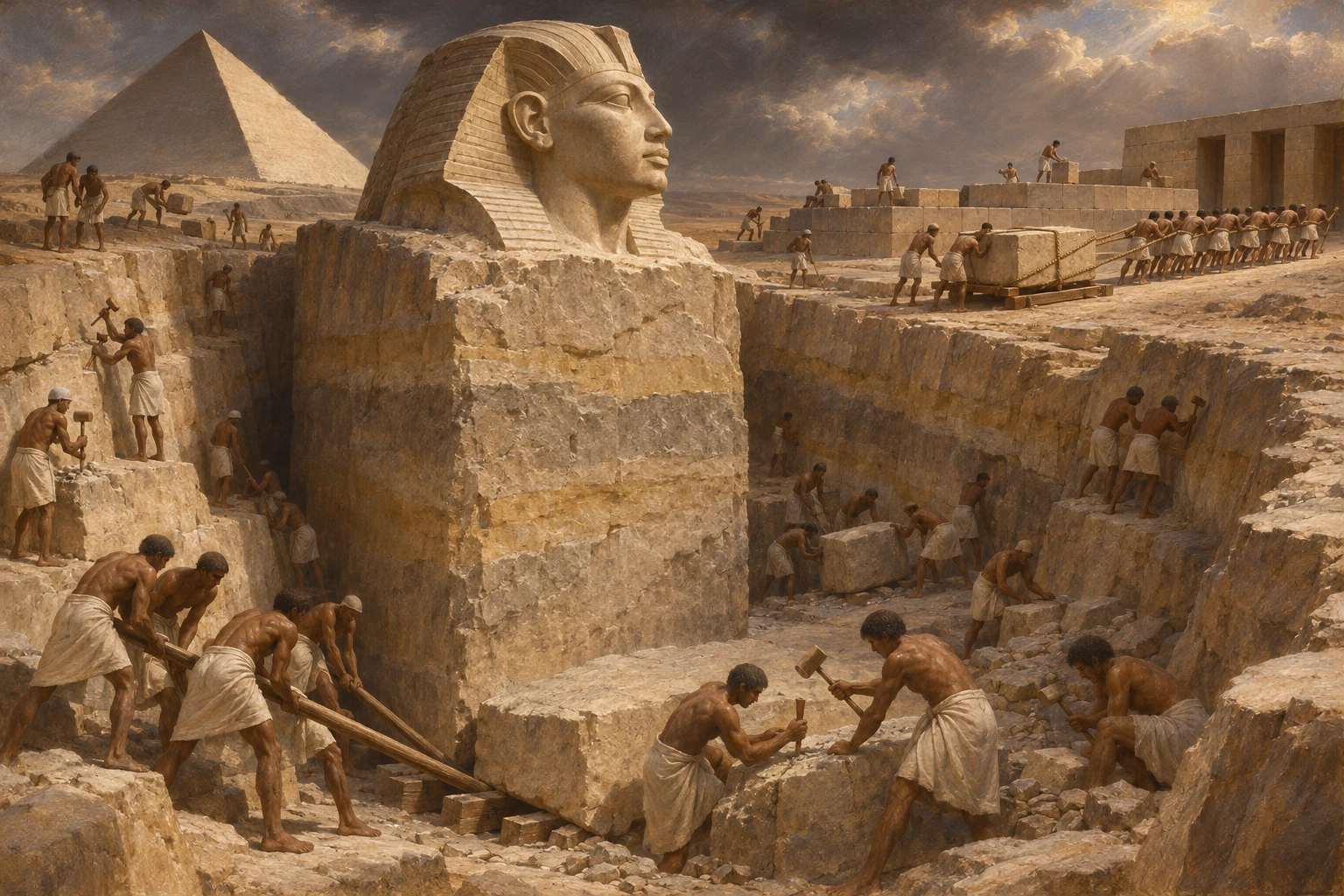
The work was never finished. The temple never received its granite casing, and the ditch was never fully squared off behind the lion’s tail. In the hundreds of Old Kingdom tombs at Giza, no one bears the title of a priest of the Sphinx. AERA, Lehner’s research team, concludes that its cult “may never have been active in the Old Kingdom”. The face was painted red: traces of the paint survive on the cheeks.
1-2 The Prince in Its Shadow
More than a thousand years later, sand had drifted over the lion. Between its paws there now stands a slab of red granite almost twelve feet high, a reused Old Kingdom lintel that a new king set up and inscribed. It is dated to the first year of Thutmose IV, the third month of the first season, the nineteenth day. This retelling follows James Henry Breasted’s translation of 1906.
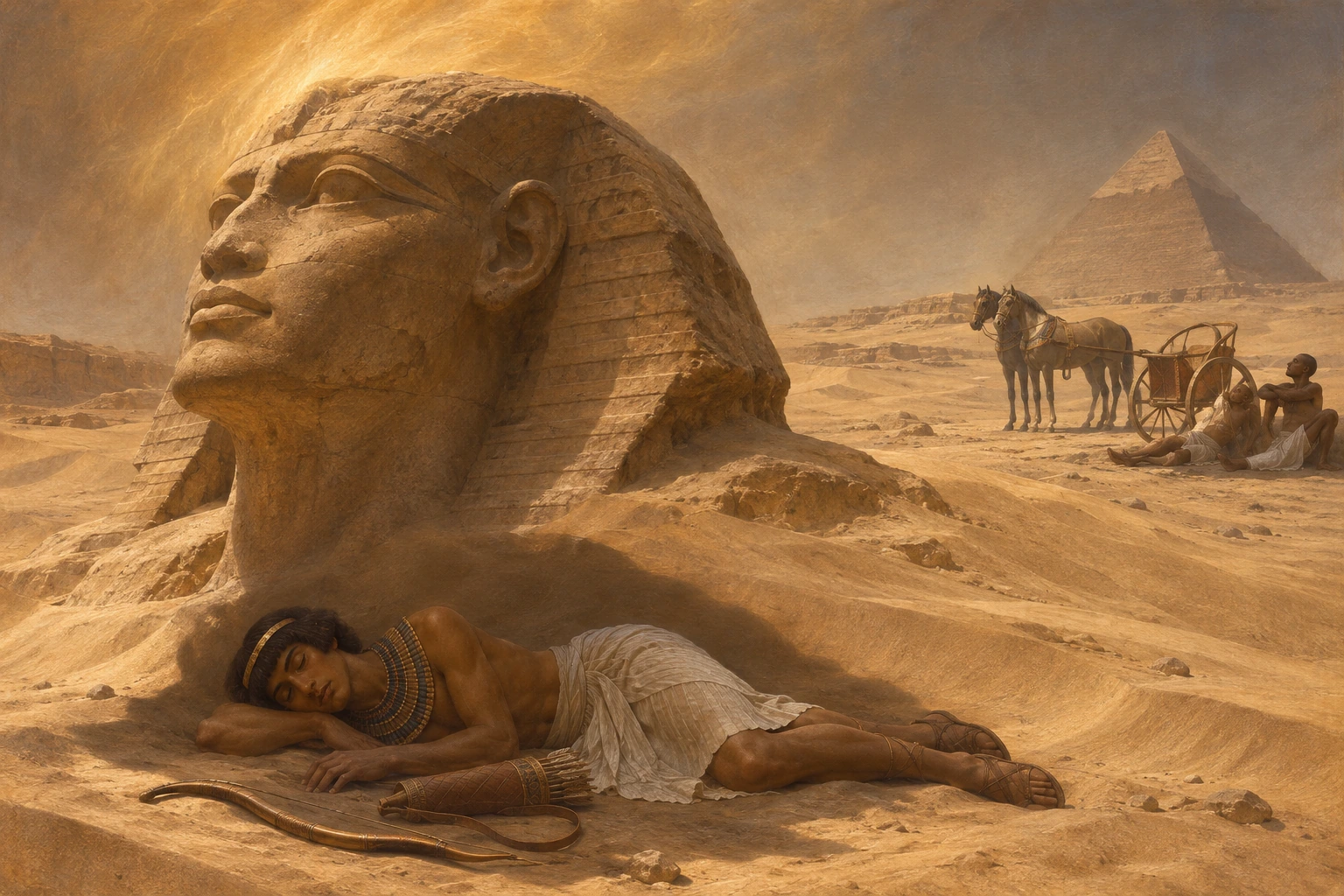
When Thutmose was still a young prince, the stela says, he liked to ride out on the desert above Memphis with just two followers, “while not a soul knew it”. He shot at targets with copper bolts, hunted lions and wild goats, and drove his chariot with horses “swifter than the wind”. At midday he always let his men rest beside “the very great statue of Khepri”, on “the sacred road of the gods” to the burial ground west of Heliopolis.
One day, at the hour when the sun stood at the zenith, the prince lay down in the shadow of the god and fell asleep. In a vision he saw the god speaking with his own mouth, “as a father speaks with his son”: “Behold thou me! See thou me! my son Thutmose. I am thy father, Harmakhis-Khepri-Re-Atum, who will give to thee my kingdom”. He promised the prince the white crown and the red crown, the throne of the earth god Geb, and the land “in its length and breadth”.
1-3 “The Sand Has Reached Me”
Then the god asked for something in return. “My manner is as I were ailing in all my limbs,” he said. “The sand of this desert upon which I am, has reached me; turn to me, to have that done which I have desired, knowing that thou art my son, my protector”. And he added: “I am with thee, I am thy leader.”
The prince woke, understood, and “kept silent in his heart”. He told his men to go back to the city and bring offerings: oxen and all kinds of young vegetables. Here the stone fails. The lower part of the slab has flaked away, and with it more than half the inscription. Among the last words that can still be read are, in Breasted’s text, “Khaf”, which he completes in brackets as Khafre (see Competing Versions), and the phrase “the statue made for Atum-Harmakhis”. Whether the prince dug out the god, the stela no longer says. He did become king. Around the Sphinx, excavators found mud-brick walls built to hold back the sand, which Selim Hassan and AERA both assign to him.
1-4 Harmachis, Hauron and the Father of Terror
From the New Kingdom on, the Sphinx had a name: Hor-em-akhet, “Horus in the Horizon”. Lehner notes that it is first attested at the very beginning of the 18th Dynasty, and is not known in any context before it. Thutmose’s father, Amenhotep II, had already built it a temple of mud brick, and buried beneath it alabaster vases inscribed “beloved of Hor-em-akhet”.
Some of its worshippers gave it another name. On stelae that Hassan dug up around the statue, the god is called Hwrna-Hor-em-akhet: Hauron, a god of Canaan. Hassan suggested that people from Canaan living near Giza saw their own god in the guardian lion, and “identified the two gods as one”.
The Greeks called the god Harmachis. In the reign of Nero, the villagers of Busiris near the pyramids set up a decree thanking the Roman governor for having “worshipped the sun, Armachis, the Overseer and Saviour”, and, it seems, for ordering work against the sand that covered it. Visitors carved verses on the stones: “all night long, while the sacrifices are burning, we sing hymns to Harmakhis” (Hassan’s translation). The Roman writer Pliny the Elder heard what the local people believed: that “King Harmaïs was buried in it”, and that it had been brought there from far away. Not so, he says: it “was hewn from the solid rock”, and “from a feeling of veneration, the face of the monster is coloured red”.
The Arabs had their own name for it. “It was formerly called Belheib,” writes the Cairo historian al-Maqrizi, “and today the Egyptians call it Abu al-Hol”, “the father of terror” (our translation from Urbain Bouriant’s French). He quotes an older author who says it was a talisman that kept the desert sand from overrunning the fields of Giza.
1-5 The Face
Around 1200, the Baghdad physician Abd al-Latif al-Baghdadi saw only a colossal head and neck rising out of the ground. Its body, he reckoned, must be more than seventy cubits long. The face still carried a red tint and a red glaze “with all the brightness of freshness”, and its mouth seemed to smile gracefully. Asked what had amazed him most in all of Egypt, he answered: the accuracy of the proportions in the Sphinx’s head. Nose, eyes and ears kept the proportions that nature keeps, although nature had never made a model for a giant of that size (our translation of Silvestre de Sacy’s French).
Some two centuries later, al-Maqrizi wrote, as Bouriant’s French gives it (we have not read the Arabic), that “in our time” a Sufi of the convent of Sa’id al-Su’ada, Sheikh Muhammad Sa’im al-Dahr, set out around the year 780 of the Hijra (1378–1379) “to combat and destroy superstitions”. He went to the pyramids and mutilated the face of Abu al-Hol, “which has remained in that state down to the present”. Since then, al-Maqrizi adds, the sand has invaded much of the land of Giza, and the people of the province blame it on the mutilation of the statue.
2 Where the Story Is Written Down
- The monument itself, with its temple. No Old Kingdom inscription on or around it names the statue, its maker or its god; what we know of its making comes from the quarry, the temple blocks and the order in which Khafre’s buildings were cut (Lehner, AERA).
- The Dream Stela of Thutmose IV, red granite, 11 feet 10 inches high and 7 feet 2 inches wide (Breasted), set against the Sphinx’s chest. The lower third has flaked off. Its text survives as it was copied by Henry Salt in 1820 and published by Thomas Young in 1823, then by Lepsius and Erman; Breasted translated it in Ancient Records of Egypt (1906), §§810–815.
- New Kingdom stelae and the temple of Amenhotep II. Hassan’s excavations from 1936 recovered votive stelae addressed to Hor-em-akhet; some show the Sphinx on a high pedestal, and several name Hauron.
- The Inventory Stela, found by Auguste Mariette in 1853 in the small temple of Isis by the Great Pyramid and dated to the 21st or 26th Dynasty. It says that Khufu repaired the Sphinx, which would make the statue older than Khafre. Lehner reads it as a literary device that lends a temple great antiquity.
- Greek and Roman texts. Herodotus, around 430 BCE, describes the pyramids at length and never mentions the Sphinx; he uses “man-headed sphinxes” only for the statues King Amasis set up at Sais (2.175). The Roman decrees and verses found by Caviglia and Baraize. Pliny the Elder, Natural History 36.77, written in the 1st century CE.
- Arabic writers. Abd al-Latif al-Baghdadi’s account of Egypt, written about 1200 (translated into French by Silvestre de Sacy, 1810), and chapter 41 of al-Maqrizi’s topography of Egypt, the Khitat, “On the statue named the Terrible” (translated into French by Urbain Bouriant, 1895–1900, from the Bulaq edition).
3 Competing Versions
- Khafre, Khufu or Djedefre? Hassan pointed to a drain cut along Khafre’s causeway that empties into the Sphinx’s ditch: no one would have drained water into a sacred enclosure that already existed, so the Sphinx was cut after the causeway. AERA adds that the Sphinx Temple shares a terrace with Khafre’s valley temple and was built after it. Rainer Stadelmann argued for Khufu, and AERA notes that others have proposed his son Djedefre. Lehner allows that Khufu might have begun the quarry. Some geologists have argued that the Sphinx is older than all of these kings; Lehner’s study of the temple blocks “says no”.
- Does the stela name Khafre? Breasted’s reading (1906): the broken “Khaf…” is his own completion, Thomas Young’s copy “has no trace of a cartouche”, and even a mention of Khafre would not prove that he made the Sphinx. Lehner’s reading (1991, citing Zivie 1976): Khafre’s cartouche once stood near the end of the preserved text and was recorded in the earliest copies, although the connection is “problematic” because the surrounding lines are lost. The two readings of the copies differ; both agree that the words around the name are gone.
- A king’s record or a priest’s tale? Breasted judged the stela a late restoration, its story “that of a folk-tale”. He noted a fragment in which an earlier prince, Amenmose, son of Thutmose I, goes out on “a pleasure walk” near the Sphinx, and concluded that the priests told such tales “to enhance the reputation of the Sphinx”. Hassan thought Thutmose was not the heir, found stelae of older princes with their names erased, and suggested that he “may even have fabricated the story of his dream”. Lehner treats the stela as Thutmose’s own, cut on a reused Old Kingdom lintel.
- Who lies inside? Pliny’s translators Bostock and Riley read “King Harmaïs”. Seventeenth- and eighteenth-century travellers quoting the same passage, Johann Michael Vansleb and Richard Pococke, read Amasis. Arab writers expected a chamber full of treasure beneath it (Hassan).
- A man or a woman? The Egyptian Sphinx wears the pleated royal headcloth of a king, the nemes. Vansleb, who saw it in 1672 or 1673, described “the Head of a Woman”, the face of the Greek sphinx.
- Where does the word come from? “Sphinx” is Greek. The Heibonsha World Encyclopedia mentions a theory that it comes from the Egyptian shesep-ankh, a word for a statue or image. Alan Gardiner took shesep-ankh to mean a sphinx; Zivie-Coche and Erik Hornung, Lehner reports, take it as “statue” in general.
4 History and Tradition
- Buried and dug out. The Romans cleared the sand and built a broad stairway down to the paws, with a platform from which visitors looked into the Sphinx’s face. When Napoleon’s scholars drew it in 1798, the sand was up to its neck. Local people later told Mariette that the French had found a door in front of it; Hassan thought they had seen the granite stela, and Lehner found no evidence of any French excavation there.
- The excavators. Giovanni Battista Caviglia, working with the British consul Henry Salt, dug a deep trench in front of it in 1817 (Lehner’s date; Breasted says the stela was uncovered in 1818) and found pieces of its beard, the chapel with the stela between the paws, and the Roman stairway. Howard Vyse bored a hole down its back in search of chambers, and used gunpowder to free his stuck drill rod. Mariette cleared it in 1853 and again in 1858, Gaston Maspero in 1885. From 1925 to 1936 the engineer Émile Baraize cleared the whole enclosure and the temple for the Antiquities Service, and propped up the weakened head with masonry. Selim Hassan took over for Cairo University in October 1936.
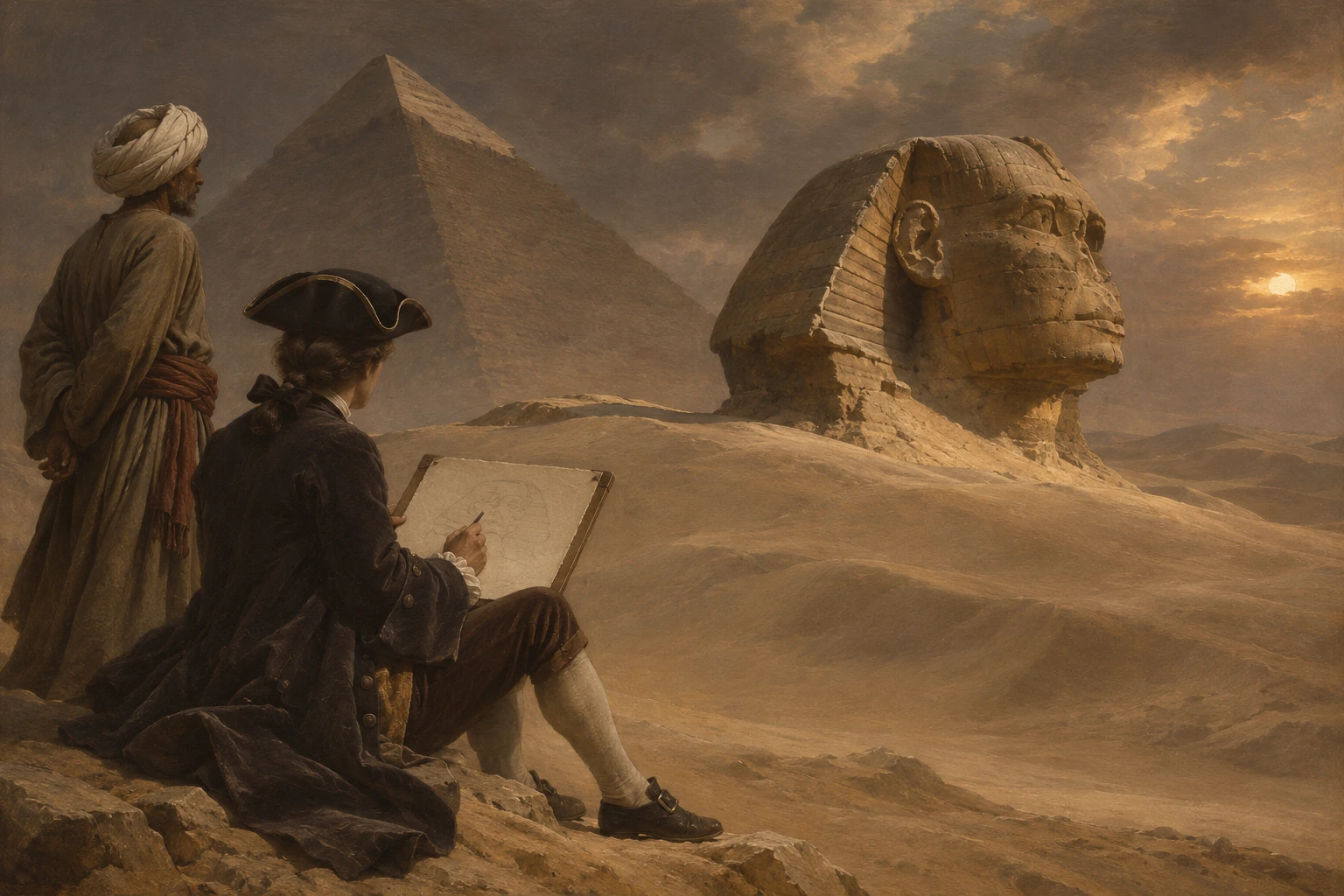
- Norden’s visit. The Danish naval officer Frederik Ludvig Norden was in Egypt in 1737 and 1738 and drew the Sphinx’s head rising from the sand. His Voyage d’Egypte et de Nubie appeared in Copenhagen in 1755, after his death.
- The first plans. Before the American Research Center in Egypt’s Sphinx Project, directed by James Allen with Lehner in the field from 1979 to 1983, no scale drawing of the Sphinx had ever been made.
- The other sphinx. The Greek sphinx is a different creature. Hesiod calls her Phix, daughter of Echidna, “the deadly Sphinx which destroyed the Cadmeans” (Theogony 326). In Apollodorus she has “the face of a woman, the breast and feet and tail of a lion, and the wings of a bird”, sits on Mount Phicium and asks the Thebans a riddle: “What is that which has one voice and yet becomes four-footed and two-footed and three-footed?” When Oedipus answers “man”, she throws herself from the citadel (Library 3.5.8). The Egyptian Sphinx is male and wingless; the Greeks gave it the name of their monster.
A popular story says that Napoleon’s soldiers shot off the Sphinx’s nose in 1798. The nose was gone before they came. In 1737 or 1738 Norden already felt “a sort of indignation at those, who have had the brutality to disfigure strangely its nose” (English translation, 1757). Al-Maqrizi, as Bouriant’s French renders him, blamed a Sufi of the 1370s for the damaged face. And Lehner, who studied the face closely, found that the nose was not shot away but pried off: one chisel “was pounded down into the bridge and another deep in and under the north nostril”.
5 Related Stories
- Atum: The Lone God Who Began the World at Heliopolis: in Thutmose’s dream the Sphinx calls itself Harmakhis-Khepri-Re-Atum, and the stela places it on the road of the gods west of Heliopolis. Selim Hassan read the name as the sun in all his phases: Khepri at dawn, Ra at noon, Atum, “the aged God of the setting sun”.
- Ra and Apophis: The Serpent the Sun Must Defeat Every Night: the Sphinx looks east, toward the horizon where the sun rises every morning as Khepri, one of the names the god gives himself on the stela, at the end of the night journey told there.
- Lamassu: The Winged Bulls at the Palace Gates: Assyrian kings set human-headed bulls and lions at their gates, and Sennacherib writes of “bull colossi and sphinxes of white limestone”. The Heibonsha World Encyclopedia’s entry on the sphinx names the lamassu as another of the winged beasts of the ancient Near East; we link them as guardians with human faces, a shared theme.
6 Sources
- The Dream Stela of Thutmose IV, trans. James Henry Breasted, Ancient Records of Egypt, vol. II (University of Chicago Press, 1906), §§810–815: archive.org
- Pliny the Elder, Natural History 36.77, Latin text (ed. Mayhoff): LacusCurtius; trans. John Bostock and H. T. Riley (Taylor and Francis, 1855), book 36, chapter 17: Perseus
- Herodotus, Histories 2.175, trans. A. D. Godley: Perseus
- Hesiod, Theogony 326–327, trans. Hugh G. Evelyn-White (1914): Perseus; Apollodorus, Library 3.5.8, trans. J. G. Frazer (Loeb, 1921): Perseus
- Abd al-Latif al-Baghdadi, Relation de l’Égypte, trans. A. I. Silvestre de Sacy (Paris, 1810), book I, chapter 4, pp. 179–180: archive.org
- Al-Maqrizi, Khitat, chapter 41, in Description topographique et historique de l’Égypte, trans. Urbain Bouriant (Mémoires de la Mission archéologique française au Caire 17, 1895–1900): archive.org; English rendering from Bouriant by Jason Colavito: jasoncolavito.com
- J. M. Vansleb, The Present State of Egypt (London, 1678), p. 88: archive.org
- Frederik Ludvig Norden, Travels in Egypt and Nubia, trans. Peter Templeman (London, 1757), vol. 1, pp. 121 and 128: archive.org; Voyage d’Egypte et de Nubie (Copenhagen, 1755): archive.org
- Selim Hassan, The Sphinx: Its History in the Light of Recent Excavations (Cairo: Government Press, 1949): archive.org
- Mark Lehner, The Archaeology of an Image: The Great Sphinx of Giza (PhD dissertation, Yale University, 1991): Zenodo
- Mark Lehner, “Who Built the Sphinx? The Sphinx Temple Has the Answer”, AERAGRAM 18.1 (2017); AERA, “Khafre’s Monuments” and “The Great Sphinx of Giza”: aeraweb.org, aeraweb.org, aeraweb.org
- “スフィンクス” (Heibonsha World Encyclopedia, revised edition, and Nipponica): Kotobank
Cover and illustrations: AI-generated images made for Arcana. They are interpretations, not historical artworks.