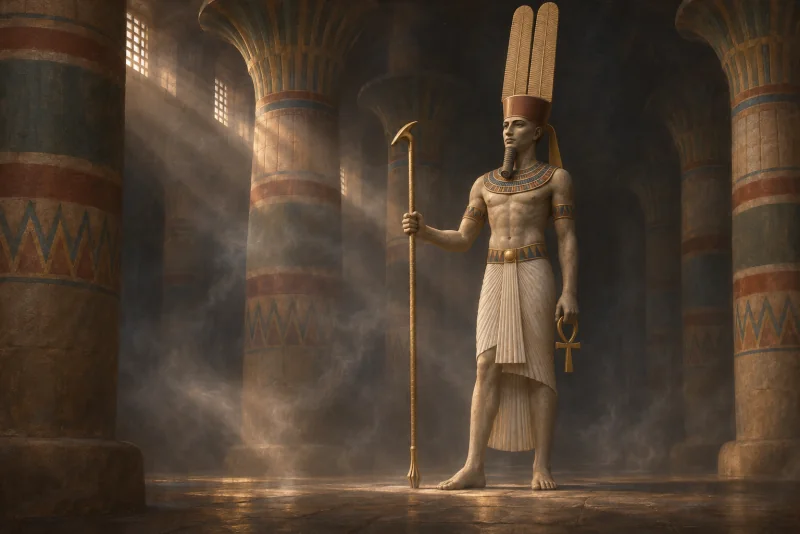
Atum: The Lone God Who Began the World at Heliopolis
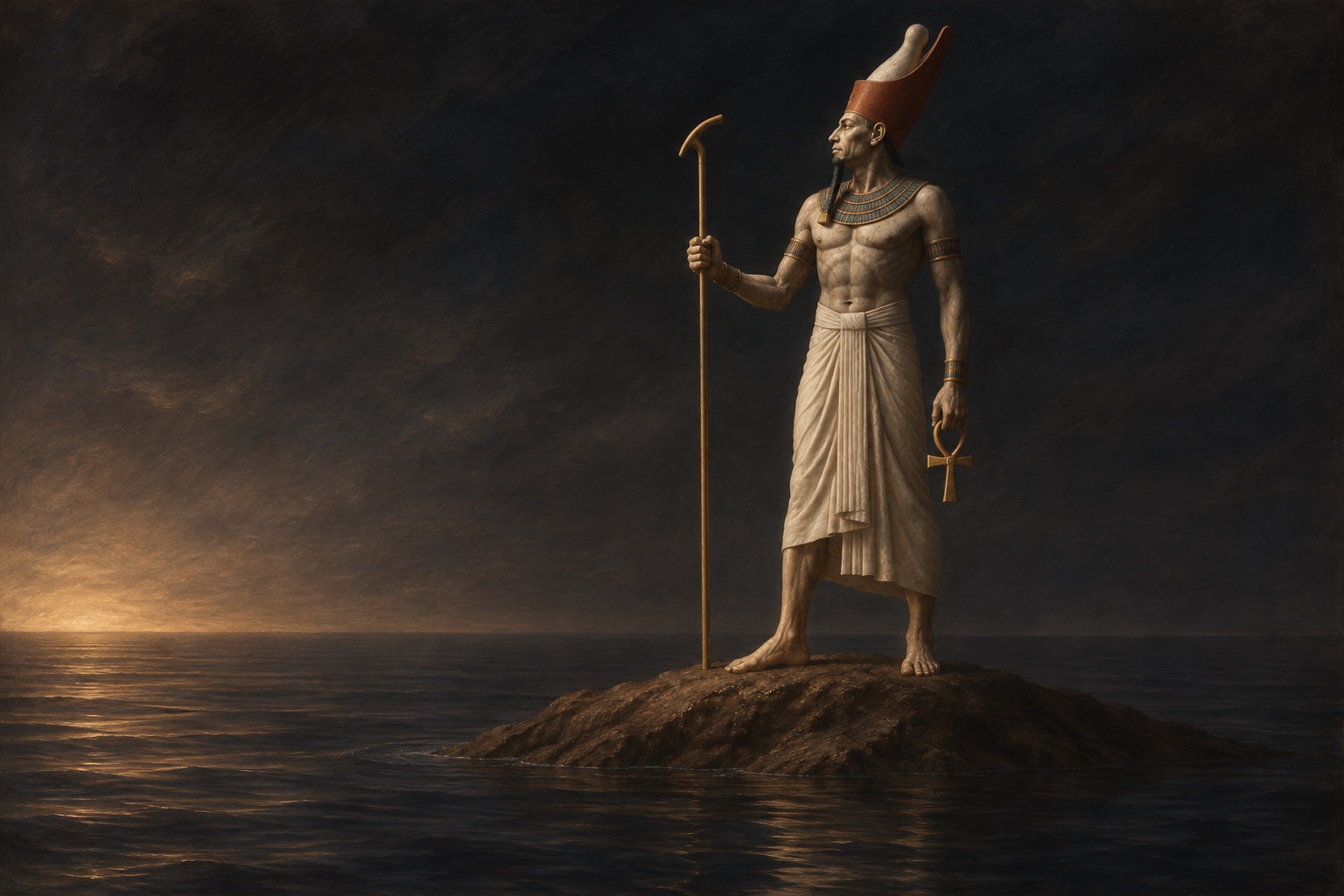
Before there was sky or earth, Atum stood alone on the first mound in the waters of Nun, and from him came the nine gods of Heliopolis. The Egyptians told it in pieces, in spells written down over two thousand years, and other temples told the beginning in other ways.
- Type: myth, the beginning of the world and of the first gods
- Culture: ancient Egypt; Heliopolis, the Egyptian Iunu, now under the northeastern suburbs of Cairo
- Earliest texts: the Pyramid Texts (from the 24th century BCE) speak of its moments; the longest telling, in the Papyrus Bremner-Rhind, was copied about 305 BCE
- Key figures: Atum (Ra-Atum), Nun, Shu, Tefnut, Geb, Nut, the Eye, the bennu bird
Before there was sky or earth, before there was even a place to stand, there was dark water, and in it a god alone. The priests of Heliopolis called him Atum, a name taken from a word meaning “to complete oneself”. Everything else came out of him: the air, the sky, the earth, and the gods who would rule Egypt.
Is Atum the same god as Ra? Yes and no. They began as separate sun gods, says the Global Egyptian Museum, but the Pyramid Texts already join them as Ra-Atum. In a later story Ra calls himself “Khepera in the morning”, Ra at noon, “and Temu in the evening” (Budge’s translation): Atum is the sun as it sets, at the end of its day.
1 The Telling
The story is scattered through Egyptian spells and hymns. The fullest telling sits in a book of spells against the serpent Apophis, copied about 305 BCE in the Papyrus Bremner-Rhind. E. A. Wallis Budge, who first published it, found the story “in no other known Egyptian document”. It is told twice there, in two versions that differ in detail. We follow the first, in Budge’s translation (1912) and R. O. Faulkner’s (1937–38), and say where the much older Pyramid Texts add to it.
1-1 Alone in the Water
In the beginning there was only Nun, the primeval water, dark and still. “The sky (or heaven) had not come into being, the earth did not exist,” says the creator in the papyrus. “I found no place whereon I could stand.” He calls himself the Lord of All, who came into being as Khepri, the sun at dawn, and the book is about “the creations of Re” (Faulkner). The Pyramid Texts, Budge noted, tell the same of Atum. As the Heibonsha World Encyclopedia puts it, Atum merged with the sun god as Khepri-Ra-Atum.
The Book of the Dead gives Atum the same words in spell 17: “I am the god Tem in rising; I am the only One. I came into existence in Nu.” He made himself out of the water, and some texts call Nun his father.
1-2 The First Mound
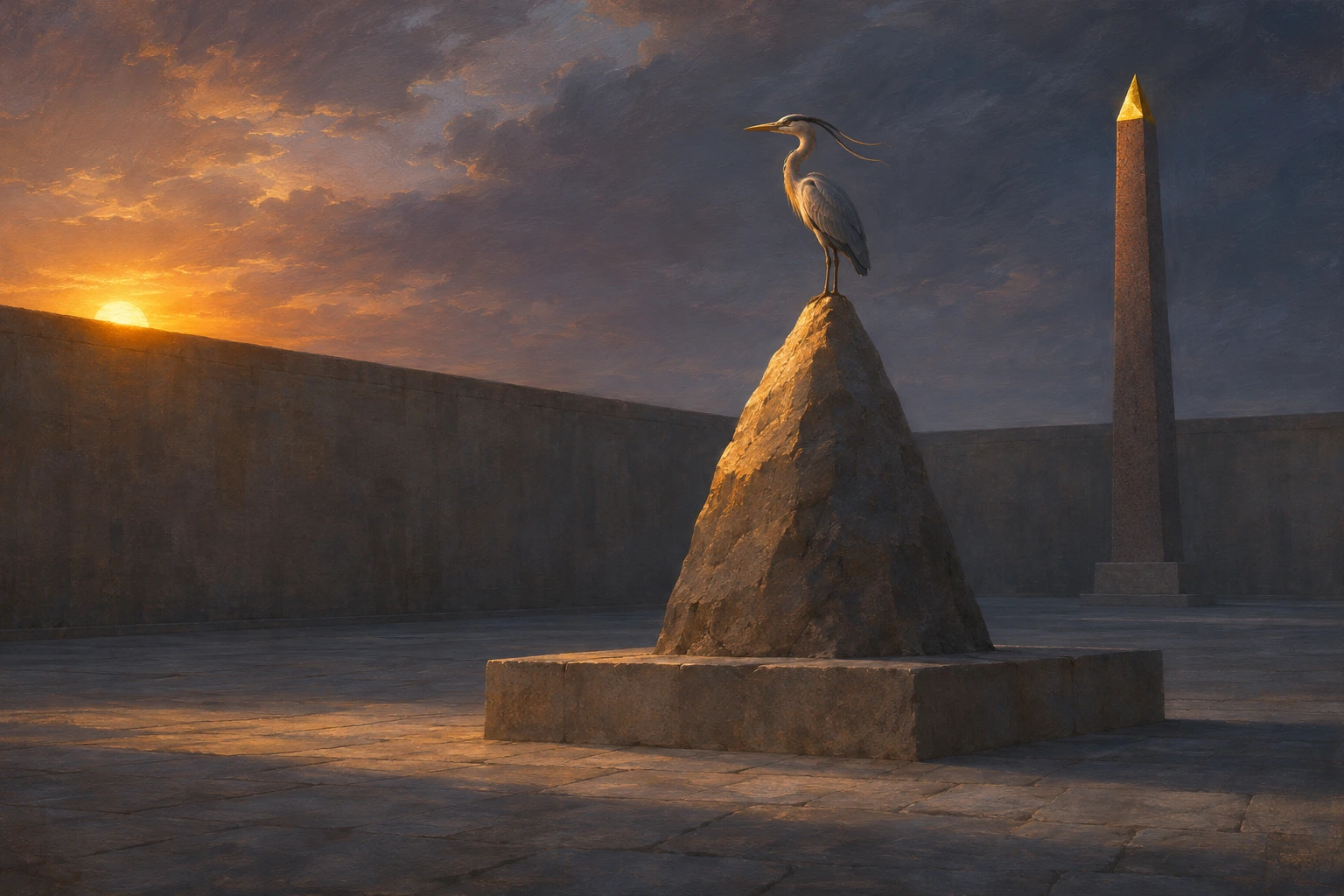
Then a place to stand rose out of the water. All the Egyptian accounts of creation share this first mound, notes the Hermopolis Project of the University of Munich. At Heliopolis it was the benben, a sacred stone. A Pyramid Text, utterance 600, addresses Atum: “Thou wast lofty on the height; thou didst shine as Phoenix of the ben in the Phoenix-hall in Heliopolis” (James Henry Breasted’s translation, 1912).
The “Phoenix” there is the bennu, the sacred bird of Heliopolis. The Global Egyptian Museum explains that its name and the name of the stone both seem to come from weben, “to rise”, and that Atum appeared in the form of a bennu in the House of the Benben.
1-3 Air and Moisture
Atum had no partner. From his own body he made the first pair of gods, Shu, the air, and Tefnut, moisture. The Pyramid Texts say how in two ways, by masturbation (utterance 527, in the pyramid of Pepi I) or by spitting them out (utterance 600), and the Bremner-Rhind papyrus says both.
“From being one god I became three gods,” says the creator in Budge’s translation, and his father Nun brought the two up. In a Coffin Text of the Middle Kingdom, spell 80, Tefnut is identified with maat, the order of the world, and Shu with life, and together they fill the universe (as Boyo Ockinga summarises it in a short abstract, which cites Faulkner’s translation; we have not seen the spell itself).
1-4 The Eye and the Tears
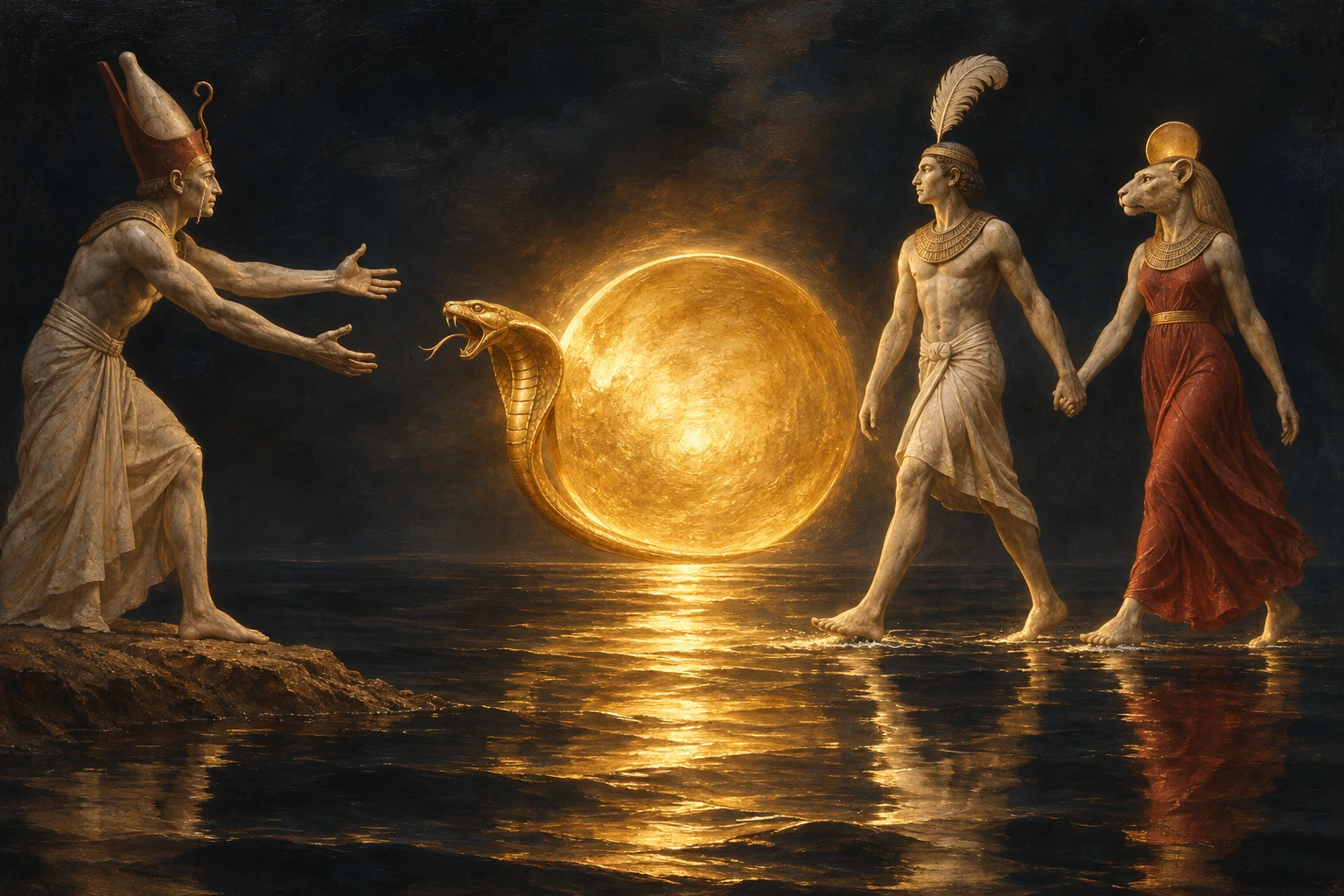
Shu and Tefnut were far away in the water, and the creator’s Eye went after them, “following after them since the aeons”, in Faulkner’s words. When the two came back they brought the Eye with them.
Then the creator gathered his limbs together and wept over them, “and men and women sprang into being from the tears which came forth from my Eye” (Budge). But when the Eye came back, it found that he had made another Eye and set it in its place, and it raged at him. To calm it he gave it a place of honour in his face. In the second version he gives it “the uraeus of fire”, and from there it rules the whole earth. The Eye has a story of its own, as the goddess sent out against mankind: see The Eye of Ra.
1-5 Earth and Sky
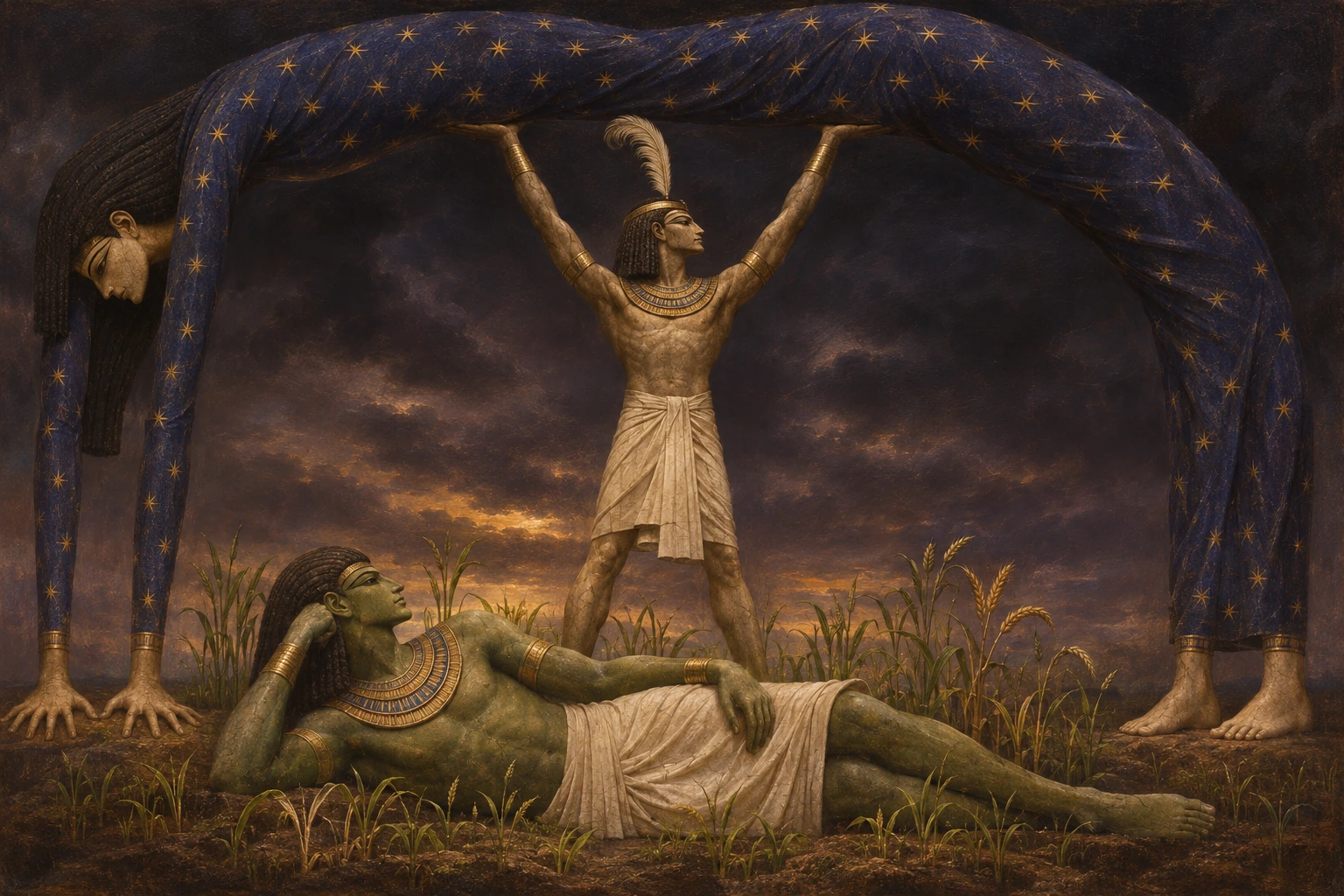
Shu and Tefnut had two children, Geb, the earth, and Nut, the sky. A Pyramid Text remembers the time “when the sky was separated from the earth, and the gods ascended to the sky”. It was Shu, Breasted explains, who parted them, and who has held up the sky ever since, standing with his feet on the earth. In a later book of the sky, Nut swallows the sun every evening and gives birth to it again every morning (the astronomer Or Graur, after Alexandra von Lieven).
Geb and Nut had five children at one birth, the papyrus says: Osiris, a Horus whom Budge calls “the Blind Horus”, Seth, Isis and Nephthys. Without that Horus, Atum, Shu, Tefnut, Geb, Nut, Osiris, Isis, Seth and Nephthys make up the Ennead, the Nine of Heliopolis, gods “who came into being from my flesh”, as the creator says (Faulkner). What happened among Nut’s children is told in Osiris.
1-6 The End
Atum began the world, and he will end it. In a spell of the Book of the Dead, the Global Egyptian Museum explains, Atum says that at the end of time he will destroy everything he has made. The world will go back to what it was before creation, an inert mass of water, and Atum, turned into a snake, will live on there with Osiris.
2 Where the Story Is Written Down
- The Pyramid Texts, carved inside royal pyramids from Unas, at the end of the 5th Dynasty, onward. Ra-Atum is named already in the pyramid of Unas (Budge). Utterance 527, in the pyramid of Pepi I, and utterance 600, in the pyramid of Merenre, tell how Shu and Tefnut were made, and utterance 600 calls on Atum to guard the king’s pyramid (see History and Tradition).
- The Coffin Texts, written inside coffins of the First Intermediate Period and the Middle Kingdom. Spell 80 gives Shu and Tefnut their meaning: life and order.
- The Book of the Dead, spell 17. In the Papyrus of Ani (about 1250 BCE) the dead man speaks as the creator, “I am the god Tem in rising”, and as his bird, “I am the Bennu bird which is in Annu (Heliopolis)” (Budge’s translation). After each line the spell asks “Who then is this?” and answers with a gloss.
- The Papyrus Bremner-Rhind (British Museum EA 10188), about 305 BCE. Its Book of Overthrowing Apep contains two versions of the creation, in columns 26–27 and 28–29; Budge called the title “Book of knowing the evolutions of Ra”. The same papyrus holds the spells against the serpent, told in Ra and Apophis.
- The Turin papyrus of Isis and Ra, in which Ra names himself Khepri in the morning, Ra at noon and Atum in the evening. How Isis won his secret name is told in Isis.
- The Shabaka Stone (British Museum EA 498), copied about 710 BCE: the creation as told at Memphis, in which Ptah comes before Atum (see Competing Versions).
3 Competing Versions
- Where did people come from? In the first version of the papyrus, from the tears the creator wept over his own limbs. In the second, in Budge’s translation, “I cried out to my Eye, and men and women came into existence”. Budge noted in 1904 that the two versions give “a different account” of the making of man.
- Did the Eye go after them? In Faulkner’s translation the Eye follows Shu and Tefnut through the ages. Budge read the same line as “My Eye was covered up behind them”, and took the first Eye for the sun and the new one for the moon.
- Alone? Atum makes the first pair with no partner. Yet the same papyrus invokes “Hathor, Lady of Hetepet, the Hand of Atum” (Faulkner), and Breasted allowed in 1912 that the sun god might have begotten them “by a consort who appeared to him”.
- Where was the first mound? At Heliopolis, in utterance 600. The commentary inside spell 17 says Ra first rose in the city of Heracleopolis, “upon the high ground of him that dwelleth in Khemennu (Hermopolis Magna)”. Breasted wrote that one temple told of an egg shaped by Ptah, another of a lotus, and that “every sanctuary sought to gain honor” by placing the sun god’s first appearance in its own past.
Other temples told the beginning in their own way. At Memphis, the Shabaka Stone makes Ptah “the father who [made] Atum”: what Ptah thought in his heart and spoke with his tongue came into being, Atum and his Nine included (Miriam Lichtheim’s translation). Lichtheim notes that it does not reject the teaching of Heliopolis outright, but “attempts to supersede it”. At Hermopolis, creation began with the Eight (Ogdoad), four pairs of gods who stand for the primeval state of the cosmos (Frauke Pumpenmeier), and in some lists Amun and his female counterpart are among them (Budge). At Thebes, Amun, joined to Ra as Amun-Ra, claimed the creator’s place, as the Heibonsha encyclopedia puts it; his story is told in Amun.
4 History and Tradition
- Heliopolis. The city the Egyptians called Iunu, On in the Bible, lies under the northeastern suburbs of Cairo; in Budge’s day its site was marked by the village of Matariyeh. It had a double temple of Ra-Horakhty and Atum, and a sanctuary called the House of the Benben, where the rays of the rising sun were believed to touch the stone first (Global Egyptian Museum). The modern city is built over much of it, and large parts have never been properly excavated. The Greek geographer Strabo found it “entirely deserted”; he was shown the houses of the priests and the schools of Plato and Eudoxus, who were said to have spent thirteen years with them.
- From benben to obelisk. The Global Egyptian Museum calls the benben the forerunner of the obelisk, and perhaps of the pyramid: the tops of obelisks and pyramids were both called benben. Senusret I, who built at Heliopolis, promised that his name would last there: “My name is the pyramidion and my name is the lake”, meaning, Breasted explains, his obelisks and the sacred lake he dug.
- The obelisks. One obelisk of Senusret I still stands where he set it up (Sakai Den’roku, Nipponica). Strabo says two others were taken to Rome. Thutmose III raised a pair before the temple of the sun; the Romans moved them to a temple of Caesar in Alexandria in 12 BCE, and they came to be called Cleopatra’s Needles, perhaps because Cleopatra had begun that temple (Central Park Conservancy). One was set up on the Thames Embankment in London in 1878, the other in Central Park, New York, in 1881. Of the obelisks of Heliopolis, writes Yakata Teisuke in the Heibonsha encyclopedia, all but one have gone abroad.
- The bennu and the phoenix. The bennu is described as a kind of wagtail in the Pyramid Texts and drawn as a heron from the Middle Kingdom on (Global Egyptian Museum). Herodotus heard at Heliopolis of a sacred bird, the phoenix, which comes to Egypt “once in five hundred years”, carrying its dead father in an egg of myrrh to the temple of the Sun; he never saw it himself, “only pictures of it”. The Global Egyptian Museum notes that much of the later phoenix legend is not found in Egyptian sources, though some of it may have an Egyptian background.
- A creation for the dead king. In utterance 600, after Atum made Shu and Tefnut and “didst put thy arms behind them”, the priest asks: “O Atum, put thou thy arms behind king Mernere, behind this building, and behind this pyramid.” The next spell names the Nine one by one: as their names are firm, so is the king’s pyramid (Breasted).
“The Egyptian creation myth” is often told as if there were only one. Egypt kept several side by side: Atum at Heliopolis, Ptah at Memphis, the Eight at Hermopolis, Amun at Thebes. The Hermopolis Project calls them “not competing local systems, but rather different explanatory approaches”, and the Memphite text itself keeps Atum and his Nine, with Ptah as the heart and tongue through which they came.
5 Related Stories
- The Eye of Ra: Sekhmet and the Destruction of Mankind: the Eye that raged here at finding itself replaced goes out again in the Book of the Heavenly Cow, this time as the goddess Ra sends against the people who plot against him.
- Amun: The Hidden God of Thebes: one of the Eight of Hermopolis, who at Thebes became Amun-Ra and claimed to have made the world himself.
- Osiris: The Murdered King Who Rules the Dead: the story of Atum’s great-grandchildren, the last four of the Nine.
- Enuma Elish: Marduk Splits Tiamat to Make the World: another world that begins in water. In 1904 Budge set the Egyptian making of mankind beside the Babylonian one, calling it “exactly what we find in the Mesopotamian creation legends”; beyond that, we link the two for the theme.
6 Sources
- Papyrus Bremner-Rhind (British Museum EA 10188), “The Book of Knowing the Evolutions of Ra”, and the Turin papyrus of Isis and Ra, trans. E. A. Wallis Budge, Legends of the Gods (1912): Project Gutenberg
- Papyrus Bremner-Rhind, The Book of Overthrowing Apep, columns 26–29, trans. R. O. Faulkner (Journal of Egyptian Archaeology, 1937 and 1938): attalus.org
- Pyramid Texts, utterances 600 and 601 and §§ 1208–1209, trans. James Henry Breasted, Development of Religion and Thought in Ancient Egypt (1912), pp. 10–11, 43–45, 70–77: archive.org
- Pyramid Texts, utterance 527 (Pepi I), and the Bremner-Rhind creation, in E. A. Wallis Budge, The Gods of the Egyptians (1904), vol. 1, pp. 79, 113, 297, 303–306, 328: archive.org
- Thomas George Allen, Occurrences of Pyramid Texts (Oriental Institute, 1950), for the numbering of utterances 527 and 600: ISAC
- Book of the Dead, spell 17, trans. E. A. Wallis Budge, The Book of the Dead: An English Translation of the Chapters, Hymns, etc., of the Theban Recension (1901), vol. 1, pp. 93–95: archive.org
- The Shabaka Stone (British Museum EA 498), trans. Miriam Lichtheim: attalus.org
- Boyo G. Ockinga, “Morality and ethics”, in Toby Wilkinson (ed.), The Egyptian World (Routledge, 2007), abstract: Macquarie University
- Frauke Pumpenmeier, “Cosmogony of Hermopolis”, Hermopolis Project, LMU Munich: hermopolis.gwi.uni-muenchen.de
- The Global Egyptian Museum, glossary: Atum, Heliopolis, Benben, Phoenix
- Or Graur, “The ancient Egyptian personification of the Milky Way as the sky-goddess Nut”, Journal of Astronomical History and Heritage 27 (2024): arXiv
- Herodotus, Histories 2.73, trans. A. D. Godley: Perseus
- Strabo, Geography 17.1.27–29, trans. H. L. Jones (Loeb, 1932): LacusCurtius
- Central Park Conservancy, “Obelisk (Cleopatra’s Needle)”: centralparknyc.org; Henry H. Gorringe, Egyptian Obelisks (1882): archive.org; James King, Cleopatra’s Needle (1886): Project Gutenberg
- “アトゥム”, “ヘリオポリス”: Kotobank, Kotobank, Kotobank
Cover and illustrations: AI-generated images made for Arcana. They are interpretations, not historical artworks.