Enuma Elish: Marduk Splits Tiamat to Make the World
Marduk killed the sea goddess Tiamat, split her like a fish and made heaven and earth from her body, and the poem was recited to his statue at Babylon's New Year festival. It never describes Tiamat as a dragon, and the famous relief said to show their fight portrays another god and another monster.
- Type: myth, the making of the world and the rise of Marduk to king of the gods
- Culture: Babylonia, in southern Mesopotamia (today’s Iraq); copied and adapted in Assyria
- Earliest texts: the Akkadian poem Enuma Elish, on seven tablets, perhaps composed under Nebuchadnezzar I in the late 12th century BCE, though the date is disputed; the best-known copies come from the library of Ashurbanipal at Nineveh, 7th century BCE
- Key figures: Apsu, Tiamat, Ea (Nudimmud), Anshar, Anu, Marduk, Kingu, Tiamat’s eleven monsters
A ritual text from Babylon tells a priest, on the fourth day of the New Year festival, to stand before the statue of Marduk and recite a poem to him from beginning to end. It opens with the words enūma eliš, “when on high”, and it tells how the god of Babylon defeated the sea, built the world out of her body, made people from the blood of her general, and was given fifty names by the gods who had made him their king.
Is this a creation myth? Only in part. The world is not made until the end of Tablet IV, more than halfway through the poem, and people not until Tablet VI. Most of the poem is about Marduk: his birth, his election by the gods, his battle and his fifty names, which fill the last tablet and a half. The Oracc encyclopedia Ancient Mesopotamian Gods and Goddesses calls the usual title, “The Babylonian Epic of Creation”, “rather a misnomer”: its main focus is Marduk’s rise to the head of the gods, “for which the creation story is only a vehicle”.
1 The Telling
The poem is told here from the edition of the electronic Babylonian Library (eBL), edited by Adrian C. Heinrich with an English translation by Benjamin R. Foster. Tablet and line numbers are the eBL’s; where L. W. King’s translation of 1902 counts differently, both are given. Quotations are from King, or from D. D. Luckenbill’s translation of 1921 for lines King did not yet have.
1-1 When Heaven Had No Name
“When in the height heaven was not named, / And the earth beneath did not yet bear a name” (I 1–2), there were only Apsu, the begetter, and Tiamat, who bore them all, and their waters were mingled together. No god had yet been brought forth. Then gods took shape within the two of them: Lahmu and Lahamu, then Anshar and Kishar, then Anu, and Anu fathered Ea, also called Nudimmud, deep in wisdom and without a rival among the gods (I 3–20).
The young gods crowded together, and their noise churned Tiamat’s insides. Apsu could not quiet them, and Tiamat kept silent (I 21–28). So Apsu went to her with his vizier Mummu. “By day I cannot rest, by night [I cannot lie down],” he said, and he meant to destroy them (I 35–40). Tiamat was furious. Should they destroy what they had made? The young gods were troublesome, but they should bear it kindly (I 41–46). Mummu urged Apsu on, and Apsu’s face lit up (I 47–54).
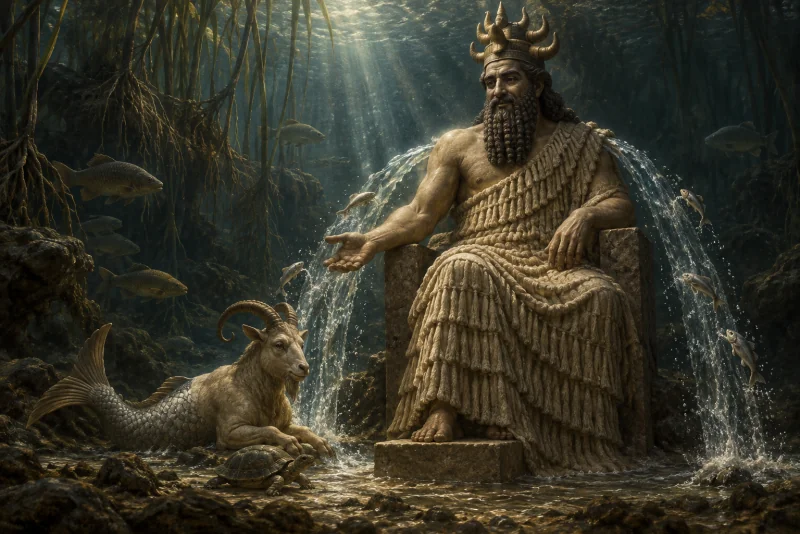
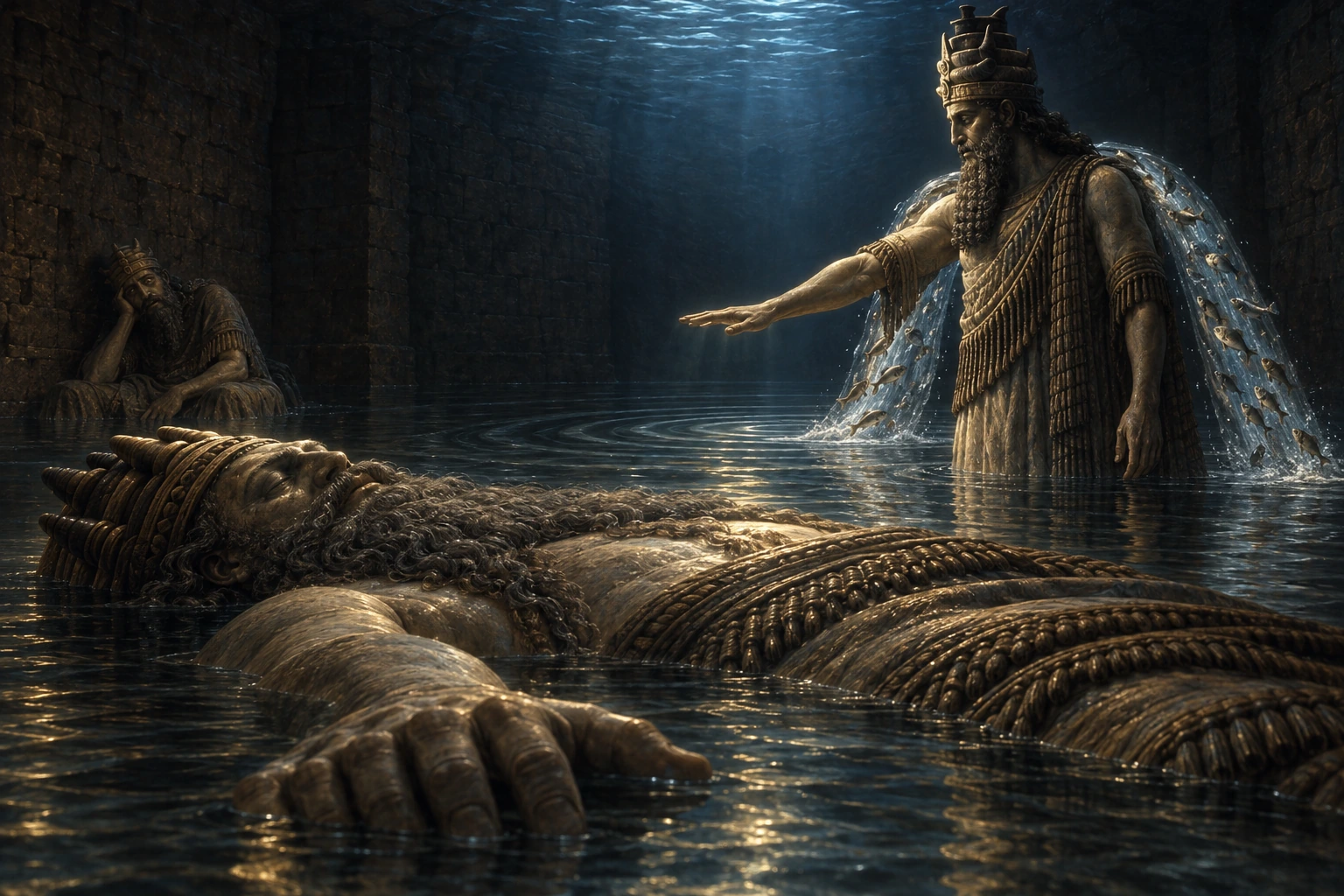
The gods heard of the plan and sat stunned. But Ea knew everything. He made a pure spell, recited it over the waters and poured sleep on Apsu. He untied his belt, took off his crown and put on his radiance himself; then he bound Apsu and killed him, and held Mummu on a rope. Over Apsu he founded his own home, called it “Apsu”, and lived there in splendour with his wife Damkina (I 59–78). Ea’s own character, the clever god of fresh water, belongs to another post (section 5).
1-2 Marduk and the Four Winds
In the chamber of destinies, in the midst of the Apsu, Marduk was born to Ea and Damkina (I 79–84). He suckled at the breasts of goddesses. He had four eyes and four ears, and fire blazed out when he moved his lips (I 85–100). His grandfather Anu was delighted. He made the four winds, put them in the boy’s hand and let him play. Dust rose, a storm carried it, a wave churned Tiamat, and she was stirred day and night (I 105–110). The gods who lived inside Tiamat could not rest. They reproached their mother: when Apsu, her husband, was killed, she had sat by and done nothing, and now these winds were stirring up her belly. They told her to make war and pay the young gods back (I 111–124).
1-3 Tiamat’s Army and the Tablet of Destinies
Tiamat agreed. As “Ummu-Hubur, who formed all things”, in King’s words, she bore monster serpents with venom for blood and dragons clad in terrifying radiance. She set up eleven kinds of creature in all; in King’s version, “vipers, and dragons, and the (monster) [Lahamu], [And hurricanes], and raging hounds, and scorpion-men, And mighty [tempests], and fish-men, and [rams]” (I 141–143; 121–123 in King). The eBL reads lion-monsters, lion-men and bull-men among them. Over them all she raised Kingu (Qingu in the eBL), one of the gods her children. She made him her husband and commander, and “She gave him the Tablets of Destiny, on [his] breast she laid them” (I 157; 137 in King).
Ea brought the news to his grandfather Anshar, who blamed him: it was Ea who had killed Apsu, so who could face Tiamat now? Ea went out to calm her and turned back; so did Anu. Each returned saying that her strength was overwhelming (II 1–118). The gods sat with their lips shut tight. Then Ea called his son. Marduk came before Anshar and offered to go, mocking the threat: it was only Tiamat, a woman, coming out to fight. But he set a price. The gods must meet in assembly, and from then on his word, not theirs, would fix destinies (II 119–162). Anshar sent his vizier Kakka to the oldest gods with the whole message again. They gathered, feasted, drank beer until they were carefree, and decreed Marduk’s destiny (III 1–138).
1-4 The Battle
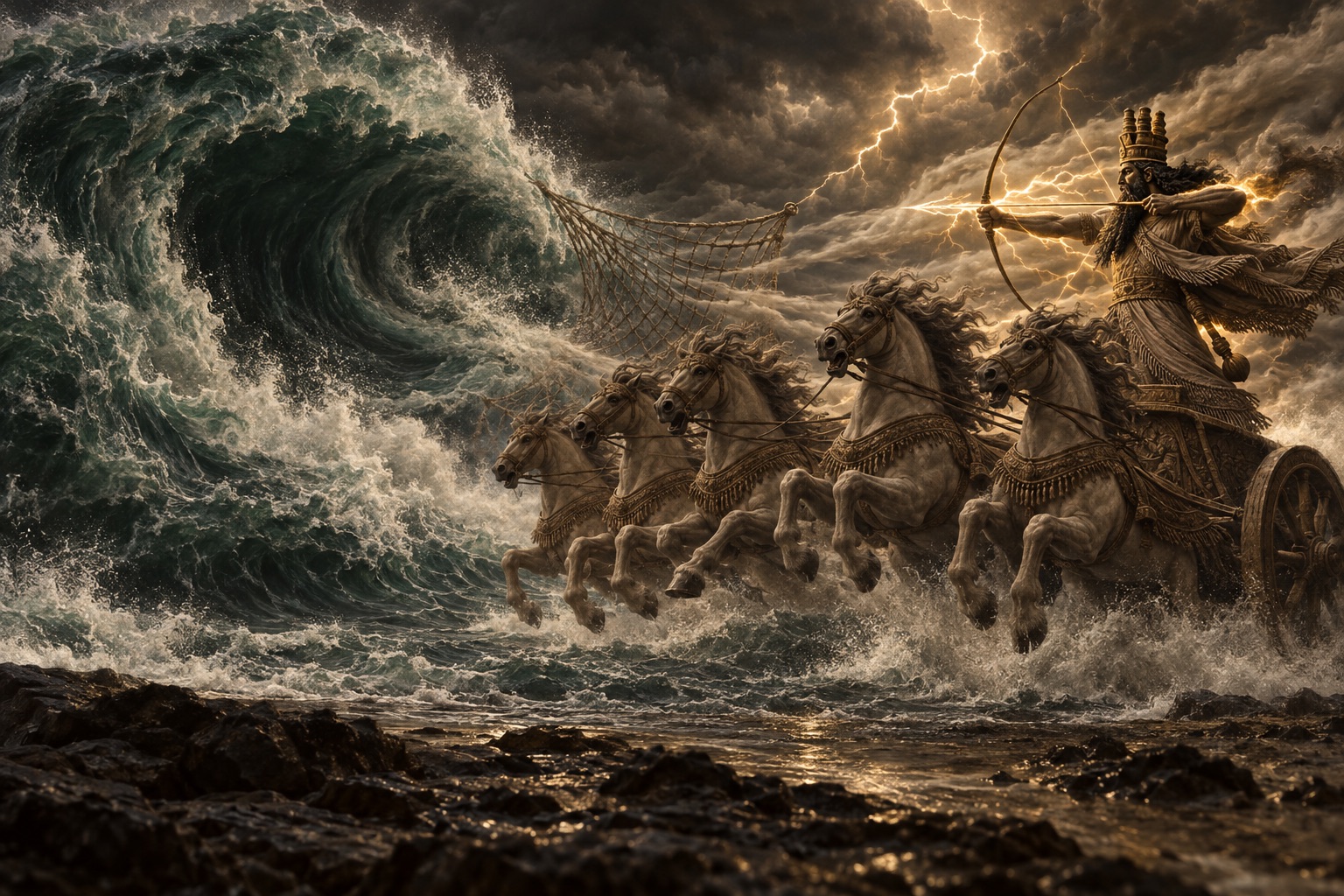
On a princely dais the gods declared his word supreme. To test it, they set a constellation before him; at his word it was destroyed, and at his word it was made again. “Marduk is king!” they cried (IV 1–28). He armed himself with a bow and arrow and a mace, set lightning before his face and filled his body with flame. He made a net to enclose her and placed the four winds so that nothing of her could escape, and he made seven more winds of his own. He raised the Deluge, his great weapon, and mounted his storm chariot behind four fierce steeds (IV 35–58).
At first, when he saw Tiamat’s array, his plan faltered (IV 65–70). Tiamat cast her spell and met him with smooth lies. Marduk called her out to single combat, and she shrieked and shook to her roots (IV 71–92). Then they closed. He spread his net around her. “As Tiamat opened her mouth to its full extent, He drove in the evil wind, while as yet she had not shut her lips” (IV 97–98). The winds swelled her belly, and his arrow tore through it and split her heart. He threw down her body and stood on it (IV 99–104). Her army fled and was caught in the net. He put lead-ropes on the eleven creatures and trampled them. He bound Kingu and counted him among the doomed gods. “He took from him the Tablets of Destiny that were not rightly his,” sealed it and fastened it to his own chest (IV 105–122).
1-5 Heaven and Earth from Her Body
Marduk turned back to Tiamat. He crushed her skull with his mace and cut the channels of her blood, and the north wind carried it away (IV 129–132). Then he rested, studied the body and made a plan. “He split her up like a flat fish into two halves; One half of her he stablished as a covering for heaven” (IV 137–138). He stretched out her skin and set guards, and ordered them not to let her waters escape. Above, he founded Esharra, a counterpart of the Apsu, as a home for Anu, Enlil and Ea (IV 139–146).
He gave the great gods their stations among the stars, laid out the year and its twelve months, three stars for each, and gave the moon the night and its phases (V 1–22). Some twenty lines after that are badly broken. Then he used the rest of her. Her foam became clouds and rain. He set down her head and heaped up earth on it, and springs opened. From her eyes he let the Euphrates and the Tigris flow. He heaped up mountains from her breasts, coiled up her tail and tied it as the “Great Bond” of heaven and earth, and spread out the other half of her to make the earth firm (V 47–62). This passage was not yet known to King in 1902.
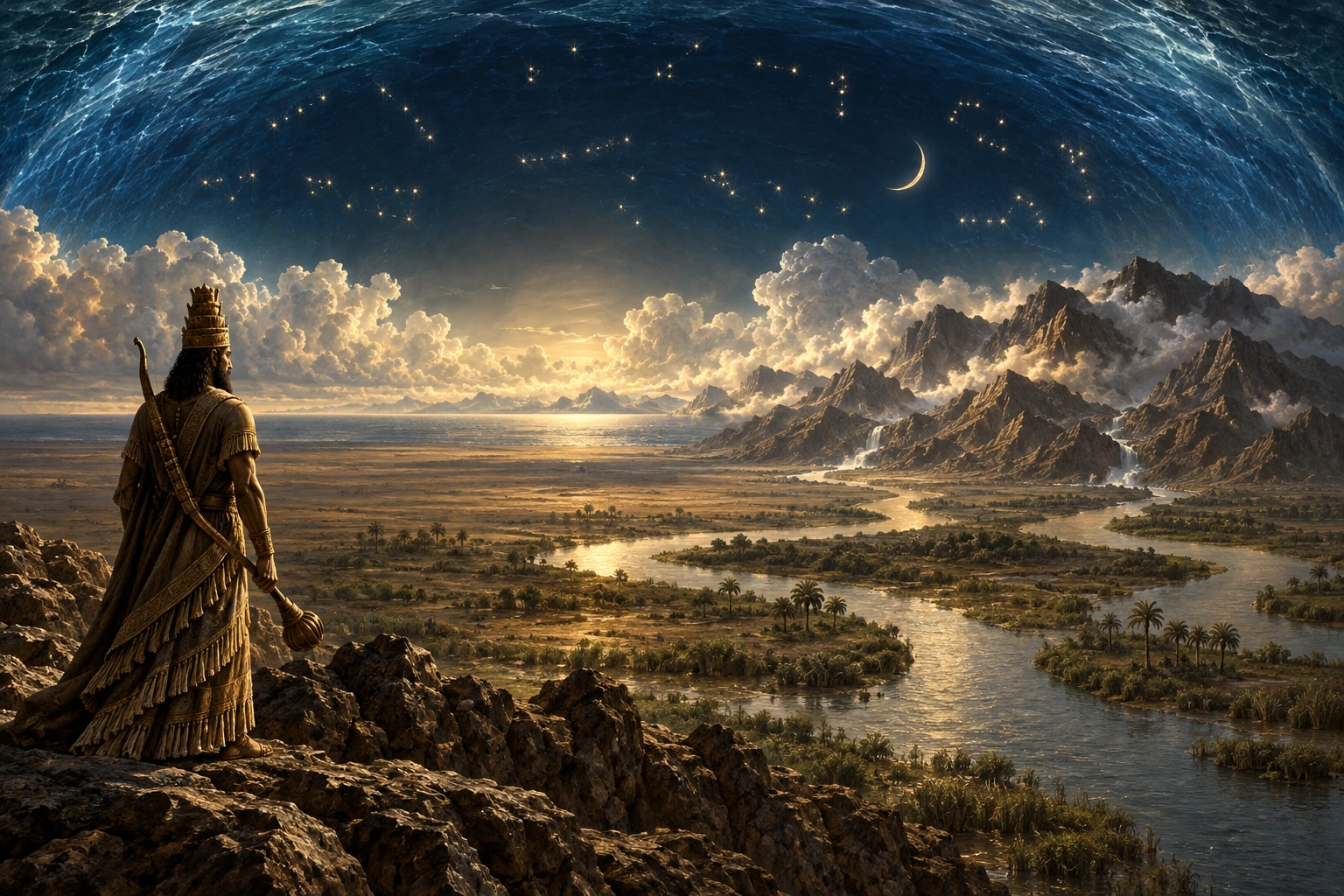
He gave the Tablet of Destinies to Anu, and set up images of the eleven creatures at the gate of the Apsu, so that they would never be forgotten (V 69–76). The gods hailed him as king and gave him the name Lugaldimmerankia, which the poem later explains as lord of all the gods of heaven and the netherworld (V 112; VI 139–141). Marduk answered that above the Apsu and below the sky he would build a house, where the gods could stay whenever they came up or down to meet, and he would call it Babylon, the home of the great gods (V 117–130).
1-6 People from Kingu’s Blood, and Babylon
Marduk told Ea his idea. In Luckenbill’s translation: “Blood will I fashion … and bone will I cause to be. I will set up an amelu, man shall be his name” (VI 5–6). People would bear the gods’ work, so that the gods could rest. Ea answered that one god must be given up for it (VI 7–16). Marduk asked the assembled gods who had started the war, and they named Kingu (VI 23–30). “They bound him, before Ea they brought him, punishment they laid upon him, they pierced him to the blood. From his blood he made mankind” (VI 31–33). It was Ea who made them, the poem says, by Marduk’s design (VI 35–38).
Marduk divided the Anunnaki gods, three hundred in heaven and three hundred below (VI 39–44). In thanks the gods offered to build him a shrine, and he told them to build Babylon. For a year they moulded bricks. In the second year they raised high the head of Esagila, his temple, and its temple tower. Marduk seated the gods at a banquet there and told them: this is Babylon, your home (VI 57–73). Anu kissed his bow and named it, set up a throne for him above all the gods, and the gods swore an oath to him (VI 82–100).
1-7 The Fifty Names
Then the gods resolved to pronounce his fifty names (VI 121). The list begins with “Marduk” itself, the name Anu gave him at birth, and runs to the end of the poem, each name with its meaning: Asari, who gave the arable land; Irqingu, the ravager of Kingu; Neberu, the star that holds the crossing of heaven and keeps Tiamat subdued. Last of all, Father Enlil gave him his own title, bēl mātāti, “lord of the lands” (VI 123 to VII 136). Ea, hearing it, rejoiced and gave him his own name too: he should be called Ea (VII 137–142). The poem ends with instructions. The names must be kept and pondered by the wise; a father should repeat them and teach them to his son; and the ruler, “the shepherd”, must not neglect Marduk, so that his land may prosper. Let people sing the song of Marduk, how he defeated Tiamat and took the kingship (VII 143–162).
2 Where the Story Is Written Down
- The poem. Seven tablets in Akkadian, named in antiquity after its first two words, enūma eliš, “when on high”. The eBL edition counts 1,096 lines. Its manuscripts come from Nineveh, Ashur, Nimrud (Kalhu), Babylon, Sippar, Kish, Borsippa, Uruk and other sites, most of them Neo-Assyrian or Neo-Babylonian, a few Late Babylonian; the eBL dates three fragments of Tablet IV from Ashur to the Middle Assyrian period, which would make them older still. The eBL calls it “perhaps the most popular religious composition in ancient Mesopotamia”, copied even in school exercises.
- Nineveh. On his second expedition, which set out in August 1849, Austen Henry Layard found rooms at Kuyunjik, the mound of Nineveh, whose floors were covered with clay tablets “to the height of a foot or more”. George Smith called them part of the royal Assyrian library; Rassam, Loftus and Smith himself found more of it. King noted that the Assyrian copies were made for Ashurbanipal, king from 668 BCE, and that his scribes “merely made copies … of older tablets of Babylonian origin”.
- George Smith, of the British Museum, described the creation fragments in a letter to the Daily Telegraph on 4 March 1875, read a paper on them to the Society of Biblical Archaeology on 2 November 1875, and published his translations in The Chaldean Account of Genesis (1876). He saw the Fall of Man in what is now Tablet VII. King judged that “these identifications were not justified”, but that Smith’s outline was “remarkably accurate”.
- King and after. King’s The Seven Tablets of Creation (1902) put the known fragments in order. Tablets found by the German excavators at Ashur and published by Ebeling “practically close up the two serious gaps”, in Tablets I and VI, as Luckenbill wrote when he translated them in 1921. Modern editions are those of Talon (2005), Kämmerer and Metzler (2012) and W. G. Lambert (2013). The eBL edition adds new fragments, among them copies from the Sippar library published by Anmar A. Fadhil and Enrique Jiménez in 2021.
- When was it composed? No one knows for certain. Proposals, the eBL says, run “from the Old Babylonian period to the first millennium BCE”. The most accepted view links it to Nebuchadnezzar I (r. 1125–1104 BCE), who brought the statue of Marduk back to Babylon from Elam. Nadav Na’aman, citing Lambert’s essay of 1964, writes that “most scholars agree” it is “a post-Kassite composition, of the time of Nebuchadnezzar I or of one of his successors”.
3 Competing Versions
- Marduk or Anshar? In the copies from Ashur that Luckenbill translated, the god born in the Apsu is Anshar, and his parents are Lahmu and Lahamu rather than Ea and Damkina (Tablet I, 78–84 in Luckenbill’s numbering). In the Neo-Assyrian period Anshar was sometimes equated with Ashur, the god of Assyria, “most likely to give Aššur more seniority”, as Nicole Brisch writes. The eBL speaks of “an Assyrianising version”. The copies from Nineveh keep Marduk.
- Whose blood? King had only the opening of Tablet VI. He read line 5 as “My blood will I take”, and, following Berossus, thought Marduk made people from his own blood. The tablets from Ashur showed otherwise. Luckenbill: “Man was created, not, as had been conjectured, from Marduk’s blood, but out of the blood and bone of the inventor of war, Kingu.”
- A garment or a constellation? In King’s version of the test in Tablet IV, the gods set a garment before Marduk, and it vanishes and reappears at his word. The eBL reads the same Akkadian word as a constellation.
- Berossus, who wrote a history of Babylonia in Greek in the 3rd century BCE, survives only in later excerpts, which King quotes. In his account a woman named Omorka ruled over the monsters before the world existed; in Chaldean, he says, she was Thalath, a name that translates into Greek as “sea”. Bel cleft her in two, “from one half of her he made the earth, and from the other the heavens”. In the poem, too, one half becomes the sky (IV 138) and the other the earth (V 62). Damascius, a philosopher writing in Greek in the 6th century CE, could still summarise the beginning closely: Tauthe and Apason (Tiamat and Apsu), then Lache and Lachos, Kissare and Assoros, then Anos, Illinos and Aos, and Belos, son of Aos, “the demiurge”. In his version Moymis (Mummu) is the only son of Tiamat and Apsu, not Apsu’s vizier.
4 History and Tradition
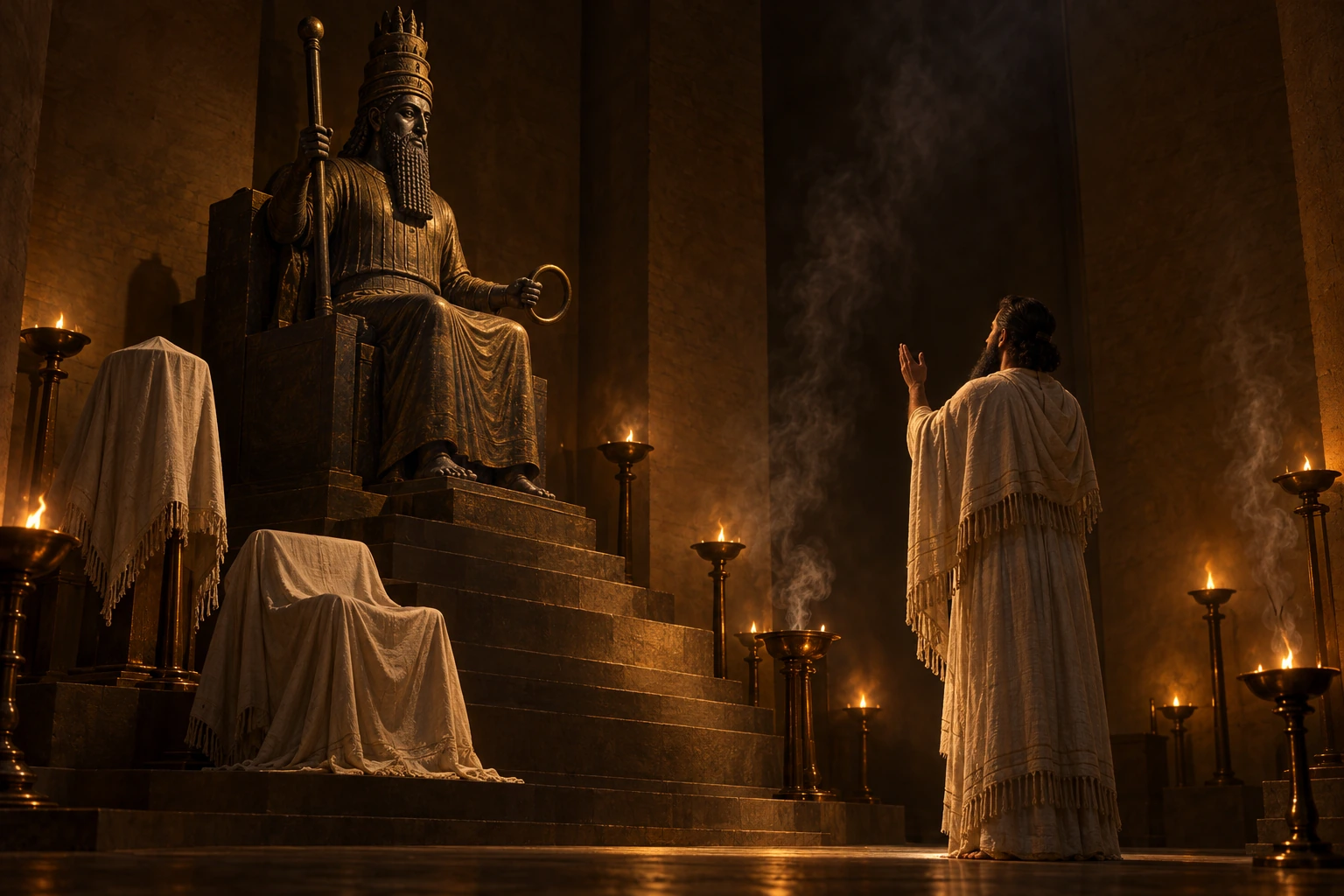
- The New Year festival. In 1921 François Thureau-Dangin edited the ritual for the second to fifth days of Nisannu, the first month (March to April), at Babylon, from four fragments of tablets. On the fourth day, after the meal at the end of the day, the urigallu priest of the Ekua, Marduk’s sanctuary, was to recite Enuma Elish to Bel, the Lord, “from beginning to end”, and while he did so the crown of Anu and the seat of Enlil were to stay covered (lines 279–284 in his numbering). On the fifth day the priest took the king’s sceptre and crown, struck his cheek and made him kneel and declare that he had not harmed Babylon; if his tears came, Bel was well disposed (around line 450). The tablets themselves are late, of the Parthian period, notes Brisch, and Céline Debourse (2022) reads them alongside priestly texts of the Hellenistic period, as “expressions of the Babylonian priesthoods’ fears and aspirations more than actual rituals”. Whether the festival also acted out the battle is still debated.
- Ashur on the door. In Assyria the hero changed. For the New Year temple outside the walls of Ashur, King Sennacherib had a copper gate made, and on it “the image of Assur, who is advancing to battle into the midst of Tiamat”, riding in a chariot with his bow raised, the gods marching before and behind him. Sennacherib, who in his own inscriptions boasts of having destroyed Babylon, says he stored some of its dust in that temple.
- The Nimrud relief. In June 1850 Layard uncovered, at a doorway of the temple of Ninurta at Nimrud, a pair of mirror-image slabs: a winged god with forked lightning in each hand pursuing a monster with a lion’s forefeet, an eagle’s talons, wings and feathers. Layard took it as “the bad spirit driven out by a good deity”. Smith printed it in 1876 as the “Fight between Merodach (Bel) and the dragon”, and King in 1902 cited it as proof that the Marduk and Tiamat story existed in the 9th century BCE. The British Museum labelled it that way until at least 1908, Ruth Horry and Eleanor Robson found. The temple’s inscriptions named its god as “Ninib”, read as Ninurta in 1915, and studies of 1972 and 1975 finally established the monster as Anzu, the lion-eagle who stole the Tablet of Destinies in the Epic of Anzu. The slab is in the British Museum (ME 124571).
- Genesis. Smith already stressed the likeness to the opening of Genesis. King wrote that the Hebrew tehom, “the deep” (Genesis 1:2), “is the equivalent of the Babylonian Tiamat”, and compared Marduk’s dome made from half of her with the firmament that divides the waters (Genesis 1:6–8). How far the poem influenced Genesis, the eBL notes, is still “subject of intense scholarly discussion”.
- Marduk’s dragon. The beast of Babylon’s glazed brick reliefs is Marduk’s own animal, the mušhuššu or “snake-dragon”. In the poem a mušhuššu is one of Tiamat’s eleven creatures (I 141), and once he has won, Marduk rests his feet on one (V 98).
Tiamat is often drawn as a scaly, winged dragon, and the Nimrud relief is still often captioned “Marduk fighting Tiamat”. The poem supports neither. King, who still pictured her as a dragon, admitted in 1902 that it “contains no direct description of Tiamat”. It gives her a mouth and lips, a belly, a heart, eyes, breasts and, once, a tail (V 59), but no horns, scales or wings, and her name is the Akkadian word for “sea”. The dragons in the poem are the monsters she gives birth to. The relief is now read as Ninurta chasing the lion-eagle Anzu, and no Mesopotamian image has yet been securely identified as Tiamat.
5 Related Stories
- Enki: The Clever God of Fresh Water: the Ea of this poem, who puts Apsu to sleep with a spell and builds his home on him, is the Sumerian Enki, the god of wisdom and magic who lives in the waters under the earth.
- Utnapishtim: The Flood Survivor, and the Older Atrahasis: in the flood poem Atrahasis, too, Ea plans the making of people so that they can do the gods’ work; there they are shaped from clay.
- Lamassu: The Winged Bulls at the Palace Gates: at the temple of Ninurta at Nimrud, the doorway with the “Marduk and Tiamat” relief stood just north of the main entrance, which was flanked by enormous human-headed lions of stone.
- Ymir: The Frost Giant Whose Body Became the World: in the Norse myth, too, the gods build the world from the body of a primordial being they have killed. We have not found a scholar who compares the two myths; we link them for the theme.
- Atum: The Lone God Who Began the World at Heliopolis: another world that begins in water. In 1904 Budge set the Egyptian making of mankind beside the Babylonian one, calling it “exactly what we find in the Mesopotamian creation legends”; beyond that, we link the two for the theme.
6 Sources
- Enūma eliš, ed. Adrian C. Heinrich, revised by Zsombor J. Földi and Enrique Jiménez, English translation by Benjamin R. Foster, electronic Babylonian Library (2021): eBL
- L. W. King, The Seven Tablets of Creation, vol. 1 (London, 1902), translation and introduction: archive.org
- D. D. Luckenbill, “The Ashur Version of the Seven Tablets of Creation”, American Journal of Semitic Languages 38 (1921), and The Annals of Sennacherib (Chicago, 1924), pp. 17–18 and 135–142: archive.org, archive.org
- F. Thureau-Dangin, Rituels accadiens (Paris, 1921), “Le rituel des fêtes du nouvel an à Babylone”: archive.org
- George Smith, The Chaldean Account of Genesis (London, 1876), and A. H. Layard, Discoveries in the Ruins of Nineveh and Babylon (London, 1853), pp. 345 and 349–350: archive.org, archive.org
- Sophus Helle, “Tiamat”; Nicole Brisch, “Marduk” and “Anšar and Kišar”; Ruth Horry, “Enki/Ea”, Ancient Mesopotamian Gods and Goddesses (Oracc, 2019): Tiamat, Marduk, Anšar and Kišar, Enki/Ea
- Ruth A. Horry and Eleanor Robson, “Anzu the monstrous lion-eagle”, Nimrud: Materialities of Assyrian Knowledge Production (Oracc, 2019): Oracc
- Nadav Na’aman, “The Israelite-Judahite Struggle for the Patrimony of Ancient Israel”, Biblica 91 (2010), pp. 8–9: bsw.org
- University of Helsinki, “Descriptions of rituals speak of priestly fears” (2022), on Céline Debourse, Of Priests and Kings: The Babylonian New Year Festival in the Last Age of Cuneiform Culture (Brill, 2022): helsinki.fi
- Gotō Kōichirō, “エヌマ・エリシュ”, Heibonsha World Encyclopedia, and the Britannica Japan concise encyclopedia: Kotobank
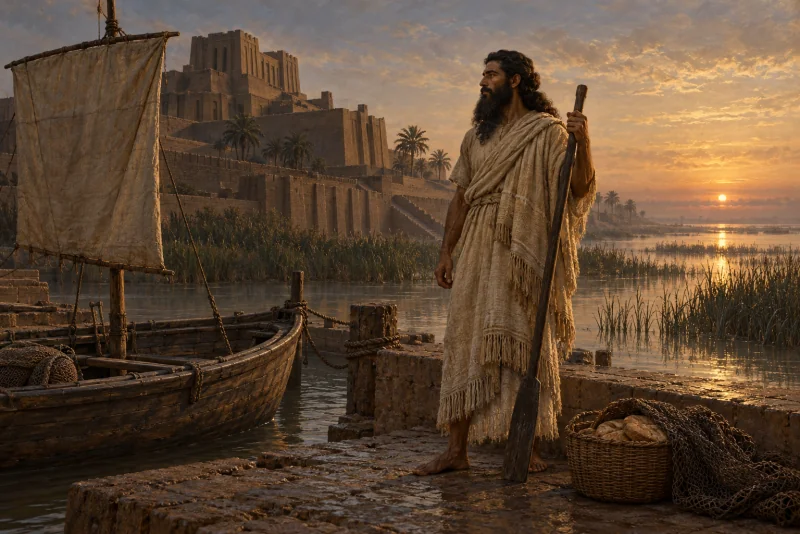
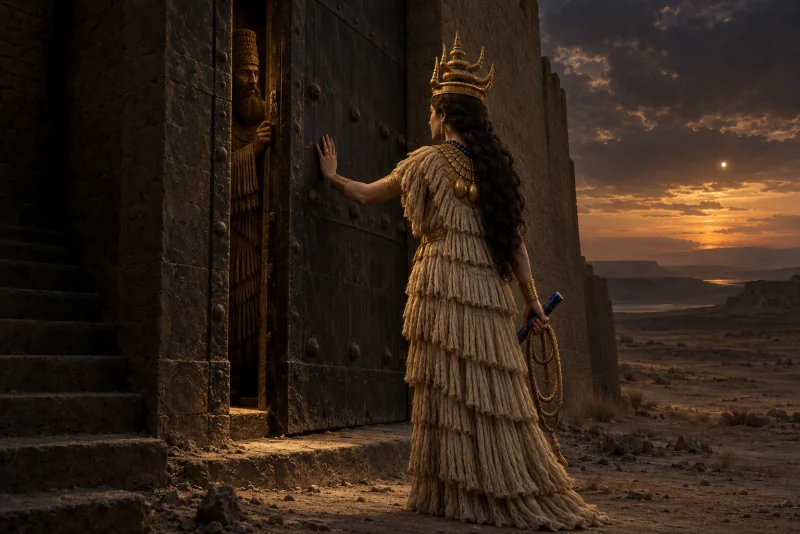
Cover and illustrations: AI-generated images made for Arcana. They are interpretations, not historical artworks.