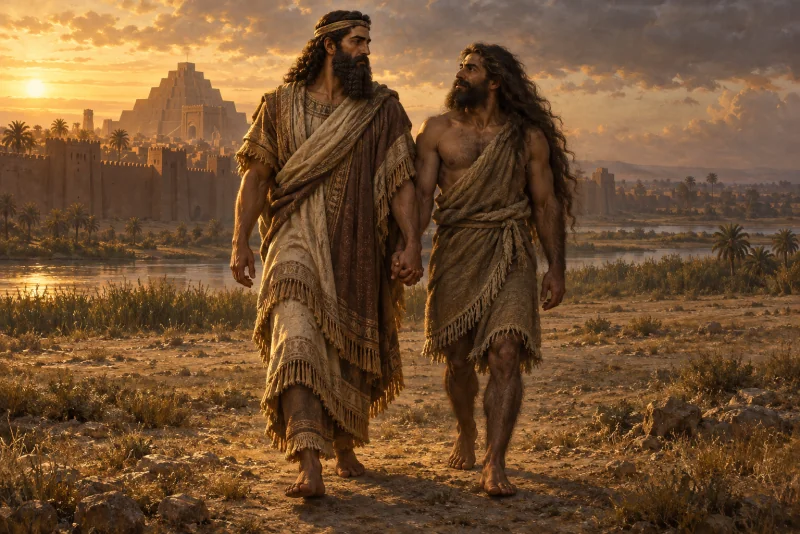
Adapa: The Man Who Refused the Bread of Life
Adapa, the sage of Eridu, broke the wing of the South Wind and was called up to heaven, where he refused the bread his god had warned him against. It was the bread of life, and the longest copy of his story was found not in Iraq but in Egypt.
- Type: myth, a wise man summoned to heaven who turns down the food of the gods
- Culture: Babylonia; copied in Egypt and in Assyria
- Earliest texts: a tablet from Amarna in Egypt (14th century BCE); fragments from Ashurbanipal’s library at Nineveh (7th century BCE); two Sumerian copies of the Old Babylonian period from Tell Haddad, published in 2014
- Key figures: Adapa, Ea (Enki), Anu (An), the South Wind, Anu’s vizier Ilabrat, Dumuzi (Tammuz), Gizzida (Ningishzida)
The story turns on a meal. A wise man is called before the king of the gods and offered the bread and water of life. He turns them down, because his own god told him they would be the bread and water of death. Then the king of the gods laughs. Why he laughs, and what the man lost, has been argued over since the tablet came to light in Egypt in 1887.
Did Ea trick Adapa on purpose? The tablet does not say. Ea warns him that he will be offered “food of death” and “water of death”; Anu orders “food of life” and “water of life”. Neither god explains the difference, and when Anu asks why he did not eat, Adapa only repeats Ea’s order. Scholars have read Ea as a deceiver, as a god who misjudged Anu, and as a god who was right all along (section 3).
1 The Telling
The story survives only in pieces (section 2). Its beginning is on a fragment from Nineveh (A), most of what we have on the tablet from Amarna (B), and a different ending on another Nineveh fragment (D). They are put together here in that order. The letters are those used by Niels-Erik Andreasen (1981) and others; line numbers follow Alexander Heidel’s translation (1951), which for the Amarna tablet match the transliteration in the SEAL corpus. Quotations are from R. W. Rogers’s translation of 1912 unless another translator is named.
1-1 The Sage of Eridu
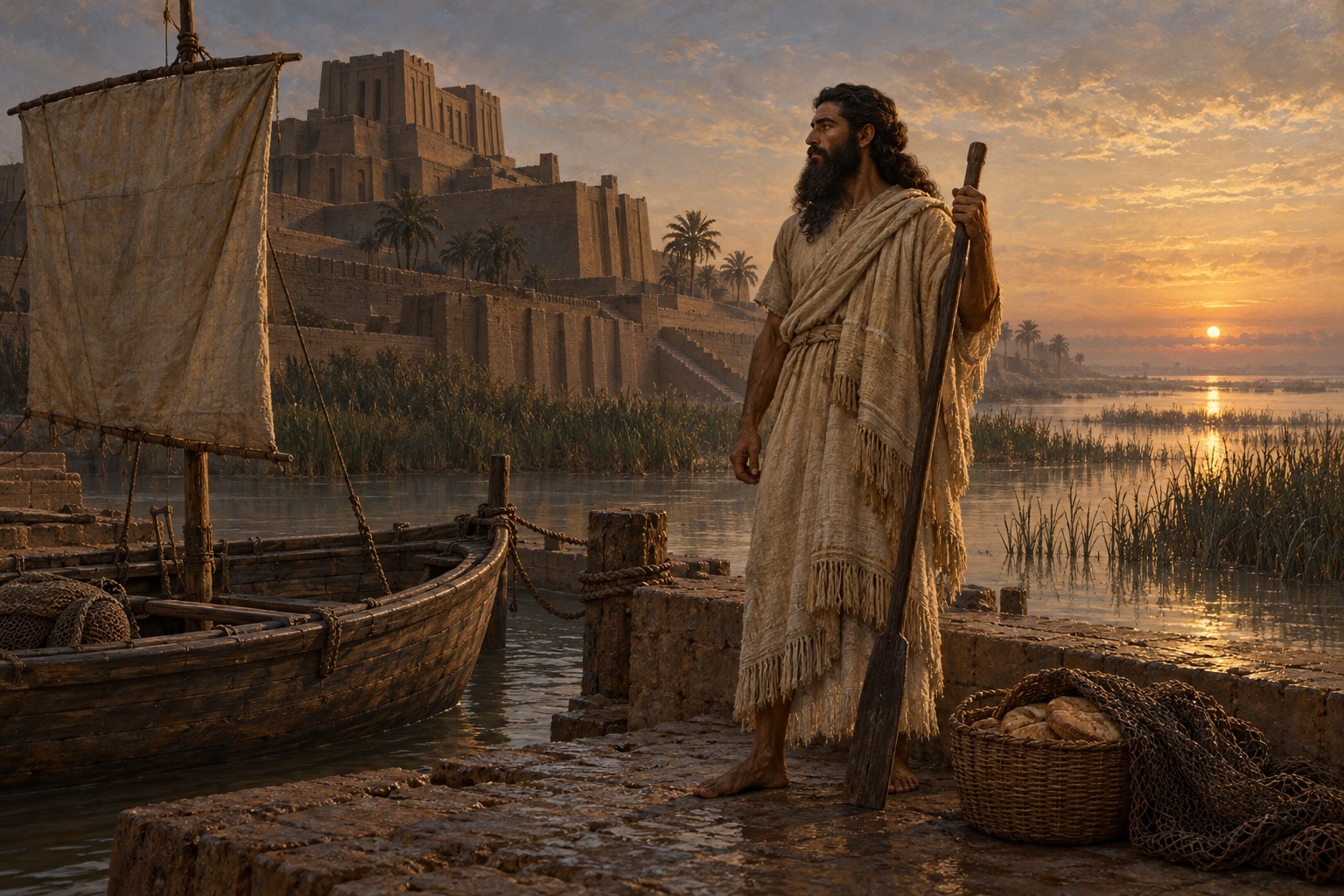
Ea, the god of Eridu, gave Adapa a wide understanding, to reveal the destinies of the land. “He granted him wisdom, but he did not grant him eternal life” (A 4). The text calls Adapa the sage (apkallu) of Eridu and “the son of Ea”, whom Ea created to stand among men.
He was pure, with clean hands. With the bakers of Eridu he baked the bread; every day he provided the food and water for Eridu; he set the table with his clean hands, and without him it was not cleared. He steered the boat and did the fishing for the city. Then, at the pure quay, the Quay of the New Moon, he boarded a sailing boat. The wind blew, and he steered with the oar out onto the wide sea (A 19–22). There the fragment breaks off.
1-2 The Wing of the South Wind
The Amarna tablet begins broken, in the middle of the storm. Adapa later tells Anu what happened (B 50–54): he was catching fish for his lord’s house, the sea lay calm as a mirror (the word is uncertain), and the South Wind blew and overturned him, plunging him into the domain of Ea. In the anger of his heart he cursed it. “Thy wing will I break,” he said, and as he spoke, the wing of the South Wind was broken. For seven days the South Wind did not blow upon the land (B 5–7).

Anu asked his vizier, Ilabrat, why the South Wind had not blown for seven days. Ilabrat answered: “Adapa, the son of Ea, the wing of the South wind has broken.” When Anu heard it he cried out, rose from his throne and ordered that Adapa be brought to him (B 8–13).
1-3 Ea’s Advice
Before Anu’s messenger arrived, Ea, “who knows the heaven”, took Adapa in hand. He made him wear his hair long, clothed him in a mourning garment, and told him what to do (B 14–34).
At the gate of Anu, he said, two gods stand guard, Dumuzi and Gizzida. They will ask for whom Adapa is mourning, and he must answer: two gods have vanished from our land. Which two? Dumuzi and Gizzida. They will look at one another, speak a good word for him to Anu, and show him Anu’s kindly face. Both were gods who die or go down to the netherworld; by mourning them, as Rogers and Heidel explain, Adapa is to win their sympathy.
Then Ea gave the warning on which the story turns: “Food of death they will set before thee, eat not. Water of death they will set before thee, drink not. Garments they will set before thee, put them on. Oil they will set before thee, anoint thyself.” He told Adapa to forget none of it.
1-4 At the Gate of Anu
Anu’s messenger came, and Adapa took the road to heaven. Everything happened as Ea had said. At the gate Dumuzi and Gizzida asked their question, heard his answer, and looked at one another (B 37–46).
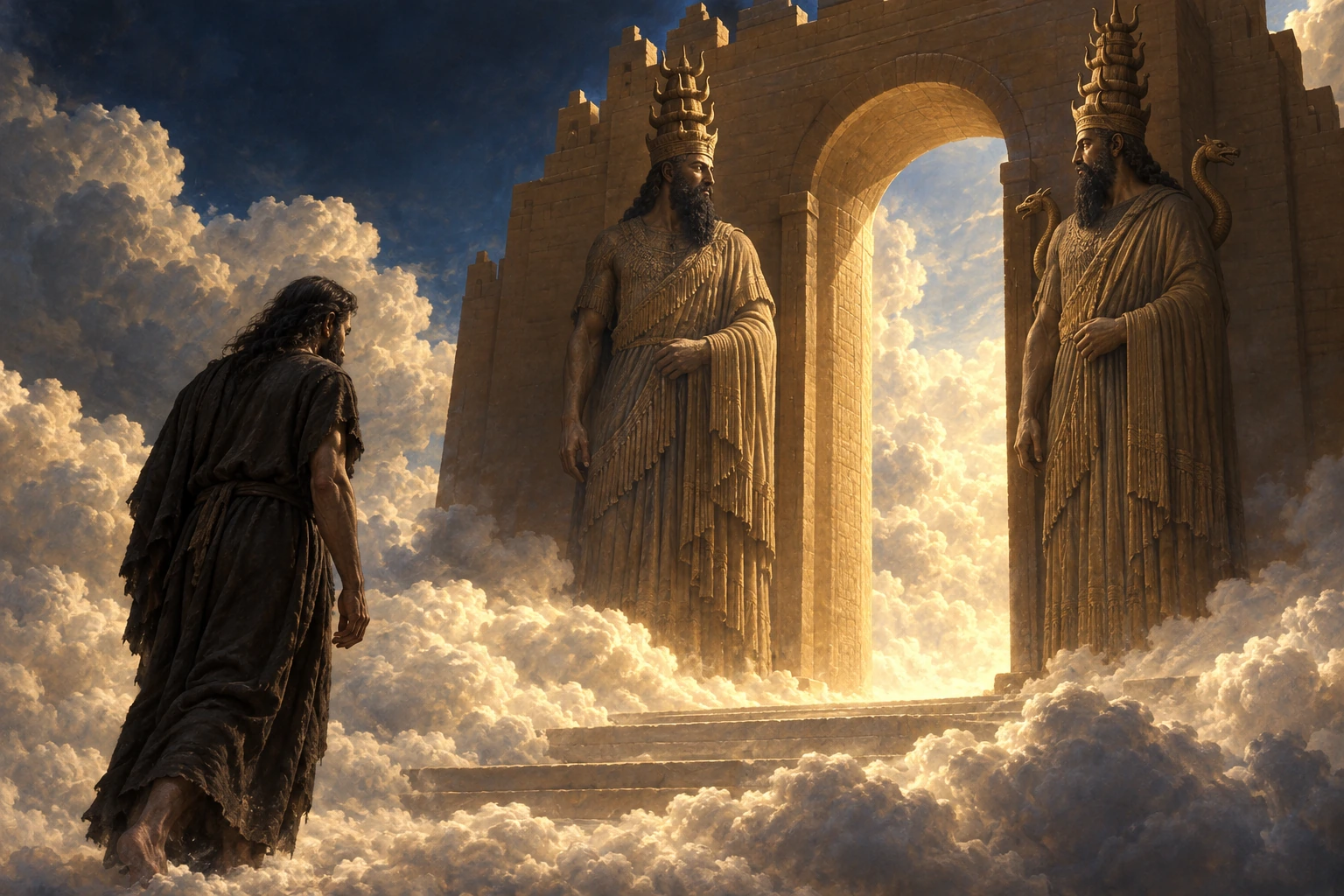
“Come hither, Adapa,” said Anu. “Why hast thou broken the wings of the South wind?” Adapa told him of the fishing and the storm. The two gatekeepers spoke up for him, and Anu’s anger cooled. Then Anu wondered aloud: “Why has Ea revealed to impure mankind the heart of heaven and earth?” Ea had made this man strong and given him a name. “What can we do with him?” Let the food of life be fetched for him, and let him eat (B 57–61).
1-5 The Bread of Life
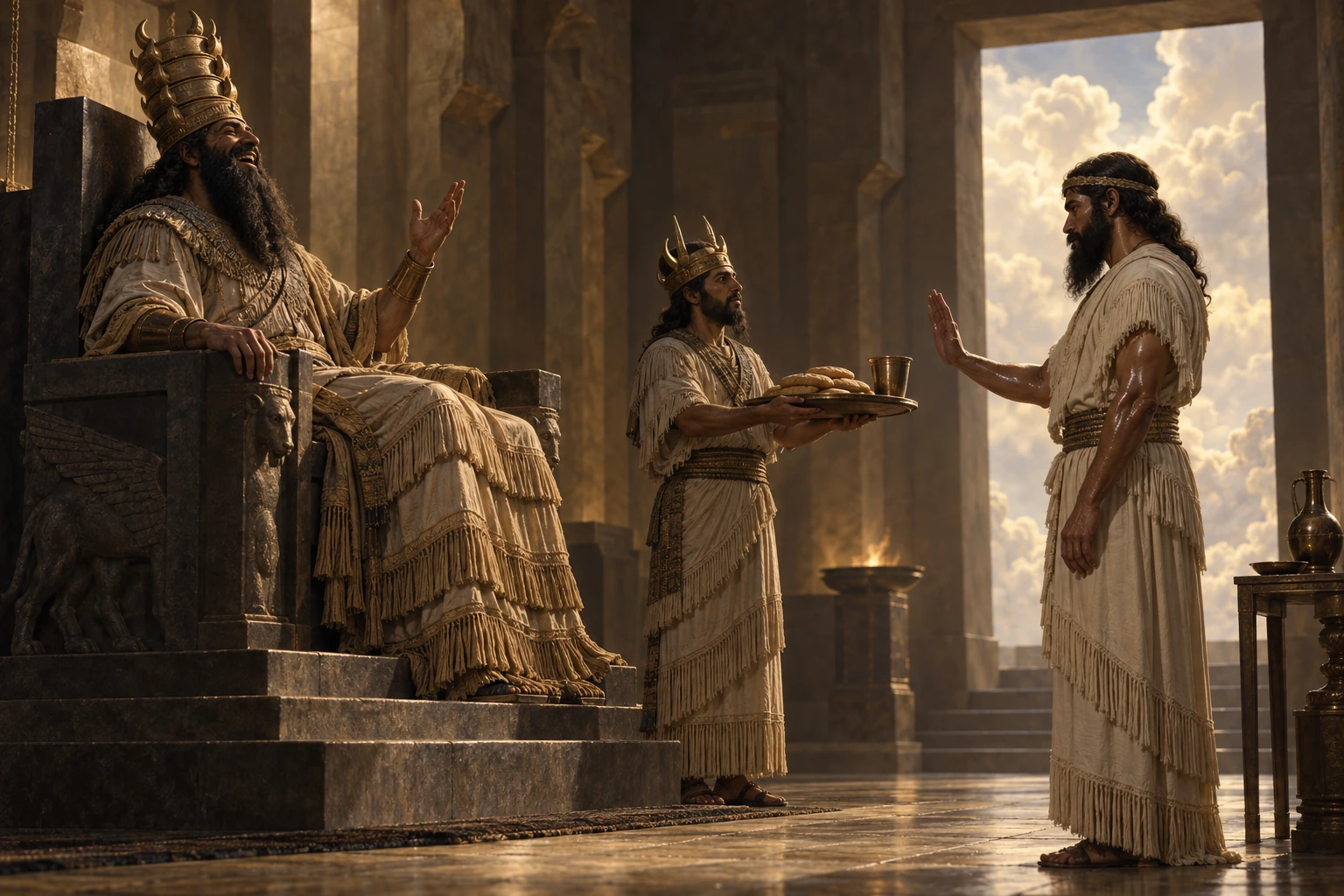
They brought him the food of life, and he did not eat. They brought him the water of life, and he did not drink. They brought him a garment, and he put it on. They brought him oil, and he anointed himself (B 62–65). Anu looked at him and laughed (B 66). Rogers in 1912 read the verb as “he wondered (?) at him”; later translators, Heidel among them, read “laughed”. “Come, Adapa, why hast thou not eaten, not drunken?” The words that follow are broken and disputed (section 3). Adapa answered that Ea, his lord, had told him not to eat and not to drink. “Take him and bring him back to his earth,” said Anu (B 70). The tablet breaks off.
1-6 The Nineveh Ending
Fragment D, from Nineveh, tells the end differently (lines 2–21 in Heidel’s numbering). Oil and a garment are given to Adapa; Anu laughs at what Ea has done and asks the gods of heaven and earth who ever gave such a command. From the horizon of heaven to its zenith, Adapa looks and sees its awesome splendour. Anu lays a duty on him, in a broken line, and frees the city of Ea from its labour service. Then the story turns into a spell. In Albert Clay’s translation of 1923: “And what evil he imposed upon the people, [And] the disease which in the body of men he imposed. That will the goddess Ninkarrak allay.” Ninkarrak is a goddess of healing.
2 Where the Story Is Written Down
- The Amarna tablet (fragment B; Berlin, Vorderasiatisches Museum, VAT 348; no. 356 in J. A. Knudtzon’s numbering of the Amarna tablets). It was found in 1887 in the archive of Akhetaten, the city of the pharaoh Amenhotep IV (Akhenaten), and dates to the 14th century BCE. It holds most of the story.
- Red dots are set at intervals between the words. Rogers took the tablet for a teaching text, “used as a means of teaching the Babylonian language in Egypt”. Shlomo Izre’el, in his edition of 2001, adds red points that earlier editors had missed, and studies them together with the poem’s metre.
- The Nineveh fragments, from the library of the Assyrian king Ashurbanipal (7th century BCE), some seven centuries later than the Amarna tablet.
- Fragment A holds the beginning; C, which Heidel lists as K 8743, repeats Ea’s advice in other words; D holds the ending with the spell. Heidel notes that C and D seem to be in the same hand.
- Older editions count four fragments in all; Izre’el counts six, the Amarna tablet and five from Nineveh.
- A Sumerian version. In 2014 Antoine Cavigneaux published two copies of the story in Sumerian, found in the Old Babylonian library at Tell Haddad (ancient Me-Turan) by an Iraqi expedition around 1980. Coming from the Old Babylonian period, they are older than the Amarna tablet. Cavigneaux writes that this version has “much in common with the Akkadian, but also much that is new and unexpected”.
- The gaps. Fragment A breaks off at sea; the Amarna tablet has lost its first lines, part of Anu’s last words and its ending. What Anu lays on Adapa himself is lost in a broken line of fragment D.
3 Competing Versions
- Did Ea deceive him? Andreasen (1981) sorts the answers into three:
- Ea lied, to keep his servant at Eridu (E. Burrows in 1928, B. R. Foster in 1974, W. H. Shea in 1977, among others);
- Ea meant well but underestimated Anu’s readiness to pardon (G. Komoróczy, S. N. Kramer);
- Ea was right, because the food of the gods would kill a mortal: in F. M. Th. Böhl’s words (1959), “for mortals, nectar and ambrosia are poison”. This is Andreasen’s own view.
- Ruth Horry, writing for ORACC, gives a fourth: Ea “helps humanity keep the gift of magic and incantations by preventing Adapa from becoming immortal”.
- Did Adapa lose anything? For Heidel (1951), he missed immortality for himself and for mankind, and brought illness on people. Andreasen answers that he never had immortality to lose (A 4), and that Anu’s laugh may show “amused satisfaction” at his wisdom.
- Different readings of the same lines. Where Rogers (1912) has the gatekeepers “astonished” and Anu “wondered”, Heidel (1951) has them smile and Anu laugh. Rogers renders Anu’s next words “(Now) thou shalt not live”; Heidel, “Art thou not well?” Ea created Adapa “as chief (?) among men” for Rogers, “as a leader among mankind” for Heidel, and as a “model of men” for Andreasen (A 6).
- What is “the heart of heaven and earth”? Heidel, following Thorkild Jacobsen, explains it as magic power: the power Adapa showed when his words broke the wind.
- Two endings. At Amarna, Anu sends Adapa home and the tablet breaks off. At Nineveh, Anu laughs at Ea’s deed, frees Eridu from service, and the story ends as a cure for disease.
4 History and Tradition
- The model of a sage. Outside the myth, Adapa is the measure of wisdom. The Chicago Assyrian Dictionary collects the examples. Sennacherib says Ea gave him “a wide knowledge equal to that of the sage Adapa”; Ashurbanipal speaks of šipir apkalli Adapa, the craft of the sage Adapa; an incantation against the demoness Lamashtu names Adapa, the sage of Eridu; and a medical prescription opens with the words “Thus says Adapa the sage”.
- The seven sages. In Akkadian apkallu means sage. The Erra poem asks where are “the seven sages of the apsû, the sacred puradu-fish”. A ritual text tells how to make seven protective figurines of the sages, crowned and robed, and an incantation hails them as “the watchers”. The fish-cloaked figures on reliefs from Ninurta’s temple at Kalhu (Nimrud) were taken for Ea in the early 20th century. Horry explains that they are these sages.
- Was Adapa one of the seven? Andreasen (1981) writes that Adapa is “now known to be the name of the first of the seven antediluvian sages”, each paired with a king before the flood. W. G. Lambert pointed to a text that gives this sage a double name, Umanna-Adapa, took adapa there as an epithet meaning “wise”, and saw in the double name the origin of Berossus’s Oannes. The link rests on these later texts: the surviving fragments of the South Wind story call Adapa a sage, but never count him among seven or set him before the flood.
- Berossus’s Oannes. Berossus was a Babylonian priest under Antiochus I, in the 3rd century BCE. His work survives in quotations, and one describes a creature that came up out of the sea “having, as to the whole, the body of a fish”, with a man’s head beneath the fish’s head and a man’s feet. It “had a human voice”, taught people letters, numbers and the arts, how to found cities and temples, make laws and gather harvests, and at sunset went back into the sea.
- “Adapa, or perhaps Adamu.” Andreasen writes that the myth’s “early discoverers and investigators claimed it as a true Babylonian parallel to the biblical story of Adam”. A. H. Sayce read the name as Adamu and wrote that “the first man Adamu had been created in Eridu” (1908). Rogers (1912) thought it “most probable”, following Zimmern, that the Paradise story of Genesis was influenced “at least in part” by the myth. Several scholars also equated Adapa with Alaparos, Berossus’s second king before the flood. Clay (1923) rejected both equations, and Heidel (1951) concluded that the two stories are “fundamentally as far apart as the antipodes”. Andreasen (1981) finds real parallels, a summons before a god and a test with food, but “seriously blunted by the entirely different contexts in which they occur”.
Adapa is often called “the Babylonian Adam”. The tablets do not make him the first man. Ea creates him as a sage among people who already have a city, bakers and a temple; “everything in it points to an advanced state of civilization”, wrote Albert Clay in 1923. The Nineveh fragment calls him “seed of mankind”, but as Heidel noted, following Jensen, that only means he was human. Whether the names themselves are related is argued both ways: Clay called it impossible, Andreasen thought some link likely.
5 Related Stories
- Enki: The Clever God of Fresh Water: Adapa’s god, “who knows the heaven”. Andreasen sets his advice to Adapa beside his other rescues, of Inanna from the netherworld and of the flood hero.
- Gilgamesh: The King Who Tried to Escape Death: “It is frequently suggested that Adapa, like Gilgamesh, sought immortality,” writes Andreasen, who disagrees: nothing in the text shows Adapa seeking it.
- Etana: The King Who Flew on an Eagle: another mortal who goes up to heaven. G. Komoróczy studied the two poems together, in “Zur Deutung der altbabylonischen Epen Adapa und Etana” (1969).
- The Odyssey: Ten Years on the Way Home from Troy: Calypso offers Odysseus immortality, and he refuses it. We have not found a scholar who compares the two refusals; we link them for the theme.
6 Sources
- Fragment B, the Amarna tablet (VAT 348, EA 356), transliteration: SEAL no. 1557, CDLI P270855
- R. W. Rogers, Cuneiform Parallels to the Old Testament (1912), pp. 67–78, the Adapa fragments and Berossus: archive.org
- Alexander Heidel, The Babylonian Genesis, 2nd ed. (University of Chicago Press, 1951), pp. 122–124 and 147–153: ISAC
- Albert T. Clay, The Origin of Biblical Traditions (Yale Oriental Series, Researches 12, 1923), pp. 109–112 and 131–132: archive.org
- A. H. Sayce, The Archaeology of the Cuneiform Inscriptions, 2nd ed. (1908), p. 91: archive.org
- Shlomo Izre’el, Adapa and the South Wind: Language Has the Power of Life and Death (Eisenbrauns, 2001): Penn State University Press
- Antoine Cavigneaux, “Une version sumérienne de la légende d’Adapa (Textes de Tell Haddad X)”, Zeitschrift für Assyriologie 104 (2014), pp. 1–41: De Gruyter
- Niels-Erik Andreasen, “Adam and Adapa: Two Anthropological Characters”, Andrews University Seminary Studies 19 (1981), pp. 179–194: Andrews University
- The Assyrian Dictionary of the Oriental Institute of the University of Chicago, vol. A, part 2 (1968), “apkallu”, pp. 171–173: ISAC
- Ancient Mesopotamian Gods and Goddesses (ORACC): Ruth Horry, Enki/Ea; Ningišzida, Geštinanna, Gula/Ninkarrak
Cover and illustrations: AI-generated images made for Arcana. They are interpretations, not historical artworks.