Gilgamesh: The King Who Tried to Escape Death
Two-thirds god and a third human, Gilgamesh watched his friend die, crossed the world to the one man who had escaped death, and lost the plant of youth to a snake. The epic is very old, but it is not the oldest story ever written.
- Type: epic, a king’s search for life after the death of his friend
- Culture: Mesopotamia, in what is now Iraq, in Sumerian and Akkadian; in the second half of the second millennium BCE also copied in Anatolia, Syria and the Levant, and translated into Hittite and Hurrian
- Earliest texts: five Sumerian poems, perhaps composed at the end of the third millennium BCE and known from copies of about the 18th century BCE; an Old Babylonian epic in Akkadian of the same period; the Standard Babylonian epic in twelve tablets, attributed to Sîn-lēqi-unninni, best known from 7th-century BCE copies from Nineveh
- Key figures: Gilgamesh, Enkidu, Ishtar, Anu, Shamash, Siduri, Urshanabi, Utnapishtim
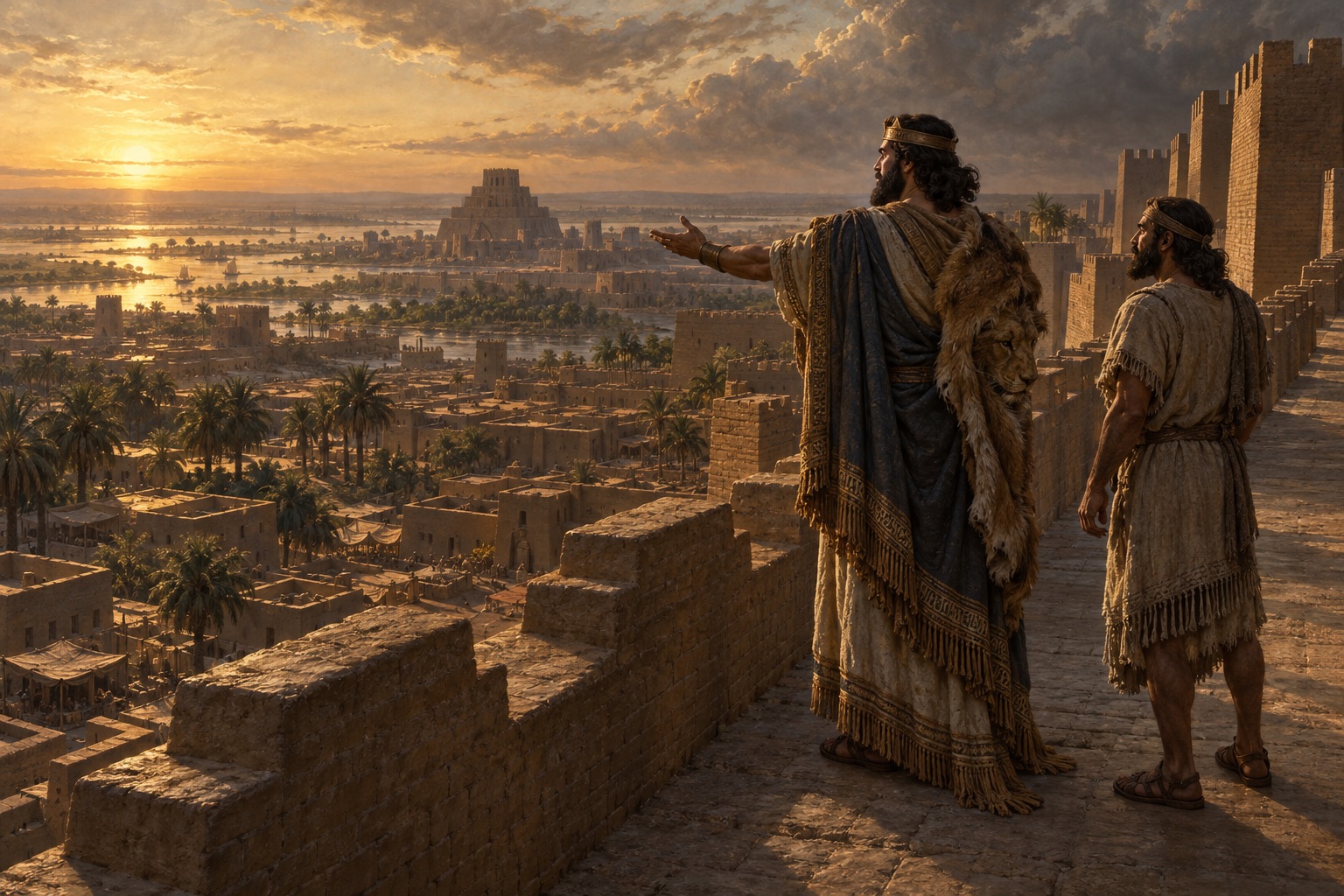
The Epic of Gilgamesh begins and ends on a city wall. It tells its reader to climb the wall of Uruk and look at the brickwork, and at the end of Tablet XI Gilgamesh says the same words to a boatman. In between, a king who is two-thirds god loses his friend, crosses the world to ask the one man who escaped death how it was done, and comes home with nothing but the wall.
Was Gilgamesh a real king? Perhaps. The Sumerian King List makes him the fifth king of the first dynasty of Uruk, with a reign of 126 years, and a Sumerian chronicle says he built part of the temple of Enlil. But both texts run on to kings who lived centuries later, and the electronic Babylonian Library’s edition of the epic puts it plainly: “It is unknown whether he was a historical figure; in any case, he was deified by the mid-third millennium BC.”
1 The Telling
This is the Standard Babylonian version, which a Babylonian catalogue of authors calls the Series of Gilgamesh, by Sîn-lēqi-unninni the exorcist. Tablet and line numbers follow Andrew George’s edition in the electronic Babylonian Library (eBL), which builds on his critical edition of 2003. Short quotations are from R. Campbell Thompson’s translation of 1928.
1-1 Uruk-the-Sheepfold
The poem opens, ša nagba īmuru, in praise of the man who saw the Deep, who knew every road and brought back word from before the Flood (I 1–8). Then it invites the reader into Uruk: to climb the wall, inspect the kiln-fired brick laid on foundations of the Seven Sages, open a cedar box and read out the tablet of lapis lazuli that tells all that Gilgamesh went through (I 11–28).
The hero is Lugalbanda’s wild bull, the son of the goddess Ninsun, the Wild Cow (I 35–36). “Two-thirds of him are divine,” Thompson translates, and the rest human; he stands eleven cubits tall (I 48–52). But he is a tyrant. He lets no son go free to his father and no girl to her bridegroom, until the gods hear the people’s complaint (I 61–91).
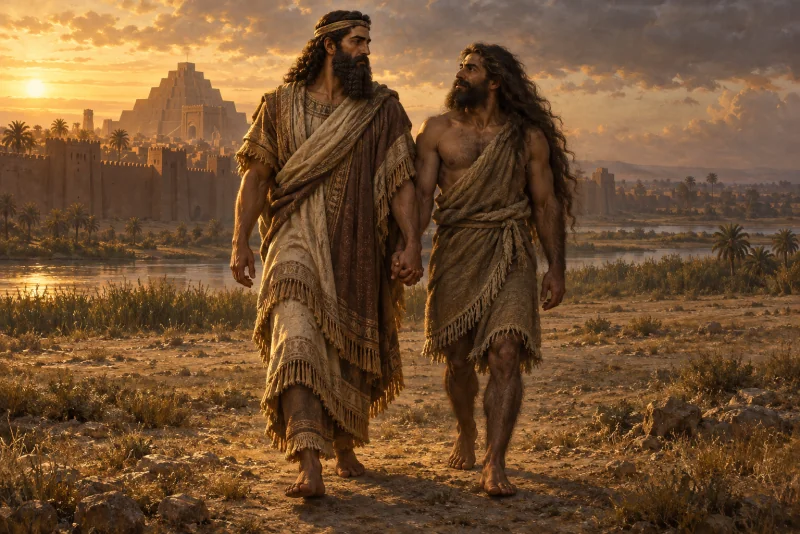
They summon the goddess Aruru, who pinches off clay and throws it down in the wild (I 92–100). So Enkidu is made, a match for Gilgamesh, and lives with the animals until the woman Shamhat brings him to Uruk. The two fight, become friends, and go together to the Cedar Forest to kill its guardian, Humbaba (Tablets I–V).
1-2 Ishtar and the Bull of Heaven
Home again, Gilgamesh washes his matted hair and puts on his crown, and the goddess Ishtar looks on his beauty. “Gilgamish, come, be a bridegroom,” she says in Thompson’s version, and promises him a chariot of lapis lazuli and gold, kings bowing at his feet, and ewes that bear twins (VI 1–21).
He refuses, and not politely. She is a door that keeps out no draught, a shoe that bites its owner’s foot. Which of her bridegrooms lasted forever? He counts her lovers: Dumuzi (Tammuz), the husband of her youth, to whom she gave weeping year after year; a bird whose wing she broke, so that it stands in the woods crying “my wing!”; a lion she trapped in pits; a horse she gave the whip; a shepherd she turned into a wolf; and her father’s gardener Ishullanu, whom she struck and transformed when he refused her (VI 32–79).
Ishtar goes up to heaven in tears. When her father Anu answers that she provoked the insults herself, she asks for the Bull of Heaven, and threatens otherwise to smash the netherworld and bring up the dead to eat the living (VI 80–100). Anu asks first that seven years of chaff and hay be put by for Uruk. She says it is done, and he puts the Bull’s nose-rope in her hand (VI 101–114).
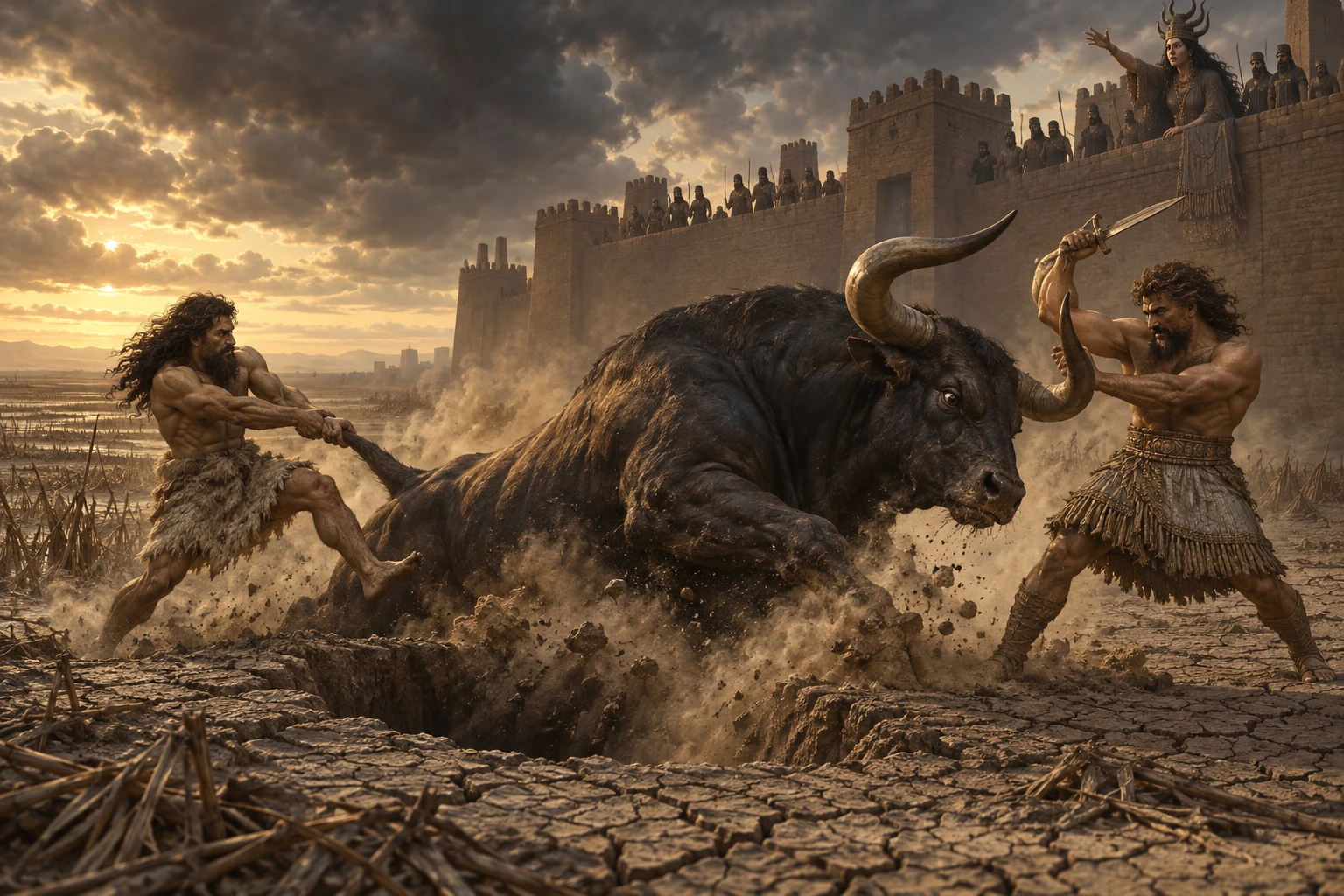
The Bull dries up the reed-beds and lowers the Euphrates by seven cubits. At its first snort a pit opens and a hundred men of Uruk fall in, at its second two hundred, and at its third Enkidu, up to his waist (VI 115–124). Enkidu seizes it by the tail, and Gilgamesh, like a butcher, drives his knife in behind its horns. They set its heart before the sun god Shamash (VI 125–150). Ishtar cries out from the wall of Uruk, and Enkidu tears a haunch off the Bull and throws it at her (VI 151–157). Gilgamesh hangs the great horns in his bedroom for his god Lugalbanda, the people crowd the street to see the two friends, and the serving girls sing that Gilgamesh is the finest of men (VI 160–179).
1-3 The Death of Enkidu
That night Enkidu dreams (VI 180–183). The beginning of Tablet VII is lost in the Assyrian copies. Thompson filled the gap from the Hittite version, in which the gods decide: “Enkidu shall die: but Gilgamish shall not die.” Enkidu lies sick for twelve days (VII 255–262); his curses, his blessing and his death are told in his own story.
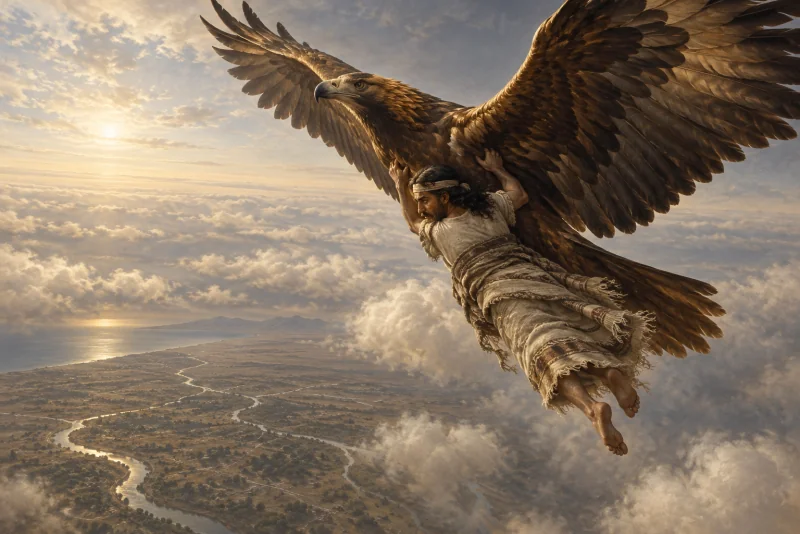
At first light Gilgamesh mourns him. Let the paths of the Cedar Forest weep for him, and the elders of Uruk, the wild animals and the holy Euphrates (VIII 1–41). He feels his friend’s heart, and it no longer beats. He veils his face like a bride’s, circles him like an eagle, paces like a lioness robbed of her cubs and tears out his hair. Then he orders a statue of Enkidu with a chest of gold, and vows to roam the wild in a lion’s skin (VIII 55–91). On the Old Babylonian tablet from Sippar he tells the ale-wife that he would not let the body be buried until a maggot dropped from its nose.
1-4 To the Edge of the World
“I, too—shall I not die like Enkidu also?” Gilgamesh asks in Thompson’s version. Afraid of death, he roams the desert, making for Utnapishtim, the man who stood in the assembly of the gods and found life (IX 1–7, 75–77). At the twin peaks of Mount Mashu, which guard the rising sun, scorpion-men keep the gate (IX 37–51). He takes the road of the sun. For twelve double-hours the dark is so dense that he cannot see behind him, and then he comes out ahead of the Sun, into a grove whose trees bear carnelian and lapis lazuli (IX 138–196; the end of the tablet is broken).
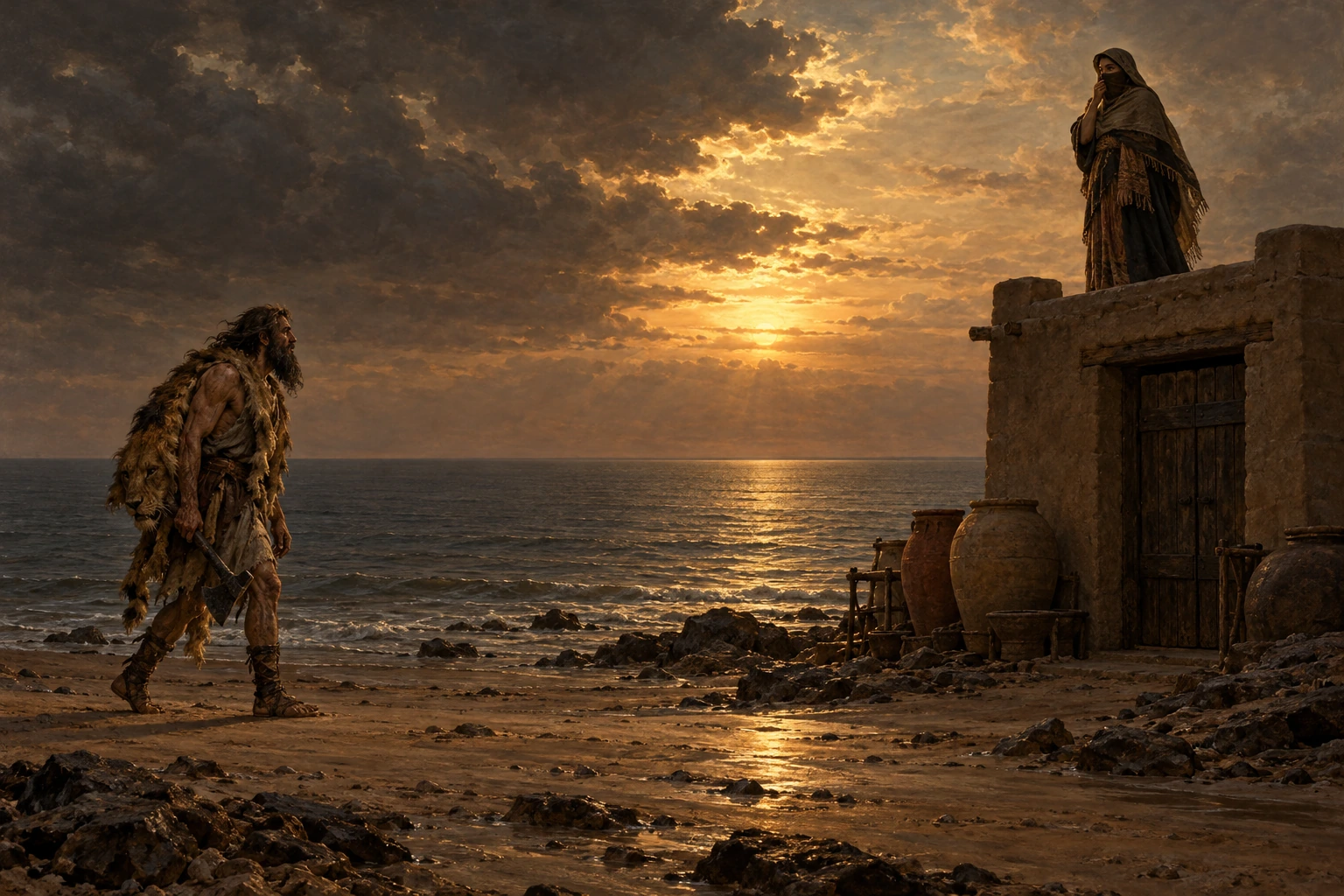
By the sea-shore lives Siduri, an ale-wife (X 1). She sees a man clad in a pelt coming, bars her gate and climbs on to the roof (X 5–16). He tells her of Enkidu and asks the way to Utnapishtim. No one but the Sun has ever crossed this ocean, she says, and in the middle lie the Waters of Death. But Utnapishtim’s boatman, Urshanabi, is in the woods nearby with the Stone Ones (X 72–91).
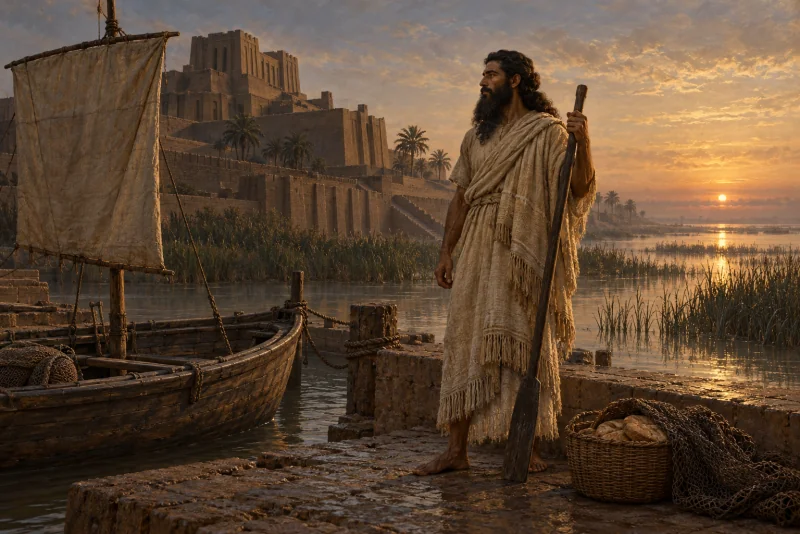
Gilgamesh falls on them with axe and dagger and smashes the Stone Ones, which were what let the boat cross the deadly water (X 92–106). So Urshanabi has him cut three hundred punting-poles, each five rods long. They push across the Waters of Death a pole at a time, so that his hand never touches the water, and when the poles run out Gilgamesh strips off his garment and holds it up as a sail (X 155–183). Utnapishtim hears his lament and answers with a speech on death. Man is snapped off like a reed in the canebrake. No one sees the face of death. When the gods fixed death and life, in Thompson’s words, “of Death is the day not revealéd” (X 297–322).
1-5 The Plant and the Snake
Gilgamesh asks how Utnapishtim found life, and hears the story of the Flood, after which the gods made Utnapishtim and his wife immortal and settled them far away, at the mouth of the rivers (XI 1–206; see Utnapishtim). But who will call the gods to assembly for Gilgamesh? Let him first stay awake for six days and seven nights. He sits down, and sleep comes over him like a fog. Utnapishtim’s wife bakes a loaf for every day he sleeps and sets it by his head. When he wakes there are seven, the first dried up, the last still on the coals (XI 207–241).
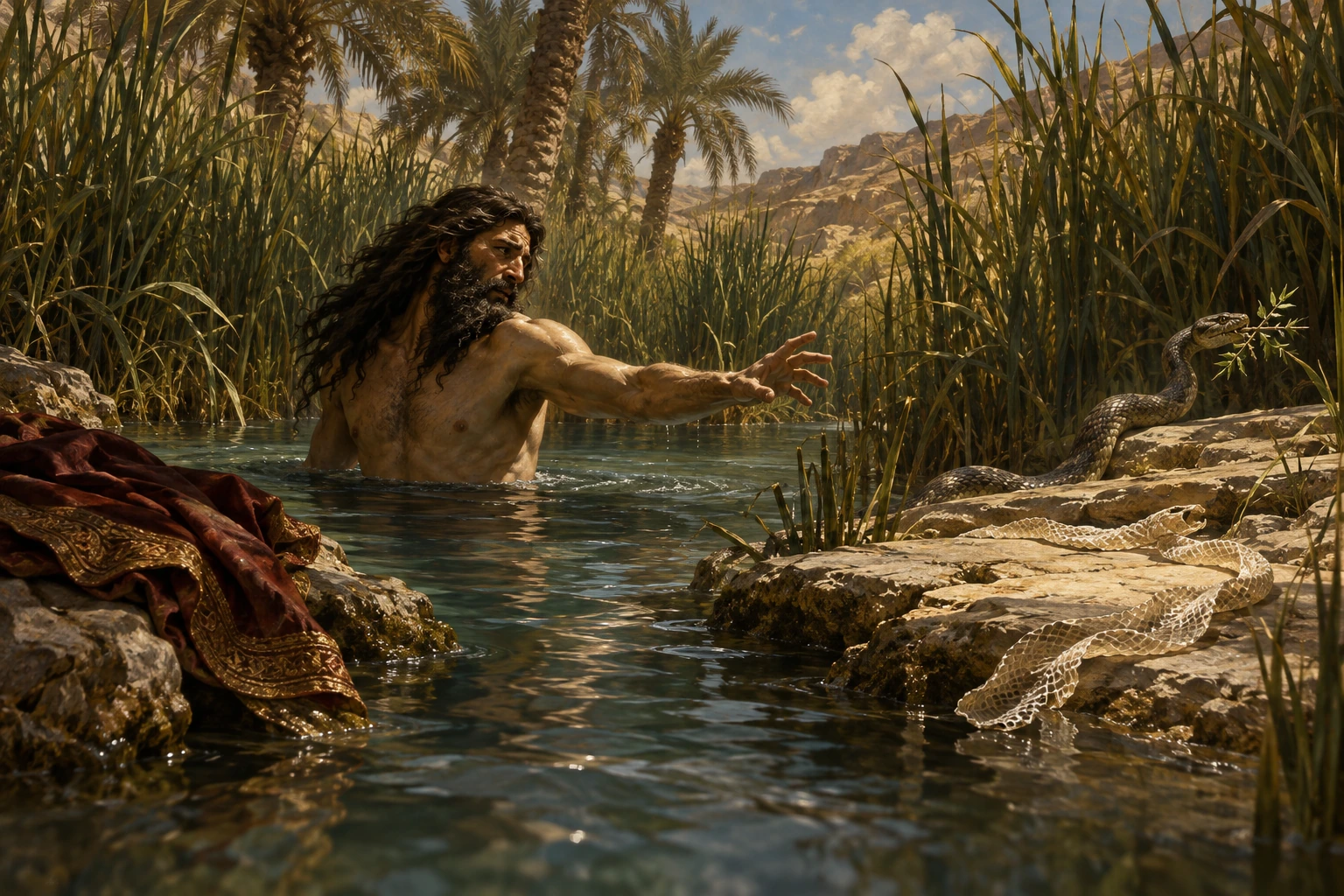
Washed and dressed in a royal robe, he is sent home. At his wife’s urging, Utnapishtim tells him one more secret: a thorny plant that gives a man back his youth. Gilgamesh ties heavy stones to his feet, sinks to the bottom of the deep and pulls it up (XI 273–293). He will try it on an old man in Uruk, he says, and then eat it himself (XI 294–300). On the way he bathes in a cool pool. A snake smells the plant, carries it off and, as it turns away, sheds its skin. Gilgamesh sits down and weeps: for whom did his arms grow tired? Not for himself, but, in Thompson’s words, “for an earth-lion” (XI 301–314).
They reach Uruk, and Gilgamesh says to Urshanabi what the poem said to its reader at the start: “go up and walk on the ramparts of Erech, / Look on its base, and take heed of its bricks” (XI 321–328). Tablet XII, an Akkadian version of the Sumerian Gilgamesh, Enkidu and the Netherworld, belongs to Enkidu.
2 Where the Story Is Written Down
- Five Sumerian poems about Gilgamesh (Bilgames in Sumerian, in Andrew George’s reading): Gilgamesh and Aga, Gilgamesh and Huwawa, Gilgamesh and the Bull of Heaven, Gilgamesh, Enkidu and the Netherworld and The Death of Gilgamesh (ETCSL 1.8.1.1–1.8.1.5). They are separate tales, not one epic. The eBL edition says they were possibly composed at the end of the third millennium BCE; the copies date from about the 18th century BCE.
- The Old Babylonian epic, in Akkadian, of the same period, survives only in pieces. The Pennsylvania tablet (CBS 7771), bought by the University of Pennsylvania Museum in 1914, calls itself in its colophon the second tablet of šūtur eli šarrī, “Surpassing all kings”: the series was named after its first line (eBL OB II 241–242). The Yale tablet (YBC 2178) is on the road to the Cedar Forest. A tablet from Sippar, which Bruno Meissner found in a dealer’s shop in Baghdad and published in 1902, now in Berlin (VAT 4105), has the meeting with the ale-wife.
- Copies of the second half of the second millennium BCE, when, says the eBL, the epic “was at the peak of its popularity”: at Hattusa in Anatolia, Emar and Ugarit in Syria, and Megiddo, with translations into Hittite and Hurrian.
- The Standard Babylonian epic. The Catalogue of Texts and Authors names its author as Sîn-lēqi-unninni (eBL, Neo-Assyrian version, line 16). The Gale World Eras puts him in the Kassite period, about 1600–1150 BCE. A copy from Nineveh (K.913) gives the title, “He who saw the Deep”, in its colophon, with the mark of the palace of Ashurbanipal, king of Assyria. The eBL counts some 75 manuscripts, the oldest from 8th-century BCE Assyria and the latest from 2nd-century BCE Babylonia.
- Rediscovery. In 1872 George Smith noticed the Flood story among the Nineveh tablets in the British Museum, and in 1930 Thompson published the full cuneiform text of the Nineveh version (Yajima Fumio, Heibonsha World Encyclopedia). The eBL edition takes in every fragment identified since George’s edition of 2003.
3 Competing Versions
- The first line. The Old Babylonian epic began “Surpassing all kings”. The Standard version puts 28 new lines in front, beginning “He who saw the Deep”, so that the old first line becomes line I 29. A tablet from Ugarit, of the Middle Babylonian period, already opens “He who saw the Deep”, but in a shorter prologue in a different order, and there it is Gilgamesh himself who is told to go up on the wall (eBL MB Ug₁ 1–28).
- The ale-wife’s advice. On the Old Babylonian tablet from Sippar she has no name, only “the ale-wife”. The gods, she says, kept life for themselves: “Gilgamish, full be thy belly”, dance and be merry day and night, wash, “Cherish the little one holding thy hand”, and let your wife delight in your embrace (column iii). The sun god Shamash has already told him that “the life which thou seekest / Thou shalt not find” (column i). In the Standard version the ale-wife is called Siduri but gives no such advice. She only points him to the boatman (X 72–91), and the speech on death belongs to Utnapishtim.
- Names and numbers. The Old Babylonian boatman is Sursunabu and the Flood hero Ūta-naʾištim; at Ugarit the Flood hero is Uttur-napišti; in the Standard version they are Ur-šanabi and Ūta-napišti. Gilgamesh mourns six days and seven nights in the Standard version (X 135), seven days and seven nights on the Sippar tablet.
- Who was his father? In the epic, Lugalbanda (I 35, VI 165). The Sumerian King List calls his father a phantom, a rendering its ETCSL translators mark as uncertain (2.1.1).
- Old readings and new. Thompson read the first line as “He who (the heart of) all matters hath proven”; the eBL reads “He who saw the Deep”. His snake “snatch’d the plant, uttering malison”; in the eBL it sheds its skin (qulipta). He gave the plant a name, “Greybeard-who-turneth-to-man-in-his-prime”; the eBL calls it a šammu nikitti, a phrase whose meaning is disputed, and reads the next words, šumma šību iṣṣahir amēlu, as a condition: if the old man grows young (XI 295–299). And in 1920 Morris Jastrow, puzzled by the word sutur on the Pennsylvania colophon, guessed it meant a copy “enlarged” from an older one. It is the first word of the title, šūtur.
4 History and Tradition
- In the king list. The Sumerian King List names, in the first dynasty of Uruk, Meš-ki-aĝ-gašer, Enmerkar, Lugalbanda the shepherd and Dumuzid the fisherman, and then Gilgamesh, lord of Kulaba, with 126 years (ETCSL 2.1.1, lines 95–133). The same list gives the kings before the Flood reigns of tens of thousands of years, and runs on to the kings of Isin.
- The Tummal. A Sumerian chronicle of the Tummal, a shrine of the goddess Ninlil, says that Gilgamesh built the Numunbura in Enlil’s temple and that his son Ur-lugal made the Tummal flourish (ETCSL 2.1.3, lines 12–16). The king list calls the son Ur-Nungal; one copy has Ur-lugal.
- Gilgamesh and Aga. In this Sumerian poem Aga, son of Enmebaragesi of Kish, besieges Uruk; Gilgamesh captures him and lets him go home (ETCSL 1.8.1.1). Fragments of stone vessels bear the name of a Mebaragesi, king of Kish (CDLI, RIME 1.07.22.02). The Japanese Britannica International Encyclopedia says the historical Gilgamesh is held to have ruled Uruk in the first half of the third millennium BCE, as a contemporary of Aga, but that nothing in the poems seems to be historical fact.
- A king’s brother. Shulgi of Ur (r. 2093–2046 BCE) claimed Ninsun and Lugalbanda as his divine parents and Gilgamesh as his brother, according to Nicole Brisch in Ancient Mesopotamian Gods and Goddesses.
- The Dream Tablet. A clay tablet in Akkadian, about 6 by 5 inches, in which Gilgamesh tells his mother his dreams and she foretells a friend: “You will see him and your heart will laugh.” On it Gilgamesh and Enkidu are called by the names of the gods Sîn and Ea. UN News reports that it was taken from a museum in Iraq after the start of the Gulf War in 1990. It was smuggled into the United States, sold in 2014 for display at the Museum of the Bible in Washington, seized by federal agents in 2019, and handed back to Iraq at the Smithsonian on 23 September 2021 (U.S. Immigration and Customs Enforcement).
The Epic of Gilgamesh is often called “the oldest story ever written”. It is very old, but not the oldest. The earliest known Gilgamesh tablets date from about the 18th century BCE. Sumerian literary tablets from Abu Salabikh, among them the Kesh Temple Hymn, the Instructions of Shuruppak and a story of the marriage of Lugalbanda and Ninsun, Gilgamesh’s own parents, are dated by the CDLI to about 2600–2500 BCE. Careful descriptions say “one of”: even the publisher of Andrew George’s translation calls it “one of the oldest written stories in existence”.
5 Related Stories
- Enkidu: The Wild Man Made to Match Gilgamesh: the friend made from clay, whose death sends Gilgamesh on the road. Tablet XII and Gilgamesh, Enkidu and the Netherworld are told there.
- Inanna’s Descent to the Underworld: Seven Gates and a Substitute: the goddess Gilgamesh turns down. He taunts her with Dumuzi, “thy maidenhood’s consort” in Thompson’s words; in the Sumerian Descent it is Inanna herself who hands Dumuzi over to the demons of the netherworld.
- Adapa: The Man Who Refused the Bread of Life: another Mesopotamian man who comes within reach of everlasting life and goes home without it. We link the two for the theme.
- The Odyssey: Ten Years on the Way Home from Troy: Yajima Fumio writes that comparative literature has discussed the epic’s relation to Homer’s Odyssey. Both heroes cross the sea to the edge of the world and come home changed.
6 Sources
- The Epic of Gilgamesh, Standard and Old Babylonian versions and the Ugarit tablet, ed. and trans. Andrew R. George, rev. Geraldina Rozzi and Enrique Jiménez, electronic Babylonian Library (2022), building on A. R. George, The Babylonian Gilgamesh Epic (Oxford, 2003); and the Catalogue of Texts and Authors, Neo-Assyrian version, line 16: eBL, eBL
- R. Campbell Thompson (trans.), The Epic of Gilgamish (Luzac, 1928): archive.org
- Morris Jastrow Jr. and Albert T. Clay, An Old Babylonian Version of the Gilgamesh Epic (Yale, 1920): Project Gutenberg
- Gilgamesh and Aga (1.8.1.1), The Sumerian King List (2.1.1), The History of the Tummal (2.1.3), Inanna’s Descent to the Netherworld (1.4.1), lines 354–358: ETCSL, ETCSL, ETCSL, ETCSL
- Abu Salabikh tablets of the Kesh Temple Hymn (P010248), the Instructions of Shuruppak (P010233) and Lugalbanda and Ninsun (P010263), and the Mebaragesi inscription (P431027): CDLI, CDLI, CDLI, CDLI
- Nicole Brisch, “Ninsumun (Ninsun) (goddess)”, Ancient Mesopotamian Gods and Goddesses (2024): ORACC
- “Sin-leqe-unnini”, World Eras (Gale): encyclopedia.com
- U.S. Immigration and Customs Enforcement, “US returns stolen ancient artifacts to Iraq in repatriation ceremony”, 24 September 2021; UN News, “UNESCO hails return of looted ancient Gilgamesh tablet to Iraq”, 20 September 2021: ice.gov, news.un.org
- Penguin Classics, The Epic of Gilgamesh, trans. Andrew George: penguin.co.uk
- Yajima Fumio, “ギルガメシュ叙事詩”, Heibonsha World Encyclopedia, with the Mypedia and Britannica International Encyclopedia entries, Kotobank; Japanese translations: Tsukimoto Akio, Girugameshu jojishi (Iwanami Shoten, 1996); Yajima Fumio, Girugameshu jojishi (Chikuma Gakugei Bunko, 1998, revised from the Yamamoto Shoten edition of 1965): NDL, NDL
Cover and illustrations: AI-generated images made for Arcana. They are interpretations, not historical artworks.