Bastet: The Lioness Who Became a Cat
For more than a thousand years Bastet was a lioness who nursed and guarded the king, and only later the cat goddess of Bubastis. Her festival filled the Nile with boats, and her temples filled with mummified cats.
- Type: a goddess, mother and protector of the king, shown first as a lioness and later as a cat
- Culture: ancient Egypt, above all the city of Bubastis in the eastern Nile Delta
- Earliest texts: her name on stone vessels of the 2nd Dynasty (about 2800 BCE) and in the Pyramid Texts (from about 2350 BCE); her festival is described only by the Greek historian Herodotus, in the 5th century BCE
- Key figures: Bastet, Ra, Sekhmet, Seth, Thoth
In museums Bastet is a sleek bronze cat, sometimes with gold rings and a silver amulet. For well over a thousand years, though, she was a lioness: a goddess who suckled the king and fought for him. The cat came later, and with it the crowds. Herodotus was told that 700,000 people came to her festival, and her temples filled with cats wrapped as mummies.
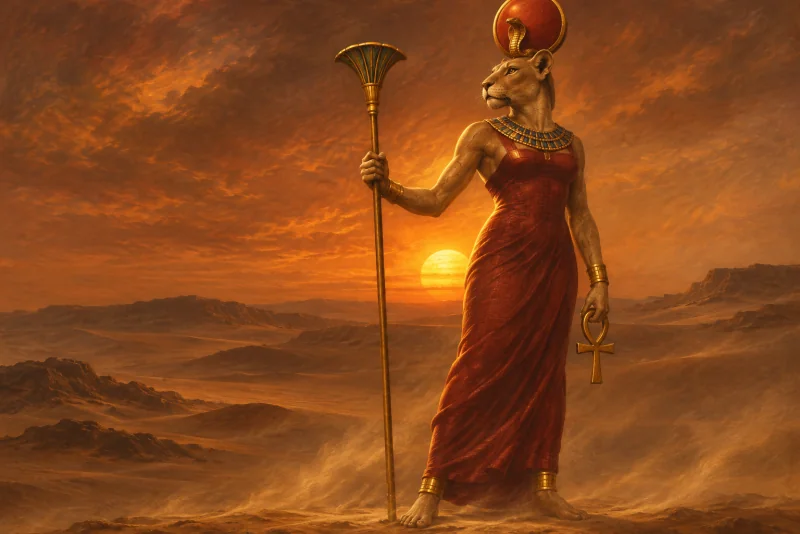
Was Bastet always a cat? No. The oldest pictures of her, on stone vessels of the 2nd Dynasty, show a woman with the head of a lioness, and so does a lintel of King Pepi I at Bubastis some five hundred years later. The Egyptologist Eva Lange-Athinodorou writes that until the later New Kingdom “Bastet is exclusively shown as a lioness”. The cat, and the woman with a cat’s head, came after that.
1 The Telling
No Egyptian text tells Bastet’s story from beginning to end. What survives are lines in royal spells and inscriptions, one local myth, and the reports of Greek visitors. Read in the order they were written, they tell how a lioness became a cat.
1-1 The Lioness Who Nursed the King
Bastet’s name first appears not at Bubastis but near Memphis, on fragments of stone vessels from burials of the 2nd Dynasty, found in the galleries under the Step Pyramid of Djoser at Saqqara. There she is a woman with a lioness’s head. Lange-Athinodorou suggests that she may have begun as a goddess of the royal residence, and that her name may come from the word for an ointment jar.
In the Pyramid Texts, the spells carved inside the kings’ pyramids, the dead king climbs to the sky to “his mother, the living uraeus which is on the head of Re”, and she gives him her breast. “His mother has nourished him,” the spell goes on, “she of Bubastis” (utterance 508, in Samuel Mercer’s translation of 1952). In another spell the king rises to heaven limb by limb, and “the heart of N. is like that of Bastet” (utterance 539).
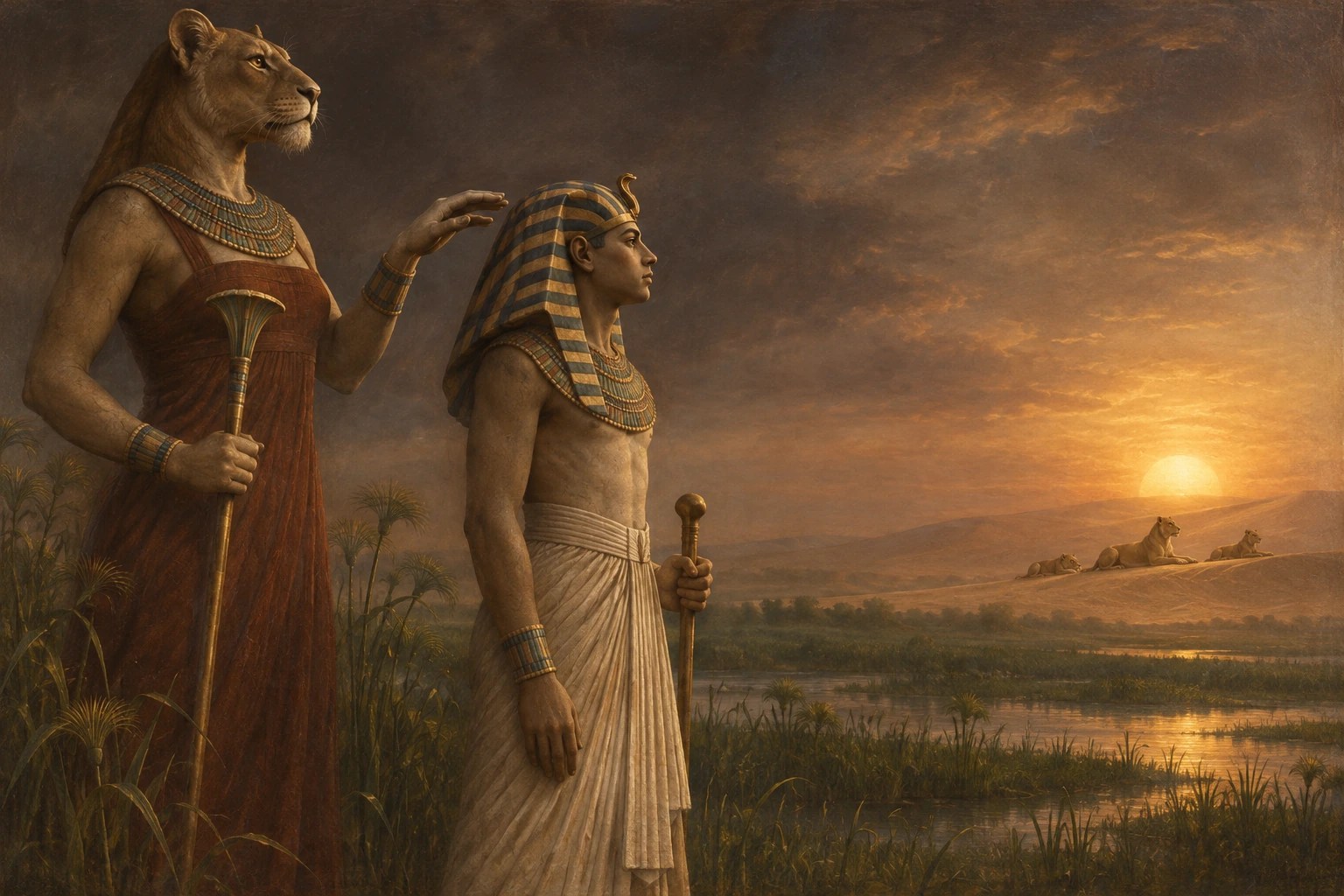
By the reign of Pepi I (about 2270 BCE) she had a cult at Bubastis itself. A door lintel from the king’s chapel there shows Bastet beside Hathor, again with a lioness’s head. Under the 12th Dynasty, King Amenemhet I built a gate at Bubastis “for his mother Bast”.
1-2 The Two Faces of the Lioness
In the same dynasty an official named Sehetepibre carved a teaching for his children on his stela at Abydos: honour the king, Amenemhet III, in your hearts. The king, he says, “is Bast protecting the Two Lands”, and “He is Sekhmet toward him who transgresses his command” (James Henry Breasted’s translation, 1906). The lioness had two faces: Bastet for the loyal, Sekhmet for the rebel. Like other lioness goddesses, Bastet was called the Daughter of Ra and the Eye of Ra. One story tells of such a daughter raging in the deserts of the south until Thoth calmed her with music, dance and drink and brought her home: the Distant Goddess, whose story belongs to The Eye of Ra. A text at Philae puts both faces into one line: the returning goddess “rages like Sekhmet and is friendly like Bastet”.
1-3 Bastet Saves the Eye
A papyrus of the 7th century BCE, now in the Brooklyn Museum (47.218.84), collects the local myths of the Delta’s cities, and gives Bubastis a story of its own. Seth stole the wedjat Eye and came to Bubastis carrying what he had swallowed. There Bastet, called Horit in this passage, took back the Eye of her father (Barbash summarises the story as Bastet saving the eye of Horus from Seth). At the moment of her victory she was rowed on the Isheru, the sacred waters around her temple, in a boat called the Oryx-Antelope. Lange-Athinodorou, who quotes the passage, suggests that the rowing of the goddess’s boat on those waters was the high point of her festival.
1-4 The Cat with Her Kittens
By the end of the 2nd millennium BCE Bastet could be a cat, or a woman with a cat’s head. Lange-Athinodorou reads the change as a softening: the cat stood for the gentler, more approachable side of the lioness, and did not threaten people as a real lioness did. Yekaterina Barbash, a curator at the Brooklyn Museum, notes that “her shielding and motherly aspects typically were emphasized”.
Her city rose with her. When the rulers of Bubastis became kings of all Egypt as the 22nd Dynasty, in the 10th century BCE, Per-Bastet, “the house of Bastet”, became the capital, and kings named Osorkon enlarged her temple. “The rise of the importance of Bastet and the cat,” says the British Museum, “can probably be dated to this period.”
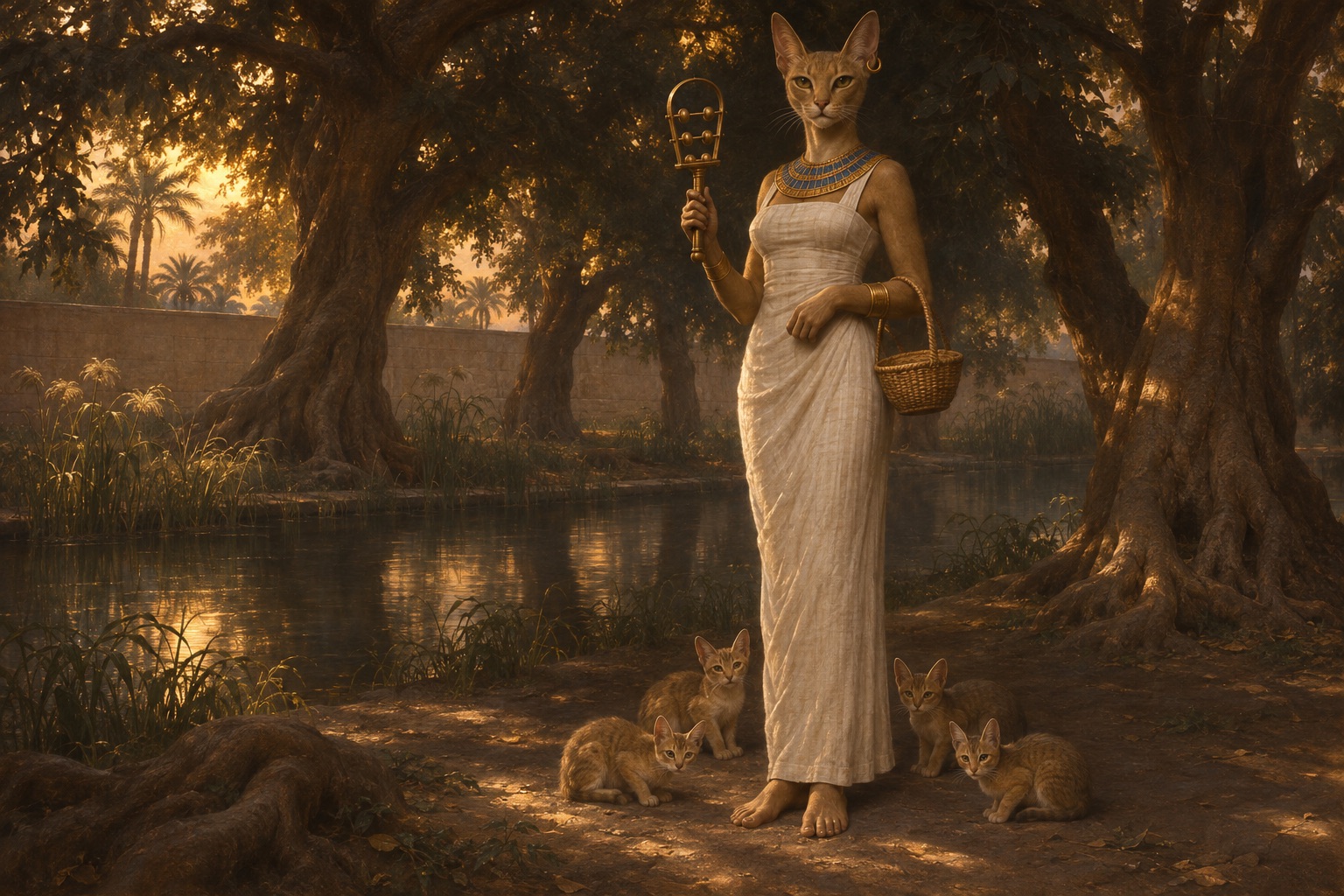
From then on the cat was everywhere: seated bronze cats, cat-headed goddesses, cats with kittens, many inscribed with a prayer to Bastet for health and children, or for life and protection. In the cat cemetery of Bubastis the excavator Édouard Naville found one such bronze. Bastet stands as “a woman with a slender body and a cat’s head”, in a long dress, holding a sistrum, a sacred rattle, and a basket, with four kittens crouching at her feet. A cat appears in the Book of the Dead too, but a male one: in spell 17 the cat that fights the serpent by the persea tree of Heliopolis is Ra himself (Ra and Apophis).
1-5 The Festival at Bubastis
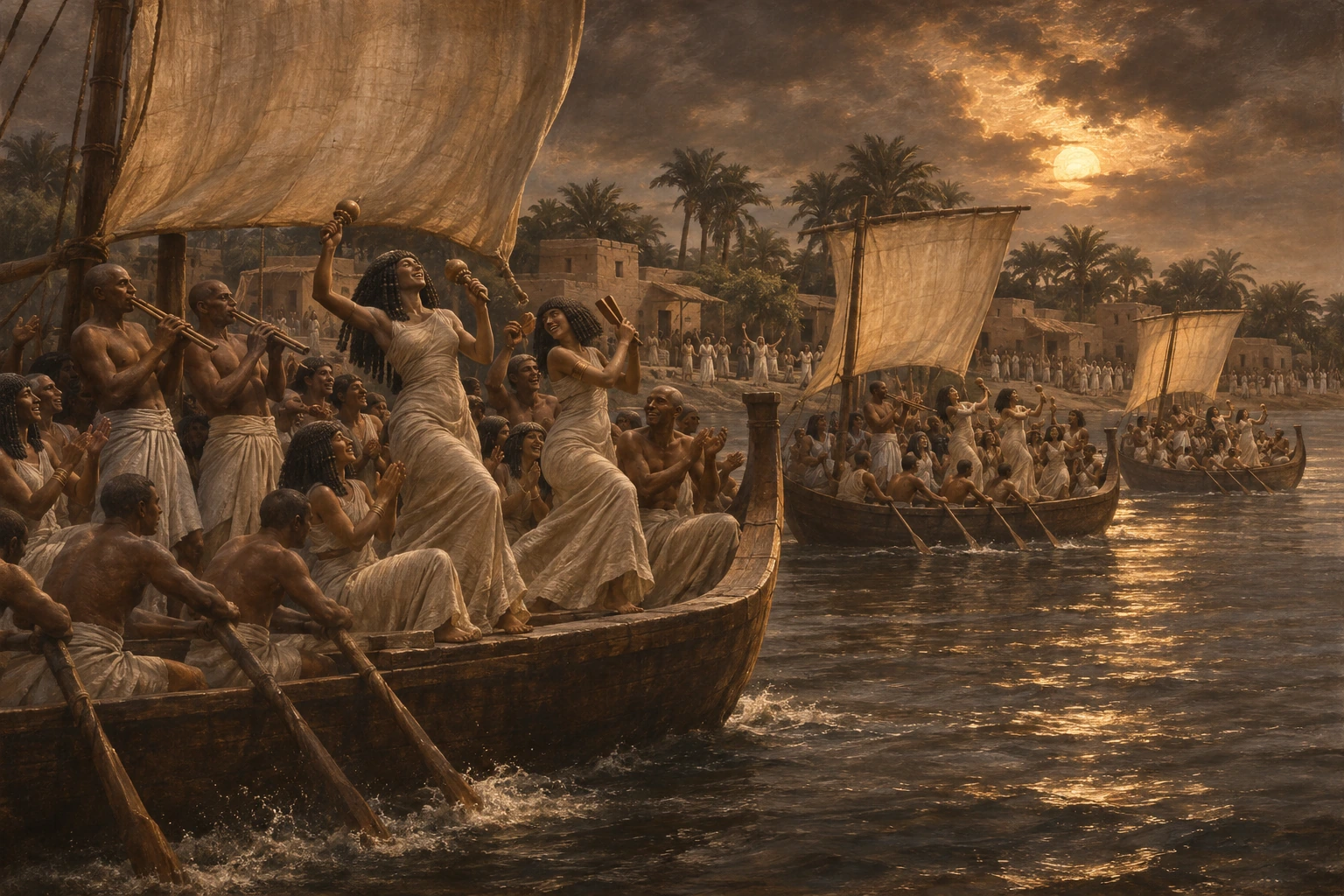
Herodotus, who visited Egypt in the 5th century BCE, calls the goddess Bubastis, like her city, and says that in Greek she is Artemis. Her festival, he says, was the greatest in Egypt (2.59). People went by river, many in every boat, men and women together. Some women shook rattles, some men played flutes all the way, and the rest sang and clapped. Whenever they passed a town they brought the boat close to the bank: some women shouted mockery at the women of the town, some danced, and some stood up and lifted their skirts. At Bubastis there were great sacrifices, and “more wine is drunk at this feast than in the whole year besides”. The people of the place told him that 700,000 men and women came, not counting children (2.60).
He describes her temple too (2.137–138). Other temples were greater and more costly, “but none more pleasing to the eye”. It stood on an island between two channels from the Nile, each a hundred feet wide and shaded by trees. The town around it had been raised on mounds, so people looked down into the temple, where a grove of very tall trees grew around the shrine with the image of the goddess.
1-6 When a Cat Died
Herodotus was struck by how the Egyptians treated cats (2.66–67). When a house caught fire, he says, people stood around it thinking more of the cats than of the fire, the cats slipped past them and leapt into the flames, and there was great mourning. When a cat died a natural death, everyone in the house shaved their eyebrows. Dead cats were carried to sacred buildings at Bubastis, embalmed and buried. Diodorus of Sicily, writing in the 1st century BCE, adds that whoever killed a cat, even by accident, was put to death, sometimes by a crowd that did not wait for a trial (1.83). He tells what he saw himself. Rome had not yet recognized King Ptolemy as its “friend” (it did so in 59 BCE), and the Egyptians were anxious to please a Roman embassy. Then one of the Romans killed a cat by accident. A crowd rushed to his house, and neither the officials the king sent nor the fear of Rome could save him.
2 Where the Story Is Written Down
- Stone vessels of the 2nd Dynasty (about 2800 BCE), found under Djoser’s Step Pyramid at Saqqara: the earliest mentions of Bastet, shown as a lioness-headed woman (Lange-Athinodorou).
- The Pyramid Texts, carved inside royal pyramids from the end of the 5th Dynasty (about 2350 BCE): utterance 508, the king nursed by his mother, “she of Bubastis”; utterance 539, the king’s heart “like that of Bastet”.
- Inscriptions at Bubastis: the lintel of Pepi I’s chapel (6th Dynasty), and Amenemhet I’s gate “for his mother Bast” (12th Dynasty).
- The stela of Sehetepibre (Cairo CG 20538), found by Mariette at Abydos, from the reign of Amenemhet III. The teaching on it is known as the Loyalist Teaching.
- Papyrus Brooklyn 47.218.84, 7th century BCE, myths and legends of the Delta, edited by Dimitri Meeks in 2006. His commentary on its Bubastis section includes “the navigation of Tefnut-Bastet on the Isheru”.
- The Myth of the Eye of the Sun, in Demotic papyri (Lange-Athinodorou gives the 2nd century BCE; the Leiden copy is dated 1st to 3rd century CE by Spiegelberg, as The Eye of Ra tells), and the version at Philae that sets Sekhmet and Bastet side by side.
- Herodotus, Histories book 2 (5th century BCE): the festival (2.59–60), the cats (2.66–67), the temple (2.137–138) and Bubastis as a daughter of Isis (2.156).
- Diodorus of Sicily, Library of History 1.83 (1st century BCE): the punishment for killing a cat, and the Roman.
3 Competing Versions
- When did she become a cat? Lange-Athinodorou: only a lioness until the later New Kingdom. Barbash: she “assumed the image of a cat or a feline-headed woman in the 2nd millennium BCE”. The British Museum ties the rise of Bastet and the cat to the 22nd Dynasty. In 1891 Naville, following Brugsch, noted that her carved reliefs and statues were lion-headed while the bronzes were cats.
- Whose daughter? The inscriptions at Bubastis call her the eye or daughter of Ra (Naville). Herodotus was told that Bubastis and Apollo, that is Horus, were the children of Dionysus and Isis, and Dionysus, he says elsewhere, is Osiris (2.156, 2.144).
- Embalmed or burned? Herodotus says dead cats were embalmed and buried at Bubastis. Naville’s team, which emptied pits in the cat cemetery there in 1889, found heaps of bones beside furnaces, mixed with ashes and charcoal, and “no traces whatever of embalming”; Naville concluded that the cats had been burned. The Berlin naturalists who examined the skulls did not accept that. At Beni Hasan, Naville added, mummification was the rule.
- Which goddess got the cats? At Bubastis, and at the Bubasteion of Saqqara, Bastet. The cats of Beni Hasan came from Istabl Antar, where another lioness goddess, Pakhet, “she who scratches”, had a temple, and they were offered to her (World Museum, Liverpool).
4 History and Tradition
- Bubastis today. Per-Bastet is the mound of Tell Basta. Egypt’s Ministry of Tourism and Antiquities lists what was built there: blocks of the 4th-Dynasty kings Khufu and Khafre reused in the 22nd-Dynasty temple, the work of Osorkon I, a gate of Osorkon II carved with scenes of his jubilee festival, and a sanctuary renewed by Nectanebo II (360–343 BCE), the last king of the last native dynasty. Naville dug there for the Egypt Exploration Fund in 1887–1889.
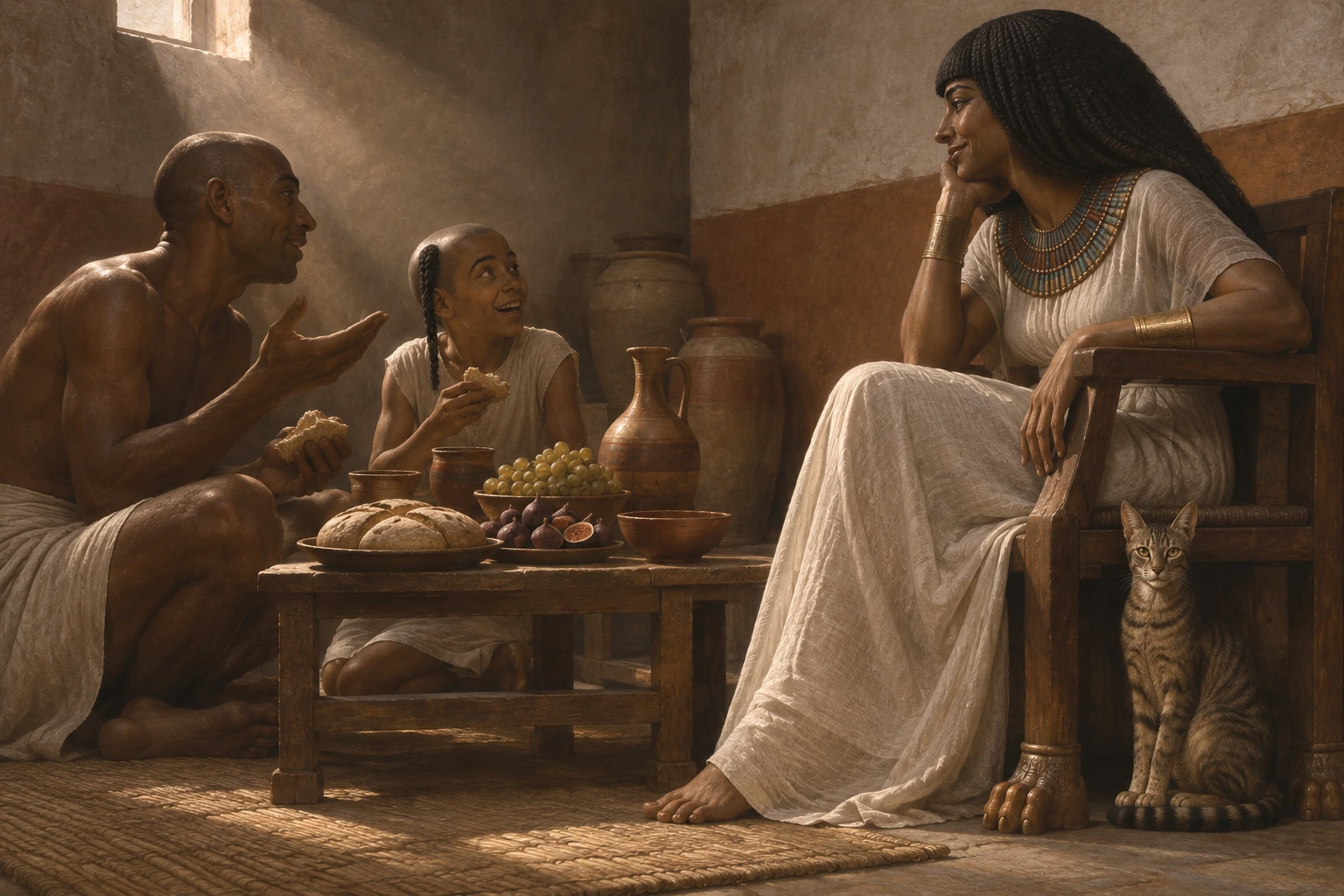
- Cats at home. Cats first appear as pets in tomb paintings of the Middle Kingdom (Lange-Athinodorou). In several New Kingdom tombs a cat sits under a chair: the Metropolitan Museum keeps painted copies of such cats from the tombs of May, Sennefer, Anen and Ipuy. The keepers of sacred cats, Diodorus says, fed them bread soaked in milk, or raw fish from the Nile.
- Mummies by the million. Votive animal mummies, Richard Johnston and his colleagues write, were made in earnest from the Late Period into the Roman period, and they “number in the millions”. Keepers bred the animals, and temple priests killed and embalmed them, so that visitors could buy them and offer them to a god. A cat mummy they scanned at Swansea University’s Egypt Centre was less than five months old, and the scan suggests that its neck was broken. Cats offered this way, they note, “were usually, though not exclusively, killed before adulthood”.
- The Bubasteion at Saqqara. Bastet had a sanctuary at Saqqara, near Memphis. In the last centuries BCE its cats were buried in catacombs set in much older tombs, among them that of Maia, the wet nurse of Tutankhamun. Among the cats the French mission at the Bubasteion found the skeleton of a mummified male lion, published in Nature in 2004.
- Sold as fertiliser. At Istabl Antar, near Beni Hasan, a cemetery of cats was uncovered. On 10 February 1890 about 180,000 of them, 19.5 tons, were auctioned in Liverpool as fertiliser, and a few went to the city’s museum. Chris Elliott has traced the episode through the British press of the day (we know his article only from its abstract).
- The Gayer-Anderson cat. In the British Museum sits a hollow-cast bronze cat of the Late Period from Saqqara, 42 cm high with its base, with gold rings, a silvered collar and a silver wedjat amulet. It is named for the man who gave it, Robert Grenville Gayer-Anderson.
“The Egyptians worshipped cats” is a common claim. They worshipped gods who could appear as animals. “Egyptians did not worship felines,” writes Yekaterina Barbash: they believed feline deities shared the animals’ traits. A cat was sacred to Bastet, and killing one could cost a man his life (Diodorus 1.83). Yet animals mummified as offerings were often bred for the purpose, and the cats among them were usually killed before they were grown.
5 Related Stories
- Ra and Apophis: The Serpent the Sun Must Defeat Every Night: Egypt’s other sacred cat is male. In spell 17 of the Book of the Dead, the cat that kills the serpent by the persea tree of Heliopolis is Ra himself.
- The Eye of Ra: Sekhmet and the Destruction of Mankind: Bastet’s fierce double. The daughter of Ra who rages in the desert as a lioness is brought home, and the Philae text calls her furious as Sekhmet and friendly as Bastet.
- Isis: The Goddess of Magic Who Outwitted the Sun: Herodotus was told that Bubastis, his Artemis, was the daughter of Isis and Osiris, and the sister of Horus.
- Freyja: The Goddess Who Weeps Gold and Chooses Half the Slain: another goddess with cats. In Snorri, Freyja drives a chariot drawn by cats. We have not found a scholar who links the two; we place them side by side for the theme.
6 Sources
- Herodotus, Histories 2.59–60, 2.66–67, 2.137–138, 2.144 and 2.156, trans. A. D. Godley: Perseus
- Diodorus Siculus, Library of History 1.83, trans. C. H. Oldfather (Loeb, 1933), with Oldfather’s introduction on its date: LacusCurtius
- Pyramid Texts, utterances 508 and 539, trans. Samuel A. B. Mercer, The Pyramid Texts (1952)
- The stela of Sehetepibre (Cairo CG 20538) and Amenemhet I’s dedication at Bubastis, trans. James Henry Breasted, Ancient Records of Egypt, vol. 1 (1906), §§485 and 743–748: archive.org
- Édouard Naville, Bubastis (1887–1889) (Egypt Exploration Fund, 1891), “The Cemetery of Cats”: archive.org
- Dimitri Meeks, Mythes et légendes du Delta d’après le papyrus Brooklyn 47.218.84 (IFAO, 2006), table of contents: IFAO
- Eva Lange-Athinodorou, “The Goddess Bastet and the Cult of Feline Deities in the Nile Delta”, American Research Center in Egypt: arce.org
- Yekaterina Barbash, “Cats, Bastet and the Worship of Feline Gods”, American Research Center in Egypt: arce.org
- Ministry of Tourism and Antiquities, Egypt, “The Temple of Bastet”: egymonuments.gov.eg
- Richard Johnston and others, “Evidence of diet, deification, and death within ancient Egyptian mummified animals”, Scientific Reports 10 (2020), 14113: nature.com
- Cécile Callou, Anaïck Samzun and Alain Zivie, “A lion found in the Egyptian tomb of Maïa”, Nature 427 (2004), 211–212: nature.com
- National Museums Liverpool, World Museum, “Mummified Cat” (1978.291.151): liverpoolmuseums.org.uk; Chris Elliott, “Cats, Commerce, and Cemeteries: The Mummified Felines of Beni Hasan”, Journal of Egyptian Archaeology 109 (2023), 147–158, abstract: Crossref
- The Metropolitan Museum of Art, facsimiles of cats under chairs from the tombs of May (30.4.94), Sennefer (30.4.76), Anen (30.4.93) and Ipuy (30.4.183): metmuseum.org
- British Museum, “Bronze figure of a seated cat” (1947,1011.1): Google Arts & Culture
Cover and illustrations: AI-generated images made for Arcana. They are interpretations, not historical artworks.