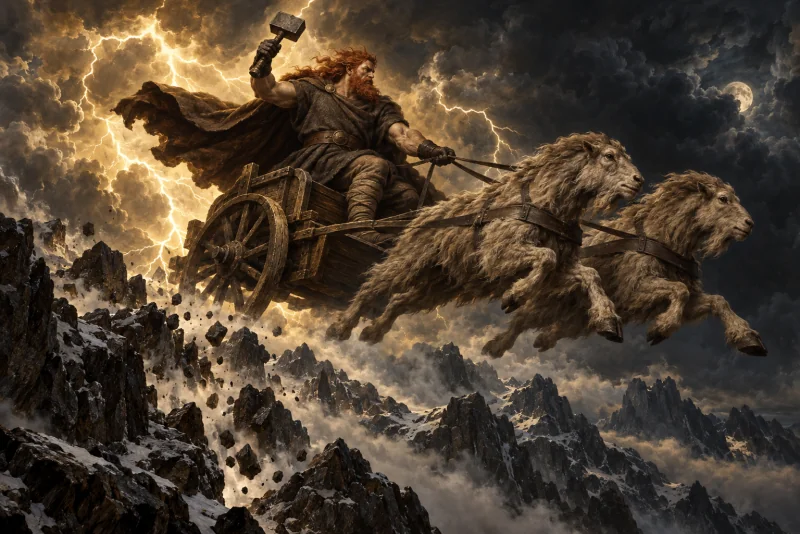
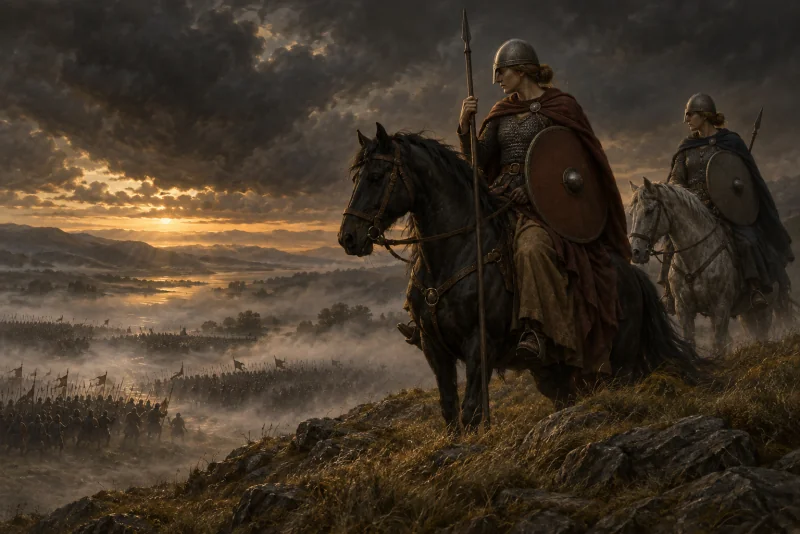
Freyja: The Goddess Who Weeps Gold and Chooses Half the Slain
She came to the gods from the Vanir, taught them seiðr, drives a team of cats, weeps red gold for a husband who never returns and takes half of the slain to her own hall. The tale of how she won her necklace survives in a single Icelandic manuscript from the end of the 14th century.
- Type: myth, a goddess of the Vanir: love, magic, gold and the slain
- Culture: Norse; Viking Age Scandinavia and medieval Iceland
- Earliest texts: skaldic verse quoted by Snorri; Ari Þorgilsson’s Íslendingabók (c. 1130); the Poetic Edda (Codex Regius, c. 1270); Snorri Sturluson’s Edda and Heimskringla (13th century)
- Key figures: Freyja, her father Njörðr and brother Freyr, her husband Óðr, Odin, Loki, Gullveig, the giantess Hyndla, four dwarves
Again and again in the Norse myths, a giant asks for Freyja. The builder of the gods’ wall wants her with the sun and the moon, Þrymr will return Thor’s hammer only if she becomes his bride, and the drunken Hrungnir boasts that he will carry her off. She is the goddess of the Vanir who taught the gods magic, and she shares the slain with Odin.
Are Freyja and Frigg the same goddess? Not in the medieval texts. There Freyja is Njörðr’s daughter, from the Vanir, and the wife of a vanished Óðr; Frigg is Odin’s wife and Baldr’s mother. One Eddic poem names them side by side: “Frigg and Freyja and more gods” (Oddrúnargrátr 9). But their names are close, both are said to own a falcon cloak, and scholars have argued since Jacob Grimm about whether they were once one goddess (section 3).
1 The Telling
There is no single story of Freyja. What follows gathers the episodes in which she is the main figure, each from the text that tells it. Many details come only from Snorri Sturluson, who wrote in Christian Iceland two centuries after the conversion, and that is said where it applies. Eddic stanzas are numbered as in Neckel and Kuhn’s edition, with Henry Adams Bellows’s number added where his translation differs.
1-1 The First War in the World
Völuspá, the poem in which a seeress tells Odin the history of the world, remembers “the war, the first in the world”. The gods stabbed a woman called Gullveig with spears and burned her in Odin’s hall, “three times burned, and three times born”, and still she lives (st. 21). Wherever she came, people called her Heiðr, a seeress who practised seiðr, a kind of magic (st. 22). The gods debated whether to pay a tribute or to share their worship; Odin hurled his spear over the host, the wall of their stronghold was broken, and the warlike Vanir trod the field (st. 23–24, which Bellows swaps). The poem never says how the war ended.
In Ynglinga saga ch. 4, Snorri tells the war as history, with Odin as a chieftain from Asia. Neither side could win, so they made peace and exchanged hostages: the Vanir gave Njörðr the Rich and his son Freyr, the Æsir gave Hœnir and the wise Mímir. Then: “Njörðr’s daughter was Freyja. She was a priestess of the sacrifices, and she first taught seiðr among the Æsir, as was the custom among the Vanir.” Njörðr, the saga adds, had married his own sister, as the Vanir allowed and the Æsir did not. Odin practised the art himself, but it brought such ergi, unmanliness, that men were ashamed to practise it, and it was taught to the priestesses (ch. 7).
1-2 Fólkvangr and the Cats
In Gylfaginning 24, Snorri calls Freyja “the most renowned of the goddesses”. Her dwelling is Fólkvangr, “field of the host”, and wherever she rides to battle she has half of the slain, and Odin half, as Grímnismál 14 says: “The half of the dead each day does she choose, And half does Othin have.” Her hall, Sessrúmnir, “roomy-seated”, is great and fair.
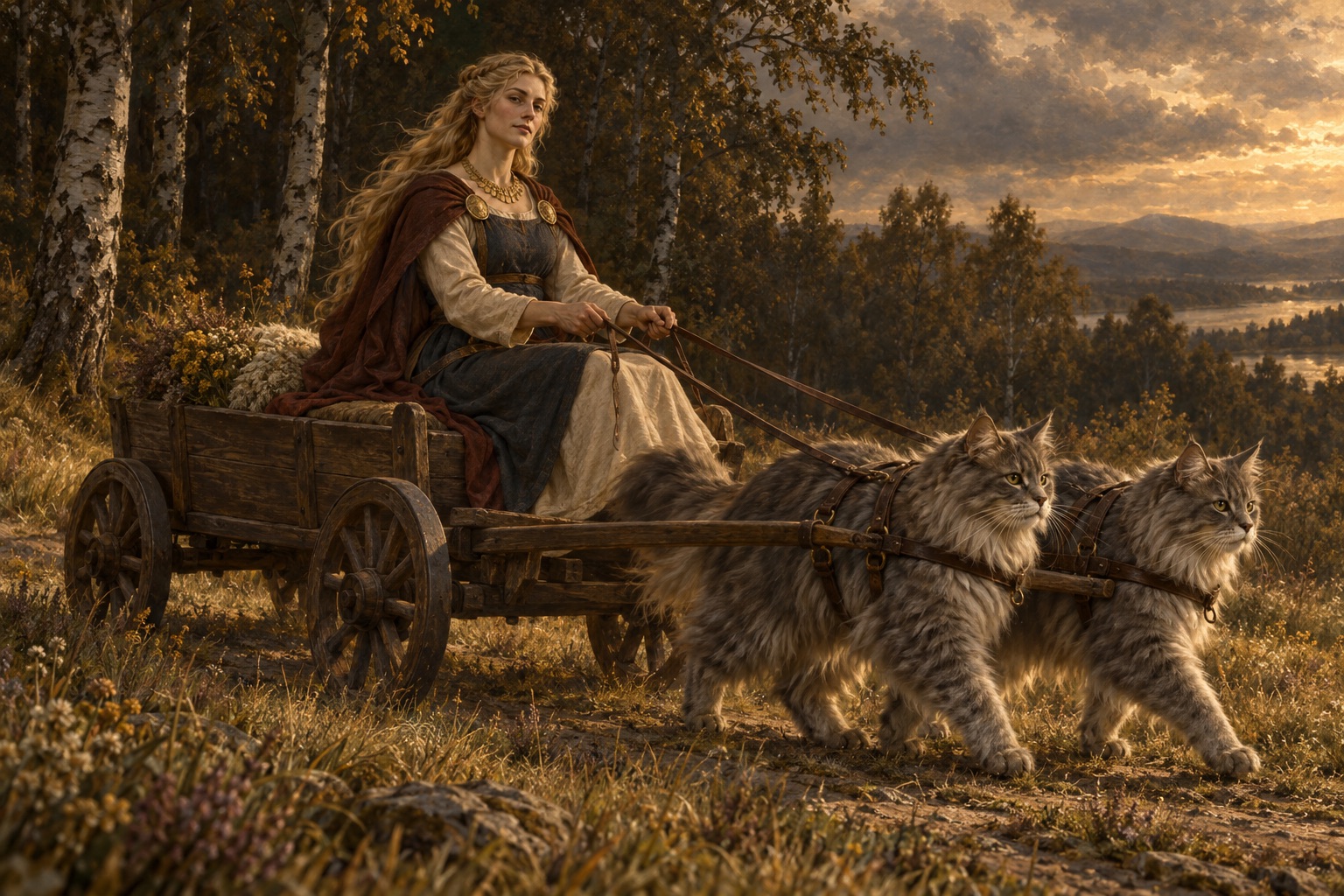
When she goes out, she drives her cats and sits in a chariot. She listens most readily to prayers, noblewomen take the title frú, “lady”, from her name, and “songs of love are well-pleasing to her”. The cats are Snorri’s alone: no Eddic poem mentions them. In his list of her poetic names she is “Possessor of the Slain, of Sessrúmnir, of the Gib-Cats” (Skáldskaparmál ch. XX), and she drives them to Baldr’s funeral (Gylfaginning 49).
1-3 The Necklace of the Brísings
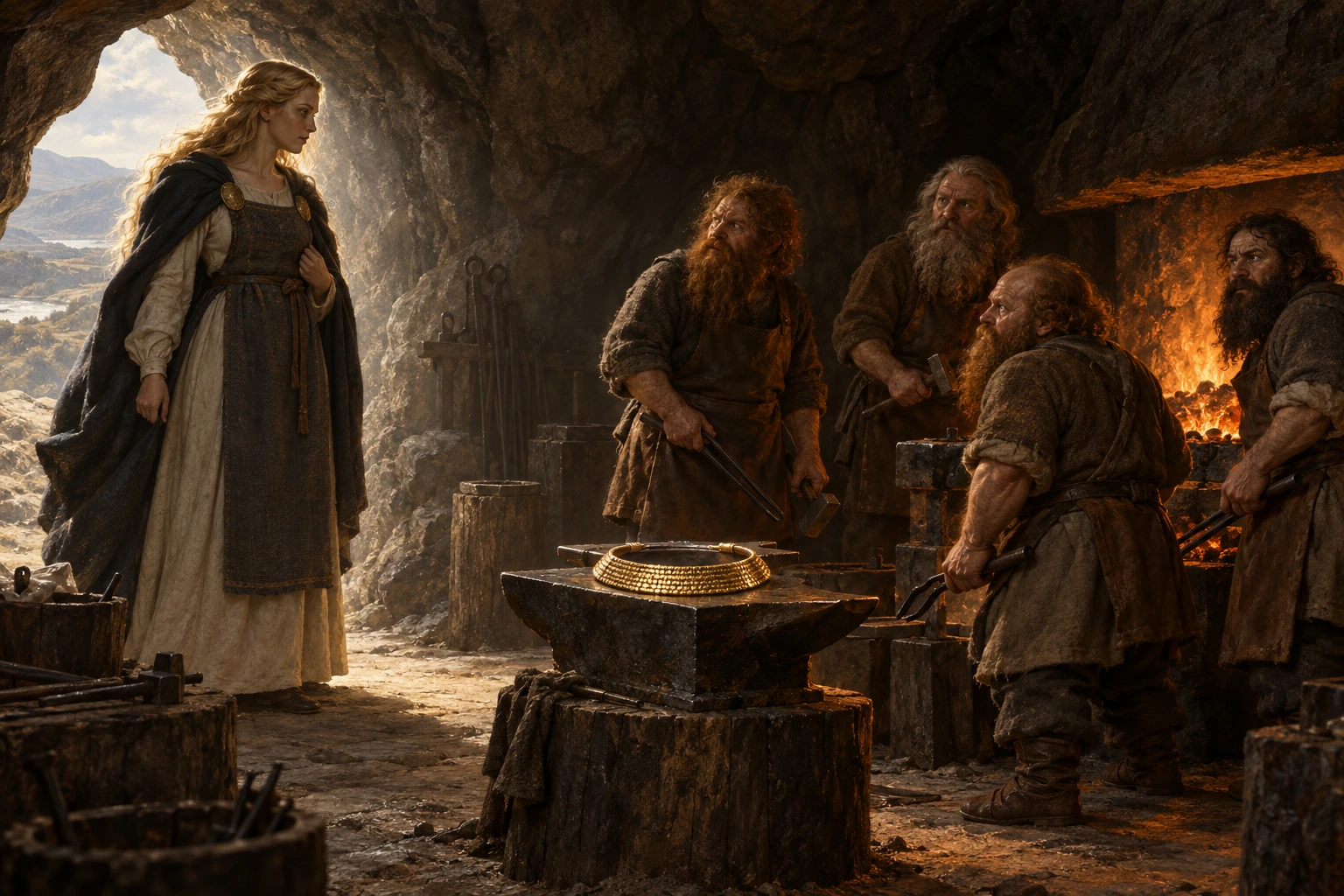
Her necklace is Brísingamen, “necklace of the Brísings”. Þrymskviða names it: told to put on the bridal veil and drive to the land of the giant Þrymr, she snorts with rage, the hall of the gods shakes, “And burst was the mighty Brisings’ necklace” (st. 13; 12 in Bellows). How she got it is told only in Sörla þáttr, a short tale in the Icelandic manuscript Flateyjarbók, and told there as history. Freyja is Odin’s mistress in Asgard. Four dwarves, Álfrigg, Dvalinn, Berlingr and Grérr, live in a rock near the king’s hall. One day she finds the rock open and the dwarves finishing a gold necklace: “fair seemed that collar to Freyia, and fair seemed Freyia to the dwarfs”. She offers gold and silver; each dwarf will sell his share only for a night with her. She agrees, and after four nights the necklace is hers.
Loki tells Odin, and Odin orders him to steal it. Her bower is locked, so Loki becomes a fly and creeps in through a hole by the gable no wider than a needle; she sleeps with the clasp beneath her, so he becomes a flea and bites her cheek, and as she turns over he unclasps it. Odin will give it back on one condition: she must set two kings, each served by twenty kings, to fight under a spell, the fallen rising to fight again, until a Christian man kills them all. She agrees. A woman who calls herself Göndul then makes the sea-king Heðinn forget his oath of brotherhood to King Högni and carry off Högni’s daughter Hildr, and lays on them “all those spells and the weird that Odin commanded”. The two hosts fight on the island of Há for 143 years, until Ívarr ljómi, a retainer of King Olaf Tryggvason, kills them all. The tale never says outright that Göndul is Freyja.
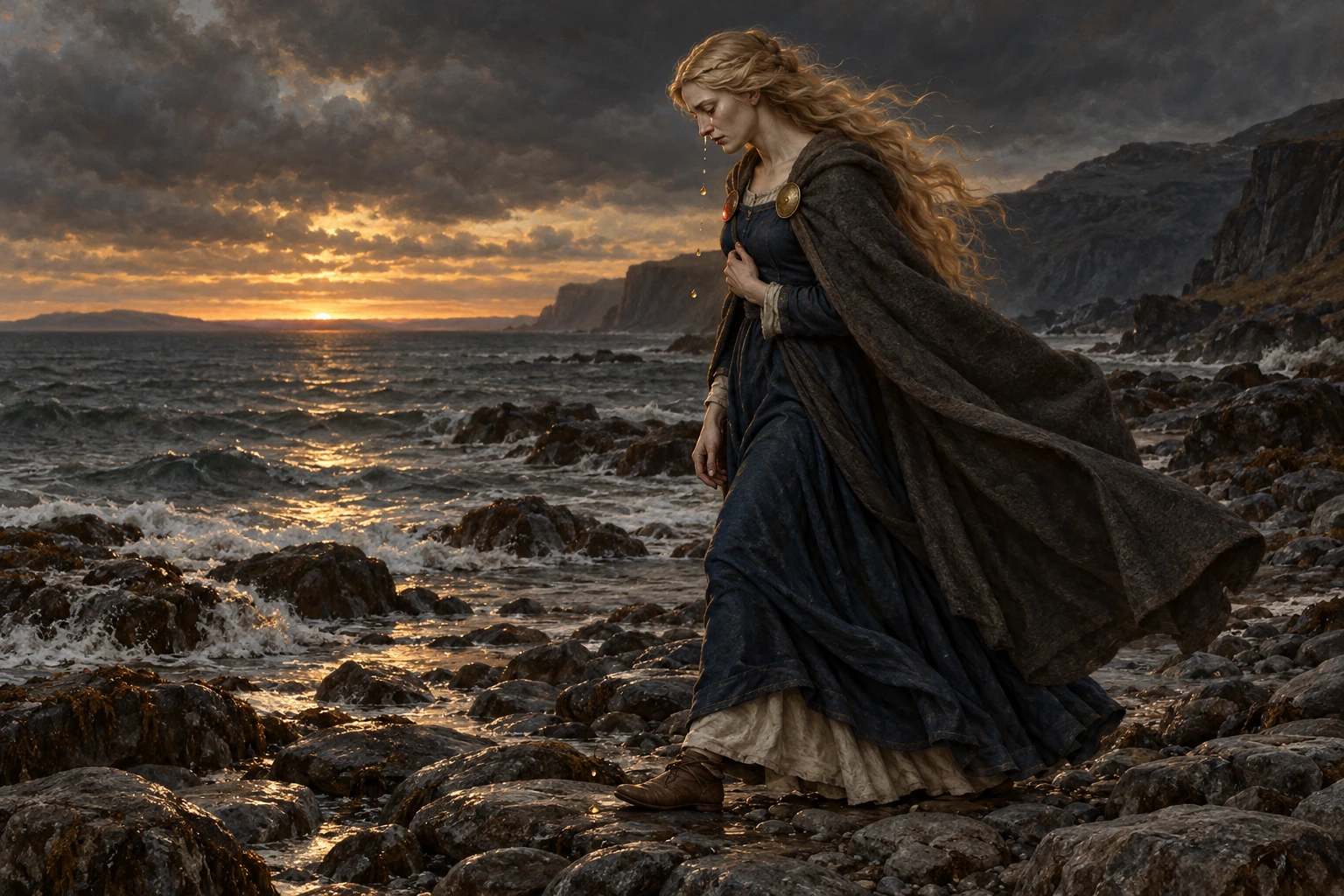
1-4 Tears of Red Gold
Among the goddesses in Gylfaginning 35, Snorri says Freyja married a man called Óðr; their daughter Hnoss was so fair that precious things are called hnossir after her. “Ódr went away on long journeys, and Freyja weeps for him, and her tears are red gold.” She took many names as she went among strange peoples looking for him: Mardöll, Hörn, Gefn, Sýr. She is also Vanadís, “lady of the Vanir”.
Poets took up the image: gold may be called “Freyja’s tears”, or the rain of her eyes, cheeks or eyelids (Skáldskaparmál ch. XXXVII). Völuspá 25 already calls her “Óðr’s girl” (Óðs mey), and Ynglinga saga (ch. 13) gives her two daughters, Hnoss and Gersemi, both words for jewels. No medieval text says that she ever found Óðr.
1-5 The Boar Hildisvíni
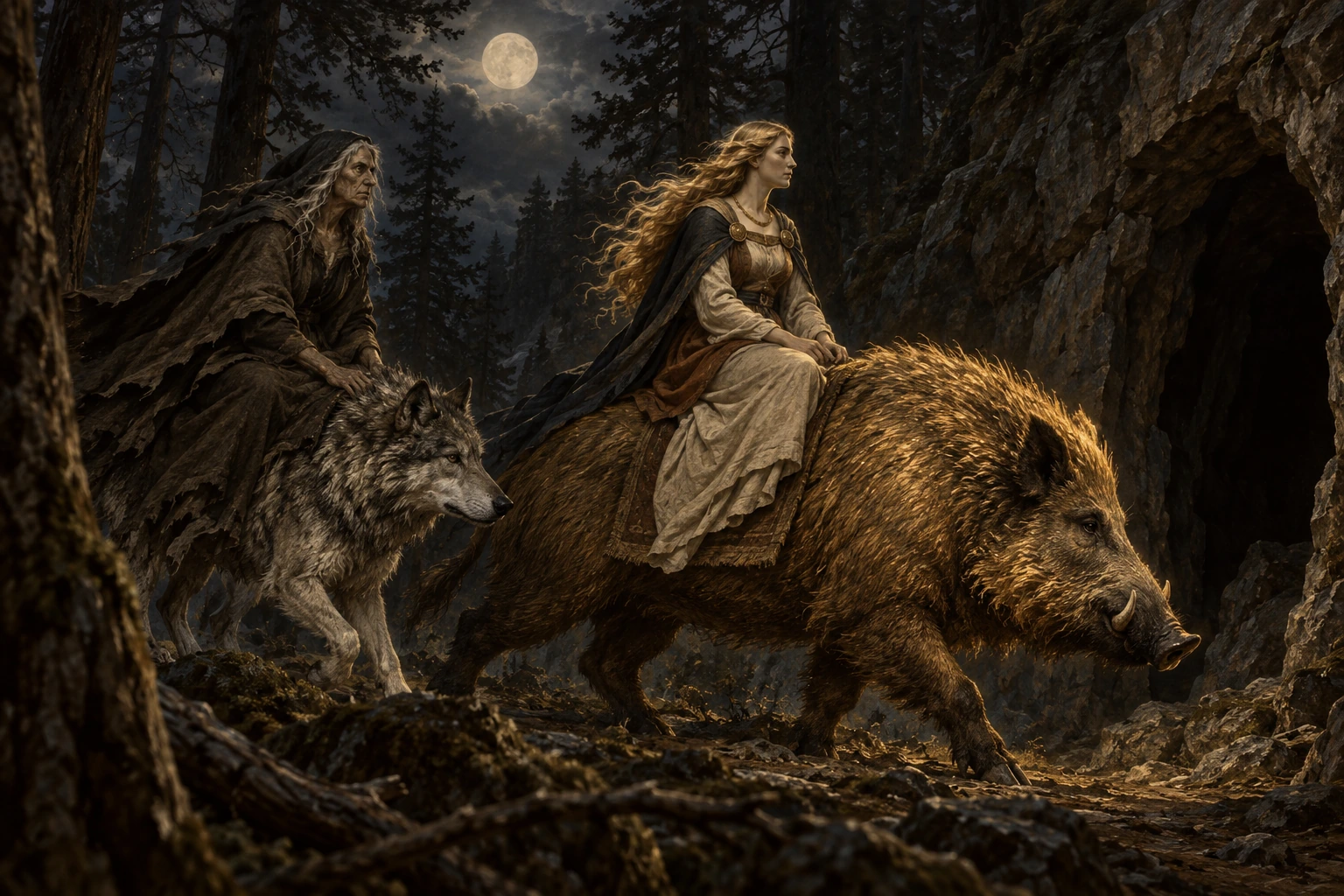
Hyndluljóð opens at night at the cave of the giantess Hyndla. Freyja wakes her: they must ride to Valhalla, Hyndla on one of her wolves, Freyja on her boar. Hyndla is not fooled: “On the way of the slain thy lover goes with thee, Ottar the young” (st. 6). No, says Freyja, this is Hildisvíni, “battle-swine”, whose golden bristles glow, made for her by the dwarves Dáinn and Nabbi (st. 7). Her favourite, Óttarr, has a wager of gold with a man called Angantýr that turns on his ancestry. He has built her an altar of heaped stones and reddened it so often with the blood of oxen that “now to glass the rock has grown” (st. 10).
Hyndla recites his forefathers, and Freyja asks her to give “my boar” the ale of memory, so that he can repeat every word three mornings later (st. 45; 46 in Bellows). Hyndla answers with taunts: Freyja ran after Óðr, ever yearning, and leaps out at night like the goat Heiðrún among the bucks (st. 47; 48 in Bellows). Freyja answers with a ring of fire around the giantess.
1-6 The Falcon Cloak
Freyja owns a feather cloak that turns its wearer into a bird. In Þrymskviða 3–5, Thor asks to borrow it to find his stolen hammer, she says she would give it “though 'twere of gold”, and Loki flies off in it. In Snorri’s story of the giant Þjazi, Loki borrows “the hawk’s plumage” from her to bring back the goddess Iðunn (Skáldskaparmál ch. I). Three more stories need only a line: the giant who builds the gods’ wall asks for her (Gylfaginning 42); when the drunken Hrungnir sits in Valhalla, “Freyja alone dared pour for him” (Skáldskaparmál ch. XVII); and her refusal to marry Þrymr belongs to Thor’s story.
2 Where the Story Is Written Down
- The Poetic Edda, in the Codex Regius (c. 1270): Völuspá 21–25, Grímnismál 14, Þrymskviða, Oddrúnargrátr 9 and Lokasenna, where Loki tells her that every god and elf in the hall has been her lover, and that the gods caught her with her brother (st. 30 and 32).
- Hyndluljóð is in neither of the great manuscripts of the Edda but in Flateyjarbók. Bellows thought it not much older than the 12th century.
- Skaldic verse quoted by Snorri. In Þjóðólfr of Hvinir’s Haustlöng, Loki is the thief of the Brísing’s girdle; Úlfr Uggason’s Húsdrápa told how Loki and Heimdallr fought for the necklace at Singasteinn, “in the form of seals” (Skáldskaparmál chs. VIII and XVI). Only these allusions survive.
- Snorri Sturluson (1179–1241): his Edda, in the chapters cited here by Brodeur’s numbering, and Ynglinga saga, the first part of his Heimskringla, chs. 4, 7 and 13 (ch. 13 is ch. 10 in the Íslenzk fornrit edition). In the saga the gods are human rulers.
- Sörla þáttr, in Flateyjarbók, written between 1387 and 1394 for the Icelandic farmer Jón Hákonarson. It is the only source for the four dwarves and for Loki as a fly and a flea.
- Beowulf (ll. 1197–1201), in Old English, mentions the Brōsinga mene that Hāma carried off as he fled from Eormanric. Its editor A. J. Wyatt, quoting John Kemble, took it for Brísingamen.
3 Competing Versions
- Is Gullveig Freyja? Völuspá never says so. Bellows reports that Karl Müllenhoff took Gullveig for another name of Freyja, and Lotte Motz summarises Gabriel Turville-Petre (1964) and Ursula Dronke (1988), who saw her as an avatar of Freyja. Motz (1993) objected: Snorri has Freyja born in Nóatún, none of her names resembles Gullveig or Heiðr, and a priestess is not a witch. She read Gullveig, “golden drink”, as a figure of the sacred mead.
- How did Freyja come to the gods? Ynglinga saga names only Njörðr and Freyr as hostages. In Turville-Petre’s words, quoted by Motz: “It is not told that Freyja was one of the hostages … but it is plain that she was established in the realm of the Aesir.”
- The necklace. The Eddic poems never say how she got it, and Sörla þáttr calls it only “a gold necklace”, never Brísingamen. In the skaldic verses Heimdallr fights Loki for it; in Sörla þáttr Heimdallr does not appear. Saxo Grammaticus (Gesta Danorum, Book 1) tells how Odin’s wife, Frigga, had the gold stripped from his statue for her ornaments and gave herself to a servant; Jacob Grimm and Wolfgang Golther both took it for the same story, told of the other goddess.
- Who is Óðr? Only his name, his journeys and Freyja’s tears are known. Taniguchi Yukio, in the Nipponica encyclopedia, notes that he is thought to be another form of Odin.
- Freyja and Frigg: one goddess or two?
- Grimm (Teutonic Mythology) kept them apart, yet found that “the forms and even the meanings of the two names border closely on one another” and that their myths mingled. The “Frea” whom Paul the Deacon, in Charlemagne’s time, makes the wife of the Langobards’ god Godan “can only mean Frigg, not Freyja”.
- Golther (1895) saw Freyja as a late Norse offshoot of Frigg, not one ancient goddess split in two. Where Snorri gives Frigg a falcon cloak (Skáldskaparmál ch. XIX), he saw “clearly a confusion with Freyja”.
- Eugen Mogk, as Bellows reports, read Grímnismál 14 as a confusion of two originally distinct goddesses: the share of the slain belongs to Odin’s wife.
- Does she find Óðr? H. A. Guerber’s Myths of the Norsemen (1909) ends the search “under the flowering myrtle-trees” of the south, with flowers springing up as the couple walk home. No medieval source has that ending.
4 History and Tradition
- “Lady”. Freyja means “lady”, as Freyr means “lord” (American Heritage Dictionary; Cleasby and Vigfússon). Snorri says that noblewomen were called frúvor after her, and the common noun freyja lives on in húsfreyja, “mistress of the house”.
- “Freyja seems to me a bitch.” Ari’s Íslendingabók (ch. 7) records that Hjalti Skeggjason, one of the first Icelanders to be baptised, was outlawed by the Althing for blasphemy because he recited at the Law Rock: “I will not bark at the gods; Freyja seems to me a bitch.” The next summer, Iceland accepted Christianity. Golther read a longer form of the verse, which names Odin and Freyja together, as Freyja standing in for Odin’s wife.
- Supper with Freyja. In Egils saga (ch. 78; 81 in W. C. Green’s translation), Egill’s daughter Þorgerðr, pretending she will starve herself to death beside her grieving father, says she will have no supper “till I sup with Freyja”. Her ruse brings him back to life, and to his poem Sonatorrek.
- The seeress in catskin. In Eiríks saga rauða ch. 4, the fullest saga picture of a seeress at work, Þorbjörg the “little völva” wears a hood lined with white catskin and gloves of catskin (J. Sephton’s 1880 translation says “ermine”). The saga does not name Freyja. Staffs of the kind the sagas give to seeresses have been found in Viking Age graves, most often women’s, such as grave 4 at Fyrkat in Denmark.
- Freyja in silver? A silver pendant from a rich woman’s grave at Aska, in Östergötland, shows a woman in a cape and long robe with a great necklace. Tom Christensen of Roskilde Museum writes that it “is interpreted as a depiction of Freyja, here wearing the Brisingamen”, citing Birgit Arrhenius.
- A goddess of fertility? She is often called one, and Taniguchi notes that her name survives in many place names. Motz (1998) observed that in the texts, “her strongest links are with sexuality, wealth, and war”.
Friday is often called Freyja’s day. The English word comes from Old English Frīgedæg, “day of Frigg”, a translation of the Latin Veneris dies, “Venus’s day” (American Heritage Dictionary). The confusion is old: Grimm found both Friadagr and Freyjudagr in Old Norse, and Cleasby and Vigfússon thought the Norse form borrowed from English. Iceland dropped the name altogether. A bishop who died in 1121 had the days renamed, and Friday became föstudagur, “fast day”.
5 Related Stories
- Valkyries and Valhalla: The Choosers of the Slain and Odin’s Hall: Grímnismál 14 divides the slain of each day, half to Freyja in Fólkvangr and half to Odin, and Snorri has her ride to the battle to claim them.
- Thor: The Thunder God Who Lost His Hammer: in Þrymskviða the giant will give back the hammer only for Freyja. She refuses, her necklace bursts, and Thor goes to the wedding in her place, wearing it.
- Loki: The Shape-Shifter Between Gods and Giants: he flies in her falcon cloak, steals her necklace, and in Lokasenna accuses her before all the gods.
- Osiris: The Murdered King Who Rules the Dead: Isis searches the world for her lost husband, as Freyja wanders among strange peoples looking for Óðr. Jacob Grimm set Freyja beside Venus, “but also with Isis who seeks Osiris”.
- Bastet: The Lioness Who Became a Cat: another goddess with cats. In Snorri, Freyja drives a chariot drawn by cats. We have not found a scholar who links the two; we place them side by side for the theme.
6 Sources
- Völuspá, Grímnismál, Þrymskviða, Lokasenna, Oddrúnargrátr and Hyndluljóð, Old Norse text of Neckel and Kuhn (5th ed., 1983): TITUS; and of Guðni Jónsson: heimskringla.no
- Henry Adams Bellows (trans.), The Poetic Edda (1923), with his notes: Völuspá, Grímnismál, Þrymskviða, Hyndluljóð, Lokasenna
- Snorri Sturluson, The Prose Edda, trans. Arthur Gilchrist Brodeur (1916): Gylfaginning, Skáldskaparmál; Ynglinga saga, Old Norse: heimskringla.no, and trans. Samuel Laing (1844): Wikisource
- Sörla þáttr, Old Norse text with the translation of Eiríkr Magnússon and William Morris (1875): germanicmythology.com; Eva Rode on Flateyjarbók: canadianmysteries.ca
- Ari Þorgilsson, Íslendingabók, ch. 7: heimskringla.no; Børge Nordbø, “Íslendingabók”: Store norske leksikon
- Egils saga, ch. 78, trans. W. C. Green (1893), and Eiríks saga rauða, ch. 4, trans. J. Sephton (1880): sagadb.org, sagadb.org
- Beowulf, ll. 1195–1201, ed. A. J. Wyatt: Wikisource; Saxo Grammaticus, The Danish History, Book 1, trans. Oliver Elton: Project Gutenberg; Paul the Deacon, Historia Langobardorum 1.8: Latin Wikisource
- Jacob Grimm, Teutonic Mythology, trans. J. S. Stallybrass, vol. 1 (1882), pp. 299–307: archive.org; Wolfgang Golther, Handbuch der germanischen Mythologie (1895), pp. 429–443: archive.org; H. A. Guerber, Myths of the Norsemen (1909): Project Gutenberg
- Lotte Motz, “Gullveig’s Ordeal: A New Interpretation”, Arkiv för nordisk filologi 108 (1993), and “The Great Goddess of the North”, Arkiv för nordisk filologi 113 (1998): journals.lub.lu.se, journals.lub.lu.se
- Tom Christensen, “A silver figurine from Lejre”, Danish Journal of Archaeology 2 (2014): tidsskrift.dk
- “Friday”, “Freya” and the root prī-: American Heritage Dictionary; Richard Cleasby and Gudbrand Vigfússon, An Icelandic-English Dictionary (1874), s.v. dagr, frjá-, freyja: archive.org
- Taniguchi Yukio, “フレイヤ”, Nipponica: Kotobank
Cover and illustrations: AI-generated images made for Arcana. They are interpretations, not historical artworks.