Thor: The Thunder God Who Lost His Hammer
A giant stole Thor's hammer and would give it back only for Freyja as his bride, so Thor went to the wedding in her veil. The poem survives in a single manuscript, and Snorri, who tells so many stories of Thor, never mentions it.
- Type: myth, the thunder god, his hammer and his goats
- Culture: Norse, Viking Age Scandinavia; amulets shaped like his hammer are found from the British Isles to Russia
- Earliest texts: Adam of Bremen describes his cult at Uppsala around 1075; the poem Þrymskviða survives in the Codex Regius (c. 1270); Snorri Sturluson’s Edda (c. 1220–30) tells how the hammer was made
- Key figures: Thor, Loki, Freyja, the giant Þrymr, the dwarves Brokkr and Sindri (or Eitri), the goats Tanngnjóstr and Tanngrísnir, Þjálfi and Röskva
Snorri Sturluson calls Thor the foremost of the gods, “strongest of all the gods and men”. In the Viking Age people wore little copies of his hammer around their necks, and about a thousand of them have been found. Yet the most famous poem about him keeps him, for most of its length, under a bride’s veil.
Did Thor really dress as a bride? Yes, in one poem, Þrymskviða. When the gods decide to send him to the giants in Freyja’s place, he protests that they will call him argr, “unmanly”. The editor Edward Pettit notes that “there could be no more offensive word for the ultra-manly Þórr”. Loki answers that without the hammer the giants will soon be living in Asgard. Snorri, who retells many of Thor’s adventures, never tells this one.
1 The Telling
This section follows two medieval Icelandic texts. For the making of the hammer and for the goats, it follows Snorri Sturluson’s Edda, in Arthur Gilchrist Brodeur’s translation of 1916. For the theft, it follows the poem Þrymskviða, “The Lay of Þrymr”, quoted in Henry Adams Bellows’s translation of 1923. Stanza numbers are those of the Neckel–Kuhn edition, with Bellows’s numbers in brackets where they differ.
1-1 The Dwarves’ Wager
Snorri tells this story in Skáldskaparmál, to explain why poets call gold “Sif’s hair”. Loki, “for mischief’s sake”, cut off all the hair of Thor’s wife Sif. Thor seized him and would have broken every bone in his body, until Loki swore to get the dark elves to make her new hair of gold that would grow like real hair. The dwarves called the sons of Ívaldi made the hair, and with it the ship Skíðblaðnir and Odin’s spear Gungnir.
Then Loki wagered his head with a dwarf called Brokkr that Brokkr’s brother Sindri could not make three treasures as good. Sindri laid a pigskin in the hearth and told Brokkr to work the bellows and not stop. A fly settled on Brokkr’s hand and stung him, but he kept blowing, and out came a boar with bristles of gold. Next Sindri laid gold in the hearth. The fly bit Brokkr on the neck “half again as hard”, and out came the gold ring Draupnir.
1-2 The Short Handle
Last, Sindri laid iron in the hearth and warned that the work would be spoiled if the blast failed. The fly settled between Brokkr’s eyes and stung his eyelid until the blood ran into his eyes and he could not see. Brokkr let go of the bellows just long enough to sweep it away. The smith came back and said that it had come near to spoiling everything in the hearth. Then he took out a hammer.
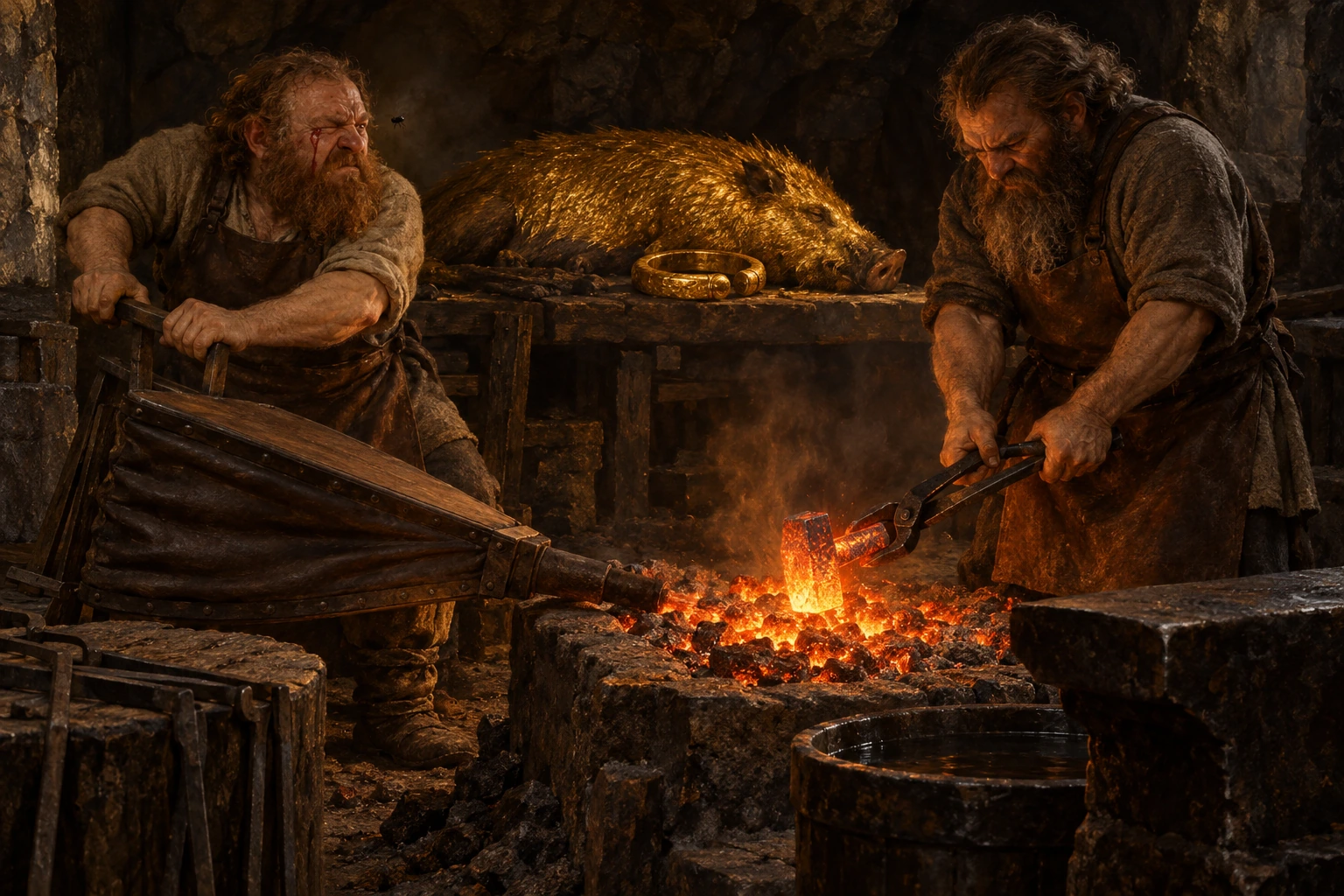
Odin, Thor and Freyr sat in judgment. Brokkr gave Thor the hammer, saying he could strike as hard as he wished and it would not fail; thrown, it would never miss and never fly so far that it did not come back to his hand; and it could be made so small that he could keep it inside his shirt. “But indeed it was a flaw in the hammer that the fore-haft was somewhat short.” The gods judged it the best of all the treasures, “the greatest defence against the Rime-Giants”. Loki fled in shoes that carried him over air and water, but Thor caught him. Loki said the dwarf could have his head but not his neck, so Brokkr sewed his lips together with a thong.
1-3 The Hammer Is Gone
Thor woke up in a rage: his hammer was missing. “He shook his beard, his hair was bristling” (1). “Our hammer is stolen,” he told Loki (2). They borrowed Freyja’s feather-cloak, and Loki flew to the land of the giants (3–5 [3–4]). There sat Þrymr, lord of the giants, on a mound, twisting golden leashes for his dogs and smoothing the manes of his horses (6 [5]). Yes, he had hidden the hammer, “Eight miles down deep in the earth”, and no one would get it back unless they brought him Freyja for his wife (8 [7]). Loki flew home, and Thor made him tell his news before he even landed: “Oft doth the sitter his story forget” (10 [9]).
1-4 The Bridal Veil
“Bind on, Freyja, the bridal veil,” said Thor (12 [11]). Freyja snorted with such rage that the hall of the gods shook and her great necklace, the necklace of the Brísingar, burst. If she drove to the giants with him, everyone would think her the most man-mad of women (13 [12]).
The gods and goddesses met in council. Heimdallr, “whitest of the gods”, had the answer: dress Thor as the bride. Let keys jingle at his belt, a woman’s dress fall to his knees, broad gems lie on his breast and a fine headdress crown his head (15–16 [14–15]). Thor refused, and Loki told him to be quiet (17–18 [16–17]). So they dressed him, Freyja’s necklace and all, and Loki went with him as his maid (19–20). The goats were driven in and harnessed: “The mountains burst, earth burned with fire, And Othin’s son sought Jotunheim” (21).
1-5 The Wedding Feast
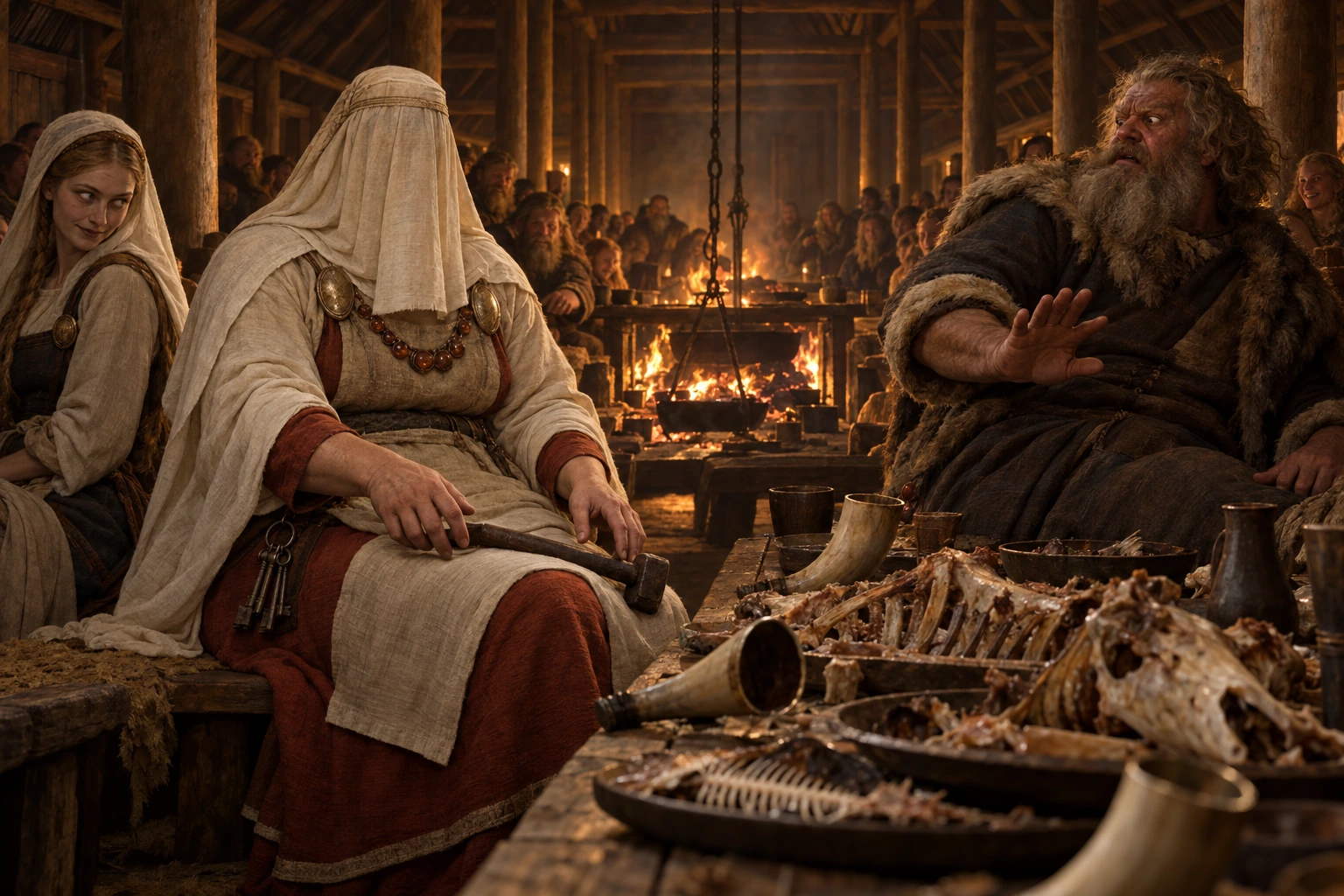
Þrymr had straw spread on the benches for Njörðr’s daughter. He had gold-horned cattle, all-black oxen and treasures in plenty; only Freyja had been missing (22–23). At the feast the bride ate a whole ox, eight salmon and all the dainties set out for the women, and drank three casks of mead (24). Þrymr had never seen a bride bite so broadly. The “serving-maid wise” had an answer: Freyja had eaten nothing for eight nights, so eager was she to come (25–26). Þrymr lifted the veil for a kiss and leapt back the length of the hall: why were Freyja’s eyes so fierce? Fire seemed to burn from them. She had not slept for eight nights, said the maid (27–28). Then the giant’s sister came in and asked the bride for red-gold rings (29).
“Bring in the hammer to hallow the bride,” said Þrymr. “On the maiden’s knees let Mjollnir lie” (30). Thor’s heart laughed in his breast when he saw his hammer. He killed Þrymr first, then all his kin. “A stroke she got in the shilling’s stead,” the poem says of the sister, and it ends: “And so his hammer got Othin’s son” (31–32 [31–33]).
1-6 The Goats
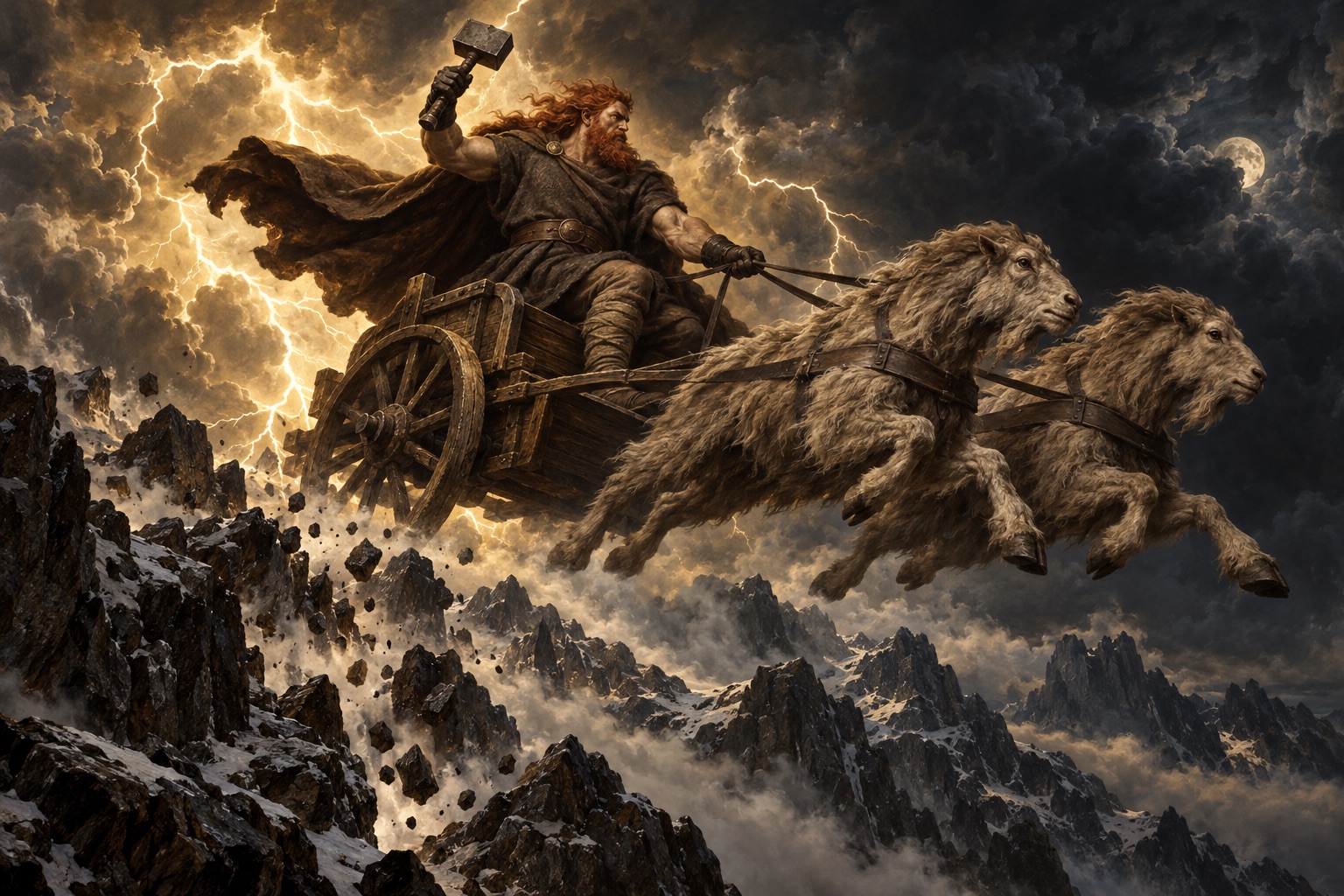
In Gylfaginning 21 Snorri lists what Thor owns: the goats Tanngnjóstr and Tanngrísnir (“Tooth-Gnasher” and “Tooth-Gritter” in Brodeur), which draw his chariot, so that he is called Öku-Þórr, “Thor the Driver”; Mjölnir; a belt of strength; and iron gloves, without which he cannot grip the hammer’s shaft. His hall, Bilskirnir, has 540 rooms.
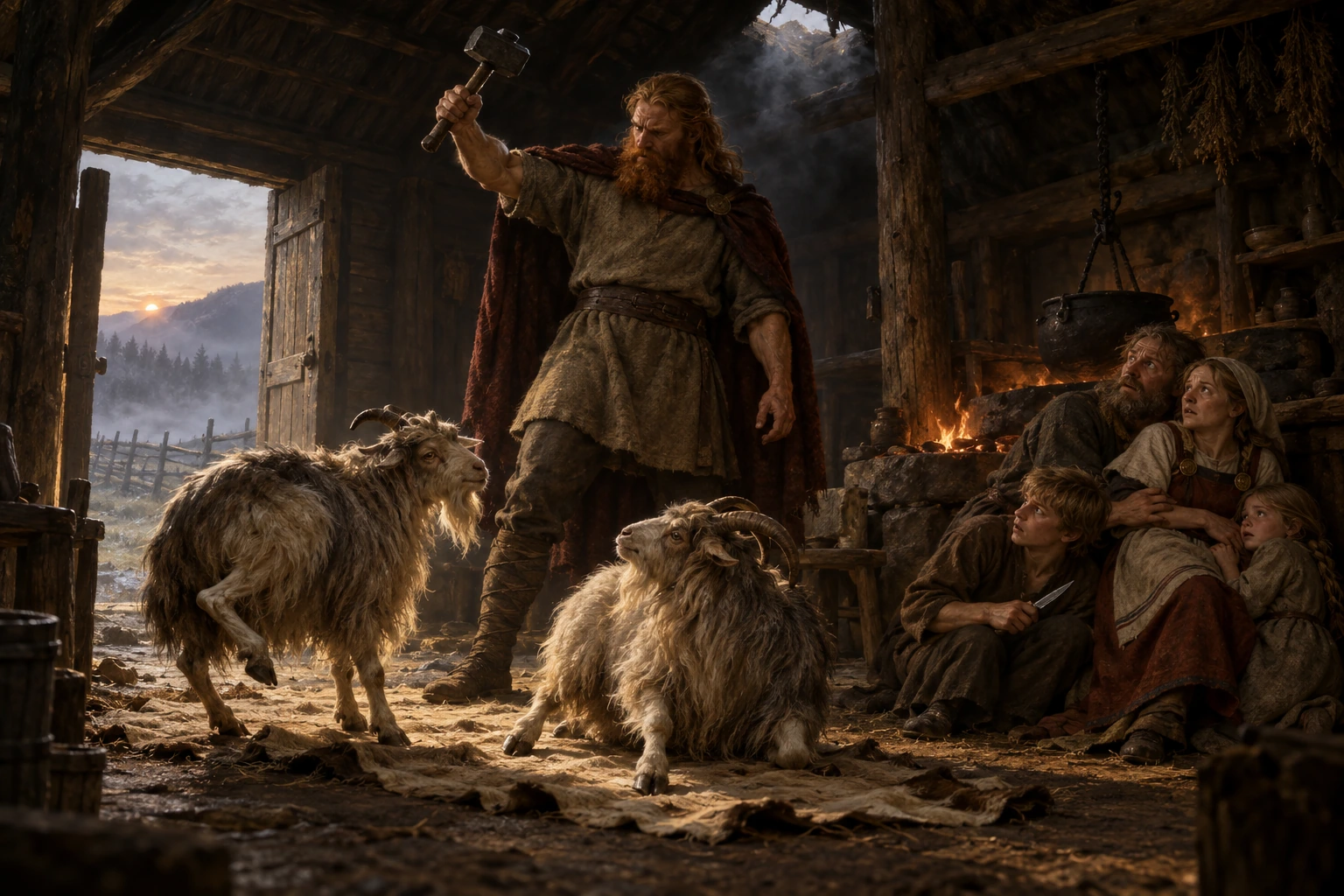
In chapter 44 Thor and Loki stop for the night at a farmer’s house. Thor slaughters both goats, has them cooked and invites the family to eat, telling them to throw the bones onto the goatskins. The farmer’s son Þjálfi splits a thigh-bone with his knife to get at the marrow. Before dawn Thor raises Mjölnir and hallows the skins, and the goats stand up, but one is lame in a hind leg. Thor’s brows sink over his eyes and his knuckles whiten on the hammer’s shaft. The family beg for mercy, and he takes the two children, Þjálfi and Röskva, as his servants. “They follow him ever since.” From that farm Snorri sends Thor on to the giant king Útgarða-Loki, whose contests Thor seems to lose (Gylfaginning 45–47); in another tale he rows out with the giant Hymir and hooks the World Serpent (Gylfaginning 48, and the poem Hymiskviða). Both stories belong to later posts.
2 Where the Story Is Written Down
- Þrymskviða survives only in the Codex Regius of the Poetic Edda, written in Iceland around 1270. No other Eddic poem mentions the theft, nor does Snorri’s Edda, nor any heathen skald (Pettit). Bellows had already noticed that, “rather oddly”, Snorri leaves it out. Its age is unknown, “with opinions ranging from the ninth century to the mid-thirteenth” (Pettit). Bellows followed the critics who dated it “somewhere about 900”; John McKinnell has argued that it was composed in the English Danelaw and revised in Iceland in the 12th or 13th century.
- Other Eddic poems. Thor fishes for the serpent in Hymiskviða, trades insults with a ferryman who is Odin in disguise in Hárbarðsljóð, and threatens Loki with Mjölnir until he leaves the feast in Lokasenna. Völuspá 56 gives his last fight: “Nine paces fares the son of Fjorgyn”. Bellows explains that Fjörgyn here “apparently refers to Jorth”, Earth, his mother.
- Snorri’s Edda (c. 1220–30): Gylfaginning 21 and 44 for the goats, Skáldskaparmál 35 for the forging (Brodeur’s chapter XXXV; 43 in Guðni Jónsson’s edition). Anthony Faulkes, its modern editor, writes that the story of Sif’s hair and the gods’ treasures “has no parallel in extant sources, and it is difficult to know whether it was derived from lost poems or from oral prose stories”. The goats’ resurrection, too, is told only by Snorri.
- Skaldic verse. Snorri quotes heathen poets who speak to Thor directly. Vetrliði: “Thou didst break the leg of Leikn … Didst stand on lifeless Gjálp.” Þorbjörn dísarskáld lists the giantesses Thor killed (Skáldskaparmál, Brodeur’s chapter IV).
- Adam of Bremen, master of the schools at Bremen, finished his history of the church of Hamburg and its bishops around 1075, according to its 19th-century editor J. M. Lappenberg. Book 4 describes the temple at Uppsala (section 4).
- Saxo Grammaticus, whose Latin history of the Danes was probably finished about 1208 (Elton’s introduction), arms Thor with a club (section 3).
3 Competing Versions
- Who made the hammer? In Brodeur and in Guðni Jónsson’s Old Norse text, Brokkr’s brother Sindri. Faulkes’s edition shows why the name wavers: in the Codex Regius of Snorri’s Edda the scribe left it blank and a later hand filled in “Sindri”, while the Codex Wormianus calls the smith Eitri. In the Codex Regius even the word “hammer” was added in the margin by a later hand.
- Why is the goat lame? In Snorri, because Þjálfi split the bone. Hymiskviða 37 (38 in Bellows) knows the lame goat too, but says “the evil Loki” did it, and the next stanza has a “lava-dweller” (hraunbúi; Bellows: “wilderness-dweller”) pay for it with both his children. Bellows notes that Snorri “does not indicate that Loki was in any way to blame”.
- Hammer or club? In Saxo’s Book 3, Thor fights for Balder against Hotherus with a club. Hotherus “hewed off the club at the haft, and made it useless”, and the gods fled. The introduction to Elton’s translation glosses the weapon “club (hammer)”.
- Was he red-bearded? The Eddic poems and Snorri give his beard no colour; Þrymskviða says only that he shook it. The red beard comes from the sagas. In Flóamanna saga (ch. 21) Thor appears in a convert’s dream as a man “big and red-bearded” (mikill ok rauðskeggjaðr). Jacob Grimm cites kings’ sagas in which he is “a tall, handsome, red-bearded youth”, and took the red beard as an allusion to lightning.
- The bride story outside the Edda. The Icelandic rhymed cycle Þrymlur, “possibly composed between the mid-fourteenth and mid-fifteenth centuries”, and Scandinavian ballads written down in the late 19th century retell it. Pettit says they “stand in uncertain relation to the Eddic poem”, and adds that “related myths are part of Baltic tradition”. The Lithuanian national encyclopedia records tales in which the devil steals the thunder god Perkūnas’s stone or axe, and some that explain Thursday as a wedding day that never came, because the devil stole Perkūnas’s bride.
- What did the hammer do at the wedding? Bellows: “just what this means is not clear”. Pettit calls Mjölnir “an obviously phallic object” whose place in the bride’s lap “might symbolize the marriage’s physical consummation”, and notes that the same verb, vígja, “to hallow”, is used when Thor hallows his goats and Baldr’s funeral pyre.
4 History and Tradition
- The name. Old Norse Þórr goes back to a Proto-Germanic word for thunder, and the Danish torden, “thunder”, was originally tor-dyn, “Thor’s crash” (Finn Stefánsson and Jens Peter Schjødt, Den Store Danske). Mjölnir probably means “the crusher” (Swedish History Museum).
- Thursday, like the German Donnerstag, is a Germanic translation of the Latin dies Iovis, “Jupiter’s day”, because the Germanic peoples identified Jupiter with Thor (Den Store Danske).
- Uppsala. Adam of Bremen writes that in a temple adorned entirely with gold the Swedes worshipped three gods, “so that the mightiest of them, Thor, has his throne in the middle”, with Wodan and Fricco on either side. “Thor, they say, rules in the air; he governs thunder and lightning, winds and rains, fair weather and crops,” and when plague or famine threatened they sacrificed to him. “Thor, with his sceptre, seems to resemble Jupiter” (4.26–27; our translation from the Latin).
- Amulets. About a thousand hammer pendants have been found, especially in women’s graves, in Scandinavia, the British Isles, the Baltic and Russia. Only one carries runes: found at Købelev on Lolland in 2014, it reads hmar is, “this is a hammer” (Den Store Danske). A soapstone mould from Trendgården in northern Jutland, of the later 10th century and now in the National Museum of Denmark, cast hammers and crosses side by side. The Swedish History Museum shows a silver hammer from Skåne with a bird of prey’s face at its loop, and iron rings hung with small hammers that were often laid on top of cremation urns around Lake Mälaren.
- Runestones and place names. The hammer sign appears on some runestones of the 11th century, set against the Christian cross. Torsåker, “Thor’s field”, is a common place name in eastern Sweden (Swedish History Museum); Torslunde, “Thor’s grove”, Thorsager and Tórshavn are others, though Thor was also a common man’s name, so not every such name points to the god (Den Store Danske).
- Iceland. In Eyrbyggja saga (ch. 4) Þórólfr Mostrarskegg asks “Thor, his beloved friend” whether to make peace with the king or leave the country. He takes down his temple and sails for Iceland with its timbers, throws his high-seat pillars overboard, one of them carved with Thor, and settles where Thor brings them ashore. The headland “was afterwards called Þórsnes”.
- Other thunder gods. Scholars, “not least Georges Dumézil”, have compared Thor with the Indian Indra, who fights the demon Vṛtra with the thunderbolt vajra, and with Zeus and Jupiter (Stefánsson and Schjødt). Jacob Grimm linked Thor’s mother Fjörgyn with the Gothic fairguni, “mountain”, and with the Lithuanian thunder god Perkūnas, whose name he also saw in the Slavic Perun. The etymology is not settled. Perkūnas is derived either from a root meaning “to strike” or from perkʷu-, “oak” (Nijolė Laurinkienė, as reviewed by Daiva Vaitkevičienė), and the University of Texas’s Indo-European Lexicon lists Fjörgyn under that same root for “oak”.
- Today. Iceland’s Ásatrúarfélagið, which honours the old gods, was founded in 1972 and officially recognized in 1973. Hammer pendants are worn again today, by followers of modern Ásatrú and by others with an interest in the Norse past (Store norske leksikon).
Retellings often say that Loki turned himself into a fly to spoil the hammer. Snorri never says so. His text says only that “a fly” (fluga ein) settled on Brokkr’s hand. The reader is left to guess whose fly it was, though only Loki had his head to lose.
5 Related Stories
- Loki: The Shape-Shifter Between Gods and Giants: the god who cut Sif’s hair, wagered his head and paid with sewn lips, and who in Þrymskviða flies for the hammer and saves the bride with his quick answers.
- Freyja: The Goddess Who Weeps Gold and Chooses Half the Slain: the goddess the giant wanted. Her refusal in Þrymskviða shakes the hall of the gods and bursts her necklace, the same necklace Thor then wears to the wedding.
- Ragnarök: The End of the World, and What Comes After: where the hammer’s last fight takes place. In Völuspá 56 Thor strikes the World Serpent and walks nine paces before he falls.
- Zeus: The Youngest Son Who Became King of the Gods: Zeus received his thunderbolt as a gift from the Cyclopes, as Thor received his hammer from the dwarves. Adam of Bremen thought the Uppsala Thor “seems to resemble Jupiter”, the Roman counterpart of Zeus, and scholars, Dumézil among them, have compared Thor with Zeus and Jupiter.
6 Sources
- Þrymskviða, Hymiskviða, Völuspá and Hárbarðsljóð, Old Norse text, ed. Gustav Neckel, rev. Hans Kuhn (5th ed., 1983): TITUS; ed. Guðni Jónsson: heimskringla.no
- Henry Adams Bellows (trans.), The Poetic Edda (1923), “Thrymskvitha”, “Hymiskvitha”, “Lokasenna”, “Voluspo”: Wikisource
- Edward Pettit (ed. and trans.), The Poetic Edda: A Dual-Language Edition (Open Book Publishers, 2023), Introduction and “Þrymskviða”: Open Book Publishers
- Snorri Sturluson, The Prose Edda, trans. Arthur Gilchrist Brodeur (1916), Gylfaginning XXI, XLIV–XLVIII and Skáldskaparmál IV, XXXV: Wikisource
- Old Norse texts, ed. Guðni Jónsson: Snorri’s Skáldskaparmál, Eyrbyggja saga ch. 4, Flóamanna saga ch. 21: heimskringla.no, heimskringla.no, heimskringla.no; Snorri Sturluson, Skáldskaparmál 1, ed. Anthony Faulkes (Viking Society for Northern Research, 1998), pp. xxiv, 41–42 and textual notes: Viking Society
- Adam of Bremen, Gesta Hammaburgensis ecclesiae pontificum 4.26–27, ed. J. M. Lappenberg (2nd ed., Hannover, 1876): archive.org
- Saxo Grammaticus, The Danish History, Books I–IX, trans. Oliver Elton (Norroena Society, 1905), Book 3: Project Gutenberg
- Jacob Grimm, Teutonic Mythology, trans. James Steven Stallybrass, vol. 1, ch. VIII “Donar, Thunar (Thorr)”: archive.org
- Den Store Danske: Finn Stefánsson and Jens Peter Schjødt, “Thor”; Else Roesdahl et al., “thorshammer”; Vibeke Dalberg and Jørgen Nørby Jensen, “torsdag”: lex.dk, lex.dk, lex.dk
- Swedish History Museum, “Tor – Åskguden” and “Torshammarringar”: historiska.se, historiska.se
- Store norske leksikon, Ellen Næss, “Mjølner”: snl.no; Visuotinė lietuvių enciklopedija, “Perkūnas”: vle.lt; Daiva Vaitkevičienė, review of Nijolė Laurinkienė, The God Perkūnas of the Ancient Lithuanians, FF Network Bulletin 59 (2025): Folklore Fellows; Indo-European Lexicon, “perku̯u-s”: University of Texas at Austin; Ásatrúarfélagið: asatru.is
Cover and illustrations: AI-generated images made for Arcana. They are interpretations, not historical artworks.