Loki: The Shape-Shifter Between Gods and Giants
A giant's son and Odin's blood-brother, Loki insults every god at a feast, fathers the wolf, the world serpent and Hel, and lies bound beneath a dripping serpent until the end of the world. There is no sign that anyone ever worshipped him.
- Type: myth, a trickster among the gods, his children and his punishment
- Culture: Norse, from Viking Age Scandinavia; written down in Christian Iceland
- Earliest texts: skaldic verse quoted by Snorri; the Lokasenna and Völuspá in the Codex Regius of the Poetic Edda (about 1270); Snorri Sturluson’s Edda (1220s)
- Key figures: Loki, Odin, Thor, Sigyn, Skaði, Angrboða, Fenrir, Jörmungandr, Hel
Snorri Sturluson introduces Loki almost with a shrug. He is “also numbered among the Æsir”, the gods, though some call him “the first father of falsehoods, and blemish of all gods and men”. In the myths the gods can neither trust him nor do without him. He gets them into trouble and out of it again, until he causes a death that no trick can undo, and they bind him to wait for the end of the world.
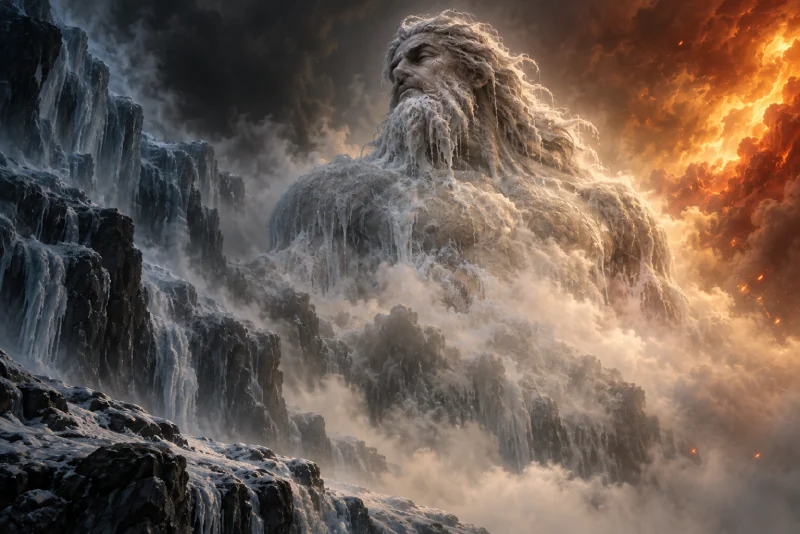
Is Loki a god or a giant? Both, in a way. Snorri makes his father, Fárbauti, a giant, and names his mother Laufey or Nál, yet he counts Loki among the gods. In the Lokasenna, Loki claims his seat at their feast by reminding Odin that “we both our blood have mixed”. The two are sworn blood-brothers, though no text tells how that came about.
1 The Telling
Loki has a part in many myths. This section tells the ones that are his own: his family, the feast at which he insults the gods, his children, and his binding. The texts are the Lokasenna, “Loki’s Wrangling”, in Henry Adams Bellows’s translation of 1923, and Snorri’s Gylfaginning in Arthur Gilchrist Brodeur’s of 1916. Stanzas are numbered as in Bellows, chapters as in Brodeur.
1-1 The Giant’s Son
Loki, also called Loptr, is the son of the giant Fárbauti. His mother is Laufey or Nál, and his brothers are Býleistr and Helblindi. He is “beautiful and comely to look upon, evil in spirit, very fickle in habit”, and no one can match him in the kind of wisdom “which is called ‘sleight’”. He “would ever bring the Æsir into great hardships, and then get them out with crafty counsel”. His wife is Sigyn, and their son is Nari or Narfi (Gylfaginning 33).
Two of his deeds belong to other stories. When a giant offers to build the gods a wall, Loki turns himself into a mare to lure away the builder’s stallion, and later gives birth to Odin’s eight-legged horse, Sleipnir (Gylfaginning 42). And he guides blind Höðr’s hand as he throws the mistletoe that kills Odin’s son Baldr (Gylfaginning 49; see Baldr).
1-2 Ægir’s Feast
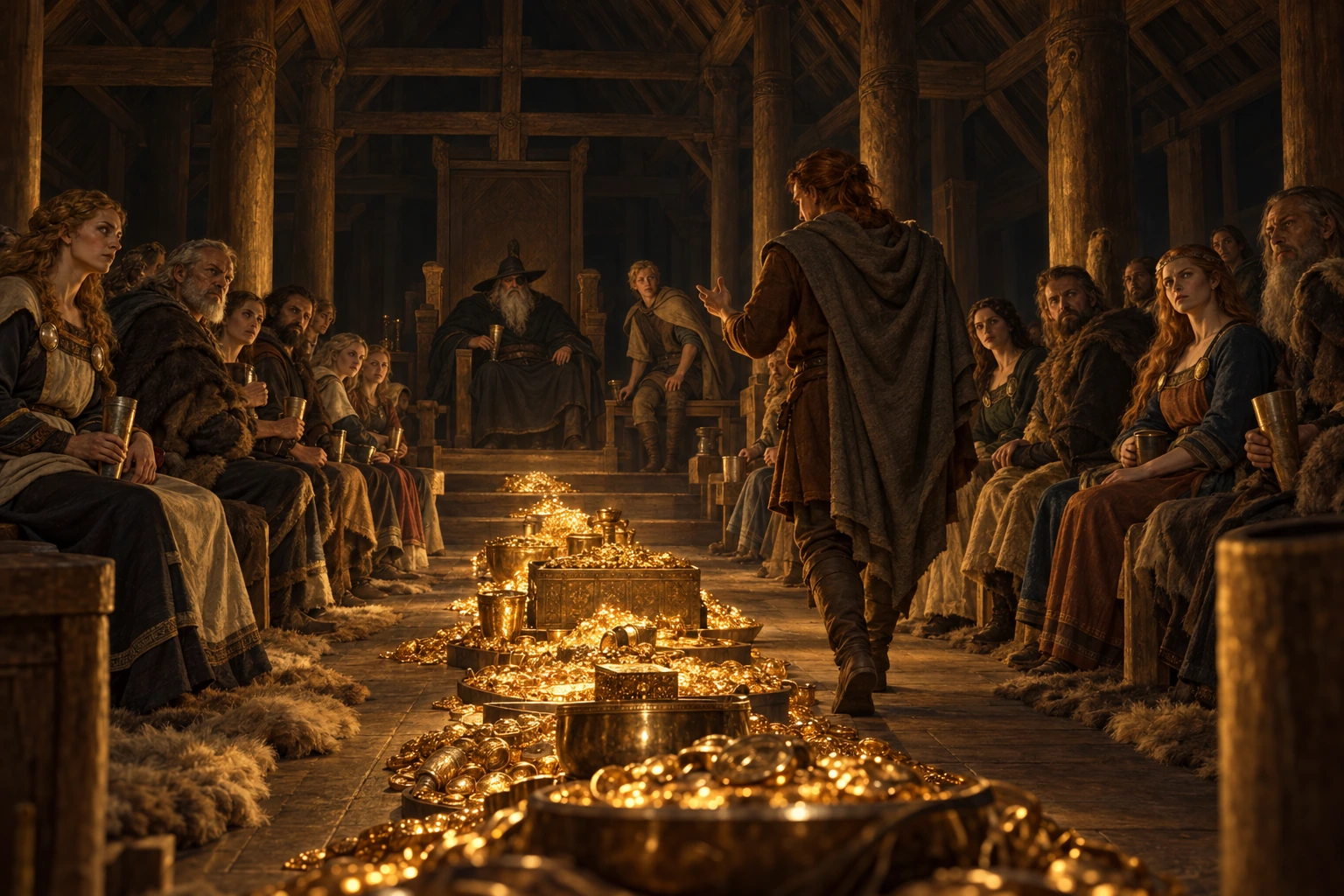
The prose that opens the Lokasenna sets the scene. The sea-giant Ægir has brewed ale for the gods, and many of them have come; Thor is away in the east. Gold on the floor lights the hall instead of fire, the ale serves itself, and the hall is a place of sanctuary. When the guests praise Ægir’s two servants, Loki cannot bear it, and he kills one of them, Fimafengr. The gods drive him out into the forest and go back to their drinking.
Loki comes back. Outside he meets the other servant, Eldir, and tells him why: “Bale and hatred I bring to the gods, / And their mead with venom I mix” (3). When he walks in, the hall falls silent, and Bragi, the god of poetry, refuses him a seat. Loki turns to Odin: “Remember, Othin, in olden days / That we both our blood have mixed; / Then didst thou promise no ale to pour, / Unless it were brought for us both” (9). Odin gives way. He tells his son Víðarr to make room for “the wolf’s father”, “lest evil should Loki speak aloud” (10).
1-3 Loki Against Everyone
It does no good. One after another, gods and goddesses speak to Loki, and each answer brings out a scandal:
- Bragi is “least brave in battle” (13), and his wife Iðunn once embraced her brother’s killer (17).
- Odin gives victory to the unworthy (22). Odin replies that Loki spent eight winters under the earth as a woman milking cows, and bore children; Loki answers that on Samsey Odin worked spells and went among men “in witch’s guise” (23–24).
- Frigg, Odin’s wife, has slept with his brothers Vili and Vé (26). When she wishes she had a son like Baldr beside her, Loki says: “Mine is the blame that Baldr no more / Thou seest ride home to the hall” (28).
- Freyja, Njörðr, Freyr and Heimdallr all hear their shame. Týr is reminded how Loki’s own son, the wolf Fenrir, bit off his hand (38).
- Skaði warns him that the gods will bind him “on the rocks … with bowels torn / Forth from thy frost-cold son” (49). Loki replies that he was “first and last” at the killing of her father, the giant Þjazi (50).
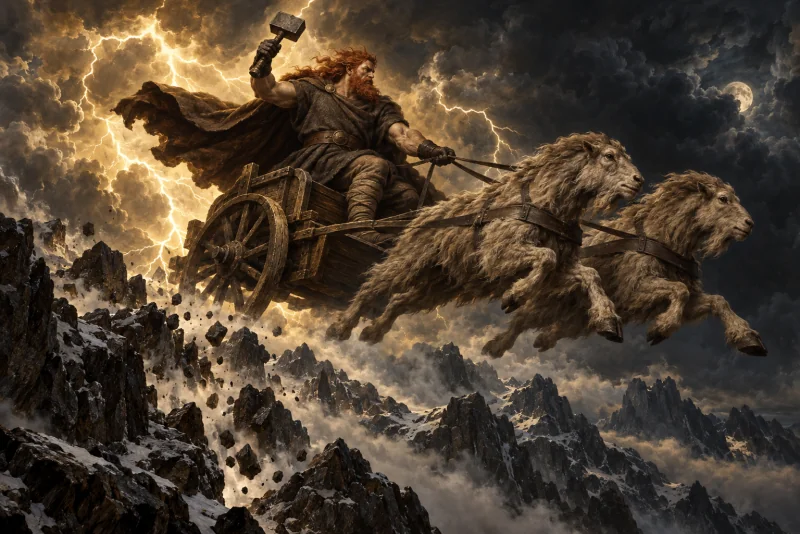
Then the mountains shake: Thor is coming. Four times he threatens to shut Loki’s mouth with his hammer, Mjölnir. Three times Loki answers with jibes about Thor’s journeys; at the fourth threat he goes, “before thee alone do I now go forth, / For thou fightest well” (64), and curses his host: flames will play over everything in Ægir’s hall (65).
1-4 The Wolf, the Serpent and Hel
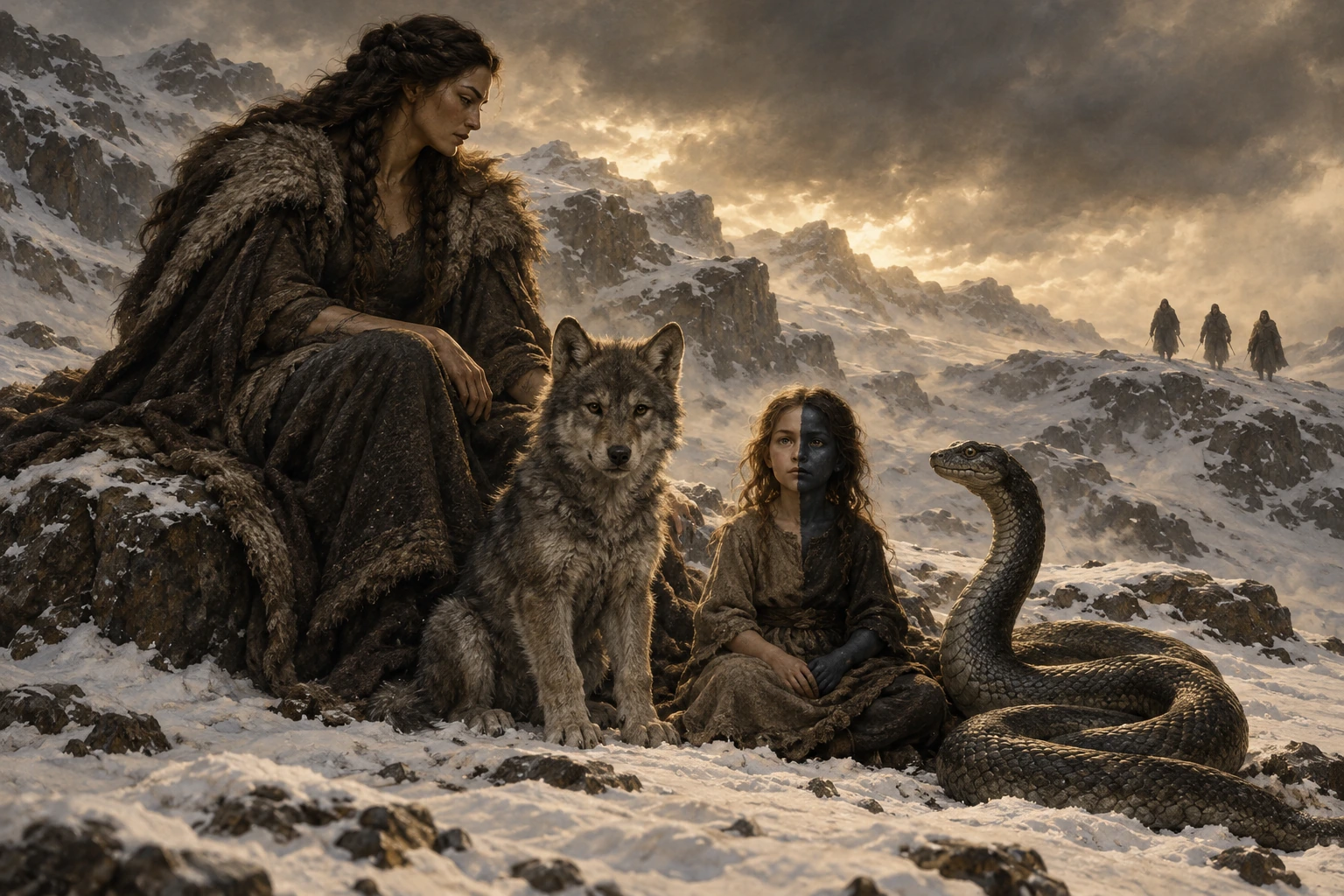
With Angrboða, a giantess in Jötunheim, the land of the giants, Loki has three more children: the wolf Fenrir, Jörmungandr, the Midgard Serpent, and Hel. Prophecies warn the gods that great harm will come from them, “first from the mother’s blood, and yet worse from the father’s”. So Odin, the Allfather, has them brought to him (Gylfaginning 34). He throws the serpent into the deep sea, where it grows until it lies around all the land and bites its own tail. He casts Hel into Niflheim and gives her power over nine worlds, and to her go all who die of sickness or old age. She is half blue-black and half the colour of flesh. The wolf the gods raise at home, and only Týr dares to feed him (see Fenrir).
1-5 The Salmon and the Net
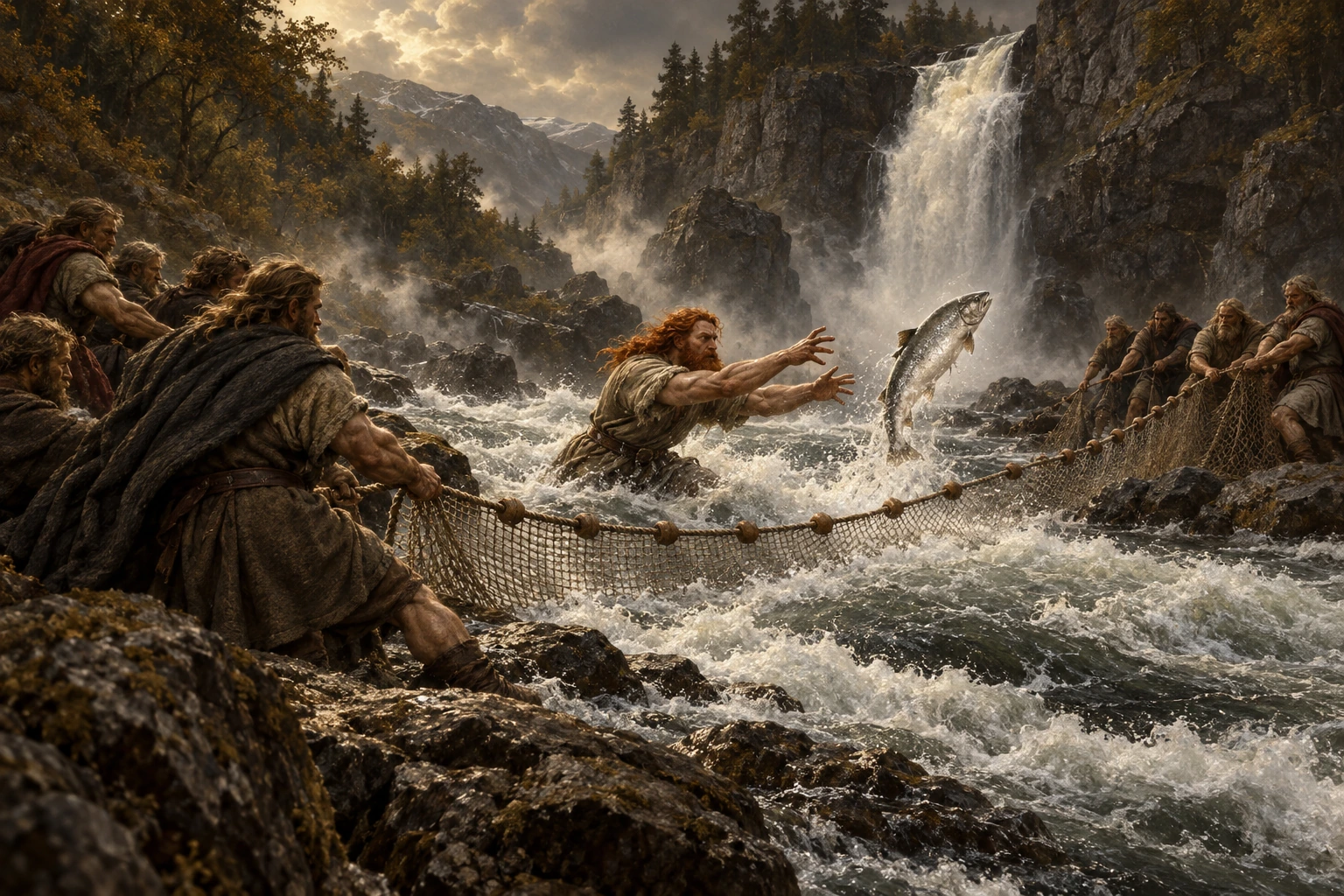
In Snorri, Loki is punished for Baldr’s death, and for keeping him among the dead: the giantess Þökk, who alone would not weep Baldr out of Hel, was, “men deem”, Loki (Gylfaginning 49). He runs away and builds a house on a mountain with four doors, so that he can see out on every side. By day he often hides as a salmon in the waterfall of Fránangr, and wonders what trick the gods might use to catch him there. One day, sitting by the fire, he knots linen twine into meshes, “as a net is made since”.
Then he sees the gods coming: Odin has spotted him from his high seat, Hliðskjálf. Loki throws the net into the fire and leaps into the river. Kvasir, the wisest of the gods, sees the pattern of the net in the white ash and understands it, and they make one like it. At the first cast Loki lies low between two stones. At the second he leaps over the net and swims back to the fall. The third time Thor wades in mid-stream, and when Loki leaps again Thor grabs him. The fish slides through his hand until it stops at the tail, “and for this reason the salmon has a tapering back” (Gylfaginning 50).
1-6 The Binding
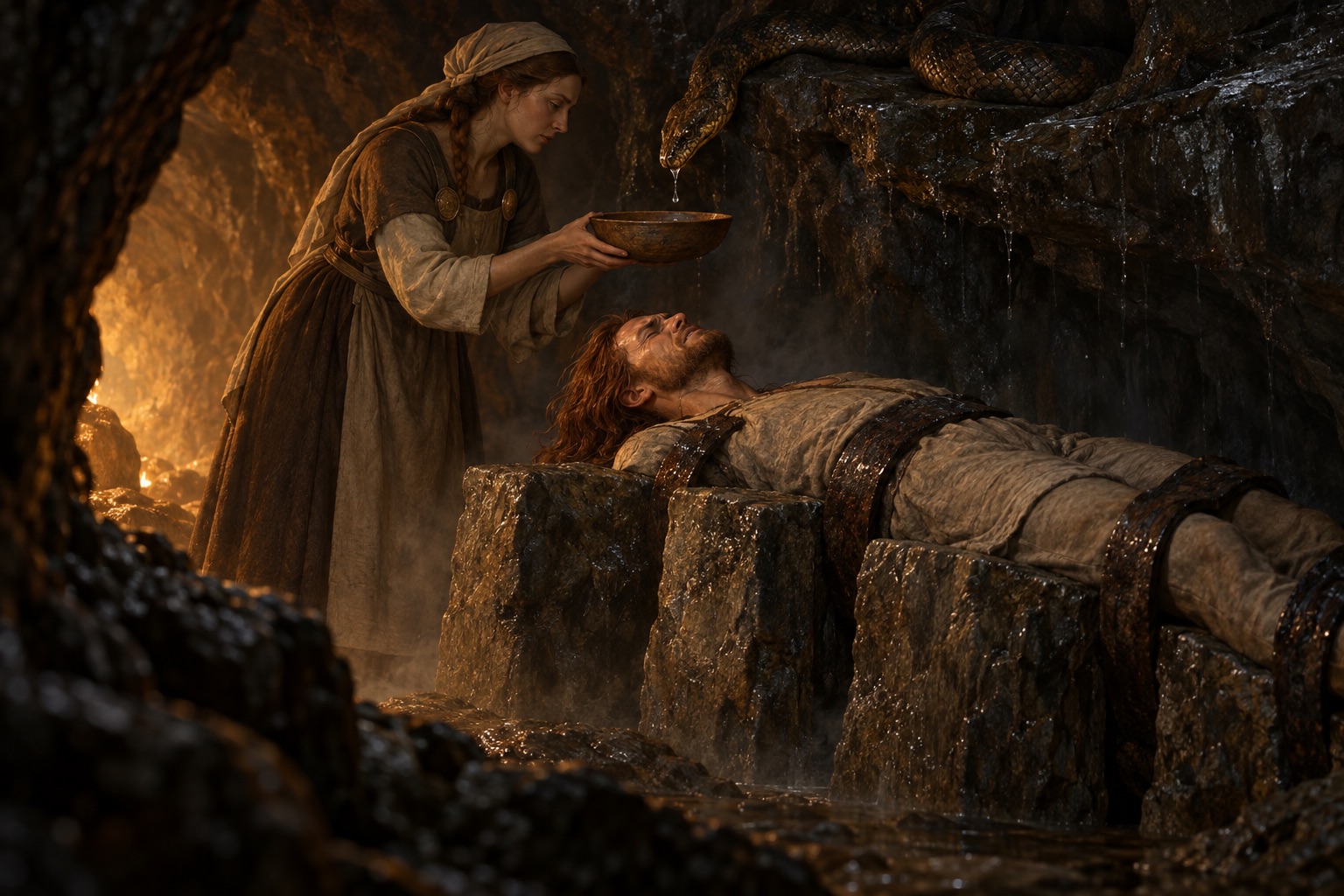
The gods carry Loki into a cave. They set three flat stones on edge and bore a hole through each. They take two of his sons, Váli and Nari or Narfi, and turn Váli into a wolf, and he tears his brother apart. With the entrails they bind Loki across the three stones, one under his shoulders, one under his loins and one under the backs of his knees, and the bonds turn to iron.
Skaði fastens a venomous serpent above him, so that the venom drips onto his face. Sigyn stands beside him and holds a basin under the drops. When it is full she goes to empty it, and the venom falls on his face, and he writhes so hard that the whole earth shakes: “ye call that ‘earthquakes’”. “There he lies in bonds till the Weird of the Gods” (Gylfaginning 50). At Ragnarök he will come loose. He steers a ship against the gods (Völuspá 51), and he and Heimdallr kill each other (Gylfaginning 51; see Ragnarök).
2 Where the Story Is Written Down
- The Lokasenna survives only in the Codex Regius (GKS 2365 4to, Árni Magnússon Institute, Reykjavík), written about 1270. When the poem was made is unknown. For Bellows, the late tenth century and Iceland were “the best guesses”; Edward Pettit, in his edition of 2023, says only that it existed by about 1225, and that its mockery of the gods has been explained as anything from tragicomedy within a strong heathen faith to Christian scorn or playful thirteenth-century antiquarianism. Its prose ending tells the binding briefly: the salmon, the son’s entrails, Skaði’s serpent, Sigyn’s basin and the earthquakes.
- Other Eddic poems know the bound Loki. In Völuspá 35 (34 in Pettit) the seeress sees a captive lying bound in Hveralundr, “to Loki like”, with Sigyn sitting by him, “nor is glad”. In Baldrs draumar 14 no one will visit her again “Till Loki wanders loose from his bonds”. Hyndluljóð 42 (40 in Pettit) names Angrboða as the wolf’s mother.
- Snorri Sturluson’s Edda was written in the 1220s in Christian Iceland, two centuries after the conversion. Gylfaginning gives the fullest account (chapters 33–34 and 50); the house with four doors, the net and Kvasir, the salmon’s tail, the three stones and the iron bonds are found only there. Skáldskaparmál tells Ægir’s feast in a few lines, in which Loki “bandied sharp words with all the gods” and killed Fimafengr (chapter 33), and lists poetic names for him, such as “Father of the Monster of Ván”, “Husband of Sigyn” and “the Bound God” (chapter 16).
- Older verse. Snorri quotes skaldic poems in which Loki already appears. In Þjóðólfr of Hvinir’s Haustlöng he is “Wolf’s Sire” and “companion of Hœnir”, and Úlfr Uggason calls him “Fárbauti’s sin-sly offspring”. Pettit notes that the tenth-century poet Egill Skallagrímsson calls Hel “sister of Nari”. Saxo Grammaticus, on the other hand, who retold many Norse myths in Latin around 1200, never names Loki, as Jacob Grimm pointed out.
3 Competing Versions
- Why was he bound? In the Lokasenna’s prose the binding follows straight on from the feast. In Snorri it is the punishment for Baldr. Bellows thought Snorri’s version “the correct tradition”. Pettit reads the poem as set on the eve of Ragnarök, after Baldr’s death, which Loki already boasts of in stanza 28.
- Which son? In the Codex Regius, Loki is bound with the entrails of his son Nari, and another son, Narfi, becomes a wolf; some editions, Bellows’s among them, print Váli for Nari. Snorri turns it round: Váli becomes the wolf and tears Narfi apart. The Hauksbók manuscript of Völuspá has two more lines on Váli and the bonds of guts.
- How was he caught? In Snorri, in a net, by Thor’s hand. Skáldskaparmál’s version of Ægir’s feast ends with the gods learning that Ægir’s wife, Rán, has a net in which she catches everyone who goes to sea. Pettit suggests that in that telling Loki was caught in Rán’s net.
- Sitting or standing? Sigyn sits in Völuspá and the Lokasenna, stands in Snorri, and kneels on the Gosforth Cross.
- Who were his parents? Little is known of them “beyond their names”, wrote Bellows. Snorri makes Fárbauti a giant; in Sörla þáttr, Pettit notes, Laufey is an old woman and Fárbauti her old husband.
- Loki as a mother. Besides Sleipnir, Odin taunts him with bearing children as a woman under the earth (Lokasenna 23), and Hyndluljóð 43 (41 in Pettit) says he ate a woman’s half-burnt heart, became pregnant, and that “every ogress on earth” comes from that (Pettit’s translation).
4 History and Tradition
- No cult. The Japanese Britannica International Encyclopaedia notes that there is no trace of Loki ever receiving worship, and that no place-name is known to come from his name.
- Who is he? Scholars have given many answers:
- A trickster. Taniguchi Yukio, who translated the Edda into Japanese, calls him a trickster who brings disaster into the world of the gods and then sets about solving it. Pettit, too, calls him “the Norse trickster-god”.
- Fire. Jacob Grimm linked Loki with Logi, “Flame”, the being who out-eats him in one of Snorri’s tales: the two names, he wrote, “really signify the same thing from different points of view”. Bellows called him “the mischief-making fire-god”, and Taniguchi credits the reading to Olrik. Grimm also collected later folk speech: in Icelandic, Sirius was Lokabrenna, “Loki’s burning”; in northern Jutland a weed harmful to cattle was “Locke’s oats”; and Danes said “Locke drinks water” when the sun shone through the clouds in streaks.
- Lóðurr. In Völuspá 18, three gods give life to the first humans: Odin, Hœnir and Lóðurr, who gives them, in Bellows’s words, “heat” and “goodly hue”. Elsewhere, as in Haustlöng, the three travelling gods are Odin, Hœnir and Loki. Grimm set the two trios side by side; Bellows took Lóðurr to be “apparently an older name for Loki”; Pettit counts that as one possibility, beside an unknown fertility god or Heimdallr.
- Others. Taniguchi lists a spider (Celander, Rooth) and a symbol of evil, cold and darkness (Dumézil), and adds that Christian influence may be at work. Pettit glosses the name as probably “Blamer”, “Mocker” or “Resolver”.
- The Snaptun stone. In spring 1950 a soapstone forge-stone, the kind that shielded the nozzle of a smith’s bellows from the fire, was found on the beach at Snaptun on Horsens Fjord in Denmark. P. V. Glob dated it to the Viking Age and thought it Norwegian. Carved on its front is a man’s face with lips that look sewn together. In 1961 Gisli Gestsson argued that the face is Loki’s. In Skáldskaparmál (chapter 35), Loki bets his head that the dwarf Brokkr’s brother cannot forge three treasures as fine as those Loki has had made, and loses, but argues that the neck was no part of the bet; so Brokkr sews his lips shut with a thong called Vartari, which Loki tears out. In that tale Brokkr’s task at the forge was to work the bellows. Gestsson adds that later popular belief made Loki a being who lived in the fire of the hearth. The stone has been shown in the Viking Age gallery of Moesgaard Museum near Aarhus.
- The Gosforth Cross, which stands in St Mary’s churchyard at Gosforth in Cumbria and was carved in the first half of the tenth century, shows at the foot of its west face a bound man, with a snake knotted to the cord round his neck, and a kneeling woman holding a bowl over him. Calverley first identified them as Loki and Sigyn in 1883. The Corpus of Anglo-Saxon Stone Sculpture notes that the same cross bears a Crucifixion, and asks whether Sigyn’s bowl is meant to echo the jar of Mary Magdalene. A picture stone of about 800 from Ardre on Gotland probably shows the same scene (Pettit).
Modern comics and films make Loki Thor’s adopted brother, and so a son of Odin. The old sources do not. There he is the son of Fárbauti and Laufey, Odin’s blood-brother (Lokasenna 9), and Thor’s travelling companion and, in the end, his captor. Snorri even calls him after his mother: “Loki Laufeyarson”.
5 Related Stories
- Fenrir: The Wolf the Gods Bound: Loki’s son by Angrboða, raised by the gods and bound by them. At Ægir’s feast Loki taunts Týr with the hand the wolf took.
- Baldr: The Death of the Shining God: the death that, in Snorri, earns Loki his bonds.
- Mount Olympus: The Real Mountain Where the Gods Lived: Jacob Grimm compared Loki with two Greek gods: with Hephaestus, who like Loki sets the gods laughing and makes a net, and, for his chains, with Prometheus. In the Iliad, the limping Hephaestus sets the gods laughing as he pours their nectar on Olympus.
- Amaterasu and the Rock Cave: The Day the Sun Hid: another god who breaks the peace of heaven. The gods fine Susanoo, cut off his beard, take his nails and drive him out. We have not found a scholar who compares him with Loki; we link them for the theme.
- Prometheus: The Theft of Fire: the chained god Grimm had in mind. Loki, he wrote, “is put in chains, like Prometheus who brought fire to men; but he is to be released again at the end of the world”.
6 Sources
- Lokasenna, Völuspá, Baldrs draumar and Hyndluljóð, trans. Henry Adams Bellows, The Poetic Edda (1923): Wikisource, Wikisource, Wikisource, Wikisource
- Edward Pettit (ed. and trans.), The Poetic Edda: A Dual-Language Edition (Open Book Publishers, 2023), introduction, Völuspá, Lokasenna and Hyndluljóð: OBP, OBP, OBP, OBP
- Snorri Sturluson, Gylfaginning chapters 33–34, 42 and 49–51, and Skáldskaparmál chapters 16, 22, 33 and 35, trans. Arthur Gilchrist Brodeur (1916): Wikisource, Wikisource
- Old Norse texts, ed. Guðni Jónsson: Lokasenna, Völuspá, Gylfaginning, Skáldskaparmál
- Jacob Grimm, Teutonic Mythology, vol. 1, trans. James Steven Stallybrass (1882), pp. 241–244: Internet Archive
- P. V. Glob, “Avlsten”, Kuml 1959; Gisli Gestsson, “Billedstenen fra Snaptun”, Kuml 1961; World-Tree Project (University College Cork), “Snaptun Stone”: tidsskrift.dk, tidsskrift.dk, World-Tree Project
- Corpus of Anglo-Saxon Stone Sculpture, vol. 2, “Gosforth 01”: Corpus
- “ロキ” (Taniguchi Yukio, Heibonsha World Encyclopedia and Nipponica; Britannica International Encyclopaedia): Kotobank
- Japanese translation: V. G. Neckel et al. (eds.), Taniguchi Yukio (trans.), Edda: Kodai Hokuō kayōshū (Shinchōsha, 1973): CiNii
Cover and illustrations: AI-generated images made for Arcana. They are interpretations, not historical artworks.