Fenrir: The Wolf the Gods Bound
The gods raised the wolf in their own home, then bound him with a ribbon made from a cat's footfall, a woman's beard and the roots of a rock, and Týr paid with his hand. Only Snorri Sturluson, around 1220, tells the whole story; the older poems know the hand, the fetter and the day the wolf runs free.
- Type: myth, a monstrous wolf whom the gods bind until the end of the world
- Culture: Norse: Viking Age Scandinavia and medieval Iceland
- Earliest texts: skaldic verse of the 10th century names him; the eddic poems of the Codex Regius (c. 1270) allude to him; only Snorri Sturluson’s Edda (c. 1220) tells the binding in full
- Key figures: Fenrir, Týr, Odin, Loki, the giantess Angrboða, Skírnir, Víðarr
Fenrir is the enemy the Norse gods raised themselves. They took him from the land of the giants, fed him in their own home and watched him grow. When the prophecies said he would be their ruin, they tricked him into a fetter he could not break, and the only god who had dared to feed him lost his hand.
Why didn’t the gods simply kill him? In Snorri’s book the questioner asks exactly that. The answer: the gods held their sanctuaries in such honour “that they would not stain it with the Wolf’s blood; though (so say the prophecies) he shall be the slayer of Odin” (Brodeur’s translation). No poem gives a reason. Snorri’s is the only one we have.
1 The Telling
This is the version of Snorri Sturluson’s Gylfaginning, chapter 34, quoted in Arthur Gilchrist Brodeur’s translation of 1916. In Snorri’s book a Swedish king, Gylfi, comes in disguise to question three mysterious figures; the one who tells this story is called Hárr, “High”.
1-1 The Wolf in the Gods’ Home
Loki had three children with a giantess called Angrboða in Jötunheimr: the wolf Fenrir, the serpent Jörmungandr and Hel. The gods learned from prophecies that great harm would come to them from these three, “first from the mother’s blood, and yet worse from the father’s”. Odin had the children brought to him. He threw the serpent into the sea and sent Hel down to Niflheimr; their stories belong to the post on Loki.
The wolf the gods raised at home, “and Týr alone dared go to him to give him meat”. Týr, Snorri says in chapter 25, is the boldest of the gods and has great power over victory in battle. His own story is told elsewhere.
1-2 Two Fetters
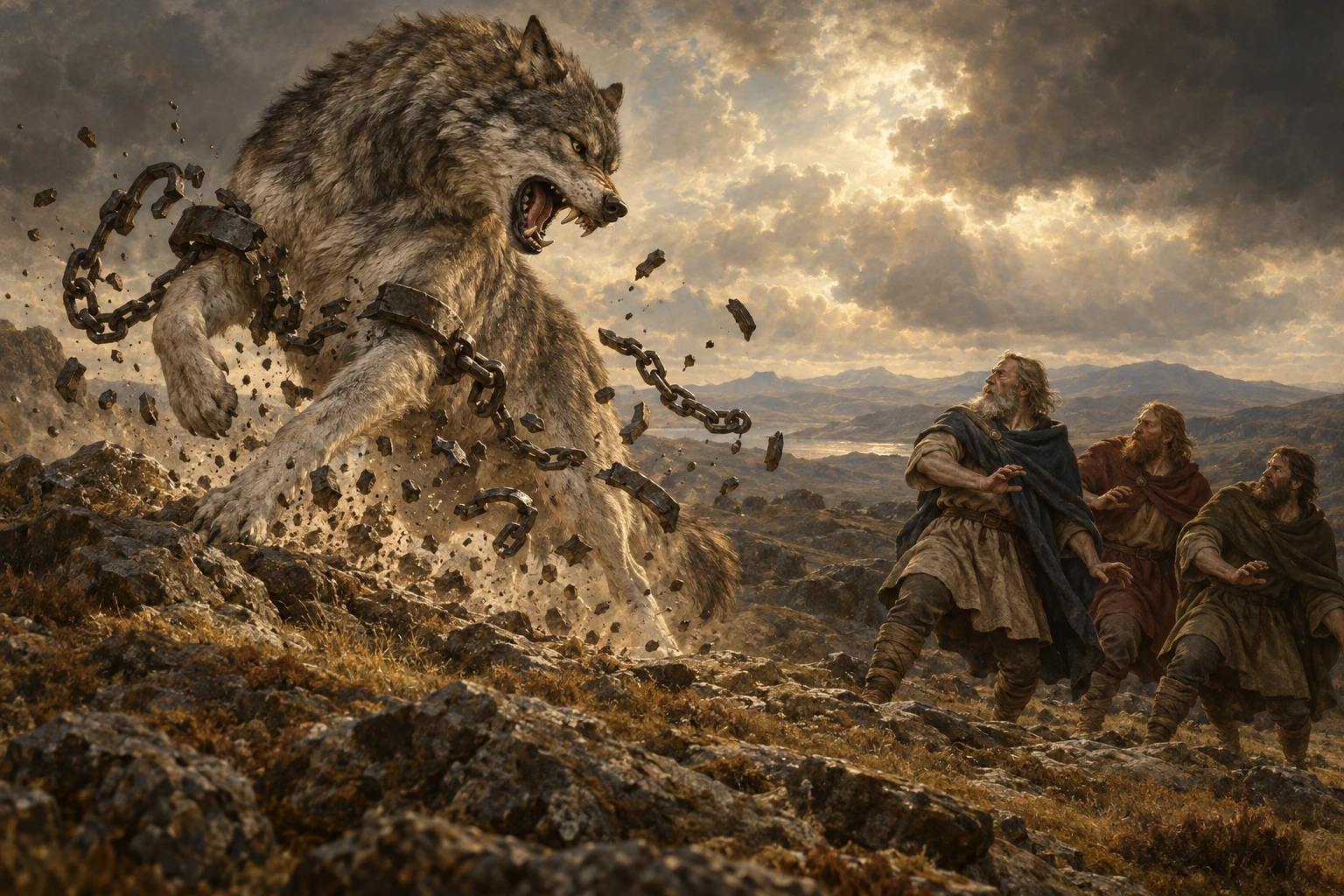
The gods saw how much the wolf grew every day, and every prophecy said he was fated to destroy them. So they made a very strong fetter called Lœðingr and asked him to try his strength against it. The wolf thought it no great matter and let them do as they liked. At his first kick it broke.
They made a second fetter, Drómi, twice as strong, and told him he would be famous for his strength if even this could not hold him. The wolf judged that he had grown since he broke Lœðingr, and that he “must expose himself to danger, if he would become famous”. He let them put it on, shook himself, dashed it against the ground and broke it, “so that the fragments flew far”. Ever since, Snorri says, when something is very hard to do, people speak of getting loose from Lœðingr or breaking out of Drómi.
1-3 Gleipnir
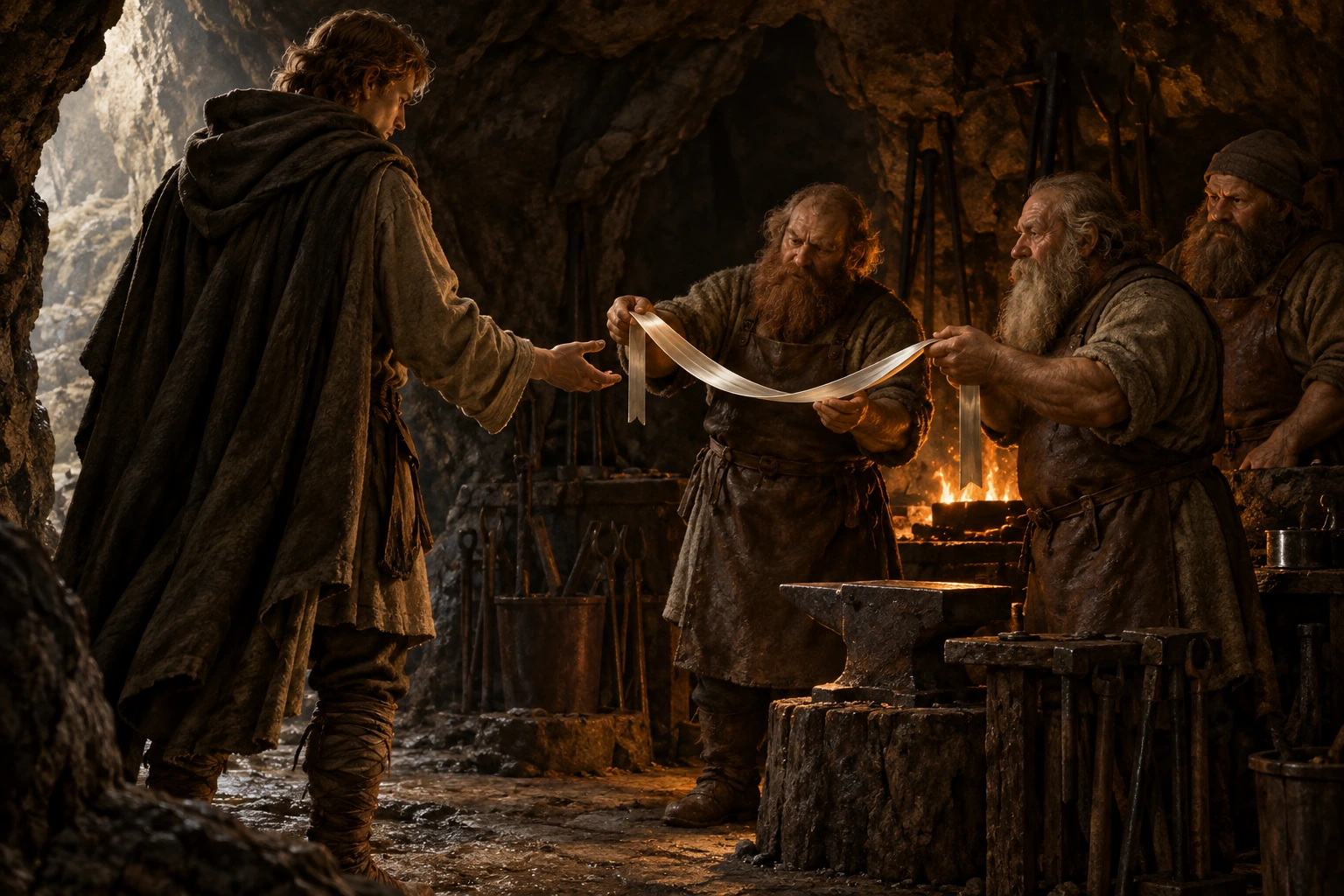
Now the gods feared they would never bind him. Odin sent Skírnir, the messenger of the god Freyr, down into Svartálfaheimr, the world of the black elves, to some dwarves, and had them make the fetter Gleipnir. It was made of six things: “the noise a cat makes in foot-fall, the beard of a woman, the roots of a rock, the sinews of a bear, the breath of a fish, and the spittle of a bird”.
Hárr offers Gylfi proof that he is not lying: he must have seen that a woman has no beard, that a cat’s leap makes no sound and that there are no roots under a rock. Some things, he admits, cannot be put to the test. The fetter itself was “soft and smooth as a silken ribbon”.
1-4 The Hand in the Wolf’s Mouth
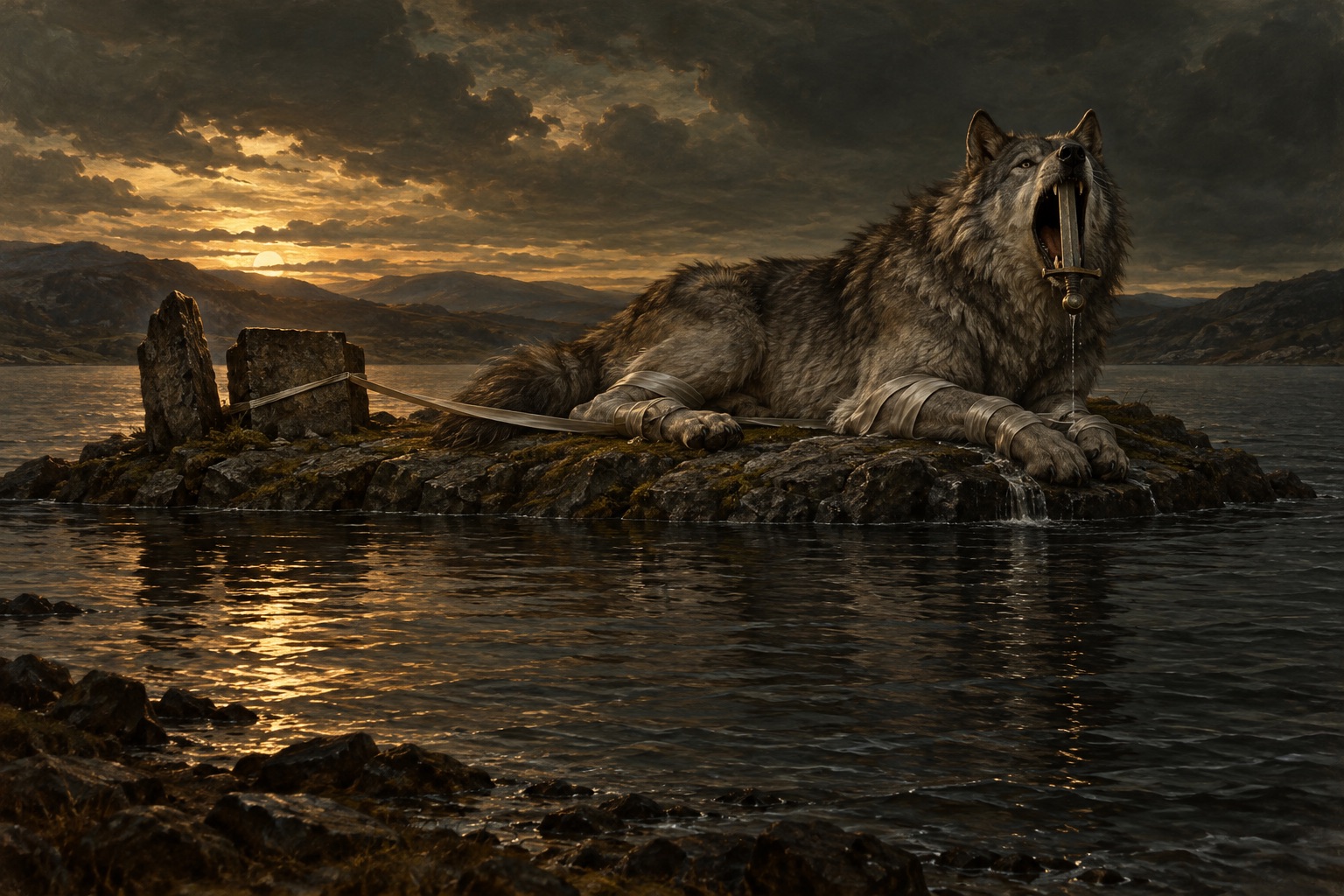
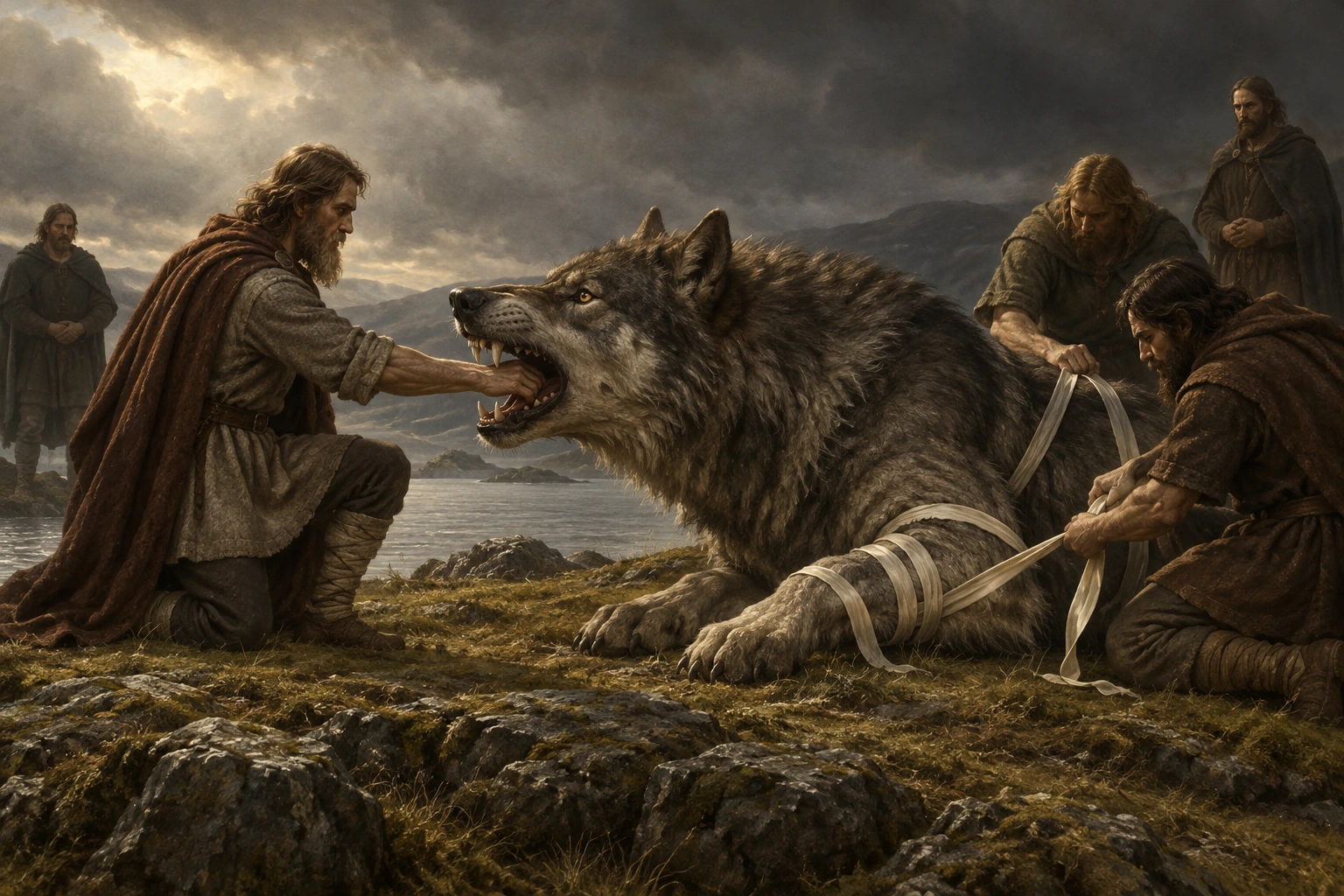
The gods went out to a lake called Ámsvartnir, to an island called Lyngvi, and took the wolf with them. They showed him the ribbon and passed it from hand to hand, pulling at it. It did not snap, yet they told him he could break it.
The wolf answered that he would win no glory by breaking so slender a band, “but if it be made with cunning and wiles, then, though it seem little, that band shall never come upon my feet”. If he could not break it, the gods said, “then thou wilt not be able to frighten the gods; and then we shall unloose thee”. The wolf said that if they bound him fast, it would be a long time before he had help from them. Still, rather than have his courage doubted, he asked that one of them lay a hand in his mouth, “for a pledge that this is done in good faith”.
The gods looked at one another. None was willing to give up his hand, until Týr stretched out his right hand and laid it in the wolf’s mouth. When the wolf strained, the band grew hard, and the more he struggled, the tighter it became. “Then all laughed except Týr: he lost his hand.” In chapter 25 Snorri adds that the wolf bit it off at the joint now called úlfliðr, “the wolf’s joint”, the wrist, and that Týr “is not called a reconciler of men”.
1-5 The Sword and the River
When the gods saw that the wolf was fully bound, they took the cord fastened to the fetter, called Gelgja, drew it through a great slab of rock called Gjöll and sank the slab deep into the earth. Then they drove a great stone, Þviti, deeper still, and used it as the anchoring peg. The wolf gaped terribly and tried to bite them, so they thrust a sword into his mouth: the hilt against his lower jaw, the point against the upper; “that is his gag”. He howls horribly, and the slaver that runs from his mouth is the river Ván. “There he lies till the Weird of the Gods”, which is Brodeur’s word for Ragnarök.
1-6 When the Fetters Break
Chapter 51 tells the end. At Ragnarök the earth will shake until “all fetters and bonds shall be broken and rent”, and the wolf will get loose. He will come on with his mouth open, the lower jaw against the earth and the upper against the sky (“he would gape yet more if there were room for it”), fire blazing from his eyes and nostrils. Odin will ride out against him, and “the Wolf shall swallow Odin”. Then Odin’s son Víðarr will set one foot on the wolf’s lower jaw. On that foot he wears a shoe made of all the scraps of leather that people have ever cut from their shoes at toe and heel. With one hand he will seize the upper jaw and tear the jaws apart, and that will be the wolf’s death. The rest of the battle is told in the post on Ragnarök. The two other wolves who, in Snorri, catch the sun and the moon are a story of their own.
2 Where the Story Is Written Down
- Snorri Sturluson’s Edda, written around 1220, is the only text that tells the binding: Gylfaginning, chapters 25, 34 and 51. Snorri wrote in Christian Iceland, more than two centuries after the conversion. His editor Anthony Faulkes notes that stories found nowhere else “may be based on poems or parts of poems that are now lost”, but also that Snorri “would probably not have felt inhibited from inventing new stories or drastically altering old ones”.
- The Poetic Edda (Codex Regius, c. 1270) never tells the binding, but its poems know it. Stanza numbers here are those of Neckel and Kuhn’s edition; quotations are Bellows’s.
- Lokasenna. A prose note before the poem says that Týr was one-handed because Fenrir tore off his hand when he was bound. In stanza 38 Loki taunts him with “how Fenrir once / Thy right hand rent from thee”. In 39 Týr answers: “My hand do I lack, but Hrothvitnir thou”, that is, Loki is without his wolf-son, and “Ill fares the wolf who shall ever await / In fetters the fall of the gods”. In 41 Freyr says the wolf lies “by the mouth of the river” until the gods are destroyed.
- Völuspá 40: an old giantess in the Ironwood bears “the brood of Fenrir”. 44, repeated at 49 and 58: “The fetters will burst, and the wolf run free”. 53: Odin “fares to fight with the wolf”. 55 (54 in Bellows): Víðarr avenges him.
- Vafþrúðnismál 53: “The wolf shall fell the father of men, / And this shall Vithar avenge”.
- Hyndluljóð 40 (42 in Bellows), preserved not in the Codex Regius but in Flateyjarbók, a compilation of about 1400: “The wolf did Loki with Angrbotha win”.
- Skaldic verse of the 10th century. Eyvindr skáldaspillir, poet of King Hákon the Good of Norway, calls a sword Fenris varra sparri, “the prop of Fenrir’s lips”; his Hákonarmál, made when the king died in 961, says the wolf will run unbound upon the homes of men before so good a king comes again. Both are quoted in Snorri’s Heimskringla. In the anonymous Eiríksmál, on the fall of King Eiríkr Bloodaxe in 954, preserved in the kings’ saga Fagrskinna, Odin explains why he took a brave king’s victory: “the grey wolf gazes at the seat of the gods”. Faulkes cites this poem for the idea that Odin gathers fallen warriors against Fenrir.
What only Snorri tells: the wolf’s upbringing among the gods, the two fetters and their proverbs (Faulkes finds no example of the sayings in Old Icelandic), Skírnir and the dwarves, the six ingredients of Gleipnir, the lake, the island and the stones, the river made of slaver, the reason the gods did not kill him, and Víðarr’s shoe of leather scraps. A verse list of Gleipnir’s ingredients does exist, but only in two manuscripts written after Snorri’s time. The poems confirm the right hand, the bonds, the river mouth, the breaking free and Odin’s death. Eyvindr’s kenning shows that the sword propping the wolf’s jaws was known more than two centuries before Snorri.
3 Competing Versions
- How does Víðarr kill the wolf? Völuspá 55: with a sword, thrust “full to the heart”. Vafþrúðnismál 53: “The terrible jaws shall he tear apart”. Snorri tells the jaw version, with the foot and the shoe, then quotes the Völuspá stanza with the sword in the same chapter, without comment.
- What is on his foot? Gylfaginning 29 says only that Víðarr “has a thick shoe”. Chapter 51 makes it of leather scraps. The list of poetic names in Skáldskaparmál calls him “Possessor of the Iron Shoe”.
- Who swallows the sun? In Vafþrúðnismál 46–47 it is Fenrir: the sun will bear a daughter “ere Fenrir snatches her forth”. In Snorri the sun is caught by another wolf, and Fenrir’s victim is Odin. Faulkes calls the poem “yet another version”; Bellows thought its poet had confused Fenrir with his offspring.
- Is Garmr the same beast? The Völuspá refrain has the hound Garmr howl at the cave Gnipahellir as the fetter bursts and the wolf runs free. Faulkes notes that in the poem Garmr “may be the same as Fenrir, while Snorri evidently assumes they are different”. In Snorri, Garmr is a separate hound who kills Týr at Ragnarök and dies with him.
- Who faces the wolf? Odin, in Völuspá 53 and in Snorri. But in Lokasenna 58 Loki tells the blustering Thor that he will not be so bold when he has to fight the wolf and it swallows Odin whole. And in the Codex Regius, one line of Völuspá 56, a stanza about Thor, has Odin’s son go “against the wolf”; the Hauksbók copy reads “serpent”, which Bellows thinks right if the line means Thor.
- Where does he lie? Lokasenna 41: before a river mouth. Snorri: on the island of Lyngvi in the lake Ámsvartnir, with the river Ván flowing from his own jaws. A river called Ván also appears in a list of rivers in Grímnismál 28, with no wolf.
4 History and Tradition
- A hand in a beast’s mouth, around 500? Gold bracteates are pendants of the Migration Period, 400–570 CE. One found near Trollhättan in south-western Sweden and received by the State Historical Museum in Stockholm in 1844 (IK 190) shows a long-haired figure in a short skirt holding an object in one hand while a dog-like animal bites the other. Eric Oxenstierna proposed in 1956 that it is Týr and Fenrir, and many bracteate scholars have agreed; Motz suggested the figure is a woman. Morten Axboe and Magnus Källström answer that the skirt copies the short military skirt of Roman emperors on coins.
- Thorwald’s Cross, at Andreas on the Isle of Man. P. M. C. Kermode described it in 1907: a man with a spear and a raven on his shoulder, his right foot in a wolf’s jaws. “Here, certainly,” he wrote, “we have a view of Ragnarök, when Odin … is swallowed by the Fenris wolf”. The other face shows a man with a cross and a book. The Friends of Manx National Heritage date it “to around AD 950”, and its runes say “Thorwald raised this cross”.
- The Gosforth Cross in Cumbria, England. Store norske leksikon (Ellen Næss) says Víðarr setting his foot in the wolf’s jaws is shown on this cross, raised in the 10th century in an area with a large Norse population.
- Saturn’s moon Fenrir, about 4 km across, was discovered on 12 December 2004 by Scott Sheppard, David Jewitt and Jan Kleyna with the Subaru telescope in Hawaii. NASA counts it among Saturn’s “Norse group” of moons.
Fenrir is usually pictured straining against iron chains. In Snorri, the iron fetters are the two he broke. The one that held him, Gleipnir, was “soft and smooth as a silken ribbon”.
5 Related Stories
- Loki: The Shape-Shifter Between Gods and Giants: Fenrir’s father. In Lokasenna he taunts Týr with the lost hand, and Freyr warns him that he will be bound next, like the wolf. By the end of that poem, he is.
- Ragnarök: The End of the World, and What Comes After: the day the fetter breaks, Fenrir swallows Odin and Víðarr avenges him.
- Ra and Apophis: The Serpent the Sun Must Defeat Every Night: in Egypt, too, a monster of chaos is held down rather than destroyed. In the seventh hour of the night the serpent Apophis is pinned with knives, with a band at his neck and a fetter at his tail, and the rite against him must be repeated every day. We have not found a scholar who compares the two; we link them for the theme.
- The Churning of the Ocean: Gods, Demons and the Nectar of Immortality: the severed head of Rāhu swallows the Sun and the Moon in eclipses, as Fenrir snatches the sun in Vafþrúðnismál. A shared theme, not a known connection.
- The Tuatha Dé Danann: The Gods Who Went into the Hills: the Irish king Nuada loses his arm in battle and his throne with it, until a silver one is made. Georges Dumézil, in Mitra-Varuna (1940), set him and Týr in one pattern, in his chapter on “the one-eyed god and the one-handed god”.
6 Sources
- Snorri Sturluson, Gylfaginning, chapters 25, 29, 34 and 51, and Skáldskaparmál, trans. Arthur Gilchrist Brodeur, The Prose Edda (1916): Wikisource
- Snorri Sturluson, Edda, Old Norse text, ed. Guðni Jónsson: heimskringla.no, heimskringla.no
- Anthony Faulkes (ed.), Snorri Sturluson: Edda. Prologue and Gylfaginning, 2nd ed. (Viking Society for Northern Research, 2005), introduction, notes and index: vsnr.org
- Völuspá, Vafþrúðnismál, Grímnismál, Lokasenna and Hyndluljóð, trans. Henry Adams Bellows, The Poetic Edda (1923): Wikisource
- The same poems in Old Norse, ed. Gustav Neckel, 5th ed. rev. Hans Kuhn (1983), whose stanza numbers are used here: TITUS
- Snorri Sturluson, Heimskringla, Saga of Hákon the Good, chapters 27 and 32, trans. Samuel Laing: Wikisource; Old Norse text: heimskringla.no
- Hákonarmál and Eiríksmál, ed. Finnur Jónsson, Carmina Scaldica (1929): heimskringla.no, heimskringla.no
- Morten Axboe and Magnus Källström, “Guldbrakteater fra Trollhättan – 1844 og 2009”, Fornvännen 108 (2013): kulturarvsdata.se
- Hanne Lovise Aannestad, “gullbrakteater”, and Ellen Næss, “Fenrisulven”, Store norske leksikon: snl.no, snl.no
- P. M. C. Kermode, Manx Crosses (1907), no. 102: archive.org
- Friends of Manx National Heritage, “Vikings Live comes to the Isle of Man” (2014): friendsofmnh.org
- NASA, “Fenrir”: science.nasa.gov
Cover and illustrations: AI-generated images made for Arcana. They are interpretations, not historical artworks.