The Churning of the Ocean: Gods, Demons and the Nectar of Immortality
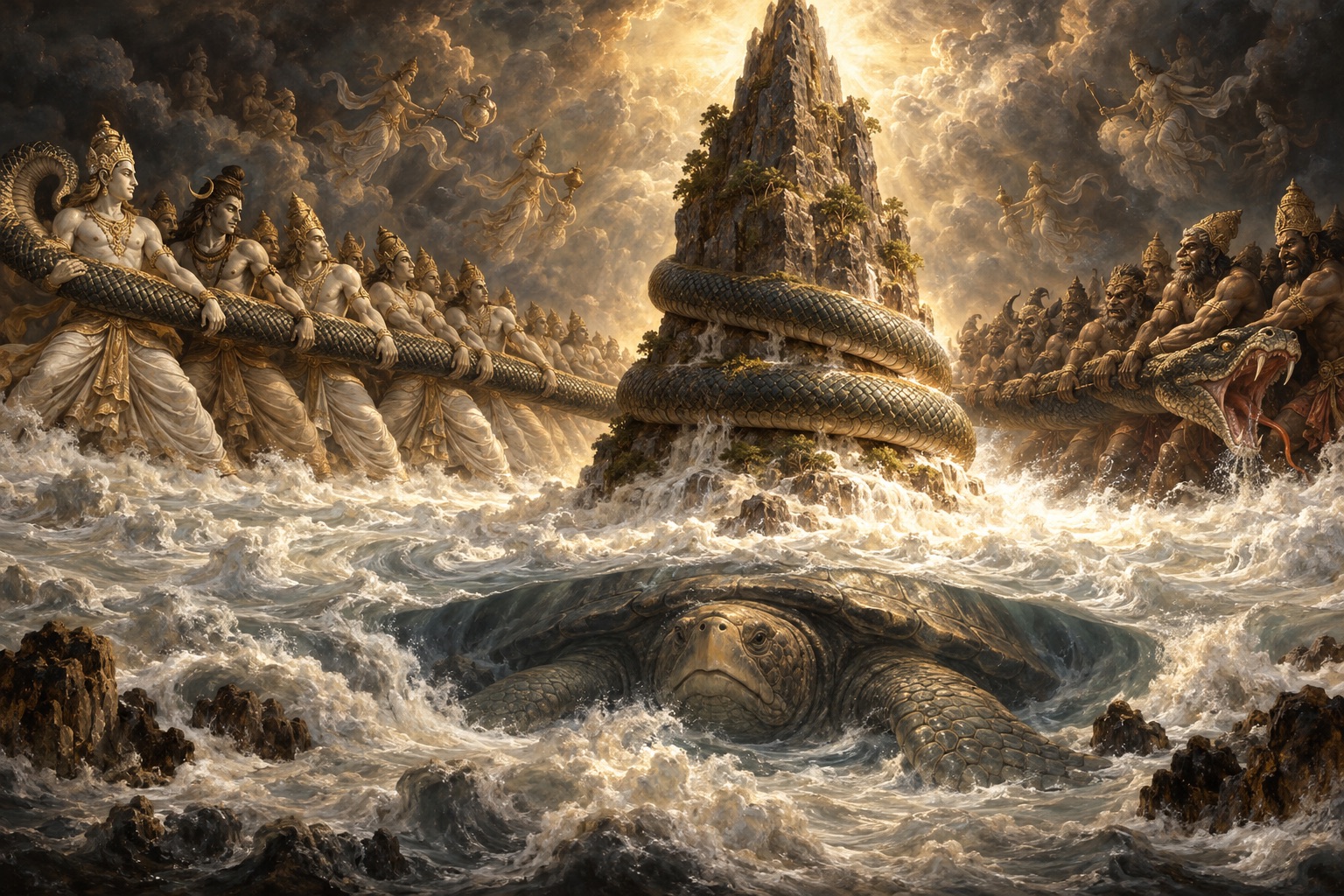
Gods and demons used a mountain as a churning stick and a serpent as the rope, and churned the ocean for amṛta, the drink of immortality. Who held the mountain up, and who drank the poison? It depends on which text you open.
- Type: myth, the quest for the drink of immortality
- Culture: India (Hindu tradition), retold across Southeast Asia
- Earliest texts: the two Sanskrit epics, the Mahābhārata (Book 1) and the Rāmāyaṇa (Book 1); later the Viṣṇu Purāṇa and the Bhāgavata Purāṇa
- Key figures: Vishnu (Nārāyaṇa), the serpent Vāsuki, Mount Mandara, the gods (devas) and the asuras, Shiva, Rāhu
In this story immortality is not a gift. It has to be churned out of the sea, the way butter is churned out of milk, and the gods cannot do it alone.
Was the turtle Vishnu? Not in the critical edition of the Mahābhārata. There the mountain rests on Akūpāra, a king of tortoises. Vishnu becomes the tortoise in the Purāṇas. Shiva drinking the poison is also missing from that edition’s main text. Section 3 shows where both come from.
1 The Telling
This follows the Mahābhārata, Book 1, chapters 15 to 17 of the critical edition published in Pune.
1-1 A Council on Mount Meru
The gods gathered on Mount Meru, a blazing peak of gold so tall that it covered the sky. They sat there to decide how to win amṛta, the drink of immortality. Nārāyaṇa, that is Vishnu, gave the answer to Brahmā: let the gods and the asuras churn the ocean together, with every herb and every jewel thrown into it, and the amṛta would come.
1-2 Mountain, Serpent and Tortoise
For a churning stick they chose Mount Mandara, eleven thousand yojanas high and as deep again below the ground. The gods could not lift it. At the word of Brahmā and Nārāyaṇa, the serpent Ananta tore it up, with its forests and everything that lived in them. The Ocean agreed to be churned, on one condition: he would have a share of the amṛta.
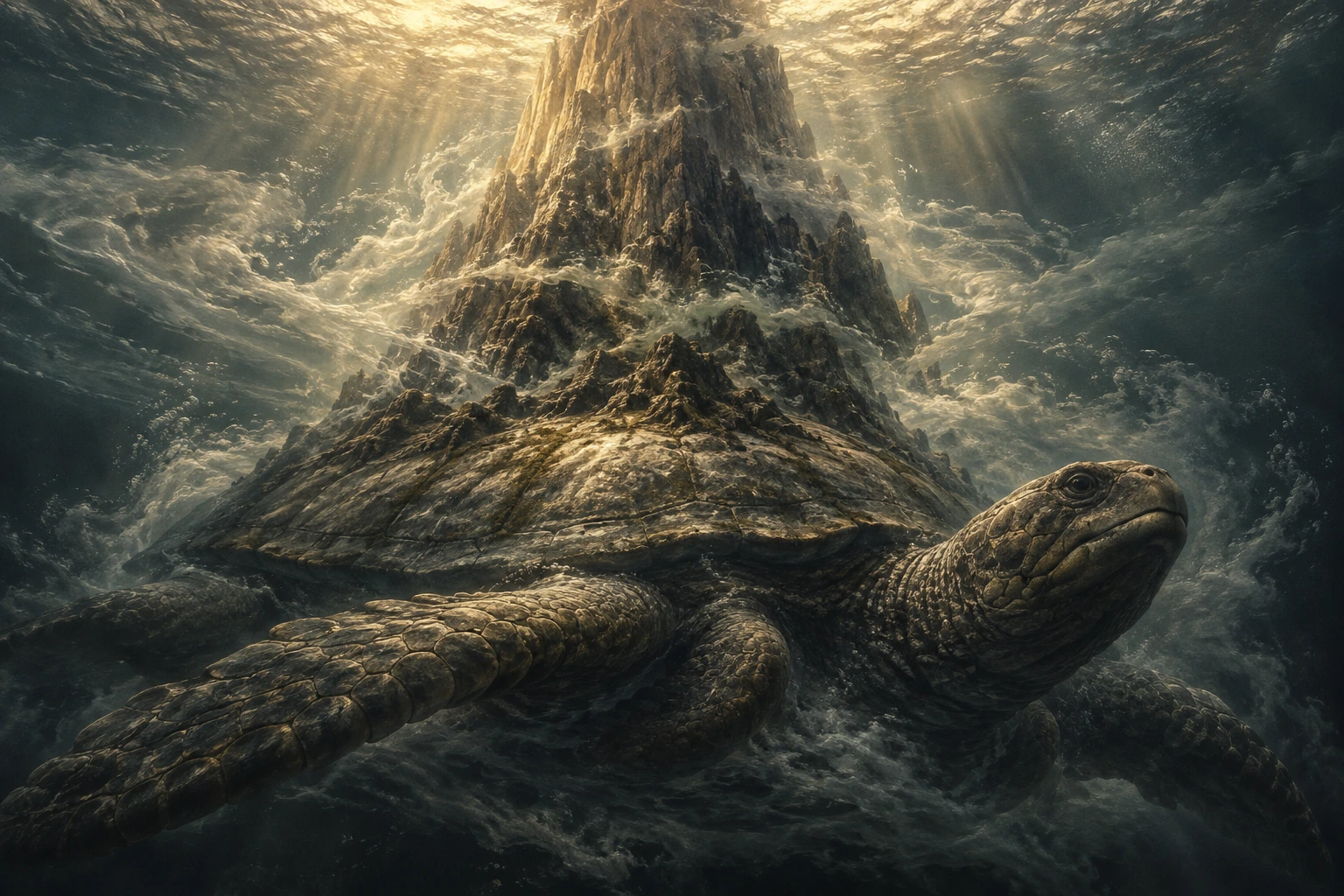
The gods and the asuras asked Akūpāra, king of the tortoises, to be the mountain’s base, and he offered his back. Indra held the summit down. The serpent king Vāsuki became the rope. The asuras took hold of one end, and the gods all stood at the tail.
Each time they hauled on Vāsuki, smoke and flames burst from his mouths. The smoke gathered into clouds full of lightning that rained down on the exhausted gods.
1-3 What Rose from the Sea
The churning roared like thunder. The mountain crushed sea creatures by the hundred. Trees on its slopes crashed together and caught fire, and Indra put the fire out with rain. Resin from the great trees and the juices of herbs ran down into the water. Oddly, the text says the gods became immortal from those juices and from melted gold, before any amṛta had appeared. The sea turned to milk, and the milk to ghee.
Still no amṛta came. The gods were worn out, so Brahmā asked Nārāyaṇa to give them strength, and they churned again. Then, one after another, the ocean gave up:
- Soma, the moon, cool and bright;
- Śrī (Lakṣmī), dressed in white, born from the ghee;
- Surā, the goddess of wine;
- a white horse;
- the jewel Kaustubha, which went to Nārāyaṇa’s breast;
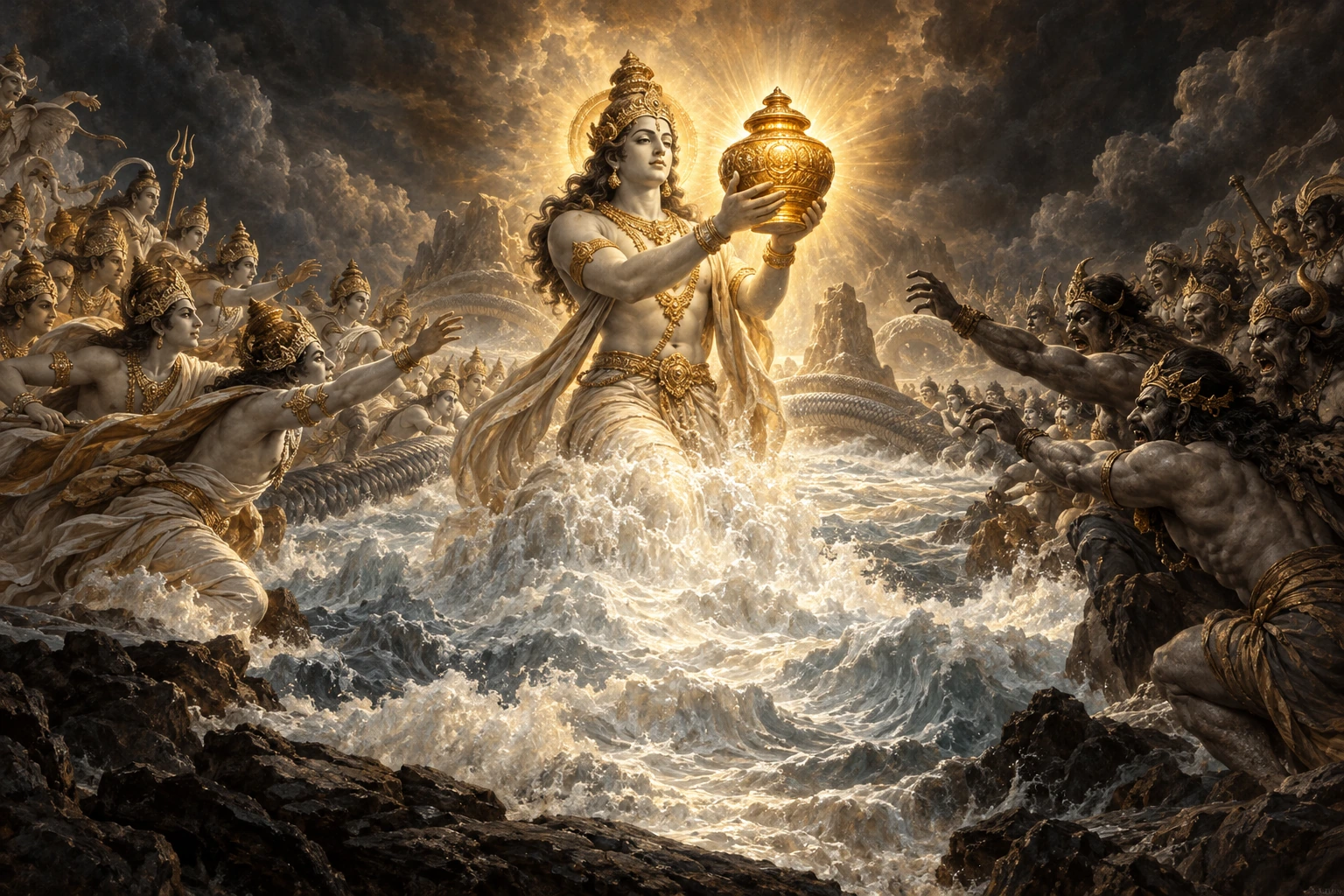
- and Dhanvantari, the god of healing, carrying a white water pot that held the amṛta.
1-4 The Enchantress and Rāhu’s Head
The asuras clamoured for the amṛta. Nārāyaṇa took on a “bewitching” illusion and became a woman of wonder, and the asuras, their minds on her, handed her the pot. Vishnu carried it off to the gods, and the gods drank.
One asura, Rāhu, took the form of a god and drank as well. The amṛta had only reached his throat when the Moon and the Sun gave him away. Vishnu’s discus cut off his head, and it fell to the earth like a mountain peak and shook it. Ever since, says the text, Rāhu’s mouth has kept up an endless feud with the Moon and the Sun. It still swallows them: that is an eclipse.
Vishnu dropped the woman’s form, and war broke out by the salt sea. Nara and Nārāyaṇa joined the battle. The asuras hurled mountains, Nara’s arrows split them, and the blazing discus Sudarśana drove the asuras into the earth and the sea. Mandara was returned to its place with honour, and the amṛta was given to Nara to guard.
2 Where the Story Is Written Down
- The Mahābhārata, Book 1 (the Ādi Parva). The epic grew over many centuries, roughly between the 3rd century BCE and the 3rd century CE. The Pune critical edition, chapters 15 to 17, gives the version above. K. M. Ganguli’s English translation of 1884, sections 17 to 19, follows other manuscripts and includes more.
- The Rāmāyaṇa, Book 1 (the Bāla Kāṇḍa) has a short version. Vāsuki is the cord and Mandara the stick. Dhanvantari and the apsaras rise from the sea, and so does Vāruṇī, the goddess of wine. Those who accepted her were called suras, the text explains, and those who refused, asuras. Book 1 is generally thought to be one of the later layers of the epic.
- The Viṣṇu Purāṇa (book 1, chapter 9) gives the gods a reason to churn: a curse (section 3). Its date is much disputed.
- The Bhāgavata Purāṇa (book 8, chapters 5 to 12) is the fullest version and the one most retellings follow. Vishnu is the tortoise, Shiva drinks the poison, and the enchantress is Mohinī. It is usually dated to the 9th or 10th century in its final form.
H. H. Wilson, who translated the Viṣṇu Purāṇa into English in 1840, already judged the accounts in the two epics to be “the oldest extant versions of the story”.
3 Competing Versions
- Who was the tortoise?
- In the Mahābhārata’s critical text, it is Akūpāra, king of the tortoises.
- In the Viṣṇu Purāṇa, the popular text of the Rāmāyaṇa, and the Bhāgavata Purāṇa, Vishnu himself takes the form of a tortoise. The Bhāgavata counts this tortoise, Kūrma, among his avatars.
- Who drank the poison?
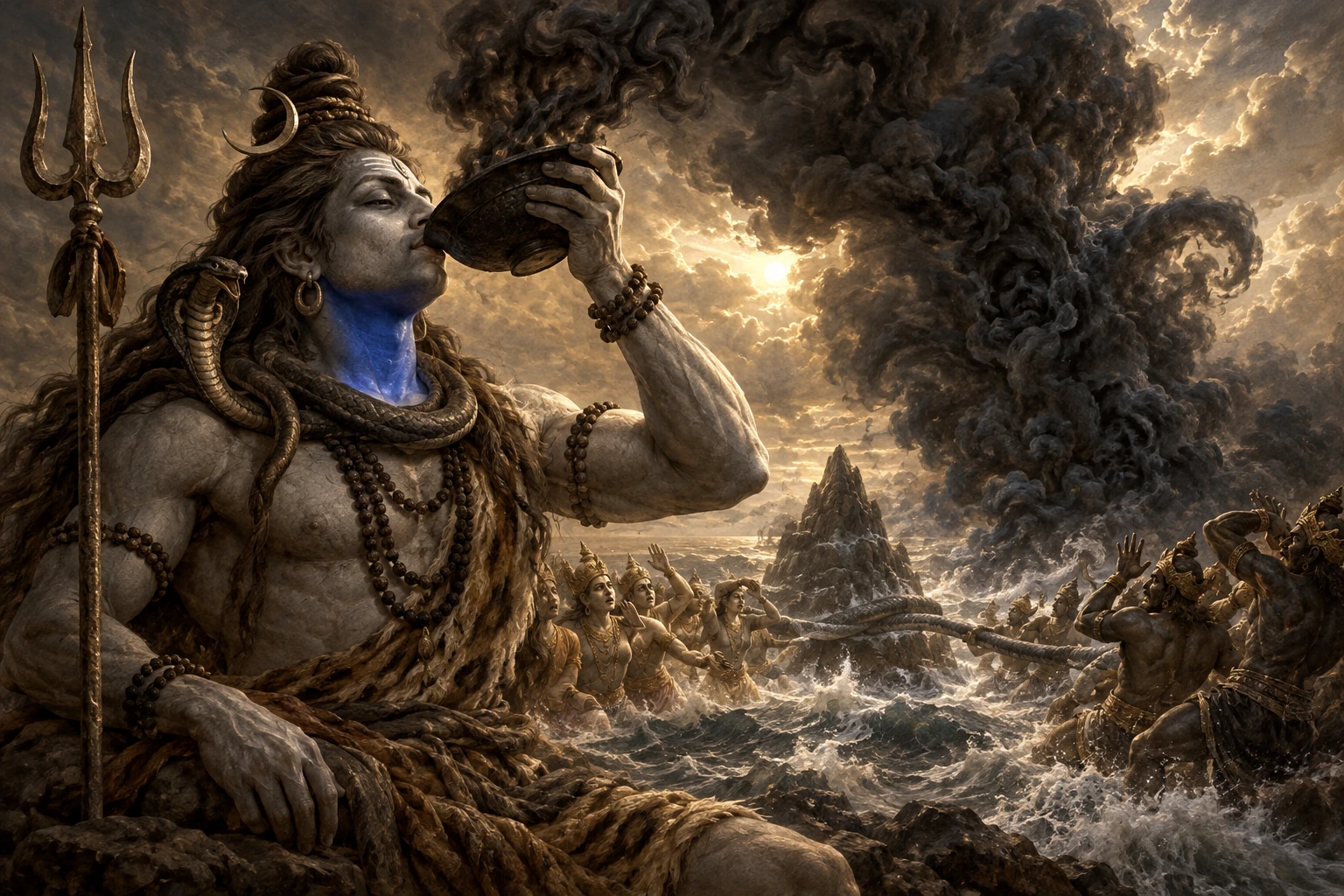
- The Mahābhārata’s critical text has no poison at all. Other manuscripts, and Ganguli’s translation, add the deadly kālakūṭa, which Shiva holds in his throat. “From that time on,” they say, he is Nīlakaṇṭha, the Blue-Throated.
- In the popular text of the Rāmāyaṇa, Shiva drinks the poison, hālāhala, but his throat is not said to turn blue.
- In the Bhāgavata Purāṇa, Shiva drinks it and it turns his throat blue: “the blue it made on his throat became the good one’s ornament”.
- In the Viṣṇu Purāṇa, the snake-gods, the Nāgas, take the poison.
- Who held the head of the serpent?
- In the Mahābhārata, the asuras take one end and the gods the tail.
- In the Viṣṇu Purāṇa, Vishnu puts the asuras at the head, where Vāsuki’s fiery breath scorches them, while the gods at the tail are refreshed by rain.
- In the Bhāgavata Purāṇa, the gods take the head first. The asuras refuse: “we will not take the tail, the snake’s inauspicious part.” So Vishnu smiles, and the gods take the tail.
- Why churn at all? In the epics, to escape old age and death. In the Viṣṇu Purāṇa, because the sage Durvāsas cursed Indra after Indra’s elephant threw a garland from the sage to the ground, and the three worlds lost their prosperity. Wilson thought the curse was “an embellishment added to the original”.
- How many treasures? “Fourteen jewels” is the number everyone knows, but no text fixes it. Wilson counted nine in the Rāmāyaṇa, nine in the Mahābhārata, ten in the Bhāgavata, nine in the Padma Purāṇa and twelve in the Vāyu Purāṇa.
- Mohinī. In the Mahābhārata, mohinī is only an adjective, “bewitching”. In the Bhāgavata it has become a name, and this female form of Vishnu is counted among his avatars.
4 History and Tradition
- Angkor Wat. The most famous picture of the churning is carved in stone. It is a relief about 50 m long, on the south half of the east side of Angkor Wat’s outer gallery, built under King Suryavarman II in the first half of the 12th century. Long rows of gods and asuras haul on the serpent from either end, with Vishnu at the centre.
- Bangkok. A large sculpture of the churning stands inside Suvarnabhumi Airport.
- Kumbh Mela. A popular story says drops of amṛta fell at four places in India, Prayagraj, Haridwar, Ujjain and Nashik, and that this is why the great Kumbh Mela pilgrimage is held there. None of the texts above tells it. The Mahābhārata has a different spill: snakes licked the darbha grass where the amṛta had rested. Their tongues split in two, which is why snakes have forked tongues, and the grass became holy.
- Japan and Vietnam. Through Buddhist translations, the Sanskrit amṛta became 甘露, “sweet dew”: kanro in Japanese, cam lồ in Vietnamese.
Amṛta means “not dead”. The Greek ambrosia, the food of the gods on Olympus, comes from the same old Indo-European word for “immortal”.
5 Related Stories
- Kuniumi: Izanagi and Izanami Give Birth to Japan: in Japan, too, the world begins by stirring the sea. The mythologist Yoshida Atsuhiko (1976) argued that the Onogoro story belongs to an “ocean-churning type” of land-creation myth that reached Japan from Inner Asia and goes back to India. Takahashi Rokuji (2011) doubted it: the Japanese gods stir brine, not milk, so he would look to seafaring peoples instead.
- Nüwa: The Serpent-Bodied Goddess Who Mended the Sky: another turtle holds up another world. Nüwa cut off the legs of the great turtle Ao to prop up the sky. We have found no scholar who argues that the two turtles are connected; the image is simply widespread.
- Mount Olympus: The Real Mountain Where the Gods Lived: where the Greek gods ate ambrosia, the other drink of immortality.
- Durga and Mahishasura: The Goddess and the Buffalo Demon: the same two sides, at war instead of churning together. The gods lose heaven to the asura Mahiṣa, and their anger takes the form of a goddess. Vishnu’s discus appears in both stories.
- Ahura Mazda and Angra Mainyu: The Two Spirits: Iran’s ahuras and daevas are the counterparts of India’s asuras and devas, with the sides reversed: in Zarathustra’s teaching the daevas are the ones who chose the lie.
6 Sources
- Mahābhārata, critical edition, Ādiparvan 1.15–17 and 1.30, with variant passages: GRETIL
- K. M. Ganguli (trans.), The Mahabharata, Book 1, sections 17–19 (1884): Wikisource
- Rāmāyaṇa, Bālakāṇḍa 1.44: GRETIL; the popular text, sarga 45: valmikiramayan.net
- H. H. Wilson (trans.), The Vishnu Purana (1840), book 1, chapter 9, with notes: sacred-texts.com
- Bhāgavata Purāṇa, book 8: GRETIL
- Takahashi Rokuji, 「「かきまわす」創世神話」, quoting Yoshida Atsuhiko, 『小さ子とハイヌウェレ』 (Misuzu Shobō, 1976): Atomi University repository
- “甘露”: Kotobank
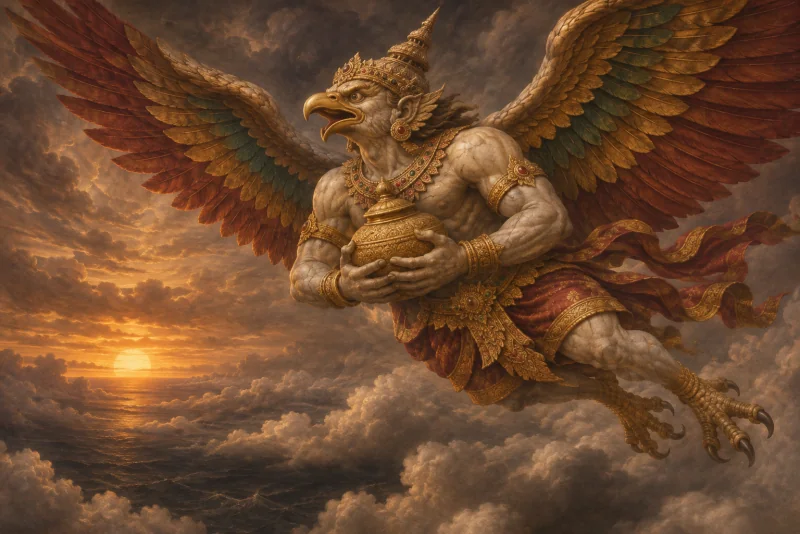
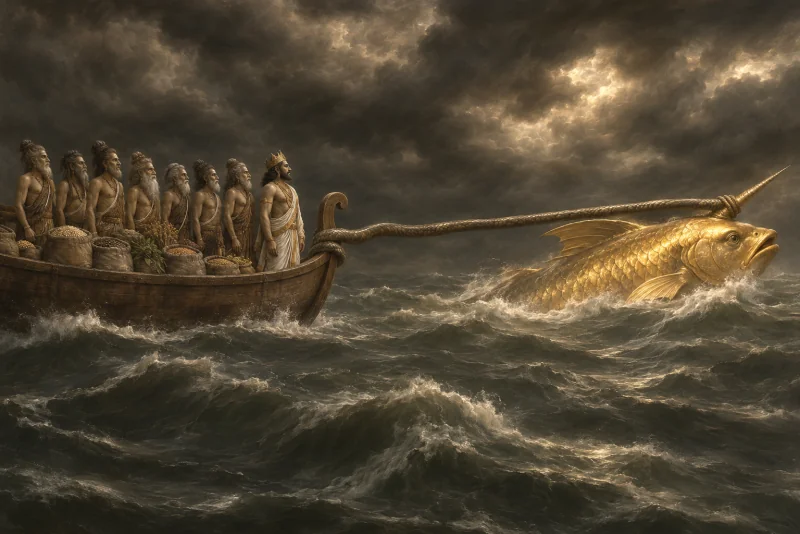
Cover and illustrations: AI-generated images made for Arcana. They are interpretations, not historical artworks.