Durga and Mahishasura: The Goddess and the Buffalo Demon
The buffalo demon Mahiṣa drove the gods out of heaven. Their anger became a mountain of light, and the light became a goddess. Images of her victory are older than the text that tells it, and every autumn Kolkata shapes her again from river clay.
- Type: myth, a goddess who wins back heaven for the gods
- Culture: India (Hindu tradition); Durga Puja is also kept by the Bengali diaspora
- Earliest texts: the Devī Māhātmya, part of the Mārkaṇḍeya Purāṇa, placed by its translator in the 5th or 6th century CE; in the Mahābhārata (Book 3) it is the god Skanda who kills Mahiṣa. Images of the goddess and the buffalo survive from about 200 CE
- Key figures: Durga (in the text mostly Caṇḍikā or Ambikā), the asura Mahiṣa (Mahiṣāsura), Brahmā, Vishnu, Shiva, Indra, the lion
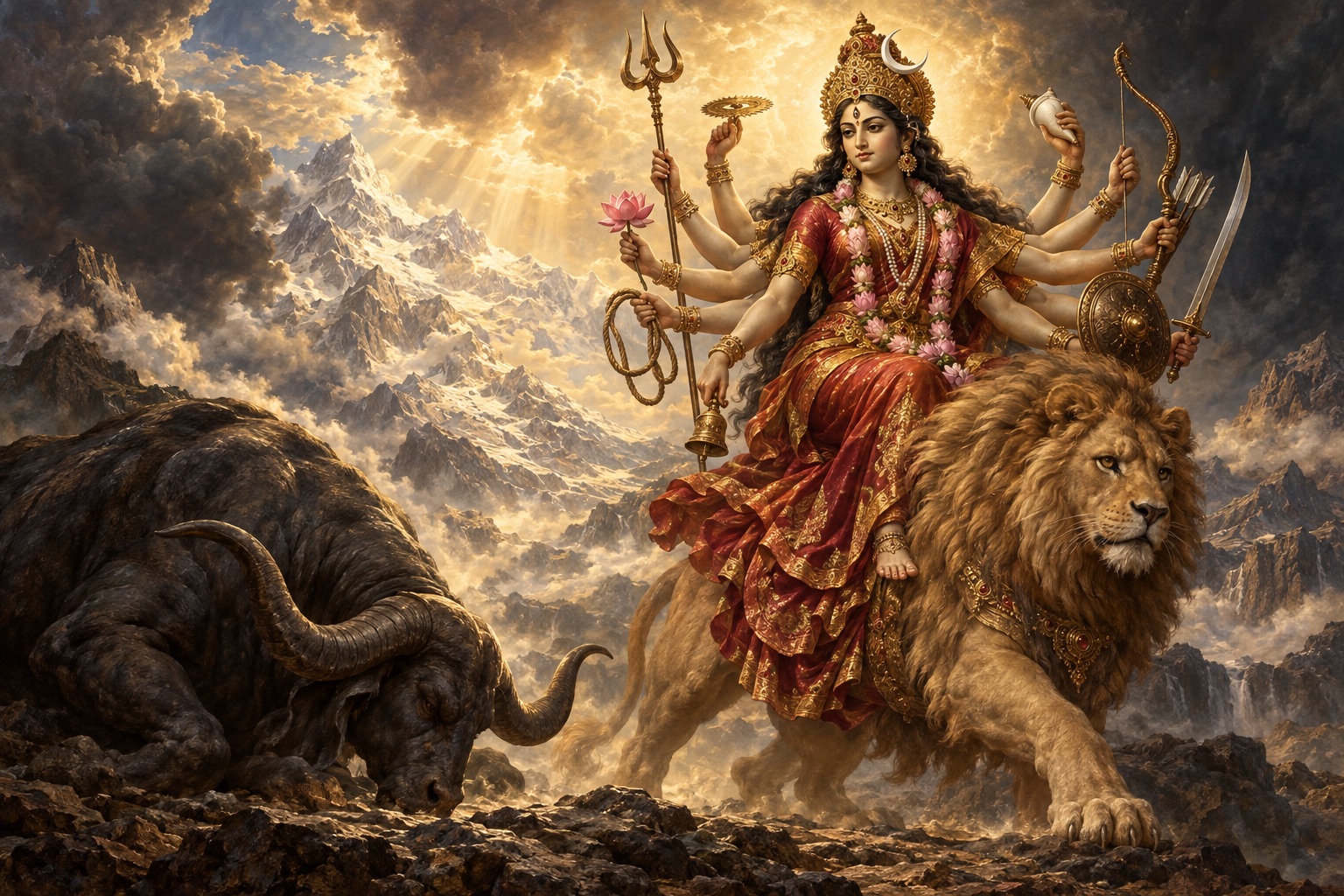
Every autumn in Kolkata, image-makers shape a goddess from the clay of the Ganga, paint in her eyes, and ten days later give her back to the river. She rides a lion and stands over a buffalo demon. The story behind that image is a war in heaven that the gods lost, and a goddess who won it back for them.
Why couldn’t the gods defeat Mahiṣa themselves? The Devī Māhātmya does not say. It tells only that they lost a war that lasted a hundred years, and that their anger became a light in which the goddess took shape. The well-known answer, that Brahmā had promised Mahiṣa no man could kill him, comes from a later text, the Devī Bhāgavata Purāṇa (section 3).
1 The Telling
This follows the Devī Māhātmya, “The Greatness of the Goddess”, chapters 81 to 84 of the Mārkaṇḍeya Purāṇa, in F. Eden Pargiter’s English translation of 1904. In the frame of the poem, the sage Medhas tells the story to a king who has lost his kingdom.
1-1 Heaven Lost
Long ago, says the sage, the gods and the asuras fought for a full hundred years. Indra led the gods, and Mahiṣa, the buffalo asura (Mahiṣāsura, often written Mahishasura), led the asuras. The gods were beaten. Mahiṣa conquered them all and “became the Indra”, the king of heaven. He took over the domains of the Sun, of Indra, Agni, Vāyu and the Moon, of Yama and Varuṇa. Driven out of heaven, the gods wandered the earth “like mortals”. With Brahmā at their head, they went to Shiva and Vishnu and told them everything.
1-2 A Mountain of Light
Vishnu grew angry as he listened, and so did Shiva, and their faces knotted into frowns. A great energy, tejas, poured from Vishnu’s mouth, then from the mouths of Brahmā and Shiva, and from the bodies of Indra and all the other gods. It merged into one mass, “like a burning mountain”, that filled the sky with its flames. Then it gathered into the form of a woman. Each god’s light became a part of her: Shiva’s her face, Yama’s her hair, Vishnu’s her arms, the Moon’s her breasts, Indra’s her waist, Brahmā’s her feet, the Sun’s her toes, Agni’s her three eyes and Vāyu’s her ears.
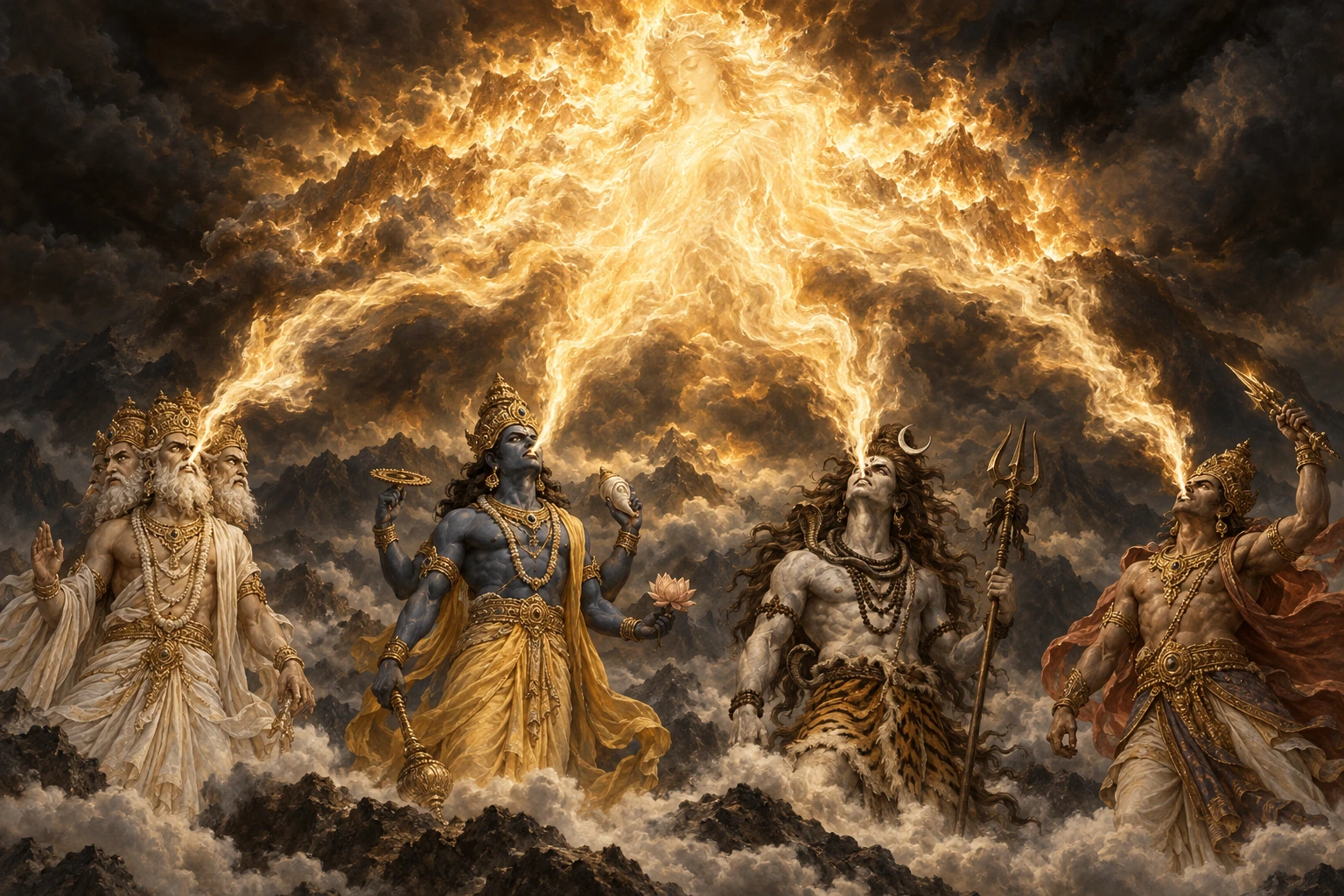
The text does not say that the gods made her, though. In the chapter before, the sage explains that the goddess “exists eternally”. When she reveals herself “to accomplish the purposes of the gods”, it is then that the world says she is born.
1-3 The Gifts of the Gods
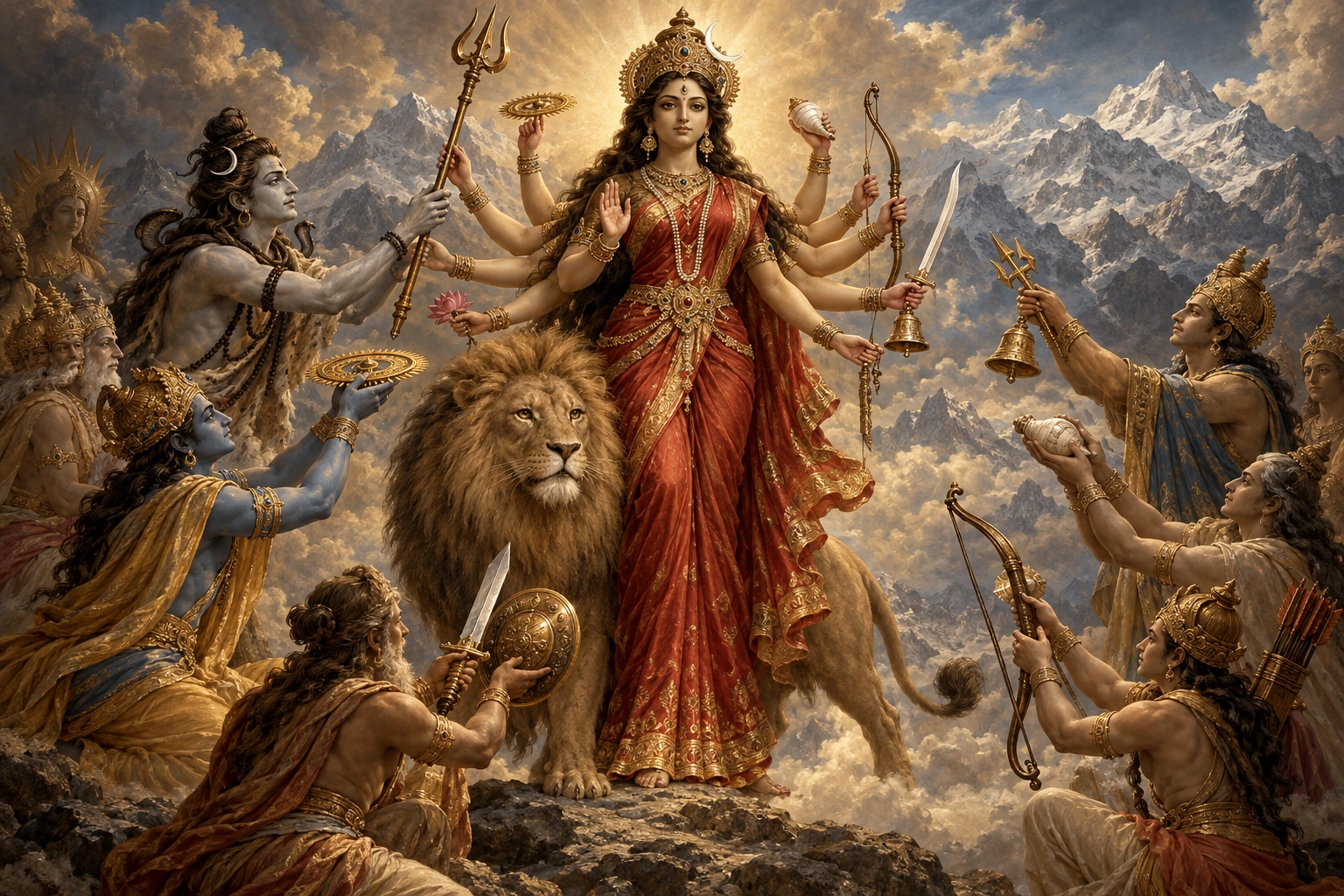
Then each god gave her a weapon, most of them drawn out of his own. Shiva drew a trident from his trident, and Vishnu a discus from his discus. Varuṇa gave a conch and a noose, Agni a spear, the wind god a bow and quivers full of arrows. Indra gave a thunderbolt and a bell from his elephant Airāvata, Yama a staff, Brahmā a water pot, and Time a sword and a shield. The Sun put his rays into the pores of her skin.
The Ocean gave her a pearl necklace, two garments that never wear out and garlands of lotuses. Viśvakarman, the craftsman of the gods, gave her jewels, an axe and armour that nothing could pierce. The mountain Himavat, the Himalaya, gave her a lion to ride, and Kubera a cup full of wine. The goddess roared and laughed, again and again. The worlds shook, the seas trembled, the mountains moved, and the gods cried out to her, “Conquer!”
1-4 The Battle
Mahiṣa heard the roar and rushed toward it with all his armies. He saw the goddess filling the three worlds with her light, the earth bowing under her feet, her crown grazing the sky, and “her thousand arms” spread out on every side. His generals came at her with millions of chariots, elephants and horses. She cut down their weapons “as it were in merest play”, and her face, the text says, showed no effort. Her lion stalked through the asura armies “like fire through the forests”, and the breaths she breathed out became troops who fought for her. One by one she defeated Mahiṣa’s generals, beginning with Cikṣura and Cāmara.
1-5 The Buffalo
Then Mahiṣa attacked “in his own buffalo-shape”. He tossed mountains on his horns. The earth crumbled under his hooves, the sea overflowed where his tail struck it, and the clouds were torn apart by his horns.
The goddess threw her noose over him and bound him. He left the buffalo’s shape and became a lion. As she cut at the lion, he became a man with a sword, and she pierced him, sword and shield together, with her arrows. He became a great elephant and dragged at her lion with his trunk, and she cut off the trunk with her sword. Then he took the buffalo’s shape again and shook the three worlds.
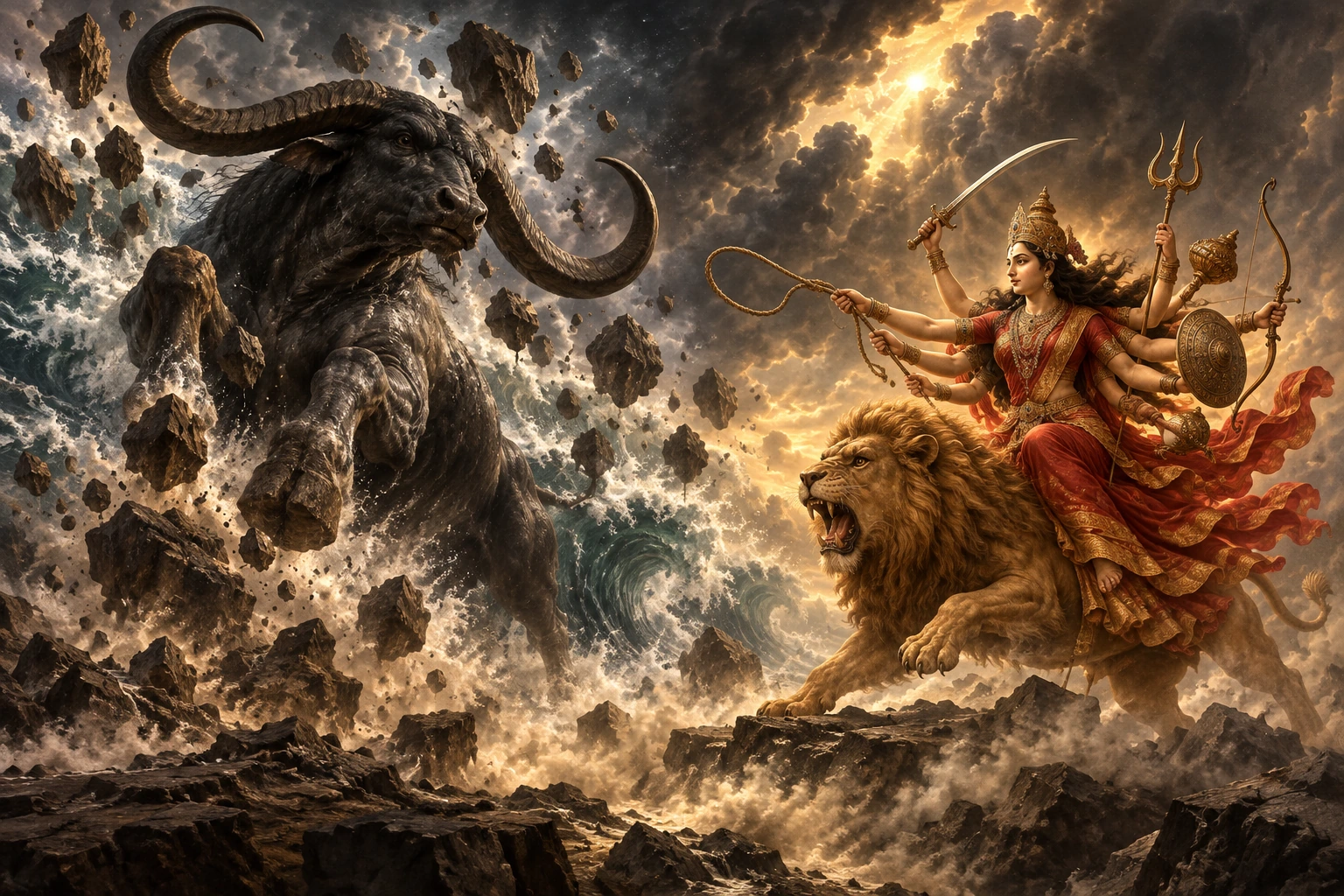
Caṇḍikā drank from her cup again and again and laughed, her eyes turning red. “Roar, roar on thy brief moment, O fool, the while I quaff this mead!” she told him. “The gods shall soon roar.” She sprang onto the buffalo, pressed down his neck with her foot and struck him with her spear. Overpowered, Mahiṣa came half out of his own mouth, still fighting. She struck off his head with her great sword, and the whole asura army perished.
1-6 The Promise
The gods sang a long hymn to her and offered her flowers and incense, and she offered them a boon. Nothing was left undone, they said, now that Mahiṣa was dead. They asked only this: whenever they called her to mind, she should take away their worst troubles, and she should bless whoever praised her with these hymns. “Be it so!” she said, and vanished.
2 Where the Story Is Written Down
- The Devī Māhātmya is a poem of thirteen chapters inside the Mārkaṇḍeya Purāṇa, chapters 81 to 93 both in the Calcutta edition of 1862 that Pargiter translated and in the Sanskrit text on GRETIL. Pargiter called it “a pure interpolation”, “a poem complete in itself”, added to an older work, and judged it “very probably” composed in the 5th or 6th century CE. The Los Angeles County Museum of Art dates it to about 550. Even in 1904, Pargiter noted, it was “a text-book of the worshippers of Kali throughout Northern India and in Bengal, especially at the great Durga-pūjā festival”.
- Chapter 81 sets up the frame and tells how the goddess helped Vishnu against the demons Madhu and Kaitabha. Mahiṣa fills chapters 82 to 84. Chapters 85 to 91 tell the story of two more asuras, Śumbha and Niśumbha.
- In chapter 92 the goddess asks for the poem to be heard “at the great annual worship that is performed in autumn time”, and on the eighth, ninth and fourteenth days of the lunar fortnight.
- The name Durga. In the Mahiṣa chapters the narrator calls her Caṇḍikā, Ambikā and Bhadrakālī. “Durgā” comes in the gods’ hymn: “Thou, O Durgā, when called to mind, dost remove terror from every creature!” The name is usually explained as “she who is hard to overcome”, and the hymn plays on it: she is Durgā, “the boat to cross the difficult ocean of existence”.
- The Mahābhārata, Book 3, the book of the forest years, has a different Mahiṣa, killed by the god Skanda (section 3).
- Later Purāṇas retell the goddess’s victory at length. The Vāmana Purāṇa (chapters 18 to 21) and the Devī Bhāgavata Purāṇa (book 5) give Mahiṣa a birth story, and the goddess another name or a reason to fight.
3 Competing Versions
- Who killed Mahiṣa?
- In the Devī Māhātmya, the goddess.
- In the Mahābhārata (critical edition 3.221; Vana Parva section 230 in K. M. Ganguli’s translation), Mahiṣa is a dānava who hurls a mountain at the gods. They flee, and he seizes the pole of Shiva’s chariot. Shiva does not kill him: he remembers that Skanda will be Mahiṣa’s death. Skanda arrives “clad in blazing red” in a chariot “bright as the Sun”, and his spear cuts off Mahiṣa’s head. One of Skanda’s names in that chapter is Mahishardana, “the slayer of Mahisha”.
- Why could no one beat him?
- The Devī Māhātmya gives no reason.
- In the Mahābhārata, Indra tells Skanda that Mahiṣa “was made invincible by the favour of Brahma”.
- In the Devī Bhāgavata Purāṇa (book 5, chapter 2), Brahmā refuses Mahiṣa immortality. So Mahiṣa asks that no male, god, dānava or human, can kill him: “how can women slay me? They are too weak to kill me!” Brahmā grants it. In chapter 10 the goddess tells him she has taken a woman’s form to keep Brahmā’s word.
- Why a buffalo? In the Devī Māhātmya the buffalo is simply “his own” form. The Vāmana Purāṇa (chapter 18) and the Devī Bhāgavata Purāṇa (book 5, chapter 2) make him the son of the dānava Rambha and a she-buffalo.
- Where did she come from? In the Vāmana Purāṇa (chapter 19) the gods’ light gathers at the hermitage of the sage Kātyāyana, who adds his own. The goddess who takes shape in it has eighteen arms, and she is called Kātyāyanī after him.
- How did he die? The Devī Māhātmya: half out of his own mouth, by her sword. The Vāmana Purāṇa (chapter 21): she pierces the buffalo’s throat with her trident, a man with a sword comes out, and she takes him by the hair and strikes off his head. The Devī Bhāgavata Purāṇa (book 5, chapter 18): she throws her discus.
- Editions differ. In chapter 91 of Pargiter’s translation the goddess foretells that she will kill an asura named Durgama. The Sanskrit text on GRETIL adds a line there: “my name will be famous as the goddess Durgā” (our translation).
4 History and Tradition
- The images are older than the text. A small red sandstone plaque from Mathura in the Los Angeles County Museum of Art (M.84.153.1) is dated about 200 CE. The six-armed goddess holds the buffalo down by the neck with her two main arms. The museum notes that Durga “first appears in Indian art during the Kushan Dynasty (circa 30-375)”, centuries before the Devī Māhātmya.
- Mamallapuram. In the Mahiṣāsuramardinī cave temple near Chennai, cut in the 7th century under the Pallava king Narasimhavarman I, a relief shows the eight-armed goddess on her lion, shooting arrows. Opposite her stands “the colossal figure of the buffalo-headed demon-king”, a mace in his hands, in an attitude “of yielding” (in a description by Dr. Vogel, quoted by H. Krishna Sastri).
- Three ways to show him. Sculptors gave Mahiṣa “a human body, or a human body with a buffalo’s head”, or showed “a buffalo from whose severed trunk proceeds a human figure”, Krishna Sastri writes. The last follows the texts in which he comes out of the buffalo. A 9th- or 10th-century sculpture from Kashmir or Himachal Pradesh in the Cleveland Museum of Art (1982.45) shows his “demonic form” emerging from the neck.
- Durga Puja in Kolkata has been on UNESCO’s Representative List of the Intangible Cultural Heritage of Humanity since 2021. UNESCO describes a ten-day worship in September or October. Workshops shape “Durga and her family” from unfired clay taken from the Ganga. Their eyes are painted on Mahalaya, the first day, “to bring the goddess to life”, and on the tenth day the images are immersed in the river the clay came from. In the images Kolkata artists make, the family is her two sons, Ganesh and Kartikeya, and her two daughters, Lakshmi and Saraswati.
- Navaratri, “nine nights”, is in UNESCO’s words “dedicated to the worship of the feminine energy or ‘Shakti’”. The Business Standard describes Durga Puja and Navaratri together as marking “the victory of the goddess Durga over Mahishasura”. In Gujarat, Navaratri is danced as Garba, around a lamp in a clay pot or an image of the mother goddess Amba. Garba joined the same UNESCO list in 2023.
- The Asur. Not everyone celebrates. In 2011 the Business Standard reported that members of the Asur, a scheduled tribe of Jharkhand and north Bengal, regard Mahiṣāsura as their ancestor and mourn him during the days of Durga Puja. The paper noted that the belief lives in oral tradition and that many younger Asurs no longer follow it. Outlook has described the same mourning: in the Asurs’ account, their king was killed by deceit.
Ten arms is how most people picture her, and a Kalighat painting from Kolkata of about 1890, now in Cleveland, gives her ten. The Devī Māhātmya gives her a thousand, the Vāmana Purāṇa eighteen, the Pallava relief at Mamallapuram eight, and the Kushan plaque in Los Angeles six.
5 Related Stories
- The Churning of the Ocean: Gods, Demons and the Nectar of Immortality: the same two sides. There the gods and the asuras churn the ocean together, and Vishnu takes a woman’s form to win the amṛta for the gods. Here they are at war, and the gods’ anger takes the form of a goddess. Vishnu’s discus is in both stories: in the Devī Māhātmya he draws a discus out of his own and gives it to her.
- Ganesha: How the God of Beginnings Got His Elephant Head: in the clay images Kolkata artists make for Durga Puja, Ganesha stands beside Durga as one of her four children.
- Zeus: The Youngest Son Who Became King of the Gods: another monster who nearly takes the gods’ throne. Hesiod’s Typhoeus would have come to reign over gods and men; Mahiṣa actually “became the Indra”. We have not found a scholar who compares the two; we link them for the theme.
- Kali: The Dark Goddess Born from Anger: the next battle of the same poem. The goddess who killed Mahiṣa returns to fight Śumbha and Niśumbha, and Kali springs from her brow. Already in 1904 Pargiter called the poem “a text-book of the worshippers of Kali”.
6 Sources
- Devī Māhātmya (Mārkaṇḍeya Purāṇa 81–93), Sanskrit text: GRETIL
- F. Eden Pargiter (trans.), The Markandeya Purana (Asiatic Society, Calcutta, 1904), cantos 81–84 and 91–92, with the introduction: archive.org
- Mahābhārata, critical edition, 3.221: GRETIL; K. M. Ganguli (trans.), The Mahabharata, Vana Parva, section 230: Project Gutenberg
- Vāmana Purāṇa, chapters 18–21, Sanskrit text: GRETIL
- Swami Vijñānānanda (trans.), The Srimad Devi Bhagavatam, book 5, chapters 2, 10 and 18 (Sacred Books of the Hindus, vol. 26, part 2, Panini Office, Allahabad): archive.org
- H. Krishna Sastri, South-Indian Images of Gods and Goddesses, chapter 5: Wikisource
- Los Angeles County Museum of Art, “Durga Slaying the Buffalo Demon” (M.84.153.1): LACMA; Cleveland Museum of Art, “Durga Destroying the Buffalo Demon” (1982.45) and “Durga Killing the Demon Mahisha” (2003.103): clevelandart.org, clevelandart.org
- Ministry of Tourism, Government of India, “Mahishasuramardini Cave Temple”: Incredible India
- UNESCO, “Durga Puja in Kolkata” (2021) and “Garba of Gujarat” (2023): ich.unesco.org, ich.unesco.org
- Amgueddfa Cymru – Museum Wales, “Durga Puja: Creating a Goddess” (2009): museum.wales
- Shine Jacob, “The demon’s brood”, Business Standard, 8 October 2011: business-standard.com; Pragya Shukla, “In The Land Of Asurs”, Outlook (updated 18 January 2024): outlookindia.com
- Kamimura Katsuhiko, “ドゥルガー”, Kaitei shinban Sekai daihyakka jiten: Kotobank
Cover and illustrations: AI-generated images made for Arcana. They are interpretations, not historical artworks.