Ra and Apophis: The Serpent the Sun Must Defeat Every Night
Every night the sun sailed through the twelve hours of the underworld, and every night the serpent Apophis lay across its path. The spells told him he would never rise again, then ordered the same rite again for the next day.
- Type: myth, the sun god’s nightly battle with the serpent of chaos
- Culture: ancient Egypt
- Earliest texts: the Coffin Texts of the Middle Kingdom already have a spell for driving Apep from the sun’s boat; the night journey is first painted in full in the tomb of Thutmose III (15th century BCE); the longest book of spells against him, in the Papyrus Bremner-Rhind, was copied about 305 BCE
- Key figures: Ra, Apophis (Apep), Isis, Seth, Serqet, Osiris, Khepri
Every evening the sun went down in the west, and every morning it came up in the east. In between, the Egyptians said, it sailed through the Duat, the world below, and somewhere on that route a great serpent lay in wait. Nobody built Apophis a temple or brought him an offering. (Apophis is the Greek form of his Egyptian name, Apep.) Instead, priests spat on him, trampled him and burned him in effigy, every day.
Did Ra ever kill Apophis? Every day, and never for good. The Book of Overthrowing Apep tells the serpent to “taste death” and says “thou shalt never rise again”. The very next instruction is to burn a wax figure of him at dawn, at noon, at sunset and at midnight, “every hour during the day and the night”, and “every day” (Budge’s translation).
1 The Telling
This retelling follows the Amduat, “What Is in the Underworld”, in E. A. Wallis Budge’s translation (1905). Where another book adds a scene, we say which.
1-1 The Night Sun
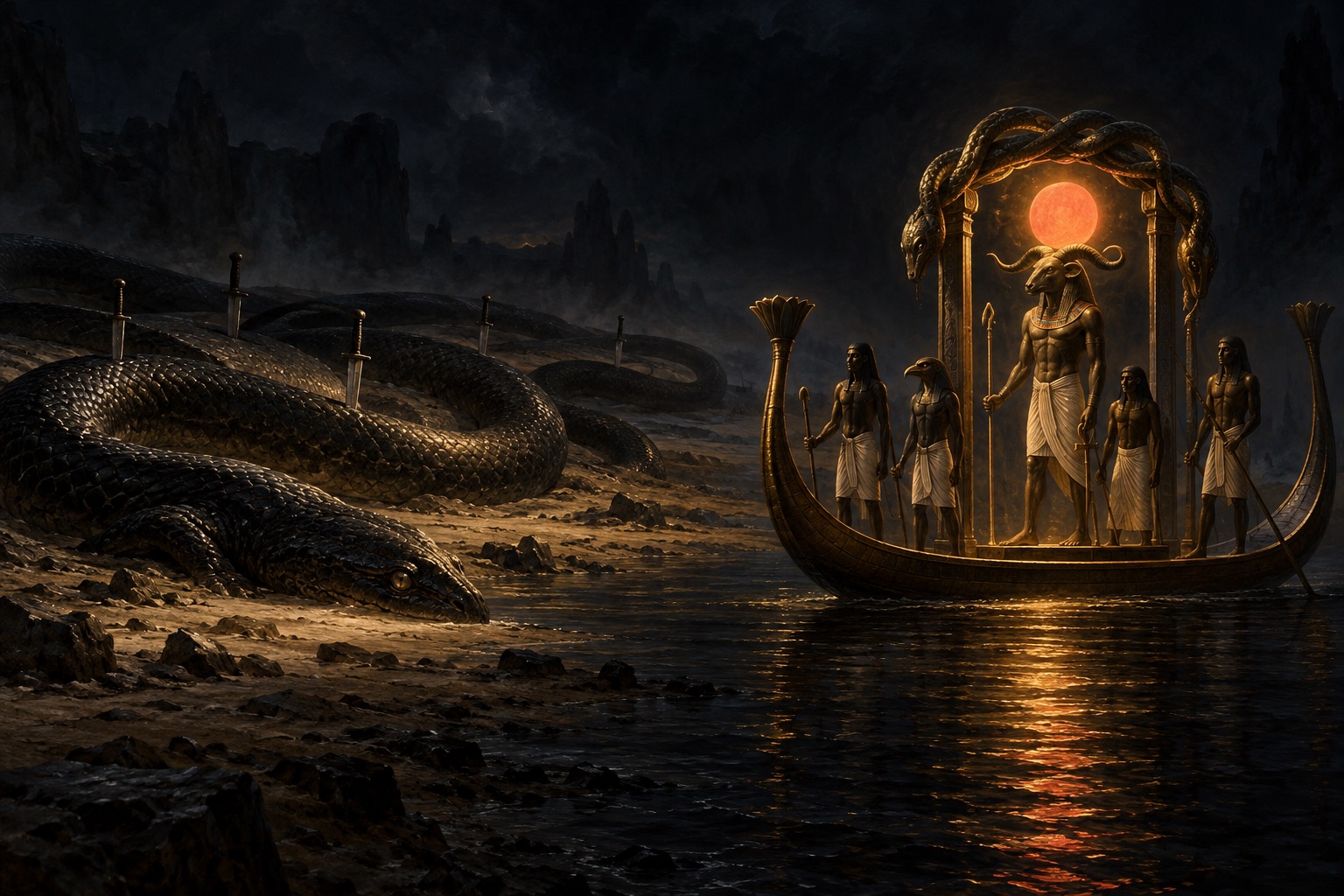
The night has twelve hours, and each is a region of the Duat with its own gate, its own name and its own inhabitants. The sun god sails through them in his boat with a crew of gods. He does not travel in his daytime form: he stands in a shrine as a man with a ram’s head, wearing the sun disk. The text calls him Af, and Budge calls him “the dead Sun-god”.
The book names everyone the boat meets, because knowing them is the point. Of the spells of the seventh hour it promises that whoever utters them “shall become one of those who are in the boat of Ra, both in heaven and upon earth”.
1-2 The Serpent across the Road
In the seventh hour the god takes up his abode in the Hall of Osiris, and there Apophis is waiting. “He surroundeth his country,” the text says, a district 440 cubits long and 440 cubits wide. The road through this hour “has no water, and none to tow”. The boat moves only by the words of power of Isis and of a god Budge reads as Ser, whom Robert Ritner, quoting the same passage, calls the “Elder Magician”. Isis stands in front of the god with both arms stretched out, reciting.
Then the serpent is bound. Six knives pin him to the ground. The scorpion goddess Serqet holds a band around his neck, and a god named Her-tesu-f ties a fetter around his tail. Four goddesses with knives, the text adds, “hack asunder Apep in the Tuat each day”.
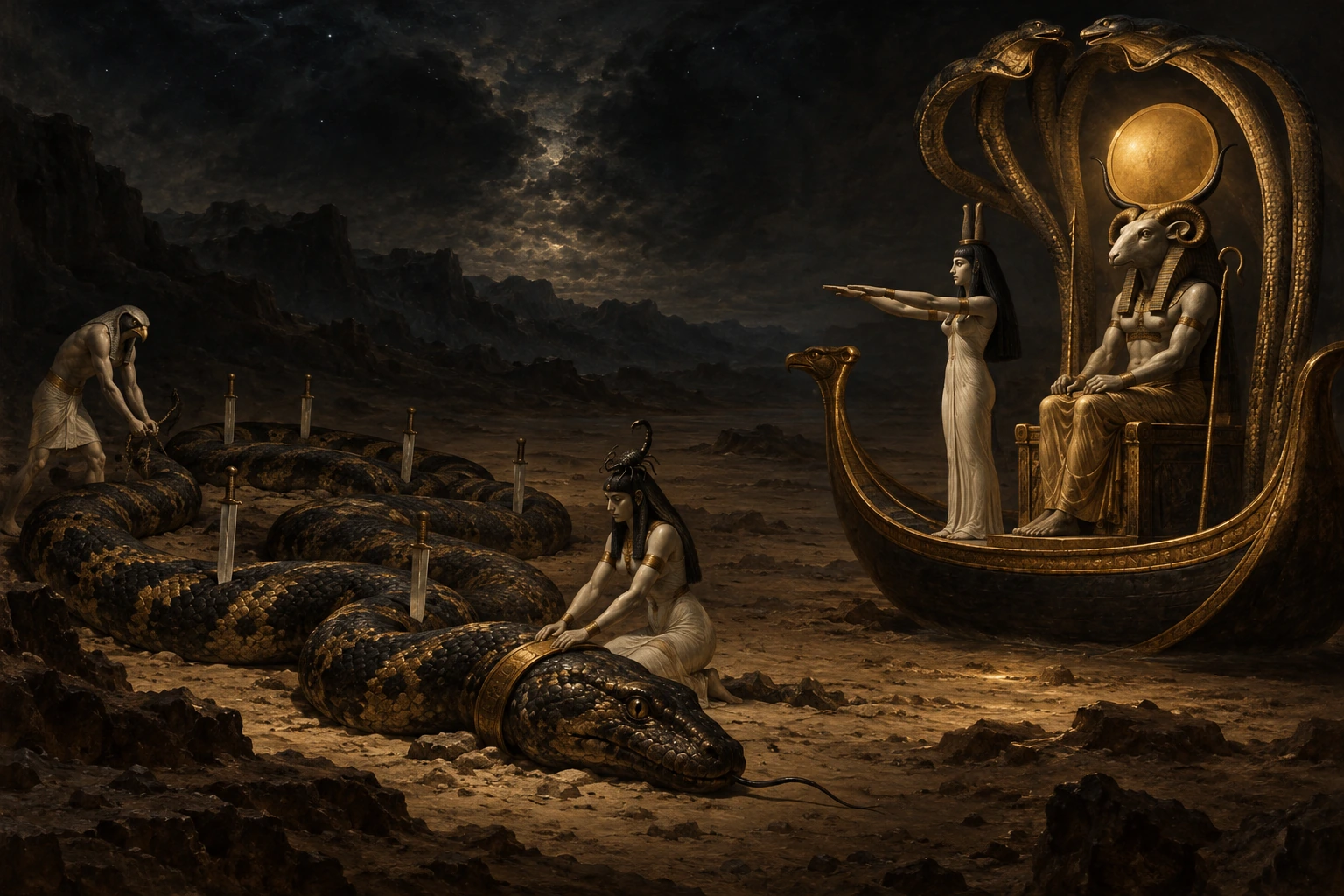
1-3 Ra and Osiris
In the same hour the sun god speaks to Osiris, “who dwelleth in the serpent Mehen”: “Hail, Osiris, Governor of the Tuat”. He says he has come “to illumine the darkness, and to embrace him that is in Mehen”. The Book of the Dead, spell 17, makes the meeting closer still. When Osiris came to Mendes, it says, he found the soul of Ra there. The two embraced, and became one pair of souls.
1-4 Seth at the Prow
The Book of the Dead tells the danger differently in spell 108. On the crest of Bakhu, the mountain on which the sky rests, lives a serpent thirty cubits long, the first cubits of him made of flint. After midday he turns his eyes on Ra. The boat stops, the crew is struck with amazement, and the serpent gulps down seven cubits of the great water.
Then Seth hurls a spear of metal at him and makes him spit out everything he has swallowed, and drives him back with a spell. Spell 108 ends with the speaker’s claim to know why Apophis is punished.
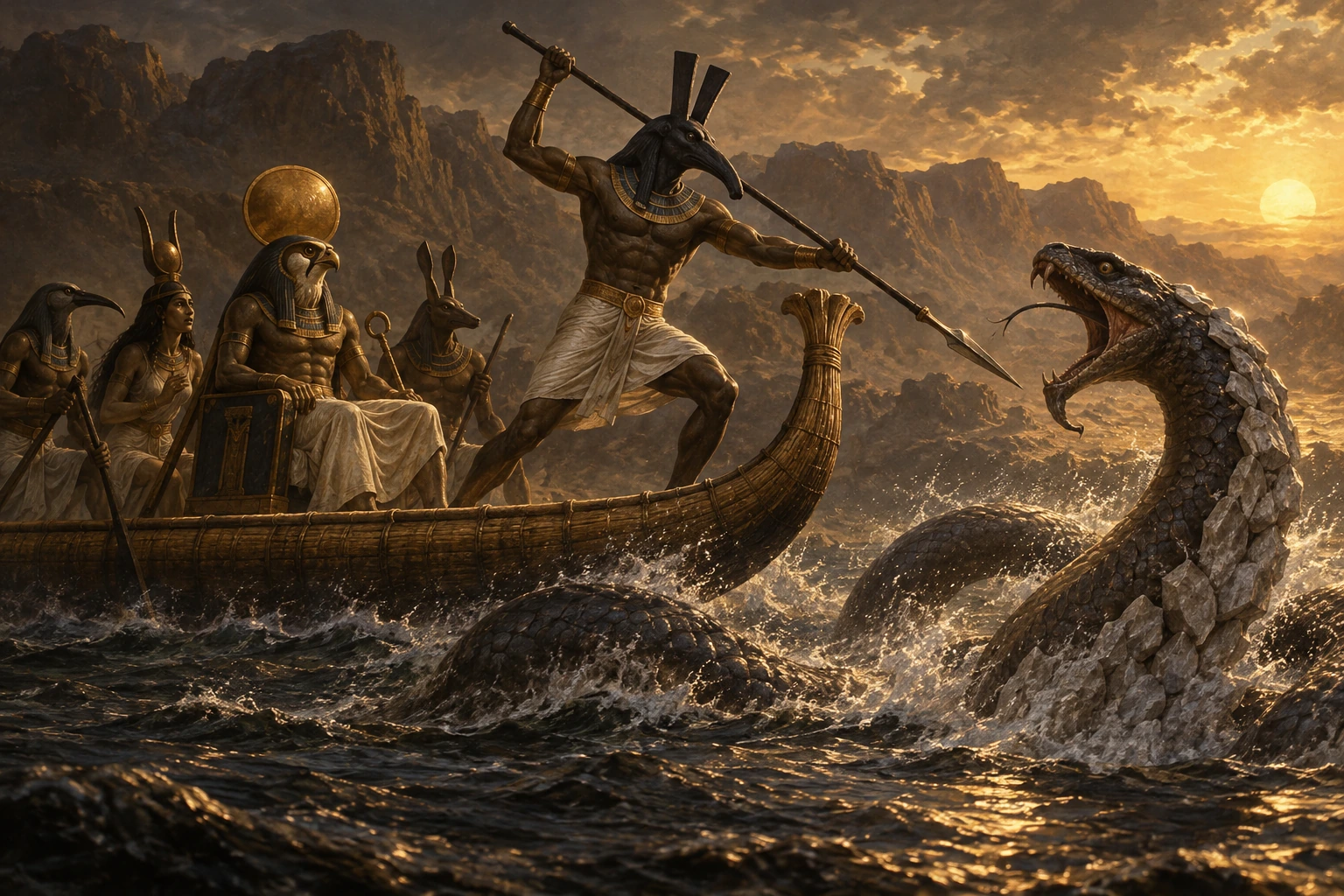
1-5 The Cat by the Tree
Spell 17 also gives the fight to the sun god himself. “I am the Cat which fought (?) hard by the Persea tree in Annu (Heliopolis),” the speaker says, “on the night when the foes of Neb-er-tcher were destroyed.” Thomas George Allen translates that title as “the Lord of the Universe”. The spell’s own commentary explains: “The male Cat is Ra himself”. The pictures that go with the spell show the fight. In the tomb of Sennedjem, a spotted cat sits beneath a leafy tree and holds a broad knife to the head of a long speckled serpent. The tomb of Inherkhau (TT 359) has the same scene.
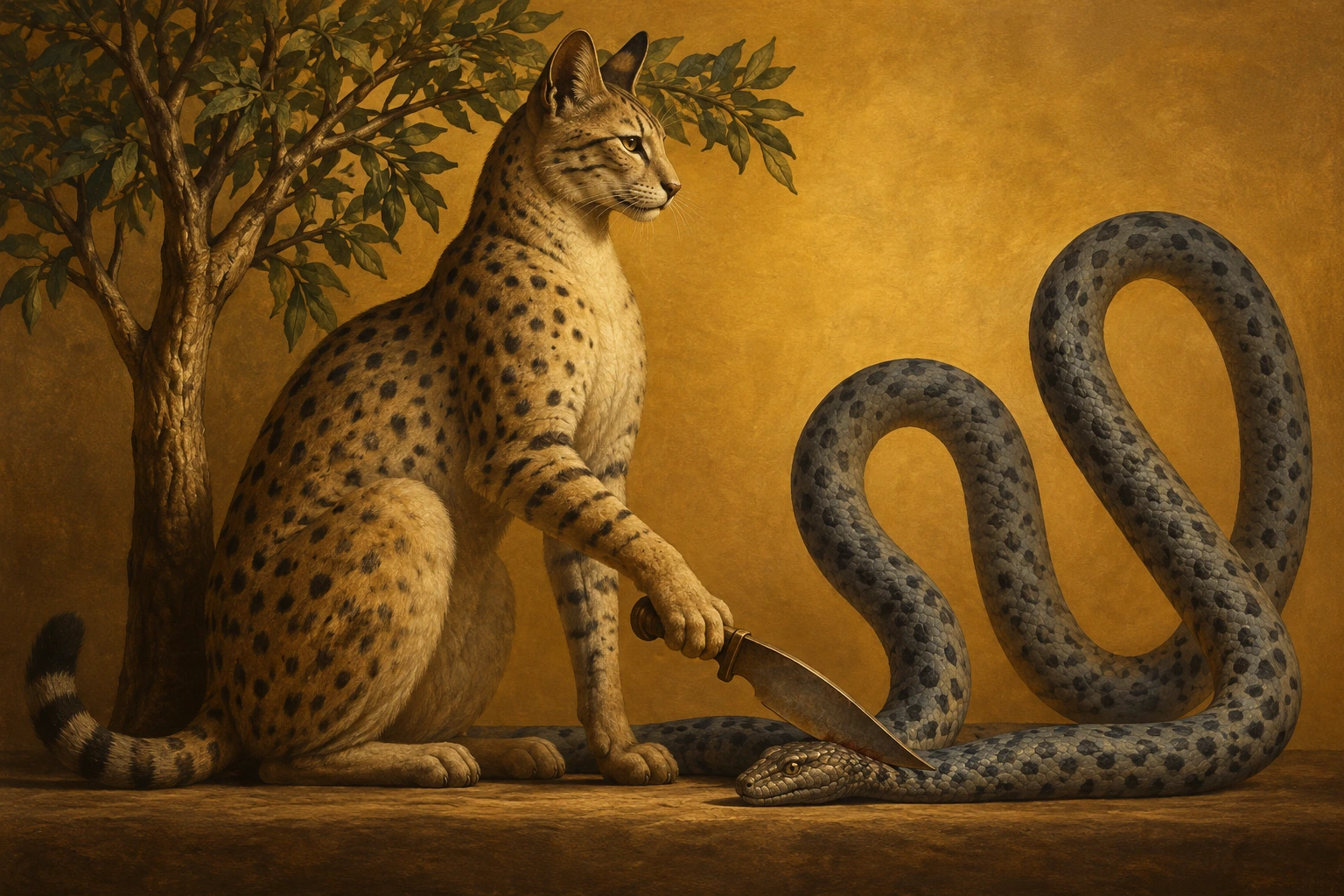
1-6 Sunrise
In the Book of Gates, in the last hours before dawn, gods hold Apophis in chains. Geb and the four sons of Horus “heap their fetters upon him”, and his poison drips down into the west. In the twelfth hour of the Amduat, the boat is towed into the tail of a giant serpent, and the god “cometh forth from his mouth” and is born as Khepri, the scarab of the morning. Shu, the god of air, receives him. The body of the night sun is left behind, cast away at the edge of the Duat, and the next evening the journey begins again.
2 Where the Story Is Written Down
- The Coffin Texts, written inside coffins of the Middle Kingdom. Spell 414 is a spell for driving Apep away from Ra’s boat, and Ritner suggests that a form of the temple rite against him already existed then.
- The Amduat, whose Egyptian title means the Book of the Hidden Chamber. The oldest complete copy is on the walls of the burial chamber of Thutmose III (KV34) in the Valley of the Kings, drawn in simple stick figures on a yellowish ground made to look like papyrus. Budge, in 1905, traced his illustrations from the published copy in the tomb of Seti I.
- The Book of Gates, named for the gate that closes each hour. Its first complete copy is carved inside and outside the alabaster sarcophagus of Seti I (died 1279 BCE), which Belzoni found in 1817 and which is now in Sir John Soane’s Museum in London. It rewards ordinary worshippers too: those who praised Ra on earth and “uttered words of power against Apep” are fed at the gate, and Ra tells them their offerings are theirs, for they have “vanquished Apep for me”.
- The Book of the Dead:
- spell 7, “of passing over the abominable back of Apep”, which addresses him as “thou creature of wax”;
- spell 15, sun hymns that rejoice because Apophis has fallen before Ra’s boat;
- spell 17, the cat by the tree;
- spell 39, “of driving back the serpent Rerek”, in which the Lynx tears open his breast, the Scorpion casts fetters on him, and the speaker declares “I am Set”;
- spell 108, Seth’s spear.
- The Papyrus Bremner-Rhind (British Museum EA 10188), about 305 BCE. Its Book of Overthrowing Apep says it is performed daily in the temple of Amun-Ra at Karnak. It holds spells for spitting on him, trampling him with the left foot, spearing, binding, cutting and burning him, a list of his names, and two accounts of the creation of the world.
3 Competing Versions
- Who defeats him? In the Amduat, the magic of Isis and the Elder Magician, with Serqet holding him down. In spell 108, Seth with a spear. In spell 17, Ra himself as a cat. In the Book of Gates, Geb and the sons of Horus with chains. In the Bremner-Rhind papyrus, priests on earth, for Ra and for Pharaoh.
- When does he strike? The Amduat meets him in the seventh hour of the night. Spell 108 has him attack after midday, on a mountain it places in the east of the sky. The Bremner-Rhind rite is to be repeated at dawn, noon, sunset and midnight, and also “when tempests rage in the east of the sky as Ra setteth”.
- How big is he? In the Amduat his district is 440 cubits each way. The serpent of spell 108 is thirty cubits long.
- His back or a sandbank? Spell 7 is for getting past his back, or “vertebra” in Allen’s translation. Allen notes that one 18th-Dynasty papyrus, that of Hatnofret, reads the word as “sandbar”.
- Where did he come from? Ritner notes a tradition in which Apep came from the spittle of the goddess Neith, just as Seth was spat out by the sky goddess Nut.
- Is the cat’s serpent Apophis? The words of spell 17 speak only of “foes”. The serpent is in the pictures, and Budge, describing the Papyrus of Ani, calls it Apep.
- Wax or red wax? Faulkner translated the figures of the Bremner-Rhind rite as having a “waxen body”. Ritner argues that the word is “red”, the colour of demons, and that the figures were of red wax.
4 History and Tradition
- A temple service. Budge found it remarkable that in the temple of Amun at Thebes, while some priests copied hymns, “another company was engaged in performing a service the object of which was to free the Sun” from “a monster called Apep”. The rubric he translates: draw Apep in green on a new sheet of papyrus, make a wax figure with his name cut into it and inlaid in green, and lay both on the fire. The Bremner-Rhind text adds wax figures of the enemies of Pharaoh, to be burned with him.
- Knives in the writing. By the New Kingdom, Ritner shows, knives were drawn stuck into images of Apophis, even into the snake sign used to write his name.
- Not only for kings. Ritner traces the rite spreading to private people by the New Kingdom. The Bremner-Rhind papyrus itself, compiled for a temple, ended up as a priest’s private property. Workmen at Deir el-Medina owned a spell whose speaker says he has fought “your Apophis” for the person it protects, and the Instruction of Amenemope uses spitting on Apep as a proverb.
- Seth changes sides. In the Book of the Dead, Seth guards the sun boat. In temple ritual, Ritner writes, he came to share the serpent’s fate: wax figures of both were bound, trampled, stabbed and burned, and in the Late Period both their names were written with knives in them.
- Fish at Esna. At the temple of Esna, priests struck fish that carried the names of Apep and other enemies at the four gates, then burned them while the Book of Overthrowing Apep was read (Ritner, citing Serge Sauneron).
- Feared, not worshipped. Apophis “never had a formal cult and was never worshiped”, as Joshua J. Mark puts it. A Japanese encyclopedia, Mypedia, describes him as killed and yet always reviving.
- Asteroid 99942 Apophis was discovered on 19 June 2004 at Kitt Peak by Roy Tucker, David Tholen and Fabrizio Bernardi. Its naming citation calls Apophis “the Egyptian god of evil and destruction who dwelled in eternal darkness”. On 13 April 2029 it will pass about 32,000 km from the Earth’s surface. NASA says it poses no risk of impact for at least 100 years, and has redirected a spacecraft, OSIRIS-APEX, to study it.
Seth is often remembered only as the god who murdered Osiris. In the Book of the Dead he is also the one who spears Apophis to save the sun boat, and in spell 39 the dead claim his strength: “I am Set”. Only later did temple ritual treat him like the serpent.
5 Related Stories
- Osiris: The Murdered King Who Rules the Dead: the Seth who kills his brother there is the Seth who guards the sun here, and the sun’s night journey passes through the realm Osiris rules.
- The Churning of the Ocean: Gods, Demons and the Nectar of Immortality: the beheaded Rāhu keeps up an endless feud with the Sun and the Moon, and swallows them in eclipses. Another enemy of the sun who is beaten but never finished. We have not found a scholar who compares the two; we link them for the theme.
- Yamata no Orochi: Susanoo and the Eight-Headed Serpent: in Japan, too, a god cuts a giant serpent to pieces. Seth, the serpent-fighter here, is also a god of storms: in spell 39 the speaker is “Set who let loose the storm-clouds and the thunder”. A shared theme, not a known connection.
- Amaterasu and the Rock Cave: The Day the Sun Hid: in Japan the sun goes missing once and has to be drawn back out. In Egypt it vanishes every night and has to fight its way back. A shared theme.
- The Eye of Ra: Sekhmet and the Destruction of Mankind: the Ra who sails through the underworld every night is here the old king who has withdrawn to the sky on the cow’s back, and the Eye that rages against mankind is his daughter. The Bremner-Rhind papyrus holds both the spells against the serpent and the story of the raging Eye.
6 Sources
- Amduat, seventh and twelfth hours, and the Book of Gates, trans. E. A. Wallis Budge, The Egyptian Heaven and Hell (1905): archive.org
- Book of the Dead, spells 7, 15, 17, 39 and 108, trans. E. A. Wallis Budge, The Book of the Dead: An English Translation of the Chapters, Hymns, etc., of the Theban Recension (1901): archive.org, vol. 1, archive.org, vol. 2
- Book of the Dead, the same spells, trans. Thomas George Allen, The Book of the Dead or Going Forth by Day (Oriental Institute, 1974): ISAC
- Papyrus Bremner-Rhind (British Museum EA 10188), The Book of Overthrowing Apep, trans. R. O. Faulkner (Journal of Egyptian Archaeology, 1937 and 1938): attalus.org
- E. A. Wallis Budge, Egyptian Magic (1901), pp. 78–81, translating the rubrics of the same book: archive.org
- Robert K. Ritner, The Mechanics of Ancient Egyptian Magical Practice (Oriental Institute, 1993), pp. 18, 31, 65, 84–85, 147–150, 165, 209–212: ISAC
- The Metropolitan Museum of Art, “Wall painting of a cat killing a serpent” (30.4.1), Charles K. Wilkinson’s facsimile from the tomb of Sennedjem (TT 1): metmuseum.org
- Sir John Soane’s Museum, “Sarcophagus of Seti I”: soane.org
- Joshua J. Mark, “Apophis”, World History Encyclopedia (2017): worldhistory.org; photograph of the cat and serpent in the tomb of Inherkhau (TT 359): worldhistory.org
- “アポピス”, Mypedia: Kotobank
- NASA, “Apophis”: science.nasa.gov; naming citation of (99942) Apophis: JPL Small-Body Database
Cover and illustrations: AI-generated images made for Arcana. They are interpretations, not historical artworks.