The Eye of Ra: Sekhmet and the Destruction of Mankind
When people plotted against the ageing sun god, he sent his Eye against them, and she became Sekhmet, the Powerful One. To save the rest of humankind, Ra flooded the fields at night with seven thousand jars of beer coloured red like blood.
- Type: myth, the sun god’s Eye as a goddess who destroys and has to be calmed
- Culture: ancient Egypt
- Earliest texts: the Pyramid Texts (from the 24th century BCE) already speak of the Eye of Ra; the destruction of mankind is told in the Book of the Heavenly Cow, whose oldest known copy is on a gilded shrine of Tutankhamun (14th century BCE); the Eye’s flight to Nubia is told most fully in a Demotic papyrus of about the 2nd century CE
- Key figures: Ra, his Eye as Hathor and Sekhmet, Nun, Shu, Nut, Tefnut, Thoth
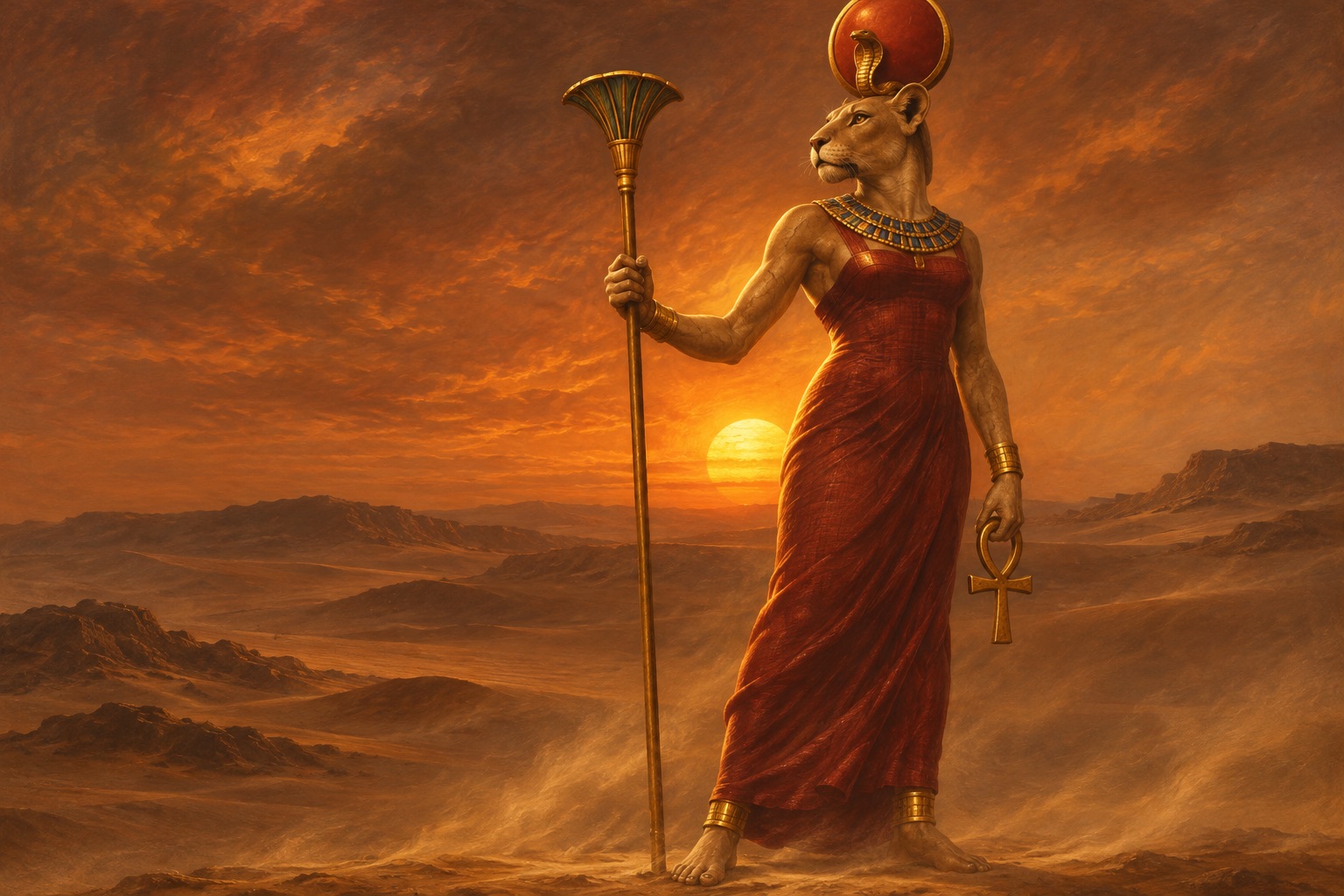
Egyptian artists gave the sun god a disk on his head and a rearing cobra on his brow. The sun, the Egyptians said, was his Eye, and the Eye was a goddess with a will of her own. Sent out against his enemies she was Sekhmet, the Powerful One, a lioness who did not know how to stop. Calmed and brought home she was Hathor, the gracious lady of music and drink. Her stories tell how the sun’s fury was once turned aside with seven thousand jars of red beer, and how, when it left Egypt, it had to be coaxed back.
Did Ra mean to wipe out humankind? Only the rebels, and only at first. The gods advised him to send his Eye after the people who had fled into the desert. After the first night of killing he had red beer brewed, and when he saw it he said, in Budge’s translation, “I must protect men and women against her.” The translations we read give no reason for the change.
1 The Telling
This retelling follows the copy in the tomb of Seti I, as E. A. Wallis Budge translated it in 1912. We check it against Mark-Jan Nederhof’s newer translation of the first part (2006, revised 2015), and say where the two read the text differently.
1-1 The Old King
Ra had made himself, and he ruled while gods and people still lived together. Then he grew old: “his bones have become like silver, and his members have turned into gold and his hair is like unto real lapis-lazuli”. People began to speak against him. Budge calls it “words of complaint”; Nederhof translates “conspired”. Ra heard them. He sent for his Eye, for Shu and Tefnut, Geb and Nut, for the fathers and mothers who had been with him in Nun, the primeval water, and for Nun himself. They were to come “secretly”, so that people would not see them and flee.
1-2 The Council in Secret
The gods bowed to the ground on either side of him. Ra said to Nun: “those who were created by my Eye are uttering words of complaint against me.” He would not kill them, he said, until he had heard what the gods advised. Nun answered that the Eye should go against them. But the people had already run off into the desert hills, Ra said, afraid of what they had said. “Let thine Eye go forth,” the gods replied, for no eye could stand against it “when it journeyeth in the form of Hathor.”
1-3 The Powerful One
The goddess went out and killed the people in the desert. When she came back, Ra welcomed her, and she told him: “when I gained the mastery over men and women it was sweet to my heart.” Ra answered that he would prevail over them as king. In Nederhof’s translation the text then says, “Thus Sachmet came into being”: the name Sekhmet means “the Powerful One”. All night she waded in their blood, as far as Herakleopolis.
1-4 Seven Thousand Jars
Ra called for messengers “able to run like the wind” and sent them to Elephantine, at Aswan, for a red mineral the text calls didi. Nederhof translates it “haematite”, red ochre. A goddess of Heliopolis ground it while servant women ground barley for beer, and when it was stirred into the mash the beer looked “like human blood”. They made seven thousand jars.
Ra came with the gods to look at the beer and said that he would protect people from her. In the middle of the night he had it poured out, and the fields were flooded with it three palms deep. At dawn the goddess came and found them flooded, and the sight pleased her. She drank, and in Budge’s words “her heart rejoiced, and she became drunk, and she gave no further attention to men and women.”
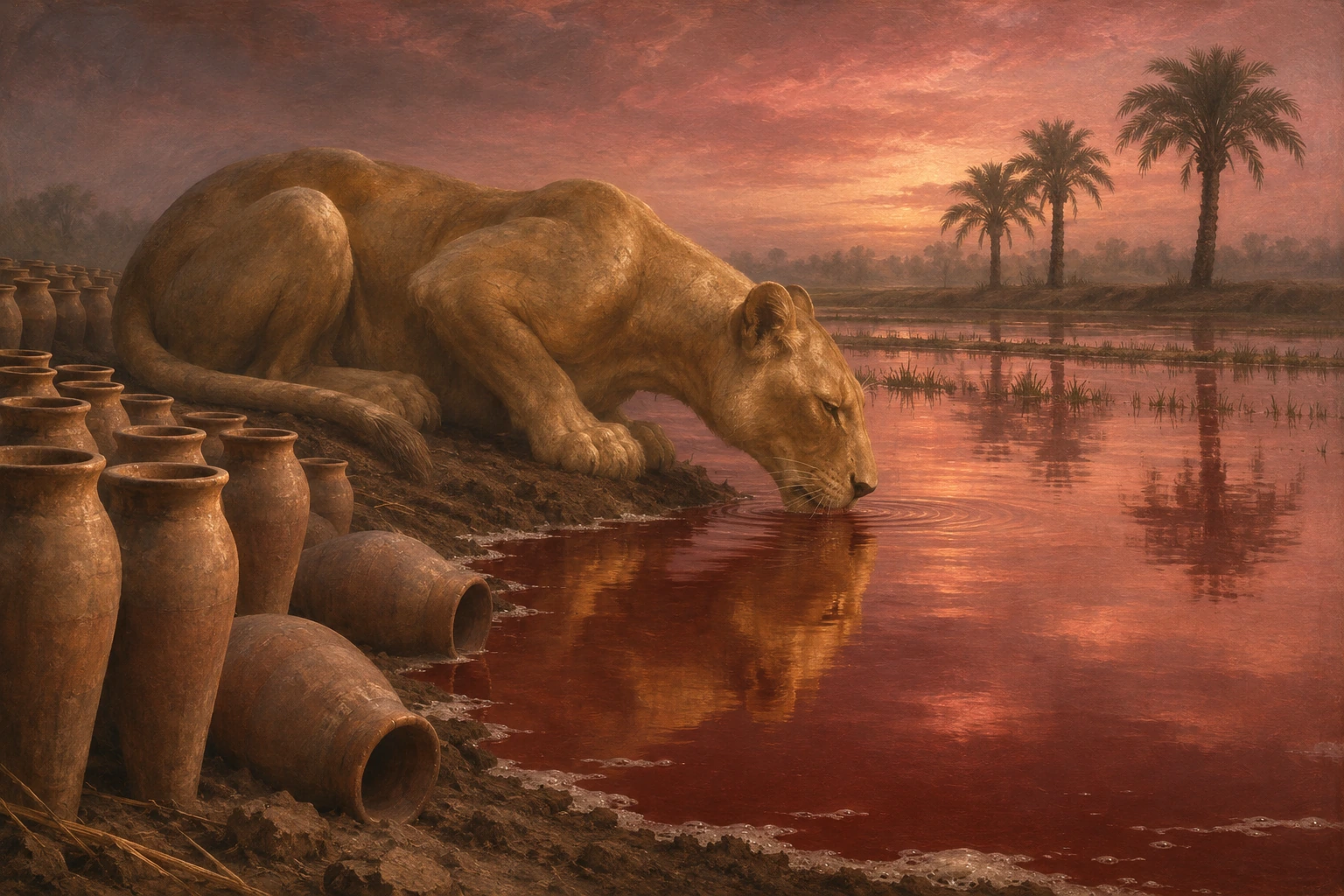
“Come in peace,” Ra said to her, and called her “gracious one”. In Egyptian the word makes a pun on the name of a town in the western Delta, which the text says got its beautiful women that day. And Ra ordered that at every festival of Hathor, jars of the beer “which make them to sleep” should be brewed, as many as his handmaidens.
1-5 The Cow of Heaven
But Ra was weary. “My heart hath become exceedingly weary with existence with them,” he said, and his limbs were weak for the first time. Nun told Shu to help him and told Nut to carry him. Nut became a cow, and Ra sat on her back.
When people saw him there, they begged him to stay and offered to fight his enemies. The earth went dark. In the morning they came out with bows and shot at the enemies of Ra. But Ra said, “I am departing from them,” and “he must come after me who would see me.” In the sky he made the Field of Peace and the Field of Reeds, as Budge calls them, and the stars. Nut trembled at the height, so Ra made the supports of heaven and set Shu beneath her to hold her up.
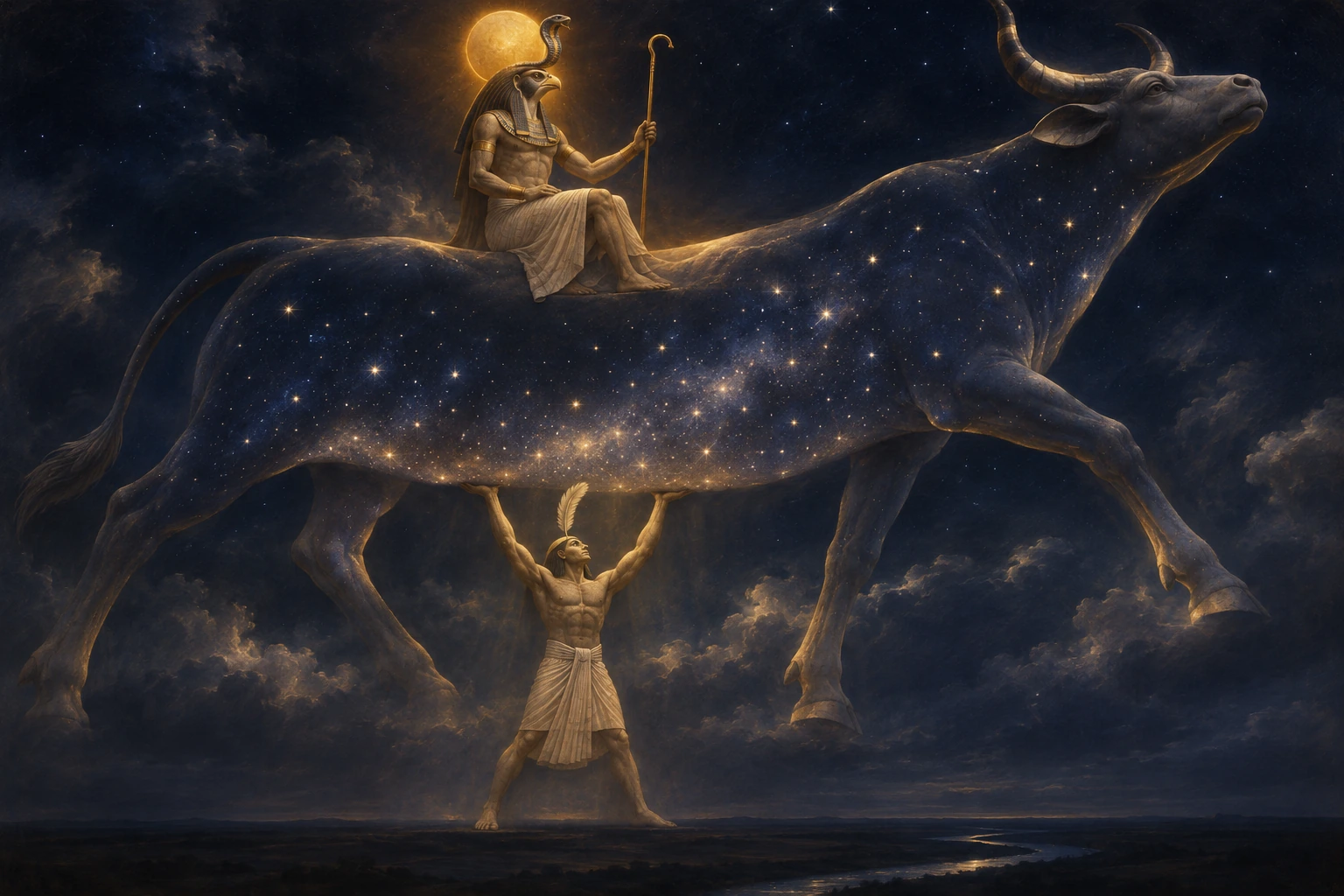
Then Ra told Geb, the earth god, to keep watch on the serpents, and made Thoth his deputy: “the Moon-god (Aah) of Thoth” came into being. The book ends with instructions for whoever recites it. He must wear new clothes and white sandals and have a figure of Maat drawn on his tongue in green, and then he “shall be like Ra on the day of his birth”.
1-6 The Goddess Who Went Away
Another story has the Eye leave Egypt. Its fullest telling is the Demotic Myth of the Sun’s Eye (Leiden papyrus I 384), whose beginning is lost. We follow the English version compiled at attalus.org from the modern translations.
The goddess, here Tefnut, the daughter of Ra, had left Egypt in anger and gone south to Nubia, where she lived as a wild “Nubian cat”. Egypt fell silent without her: “Joy has left along with you; intoxication is finished and forgotten”. So a small baboon, a “dog-monkey”, went to fetch her, the sacred animal of Thoth: The Ibis God of Writing and the Moon. He praised her, argued with her and told her fables, among them the lion and the mouse, which is also one of Aesop’s.
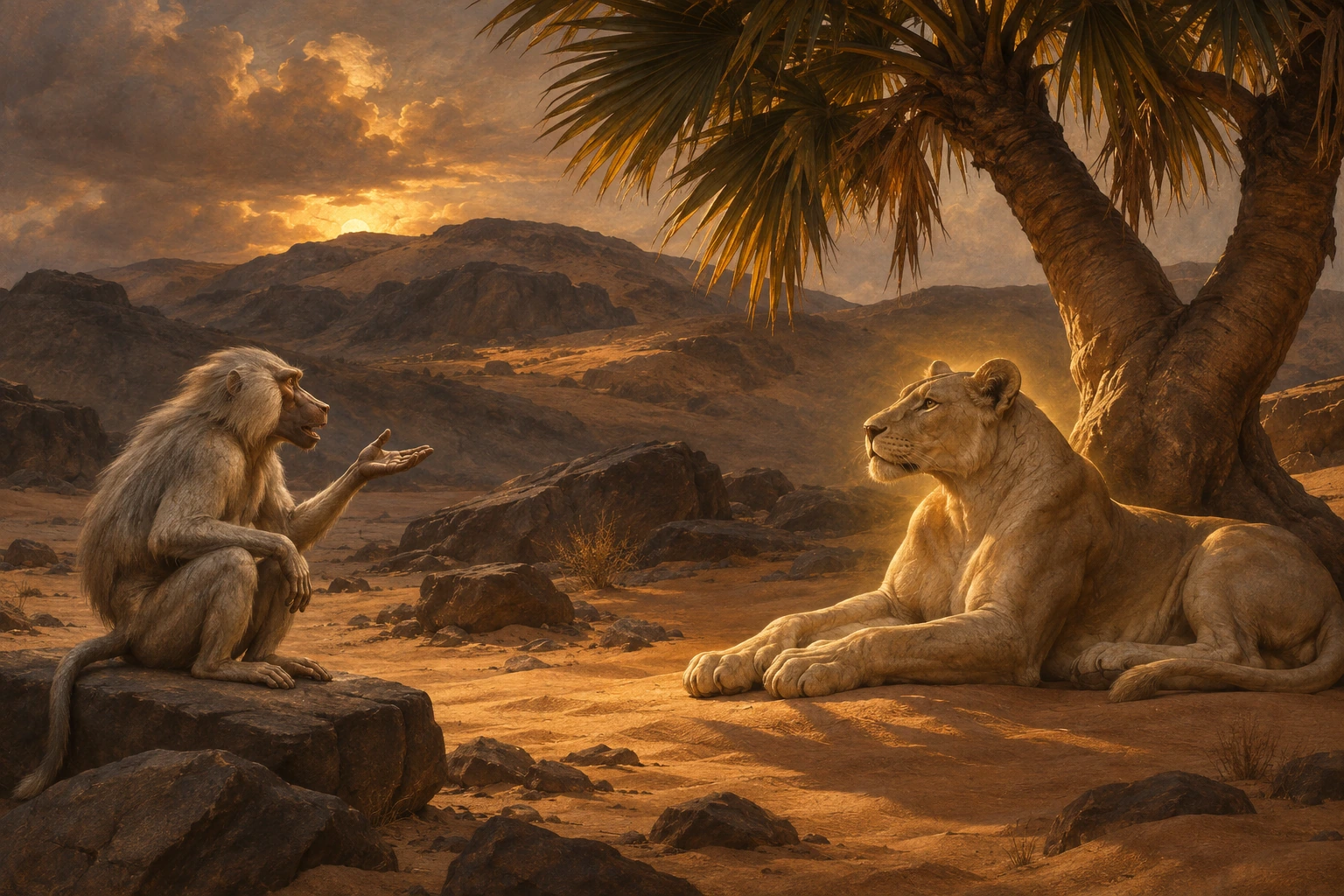
Once she wept. Once she turned into a furious lioness, whose “face shone like the disk of the sun”, and the little baboon shrank in terror. Then she was calmed and turned her face towards Egypt. She came home by way of Thebes and Memphis, with festivals on the road, and Ra praised the baboon “as Thoth the thrice-great god”. In the temples of the Ptolemies, as Barbara Richter sums them up, Shu and Thoth bring her back, and at Philae she bathes in the sacred waters and becomes a beautiful woman.
2 Where the Story Is Written Down
- The Pyramid Texts. Utterance 405 makes the king “that Eye of yours”, the Eye of Ra, “which is on the horns of Hathor”, and utterance 689 sets the Eye of Horus “on the brow of Ra” (as Barbara Richter translates them).
- The Coffin Texts. In spell 76 Shu says that Atum once sent his “Sole Eye” to look for him and his sister Tefnut. In spell 890 the speaker is “he who sought her who is far away” (both as Richter quotes them).
- The Book of the Heavenly Cow. Its oldest known copy, incomplete, is inside the left and back panels of Tutankhamun’s outermost gilded shrine. Fuller copies fill the walls of a room beside the burial chamber in the tombs of Seti I, Ramesses II and Ramesses III; Ramesses VI has a shortened one in a niche, and a papyrus extract from Deir el-Medina is in Turin (Andrew Fulton). In Seti I’s room the cow is painted on the wall facing the door, with stars along her belly, the two boats of the sun, and Shu holding her up (Budge).
- The Book of the Dead, spell 167. Thoth brings back the Eye and calms it after Ra sent him to look for it (Papyrus of Nebseni, as Richter quotes it from C. J. Bleeker).
- The Cairo Calendar (Papyrus Cairo 86637, about 1244–1163 BCE), a calendar of lucky and unlucky days, marks “the day of the executioners of Sakhmet” (A. Bakir’s translation, as Lauri Jetsu and Sebastian Porceddu quote it).
- The Papyrus Bremner-Rhind (British Museum EA 10188), about 305 BCE. When the Eye comes back with Shu and Tefnut, it finds another eye grown in its place and rages, and the creator sets it on his face (see Atum: Creation at Heliopolis).
- The Leiden papyrus I 384, in Demotic, found at Thebes. Wilhelm Spiegelberg, who published it in 1917, dated the hand between the 1st and 3rd centuries CE. Pieces of other copies survive, and a London papyrus of the 3rd century CE (P. BM 274) holds fragments of a Greek translation.
- Temple walls. Richter finds the Distant Goddess in at least twenty-two temples of the Ptolemaic period, from Bubastis in the Delta to el-Dakka in Nubia.
3 Competing Versions
- Hathor or Sekhmet? The Eye goes out “in the form of Hathor”. Sekhmet appears only after the killing, when Ra says he will prevail (sekhem) over them: her name is made from that word. Budge, in 1912, read the line as “Sekhet of the offerings waded about in the night season in their blood”.
- Mandrakes or ochre? Budge, following Brugsch, took the fruit he calls tataat for “mandrakes”, and read the brewers as adding “some of the blood of the men and women”. In Nederhof the beer only looks like blood because of the haematite, and the Global Egyptian Museum describes it as beer “mixed with red ochre”.
- What was flooded? In Budge “the meadows of the Four Heavens were filled with beer”. Nederhof’s fields are flooded “three palms high”.
- Which goddess goes away, and who fetches her? In the Leiden papyrus it is Tefnut, the “Nubian cat”, whom the baboon also hails as “Shesmetet-Sekhmet” when she rages. Spiegelberg took the baboon for Thoth himself; attalus.org notes that he is sometimes identified as Thoth’s son. In the Ptolemaic temples Shu comes with Thoth, and in the town of This the god Onuris brings home the lioness Mehyt. His Egyptian name, Iniheret, means “He who has brought the far-off one” (Global Egyptian Museum).
- What did it mean? Richter gathers the readings. Leitz tied the red beer to the low Nile, when the river turns reddish-brown and plague spreads; Junker and Spiegelberg placed the festival of her return at the summer solstice; Bleeker saw an eclipse in it, and Goebs the sunrise.
4 History and Tradition
- The uraeus. The cobra on the brow of kings and gods was the goddess Wadjet, and myth linked it with the Eye of Ra, the Eye of Horus and the crown of Lower Egypt. Hathor, Bastet, Sekhmet and Tefnut were all associated with it (Global Egyptian Museum).
- Cause and cure. Sekhmet’s arrows and scorching breath brought sickness, so she was also the goddess who could take it away. Her priests had to ward off “disease-bearing demons” with magic (Global Egyptian Museum).
- A lioness and a cat. In time Bastet came to stand for the lioness goddess’s friendly side and Sekhmet for her wild one; the Global Egyptian Museum dates that to the Middle Kingdom, though Bastet appears as a cat only later (see Bastet: The Cat Goddess).
- Hundreds of statues. Amenhotep III (about 1390–1352 BCE) dedicated hundreds of granodiorite statues of Sekhmet in his mortuary temple at Thebes, and many were later moved across the river to the temple of Mut at Karnak (Cleveland Museum of Art). Some put their number above 730, and Jean Yoyotte read them as a rite in stone to pacify the goddess. In the Amarna period the king’s name was chiselled off their thrones, then cut again; most were later damaged on purpose, above all on the head and hands (Simon Connor). The largest groups are now in Turin, London, Paris, Berlin, New York and Cairo.
- A hall of drunkenness. At the temple of Mut, Betsy Bryan’s team found column drums from a “columned hall/porch of drunkenness” that Hatshepsut built for the goddess. A feast of drunkenness on the 20th day of the first month is already listed in a Middle Kingdom papyrus from Illahun. A Ptolemaic festival calendar of the temple has beer tinted with didi poured for her “to appease her heart in her anger”, and Dendera kept its own Festival of Drunkenness of Hathor.
The Eye of Ra and the Eye of Horus are often taken for one symbol. They began as two. The Eye of Horus is the eye Horus lost in his fight with Seth and got back sound, the wedjat, mostly linked with the moon. The Eye of Ra is the sun’s eye, a goddess who acts on her own. Yet the Egyptians let them blur: a Pyramid Text sets the Eye of Horus on Ra’s brow, Plutarch heard that Seth gave Horus’s eye back “to the Sun”, and the Global Egyptian Museum notes that the myths “became confused” very early.
5 Related Stories
- Ra and Apophis: The Serpent the Sun Must Defeat Every Night: the Ra who leaves the earth on the cow’s back here sails through the underworld every night there, and the Bremner-Rhind papyrus holds both the spells against the serpent and the story of the raging Eye.
- Horus and Seth: The Eighty-Year Trial: the other Eye, the one Horus lost to Seth. Some versions have Thoth heal it, others Hathor, and a papyrus of the Delta has Bastet take it back from Seth (see Bastet below).
- Bastet: The Lioness Who Became a Cat: the gentle cat to Sekhmet’s lioness. A gloss in the Leiden papyrus calls the Eye “Sekhmet-Bastet”.
- Kali: The Dark Goddess Born from Anger: in India, too, a goddess drinks blood in battle, and in the story told at Kali Puja her rampage stops only when Shiva lies down beneath her feet. A shared theme; we link them for it.
6 Sources
- Book of the Heavenly Cow, the copy in the tomb of Seti I (Lefébure’s text), and the creation story of the Papyrus Bremner-Rhind, trans. E. A. Wallis Budge, Legends of the Gods (1912): Project Gutenberg
- “The myth of the Destruction of Mankind”, transliteration and translation by Mark-Jan Nederhof (2006, revised 2015), after the text in A. de Buck, Egyptian Readingbook (1948): University of St Andrews
- The Myth of the Solar Eye (Leiden papyrus I 384), English version compiled from the modern translations: attalus.org
- Wilhelm Spiegelberg, Der ägyptische Mythus vom Sonnenauge (der Papyrus der Tierfabeln, “Kufi”) (1917): archive.org
- Barbara A. Richter, “On the Heels of the Wandering Goddess: The Myth and the Festival at the Temples of the Wadi el-Hallel and Dendera”, in the proceedings of the 8th Egyptological Tempeltagung, ed. Monika Dolińska and Rolf Gundlach (2010): barbararichter.com
- Andrew Fulton, “The Book of the Heavenly Cow”, Ancient Egypt 137 (2022): The Past
- Betsy M. Bryan, “Hatshepsut and Cultic Revelries in the New Kingdom”, in José M. Galán, Betsy M. Bryan and Peter F. Dorman (eds), Creativity and Innovation in the Reign of Hatshepsut (Oriental Institute, 2014), pp. 93–123: ISAC
- The Global Egyptian Museum (CIPEG), glossary entries “Eye of Horus”, “Udjat-eye”, “Uraeus”, “Hathor”, “Sakhmet” and “Onuris”: Eye of Horus, Sakhmet
- Simon Connor, “The Statues of Sekhmet: ‘Mistress of Dread’”, American Research Center in Egypt: arce.org
- Cleveland Museum of Art, “Head of Sekhmet” (1916.2011): clevelandart.org
- Plutarch, On Isis and Osiris 55, trans. Frank Cole Babbitt (Loeb, 1936): LacusCurtius
- Lauri Jetsu and Sebastian Porceddu, “Shifting Milestones of Natural Sciences: The Ancient Egyptian Discovery of Algol’s Period Confirmed”, PLOS ONE (2015), quoting the Cairo Calendar in A. Bakir’s translation (1966): PLOS ONE
Cover and illustrations: AI-generated images made for Arcana. They are interpretations, not historical artworks.