Horus and Seth: The Eighty-Year Trial
For eighty years the gods argued over who should inherit the throne of Osiris: his son Horus or his brother Seth. The only full telling, a papyrus of the 12th century BCE, plays the lawsuit as a comedy of tricks, sulks and letters.
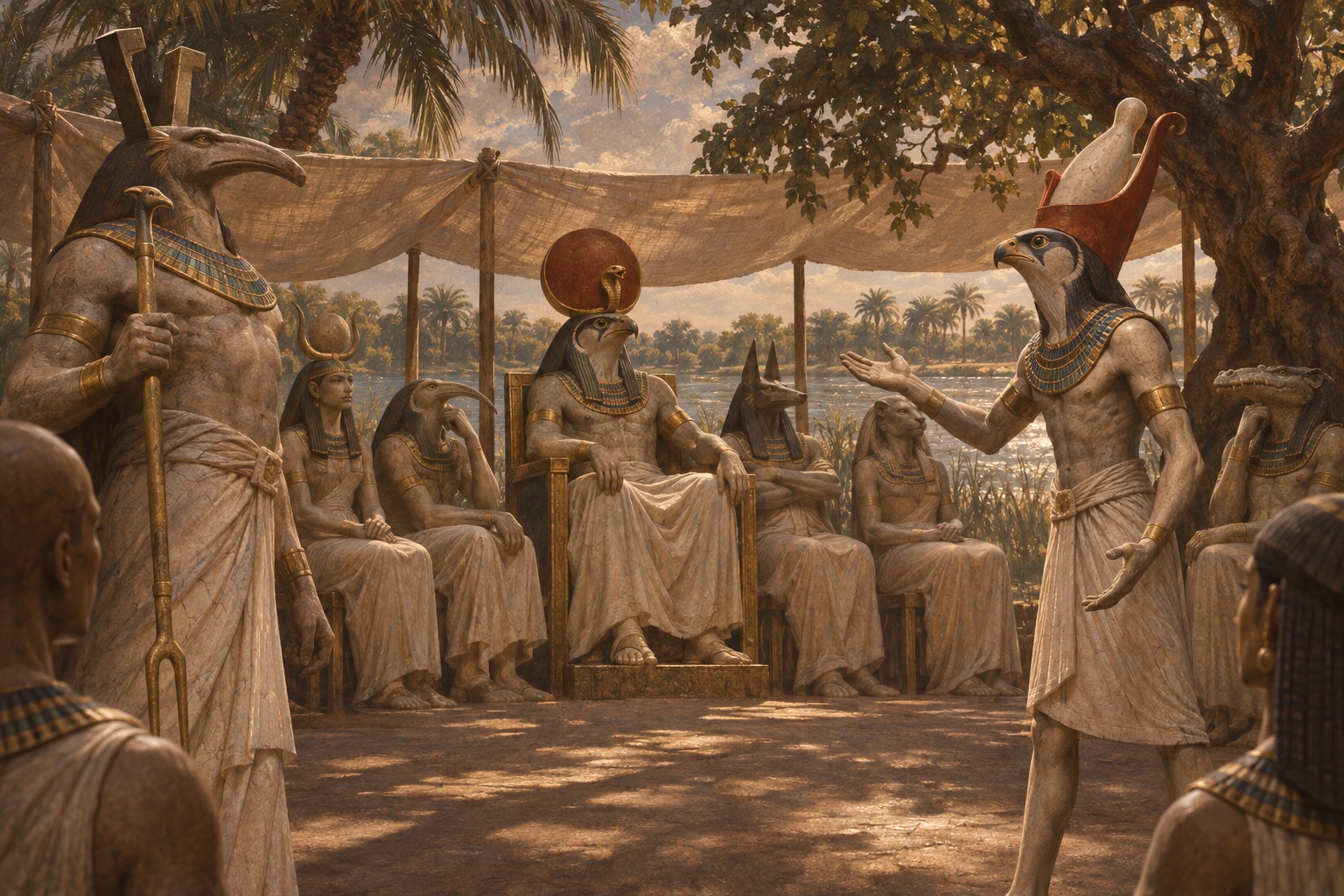
- Type: myth, a lawsuit among the gods over the throne of Osiris
- Culture: ancient Egypt
- Earliest texts: the Pyramid Texts (from about 2350 BCE) allude to the fight; the only full telling is The Contendings of Horus and Seth, on Papyrus Chester Beatty I, copied in the reign of Ramesses V (12th century BCE)
- Key figures: Horus, Seth, Isis, Ra-Harakhti, Thoth, Neith, Hathor, Osiris
Osiris was dead, and the throne of Egypt was empty. His son Horus claimed it by birth; his brother Seth claimed it by strength. Egyptians had told of their quarrel since the Pyramid Texts, but only one text tells it from beginning to end: a papyrus written at Thebes more than three thousand years ago, which turns it into a lawsuit the gods cannot finish.
Did the trial really last eighty years? So the papyrus says, twice. The sun god’s letter to the goddess Neith speaks of the two “who these eighty years past have been before the tribunal”, and Horus repeats it to her near the end. Yet all through the story Horus is called a child. Alan Gardiner, the papyrus’s first editor, pointed out the contradiction in 1931.
1 The Telling
This retelling follows the papyrus in Gardiner’s translation (1931), which the Chester Beatty Library has put online, compared with those of Miriam Lichtheim (1976) and Michal Čermák (2024).
1-1 A Court That Cannot Decide
A child sat before the Lord of All, asking for the office of his father Osiris. Shu, son of Ra, spoke for justice: give the office to Horus. Thoth agreed, “a million times right”, and Isis cried out for joy and told the north wind to carry the news west to Osiris. But the presiding judge, the sun god Ra-Harakhti, wanted the office for Seth, “great of strength”, and he was angry with his court.
Seth offered to step outside and show that his hand was stronger. The gods called in Banebdjedet, the god of Mendes, who would not decide and told them to write to Neith, the great goddess of Sais and mother of the sun god. Thoth wrote the letter. Neith replied: give the office of Osiris to his son Horus, “else I shall be angry, and the heaven shall crash to the ground”; and to keep Seth content, double his possessions and give him Ra’s two daughters, the foreign goddesses Anat and Astarte.
The court agreed, but Ra turned on Horus: “Thou art feeble in thy limbs,” a boy whose breath smelled bad. An obscure god, Baba, shouted at Ra, “Thy shrine is empty!” The sun god lay down on his back in his pavilion and stayed there alone, sulking, until his daughter Hathor came and uncovered herself before him. He laughed, got up and went back to court.
1-2 The Ferryman and the Widow
Seth boasted that he alone, at the prow of the sun’s boat, killed the enemy of Ra every day. He threatened to kill one of the gods each day with his enormous sceptre, and swore he would not plead while Isis was in court. So Ra moved the hearing to the Island-in-the-Midst and told the ferryman, Nemty, to carry no woman who looked like Isis.
Isis came to the river as a bent old woman with a little gold ring on her finger, bringing a jar of flour, she said, for a boy who had been minding cattle on the island for five days. Nemty turned down her loaf of bread but took the ring. On the island she made herself the most beautiful girl in the land, and Seth slipped away from the gods’ meal to follow her.
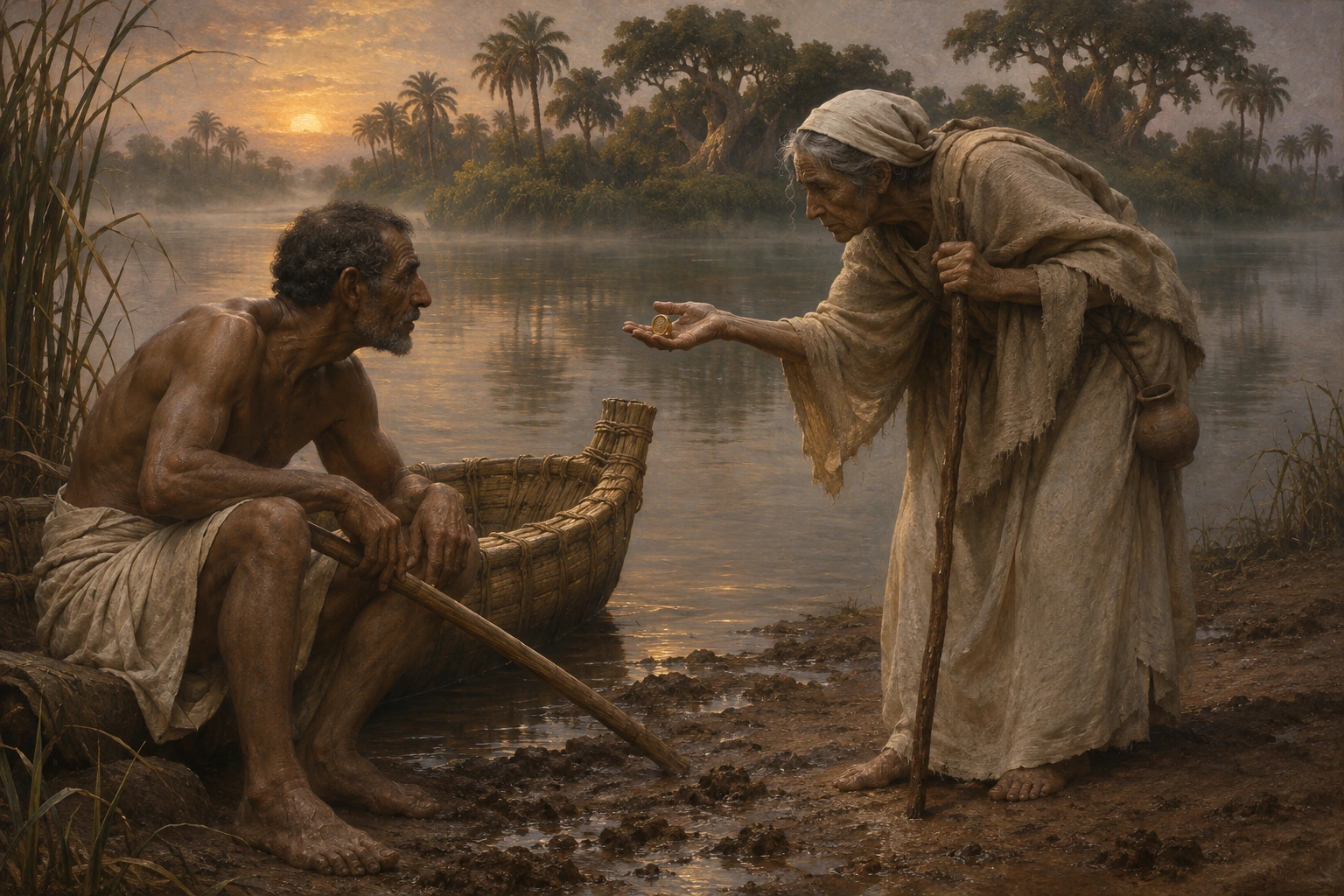
She told him that she was a herdsman’s widow. Their son had taken over his father’s cattle until a stranger came, threatening to beat the boy, take the cattle and throw him out. “Shall the cattle be given to the foreigner, while the son of the goodman is alive?” said Seth. Isis turned into a kite, flew to the top of a tree and called down: “Weep for thyself; it is thine own mouth that hath said it.” In Egyptian, Gardiner explains, the word for cattle puns on the word for office. Seth went weeping to Ra, who told him he had judged himself. The ferryman was punished on the soles of his feet, and gold became “an abomination” to him and to his town; and on Ra’s orders the gods set the White Crown on the head of Horus.
1-3 Two Hippopotamuses
Seth would not accept it. He challenged Horus to turn into a hippopotamus with him and sink into the sea: whoever came up within three months would lose. Isis, weeping that Seth would kill her son, made a rope from yarn, cast a harpoon from a deben of copper and threw it into the water. It struck Horus, who cried out to her, and she called it off. She threw again and struck Seth, who begged her as her brother “on the side of the mother”, and she let him go too. Horus came out of the water, his face “savage like a panther”, cut off his mother’s head with his knife and carried it into the mountains. Isis turned herself into a headless statue of flint. When Ra asked what this headless figure was, Thoth told him it was Isis, whose son had taken her head. The papyrus says no more about how she was made whole; other texts give the cure to Thoth (see Competing Versions).
1-4 The Eyes of Horus
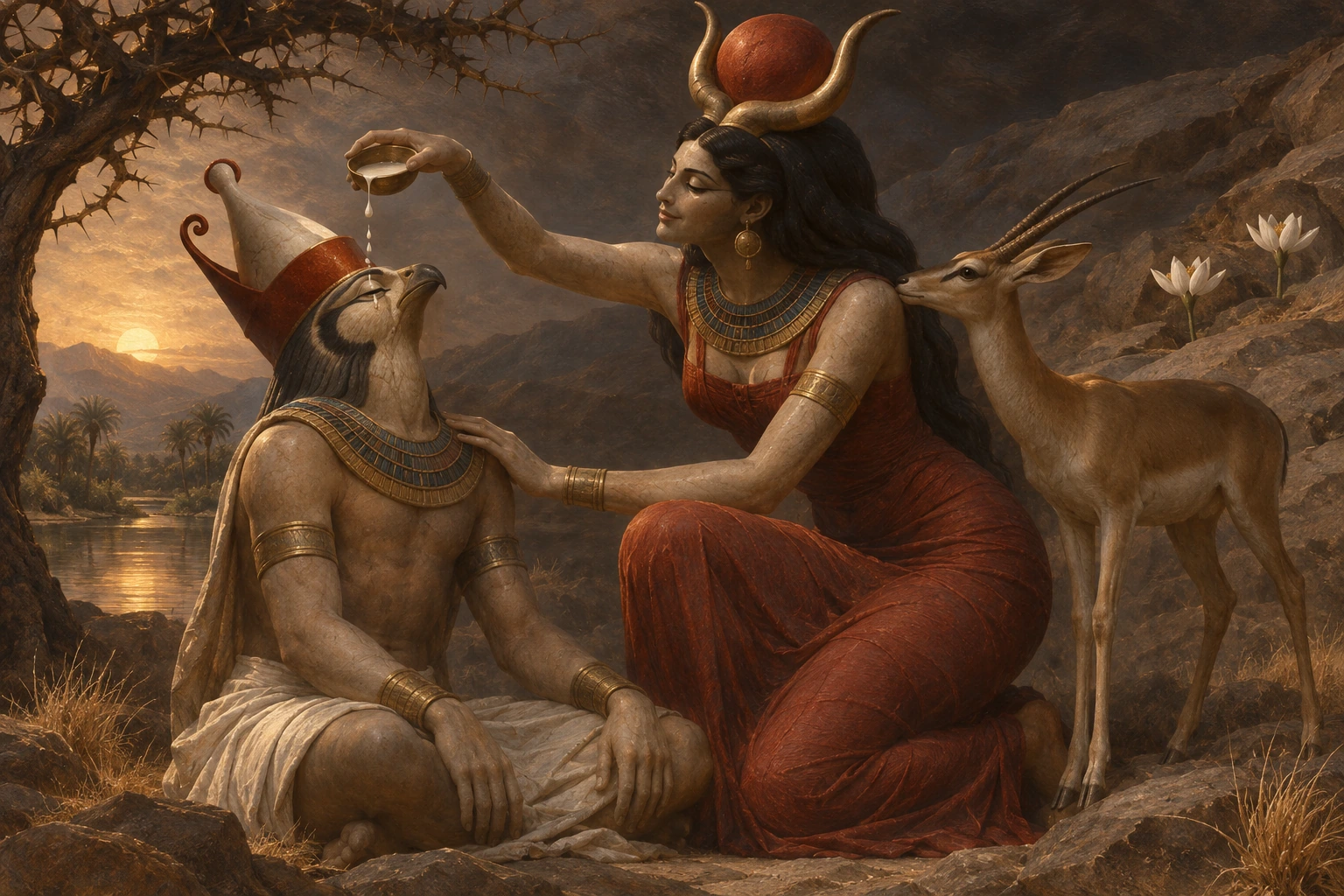
The gods went up into the mountains to punish Horus. Seth found him first, asleep under a tree in the oasis country, threw him on his back, tore out both his eyes and buried them on the mountain, where they became bulbs and grew into lotuses. Then he told Ra that he had not found Horus. Hathor, “the lady of the southern sycomore”, found Horus weeping in the desert. She caught a gazelle, milked it and put the milk in his right eye and in his left. He opened his eyes, and she found him whole.
1-5 Lettuce and Stone Boats
Ra told the two to eat, drink and stop quarrelling, and Seth invited Horus to spend a happy day at his house. That night Seth tried to shame Horus, who caught Seth’s seed in his hands; Isis cut off the defiled hand, threw it in the river and made him a new one, then put Horus’s own seed on the lettuces Seth ate every morning. In court Seth claimed he had shamed Horus, but when Thoth called out the two seeds, Seth’s answered from the water of the marsh and Horus’s rose from Seth’s forehead as a sun of gold, which Thoth set on his own head. “Horus is in the right,” said the gods, “and Seth is in the wrong.”
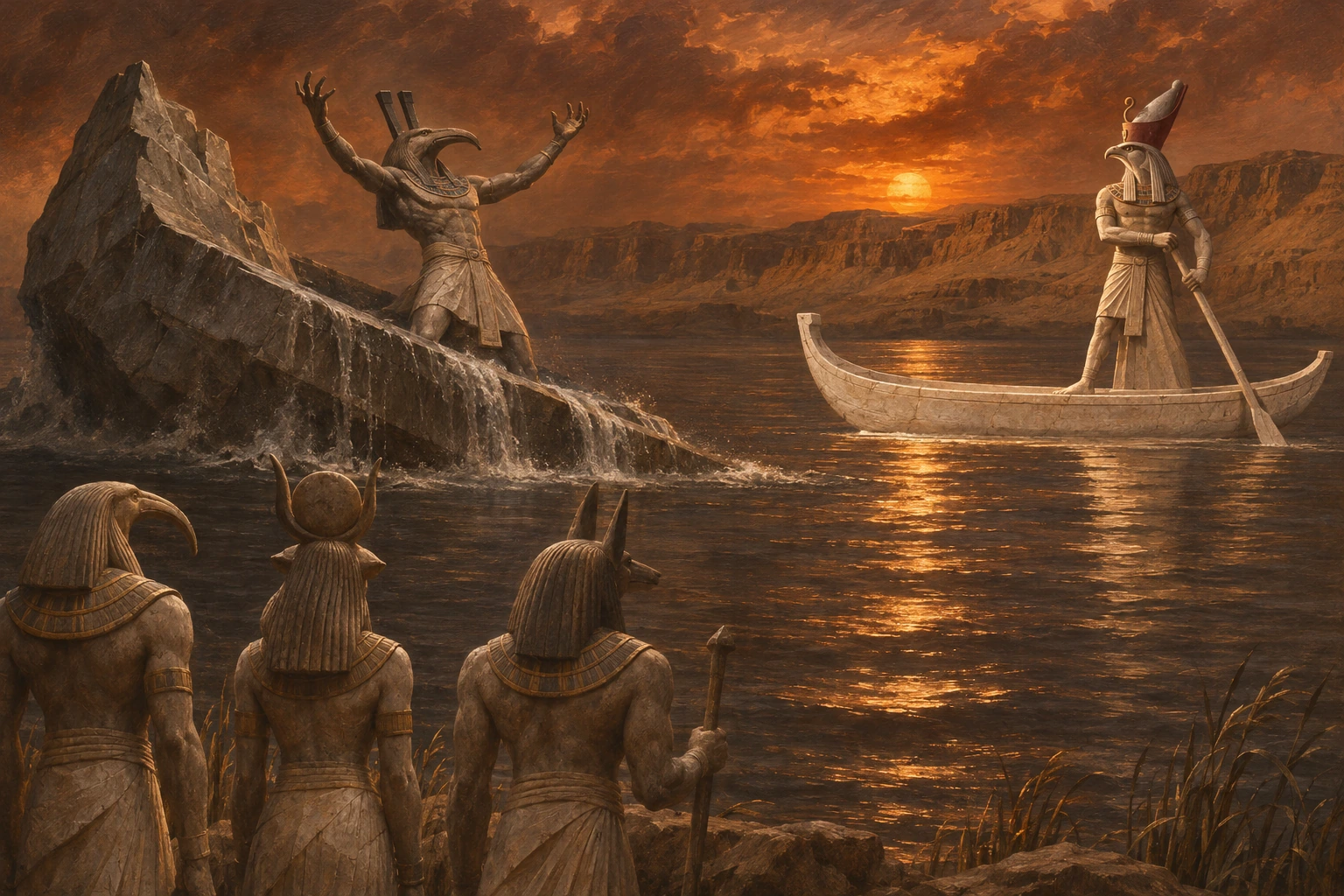
Seth swore again: they would build ships of stone and race, and the winner would rule. Horus built a ship of cedar, plastered it with gypsum and launched it at dusk, when no one could see. Seth took it for stone, cut the top off a mountain and made a stone ship 138 cubits long, which sank. Seth turned into a hippopotamus and wrecked the boat of Horus, and when Horus struck at him with his harpoon, the gods told him to stop.
1-6 Letters to the Dead King
Horus sailed down to Sais and complained to Neith that after eighty years no one knew how to judge them. At last Thoth wrote to Osiris in the underworld. Osiris answered: why should his son be cheated, when it was he who made the barley and emmer that feed the gods? Ra retorted that barley and emmer would exist without him. Osiris’s second letter was a threat. His land was “full of savage-faced messengers” who feared no god or goddess and would fetch the heart of every wrongdoer, and the stars, the gods and all people come to rest in the West in the end.
The gods said he was right. Seth asked to fight once more on the island and lost; Atum had Isis bring him in bonds, and Seth gave way: let the office of Osiris be given to Horus. They set the White Crown on Horus’s head and seated him in his father’s place, and Isis rejoiced. Ptah asked what should be done with Seth, and Ra answered: let him live with me as my son, “and he shall thunder in the sky, and men shall fear him”. The papyrus closes: “It has come to a happy ending in Thebes.”
2 Where the Story Is Written Down
- Papyrus Chester Beatty I, in the Chester Beatty Library, Dublin. The story fills the first sixteen pages of the front of a roll about five metres long, and love songs follow; a hymn praising Ramesses V on the back dates the copy to his short reign. The colophon names Thebes. A later owner, the scribe Nakhtsobek, wrote his name over an erasure, “an impudent usurpation” in Gardiner’s words. Čermák, following Pieter Pestman, places the roll in the library of a family of scribes at Deir el-Medina, the village of the royal tomb-builders.
- The Pyramid Texts know the fight already, in passing: “Horus wailed for his eye; Seth wailed for his testicles” (spell 359, as Čermák quotes it).
- A papyrus from Lahun, of the 12th Dynasty, published by Francis Griffith in 1898, preserves a fragment of Seth’s advances to Horus and Isis’s advice to her son. Gardiner was unsure whether it came from a story of the same kind.
- Papyrus Sallier IV, a calendar of lucky and unlucky days, gives the hippopotamus episode under a day of the flood season: “It is the day when Horus fought with Seth”. Gardiner found its wording so close to the Chester Beatty text that both must draw on one written source, and judged that the tale’s origins go back, at least in part, to the Middle Kingdom.
- The Shabaka Stone (about 710 BCE) gives the judgement to Geb, the earth god.
- The temple of Horus at Edfu, built under the Ptolemies, carves two versions on its walls: the legend of Horus of Behdet, who hunts Seth’s followers when they turn into crocodiles and hippopotamuses, and a sacred drama of Horus harpooning a hippopotamus.
- Plutarch, On Isis and Osiris 19, about 100 CE, gives a short Greek version, told in Osiris: the gods, with Thoth pleading for Horus, declare him the lawful heir.
3 Competing Versions
- Who judges? In the papyrus, the sun god’s court, undecided for eighty years. On the Shabaka Stone, Geb first divides the land, making Seth king of Upper Egypt and Horus king of Lower Egypt, then thinks it wrong that their shares are equal and gives Horus everything, “for he is the son of his firstborn son” (Lichtheim). In Plutarch, the gods, with Hermes, his name for Thoth, as advocate.
- Brothers, or uncle and nephew? In court Banebdjedet asks whether the office should go to “this stripling, while Seth, his elder brother, is yet alive”, and Seth calls Horus “my little brother”; elsewhere Seth is Isis’s brother. Gardiner saw two traditions used side by side: an older one in which Horus and Seth were rival brothers, and a later one in which Seth, a son of the sky goddess Nut, was Horus’s uncle.
- How was Isis healed? The papyrus does not say. In Papyrus Sallier IV, Thoth changes himself into Heka, magic, and restores her head as a cow’s head; in Plutarch, Hermes puts on her a helmet shaped like a cow’s head. Gardiner thought the episode was meant to explain the cow-headed Hathor, and that the Chester Beatty author, with no such aim, left the cure out.
- One eye or two? In the older legend, Gardiner notes, Seth tears out one eye of Horus and Thoth restores it; here both eyes are taken and Hathor heals them. Plutarch reads the eye as the moon: Typhon, his Seth, strikes the eye of Horus or swallows it and then gives it back to the Sun (ch. 55).
- What rose from Seth’s forehead? In older texts, Gardiner shows, it was Thoth himself: a Coffin Text has Thoth call himself “the god who adjudged the two brothers”, and a Late Period statue names him the son of the two gods “who came forth from the forehead”.
- What became of Seth? Here Ra adopts him and he thunders in the sky. In the Edfu legend, as Budge translated it, Horus son of Isis cuts off the heads of Seth and his followers. In Plutarch, Isis lets Seth go, and he is beaten in two more battles.
4 History and Tradition
- The king as Horus. From the 1st Dynasty the king was Horus on earth, and the first of his names, the Horus name, was written in a palace-façade frame with a falcon on top. The stela of King Djet from his tomb at Abydos, the Louvre’s “Stela of the Serpent King” (E 11007, about 3100–2900 BCE), is that frame carved more than a metre high. In the papyrus, Thoth heads the sun god’s letter to Osiris with the five names of a pharaoh, as Gardiner notes.
- Edfu. The temple of Horus of Behdet at Edfu was laid out in 237 BCE and dedicated in 70 BCE, as its own building inscriptions record. On the inner face of its enclosure wall a sacred drama is carved in reliefs and text: Horus in his boat drives ten harpoons into a hippopotamus while the chorus cries, “Hold fast, Horus, hold fast!” A stage direction has a hippopotamus made of cake carried in and cut up by the butcher, and the book recited by the chief lector on the 21st day of the second month of the season of Peret.
- The eye made whole. The eye of Horus became the wedjat amulet, a sign of health and wholeness. Whether it is the same as the Eye of Ra is a separate question: see The Eye of Ra.
- Seth at the prow. Seth’s boast in court, that he kills the enemy of Ra every day, is his other face, told in Ra and Apophis. The thunder Ra promises him, Gardiner wrote, was more explicit than any earlier reference to Seth as a god of thunder.
- An awkward discovery. Gardiner published the papyrus in 1931 in a very limited edition, possibly, Čermák suggests, because of its contents. He translated one word only as “nakedness”, called the tale mythology “in the spirit of Offenbach”, and decided that its coarsest passage was “too barbaric to give real offence”.
There is no single Horus. Egyptians worshipped Horus the Elder (Haroeris), Horus son of Isis, Horus the child (Harpocrates), Horus of Behdet at Edfu and the sun as Ra-Harakhti, “Ra-Horus of the Horizon”. Plutarch makes the elder Horus a brother of Osiris and Seth, born on the second of the added days (ch. 12). In the Edfu legend, Horus of Behdet and Horus son of Isis fight Seth side by side. Even the judge who favours Seth in the papyrus is a Horus: Gardiner speaks of “the identification of the sun-god with a Horus, though not with Horus, the son of Isis”. A Japanese edition of the Britannica adds that the son of Isis gradually took over the elder’s roles.
5 Related Stories
- Osiris: The Murdered King Who Rules the Dead: the murder that leaves the throne empty, and Plutarch’s short version of this trial, in which Thoth speaks for Horus.
- Ra and Apophis: The Serpent the Sun Must Defeat Every Night: the work Seth boasts of before the court, spearing the serpent from the prow of the sun’s boat.
- Isis: The Goddess of Magic Who Outwitted the Sun: the goddess who outwits the ferryman and Seth here, in her own stories, among them Horus as a child hidden in the marshes.
- Thoth: The Ibis God of Writing and the Moon: the scribe of the gods, who writes the court’s letters here and calls out the two seeds.
6 Sources
- The Contendings of Horus and Seth, Papyrus Chester Beatty I, ed. and trans. Alan H. Gardiner, The Library of A. Chester Beatty: Description of a Hieratic Papyrus with a Mythological Story, Love-Songs, and Other Miscellaneous Texts (1931), pp. 1–26: Chester Beatty Library
- The same, trans. Miriam Lichtheim, Ancient Egyptian Literature, vol. II (University of California Press, 1976), pp. 214–223, read in the publisher’s preview: Biblia
- Michal Čermák, The Way of Horus: Kingship and Transition in the Contendings of Horus and Seth (doctoral thesis, Charles University, 2024), pp. 13–17, 101–102, 146, 149, 166–167, translation pp. 360–370: Charles University
- Jenny Cromwell, “‘My heart, don’t act so stupidly!’: An Ancient Egyptian Love Song”, Papyrus Stories (2023), on Papyrus Chester Beatty I in Dublin: papyrus-stories.com
- Plutarch, On Isis and Osiris 12, 19, 54–55, trans. Frank Cole Babbitt (Loeb, 1936): LacusCurtius, LacusCurtius; Japanese translation by Yaginuma Shigetake (Iwanami Bunko, 1996)
- The Shabaka Stone (British Museum, EA 498), trans. Miriam Lichtheim: attalus.org
- “The Sacred Drama of Horus at Edfu”, trans. A. M. Blackman and H. W. Fairman (Journal of Egyptian Archaeology, 1943 and 1944), and the building inscriptions of the temple, trans. Dieter Kurth: attalus.org, attalus.org
- “The Legend of Horus of Behutet and the Winged Disk”, trans. E. A. Wallis Budge, Legends of the Gods (1912): Project Gutenberg
- F. Ll. Griffith, Hieratic Papyri from Kahun and Gurob (1898), plates, “Fragment of a Legend of Horus and Set”: archive.org
- Musée du Louvre, “Stèle du roi Serpent” (E 11007): collections.louvre.fr
- Japanese translation of the Contendings in Sugi Isamu and Yakata Teisuke (trans.), Ejiputo shinwa shūsei (Chikuma Gakugei Bunko, 2016): Chikuma Shobō
- “ホルス”: Kotobank
Cover and illustrations: AI-generated images made for Arcana. They are interpretations, not historical artworks.