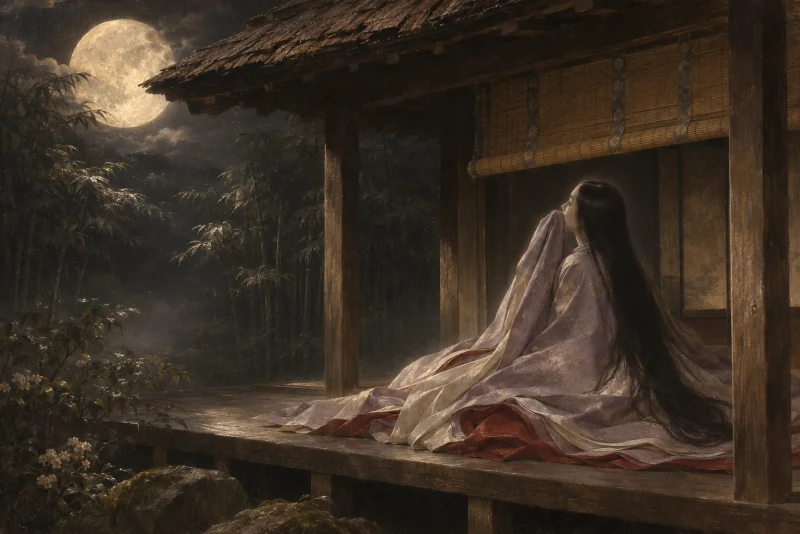
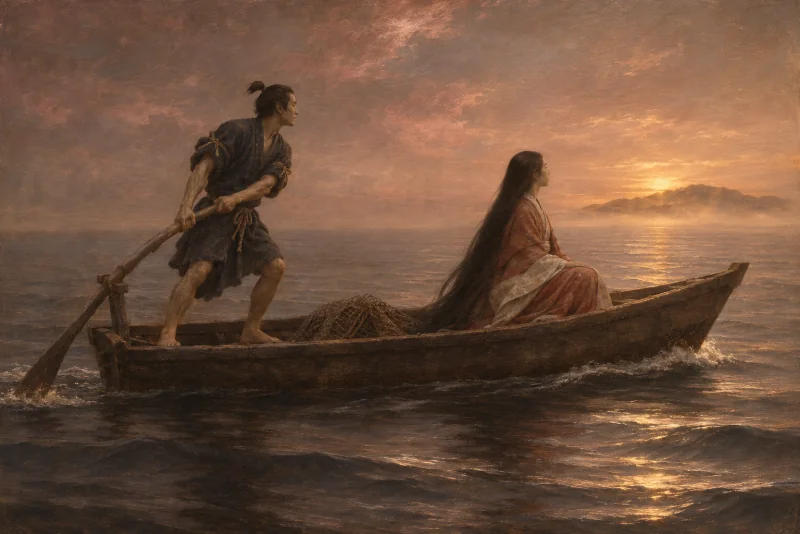
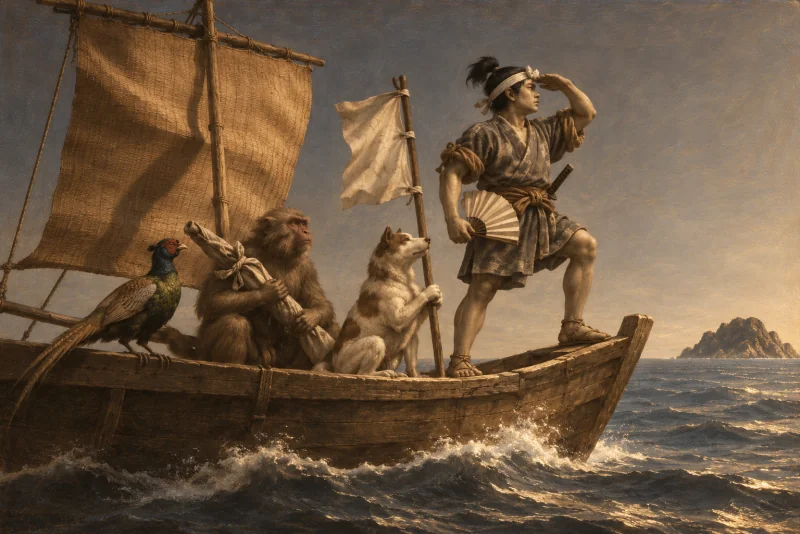
Yamata no Orochi: Susanoo and the Eight-Headed Serpent
Thrown out of heaven, Susanoo comes down by a river in Izumo, makes a serpent with eight heads drunk and cuts it to pieces. In its tail is the sword that became one of Japan's imperial regalia. Izumo's own record of its gods never mentions the serpent.
- Type: myth, a banished god kills a serpent, wins a bride and finds a sword
- Culture: Japan, the Yamato court; the story is set in Izumo, in today’s Shimane Prefecture
- Earliest texts: Kojiki (712) and Nihon Shoki (720). Izumo’s own gazetteer, the Izumo Fudoki (733), does not tell it
- Key figures: Susanoo, Kushinadahime, her parents Ashinazuchi and Tenazuchi, the serpent Yamata no Orochi, Amaterasu
In heaven, Susanoo is the god who wrecks everything. On earth, within a single page of the Kojiki, he becomes a hero: he saves a girl, kills a serpent with eight heads, finds a sword, builds a house and sings a song that later poets counted as the first poem of thirty-one syllables.
Did Susanoo kill the serpent with the Kusanagi sword? No. He cut it to pieces with the sword he was already wearing, a “ten-grasp sabre”. Kusanagi was inside the serpent: when his blade struck the middle tail, its edge chipped, and he split the tail open and found a great sword. That sword, not the one that did the killing, became one of the imperial regalia.
1 The Telling
This is the version of the Kojiki, book 1, quoted in Basil Hall Chamberlain’s translation of 1882. It follows straight on from Susanoo’s banishment from heaven, after one short episode: first he kills the food goddess Ōgetsuhime, and silkworms, rice and other grains grow from her body.
1-1 Chopsticks on the Water
Susanoo came down at a place called Torikami, at the head-waters of the Hi river in the land of Izumo. Some chopsticks came floating down the stream. Thinking that there must be people upriver, he went up to look, and found an old man and an old woman weeping, with a young girl between them.
The old man said he was an earthly god, a son of the mountain god Ōyamatsumi. His name was Ashinazuchi, his wife was Tenazuchi, and their daughter was Kushinadahime. They had once had eight daughters, but “the eight-forked serpent of Koshi” had come every year and eaten one, and now its time had come again.
1-2 Eight Heads, Eight Tails
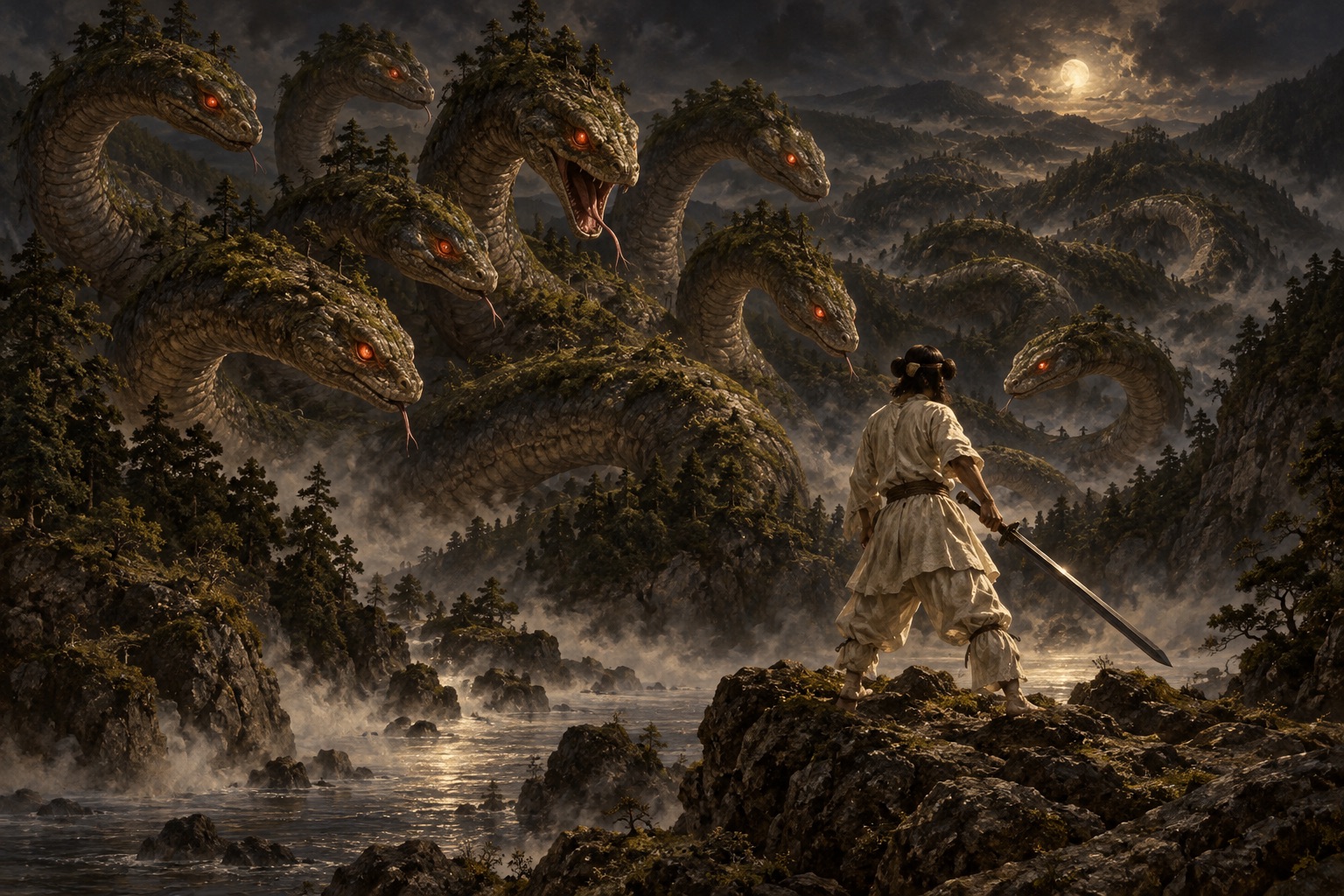
Susanoo asked what it looked like. The old man’s answer is the only description the Kojiki gives. Its eyes were red like winter cherries. It had “one body with eight heads and eight tails”. Moss, cypress and cedar grew on its body, it stretched over eight valleys and eight hills, and its belly was “all constantly bloody and inflamed”.
Susanoo asked for the girl. The old man answered that he did not know his name. Susanoo said that he was the brother of Amaterasu, the sun goddess, and had just come down from heaven, and the parents gave her to him.
1-3 The Comb and the Sake
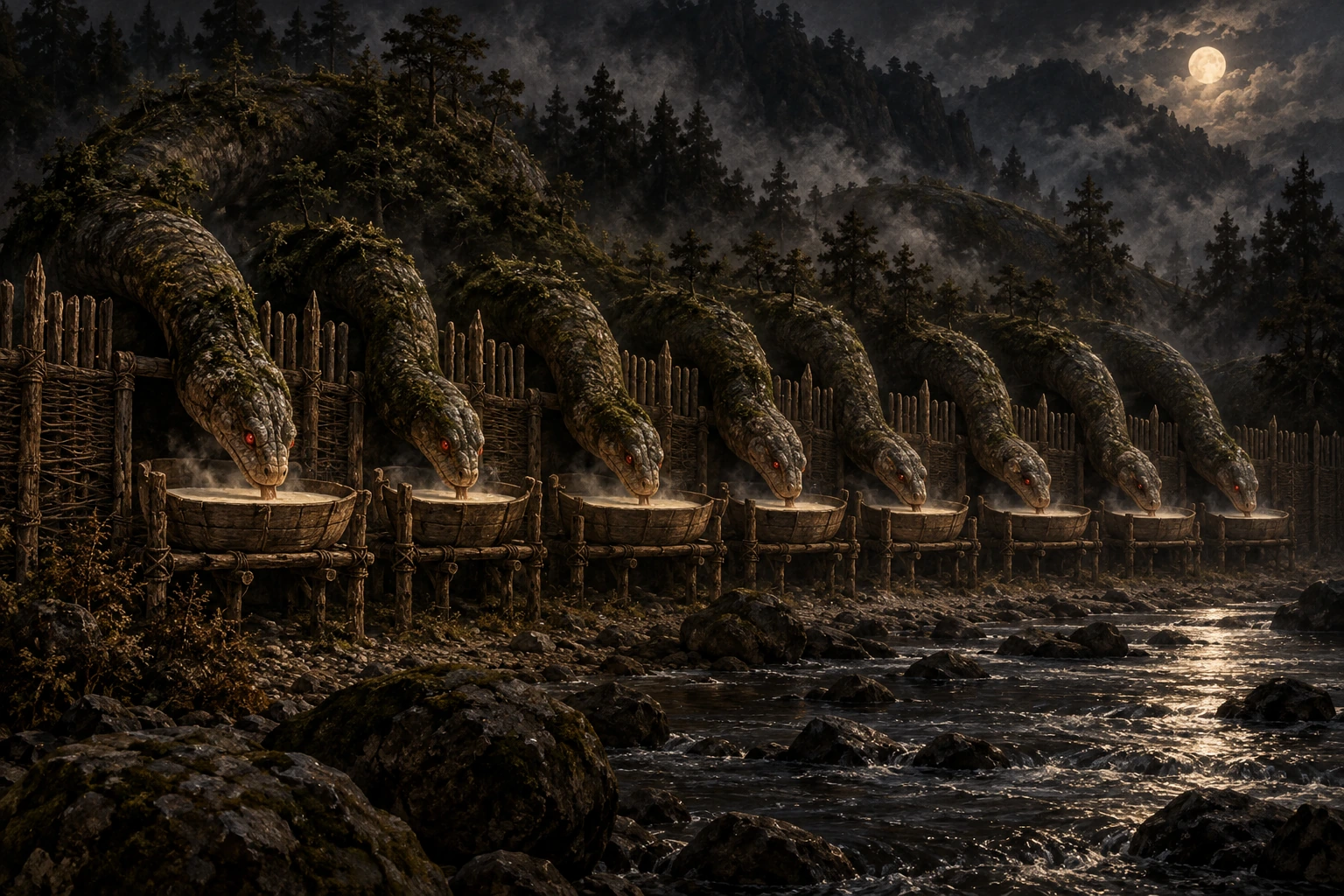
At once Susanoo turned the girl into “a multitudinous and close-toothed comb” and stuck it into his hair. Then he told her parents to brew “eight-fold refined liquor”, a sake brewed over and over until it was strong. They were to build a fence with eight gates, set up a platform at each gate, put a vat on each platform and fill every vat.
1-4 The Sword in the Tail
The serpent came, just as the old man had said. It dipped a head into each vat and drank, until it was drunk and all its heads lay down and slept. Susanoo drew the ten-grasp sabre he wore and cut the serpent to pieces, “so that the River Hi flowed on changed into a river of blood”.
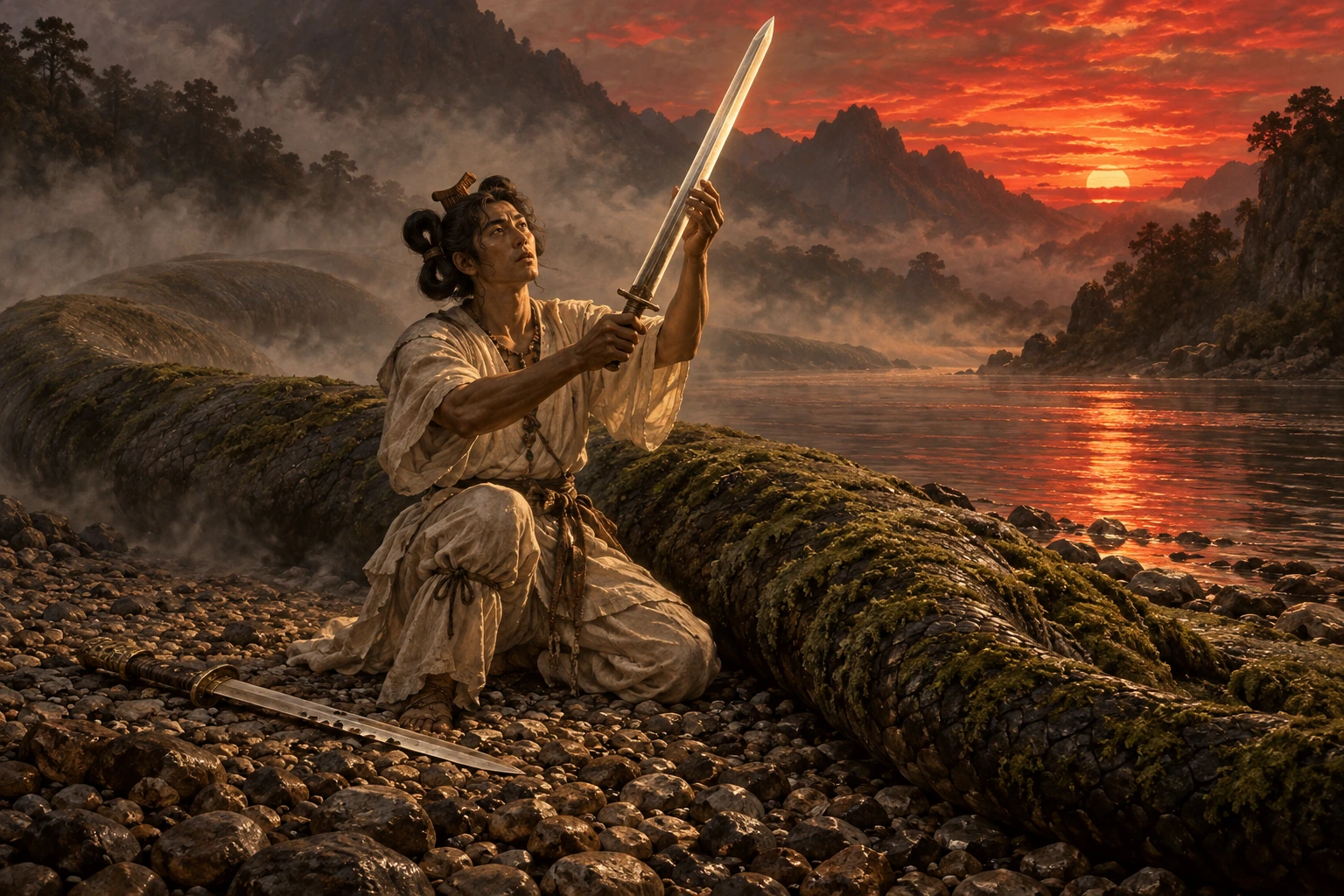
When he cut the middle tail, the edge of his sword chipped. Thinking this strange, he split the tail open with the point of his sword and found “a sharp great sword” inside. He took it and, thinking it a strange thing, told Amaterasu of it. “This,” the text adds, “is the Herb-Quelling Great Sword”: Kusanagi.
1-5 The Palace at Suga
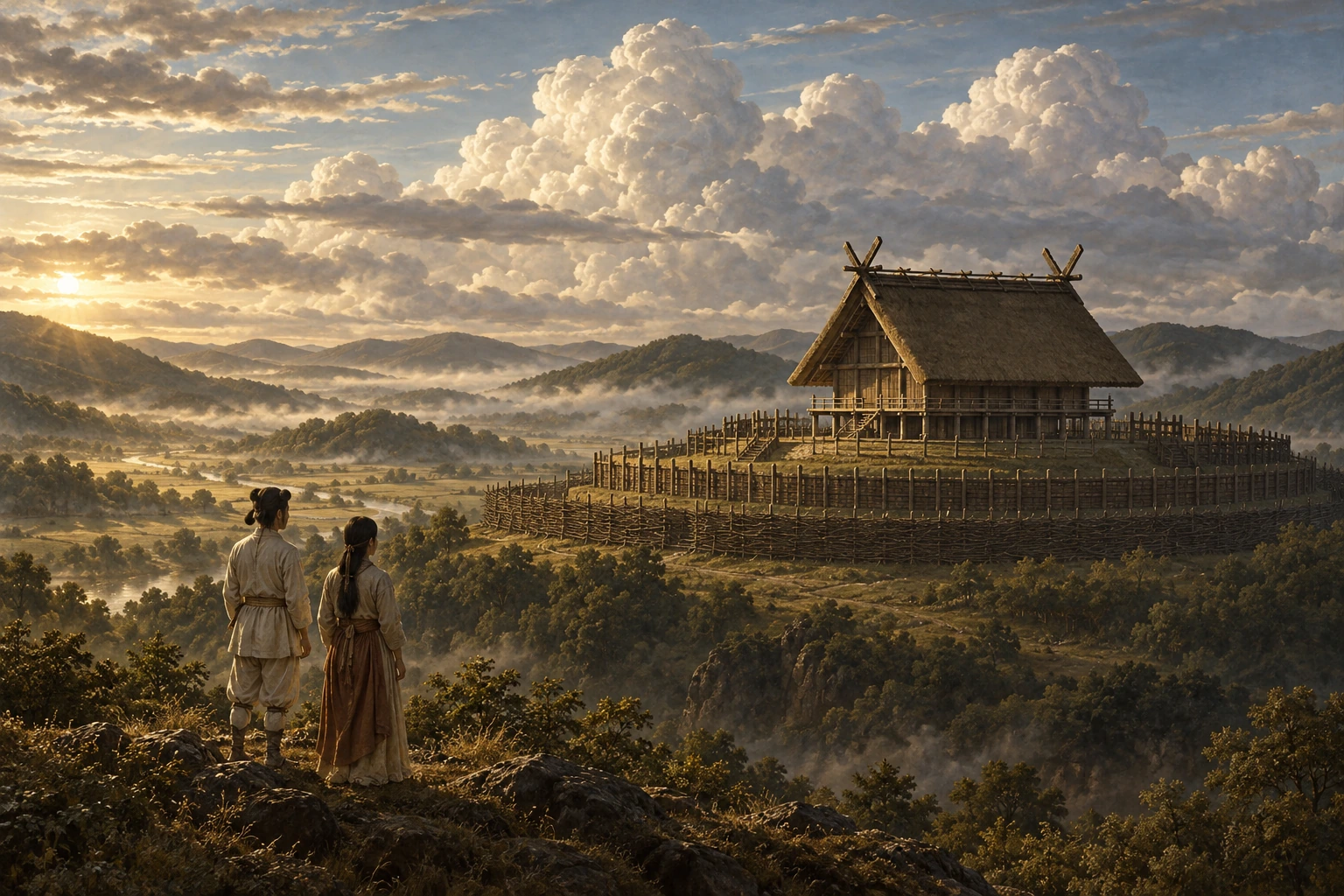
Then Susanoo looked in Izumo for a place to build a palace. When he came to Suga he said that his heart felt sugasugashi, refreshed, and the Kojiki says that is why the place is called Suga. As he built, clouds rose up, and he made a song, the first in the book. It begins Yakumo tatsu; in Chamberlain’s words: “Eight clouds arise. The eight-fold fence of Idzumo makes an eight-fold fence for the spouses to retire [within]. Oh! that eight-fold fence.”
He made Ashinazuchi the headman of his palace. The Kojiki then follows the couple’s descendants down the generations to Ōkuninushi, the great god of Izumo.
2 Where the Story Is Written Down
Kojiki (712), book 1. It writes the serpent’s name with sounds alone, 八俣遠呂知, Yamata no Orochi, “the eight-forked orochi”. The Kokugakuin University commentary notes that the meaning of orochi is uncertain, and that no other early text spells the word out this way.
Nihon Shoki (720), book 1. It writes 八岐大蛇, “eight-forked great serpent”. Its main text tells the story much as the Kojiki does, but Susanoo finds the family by the sound of their weeping, not by chopsticks, the serpent drinks from tubs set in eight cupboards, and the song appears only in a note. After the main text come three more versions of the fight, each introduced as “in one writing it is said” (section 3).
Izumo Fudoki (733), the report on the province that Izumo no Omi Hiroshima, its hereditary chieftain, compiled under an imperial order of 713. It is the only gazetteer of the period to survive complete, and it has no serpent. Its Susanoo is a local god who gives places their names:
- at Yasuki he says that his heart has become calm, yasu;
- at Susa he declares the land small but a good place to be, gives it his own name and lays his spirit to rest there;
- at Sase, the old men say, he danced with leaves of the sase tree in his hair, and the leaves fell to the ground.
Several of his children are local gods, and two of his daughters are courted by Ōnamochi, “the great god who made the land”. A goddess called Kushi-inada-mitoyo-manura-hime appears once, pregnant and looking for a place to give birth. The book has the Hi river rise at Mount Torikami on the border with Hōki, and lists a shrine and a mountain called Suga, with no word of the fight. Koshi does appear, as a place from which Ōnamochi returns after subduing “the Yakuchi of Koshi”; the text does not say what the Yakuchi were.
3 Competing Versions
- Where does Susanoo come down? The Kojiki and the Nihon Shoki’s main text: at the head of the Hi river in Izumo. One version: at the head of the river E in Aki province; the girl is taken to Izumo afterwards. Another: first to the Korean kingdom of Silla, where he stays at Soshimori and declares, “I will not dwell in this land.” He makes a boat of clay and crosses east to Mount Torikami.
- Who is in danger? The Kojiki: eight daughters, one a year. One version: the couple’s unborn child, because the serpent eats every baby as soon as it is born. In another, the parents tell Susanoo to kill the serpent first and take their daughter afterwards.
- How does the sake work? The Kojiki: strong sake in vats behind a fence. One version: sake brewed from “fruit of all kinds”, which Susanoo pours into each mouth himself, saying, “Thou art an Awful Deity. Can I dare to neglect to feast thee?” Another: “a poisonous sake”.
- Which sword killed it? The Kojiki and the main text: Susanoo’s own long sword. The versions give it names: Worochi no Ara-masa, “now at Isonokami”; Worochi no Kara-sabi, “now with the Kambe of Kibi”; and Ama no Haye-kiri.
- What is the sword in the tail called? In the Kojiki it is the tsumuha or tsumugari sword, since the manuscripts disagree on one character, and the text then calls it the Kusanagi. The Nihon Shoki’s main text calls it Kusanagi too, but a note gives its original name as Ame no Murakumo, “the sword of the gathering clouds of heaven”, perhaps from the clouds that always hung over the serpent, and says it was renamed in the time of Prince Yamato Takeru.
- Where does it go?
- The Nihon Shoki’s main text: “This is a divine sword. How can I presume to appropriate it to myself?” So he gives it up to the gods of heaven. In the version that begins in Silla, he sends a descendant to deliver it to heaven.
- The Kojiki’s verb, 白上, may mean only that he “informed” Amaterasu. Chamberlain followed the scholar Hirata in reading it that way; Motoori Norinaga read “sent it up”. The Kokugakuin commentary cites Matsumoto Naoki’s point that the text never says the sword went to heaven.
- Two versions keep it on earth: “It is now in the province of Ohari”, or “in the charge of the Hafuri of Atsuta”.
- Whose son is Ōkuninushi? In the Nihon Shoki’s main text the couple’s son is Ōnamuchi, that is, Ōkuninushi. In the Kojiki and in two of the versions he is a descendant several generations later.
4 History and Tradition
- From Ise to Atsuta. Later in both books, the priestess Yamato-hime at the shrine of Ise gives the sword to her nephew Yamato Takeru as he sets out to subdue the east. When enemies set a moor on fire around him, the Kojiki has him mow the grass with it and light a counter-fire. The Nihon Shoki has him escape by fire alone, but a note says “the sword Mura-kumo … wielded itself, and mowed away the herbage”, and “therefore that sword was called Kusa-nagi”. On his way home he leaves it at the house of Princess Miyazu in Owari and goes to face the god of Mount Ibuki without it. He does not come back. The Nihon Shoki adds that the sword “is now in the shrine of Atsuta”.
- Stolen and sent back. The Nihon Shoki records that in 668 a monk, Dōgyō, stole the Kusanagi and fled toward Silla, but a storm drove him back. In 686, a divination found Emperor Tenmu’s illness to be a curse of the Kusanagi, and it was sent to the Atsuta shrine that same day. Yoshii Iwao, in the Nipponica encyclopedia, takes the curse as a sign that it was not originally the imperial sword, and the Yamato Takeru episode as an origin tale explaining why the regalia sword is in Owari.
- Atsuta today. Atsuta Jingū in Nagoya worships Atsuta no Ōkami, with the Kusanagi as the god’s sacred object. Explaining the regalia in 2019, Kyodo News wrote that the mirror and the sword themselves are kept at Ise and Atsuta, and a replica of the sword, with the jewel, in the emperor’s residence.
- Lost at sea. At Dan-no-ura in 1185, the last sea battle of the Taira against the Minamoto, the child emperor Antoku drowned. The mirror was saved and the jewel recovered, but the sword sank with Antoku’s grandmother and stayed in the sea. The Britannica entry on the regalia notes that the sword and mirror kept at court were katashiro, stand-ins.
- What does “Kusanagi” mean? Both books say “grass-mower”. The Kokugakuin commentary cites Satake Akihiro, who took kusa as “foul” and nagi as an old word for snake: a name born of fear of a fierce serpent. Yoshii, too, calls the grass-mowing story a later folk explanation.
- A river, rice and iron. There are many modern readings:
- Sakashita Keihachi, in the Heibonsha World Encyclopedia, sees in the serpent a dragon god who rules the water, its size drawn from the Hi river and its seasonal storms and floods, and in Kushinadahime, the “rice-field princess”, the rice fields themselves.
- The Kokugakuin commentary objects that if Koshi means the far-off north, the serpent comes from the edge of the land, and cannot simply be the river.
- Yoshii traces the story to a snake cult in fertility festivals of the Suga river valley, which moved to the Hi river and was later absorbed into the tradition of Susanoo, a god with “a new iron culture” behind him. The Izumo Fudoki does say of the villages on the upper Hi that the iron they produce “is hard, and best of all for making tools of every kind”.
- The first poem. The preface to the Kokinshū anthology says that poems of thirty-one syllables began with Susanoo. Suga Shrine in Unnan, Shimane, is said to stand where his palace stood, and calls itself “the first palace in Japan”.
- Iwami kagura. In the kagura dance theatre of western Shimane, Orochi is the signature piece. The serpents’ coiling bodies were inspired by paper lanterns, and they spit fireworks as Susanoo fights them. At the Osaka Expo of 1970, thirteen serpents took the stage at once for the first time.
Yamata no Orochi is often called an Izumo legend. Yet Izumo’s own gazetteer, finished in 733, thirteen years after the Nihon Shoki, has no serpent at all. Its Susanoo names villages, dances with leaves in his hair and lays his spirit to rest at Susa. The fight is told only in the two books made at the court in Yamato.
5 Related Stories
- Amaterasu and the Rock Cave: The Day the Sun Hid: what comes just before. Susanoo’s outrages drive the sun goddess into a cave, and the gods drive him out of heaven. The mirror and the jewels of the regalia go back to that story, as the sword goes back to this one.
- Kuniumi: Izanagi and Izanami Give Birth to Japan: Susanoo’s parents. The Kojiki buries Izanami on Mount Hiba, on the border of Izumo and Hōki, and the Izumo Fudoki has the Hi river rise at Mount Torikami on that same border.
- Medusa: The Gorgon Whose Story Kept Changing: on his way back with the Gorgon’s head, Perseus kills a sea monster and frees the princess Andromeda. In a note to his Nihongi of 1896, W. G. Aston found it “hardly necessary to point out the resemblance of this story to that of Perseus and Andromeda”. Yoshii Iwao notes that scholars have linked it to the “Andromeda type” found around the world, in which a hero saves a woman offered to a monster, and Sakashita Keihachi names Perseus and Siegfried among such heroes.
6 Sources
- Kojiki, book 1, critical text, modern Japanese translation and commentary: Kokugakuin University Kojiki Viewer, “Yamata no Orochi” 1, “Yamata no Orochi” 2, “The Palace of Suga” 1
- Basil Hall Chamberlain (trans.), Kojiki, 1882, sections XVII–XX, LXXXII–LXXXIII and LXXXVII: Wikisource
- Nihon Shoki, books 1, 7, 27 and 29 (original text): Wikisource
- W. G. Aston (trans.), Nihongi, 1896, vol. 1, books I and VII: Wikisource, Wikisource
- Izumo Fudoki (733), original text: Wikisource
- Matsunaga Naomichi, “Yamatanoorochi”, Encyclopedia of Shinto, Kokugakuin University: Kokugakuin
- Sakashita Keihachi, “八岐大蛇” and “素戔嗚尊”, Heibonsha World Encyclopedia; Yoshii Iwao, “八岐大蛇” and “草薙剣”, Nipponica: Kotobank, Kotobank, Kotobank
- “出雲国風土記”, “熱田神宮” (Kamata Jun’ichi, Nipponica), “三種の神器” (Kyodo News; Britannica), “壇ノ浦の戦” (Sugihashi Takao, Heibonsha), “須我神社”: Kotobank, Kotobank, Kotobank, Kotobank, Kotobank
- Hamada City Tourism Association, Iwami Kagura (2024): kankou-hamada.or.jp
Cover and illustrations: AI-generated images made for Arcana. They are interpretations, not historical artworks.