The Weighing of the Heart: The Judgement of the Dead
In the Hall of the Two Truths the dead denied forty-two sins, one before each judge, and watched their heart weighed against the feather of Maat while a monster waited. The papyri buried with them show the beam level: the heart had to balance, not to be light.
- Type: myth and funerary belief, the judgement of the dead before Osiris
- Culture: ancient Egypt, from the New Kingdom (about 1550 BCE) to Roman times
- Earliest texts: parts of the idea in the Coffin Texts of the Middle Kingdom; spell 125 of the Book of the Dead and its picture of the weighing from the New Kingdom; the Papyrus of Ani, the fullest painted version, from the 13th century BCE
- Key figures: Osiris, Anubis, Thoth, Maat, Ammit, Horus, the forty-two judges
An Egyptian’s last trial was held after death. In the hall of Osiris the dead person named forty-two judges, swore to each of them that one particular wrong had never been done, and watched the heart go into one pan of a balance. The papyri buried with the dead always show them acquitted, because that is what they were made for. As E. A. Wallis Budge put it, it “was always assumed” that their owners would be found innocent, and “true of voice” was written after every name.
What happened to someone who failed? The papyri do not show it. The words around the scene give hints. The forty-two judges, spell 125 says, keep watch over sinners and “feed upon their blood” on the day of reckoning, and the monster Ammit waits beside the balance. The British Museum’s description of Hunefer’s papyrus says that the condemned dead were left to “non-existence”, eaten by the devourer. The second story of Setne Khamwas, written in Roman Egypt, is plainer: the man whose evil deeds outnumber his good is handed to the devourer and destroyed, soul and body, and she “does not permit him to live again for ever”.
1 The Telling
The judgement is never told as one story. It has to be put together from spells and the pictures painted beside them. This retelling follows the Papyrus of Ani, made for a royal scribe of Thebes in the 13th century BCE (British Museum EA 10470), in E. A. Wallis Budge’s translation of 1901. Where Ani’s copy of spell 125 is short, Budge supplies the Papyrus of Nu and the Papyrus of Nebseni, and so do we.
1-1 Coming into the Hall
Spell 125 is to be said, its title explains, when the dead come into the Hall of the Two Truths, “so that he may be separated from every sin which he hath done and may behold the faces of the gods”. In Ani’s copy, the god Anubis asks him the name of the door. Ani knows it, and the names of both its leaves, and Anubis lets him pass.
In Nu’s copy the dead man then greets the Great God, the lord of the hall. He knows his name, he says, and the names of the forty-two gods with him, “who live as warders of sinners and who feed upon their blood on the day when the lives of men are taken into account” before Osiris. “I have brought Maat (i.e., right and truth) to thee.” What follows is a long list of things he has not done. He has caused no pain, let no one go hungry, made no one weep, killed no one. He has robbed no temple of its offerings. “I have not added to the weights of the scales [to cheat the seller],” he says, “I have not mis-read the pointer of the scales [to cheat the buyer].” He has not taken “the milk from the mouths of children”. And he ends: “I am pure. I am pure. I am pure, I am pure.”
1-2 The Forty-Two Judges
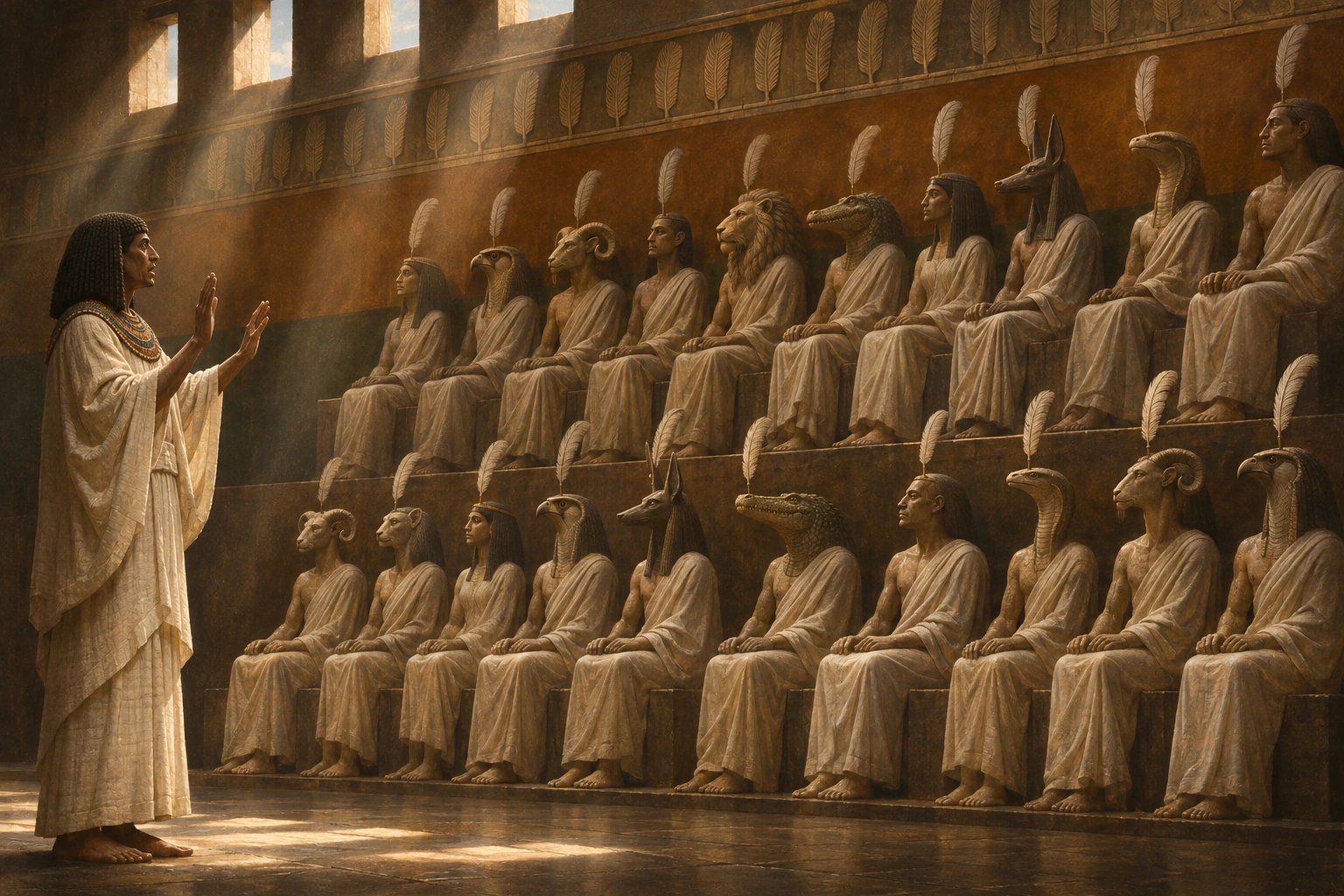
The hall is the hall of the two goddesses of Right and Truth, and in it sit the forty-two gods. In the Papyrus of Anhai, Budge notes, each has his own head and nearly all wear the feather of Maat. The dead address them one by one, each by a strange name and the place he comes from, and deny one wrong before each. In the Papyrus of Nebseni (British Museum EA 9900) it begins: “Hail, thou whose strides are long, who comest forth from Annu (Heliopolis), I have not done iniquity.” The Crusher of bones, from Heracleopolis, hears “I have not uttered falsehood”. Before the Leg of fire the dead say “I have not eaten my heart”, which Budge explains as losing one’s temper.
1-3 The Door That Asks Its Name
Then the dead turn to the gods of the hall and say what they have done as well. “I have given bread to the hungry man, and water to the thirsty man, and apparel to the naked man, and a boat to the [shipwrecked] mariner.” The gods answer: “enter in through the door of this Hall of double Maati, for thou knowest us.”
But in Nu’s copy the door itself will not open. Its bolts, its lintels, its threshold and its fastening each refuse to let him in “unless thou tellest [us] our names”, and the bolts are called the “Tongue [of the Balance] of the place of right and truth”. The floor will not be trodden on “because I am silent and I am holy”, until it learns the names of his feet. The doorkeeper’s name is “Discerner of hearts and searcher of the reins”. At last Thoth comes: “But why hast thou come?” He will announce the dead man to the one “whose heaven is of fire, whose walls [are surmounted by] living uraei, and the floor of whose house is a stream of water”. “It is Osiris.”
1-4 The Heart in the Balance
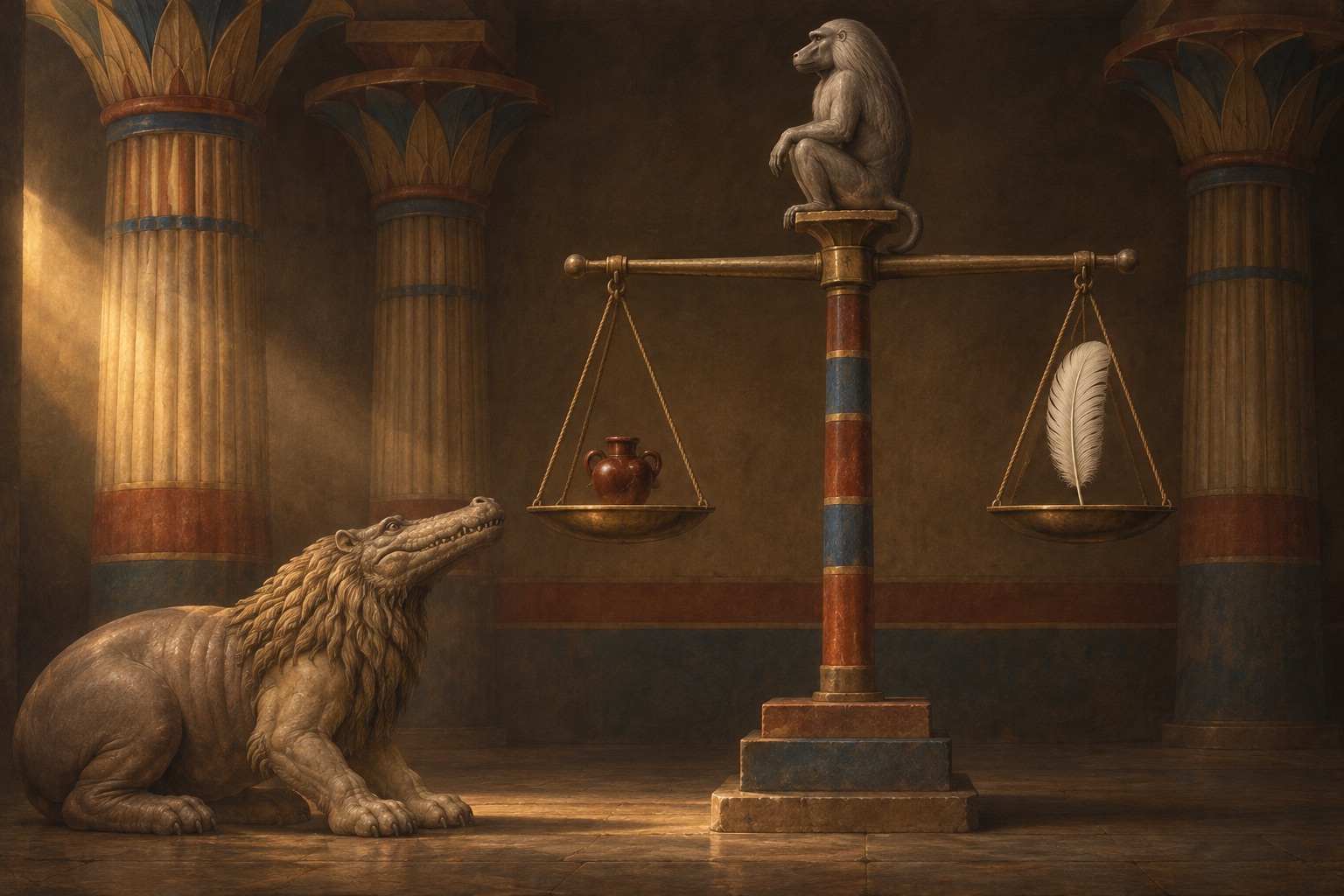
Ani’s papyrus shows the rest in a painting near the start of the roll, on its third and fourth sheets. Ani comes into the hall with his wife Thuthu, his head bowed. Above sit the gods who judge: Harmachis in his boat, Atum, Shu, Tefnut, Geb, Nut, Isis, Nephthys, Horus, Hathor, Hu and Sia. In the middle stands the great balance. A baboon, the companion of Thoth, sits on top of its post. Ani’s heart lies in one pan and the feather of Maat in the other. Anubis tests the tongue of the balance. Near him stand Ani’s “Luck”, the birth goddesses Meskhenet and Renenet, and Ani’s soul, a bird with a man’s head. On the other side Thoth, the scribe of the gods, stands ready with reed pen and palette to write down the result. Behind Thoth waits the monster Ammit, “the Eater of the Dead”.
While his heart is weighed, Ani speaks to it in the words of spell 30B: “My heart my mother, my heart my mother, my heart my coming into being. May there be nothing to resist me at [my] judgment … may there be no parting of thee from me in the presence of him that keepeth the scales.” He asks it not to let his name “stink” before the officers of the court, nor to tell lies about him before the god.
Thoth gives the verdict: “Hear ye this judgment. The heart of Osiris hath in very truth been weighed, and his soul hath stood as a witness for him; it hath been found true by trial in the Great Balance. There hath not been found any wickedness in him.” The gods agree. “It shall not be allowed to the devourer Amemet to prevail over him.” He is to have offerings, an audience with Osiris and a homestead for ever in the Field of Offerings.
1-5 True of Voice
Beside the weighing, Horus, the son of Isis, takes Ani by the hand and leads him to Osiris, who sits in a shrine with Isis and Nephthys behind him. “I have brought unto thee the Osiris Ani,” Horus says. “His heart is [found] righteous, and it hath come forth from the balance; it hath not sinned against any god or any goddess.” Ani kneels: “There is no sin in my body. I have not spoken that which is not true knowingly.”
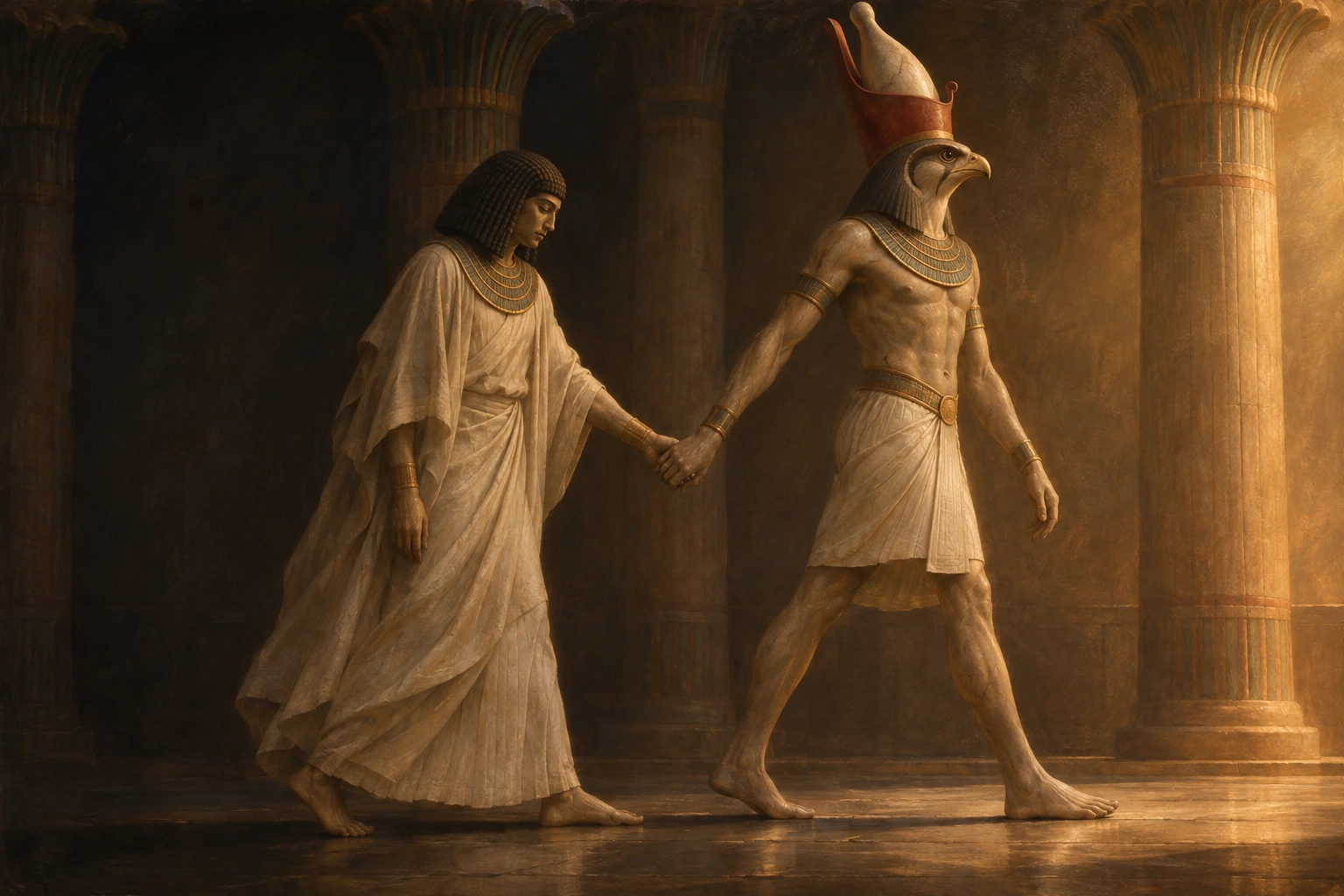
Ani is now “true of voice”, maa kheru: in Budge’s words, “innocent and acquitted”. The dead man has been called “the Osiris Ani” throughout, as if he were the god, and he enters the kingdom of the god whose story is told in Osiris.
2 Where the Story Is Written Down
- Tomb inscriptions of the 4th Dynasty. Martin Stadler, in the UCLA Encyclopedia of Egyptology, suggests that the belief may have its roots in warnings carved for visitors in tombs of the Old Kingdom: whoever defiled the tomb would be judged in the hereafter “before the Great God”.
- The Coffin Texts, written inside coffins of the First Intermediate Period and the Middle Kingdom. Some parts of the belief are already there, Stadler writes, among them “the scale upon which the heart (or other body part) of the deceased would be weighed”. But the judgement “first appears fully developed” in the Book of the Dead.
- The Book of the Dead, spell 125. It is first known from the New Kingdom, and the picture of the weighing from the middle of the 18th Dynasty. It was copied for more than 1,500 years, with the list of denials “remarkably stable”; a copy in Demotic is dated by its colophon to 63 CE.
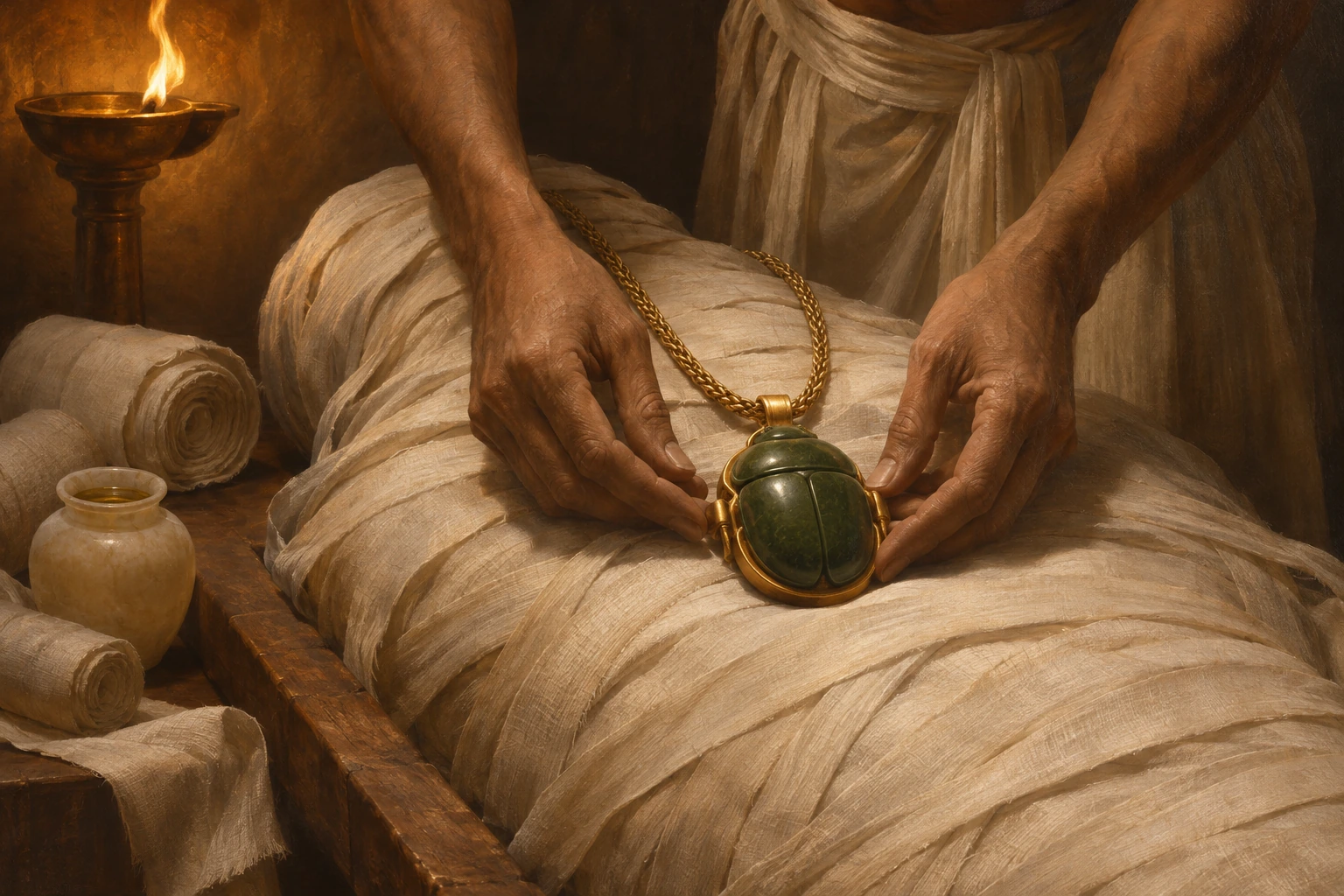
- Spell 30B and heart scarabs. The heart’s prayer was carved on scarabs of hard stone laid with the dead. One rubric orders it said over “a scarab of green stone” set in metal and hung at the neck. Another claims the spell was found at Hermopolis, under the feet of the god, “in the writing of the god himself”, by Prince Hordedef in the reign of King Menkaure.
- The Papyrus of Ani (British Museum EA 10470), about 24 metres long by Budge’s measure, “the finest example” of the painted rolls in his view. Yakata Teisuke, in Heibonsha’s World Encyclopedia, says the illustrated Book of the Dead deserves to be called the world’s oldest picture book.
- The Papyrus of Hunefer (British Museum EA 9901), made for a royal scribe and steward of Seti I. The British Museum says it was found inside a figure of the god Ptah-Sokar-Osiris. Above the devourer a label describes her: “her forepart [is that of] crocodiles, her hind-part [is that of a] hippopotamus, and her middle [is that of a] lion”.
- The Book of Gates. In the tombs of the kings, from Horemheb’s (KV 57) onward, the judgement hall of Osiris appears on the sun’s night journey (Stadler).
- Greek and Demotic tellings. Diodorus of Sicily, in the 1st century BCE, describes a court of “forty-two” judges sitting by a lake to try the dead before burial (1.92). The second story of Setne Khamwas, on a British Museum papyrus whose other side holds Greek land registers of 46–47 CE, takes its hero into the hall of Osiris (F. Ll. Griffith’s translation, 1900).
3 Competing Versions
- What lies in the other pan? Usually the feather of Maat, as in Ani and Hunefer. In the simplest form of the 18th Dynasty, Thomas George Allen notes, the goddess Truth herself squats in the pan; in another papyrus, what looks like an ordinary weight. In the Papyrus of Nebseni the dead man kneels in one pan and is weighed against his own heart in the other. In the Book of Gates, Budge says, the balance weighs “some rectangular object” against the bird that stands for evil.
- Who weighs, and who leads the dead in? Anubis tests the balance in Ani and Hunefer; Budge found Maat doing it in other copies, and a baboon of Thoth on the post. The dead are brought into the hall by Anubis, Thoth, Maat or the goddess of the West (Stadler), and led to Osiris by Horus or by Anubis.
- Heart or deeds? In spell 125 the heart is weighed. In the second Setne Khamwas story, Griffith translates, “they were weighing the evil deeds against the good deeds”, with three outcomes: more evil, and the dead are destroyed; more good, and they join the gods of Osiris’s council; equal, and they serve Sokar-Osiris.
- Who is the devourer? Ammit stands or sits by the balance in the papyri. In the Book of Gates a pig named “Eater of the Arm” is driven off in a boat by a baboon. Budge thought the pig might stand for the Eater of the Dead, but called it “conjecture”.
- Where is the scarab put? One rubric hangs it at the neck. A version Allen translates puts it “within a man’s breast”, and a late copy “in place of a man’s heart”. The Global Egyptian Museum calls the common idea that the scarab replaced the removed heart “incorrect”.
- A trial on earth? Diodorus’s court tries the dead before burial, and anyone may accuse them. Some scholars have read this as a drama staged at the tomb; others think Diodorus turned a myth into a custom (Stadler). His boatman, whom he says the Egyptians call Charon, has no support in Egyptian sources, as J. A. Wilson told Diodorus’s translator.
4 History and Tradition
- Maat. Maat is a goddess who wears the feather, and also the order of the world and justice (Stadler). The hall belongs to the “Two Truths”, and the dead come to bring Maat to its lord. Stadler calls the forty-two denials, with the instructions and the tomb biographies, “a major source of ancient Egyptian ethical standards”.
- The heart in the body. The heart was thought to hold the emotions, the intellect and the character, and so, the British Museum explains, stood for the good and bad of a person’s life. Diodorus says the embalmers took out everything “but the kidneys and heart” (1.91). The Global Egyptian Museum says the heart was left in the body or put back. But Andrew Wade and Andrew Nelson, studying mummies by CT scan, found that the heart was not always left in place (Live Science).
- Scarabs ready-made. Budge noticed scarabs with a blank space for the owner’s name, kept as “some undertaker’s stock-in-trade”. The Metropolitan Museum’s heart scarab of Hatnefer, serpentinite on a gold chain from her tomb at Thebes (36.3.2, about 1491–1473 BCE), carries her name written over an erased one: it was made for someone else (Live Science, after the Met).
- The forty-two. Budge thought the forty-two judges stood for the forty-two nomes of Egypt, and that most were local gods of whom “nothing is known”. Diodorus’s translator C. H. Oldfather links Diodorus’s forty-two judges to those of spell 125.
- Priests’ oaths. Two oaths of purity sworn by priests, preserved in Greek on papyri of Roman date and translated from an Egyptian book, read much like the denials of spell 125. Some scholars think the spell grew out of such oaths; it may be the other way round (Stadler).
“The heart had to be lighter than a feather” is a common way of telling it. The Egyptian texts ask for balance: in spell 125 the dead have come “to equilibrate the balance” (Allen’s translation). Budge noticed that in the pictures the beam is “always exactly horizontal”, and took it to mean that the heart only had to “just counterbalance, and not outweigh the feather”. The British Museum’s text on Hunefer says the same: the dead were condemned “if the heart did not balance with the feather”.
5 Related Stories
- Osiris: The Murdered King Who Rules the Dead: the judge on the throne at the end of the hall. His murder, Isis’s search and Horus’s victory are told there. Here every acquitted dead person takes his name: the scribe becomes “the Osiris Ani”.
- Anubis: The Jackal God of Embalming: the god who tests the tongue of the balance, and in Ani’s copy asks the name of the door, is first of all the embalmer of the dead.
- Mictlan: The Nine Places of the Dead: in Sahagún’s account of the Aztec dead, it is the way a person died, not a trial of their life, that decides where they go. We have not found a scholar who compares the two; we link them for the theme.
- Jeoseung Saja: The Messengers of Death: in Korea the messengers bring the dead before King Yeomra and the Ten Kings, who judge them. Another court of the dead; a shared theme, not a known connection.
6 Sources
- Book of the Dead, spells 30B and 125, and the judgement scene of the Papyrus of Ani (British Museum EA 10470), trans. E. A. Wallis Budge, The Book of the Dead: An English Translation of the Chapters, Hymns, etc., of the Theban Recension (1901), vol. 1, pp. 22–34 and 149–151, vol. 2, pp. 355–378: archive.org, vol. 1, archive.org, vol. 2
- Book of the Dead, spells 30B and 125, trans. Thomas George Allen, The Book of the Dead or Going Forth by Day (Oriental Institute, 1974), pp. 40 and 97–101: ISAC
- E. A. Wallis Budge, The Book of the Dead (British Museum, 1920), chapter 7, “The Judgment of Osiris”: Project Gutenberg
- E. A. Wallis Budge, The Book of the Dead: Facsimiles of the Papyri of Hunefer, Anhai, Kerasher and Netchemet (1899), plate IV: archive.org
- E. A. Wallis Budge, The Egyptian Heaven and Hell (1905), the judgement hall of Osiris in the Book of Gates: archive.org
- E. A. Wallis Budge, The Literature of the Ancient Egyptians (1914), on spells 30B and 125: Project Gutenberg
- Martin A. Stadler, “Judgment after Death (Negative Confession)”, UCLA Encyclopedia of Egyptology (2008): eScholarship
- The British Museum, “Hunefer’s Judgement in the presence of Osiris”, in Smarthistory’s History of Art: LibreTexts
- Diodorus Siculus, Library of History 1.91–92, trans. C. H. Oldfather (Loeb, 1933): LacusCurtius
- F. Ll. Griffith, Stories of the High Priests of Memphis: The Sethon of Herodotus and the Demotic Tales of Khamuas (Oxford: Clarendon Press, 1900), the second tale of Setne Khamwas (Griffith’s “Khamuas”), pp. 46–49 and 67–68: archive.org
- The Metropolitan Museum of Art, “Heart Scarab of Hatnefer” (36.3.2), collection record: metmuseum.org
- Kristina Killgrove, “Hatnefer’s heart scarab”, Live Science (2025): livescience.com; Tia Ghose, “Image Gallery: Mummy Evisceration Techniques”, Live Science (2013): livescience.com
- The Global Egyptian Museum, glossary, “Heart”: globalegyptianmuseum.org
- Yakata Teisuke, “死者の書”, Heibonsha’s World Encyclopedia, revised edition: Kotobank
Cover and illustrations: AI-generated images made for Arcana. They are interpretations, not historical artworks.