The Mabinogi: The Four Branches
A prince who spends a year in another king's shape, a giant who lies down as a bridge, a kingdom emptied by a spell and a woman made of flowers: four medieval Welsh tales, each ending "thus ends this branch of the Mabinogi". No medieval book was ever called the Mabinogion; the name comes from a copyist's slip and a Victorian translation.
- Type: four linked prose tales, the “branches” of the Mabinogi, about the rulers of Dyfed and Gwynedd and their dealings with the Otherworld
- Culture: medieval Wales; the tales move between Dyfed in the south-west and Gwynedd in the north-west, with Ireland and England beyond the sea and the border
- Earliest texts: fragments in the manuscript Peniarth 6 (second half of the 13th century); complete in the White Book of Rhydderch (about 1350) and the Red Book of Hergest (about 1400). The tales themselves were probably composed in the 11th or 12th century
- Key figures: Pwyll, Rhiannon, Pryderi, Bendigeidfran (Brân), Branwen, Manawydan, Math, Gwydion, Arianrhod, Lleu Llaw Gyffes, Blodeuwedd
Four Welsh tales end with the same words: “and thus ends this branch of the Mabinogi”. In them a prince spends a year in the Otherworld in another king’s shape, a giant lies down across a river so that his army can walk over him, a whole kingdom vanishes in a mist, and two magicians make a woman out of flowers. Their author’s name is lost, and so is the exact meaning of the word mabinogi. Yet they are the heart of the book that the world now knows as the Mabinogion.
What ties the four branches together? One man, Pryderi of Dyfed. He is born in the first branch and lost the same night. In the second he is only a name, one of the seven who come home alive from Ireland. In the third he is caught by a spell, and in the fourth he dies in single combat. He is the only character named in all four. Otherwise the branches are only loosely linked: the second and third follow the children of Llŷr, the fourth the children of Dôn.
1 The Telling
The telling follows the Welsh text of the White Book of Rhydderch; the Red Book of Hergest tells the same story in nearly the same words. Quotations are from Lady Charlotte Guest’s translation, made from a copy of the Red Book, which spells the names in an older way (Bendigeid Vran, Manawyddan, Dyved). Where Guest left a passage out, the translation is our own.
1-1 The First Branch: Pwyll, Prince of Dyfed
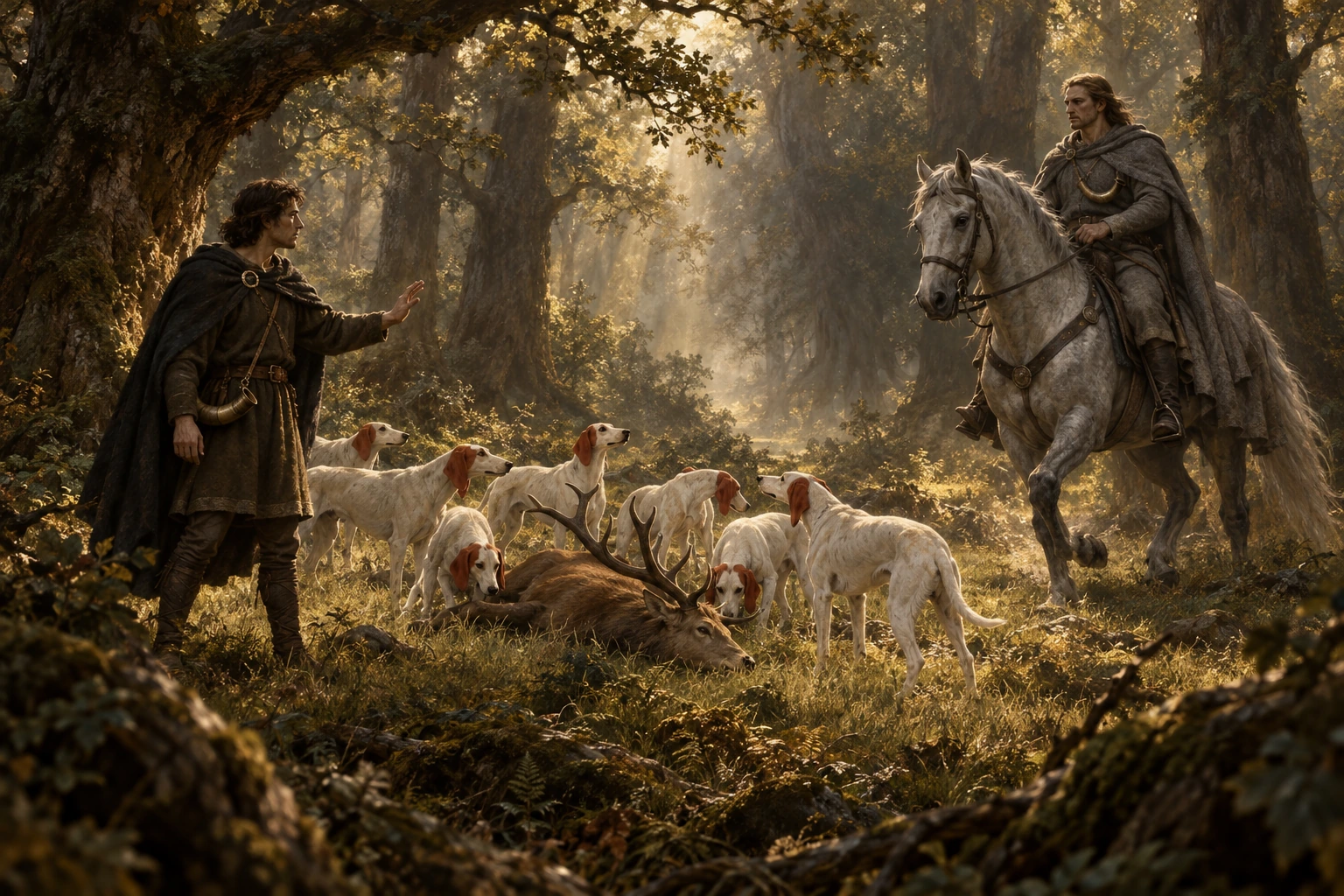
Pwyll, lord of the seven cantrefs of Dyfed, was hunting in Glyn Cuch when he heard another pack. Its hounds were “of a brilliant shining white, and their ears were red”, and they had brought down a stag. Pwyll drove them off and set his own hounds on it. A horseman in grey hunting clothes rode up: Arawn, a king of Annwfn, the Otherworld. To make amends, Pwyll agreed to take Arawn’s shape for a year and to fight his rival Hafgan at a ford, with one blow only. He must not give a second, Arawn warned, however Hafgan begged. Pwyll struck once, Hafgan died, and Annwfn was one kingdom again. In the Welsh text, Pwyll turned his face away from Arawn’s queen every night of that year. When Arawn came home and was tender with her again, she told him he had not turned his face to her for a year, and he understood what a friend he had found. From then on Pwyll was called Head of Annwfn.
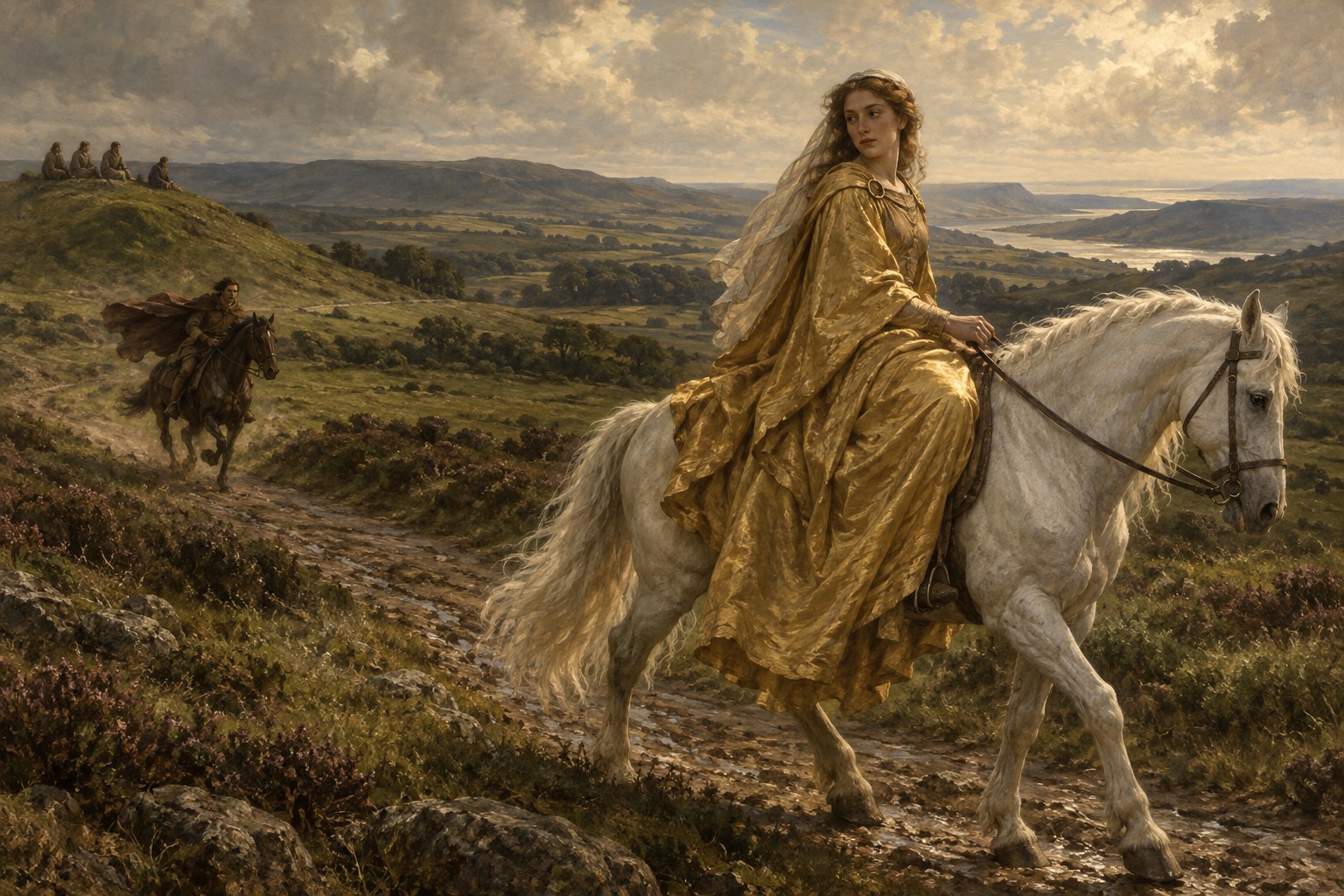
Near his court at Arberth stood a mound, and whoever sat on it would either be wounded or see a wonder. Pwyll sat on it and saw a lady on a great white horse, in shining gold, riding slowly along the road. His swiftest rider could not catch her, though she never went faster. On the third day Pwyll called out and asked her to wait. “I will stay gladly,” she said, “and it were better for thy horse hadst thou asked it long since.” She was Rhiannon, and she had come to choose him rather than the husband her family had chosen for her. At their wedding feast Pwyll rashly promised a stranger whatever he asked: it was Gwawl son of Clud, that very suitor, and he asked for the bride. A year later Pwyll came to Gwawl’s own wedding feast in rags, with a small bag Rhiannon had given him, and asked only to have it filled with food. No amount filled it until a rich man trod it down with both feet. Gwawl stepped in, the bag closed over his head, and Pwyll’s men beat it with sticks and feet: “the game of Badger in the Bag”.
When the nobles began to press Pwyll for an heir, Rhiannon bore a son at Arberth, and the same night he vanished while the six women set to watch him slept. Afraid for their lives, they killed some puppies, smeared the blood on Rhiannon’s face and hands, and swore she had eaten her child. Pwyll would not put her away, so she took a penance: for seven years she sat by the horse-block outside the gate, told her story to every stranger and offered to carry visitors into the court on her back.
Far away in Gwent, Teyrnon’s mare foaled every year on the night of the first of May, and the foal always disappeared. Teyrnon kept watch: a great claw came through the window and seized the newborn colt, he cut off the arm, and outside his door he found a baby boy wrapped in satin. He and his wife raised him as Gwri Wallt Euryn, “Gwri of the golden hair”. The boy grew at a marvellous rate, and he looked so like Pwyll that Teyrnon brought him to Arberth. “I would be delivered of my care (pryder), if that were true,” said Rhiannon. So the boy was named Pryderi. He grew up to rule Dyfed and married Cigfa.
1-2 The Second Branch: Branwen, Daughter of Llŷr
Bendigeidfran son of Llŷr, crowned king of the Island of the Mighty, was sitting on the rock of Harlech when thirteen ships came from Ireland. King Matholwch had come to ask for his sister Branwen. They were married at Aberffraw, in tents, since “no house could ever contain Bendigeid Vran”. But Branwen’s half-brother Efnysien had not been asked. In his rage he cut the lips, ears and tails off Matholwch’s horses. To make peace Bendigeidfran gave new horses, a staff of silver, a plate of gold and a cauldron: a dead man thrown into it would rise the next day as well as ever, “except that he will not regain his speech”.
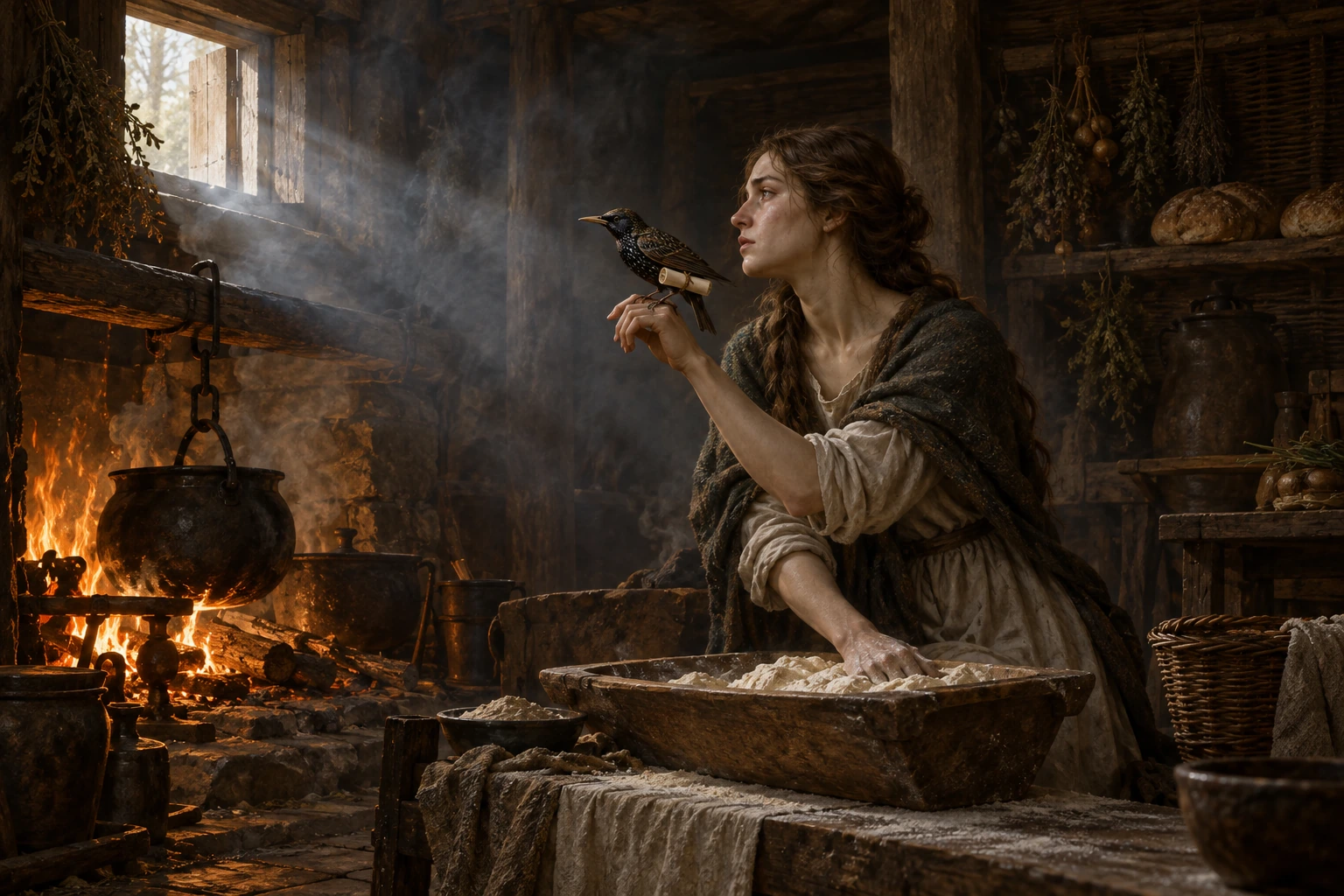
In Ireland Branwen bore a son, Gwern. Then the insult to the horses was remembered. Branwen was put to work in the kitchen, the butcher boxed her ears every day, and for three years no ship was allowed to sail for Wales. She raised a starling on the edge of her kneading trough, taught it to speak, tied a letter under its wing and sent it across the sea. It found her brother at Caer Seiont in Arfon and landed on his shoulder.
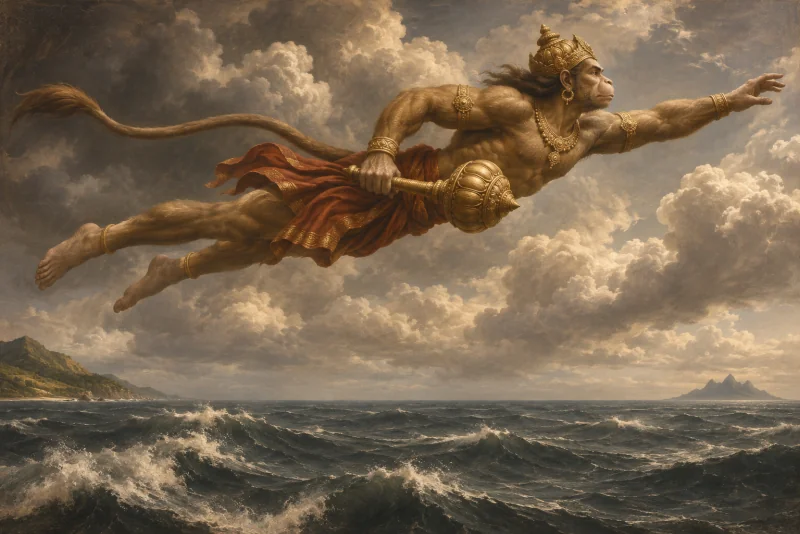
Bendigeidfran’s fleet crossed, and he waded beside it. Matholwch’s swineherds reported a forest on the sea and a mountain beside it, with a ridge and two lakes: the masts, Bendigeidfran, his nose and his angry eyes. The Irish broke the bridge over the river Llinon, so the king lay down across it: “he who will be chief, let him be a bridge”, a saying, the story notes, still in use. Peace was offered, with a house built at last big enough to hold him. Efnysien found two hundred armed men hidden in leather bags inside it and crushed their heads one by one. Then, at the peace feast, he threw the boy Gwern into the fire.
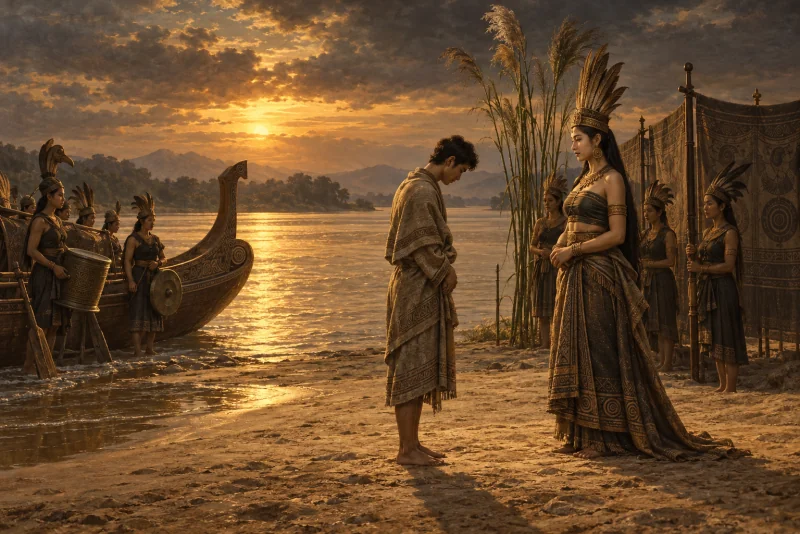
In the battle the Irish revived their dead in the cauldron. Efnysien lay down among the Irish dead and was thrown in; he stretched himself out, broke the cauldron in four, and his heart burst. Only seven men of the Island of the Mighty survived, among them Pryderi and Manawydan. Bendigeidfran, wounded in the foot by a poisoned spear, told them to cut off his head and carry it to the White Mount in London, to be buried facing France. On the way home Branwen sat on the bank of the Alaw and looked at the two countries: “two islands have been destroyed because of me!” Her heart broke, and they buried her in a four-sided grave.
The seven feasted at Harlech for seven years while the birds of Rhiannon sang to them, and the head was “as pleasant company as it ever was”. Then they spent eighty years in a hall at Gwales, without sorrow and without knowing how long, until Heilyn opened the one door they had been told to keep shut, the door facing Cornwall. All their grief came back at once. They took the head to London and buried it, and while it lay hidden no invasion would come over the sea. In Ireland, the branch adds, only five pregnant women survived in a cave, and their sons divided the land into its five provinces.
1-3 The Third Branch: Manawydan, Son of Llŷr
Manawydan had no land of his own: his cousin Caswallon had taken the crown. Pryderi gave him his mother Rhiannon as wife and the use of Dyfed. At a feast at Arberth the four friends, Pryderi, Cigfa, Rhiannon and Manawydan, sat on the mound. There was a peal of thunder and a thick mist, and when it lifted Dyfed was empty: no people, no cattle, no houses with smoke, only the four of them.
After two years of hunting they went to England to earn a living, first making saddles at Hereford, then shields, then shoes. Each time their work was so good that the local craftsmen plotted to kill them. Pryderi wanted to fight; Manawydan always moved on. Back in Dyfed, a pure white boar led their hounds into a fort that had never stood there before. Pryderi went in after them, against Manawydan’s advice, took hold of a golden bowl on a marble slab by a fountain and stuck fast, unable to speak. Rhiannon followed him and was caught too, and the fort vanished in thunder and mist.
Manawydan stayed with Cigfa, whom he swore to protect, and sowed three fields of wheat. On the eve of each harvest the ears were stripped overnight. Watching the third field, he saw a host of mice beyond counting. He caught one, slower than the rest, and set up a gallows for it on the mound. A poor scholar, then a priest, then a bishop with his whole train offered him more and more to let it go: a pound, three pounds, seven, twenty-four, then all their horses. Manawydan named his price: the return of Rhiannon and Pryderi, the lifting of the spell from Dyfed, and a promise that no one would be avenged on any of them. The bishop was Llwyd son of Cil Coed. He had laid the spell to avenge his friend Gwawl and the game of Badger in the Bag, and the mouse was his pregnant wife. Rhiannon and Pryderi came back; Pryderi had worn the door-knockers of Llwyd’s gate round his neck, and Rhiannon the collars of donkeys after they had carried hay. That bondage, the branch says, is why it was called “the Mabinogi of Mynweir and Mynord”.
1-4 The Fourth Branch: Math, Son of Mathonwy
Math son of Mathonwy, lord of Gwynedd, could not live unless his feet lay in a virgin’s lap, except in time of war. His footholder was Goewin, and his nephew Gilfaethwy fell sick with love for her. Gilfaethwy’s brother Gwydion, “the best teller of tales in the world”, made a war to get Math away. Disguised as a bard, he went to Pryderi and asked for the new animals Arawn had sent him from Annwfn: pigs. He paid for them with horses, hounds and gilded shields made by magic, an illusion that would last only until the same hour the next day. Pryderi’s army marched north, and while Math was away Gilfaethwy forced Goewin in Math’s own bed. Pryderi offered to settle the war by single combat with Gwydion and was killed, “by the magic and charms of Gwydion”. He was buried at Maen Tyriawg, above Y Felenrhyd.
Math married Goewin to make amends to her and gave her authority over his realm. Then he struck his nephews with his wand. For three years they lived as animals, a pair of deer, then wild pigs, then wolves, and the Welsh is plain that each year one brother was the female. Each pair came back with a young one: Hyddwn, Hychdwn and Bleiddwn. Math needed a new footholder, and Gwydion named their sister Arianrhod. Asked to step over Math’s wand to prove she was a virgin, she dropped a yellow-haired boy, who made for the sea and was called Dylan Eil Ton, “son of the wave”, and something small that Gwydion hid in a chest. It was another boy.
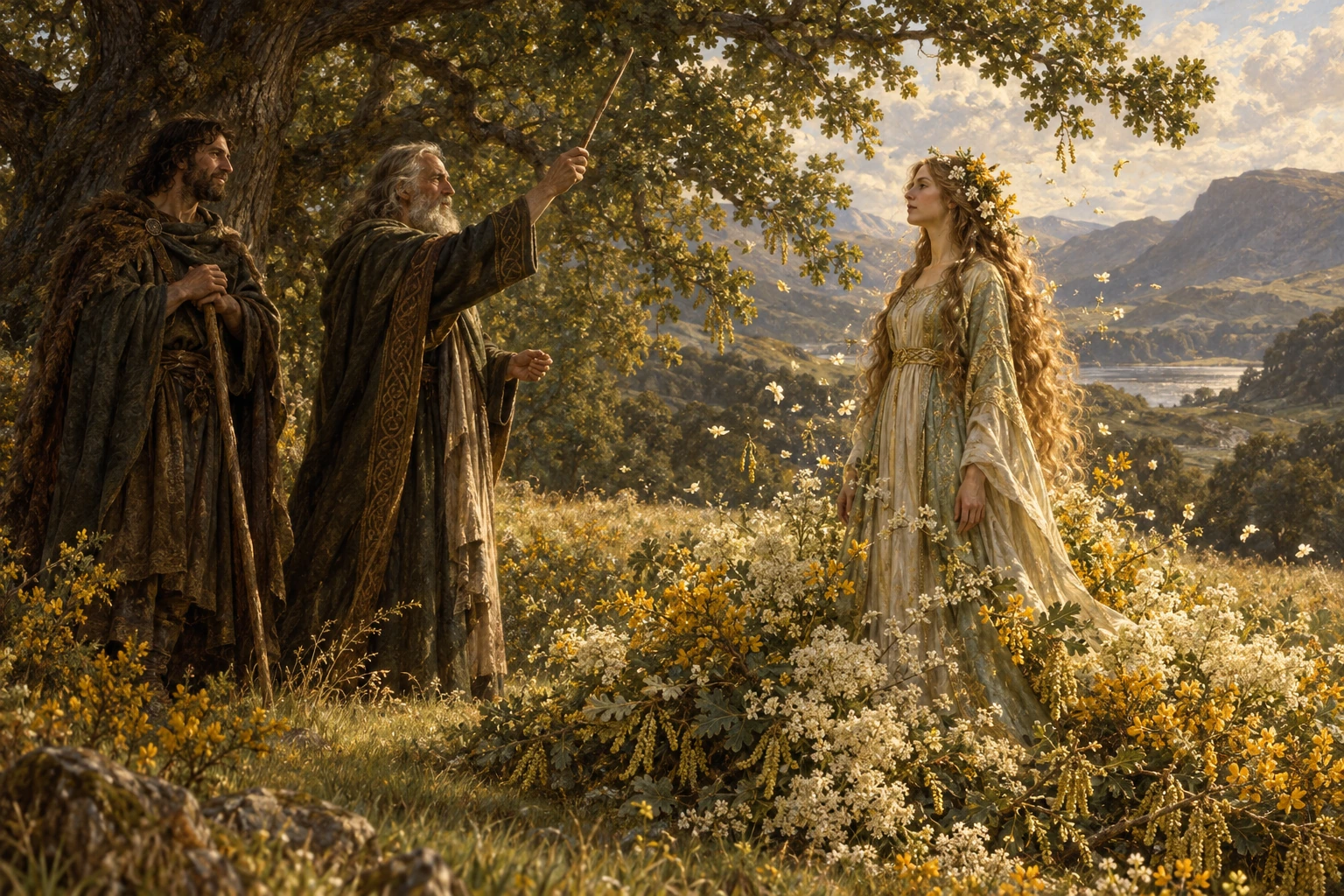
Arianrhod refused the child everything a young lord needs. He would have no name unless she gave it; Gwydion took him to her disguised as a shoemaker, the boy hit a wren “between the sinew and the bone”, and she said that the fair one had hit it with a skilful hand. So he was named Lleu Llaw Gyffes. He would bear no arms unless she armed him; Gwydion conjured a fleet off her shore, and she buckled on his armour herself. He would have no wife “of the race that now inhabits this earth”. So Math and Gwydion took the flowers of the oak, the broom and the meadowsweet and made from them the fairest maiden anyone had seen, and named her Blodeuwedd.
While Lleu was away, Blodeuwedd took in a hunter, Gronw Pebyr, lord of Penllyn, and they fell in love at first sight. She drew out of Lleu the secret of his death. The spear must be a year in the making, worked on only “during the sacrifice on Sundays”. He could be killed neither in a house nor outside, neither on horseback nor on foot: only standing with one foot on the edge of a bath under a thatched roof by a river and the other on the back of a billy goat. A year later she asked him to show her. Gronw threw the spear from ambush on a nearby hill, and Lleu flew up as an eagle with a terrible scream.
Gwydion found him by following a sow to an oak at Nant y Llew, where an eagle sat shedding rotten flesh. He sang three verses that brought the bird down, branch by branch, to his knee, and struck it with his wand: Lleu was “nothing but skin and bone”. Blodeuwedd fled with her maidens, who walked looking backwards in their fear and fell into a lake. Gwydion would not kill her. He turned her into an owl, never to show her face by day, and the Welsh adds that blodeuwedd is the word for “owl” in the language of its own time. Lleu threw the spear back at Gronw from the same spot. Gronw held up a stone slab, but the spear went through it and through him. The holed stone by the river Cynfael, the branch says, is still called Llech Gronwy, and Lleu went on to rule Gwynedd.
2 Where the Story Is Written Down
- The White Book of Rhydderch (Llyfr Gwyn Rhydderch), National Library of Wales, Peniarth MS 4, with Peniarth MS 5, about 1350. It is named after Rhydderch, one of its early owners. Its text of the Four Branches is the one followed above.
- The Red Book of Hergest (Llyfr Coch Hergest), Jesus College, Oxford, MS 111, written “with few exceptions during the last quarter of the xivth, and the first quarter of the xvth centuries”, in the words of the palaeographer J. Gwenogvryn Evans. Its chief scribe was Hywel Fychan ap Hywel Goch. It is a whole library of Welsh writing, with poetry and chronicles beside the tales, and it was given to Jesus College in 1701. In the Red Book the first branch opens with the words Llyma dechreu mabinogi, “Here begins the mabinogi”.
- Peniarth 6, fragments of the Four Branches. The palaeographer Evans dated them to about 1225; Daniel Huws later placed them in the second half of the 13th century. They are the oldest copies known.
- The formula. Each branch ends with Ac yuelly y teruyna y geing honn o’r Mabinogi, “and thus ends this branch of the Mabinogi”. The word cainc means “branch” (and also a song or tune). Guest translated it “portion”.
- The other tales. The same two books hold seven more prose tales, among them Lludd and Llefelys, Culhwch and Olwen and three Arthurian romances. Only the four tales above call themselves mabinogi. John Rhŷs, editing the Red Book text in 1887, wrote that there was “no warrant for extending the use of the term” to any others.
3 Competing Versions
- When were they composed? No one knows, and the guesses span two centuries. Ifor Williams, in his edition of 1930, put them about 1060. Thomas Charles-Edwards, arguing from law and lordship rather than spelling, suggested 1050 to 1120. Saunders Lewis argued for a date after Henry II landed in Ireland in 1171. Patrick Sims-Williams, in a book of 2011 on Irish influence, found neither limit secure. Andrew Breeze places them between 1120 and the mid-1130s.
- Who wrote them? The author is unknown. Since 1997 Breeze has argued that it was a woman: Gwenllian, daughter of Gruffudd ap Cynan, king of Gwynedd, who married into Dyfed and died in 1136. Few have followed him. In his own survey of 2018 he quotes the historian Geraint H. Jenkins, for whom the claim “has been universally derided”. In 1914 W. J. Gruffydd even gave each branch its own date. Brynley Roberts, by contrast, hears in all four the “hand and voice of a single author”.
- Lleu or Llew? The manuscripts spell the hero’s name Llew, “lion”, and Guest followed them: “with a steady hand did the lion aim at it”. Joseph Loth argued in 1913 that the scribe misread Lleu, and the Welsh dictionary of the University of Wales marks llew there as an error. Lleu means “light” or “bright”, so the name comes straight from Arianrhod’s own words: the bright one hit it with a skilful hand.
- What Guest left out. Loth noted that Guest cut passages she found risqué or shocking. Where Pwyll turns away from Arawn’s queen every night, her translation has a row of asterisks. Where Math makes one brother a hind and the other a stag, she writes only of “two deer, and a fawn”. A translation of Pwyll printed in the Cambrian Register in 1795–96 had already cut the same passages.
- What does mabinogi mean? The University of Wales dictionary gives “childhood, youth; events or feats of youth, story of (someone’s) youth, story, legend”. A fourteenth-century Welsh text of the childhood of Christ is called Mabinogi Iesu Grist. The dictionary also notes a proposal linking the word with the name Mabon, from Celtic Maponos. Rhŷs thought a mabinog was a bard’s apprentice, but Loth had to admit that the word “with this sense is found in no ancient text”.
4 History and Tradition
- A word already forgotten. In 1707 the scholar Edward Lhuyd described the book in his Archaeologia Britannica. What the word mabinogi means, he wrote in Latin, “is not known today”. The copy he had seen was divided into four parts, which “the author or copyist” calls the branches of his Mabinogi.
- Lady Charlotte Guest’s Mabinogion. Guest began translating in 1837. Her Mabinogion, with the Welsh text from a copy of the Red Book made by John Jones (Tegid), came out in seven parts printed by William Rees of Llandovery from 1838. The part with Branwen, Manawydan and Math is dated 1845, and the whole was bound in three volumes in 1849. Loth called it the first complete translation of the collection. She added a twelfth tale, Taliesin, which is not in the Red Book, and she dedicated the work to two of her children.
- Branwen’s grave. By the river Alaw on Anglesey stands a mound still called Bedd Branwen. When a cremation urn was found there in 1813, it “reminded certain clergymen” of the four-sided grave in the story. Excavated in 1967, it proved to be a Bronze Age burial mound, with radiocarbon dates of 1274–1403 BCE.
- Stories of place-names. The branches often stop to explain a name. Talebolion, in Anglesey, is where Matholwch was paid in colts; several places called Mochdre mark the nights of Gwydion’s flight with the pigs; Llech Gronwy is Gronw’s stone.
“The Mabinogion” is often described as an ancient Welsh book. No medieval manuscript gives the tales that name. The plural mabynnogyon occurs once, at the end of the first branch, where the scribes elsewhere write mabinogi, and the University of Wales dictionary calls it probably a copying error. Guest took it as the title of her translation, and it has stayed with the eleven tales of the White and Red Books ever since. The manuscripts date from the 14th century, the tales probably from the 11th or 12th.
5 Related Stories
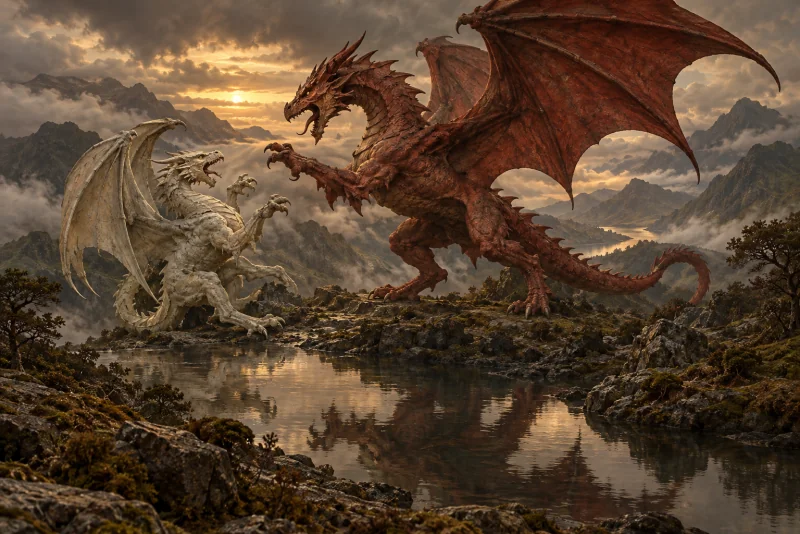
- The Red Dragon: The Dragon on the Welsh Flag: Lludd and Llefelys, the tale of the two dragons fighting under Britain, is copied in the same two books as the Four Branches, and Guest translated it in the same volume.
- The Tuatha Dé Danann: The Gods Who Went into the Hills: Joseph Loth identified the Irish Lir and his son Manannán, of the Tuatha Dé, with the Welsh Llŷr and his son Manawydan. He thought the old myths showed much more clearly in the Irish tales than in the Welsh.
- Oisín and Tír na nÓg: The Land of Youth: at Gwales the seven companions spend eighty years without noticing the time, until a door is opened and the world comes back. Time passing unseen in another world is a shared theme; we have not found a scholar who compares the two tales.
- Baldr: The Death of the Shining God: a hero who can hardly be killed, and the one way it can be done, drawn out of the person closest to him: Frigg tells Loki in disguise of the mistletoe, and Blodeuwedd learns Lleu’s secret by pretending to worry for him. We link them for the theme; we have not found a scholar who compares them.
6 Sources
- Pedeir Keinc y Mabinogi, Welsh text, with the readings of the White Book of Rhydderch: Wicidestun, Wicidestun, Wicidestun, Wicidestun
- Lady Charlotte Guest (trans.), The Mabinogion: Project Gutenberg; the 1849 volume with the Four Branches and the Welsh text (Longman, London, and W. Rees, Llandovery): archive.org
- John Rhŷs and J. Gwenogvryn Evans (eds), The Text of the Mabinogion and Other Welsh Tales from the Red Book of Hergest (Oxford, 1887): archive.org
- Joseph Loth (trans.), Les Mabinogion du Livre rouge de Hergest avec les variantes du Livre blanc de Rhydderch, vol. 1 (Paris, 1913), introduction: archive.org
- Geiriadur Prifysgol Cymru (the University of Wales Dictionary), “mabinogi”, “cainc”, “pryder”, “lleu”, “cyffes” and “blodeuwedd”: geiriadur.ac.uk, geiriadur.ac.uk, geiriadur.ac.uk, geiriadur.ac.uk, geiriadur.ac.uk, geiriadur.ac.uk
- CODECS, “Aberystwyth, National Library of Wales, Peniarth MS 4” and “Oxford, Jesus College, MS 111”: codecs.vanhamel.nl, codecs.vanhamel.nl
- Andrew Breeze, “The Dates of the Four Branches of the Mabinogi”, Studia Celtica Posnaniensia 3 (2018), 47–62, with its survey of earlier views: pressto.amu.edu.pl
- Edward Lhuyd, Archaeologia Britannica (Oxford, 1707): archive.org; D. Rhys Phillips, Lady Charlotte Guest and the Mabinogion (Carmarthen, 1921): archive.org
- Royal Commission on the Ancient and Historical Monuments of Wales, “Bedd Branwen - Cairn South-West of Glanalaw” (NPRN 302327): Coflein
Cover and illustrations: AI-generated images made for Arcana. They are interpretations, not historical artworks.