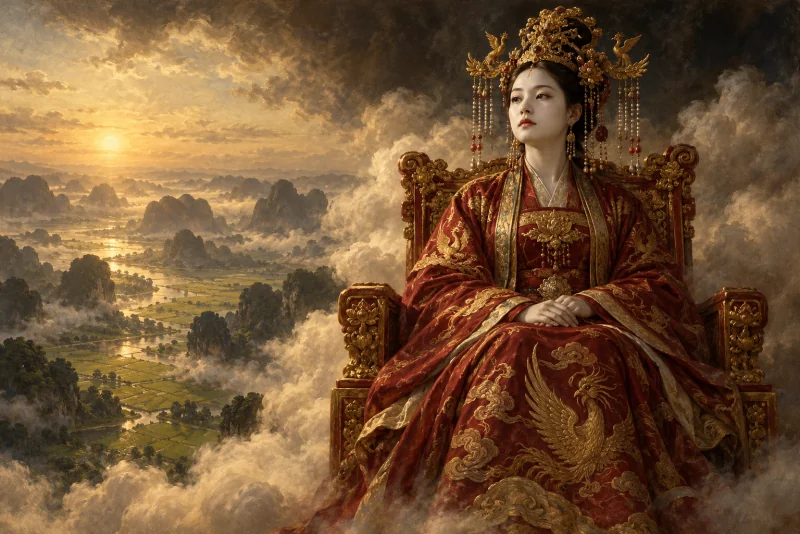
Chử Đồng Tử and Tiên Dung: The Poorest Man and the Princess
A man so poor that he and his father shared one loincloth hid in the sand, and the princess who found him there made him her husband. In the oldest full telling they become merchants and Buddhists, and their city rises in one night and vanishes in another, leaving a marsh behind.
- Type: legend, a poor man and a princess who marry, grow rich by trade and rise to heaven; he is worshipped as a god
- Culture: Việt, the Red River delta; Chử Xá on the edge of Hanoi, and Khoái Châu in Hưng Yên province
- Earliest texts: a note in the Đại Việt sử ký toàn thư (1479) and the full story in the Lĩnh Nam chích quái, both in their 15th-century form; the dragon’s claw, without his name, already in the Việt điện u linh tập (preface dated 1329)
- Key figures: Chử Đồng Tử, Tiên Dung, the third Hùng king, the monk Phật Quang, Triệu Quang Phục (Triệu Việt Vương)
On the left bank of the Red River, villages carry their palanquins every spring to the temples of a man who once owned nothing, not even a loincloth of his own. A princess found him hiding in the sand and married him. The marsh where their city is said to have vanished later hid a rebel king, and its god gave him a dragon’s claw.
Did Chử Đồng Tử and Tiên Dung teach the people to grow rice and weave? Not in the old texts. That comes from the school reading, Sự tích lễ hội Chử Đồng Tử in the third-grade textbook, adapted from Hoàng Lê, where the couple “seek a teacher of the Way” and go about teaching rice-growing, silkworms and weaving. In the Lĩnh Nam chích quái they open a market, trade with merchants from overseas, and the husband sails abroad to buy goods. The Toàn thư has neither trade nor teaching.
1 The Telling
This is the version of the Lĩnh Nam chích quái, in its chapter “Nhất Dạ Trạch truyện” (一夜澤傳), “The Tale of the One-Night Marsh”. We follow the text corrected by Vũ Quỳnh and Kiều Phú at the end of the 15th century, as transcribed on Chinese Wikisource, and say where the copy translated into English by Eric Henry differs.
1-1 The Princess and the Poorest Man
The third Hùng king had a daughter, Tiên Dung. The text calls her Tiên Dung mị nương, the title every Hùng king’s daughter bore, and a note makes her a descendant of the farming god Shennong in the tenth generation. At eighteen she was beautiful, but she did not want a husband. She loved to roam, and her father let her. Every year, in the second and third months, she fitted out boats and drifted out to sea, enjoying herself so much that she forgot to come home.
In Chử Xá, a village on the bank of the great river, lived Chử Vi Vân and his son Chử Đồng Tử, good and kind people both. A fire took everything they had except one cloth loincloth, which father and son took turns to wear when they went out. When the father grew old and ill, he told his son: “When I die, bury me naked, and keep it for yourself.” The son could not bear to. He buried his father in it, and now he had nothing at all. Naked, cold and hungry, he stood in the river and begged from the merchant boats that passed, or fished with a rod to stay alive.
1-2 The Reeds on the Sandbank
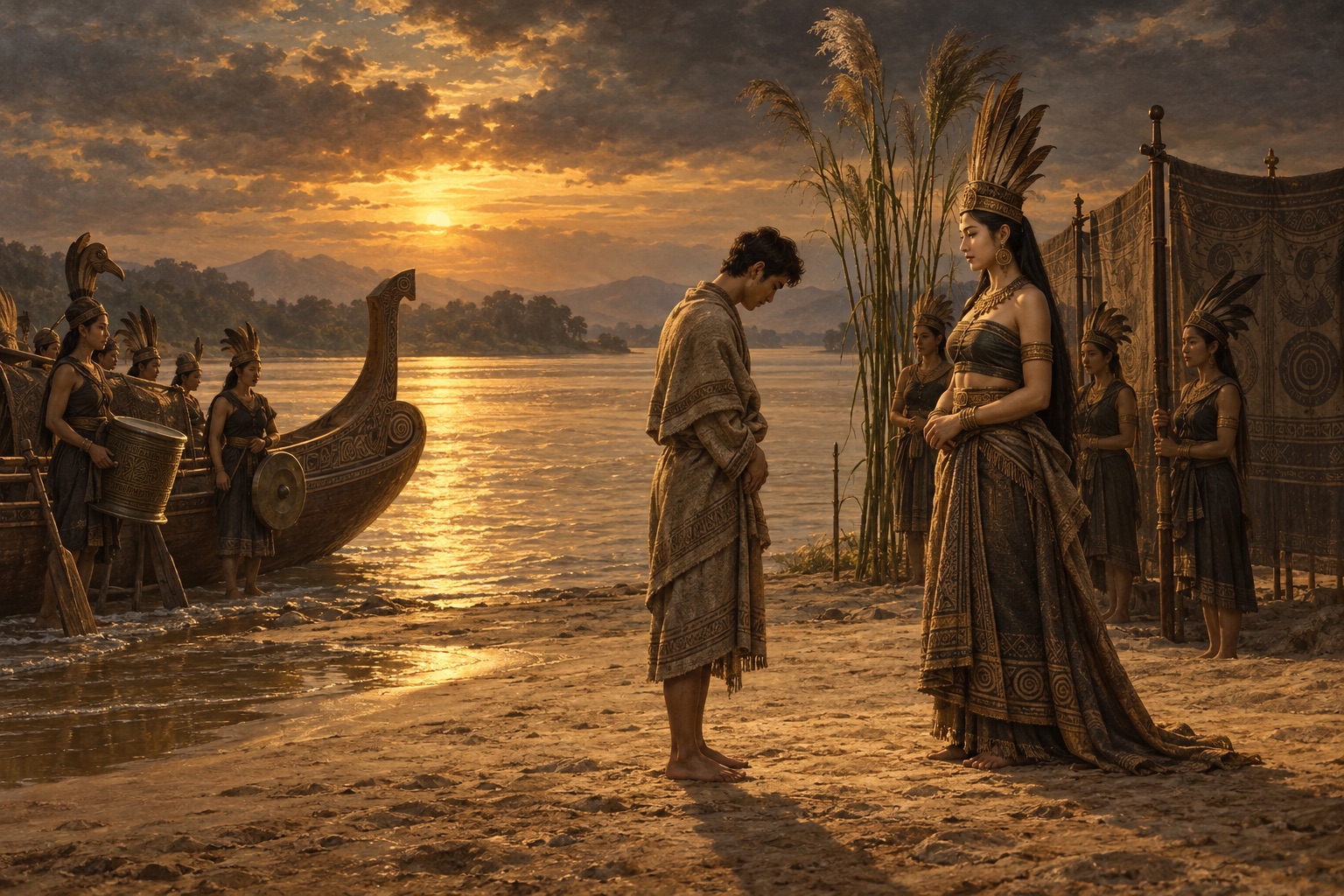
One day Tiên Dung’s boat came upon him without warning, with bells and drums, pipes and flutes, and a crowd of attendants. Đồng Tử was terrified. On the sandbank stood a sparse clump of reeds, three or four stems. He hid among them, scooped a hollow in the sand, lay down in it and covered himself over.
A moment later the princess moored there to amuse herself on the sand, and had curtains hung around the reeds to make a place to bathe. Inside, she undressed and poured water over herself. The sand washed away, and there was Đồng Tử. She stared at him a long time before she understood that he was a man. “I never wished to marry,” she said. “Now I have met this man, and we are uncovered together in one hollow. Heaven has arranged it. Get up and bathe.”
She gave him clothes and took him aboard, where they feasted, and everyone on the boat said that no meeting like it had ever happened. Đồng Tử told her his story; she sighed, and declared that they would be husband and wife. He refused, firmly. “This is a match Heaven has made,” she said. “Why refuse?” Her attendants rode to tell the king. “Tiên Dung cares nothing for her good name or for my wealth,” he said. “She roams the roads and marries down to a poor man. With what face can she come before me?”
1-3 The Market
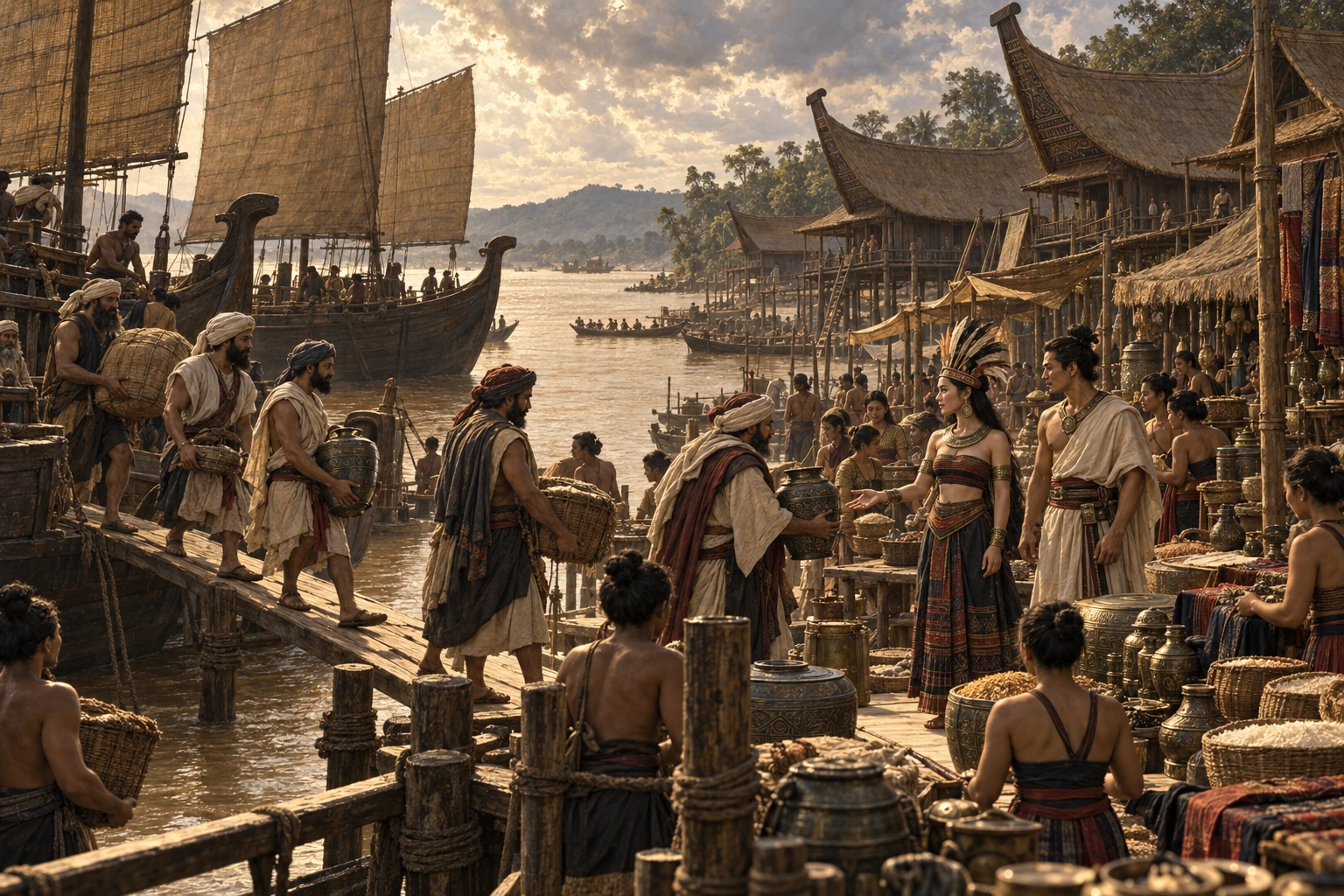
Hearing this, Tiên Dung dared not go home. With Đồng Tử she opened a market at a ferry landing, set up shops and traded with the people, and it grew into a great market: the text names it Thâm market, or in another reading Hà Lương. Rich merchants from foreign lands came and went, and treated the couple as their masters. One of them said: “Noble lady, put up one dật of gold. Go overseas this year and buy precious goods, and next year you will have ten.” Tiên Dung was delighted. “Heaven brought us together,” she told her husband, “and Heaven gives us our food and clothing. Take the gold, go overseas with our people and trade for our living.”
1-4 The Staff, the Hat and the City
Out at sea stood Mount Quỳnh Viên, with a small hermitage on its top. While the crew moored to take on water, Đồng Tử climbed up. In the hermitage lived a young monk named Phật Quang, “Buddha’s Light”, who taught him the Dharma. Đồng Tử stayed to study and gave the gold to his people to buy goods. They picked him up on their way home, and the monk gave him a staff and a conical hat. “The spiritual power is in these,” he said. Back home, Đồng Tử told Tiên Dung of the Buddhist way, and she too was awakened. They gave up the market and went far away in search of a teacher.
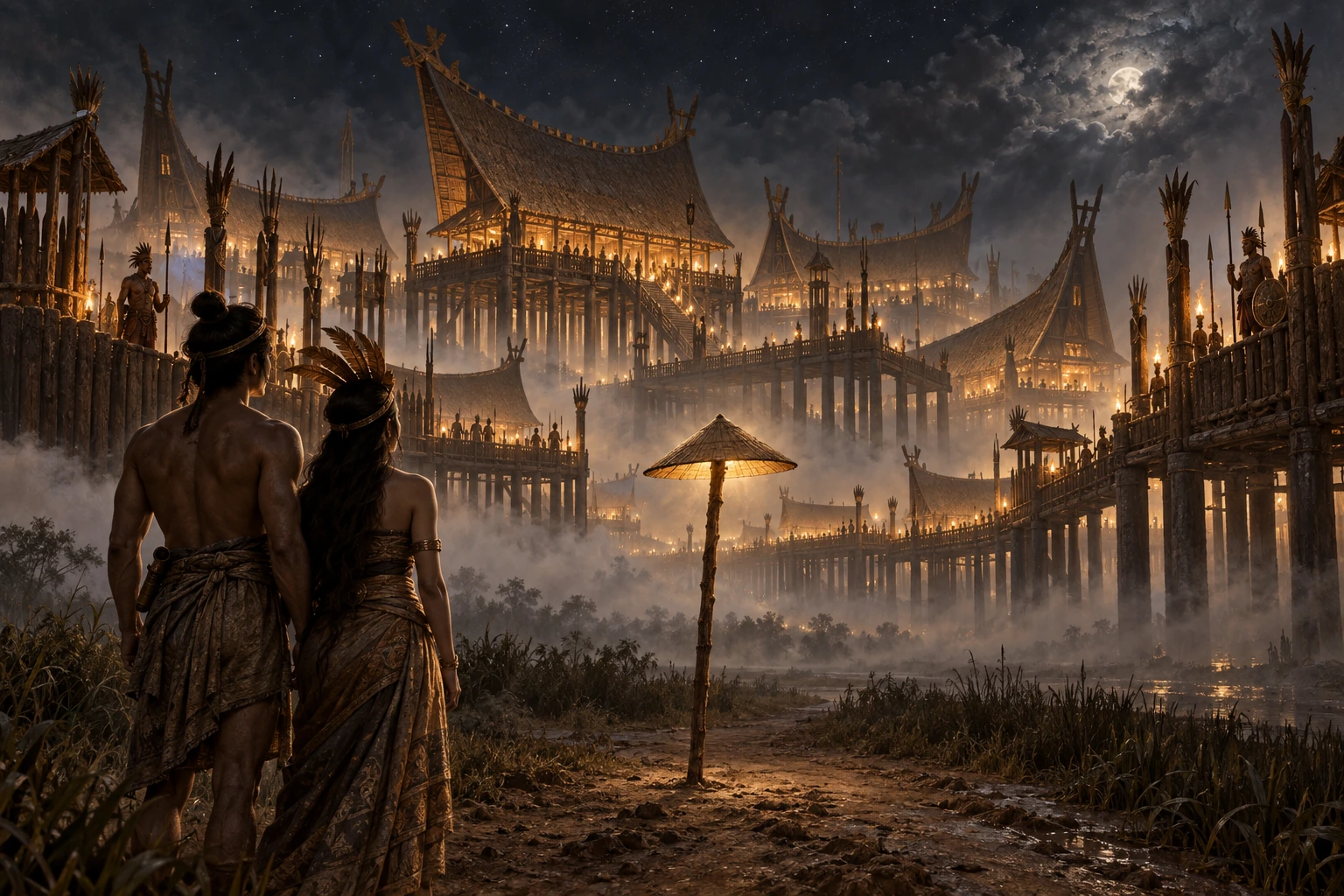
One day night fell before they reached a village. They stopped by the road, planted the staff in the ground and set the hat on top of it for shelter. At the third watch there appeared walls and gates, towers of pearl and halls of jewels, terraces and corridors, storehouses, temples and altars, gold, silver, pearls and jade, beds and curtains, immortal youths and jade maidens, generals, soldiers and guards, all arrayed before them. In the morning, everyone who saw it was astonished. People came with incense, flowers and fine food and offered themselves as subjects. There were officials civil and military, and troops to keep watch: it had become a kingdom of its own.
1-5 The One-Night Marsh
The Hùng king heard of it, decided that his daughter was in revolt, and led his troops against her. Her officials asked leave to fight. Tiên Dung laughed. “This is not my doing; Heaven made it so. Life and death lie with Heaven. How could I dare resist my father? I will accept what is right, and let him put us to death.”
The new subjects scattered in fear, and only the old followers stayed. The royal army camped on the islet of Tự Nhiên, still across the great river, and as dusk fell it did not advance. At midnight a great wind lifted the sand and tore up trees, and the king’s army was thrown into confusion. Tiên Dung’s people and her city rose to heaven all at once, and the ground where it stood sank into a great marsh. The people built a shrine there and made offerings regularly. They called the marsh Nhất Dạ Trạch, the One-Night Marsh, the islet Mạn Trù, “the Curtains”, and the market Thâm.
1-6 The Dragon’s Claw
Centuries later the Liang dynasty of China sent Chen Baxian (Trần Bá Tiên) to invade the south, and Lý Nam Đế sent Triệu Quang Phục against him. Quang Phục hid his army in this marsh. It was deep, wide and boggy; he slipped out in dugout canoes to raid and seize grain, wearing the enemy down. For three or four years the two sides never crossed blades. “Of old,” Chen Baxian sighed, “they called it the Marsh Where They Rose to Heaven in One Night. Now it is the Marsh of One-Night Raids.”
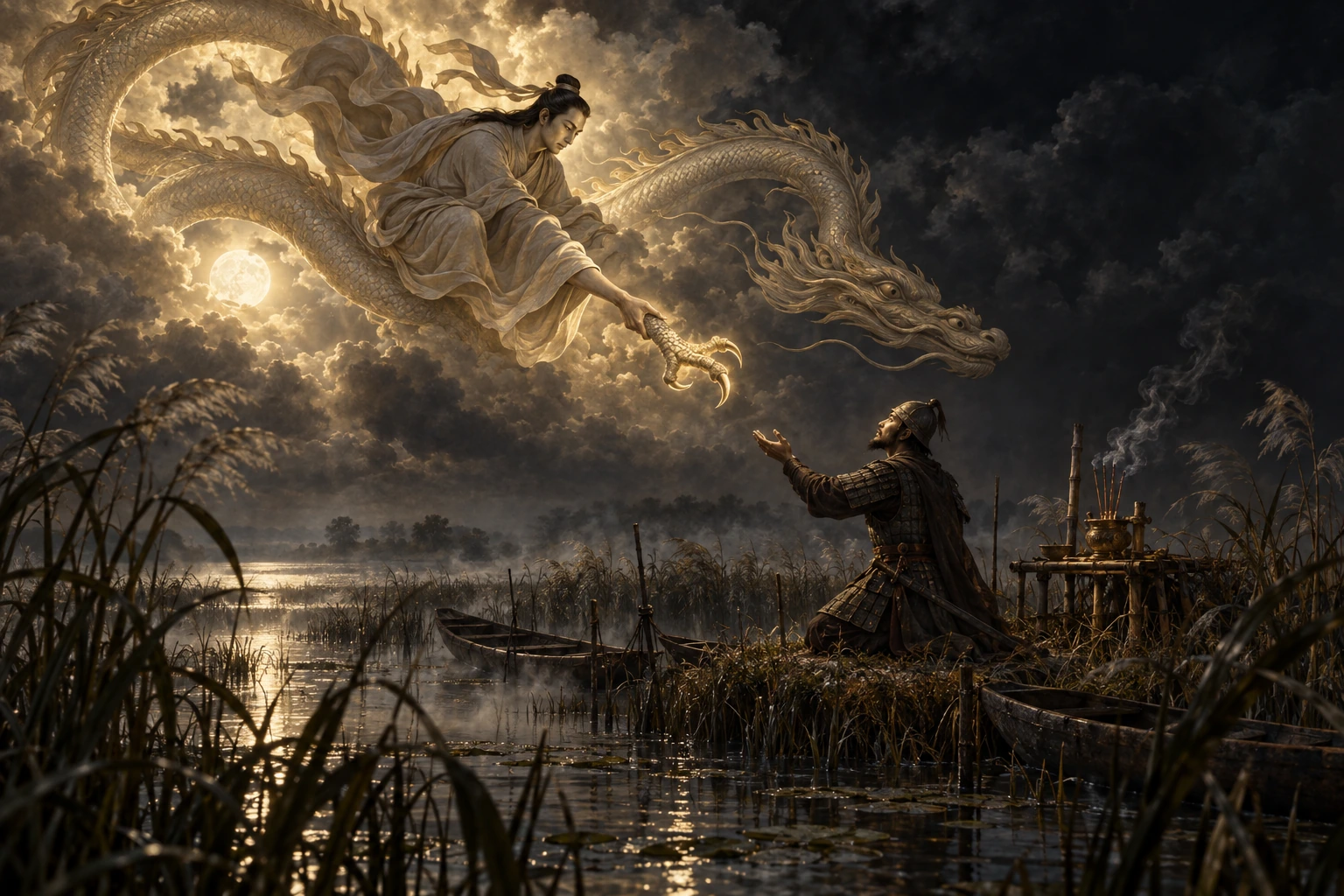
When Hou Jing rebelled in China, the Liang called Chen Baxian home and left the army to a lieutenant, Dương Sằn. Quang Phục fasted, set up an altar in the marsh, burned incense and prayed. Suddenly a divine man came down onto the altar riding a dragon; one copy, a note says, names him Chử Đồng Tử. “The place where I rose to heaven keeps its power,” he said. “You have prayed earnestly, so I have come to help you.” He took off the dragon’s claw and gave it to Quang Phục: “Fix it on your helmet, and wherever you turn, the enemy will perish.” Then he rose to heaven. With the claw, Quang Phục’s army took heart. The Liang were routed and Dương Sằn was beheaded before the lines. Hearing that Lý Nam Đế had died, Quang Phục made himself king, Triệu Việt Vương, and built his citadel at Trâu Sơn in Vũ Ninh.
2 Where the Story Is Written Down
- The Việt điện u linh tập (Spiritual Powers of the Việt Realm) has no entry for Chử Đồng Tử. Its preface, by Lý Tế Xuyên, is dated 1329; we read Lê Hữu Mục’s translation of manuscript A.751. In the entry on Triệu Việt Vương and Lý Nam Đế, after a year in the marsh Quang Phục sees “a yellow dragon” one night, which takes off its claw and tells him to fix it on his helmet. The translator notes that the text never says it was Chử Đồng Tử.
- The Đại Việt sử ký toàn thư (Complete Annals of Đại Việt). Ngô Sĩ Liên’s Outer Annals (1479) give the couple no entry either. The story is a note under the year 547, explaining the name of the marsh where Triệu Quang Phục took refuge. It has no monk, no trade, no staff and no hat: the princess finds the naked Chử Đồng Tử in the reeds, they live on the bank for fear of punishment, their home becomes a city, and when the king’s troops come a midnight storm lifts the people, with their chickens and dogs, up to heaven. The claw comes under 549, with a note: “Popular tradition says” that the divine man of the marsh, Chử Đồng Tử, came down on a yellow dragon and gave it.
- The Lĩnh Nam chích quái (Strange Tales from South of the Passes), the source of section 1. In his preface of 1492, Vũ Quỳnh says what the tale teaches: in Chử Đồng Tử’s chance meeting with Tiên Dung, as in another tale of a man who finds an immortal wife, one can see “the hidden reward for doing good”. The copy Henry translated, published by Lê Hữu Mục in Saigon in 1959, has forty-one tales. Among them is a separate “Tale of the Dragon’s Claw That Drove Back the Invaders” (Long trảo khước lỗ), in which the giver is “said among the people to be Chử Đồng Tử”.
- The Khâm định Việt sử thông giám cương mục, the Nguyễn court’s history of the 19th century, keeps the story only in a note. It comes “from the Lĩnh Nam chích quái”, the note says, and “the affair is absurd”; it is appended for reference. The same note puts Dạ Trạch in Đông An district, Khoái Châu prefecture.
- Later retellings. Phan Kế Bính’s Nam Hải dị nhân liệt truyện (Lives of Remarkable People of the Southern Sea), read here in its fifth edition (Hanoi, 1930), follows the Lĩnh Nam chích quái closely under the title “Sử-đồng-Tử”. The version most Vietnamese know is the school reading in the third-grade textbook Tiếng Việt 3.
3 Competing Versions
- Which Hùng king? The third, in both copies of the Lĩnh Nam chích quái and in Phan Kế Bính. The Toàn thư gives no number. The school reading says the eighteenth, the last.
- The father’s name. Chử Vi Vân (褚微雲) in the Wikisource text and in Henry’s copy, with a variant reading Chử Vi Tử. Phan Kế Bính writes Sử Cù Vân; modern accounts say Chử Cù Vân. The school reading gives him no name, and adds that the mother had died early.
- Who made the match? Heaven, says Tiên Dung in the Lĩnh Nam chích quái. The Toàn thư note says she took it for the work of the Old Man of the Moon, the matchmaker god, and Phan Kế Bính has her say so too.
- Who gave the claw, and where did it go?
- A yellow dragon, unnamed, for the helmet: Việt điện u linh tập.
- A divine man on a dragon, “in one copy Chử Đồng Tử”: the Wikisource text. An unnamed spirit, who tells him to tie it to the tip of his spear: Henry’s copy.
- Chử Đồng Tử on a yellow dragon, as “popular tradition says”: the Toàn thư and the Cương mục. Phan Kế Bính simply adds “that is, Sử-đồng-tử”.
- One night, or night? The Lĩnh Nam chích quái explains Nhất Dạ by the city that vanished in a night. The Cương mục quotes the Qing imperial gazetteer for another reason: Lý Nam Đế hid from Chen Baxian in the marsh and came out to raid at night, “hence it was called Dạ Trạch”, the Night Marsh. Lê Hữu Mục went further: he thought Dạ Trạch and the One-Night Marsh were two places that later writers confused, and that this is how the claw came to be credited to Chử Đồng Tử.
4 History and Tradition
- Triệu Việt Vương in the annals. The Outer Annals note that “the old history” did not record Triệu Việt Vương, and that his reign is taken from unofficial histories and other books. They date the retreat to the marsh to 547, the claw to 549 and Dương Sằn’s defeat to 550. Lê Hữu Mục notes that Henri Maspero did not count Triệu Việt Vương as a historical figure; Lê Hữu Mục himself thought him real.
- The claw lost. The Toàn thư also tells how the claw was lost. Nhã Lang, son of the rival king Lý Phật Tử, married Triệu Việt Vương’s daughter Cảo Nương, had her show him the claw helmet, and swapped the claw. His father attacked, and the king fled to the sea at Đại Nha and threw himself in. In the 18th century the commentator Cao Huy Diệu set this beside the story of An Dương Vương: a turtle’s claw swapped by Trọng Thủy, a dragon’s claw swapped by Nhã Lang, and two daughters undone by love.
- Three readings. Vũ Quỳnh saw a reward for virtue. Eric Henry reads in the tale what mattered in the Trần era: supernatural powers that came through Buddhist adepts, and wealth won by trade at sea. Dương Thị Thu Hà, a scholar of cultural studies, sees a love that crossed every boundary of rank, and notes that Chử Đồng Tử is regarded as the forefather of Vietnam’s foreign trade.
- The temples. Dương Thị Thu Hà, citing the Ministry of Culture, counts seventy-two villages with shrines to him along the Red River. The best known are the temples of Đa Hòa and Dạ Trạch at Khoái Châu, in Hưng Yên. Đa Hòa looks out on the river and the Tự Nhiên sandbank, where tradition places the meeting; it was rebuilt in 1894 under the scholar Chu Mạnh Trinh. In November 2024 the government ranked the Đa Hòa–Dạ Trạch complex a special national relic.
- The festival. Both temples hold their main festival on the 10th to 12th days of the second lunar month, with palanquin processions and a procession to draw water from the river. At Đa Hòa the villages of the old Mễ canton hold it on a grand scale every three years. In 2023 both festivals were added to the national list of intangible cultural heritage.
- A second wife. The temples honour Chử Đồng Tử with two ladies. The second, Tây Sa, is in none of the old books. She comes from temple records attributed to Nguyễn Bính, a court scholar of the 16th century, in which Tiên Dung herself arranges the match. One report on the heritage listing names the third figure worshipped at both temples Princess Hồng Vân.
- A name not to be spoken. In a commentary on the Việt điện u linh tập, Cao Huy Diệu noted that the people of Đông An district, where Dạ Trạch lies, would not say Chử Đồng Tử’s name, and even avoided the word tử. He found the custom rustic.
- One of the Four Immortals. Vietnamese belief counts Chử Đồng Tử among the Tứ bất tử, the Four Immortals, with Tản Viên, Thánh Gióng and the Mother Goddess Liễu Hạnh; the Liễu Hạnh post explains the group.
Chử Đồng Tử is often presented as a Daoist. Vietnamese belief honours him as Chử Đạo Tổ, forefather of the cult of immortals, and one modern account calls his teacher Phật Quang a Daoist master (đạo sĩ). In the Lĩnh Nam chích quái, Phật Quang, “Buddha’s Light”, is a young monk, and what he teaches is “the Buddhist way” (佛道). In Phan Kế Bính, too, Đồng Tử brings “đạo Phật”, Buddhism, home to Tiên Dung.
5 Related Stories
- An Dương Vương and Mỵ Châu: The Magic Crossbow and the Trail of Feathers: the claw from the One-Night Marsh is lost the way the Golden Turtle’s claw was lost at Cổ Loa, through a son-in-law. Cao Huy Diệu in the 18th century and Eric Henry today both point out the likeness.
- Sơn Tinh and Thủy Tinh: The Mountain Spirit, the Water Spirit and the Yearly Floods: another Hùng king’s daughter, but there the king gives her to whichever suitor brings his gifts first. Here the princess chooses for herself, and her father calls it shame.
- Thánh Gióng: The Boy Who Grew into a Giant: another of the Four Immortals. Gióng drives back the invaders himself and then rides up to heaven; Chử Đồng Tử rises to heaven first, and comes back down to help an army against the Liang.
- Liễu Hạnh: The Exiled Princess Who Became the Mother Goddess: the fourth of the Four Immortals, and the post where the group is explained in full.
6 Sources
- Lĩnh Nam chích quái, book 1, “Nhất Dạ Trạch truyện”, text corrected by Vũ Quỳnh and Kiều Phú, with Vũ Quỳnh’s preface (1492): Wikisource (Classical Chinese), preface
- Eric Henry, trans., “The Tale of the One-night Swamp” and “The Story of the Dragon’s Claw of Khước Lỗ”, from the text published by Lê Hữu Mục (Saigon, 1959), Rising Asia Journal: Book One, Book Four
- Lý Tế Xuyên, Việt điện u linh tập, chapter on Triệu Việt Vương and Lý Nam Đế, with Cao Huy Diệu’s commentaries on it and on Sĩ Nhiếp, trans. Lê Hữu Mục from manuscript A.751: archived PDF
- Ngô Sĩ Liên et al., Đại Việt sử ký toàn thư, Outer Annals, book 4: Wikisource (Classical Chinese)
- Khâm định Việt sử thông giám cương mục, Tiền biên, book 4: Wikisource
- Phan Kế Bính, Nam Hải dị nhân liệt truyện, no. 38, “Sử-đồng-Tử”, 5th edition, revised by Lê Văn Phúc (Hanoi, 1930): Vietnamese Wikisource
- “Sự tích lễ hội Chử Đồng Tử”, adapted from Hoàng Lê, Tiếng Việt 3, vol. 2, p. 65, as reproduced by Lời giải hay: loigiaihay.com
- Dương Thị Thu Hà, “Tín ngưỡng thờ Tứ bất tử trong văn hóa người Việt Nam”, Khoa học xã hội Việt Nam 4 (2020): 50–57: VJOL
- On the temples and Tây Sa: Nguyễn Khắc Huy, “Đền Chử Đồng Tử - linh thiêng một tình yêu”, Tuổi Trẻ, 13 November 2005: tuoitre.vn; Phạm Kim Thanh, “Hội Thánh Chử Đồng Tử, một lễ hội vùng đặc sắc”, Nhân Dân, 13 March 2007: nhandan.vn; Hạnh An, “Chử Đồng Tử - Từ vị thánh hiếu đạo đến biểu tượng siêu việt của tình yêu”, Báo Văn hóa, 4 February 2026: baovanhoa.vn
- On the festival and the listings: Linh Khánh, “Công bố thêm 10 di sản văn hóa phi vật thể quốc gia”, Nhân Dân, 6 February 2023: nhandan.vn; Phạm Văn Hà, “Hưng Yên khai mạc Lễ hội truyền thống Chử Đồng Tử - Tiên Dung”, Nhân Dân, 1 March 2023: nhandan.vn; Tùng Quang, “Thêm 6 di tích được xếp hạng Di tích quốc gia đặc biệt”, Báo Văn hóa, 27 November 2024: baovanhoa.vn
Cover and illustrations: AI-generated images made for Arcana. They are interpretations, not historical artworks.