Sơn Tinh and Thủy Tinh: The Mountain Spirit, the Water Spirit and the Yearly Floods
Two spirits asked a Hùng king for the same daughter. The Mountain Spirit brought his gifts first, and the Water Spirit has attacked his mountain every year since. The famous nine-tusked elephant is not in the old texts.
- Type: legend, a rivalry of two spirits that explains the yearly floods
- Culture: Việt, the Red River delta of northern Vietnam
- Earliest texts: the Việt điện u linh tập (preface dated 1329), the Đại Việt sử ký toàn thư (1479) and the Lĩnh Nam chích quái (edition of 1492)
- Key figures: Sơn Tinh, the Mountain Spirit of Tản Viên; Thủy Tinh, the Water Spirit; Mỵ Nương; the last of the Hùng kings
West of Hanoi rises a mountain with three rounded peaks. The old books call it Tản Viên, because its summits are “round like a parasol”, and they say its god once won a king’s daughter by arriving first. The rival who came too late has never given up. Every year, in the season of floods, he sends the water against the mountain.
Did the Hùng king ask for an elephant with nine tusks? Not in the old texts. In the Lĩnh Nam chích quái and the Đại Việt sử ký toàn thư, the Mountain Spirit brings jewels, gold and silver, mountain birds and wild beasts. The Việt điện u linh tập adds rhinoceros and ivory, a hundred of each. The earliest written trace of the nine-tusked elephant we have found is a footnote in Phan Kế Bính’s Nam Hải dị nhân liệt truyện (1930 edition), and it introduces the list as what “popular tradition says”.
1 The Telling
This is the version of the Lĩnh Nam chích quái, in its chapter “Tản Viên sơn truyện” (傘圓山傳), “The Tale of Mount Tản Viên”. We follow the text corrected by Vũ Quỳnh and Kiều Phú at the end of the 15th century, as it is transcribed on Chinese Wikisource.
1-1 The Parasol Mountain
Mount Tản Viên stands west of the capital, Thăng Long. Its three peaks stand side by side, each “round like a parasol”, and that is how it got its name. The Great King of the mountain, says the chapter, quoting a lost Giao Châu ký of the Tang period, is a mountain spirit, a sơn tinh, whose family name is Nguyễn (in the original, 以為山精,姓阮氏).
In drought and in flood people prayed to him, and he answered faster than an echo answers a voice. On clear days something like banners could be seen drifting through the valleys, and the villagers would say that the mountain god had shown himself.
1-2 Two Suitors
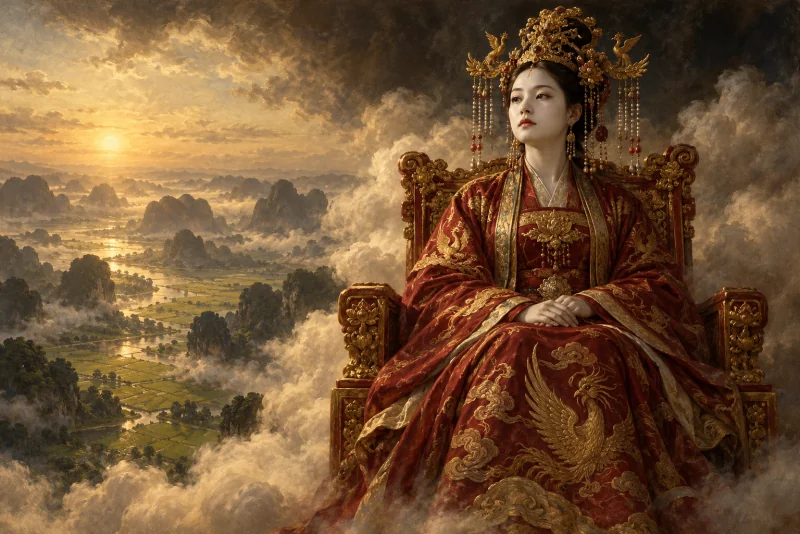
In the time of King Nan of Zhou, the eighteenth Hùng king ruled the realm of Văn Lang from Việt Trì, in Phong Châu. He had a daughter, Mỵ Nương, whose beauty was known far and wide. Phán, the king of Thục, asked to marry her. The Hùng king refused him, for he wanted to choose a better match.
A few days later two men appeared. One called himself the Mountain Spirit, the other the Water Spirit, thủy tinh (水精), and both had come to ask for her hand. The king asked them to show their magic. The Mountain Spirit pointed at a mountain and it crumbled, and he walked in and out of the rock as if nothing stood in his way. The Water Spirit sprayed water into the sky, and it turned into clouds and rain.
“You both have divine powers,” said the king, “but I have only one daughter. Whoever brings the betrothal gifts first shall have her.”
1-3 The Gifts
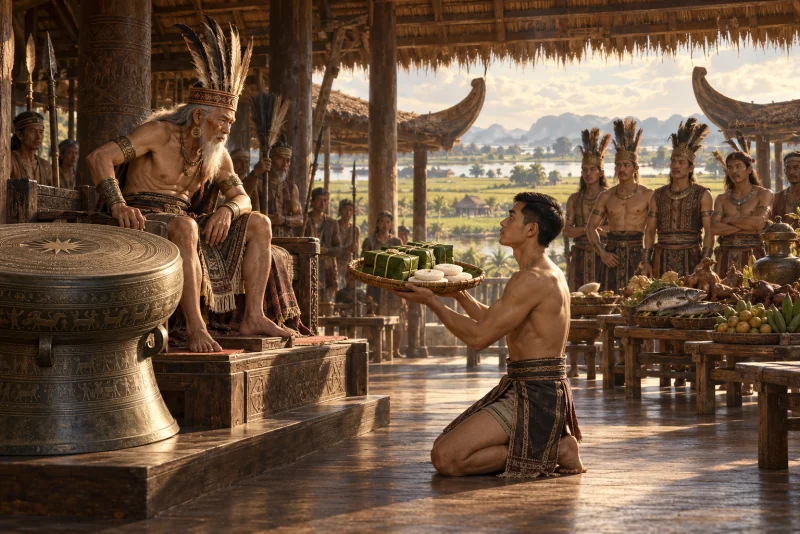
The next day the Mountain Spirit came with precious jade, gold and silver, birds of the mountains and beasts of the wild. The king kept his word and gave him his daughter.
The Water Spirit came later. When he found that Mỵ Nương was gone, he flew into a rage and led the creatures of the water to take her by force.
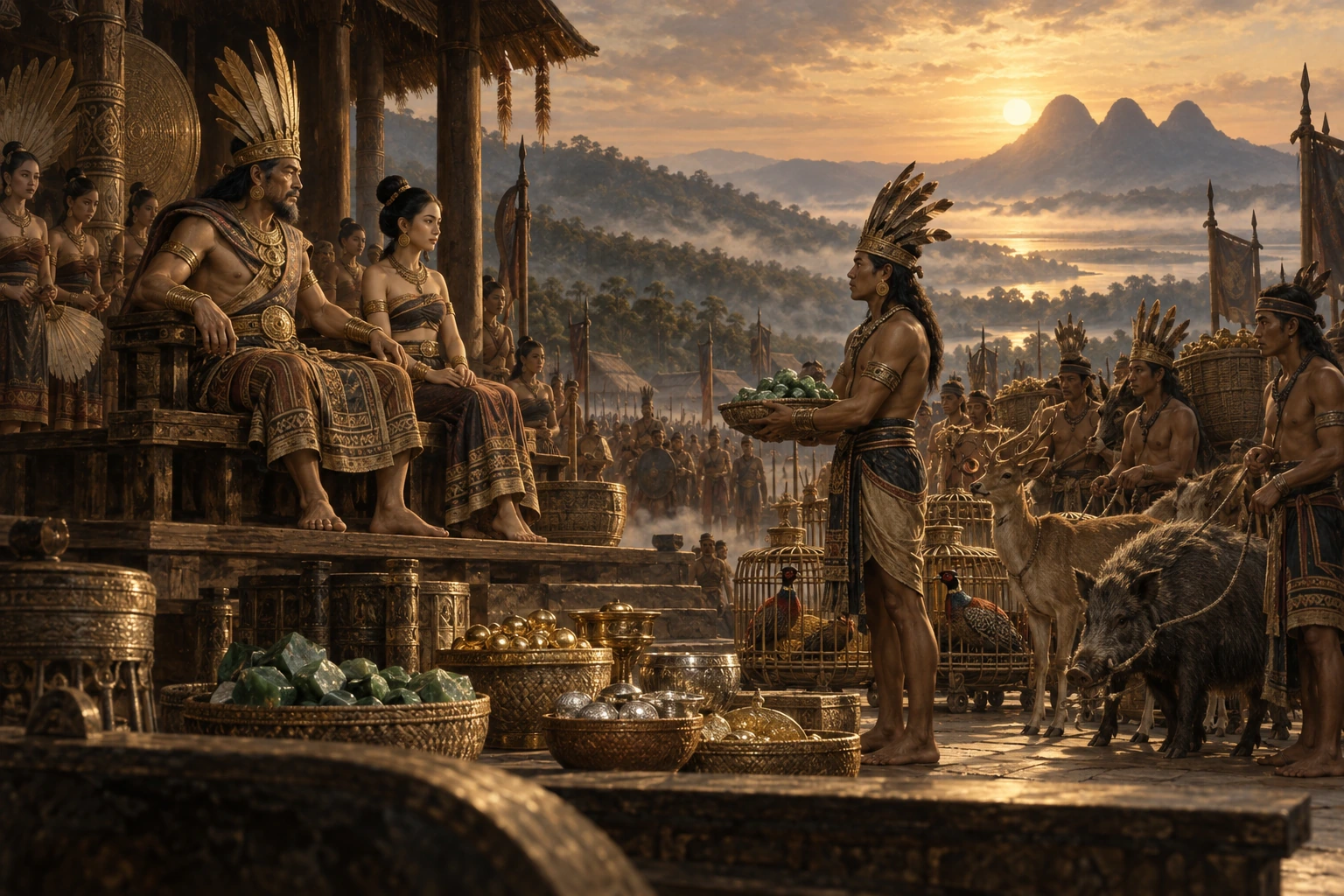
1-4 The War of the Waters
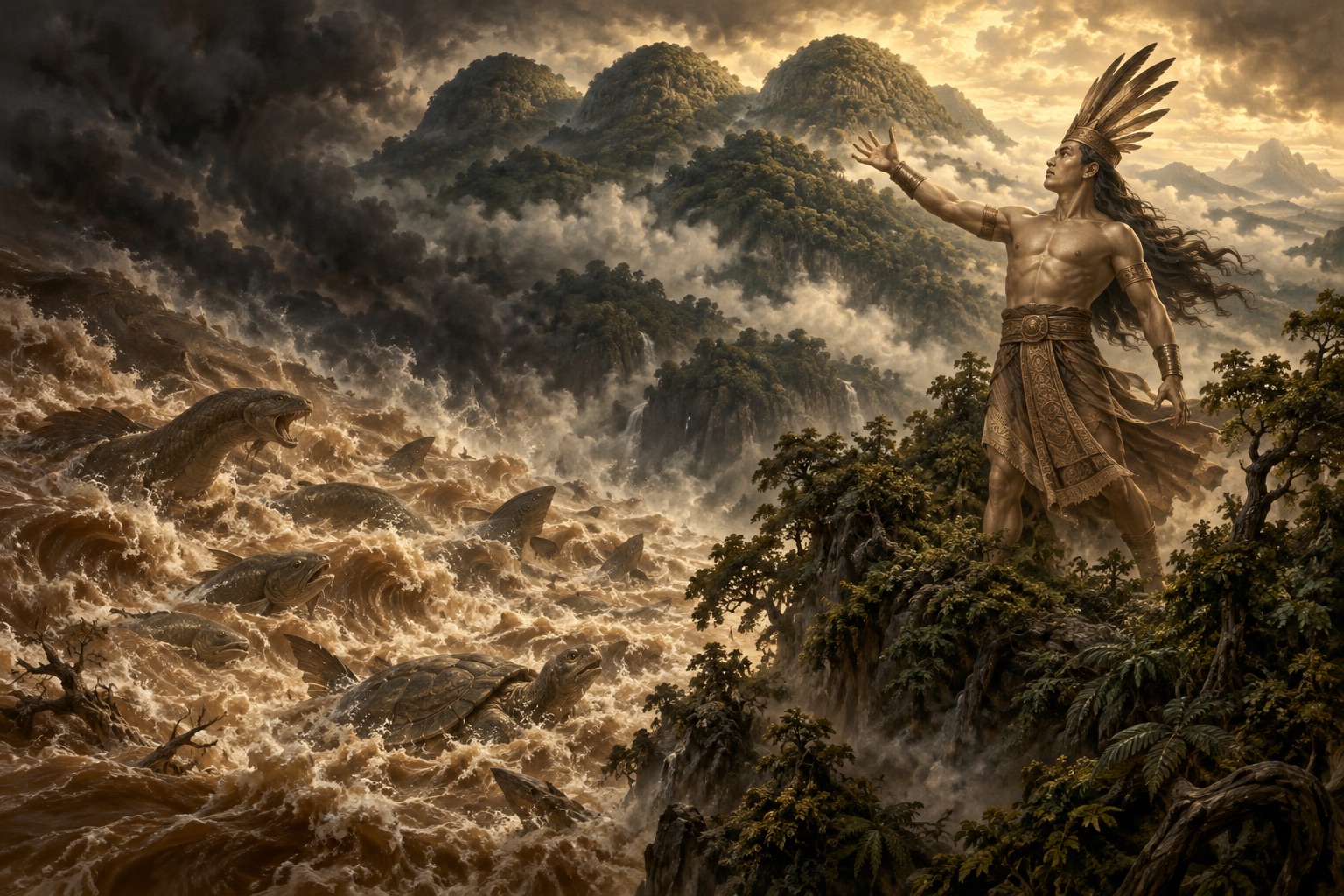
The Mountain King stretched fishing nets across the river at Từ Liêm. The Water Spirit found another way. He opened the Tiểu Hoàng river and drove his waters into the Đà River to strike the mountain from behind, and cut more channels to strike it from the front. All along the rivers he gouged out bays and pools for his armies of the water. He raised wind and darkness and brought the floods against the king.
The people at the foot of the mountain wove fences to protect it, and they beat and pounded and shouted to help him. Whenever they saw clumps of weed drifting against the fences, they shot at them. The dead turned out to be dragons, snakes, fish and turtles, and their bodies choked the rivers.
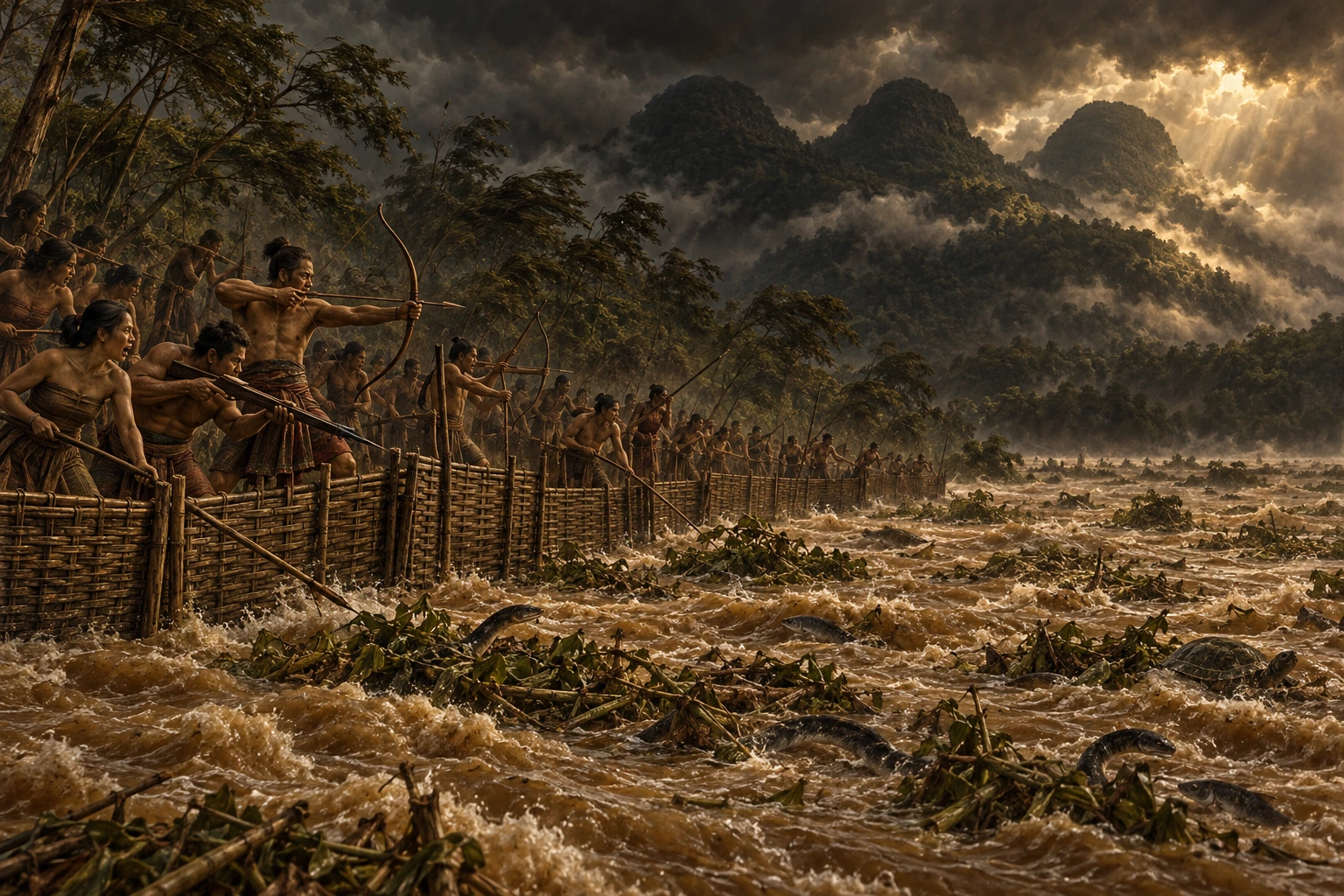
1-5 Every Year
The text ends with the floods. Every year, in the seventh and eighth months, the water rises. The people who live near the mountain suffer wind and high water, and the rice is ruined. “It is handed down,” the chapter closes, “that the Water Spirit and the Mountain Spirit are fighting to marry Mỵ Nương.”
2 Where the Story Is Written Down
Three works of the 14th and 15th centuries tell the story, and no two tell it the same way.
- Việt điện u linh tập (“The Hidden Spirits of the Việt Realm”), a collection on the gods worshipped in the temples of the Lý and Trần dynasties. Its preface, by Lý Tế Xuyên, is dated 1329. The chapter on Tản Viên is headed with the titles the Trần court gave the god, and it says it follows a Giao Châu ký by a “Lord Tăng”, a book now lost. The manuscripts of the collection differ widely. We read Lê Hữu Mục’s translation of manuscript A.751.
- Đại Việt sử ký toàn thư. The court historian Ngô Sĩ Liên, in the Outer Annals he added in 1479, tells the story under the last generation of the Hùng kings. For him it is part of history: Mỵ Nương’s marriage angers the king of Thục, and his grandson Thục Phán goes on to conquer Văn Lang.
- Lĩnh Nam chích quái. In 1492 Vũ Quỳnh copied and corrected an older text whose author was unknown. His preface explains why this tale belongs in the book: the spirit of Tản Viên “could drive back the water tribes”, so who would object to making him known? The chapter names its written sources, a Giao Châu ký and a Thế pháp tập, and twice says it is reporting what people hand down.
- Later retellings. Phan Kế Bính’s Nam Hải dị nhân liệt truyện (“Lives of Extraordinary People of the South”) retold the tale in modern Vietnamese script. It was first published in 1909; we read the revised fifth edition of 1930. Today’s best-known version is the one Vietnamese children read at school.
The historian who put the story into the national annals did not believe it. “The affair of the Mountain Spirit and the Water Spirit is very strange and absurd,” Ngô Sĩ Liên wrote. “To believe books is worse than to have none.” The line echoes Mencius. “We set down the old account for now, to pass on the doubt.”
3 Competing Versions
- Who is Sơn Tinh?
- The Lĩnh Nam chích quái, quoting a Giao Châu ký, first calls him a spirit of the mountain, surnamed Nguyễn.
- Then, quoting the Thế pháp tập, it makes him one of the fifty sons who went into the sea with Lạc Long Quân, “not a god of the mountain’s vapours”. He came back from the sea looking for a place where the people were simple and honest.
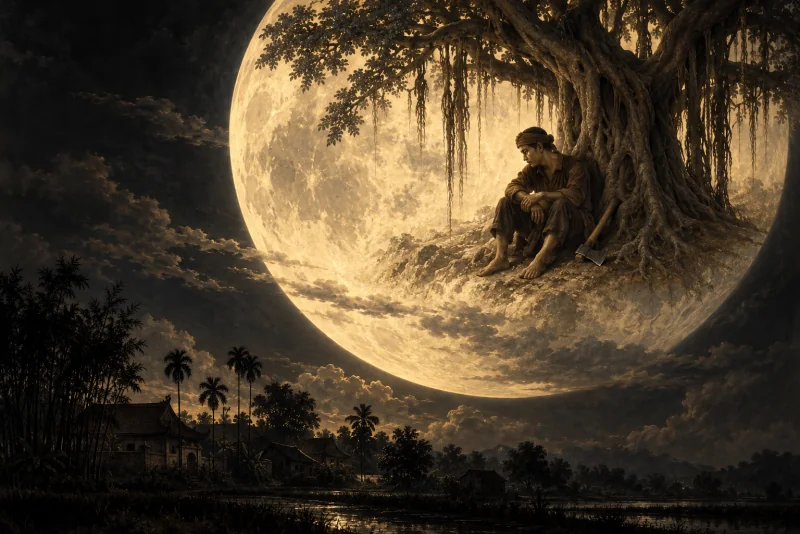
- Phan Kế Bính adds what popular tradition says: he was a poor woodcutter. The star Thái Bạch gave him a staff that healed the sick. With it he revived a snake that turned out to be a son of the Dragon King, who gave him a book of wishes.
- The temple records (thần tích) of villages in the old provinces of Hà Tây and Vĩnh Phú and in Hanoi make him a real man of poor birth. As the newspaper Pháp luật Việt Nam retold them in 2019, he was born under the eighteenth Hùng king to Nguyễn Cao Hạnh and Đinh Thị Điên, charcoal burners at Lăng Xương on the Đà River, and named Tuấn. Later he took the name Nguyễn Tùng.
- Friends first. The Việt điện u linh tập opens with Sơn Tinh and Thủy Tinh as close friends, living in seclusion at Gia Ninh in Phong Châu. The Lĩnh Nam chích quái says he had sworn a pact with the water tribe there.
- The contest. In the Lĩnh Nam chích quái, a crumbling mountain against clouds and rain. In the Việt điện u linh tập, Sơn Tinh can see through jade and stone, and Thủy Tinh can pass into water and fire. The Toàn thư has no contest at all.
- The gifts.
- Lĩnh Nam chích quái and Toàn thư: jewels, gold and silver, mountain birds, wild beasts.
- Việt điện u linh tập: gold, silver, jewels, rhinoceros, ivory, rare birds and strange beasts, a hundred of each, brought at dawn. Thủy Tinh comes that evening with pearls, tortoiseshell, coral, amber, whales and fine fish, too late.
- Phan Kế Bính’s footnote: “an elephant with 9 tusks, a cock with 9 spurs, a horse with 9 red manes, and a jar of gold nuggets”.
- The school version: a hundred trays of sticky rice, a hundred bánh chưng rice cakes, and the elephant, the cock and the horse, “a pair of each”.
- How the mountain held. Fishing nets (Lĩnh Nam chích quái, Wikisource text). An iron net laid by the Hùng king and Sơn Tinh together, with bamboo fences and crossbows (Toàn thư). Dikes that the people build every autumn (Việt điện u linh tập). In modern retellings, however high the water rises, Sơn Tinh raises the mountain higher.
- Which months? The seventh and eighth in the Wikisource text; every autumn in the Việt điện u linh tập. Eric Henry’s English translation follows a text of the Lĩnh Nam chích quái that differs in places: its net is iron, and its floods come in the eighth and ninth months.
4 History and Tradition
- “The first blessing-spirit of Đại Việt.” So the Lĩnh Nam chích quái calls the god of Tản Viên. The Việt điện u linh tập records his titles: Hựu Thánh in the first year of the Trùng Hưng era (1285), Khuông Quốc in its fourth (1288), and then Hiển Ứng.
- The rider on the white horse. The Tang protector-general Gao Pian (Cao Biền), says the Lĩnh Nam chích quái, tried to bind the sacred places of the south with a cruel rite. When he made the offering to Tản Viên, he saw a rider on a white horse at the edge of the clouds, who spat on it and rode away. Gao Pian sighed: “The spirit-force of the South cannot be measured.”
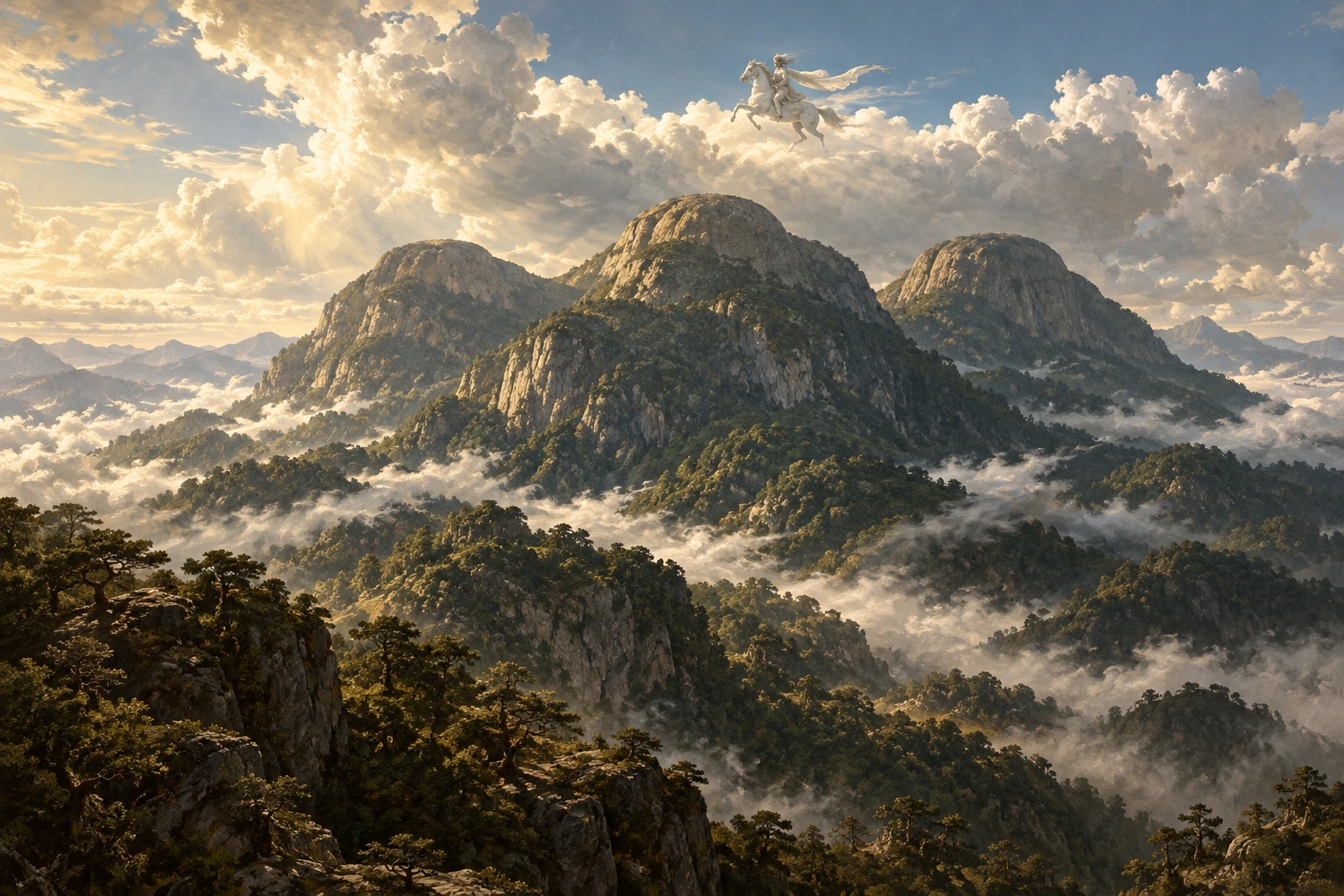
- A prayer to Mỵ Nương. The same chapter quotes a poem by Nguyễn Sĩ Cố, a scholar of the Trần court, written at the temple on his way to a campaign in the west. It ends: “Mỵ Nương too has the power to show her spirit; let her guard this scholar on his way.”
- First of the Four Immortals. A commentary in the Việt điện u linh tập, which the translator attributes to the 18th-century official Cao Huy Diệu, says that under the Lê dynasty the god’s rites ranked first among those of the four immortal spirits, and that the thirteen villages on the mountain’s slopes paid no taxes. The Four Immortals (Tứ bất tử) of Vietnamese folk belief are Tản Viên, Thánh Gióng, Chử Đồng Tử and the Mother Goddess Liễu Hạnh, with Tản Viên at their head.
- Ba Vì today. The temple on the mountain is now called the Upper Temple (Đền Thượng), in Ba Vì, on the outskirts of Hanoi. With the Middle and Lower Temples (Đền Trung, Đền Hạ) it forms one group of shrines to the god, and the Lower Temple at Phú Lội is a national historic site. In 2025 the rites for his death anniversary were held there from the 5th to the 7th of the eleventh lunar month.
- Rain, not war. The same commentary doubts the feud. Between summer and autumn, it says, the rains pour down and flood the mountains, and the mountain people, who love tales of spirits, pass rumour on until they believe it. As for water and fire fighting each other, the commentator dares not believe it. Dương Thị Thu Hà, a scholar of cultural studies, reads in the battle the work of rice farmers building dikes and winning land from the sea.
Mỵ Nương is usually taken as the princess’s name. Yet the Toàn thư’s own entry on the Hùng kings says that every king’s daughter was called mị nương (媚娘), as every son was called quan lang. The story turns a title into a name.
5 Related Stories
- Lạc Long Quân and Âu Cơ: The Dragon, the Fairy and the Hundred Eggs: the Lĩnh Nam chích quái quotes a source that makes the Mountain King one of the fifty sons who followed their dragon father into the sea. The god of the mountain becomes a son of the water.
- Thánh Gióng: The Boy Who Grew into a Giant: the Toàn thư tells Gióng’s story under the sixth Hùng king, a few lines before this one. The Việt điện u linh tập sets the two gods in the same section, and both are counted among the Four Immortals.
- An Dương Vương and Mỵ Châu: The Magic Crossbow and the Trail of Feathers: what came of the refusal. The Toàn thư goes straight on to Thục Phán, grandson of the spurned king of Thục, who conquers Văn Lang and builds the spiral citadel of Cổ Loa.
- Yamata no Orochi: Susanoo and the Eight-Headed Serpent: a god wins his bride by defeating a monster of the river, and Japanese reference works note that the serpent is also read as the floods of Izumo. We have not found a scholar who compares the two stories; we link them for the theme.
- Dangun: The Bear, the Tiger and the First Korean Kingdom: Korea’s founder ends his life as a mountain god, as a son of Lạc Long Quân does in the Thế pháp tập version. Here, too, the link is a shared theme.
6 Sources
- Lĩnh Nam chích quái, book 2, “Tản Viên sơn truyện”, text corrected by Vũ Quỳnh and Kiều Phú, with Vũ Quỳnh’s preface (1492): Wikisource (Classical Chinese)
- Eric Henry, trans., “The Story of Tản Viên”, Lĩnh Nam chích quái, narrative 15: Rising Asia Journal
- Lý Tế Xuyên, Việt điện u linh tập, chapter on Tản Viên with its commentary, trans. Lê Hữu Mục from manuscript A.751: archived PDF
- Ngô Sĩ Liên et al., Đại Việt sử ký toàn thư, Outer Annals, book 1, “Hùng Vương”, and front matter: Wikisource (Classical Chinese)
- Mencius 7B.3: Wikisource
- Phan Kế Bính, Nam Hải dị nhân liệt truyện, no. 40, “Tản-viên sơn-thần”, 5th ed. (Hanoi: Imprimerie Tonkinoise, 1930): Vietnamese Wikisource
- Dương Thị Thu Hà, “Tín ngưỡng thờ Tứ bất tử trong văn hóa người Việt Nam”, Khoa học xã hội Việt Nam 4 (2020): 50–57: VJOL
- X. Quang, “Dâng hương tưởng niệm ngày giỗ Đức Thánh Tản Viên Sơn năm 2025”, Báo Văn hóa, 22 December 2025: baovanhoa.vn
- Lê Sơn, “Ly kỳ nguồn gốc xuất thân Đức Thánh Tản Viên, thần tượng chống thiên tai lũ lụt”, Pháp luật Việt Nam, 5 August 2019, retelling the village temple records: baophapluat.vn
- “八岐大蛇”, Mypedia and Britannica International Encyclopaedia: Kotobank
Cover and illustrations: AI-generated images made for Arcana. They are interpretations, not historical artworks.