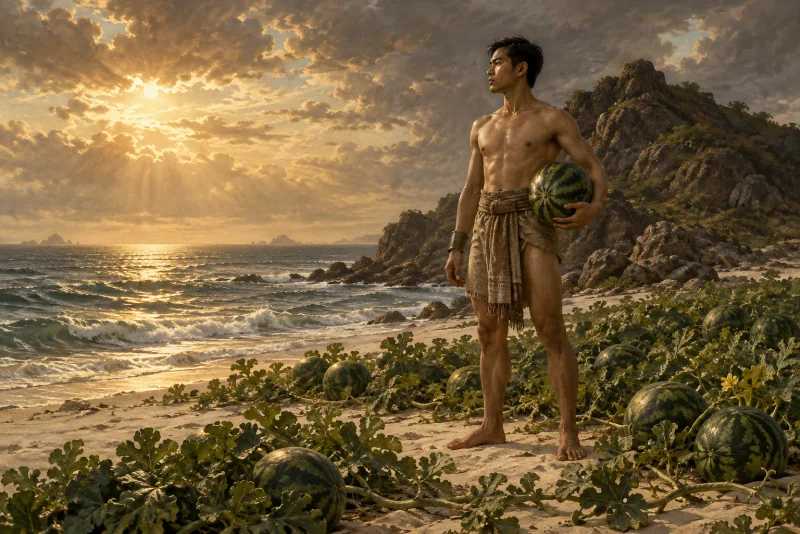
Chú Cuội: The Man on the Moon
A woodcutter found the tree whose leaves bring back the dead, and it carried him off to the moon. The oldest written telling, from 1886, never calls its hero Cuội, and the oldest Cuội we have found, in a dictionary of 1651, is a liar with no moon at all.

- Type: folk tale (truyện cổ tích); a tree that brings back the dead, and why there is a shape on the face of the moon
- Culture: Việt (Kinh), Vietnam
- Earliest texts: the name, for a famous liar, in Alexandre de Rhodes’s Vietnamese dictionary (Rome, 1651); the moon tale in A. Landes, Contes et légendes annamites (Saigon, 1886); “Cuội’s banyan” in Huỳnh Tịnh Của’s dictionary (1895)
- Key figures: Cuội (chú Cuội, thằng Cuội), a tigress and her cub, a dog, a rich man’s daughter who becomes Cuội’s wife, the banyan
Look at the full moon from Vietnam and you are looking for a man under a tree. Children are told it is Cuội, chú Cuội, “Uncle Cuội”, or less politely thằng Cuội, “that fellow Cuội”, sitting at the foot of his banyan. He did not go up there by choice. The tree took him.
Is the Cuội on the moon the Cuội who lies? Vietnamese say a liar “lies like Cuội” (nói dối như Cuội), but the two did not start as one story. The oldest Cuội we have found on record, in Alexandre de Rhodes’s dictionary of 1651, is “a man of whom many tales are told”, a famous liar, and there is no moon. In the oldest written moon tale, printed by A. Landes in 1886, the man who goes up tells no lies and has no name until the last line, which names the tree after him. Landes lists “lie like Cuội” in a footnote, as a separate saying.
1 The Telling
This is the version A. Landes, an “administrator of native affairs” in French-ruled Cochinchina, published in Saigon in 1886 as tale 45, “L’homme de la lune”, “The Man in the Moon”. Landes explains that he could not take the tales down from storytellers himself. Helpers wrote out in Vietnamese what they knew or had been told, and he translated; his main informants were a diviner and a scholar from the province of Nghệ An.
1-1 The Tiger Cub
Two brothers built a raft and went up into the forest to cut wood. The elder went in to cut, and the younger stayed to guard the raft. In a thicket the younger brother found a little animal he took for a puppy. He carried it off, killed it and scraped it ready for the pot. When the elder came back he saw that it was a tiger cub, and told his brother to put it back where he had found it, before the tigress came after them.
The younger brother did as he was told. He had hardly laid the cub in the thicket when the tigress arrived. She picked some leaves from a tree, chewed them and spat them on her cub, and it came back to life at once. Then the two went off, leaving the rest of the leaves on the ground.

1-2 The Dog
The younger brother had watched it all from up a tree. He gathered the leaves, went back to the raft and said nothing to his brother. On the way home they passed a dead dog floating on the water, already swollen. He chewed some leaves and spat them on it, and the dog came back to life and followed him.
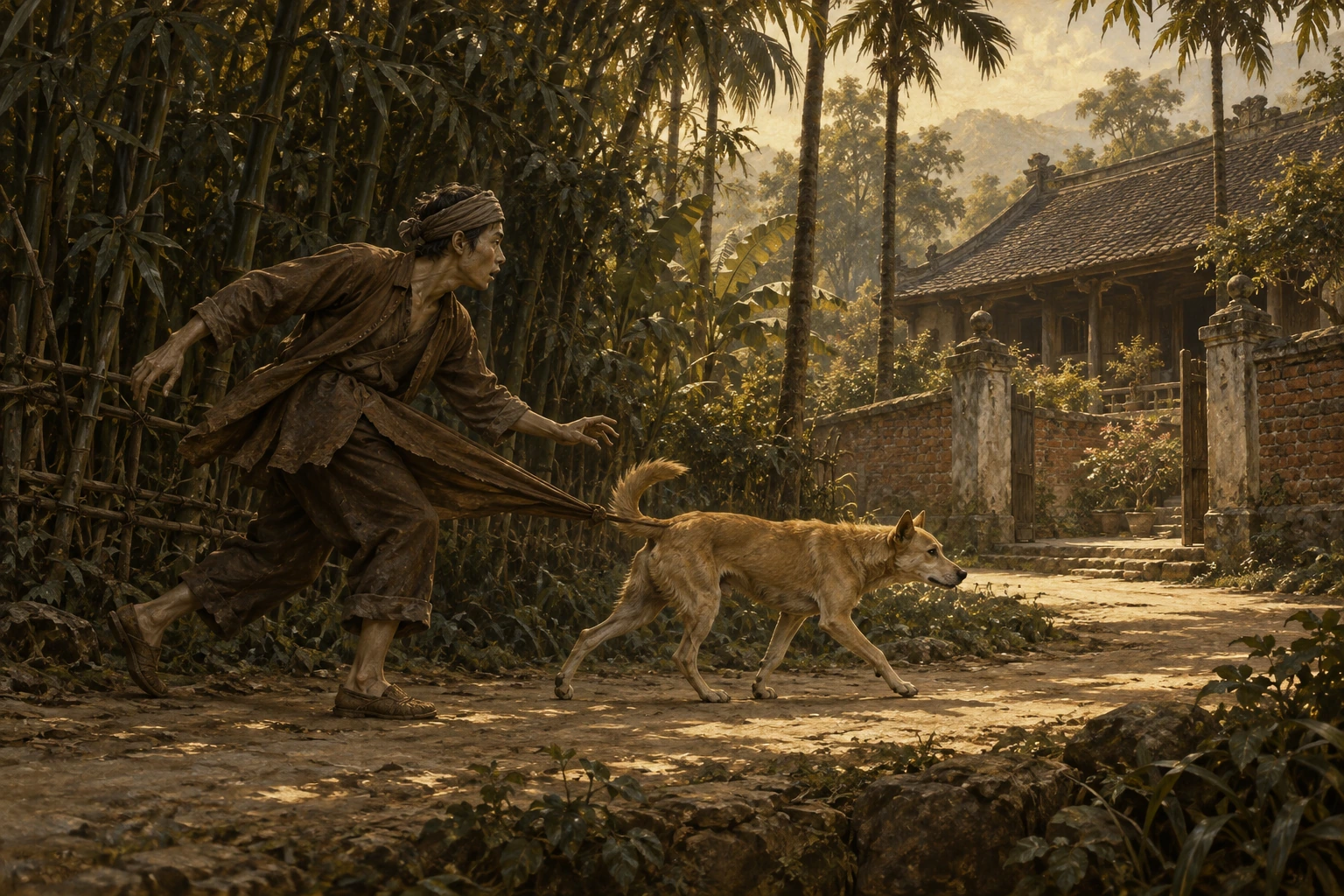
It was a clever dog. One day it heard a rich old man lamenting. His daughter had just died, and he promised her, with everything he owned, to whoever could bring her back. The dog ran to its master and pulled him by the hem of his coat to the old man’s house. The girl was brought back to life, and her father gave her to her rescuer, with all his wealth.
1-3 The Dog’s Gift
At home the man planted a đa, a banyan, and told his wife never to forget to water it while he was away. Some people, jealous of his marvellous cures, decided to kill his wife and see whether he could bring her back. He did, easily. So they killed her again, and this time they took out her entrails and threw them far away.
The husband did not know how to replace them. He called his dog: “I fed you like a father, I saved you and gave you back your life. Now my wife’s insides are gone. Lie down, so that I may take yours.” The dog obeyed. With its entrails and the leaves of his tree the man brought his wife back, and he gave the dog new entrails made of clay and revived it too. That, the tale says, is why the woman has a dog’s instincts, and why a dog feels every sound made on the earth echo inside it.
1-4 The Tree That Flew
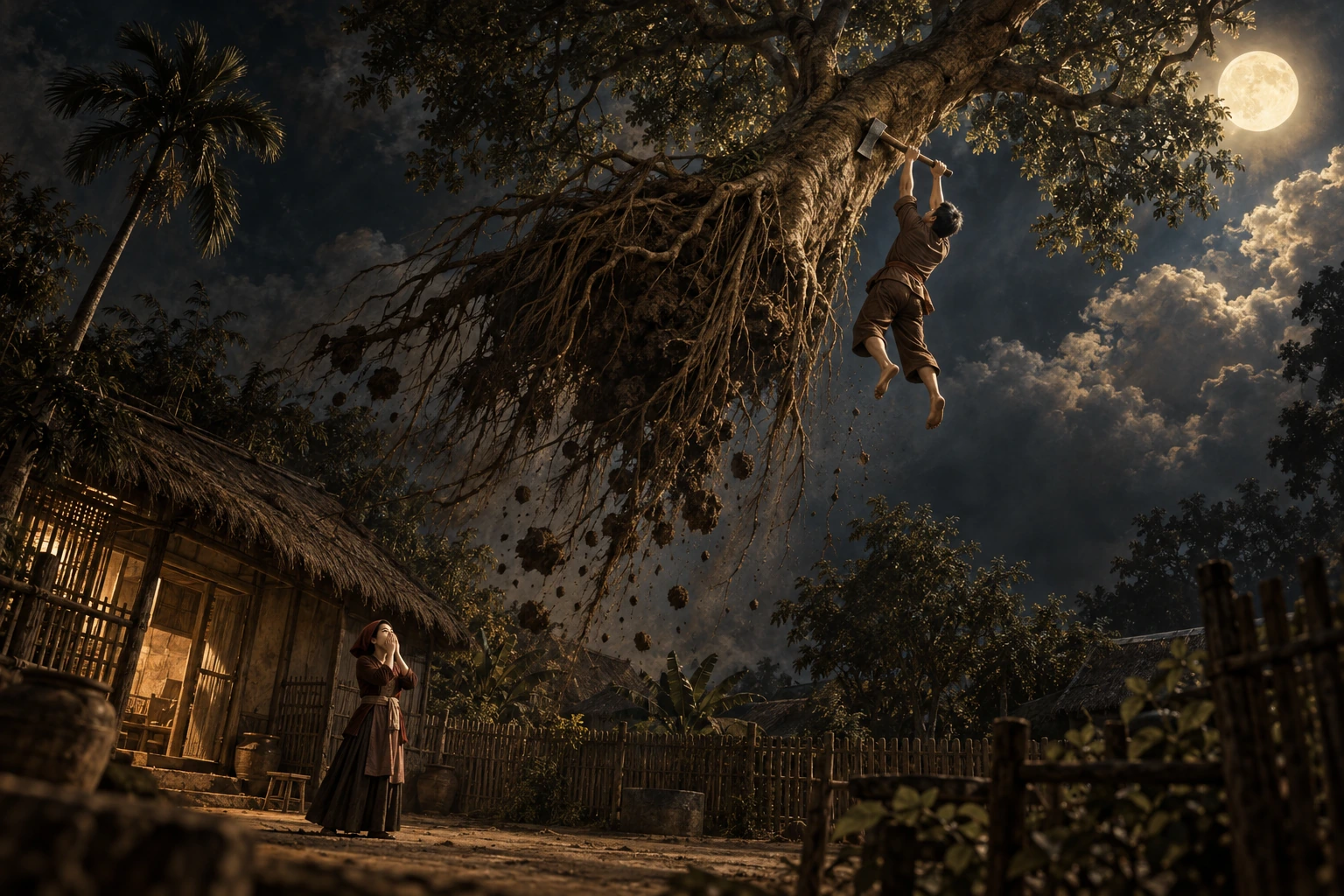
One day he went out again and told his wife to water the tree. She forgot. When she saw him coming home she suddenly remembered, ran to the tree and squatted at its foot to wet the ground. At that unclean touch the tree flew up into the air. Her husband ran and swung his axe at it, hoping to cut off a branch he could plant again. The axe stuck in the trunk, and the man was carried up with his tree to the moon. The tale ends by naming it: cây đa thằng Cuội, Cuội’s banyan.
People say, Landes adds, that the tree grows on the mountain, and that every year one of its leaves falls into the sea and is swallowed by the dolphin. The tale closes on a proverb, which his footnote gives in Vietnamese: cứu vật thì vật trả ơn, cứu nhơn thì nhơn báo oán, “save an animal and it repays you; save a person and he repays you with harm”. Saving the dog made the man’s fortune; saving the woman cost him his tree.
2 Where the Story Is Written Down
- Alexandre de Rhodes, Dictionarium Annamiticum Lusitanum et Latinum (“Annamese, Portuguese and Latin Dictionary”, Rome, 1651). Under quội, thằng quội it gives, in Portuguese and Latin, “a certain man of whom many fables and tall tales are told”. Under nói quội: “to tell lies, because the one called Quội was a famous maker of lies”. There is no tree and no moon.
- A. Landes, Contes et légendes annamites (“Annamese Tales and Legends”, Saigon, 1886), reprinted from the journal Excursions et reconnaissances. Tale 45 (pp. 118–120) is the oldest written telling of the moon story we have found. Its footnote on the name says much in a few lines:
- thằng Cuội, also called thằng Cội, is “the man one sees in the moon with his tree”;
- woodcutters who hear their axe blows echo in the mountains say it is Cuội cutting his tree;
- “lie like Cuội” is a saying;
- children playing in the moonlight call: “Cuội ơi! xuống đây, ta may quần tía, cái áo nọ, cái áo nầy”, “Cuội, come down here, we’ll sew you purple trousers, a coat like this, a coat like that”.
- Huỳnh Tịnh Của, Đại Nam quấc âm tự vị (“Dictionary of the National Language of Đại Nam”), volume 1, 1895. Cuội: “an echo, a sound that mimics”; thằng Cuội, the same; cây đa thằng Cuội, “the shadow of a tree seen on the face of the moon”; dạ như thằng Cuội, “to say yes and not do it”. Under đa (which he spells da): a long-lived tree with a sticky sap, “often planted at pagodas and shrines”.
- Phạm Quang Sán, Nam ngạn chích cẩm (1918), a collection of Vietnamese sayings, has both Cuội: “Thằng cuội ngồi gốc đa”, “Cuội sits at the foot of the banyan”, among the five-word sayings, and “Nói thằng cuội”, “talking Cuội”, among the three-word ones.
- Nguyễn Đổng Chi, Kho tàng truyện cổ tích Việt Nam (“A Treasury of Vietnamese Folk Tales”), retells the tale of the tree that brings the dead back to life and of Cuội in the moon. As the folklorist Nguyễn Hùng Vĩ quotes him, he found that the Vietnamese tale of Cuội in the moon resembles the moon myths of many peoples, “with a medicine of immortality and the image of flying up to the moon”, and he set out related versions from China, closest in plot in his view, to India and Indonesia.
- The school version is the one most Vietnamese know: the third-grade reading lesson Sự tích chú Cuội cung trăng, “How Uncle Cuội Came to the Moon”. The teachers’ notes say it praises kindness and faithfulness and explains “Cuội’s banyan” on the moon.
3 Competing Versions
- Who is he? In Landes, an unnamed younger brother, one of two woodcutters on a raft; the name arrives only with the tree. In the school version, a woodcutter called Cuội, alone in the forest.
- The cub. Landes’s younger brother takes it for a puppy and kills it for food. In the school version a tiger cub attacks Cuội and he strikes it down.
- The first to live again. In Landes, a drowned dog, which then finds him a wife. In the school version Cuội saves “a great many people”, among them a rich man’s daughter, whom he marries. There is no dog.
- The wife’s second life.
- Landes: jealous neighbours kill her twice and take her entrails; the dog gives her its own, and the clay goes to the dog.
- School version: she falls and breaks her head, and Cuội makes her a brain of clay. She lives, but becomes forgetful. The clay has moved from the dog to the wife, and now it explains why she forgets.
- The water. Landes: she forgets to water the tree, then squats at its foot. School version: forgetting what Cuội told her, she waters it with urine.
- How he went up. Landes: his axe sticks in the trunk. His footnote gives another account, which explains the name thằng Cội: the trunk (cội) wrapped him in its hanging roots and did not let go until he was in the moon. School version: Cuội grabs the roots as the tree rises.
- Echo or liar? Dictionaries from the 18th to the 20th century gloss cuội as “echo”, Huỳnh Tịnh Của’s among them. Nguyễn Hùng Vĩ, writing in 2011, calls this an error copied from one dictionary to the next since Pigneau de Béhaine’s (1772–1773): as a native speaker he has never met the word in that sense, nor has he found it in texts written in Nôm. He suggests a missionary heard the long call “ời ời” in the children’s rhyme and took it for an echo. Yet Landes, in the 1880s, met woodcutters who heard Cuội in the echo of their axes.
- One Cuội or two? Nguyễn Hùng Vĩ counts two kinds of tale: Cuội in the moon, and Cuội the liar, whose lies everyone believes, a type found all over the world. He puts forward, as his own hypothesis, that two words merged in the name: cội, the foot of a tree, and the Sino-Vietnamese quải (拐), “to swindle”.
4 History and Tradition
- The Mid-Autumn festival falls on the 15th of the eighth lunar month. In 1915 Phan Kế Bính, describing it in Việt Nam phong tục (“Vietnamese Customs”), calls it “the children’s Tết”: moon cakes, paper toys, lantern processions. He explains the lanterns by Chinese stories and never mentions Cuội. Today Cuội belongs to the night: according to folk belief, as a Mid-Autumn article in the trade ministry’s magazine puts it, the festival goes with chú Cuội and chị Hằng, and children believe the dark shape on the moon is Cuội under his banyan.
- The rhyme. The best-known verse about him, as Nguyễn Hùng Vĩ gives it from the anthology Kho tàng ca dao người Việt, begins: “Thằng Cuội ngồi gốc cây đa / Thả trâu ăn lúa van cha ời ời”, “Cuội sits at the foot of the banyan, lets his buffalo eat the rice, and calls for his father, ời ời”. His father, it goes on, is cutting grass in the sky, and his mother has ridden off to invite the notables. Wordings differ: a note on Vietnamese Wikisource gives the second line as “Để trâu ăn lúa gọi cha ời ời”.
- Hằng Nga. Cuội shares the moon with chị Hằng, Hằng Nga, the woman who stole the medicine of immortality; her story is told in Hou Yi and Chang’e.
- The poets. In the north, Trần Tế Xương (1870–1907), better known as Tú Xương, opens a poem: “I see that people still say, say that Cuội lives in the palace of the moon.”
- The Chinese man in the moon. In Duan Chengshi’s Youyang zazu (c. 860), a man named Wu Gang chops at the moon’s cassia tree forever. The same passage quotes Buddhist books for another explanation: the shadow of a tree on Mount Sumeru falls on the moon as it passes, much as Huỳnh Tịnh Của would later define Cuội’s banyan. In Japan, according to the Nihon Kokugo Daijiten, the same legend gave the moon a “cassia man”, katsura-otoko (桂男).
- On stage and in school. Lưu Quang Vũ’s play Lời nói dối cuối cùng (“The Last Lie”) draws on both Cuội. Tenth-graders now read it alongside the two folk tales and compare the endings: in the folk tale Cuội is carried up against his will, and in the play he chooses to go.
Cuội is often called the Vietnamese Wu Gang (吳剛), the man who chops the cassia in the Chinese moon. They share a tree and an axe, not a story. In the Youyang zazu, Wu Gang studied to become an immortal, did wrong, and was banished to fell a cassia five hundred zhang tall whose cuts close up as soon as he makes them. Cuội goes up by accident, holding on to the tree he wanted to keep. Landes already saw where the two meet: the woodcutters’ belief that Cuội is up there cutting his tree, he wrote in 1886, seems to be “a confusion” with Ngô Cương, the Vietnamese reading of Wu Gang’s name.
5 Related Stories
- Hou Yi and Chang’e: The Archer Who Shot the Suns and the Woman in the Moon: the woman Vietnamese call Hằng Nga, who shares the moon with Cuội. Han writers put a toad and a hare in the moon, and a Tang writer named the man who chops its cassia; Vietnamese tradition adds a banyan and Cuội.
- Sơn Tinh and Thủy Tinh: The Mountain Spirit, the Water Spirit and the Yearly Floods: Phan Kế Bính records a popular tradition that the Mountain Spirit began as a poor woodcutter. A star brought back to life a tree he had cut, and gave him a staff that cured the sick, with which he revived a snake. We have not found a scholar who compares the two woodcutters; we link them for the theme.
- Thánh Gióng: The Boy Who Grew into a Giant: in one 15th-century version the hero leaves the earth by climbing a banyan on Mount Vệ Linh and flying up from it. Another Vietnamese journey to the sky by way of a banyan, linked for the theme.
- Gilgamesh: The King Who Tried to Escape Death: a plant that gives life back, found and then lost through one careless moment, when a snake carries it off. A shared theme, not a known borrowing.
6 Sources
- A. Landes, Contes et légendes annamites (Saigon: Imprimerie coloniale, 1886), no. 45, “L’homme de la lune”, pp. 118–120, and the foreword: archive.org
- Alexandre de Rhodes, Dictionarium Annamiticum Lusitanum et Latinum (Rome, 1651), entry quội, cols. 627–628, in the facsimile with Vietnamese translation by Thanh Lãng, Hoàng Xuân Việt and Đỗ Quang Chính (Hanoi: Khoa học xã hội, 1991): archive.org
- Huỳnh Tịnh Của, Đại Nam quấc âm tự vị, vol. 1 (1895), entries Cuội and Da: Vietnamese Wikisource, Vietnamese Wikisource
- Phạm Quang Sán, Nam ngạn chích cẩm (1918), three- and five-word sayings: Vietnamese Wikisource, Vietnamese Wikisource
- Phan Kế Bính, Việt Nam phong tục (1915), “Tứ thời tiết lạp”: Vietnamese Wikisource; Nam Hải dị nhân liệt truyện, no. 40, “Tản-viên sơn-thần”, 5th ed. (Hanoi, 1930): Vietnamese Wikisource
- Trần Tế Xương, “Gái góa nhà giàu”; the note on the rhyme in “Hỏi trăng 2”, a poem attributed to Hồ Xuân Hương: Vietnamese Wikisource, Vietnamese Wikisource
- Duan Chengshi, Youyang zazu, book 1, “Tianzhi”: Wikisource
- Nguyễn Hùng Vĩ, “Từ điển cũng… cuội” (Hanoi, 2011), quoting Nguyễn Đổng Chi’s Kho tàng truyện cổ tích Việt Nam and Kho tàng ca dao người Việt: PDF
- “Sự tích chú Cuội cung trăng”, third-grade lesson notes: VietJack, Toplist; tenth-grade lesson on Lời nói dối cuối cùng: Lời giải hay
- “Ý nghĩa ngày Tết Trung thu ở Việt Nam”, Tạp chí Công Thương, 21 September 2023: tapchicongthuong.vn
- “酉陽雑俎”, “月の桂”, “桂男”, Sekai Daihyakka Jiten and Nihon Kokugo Daijiten: Kotobank, Kotobank, Kotobank
Cover and illustrations: AI-generated images made for Arcana. They are interpretations, not historical artworks.