Lang Liêu and the Bánh Chưng: The Cakes of Tết
A Hùng king promised his throne to the son who brought the best offering for the ancestors, and his poorest son won it with two cakes of glutinous rice, one square and one round. In the oldest text a spirit dictates both cakes, and the square one stands for more than the earth.
- Type: legend, the origin of the rice cakes offered at Tết
- Culture: Việt, the Red River delta of northern Vietnam; the cakes are now made across the country
- Earliest text: the Lĩnh Nam chích quái, in its 15th-century form (preface dated 1492)
- Key figures: the Hùng king, his son Lang Liêu, a spirit seen in a dream, Lang Liêu’s twenty-one brothers
In the last days of the lunar year, families in northern Vietnam fold dong leaves around glutinous rice, mung beans and pork, tie them into squares and keep a pot boiling through the night. The cake is bánh chưng. A legend says that it once won a prince his father’s throne.
Did Lang Liêu think up the cakes himself? Not in the oldest text. In the Lĩnh Nam chích quái, a spirit in a dream tells him everything: use glutinous rice, make the cakes square and round, put leaves outside and good food within, and what each of these means. In the version Vietnamese children read at school, the spirit only says that nothing is more precious than rice. Lang Liêu works out the cakes for himself, and it is the king who names them and says what they mean.
1 The Telling
This is the version of the Lĩnh Nam chích quái, in the chapter “Truyện bánh chưng” (蒸餅傳), “The Tale of the Steamed Cakes”, as the copy on Chinese Wikisource gives it. That copy carries the names of its 15th-century editors, Vũ Quỳnh and Kiều Phú. Where the copy that Eric Henry translated into English differs, section 3 says so.
1-1 The King’s Test
The Hùng king had defeated the army of Ân, the war told in the story of Thánh Gióng, and the land was at peace. He wanted to hand the throne to a son. So he called together the princes, the quan lang, twenty-two of them, and told them his wish. Whoever brought him the finest delicacies, to be offered to the former kings at the end of the year as a son’s duty, would have the throne.
The princes went looking for rare things from the water and the land, more than could be counted.
1-2 The Eighteenth Son
Only the eighteenth son, Lang Liêu (郎僚), had no means to compete. His mother had been alone, poor and of low rank, and she had already died of illness. He had few people around him. He thought about it day and night and could not sleep in peace.
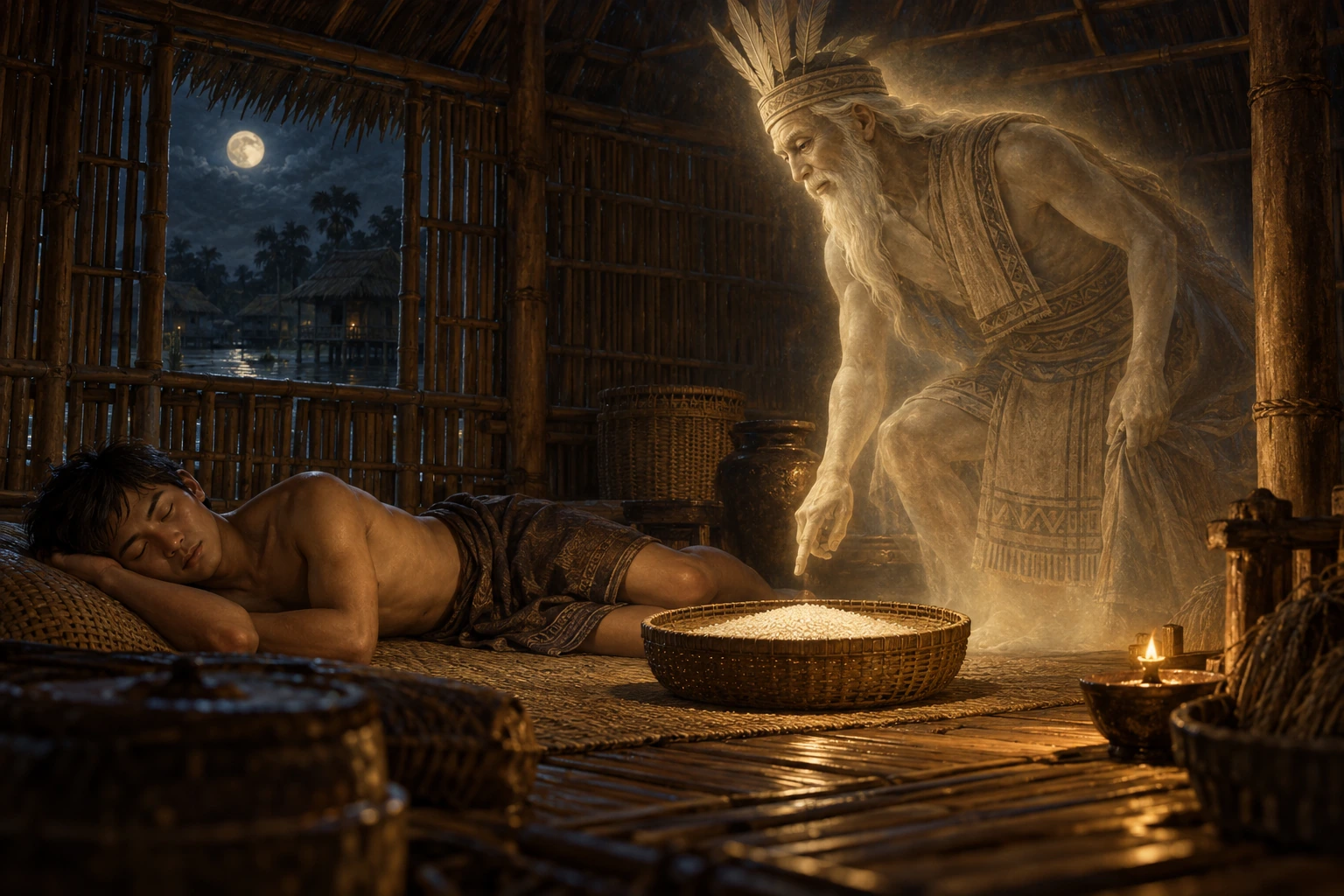
One night a spirit, a thần nhân (神人, “divine person”), spoke to him in a dream. “Of all the things of heaven and earth that people value,” it said, “none surpasses rice. It is what feeds people and makes them strong. They eat it and never tire of it, and nothing else comes before it.”
It told him to make cakes of glutinous rice, “some square, some round, to represent the shapes of heaven and earth”. He was to wrap leaves around the outside and hide good food within, as a sign of how much a father and mother give in bearing and raising a child.
1-3 Two Cakes of Rice
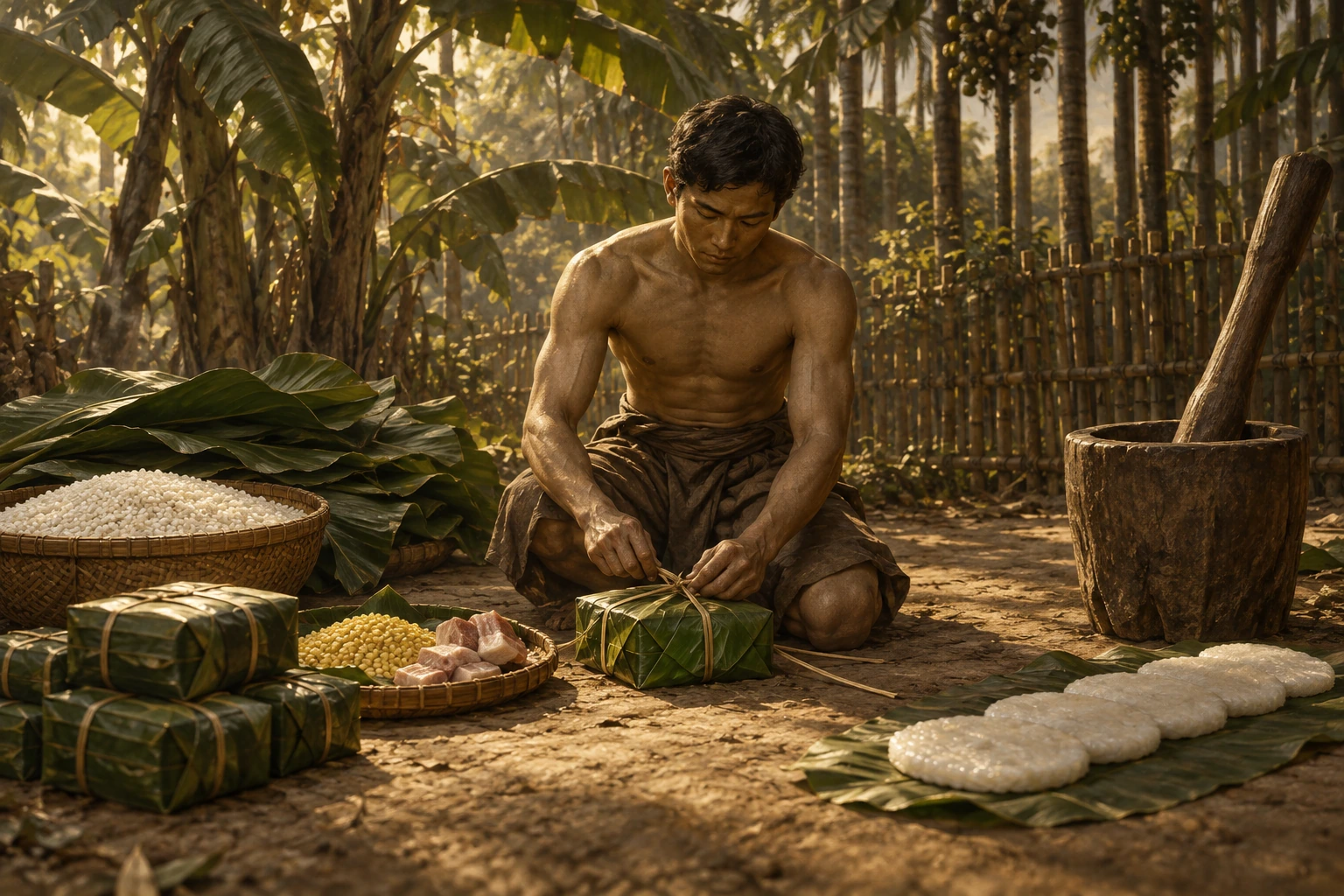
Lang Liêu woke with a start and cried out with joy: “A spirit is helping me!” He did as he had been told. He chose glutinous rice, polished white, keeping only round, whole grains with none broken, and washed it clean. He wrapped it in green leaves into a square, set good food in the middle, and so imitated “heaven and earth holding all things within them” (以象天地包藏萬物). He boiled it until it was cooked, and so it was called the steamed cake, 蒸餅, bánh chưng.
Then he cooked more glutinous rice, pounded it until it was soft and shaped it round, to represent heaven. The text calls this one 薄持餅: the cake known today as bánh giầy.
1-4 The King’s Choice
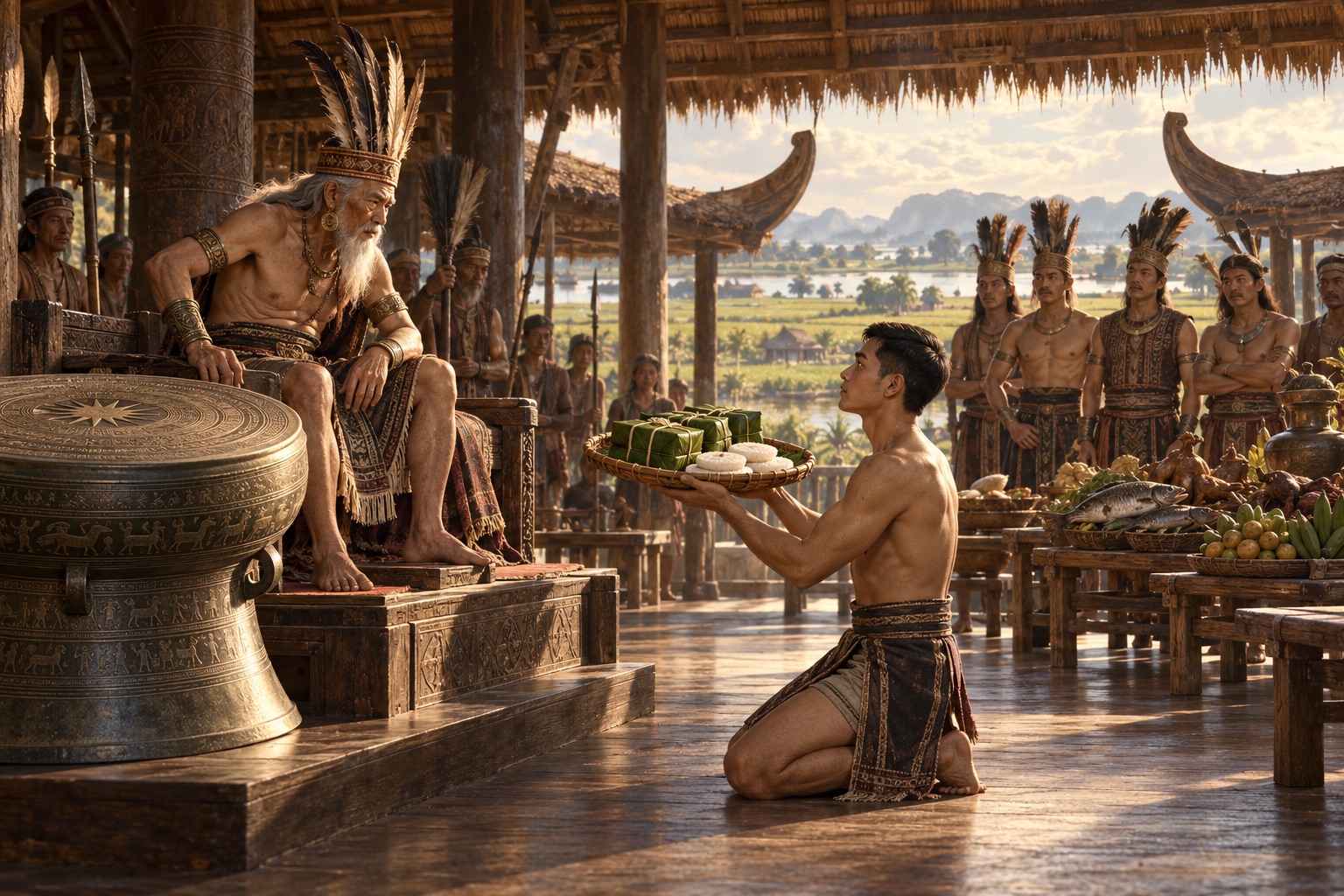
On the appointed day the king had his sons lay out what they had brought, and he went from one offering to the next: every kind of thing was there. Lang Liêu alone offered only his two kinds of cake. The king, surprised, asked about them, and Lang Liêu told him the whole dream.
The king tasted the cakes himself. They suited the mouth and he never tired of them; they were better than anything his other sons had set out, and he praised them for a long time. He placed Lang Liêu first. From then on, at every season and festival of the year, the king offered these cakes to his father and mother, and the whole realm has done the same “to this day”. The text ends on a play on words: from the prince’s name, Liêu, the festival fare is called tiết liệu (節料).
1-5 Twenty-One Brothers
The king gave the throne to Lang Liêu. His twenty-one brothers went to guard the borders, each making his own clan into an outlying domain. Later they quarrelled over who should lead, and each put up a wooden palisade to protect himself. That, the chapter says, is how the words for the stockade, the village, the hamlet and the ward (sách, thôn, trang, phường) began.
2 Where the Story Is Written Down
- The Lĩnh Nam chích quái (Strange Tales from South of the Passes) is the only old text that tells the story. In his preface of 1492, Vũ Quỳnh says he copied and corrected an older collection, and Kiều Phú revised it in 1493. Its hand-written copies differ: Eric Henry counts fourteen in Hanoi libraries. We read two.
- The copy on Chinese Wikisource, which carries the names of Vũ Quỳnh and Kiều Phú and puts the tale eighth in book 1.
- Henry’s English translation (Rising Asia Journal), made mainly from the text Lê Hữu Mục published in Saigon in 1959, a reproduction of a hand-copy made in the 1920s for the scholar Phạm Quỳnh. There it is narrative 8, “The Legend of the Rice Cakes”.
- The Đại Việt sử ký toàn thư (Complete Annals of Đại Việt) does not tell it. Its Outer Annals of 1479 give the stories of Thánh Gióng and Sơn Tinh under the Hùng kings, but no cakes and no Lang Liêu. They do say that a king’s sons were called quan lang (官郎), the word the Lĩnh Nam chích quái uses for the twenty-two princes. The Việt điện u linh tập (1329) has no cakes either.
- Alexandre de Rhodes’s dictionary (Rome, 1651) defines bánh chưng in Portuguese as a cake “made at the New Year of rice and pork”, and adds in Latin that it is “made only at the beginning of the year”.
- Huỳnh Tịnh Của’s Đại Nam quấc âm tự vị (1895) defines bánh chưng, bánh giầy and bánh tét (section 4).
- Phan Kế Bính’s Việt Nam phong tục (Vietnamese Customs, 1915) does not tell the legend, but it describes the feast. On the first morning of the year, it says, the offering to the ancestors may be large or small, but it “must have bánh chưng”, with braised fish, pork pâtés, pickled onions and beef. In the countryside, savings clubs (họ bánh chưng) collected small sums all year, and at its end made the cakes and shared them out among their members.
- The school text. “Bánh chưng, bánh giầy” is a legend Vietnamese pupils read in the sixth-grade literature course (Ngữ văn 6). It keeps the old plot but rewrites much of the detail (section 3).
3 Competing Versions
- Which king, and which son? The Wikisource copy gives the king no number and makes Lang Liêu the eighteenth of twenty-two sons. In the copy Henry translated he is the ninth of twenty-two, and Henry’s headnote names the third Hùng king, the reign in which that copy sets the war with Ân. Modern retellings usually say the sixth. The school text gives the king twenty sons, with Lang Liêu still the eighteenth. In Dữu Lâu, now part of Việt Trì, local tradition makes him the sixth son of the sixth Hùng king, born in the village, who later reigned as the seventh Hùng king, Hùng Chiêu Vương.
- His name. 郎僚 in the Wikisource copy, Lang Liệu (郎燎) in Henry’s. Some copies call him Tiết Liêu or Tiết Liệu. Henry’s copy turns the closing pun around: there it is the prince whom people call “Festival Liệu”.
- Who thought of the cakes? In both old copies the spirit gives the shapes and their meaning. In the school text it only praises rice and says “make cakes of rice to offer to the former kings”. Lang Liêu, who grows rice and root crops with his own hands, decides how, and the king names the cakes and explains them.
- Leaves and fire. “Green leaves”, boiled “until cooked”, in the Wikisource copy; banana leaves in Henry’s translation; dong leaves from his garden, boiled “a day and a night”, in the school text.
- What the wrapping means. For the spirit of the Wikisource copy, the leaves around the filling show what parents give in bearing and raising a child. In Henry’s copy the filling imitates heaven and earth holding all beings, “produced through the favor of Heaven and Earth”. In the school text the king says that the leaves outside and the good things within mean that people should shelter one another.
- The round cake’s name. 薄持餅 in the Wikisource copy. Henry translates his copy’s name as “thick cakes” (bánh dày).
- The ending. The old chapter ends with the twenty-one brothers and their palisades. The school text ends instead with the country turning to farming and herding, and with the custom of the two cakes at Tết.
4 History and Tradition
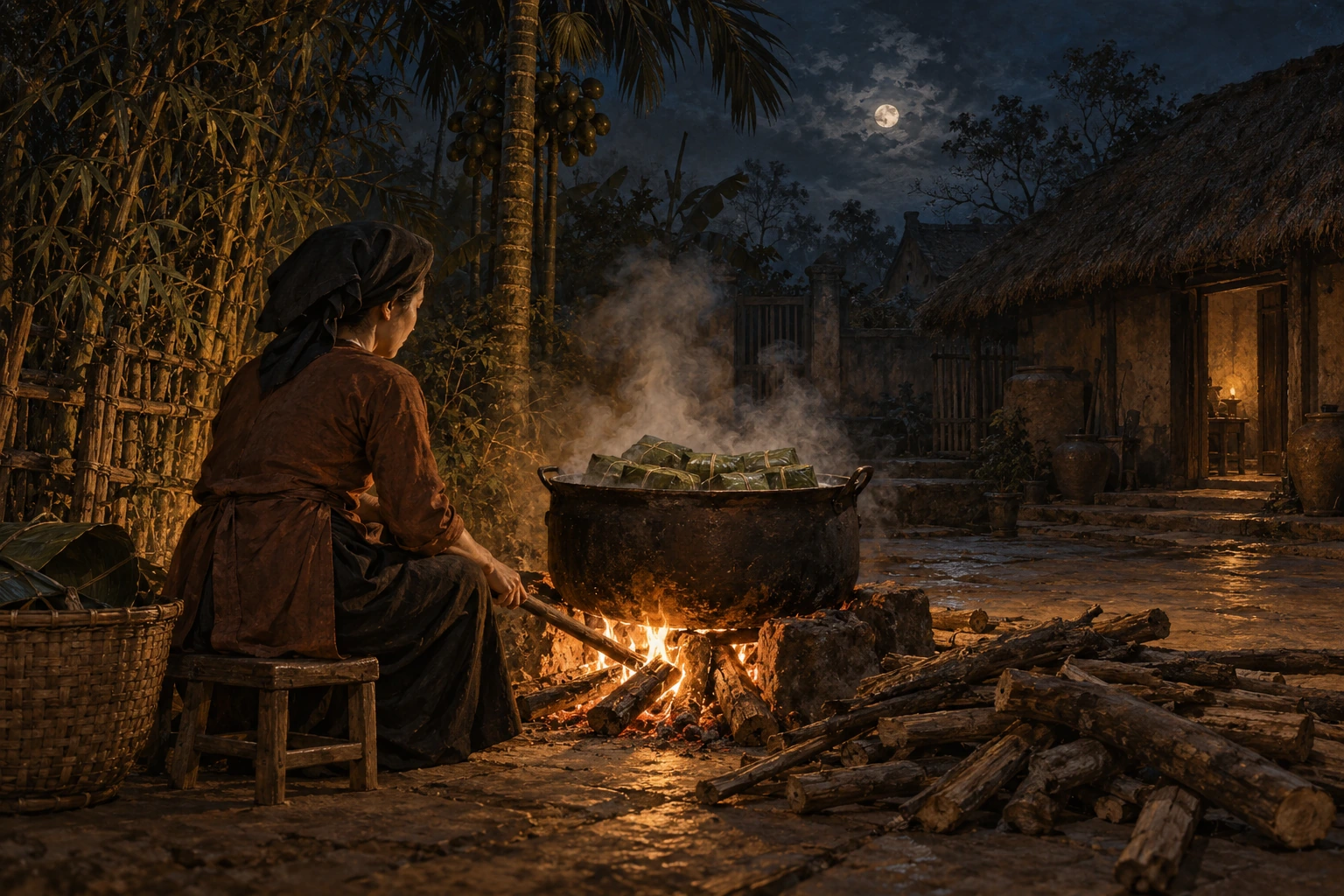
- The night of the pot. Bánh chưng is still folded by hand from dong leaves, rice, mung beans and pork, tied into a square and boiled through the night before the New Year. A joke in the collection Tiếu lâm An Nam (Annamese Jokes), by Thọ An (Phạm Duy Tốn), first published in 1912, begins with a husband and wife on the last night of the year taking turns to watch the pot of bánh chưng: he from dusk to midnight, she from midnight to dawn.
- Square and long. In the south the New Year cake is bánh tét, a long cylinder. Huỳnh Tịnh Của explains its name from tét, “to split”, because it is cut into rounds to be eaten, and adds that “some take it to mean the cake wrapped for Tết”. In Sino-Vietnamese, he says, it is the “heaven cake” (天餅, thiên bỉnh), from “heaven round, earth square”, and the square bánh chưng is the “earth cake” (地餅). In Phú Thọ, a 2020 study notes, the square bánh chưng and the long bánh tày are both still made.
- “Fakelore”. The historian Trần Quốc Vượng argued that the first bánh chưng was long and round like bánh tét; at Cổ Loa, outside Hanoi, he wrote, people still wrap their bánh chưng that way. Round heaven and square earth were, for him, “a late Chinese philosophy” read into the cakes: “not folklore but fakelore”. He saw instead a pair from the old fertility beliefs of the delta, the long cake male and the flat round one female. Nor, he added, are the cakes Vietnamese alone: he pointed to a Sichuan cake wrapped round like bánh tét, and, citing the Japanese ethnologist Ōbayashi Taryō, to the mochi of the Japanese New Year, which he called Japan’s bánh giầy.
- One cake, three spellings. Vietnamese write bánh giầy, bánh dầy or bánh dày. Huỳnh Tịnh Của wrote bánh giầy; Phan Kế Bính used both giầy and dầy; Henry and the Phú Thọ study write dày. When a banner at the Hùng Temple festival of 2010 read “bánh trưng, bánh giày”, the director of the Institute of Linguistics, Nguyễn Đức Tồn, told VnExpress that only “bánh chưng” and “bánh giầy” are correct. The school text writes giầy.
- At the Hùng Temple. The festival of the Hùng kings in Phú Thọ holds a contest every year in wrapping and boiling bánh chưng and pounding bánh giầy.
- Lang Liêu’s shrine. In the ward of Dữu Lâu, in Việt Trì, an old shrine is dedicated to Lang Liêu Đại Vương, and his death anniversary is kept on the tenth day of the fourth lunar month. Local tradition points to the Hương Trầm field nearby as the place where he grew his glutinous rice.
Bánh chưng is square for the earth and bánh giầy round for the sky: that is how the cakes are explained today, and in the school text the king says so himself. The Wikisource copy of the old text is less tidy. The spirit does give the two shapes to heaven and earth, and the round cake stands for heaven. But the square one, leaves wrapped around a filling, imitates “heaven and earth holding all things within them”, the whole world and not the earth alone, and its wrapping stands for what parents give their children.
5 Related Stories
- Thánh Gióng: The Boy Who Grew into a Giant: the war with Ân that the Hùng king has just won when this story begins. The Lĩnh Nam chích quái tells it three chapters earlier, in the same book.
- Mai An Tiêm: The Watermelon Island: the next chapter of the Lĩnh Nam chích quái in the Wikisource copy, and in Henry’s translation the next tale among the origins of customs. Another food that found its way to the ancestors’ altar.
- Táo Quân: The Kitchen Gods Who Ride to Heaven: Tết’s other story. A week before the New Year, on the 23rd day of the twelfth month, the kitchen gods leave for heaven.
- Sơn Tinh and Thủy Tinh: The Mountain Spirit, the Water Spirit and the Yearly Floods: another Hùng king who sets a contest of gifts, this time for his daughter’s hand. In the school version of that story, the gifts include a hundred bánh chưng.
6 Sources
- Lĩnh Nam chích quái, book 1, “Truyện bánh chưng” (蒸餅傳), text corrected by Vũ Quỳnh and Kiều Phú: Wikisource (Classical Chinese)
- Eric Henry, trans., “The Legend of the Rice Cakes”, Lĩnh Nam chích quái narrative 8, from the text published by Lê Hữu Mục (Saigon, 1959), and the translator’s introduction, Rising Asia Journal 6.2 (2026): Book Eight, Introduction
- Ngô Sĩ Liên et al., Đại Việt sử ký toàn thư, Outer Annals, book 1, “Hùng Vương”: Wikisource (Classical Chinese)
- Lý Tế Xuyên, Việt điện u linh tập, trans. Lê Hữu Mục from manuscript A.751: archived PDF
- Alexandre de Rhodes, Dictionarium Annamiticum Lusitanum et Latinum (Rome, 1651), entry “chưng”: Vietnamese Wikisource
- Huỳnh Tịnh Của, Đại Nam quấc âm tự vị, vol. 1 (1895), entries “bánh” and “chưng”: Vietnamese Wikisource, Vietnamese Wikisource
- Phan Kế Bính, Việt Nam phong tục (1915), chapters XII, “Tứ thời tiết lạp”, and XXXI, “Hội tư cấp”: Vietnamese Wikisource, Vietnamese Wikisource
- Thọ An (Phạm Duy Tốn), Tiếu lâm An Nam, book 1, no. 5, 3rd printing (1924): Vietnamese Wikisource
- The school text “Bánh chưng, bánh giầy” (Ngữ văn 6), as quoted in study guides: loigiaihay.com, loigiaihay.com, vietjack.com
- Trần Quốc Vượng, “Triết lý bánh chưng – bánh dày”: archived copy
- Trịnh Thế Truyền, Nguyễn Thị Huyền and Hà Thị Lịch, “Bảo tồn, phát huy các giá trị văn hóa thời Hùng Vương qua hình tượng Lang Liêu và truyện bánh chưng bánh dày”, Tạp chí Khoa học và Công nghệ, Trường Đại học Hùng Vương 18.1 (2020): 87–92: hvu.edu.vn
- Trí Khang, “Lỗi chính tả tại lễ hội Đền Hùng”, VnExpress, 20 April 2010: vnexpress.net
- “Gần 200 đầu bếp cả nước về dâng hương tưởng nhớ Hoàng tử Lang Liêu”, Báo Văn hóa, 18 May 2024: baovanhoa.vn
Cover and illustrations: AI-generated images made for Arcana. They are interpretations, not historical artworks.