Táo Quân: The Kitchen Gods Who Ride to Heaven
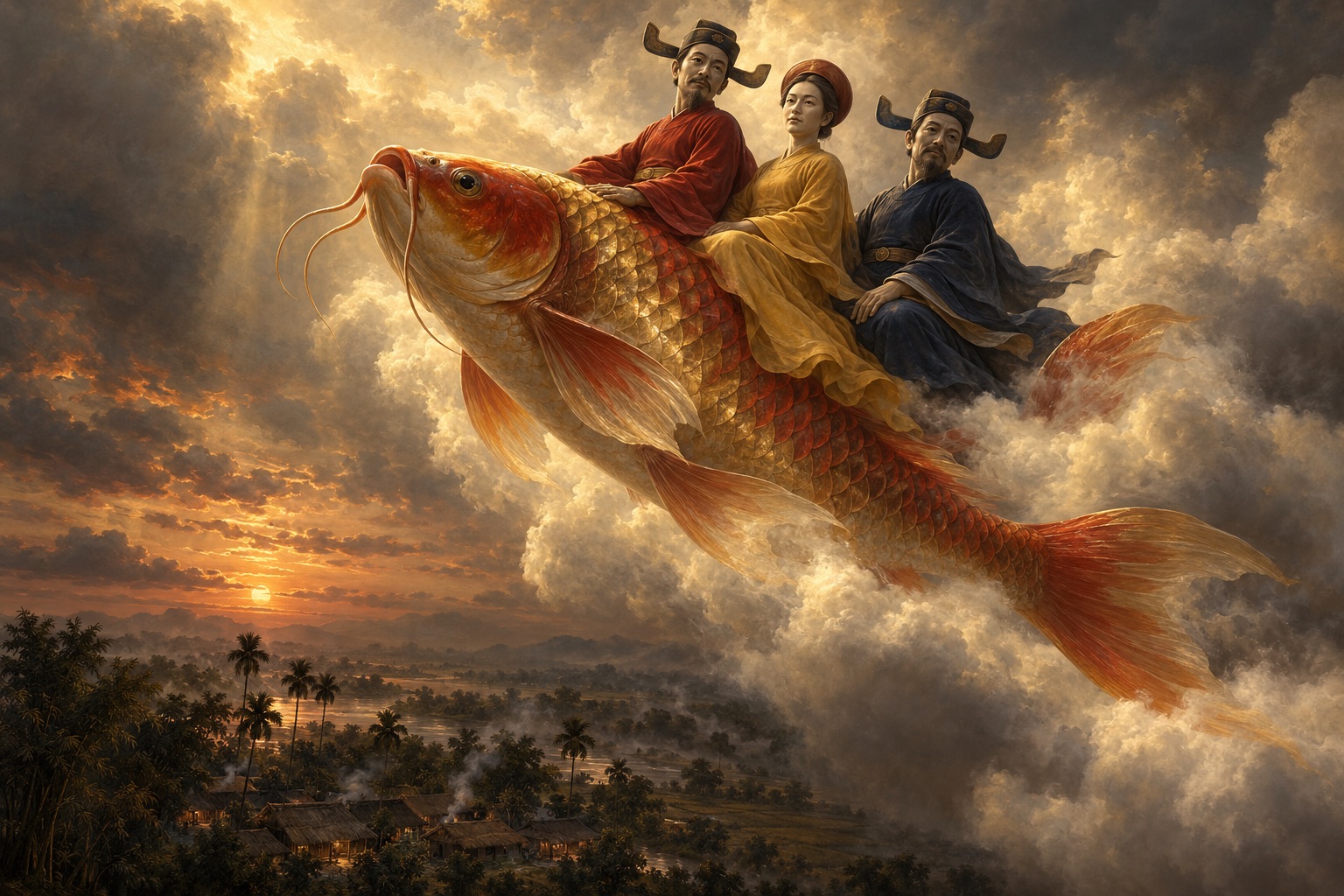
Every year on the 23rd of the twelfth lunar month, Vietnamese families send their kitchen gods to heaven on a carp, with two men's hats and one woman's. Their tale, a wife and two husbands who died in one fire, was already written down in 1659, but the gods' names, their number and even the meaning of Ông Công have shifted since.
- Type: folk tale (truyện cổ tích) explaining the gods of the hearth, and a household rite kept every year
- Culture: Việt (Kinh), throughout Vietnam; the name “Ông Công Ông Táo” belongs to the North
- Earliest texts: Alexandre de Rhodes’s dictionary (Rome, 1651) names the “king of the kitchen”; a letter by the Vietnamese Catholic Bento Thiện (1659) tells of three who died in one fire; the names Trọng Cao, Thị Nhi and Phạm Lang appear in a missionary’s Latin treatise of 1750
- Key figures: Trọng Cao, his wife Thị Nhi, her second husband Phạm Lang; Ngọc Hoàng, the Jade Emperor; in other versions, the King of the Underworld and a faithful servant
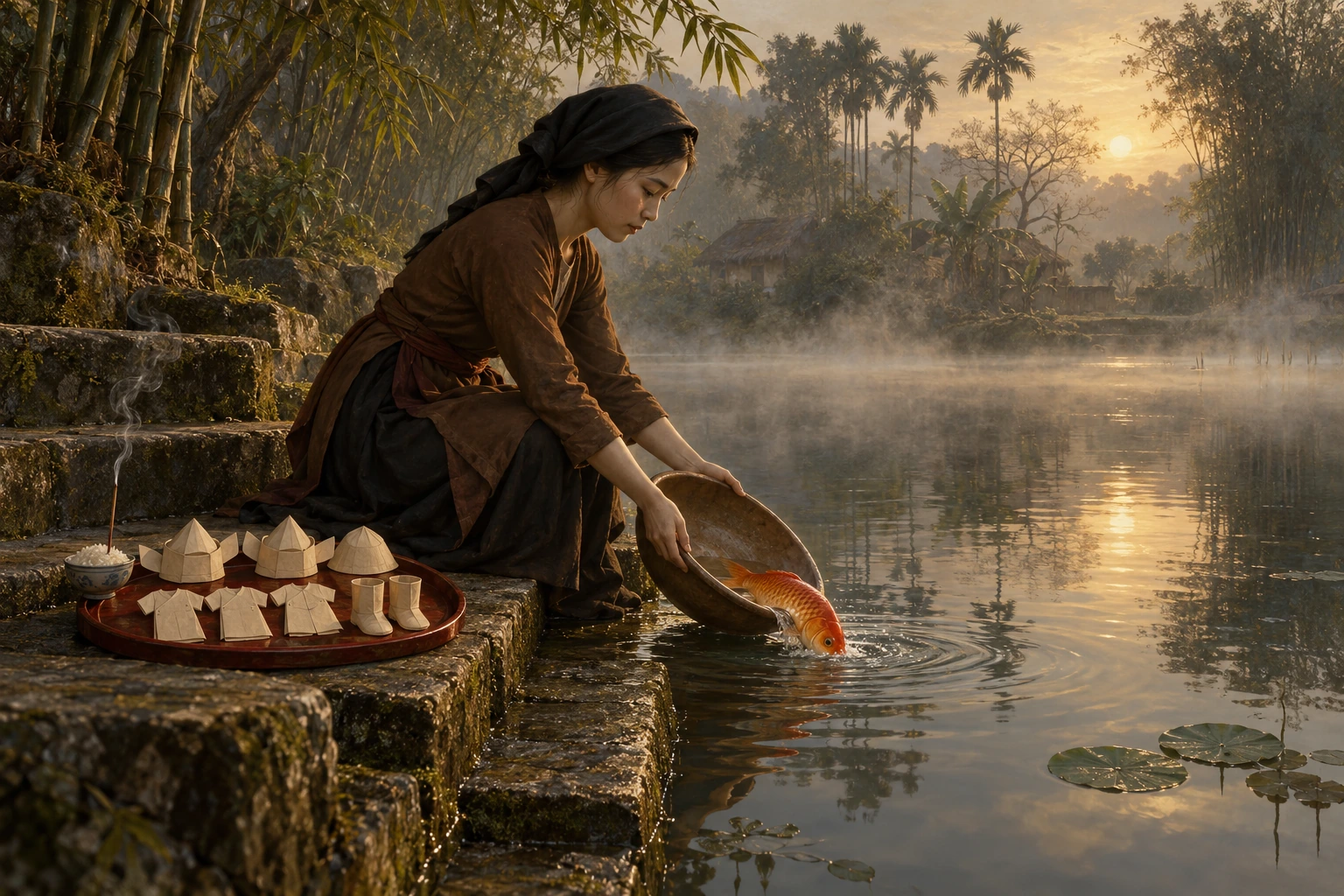
A week before Tết, Vietnamese families send three gods back to heaven. On the 23rd day of the twelfth lunar month, paper hats wait on the altar, two for men and one for a woman, and a live carp swims in a basin, ready to carry them. The gods are going to report on the family’s year to the Jade Emperor. Who they are depends on whom you ask: a wife and two husbands who died in one fire, three lumps of clay under the cooking pot, or two gods whose names have run together.
Why a carp? The old descriptions say only that it is the gods’ horse. So wrote the scholar Đoàn Triển in his An Nam phong tục sách, in Classical Chinese, early in the 20th century (as quoted by the Japanese researcher Nabeta Naoko), and Phan Kế Bính in 1915. Neither says why. The reason given today is the Chinese legend of the Dragon Gate: a carp that leaps the falls of the Yellow River becomes a dragon, and a dragon can fly to heaven. In China itself the kitchen god rides a horse of paper; according to the studies Nabeta cites, only some fishermen of Zhejiang and Guangdong use a carp.
1 The Telling
We follow the outline that the folklorist Nguyễn Đổng Chi gave in his Lược khảo về thần thoại Việt Nam (A Brief Survey of Vietnamese Myth, 1956) and repeats among the variants of tale 21 of his Kho tàng truyện cổ tích Việt Nam (Treasury of Vietnamese Folk Tales). It carries the three names that most retellings use today. Where his outline is silent, we add the details of the retelling most often read now, an anonymous, undated text on Vietnamese Wikisource, and we say where the two differ.
1-1 The Quarrel
Trọng Cao and Thị Nhi had been married a long time, and they had no children. In the Wikisource retelling they love each other dearly, but the lack of a child turns Cao bitter, and he picks quarrels with his wife.
One day, over a small thing, a quarrel grew into a big one. Cao struck Thị Nhi and drove her out. She wandered to another region, and there she married a second husband, Phạm Lang.
1-2 The Beggar at the Door
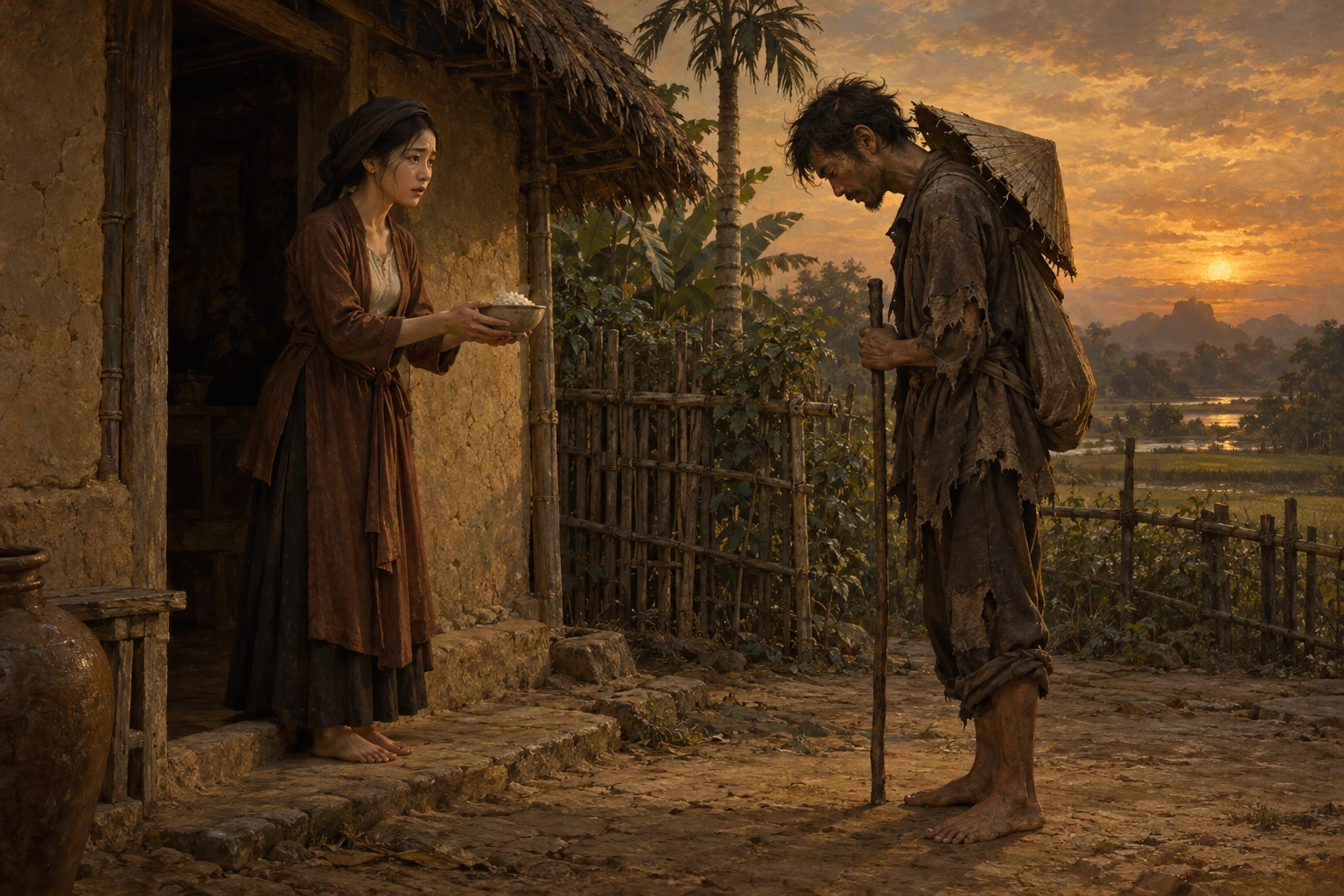
Once his anger had cooled, Trọng Cao was sorry. He left home to look for his wife. He searched until his money and his rice were gone, and then he begged his way along the roads.
One day, by chance, he begged at Phạm Lang’s door while Phạm Lang was away. Thị Nhi recognized the ragged beggar as the man she had married. She took him in and cooked rice for him.
1-3 The Straw Stack
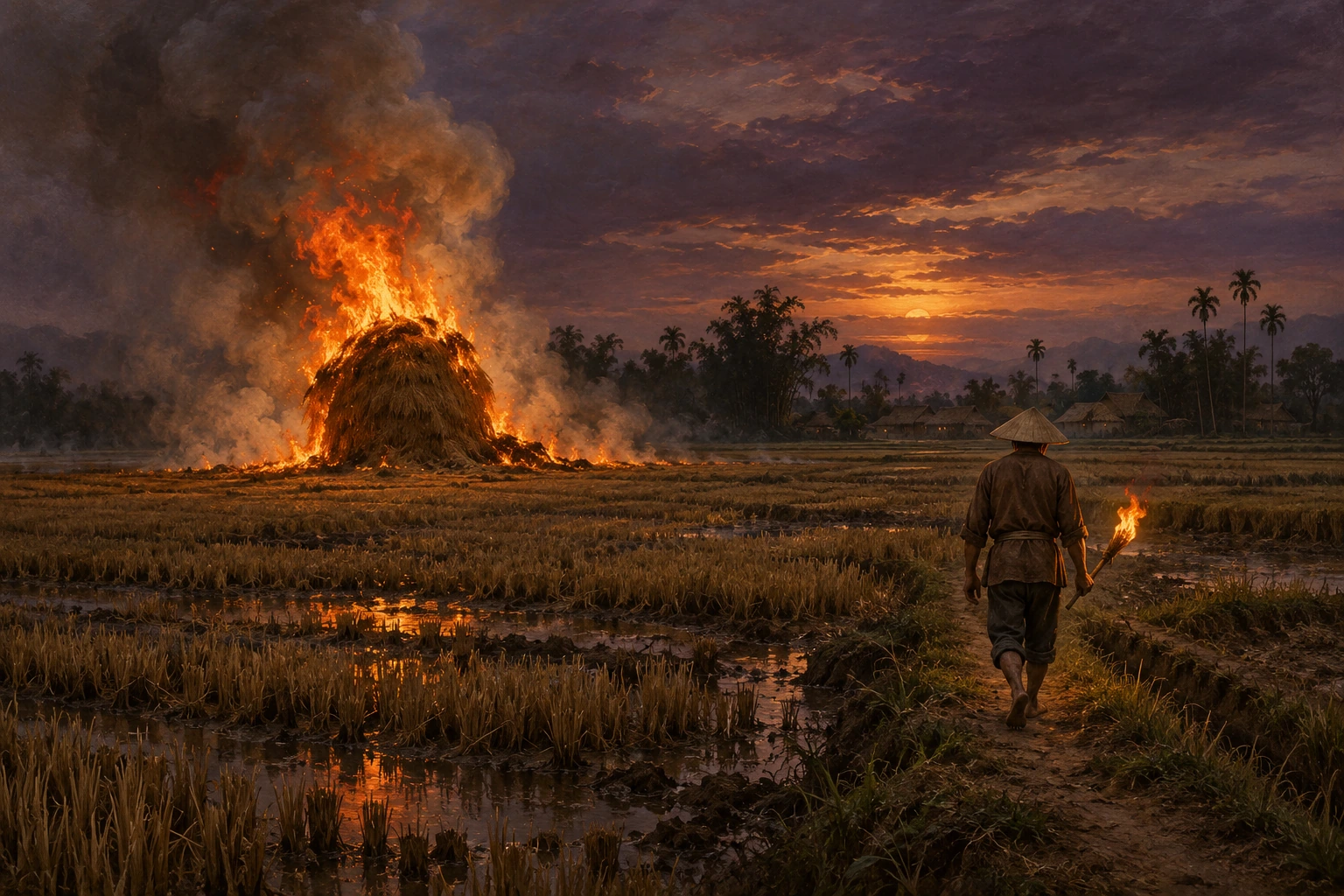
Afraid that her husband would come home and suspect her, Thị Nhi hid Trọng Cao in a stack of straw: out in the field, says Nguyễn Đổng Chi; behind the garden, with Phạm Lang already at the door, says the retelling.
Soon after, Phạm Lang set fire to the straw stack to make ash for his fields, not knowing that anyone was inside. Trọng Cao died in the fire. Thị Nhi threw herself into the flames, and Phạm Lang rushed in after his wife. In Nguyễn Đổng Chi’s outline a servant runs in after them to save them and dies too. In the Wikisource retelling there is no servant, and Thị Nhi runs into the fire to pull Cao out.
1-4 The Three Stones by the Fire
The Jade Emperor, Ngọc Hoàng, saw that all three had loved truly. So that they would never be parted, he made them the gods of the kitchen, the Táo quân, to stay together by the hearth. The retelling ends with the rule they keep: every year, at the end of the 23rd day of the twelfth month, the kitchen gods go up to heaven to report the good and evil done on earth, and on the afternoon of the 30th they come back to their work.
The hearth they guard was made of three stones or lumps of clay set under the pot, the đầu rau, and the stones themselves are given a title, ông đầu rau, “Sir Hearth Stone”. Nguyễn Đổng Chi’s own main version of the tale ends with the three lovers turned into exactly those stones, “so that the fire would always keep their love warm”.
2 Where the Story Is Written Down
The Lĩnh Nam chích quái, at least in the copy on Chinese Wikisource, has no tale of the kitchen gods, and Nabeta, who surveyed the written record, could confirm nothing earlier than the 17th-century notes below. The story reaches us through a Vietnamese Catholic’s letter, missionaries’ notes, dictionaries and 20th-century writers.
- Alexandre de Rhodes, Dictionarium Annamiticum Lusitanum et Latinum (Rome, 1651), the Jesuit’s Vietnamese–Portuguese–Latin dictionary. Under táo, the kitchen hearth, he lists táo coên (the spelling could stand for táo công or táo quân) and vua bếp, “king of the kitchen”, then phăm cao, which he glosses with the Latin Dii lares, the household gods of Rome. Under đầu rau he writes: “three stones in the hearth on which the pot is set, like a tripod”. The 1991 Vietnamese edition renders phăm cao simply as “kitchen god”; Nabeta wonders whether it echoes the names Phạm Lang and Trọng Cao, and leaves the question open.
- Bento Thiện’s letter (1659). A Vietnamese Catholic described the customs of his country for a Jesuit in Rome. In the kitchen, he says, people worship Táo quân, “called the king of the kitchen”. A woman’s first husband fell into a fire and died; she married again but still loved him, and at the old pit she fell in too; her second husband, seeing her dead, threw himself in after her, so that “the three went into one pit”. People made up, he adds, that these were the kitchen king. We read the letter as Nabeta quotes it from Đỗ Quang Chính’s transcription.
- Adriano di St. Thecla, Opusculum de Sectis apud Sinenses et Tunkinenses (1750), a Latin treatise on the religions of China and Tonkin by an Italian missionary, translated into English by Olga Dror (Cornell, 2002). According to Nabeta, it tells the tale with the names Trạng Cao (Trọng Cao), Thị Nhi and Phạm Lang, much as it is told today. Women, it says, worship the kitchen king; on the first day of the year a picture of four figures painted on paper is hung in the kitchen, with offerings for three days; a new bride honours the kitchen king and asks for his help with the cooking. The Tam giáo chư vọng (1752), written in the Latin-based Vietnamese script, tells the same tale in verse.
- Huỳnh Tịnh Của, Đại Nam quấc âm tự vị, volume 2 (Saigon, 1896), a dictionary of Vietnamese. Under 竈 táo he explains the hòn táo, “a lump of earth moulded with a slight curve to hold up the pot (three are needed)”, and táo quân, “king of the kitchen”. The rite of “sending off ông Táo” falls, he writes, on the 29th or 30th of the twelfth month: the god knows every good and bad deed in the house, and people pray that when he reaches the Jade Emperor he will speak well of them.
- Phan Kế Bính, Việt Nam phong tục (Vietnamese Customs), serialized in 1913–1914 and published as a book in 1915; we read the Khai Trí edition (Saigon, 1973) on Vietnamese Wikisource. The 23rd, he writes, comes from Taoism, which says that on that day the kitchen god goes to court in heaven “to report the good and evil deeds of the human world”. Then he tells the tale as “a book says” (section 3). “Following these two traditions,” families buy “two men’s hats and one woman’s hat” and a carp “to be the horse on which the kitchen god goes up to court in heaven”.
- Nguyễn Đổng Chi, Kho tàng truyện cổ tích Việt Nam, five volumes published from 1957 to 1982; we read the 8th printing (Hà Nội: Giáo dục, 2000), volume 1, tale 21, “Sự tích ông đầu rau” (“The Story of the Hearth Stones”). His main text is a different story (section 3). His notes add three Vietnamese variants, a Cham tale, a Cantonese one and one from South India; the outline of section 1 is the variant he had told in his survey of 1956.
One early collection is silent. A. Landes’s Contes et légendes annamites (Saigon, 1886) has 127 tales and a set of comic ones, and none of them is about the kitchen gods.
3 Competing Versions
- How do they die?
- Bento Thiện (1659): the first husband falls into a fire; later the wife falls into the same pit, and the second husband throws himself after her.
- Phan Kế Bính (1915): a poor couple separate, and the wife marries a rich man. During a rite, while paper offerings burn in the yard, a beggar comes in; she sees her first husband and gives him rice and money. Her new husband suspects her, and in shame she throws herself into the fire. The first husband follows her, then the second.
- Nguyễn Đổng Chi’s 1956 outline: the servant who runs in to save them makes four deaths.
- Nguyễn Đổng Chi’s main text has no fire at all. A young couple of hired labourers are parted by famine; the husband leaves and asks her to wait three years. She waits seven, then marries the kind master who fed her through the hunger. Three months later the first husband comes home, wishes them well, and hangs himself from the banyan at the village gate. She drowns herself in the pond, and the second husband gives away his goods and takes poison. Before the King of the Underworld, Diêm Vương, each confesses a love that will not let the others go, and the king turns all three into hearth stones and makes them Táo quân.
- The servant. In a version told in Sơn Tây, the second husband is a hunter, and his servant Lốc lights the straw to singe a civet they have caught. All four die. The King of the Underworld turns the three into hearth stones, and Lốc into the clay weight that held down the pile of smouldering husks kept by the hearth overnight, in the days before matches, which people called “thằng Lốc”. Pictures of the kitchen gods, Nguyễn Đổng Chi notes, never leave out the faithful servant beside the three. Thecla, too, describes a picture of four figures in 1750.
- Who makes them gods? The Jade Emperor in the Wikisource retelling and in Nguyễn Đổng Chi’s 1956 outline; “the Lord on High” (Thượng đế) in Phan Kế Bính; the King of the Underworld in Nguyễn Đổng Chi’s main text and the Sơn Tây version. In Bento Thiện, nobody: people simply said so.
- Which day? In Phan Kế Bính and the retelling, the 23rd of the twelfth month; in Huỳnh Tịnh Của’s Saigon dictionary, the 29th or 30th. In Thecla’s Tonkin the new picture went up on the first day of the year.
- Who sits in the middle? The woman. Trịnh Hoài Đức’s gazetteer of the South, Gia Định thành thông chí (around 1820), as Nabeta quotes it, says the kitchen god is painted as two men left and right with a woman between them, like the trigram for fire, ☲: two yang lines around the one yin line that rules them. In Nguyễn Đổng Chi’s note, northerners call the middle hearth stone the female one and the other two the male ones. The retelling’s clay figures have the woman in the middle too.
4 History and Tradition
- The stones themselves. Clay hearth supports were moulded at home and wore out. In 1948 a writer signing H.V.V. described village households that still made three new “ông bếp” each year and threw the old, chipped ones into the pond; Đoàn Triển writes of laying the old ones in a clean place. Henri Oger’s drawings in Technique du peuple annamite (1909) include a woman “changing the kitchen king” at the foot of a tree, and in Huế, Trần Đại Vinh wrote in his Tín ngưỡng dân gian Huế (1995), the three old stones are carried after the 23rd to a big tree or a corner of a shrine. In Central Vietnam the stones are called ông Núc: the writer Phan Khôi explained that in his home region the hearth stone earned its “ông”, like the tiger and the lime pot, because it lasted five or ten years before it was replaced. In a poem on a flood, Nguyễn Khuyến wrote “we must build a raft to carry the king out”, and Trần Trọng Kim’s anthology Việt thi explains: “the king is the king of the kitchen”.
- The 23rd today. Families set out three paper hats with robes and paper boots: the two men’s hats have upturned “dragonfly wings” (cánh chuồn), the flaps of a mandarin’s hat, and the woman’s has none. The old set is burned and a new one bought every year, writes Trần Hạnh Nguyên, a lecturer at Tây Bắc University; if only one hat is offered, it belongs to Thổ Công. After the rite a carp is released into a pond or a river. In the South, writes the researcher Huỳnh Ngọc Trảng, woodblock prints of “flying egrets and running horses” take the place of the carp: the horse carries the god overland, and the egret flies him to heaven. The rest of the Tết preparations, bánh chưng included, belong to the story of Lang Liêu.
- The Dragon Gate. The Taiping guangji, a Chinese compendium of the 10th century, quotes an older Sanqin ji: at the Dragon Gate on the Yellow River, “every late spring yellow carp swim upstream, and those that make it become dragons”. No more than seventy-two pass in a year; clouds and rain follow them, and fire from heaven burns their tails. Vietnamese speak of the carp that “passes the Vũ Môn and becomes a dragon”, and today’s explanations of the rite rest on it.
- China’s kitchen god. The Chinese Zao Jun (灶君) is far older, and is one god, sometimes with a wife. In the 4th century Ge Hong’s Baopuzi says that “on the last night of each month the stove god also goes up to heaven to report people’s misdeeds”; a serious one costs three hundred days of life. In the 12th century the poet Fan Chengda put the offering on the night of the 24th of the twelfth month and described the send-off: a pig’s head and a pair of fresh fish, wine poured by the men while the women keep away, and a plea that the god, sent off “drunk and full”, should say nothing at heaven’s gate about the quarrels of the house. His god travels by “cloud carriage and wind horse”. Nguyễn Đổng Chi set the Vietnamese tale beside a Cantonese one, from a people who also make their offering on the 23rd: Zhang Lang (Trương Lang) drives out his wife Ding Xiang (Đinh Hương), loses everything and his sight, begs at her door, and dies of shame when he learns who she is; the Jade Emperor, who shares his surname, makes him kitchen god. Trần Hạnh Nguyên, comparing the two cults, finds the Chinese god a single figure and the Vietnamese one three, and writes that the Vietnamese do not speak of bribing him, although Huỳnh Tịnh Của’s dictionary already has them praying that he will speak well of them.
“Ông Công Ông Táo” sounds like two gods, and the three of the tale are now often named Thổ Công, Thổ Địa and Thổ Kỳ, the gods of the kitchen, the house and the market. In 1915 Phan Kế Bính still listed Thổ công, the god of the house’s ground, and Táo quân, the kitchen god, side by side as two different gods. By the middle of the century the North had merged them: in 1956 Nguyễn Đổng Chi noted that people “call the kitchen god Thổ công”. Huỳnh Ngọc Trảng traces the merger to the custom of worshipping all the household gods at one altar under one tablet; in Central and South Vietnam, people simply say “ông Táo goes back to heaven”.
5 Related Stories
- Lang Liêu and the Bánh Chưng: The Cakes of Tết: the farewell to the kitchen gods opens the last week of the year. The cakes that crown Tết have their own story.
- Vesta: The Hearth Goddess and Her Virgins: when Alexandre de Rhodes needed a Latin word for the Vietnamese gods of the kitchen in 1651, he chose Dii lares, Rome’s household gods. Vesta was the hearth of Rome. We have found no scholar who compares her with Táo quân; we link them for the theme.
- La Befana: The Old Woman Who Brings Gifts at Epiphany: Italy’s visitor at the turn of the year comes down the chimney, by the hearth that the kitchen gods guard in Vietnam. Here, too, the link is a shared theme.
- The Jade Emperor: The Ruler of Heaven: the ruler of heaven to whom the kitchen gods report at the end of the year, and how he came to stand at the top of the Chinese pantheon.
6 Sources
- Alexandre de Rhodes, Dictionarium Annamiticum Lusitanum et Latinum (Rome, 1651), entries táo and đầu rau: Vietnamese Wikisource; Vietnamese translation by Thanh Lãng, Hoàng Xuân Việt and Đỗ Quang Chính (Hà Nội: Khoa học Xã hội, 1991): archive.org
- Huỳnh Tịnh Của, Đại Nam quấc âm tự vị, vol. 2 (Saigon: Rey, Curiol & Cie, 1896), entry 竈 táo: Vietnamese Wikisource
- Phan Kế Bính, Việt Nam phong tục, part 1, chapters 4 and 12 (“Tứ thời tiết lạp”, no. 9, “Tết Táo quân”), Khai Trí edition (Saigon, 1973): Vietnamese Wikisource
- Nguyễn Đổng Chi, Kho tàng truyện cổ tích Việt Nam, vol. 1, tale 21, “Sự tích ông đầu rau”, with its variants, 8th printing (Hà Nội: Giáo dục, 2000): archive.org
- “Sự tích táo quân”, anonymous modern retelling, no date: Vietnamese Wikisource
- A. Landes, Contes et légendes annamites (Saigon, 1886), table of contents: archive.org
- Phan Khôi, “Ông bình vôi” (1956): Vietnamese Wikisource; Nguyễn Khuyến, “Lụt”, no. 102 in Trần Trọng Kim, Việt thi: Vietnamese Wikisource
- Nabeta Naoko, “Thờ cúng ông Táo ở Việt Nam qua nghiên cứu tư liệu và điều tra so sánh”, Tạp chí Khoa học Đại học Thăng Long A1(1) (2021): 111–122, quoting Bento Thiện, Thecla, Đoàn Triển, Nguyễn Đổng Chi’s Lược khảo, Trịnh Hoài Đức, H.V.V., Henri Oger, Trần Đại Vinh and Huỳnh Ngọc Trảng: Thang Long University
- Trần Hạnh Nguyên, “Nghiên cứu so sánh tín ngưỡng thờ Táo quân của người Việt ở Việt Nam và người Hán ở Trung Quốc”, Nghiên cứu Tôn giáo 1 (2014): 98–116: VJOL
- Adriano di St. Thecla, Opusculum de Sectis apud Sinenses et Tunkinenses, trans. Olga Dror (Ithaca: Southeast Asia Program, Cornell University, 2002), cited through Nabeta
- Ge Hong, Baopuzi, inner chapters, book 6, “Weizhi”: Wikisource (Classical Chinese)
- Fan Chengda, “Jizao ci” and the preface to his Cuntian yuefu, in Shihu jushi shiji, book 30: Wikisource (Classical Chinese)
- Taiping guangji, book 466, “Longmen”, quoting the Sanqin ji: Wikisource (Classical Chinese)
- Vạn Xuân, “Sự tích ông Công ông Táo gắn liền huyền tích ‘hai ông một bà’”, Báo Thế giới và Việt Nam, 9 January 2023: baoquocte.vn
- Phương Nga, “Vì sao cúng ông Công ông Táo phải có cá chép?”, VOH, 1 February 2024: voh.com.vn
Cover and illustrations: AI-generated images made for Arcana. They are interpretations, not historical artworks.