La Befana: The Old Woman Who Brings Gifts at Epiphany
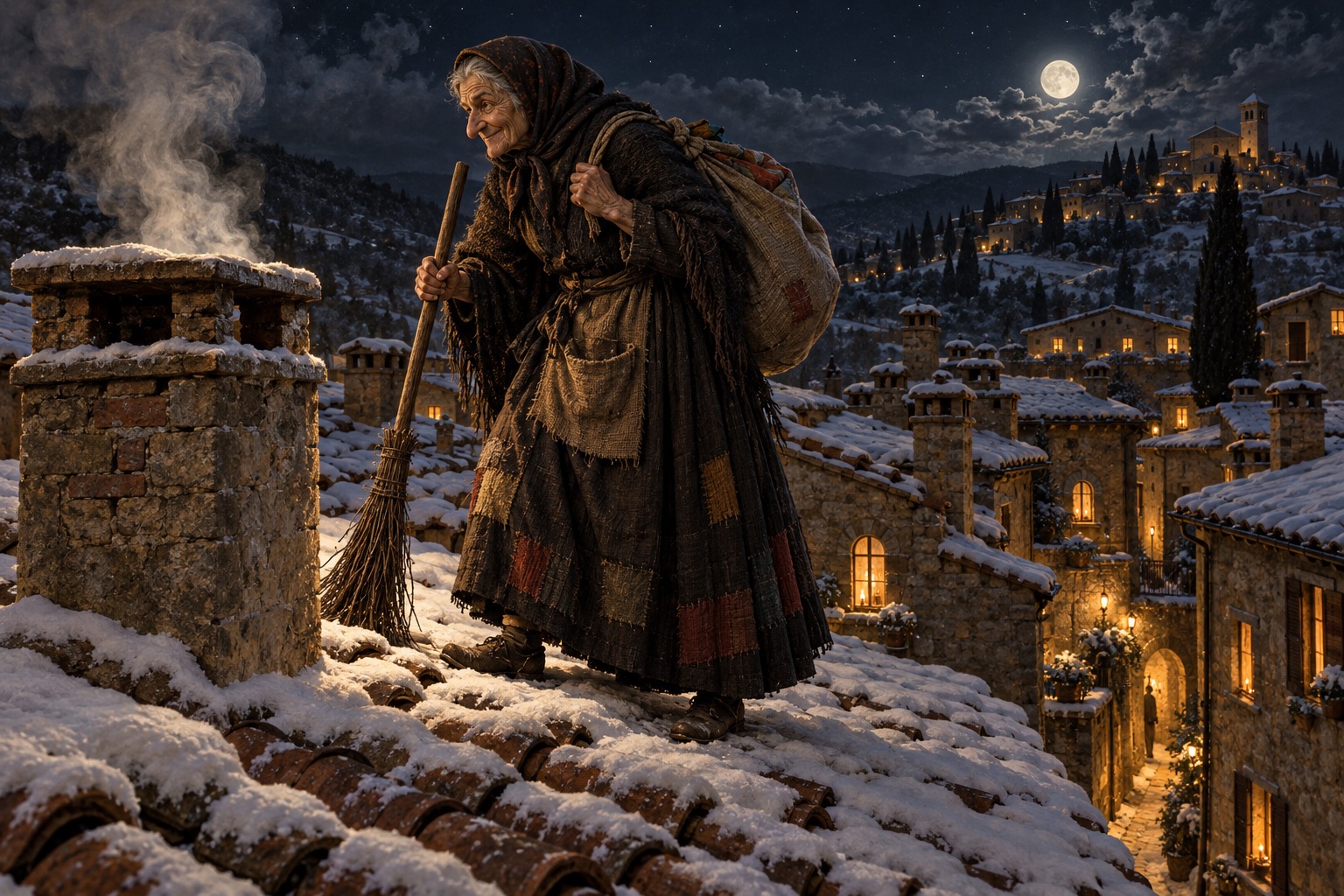
On the night before Epiphany an old woman comes down Italian chimneys to fill children's stockings with sweets, or with coal. She is often called a Roman goddess in disguise, but her name is the name of the Christian feast, and the oldest texts we found that make a figure of it are Tuscan poems of the 15th and 16th centuries.
- Type: folklore and living custom, the gift-bringer of the night before Epiphany
- Culture: Italy, today in every region; in the 19th century Santa Lucia or the dead still brought the gifts in some of them
- Earliest texts: the word, as the name of the feast, in a Florentine statute by 1284 (in Latin, Bitfanie, in a Sienese charter of 1048); as a figure, a bogey in Luigi Pulci’s Morgante (begun 1461, final version printed 1483) and a rag doll in a sonnet by Francesco Berni (died 1535)
- Key figures: the Befana, the Magi; in the north-east, the “old woman” burned on the Epiphany bonfire
Italians say that l’Epifania tutte le feste porta via: Epiphany, on 6 January, carries all the holidays away. The last night of the season belongs to an old woman. She comes down the chimney while the children sleep and fills the stockings they have hung up, with sweets if they have been good and with coal if they have not. No scripture tells her story and no known author invented her. She is a custom, and the custom has a long written trail.
Is the Befana a witch? Not in the dictionaries. She rides a broom and is drawn with a hooked nose, but the Treccani dictionary describes her as an old woman, “very ugly but kind”, who brings gifts by night, and calls her the “personification of Epiphany”. The word befana is simply the popular form of Epifania, the name of the feast.
1 The Telling
There is no single text to follow. This is the custom as Italian dictionaries, writers and the festival town of Urbania describe it, and the Christian legend told to explain it.
1-1 The Night of 5 January
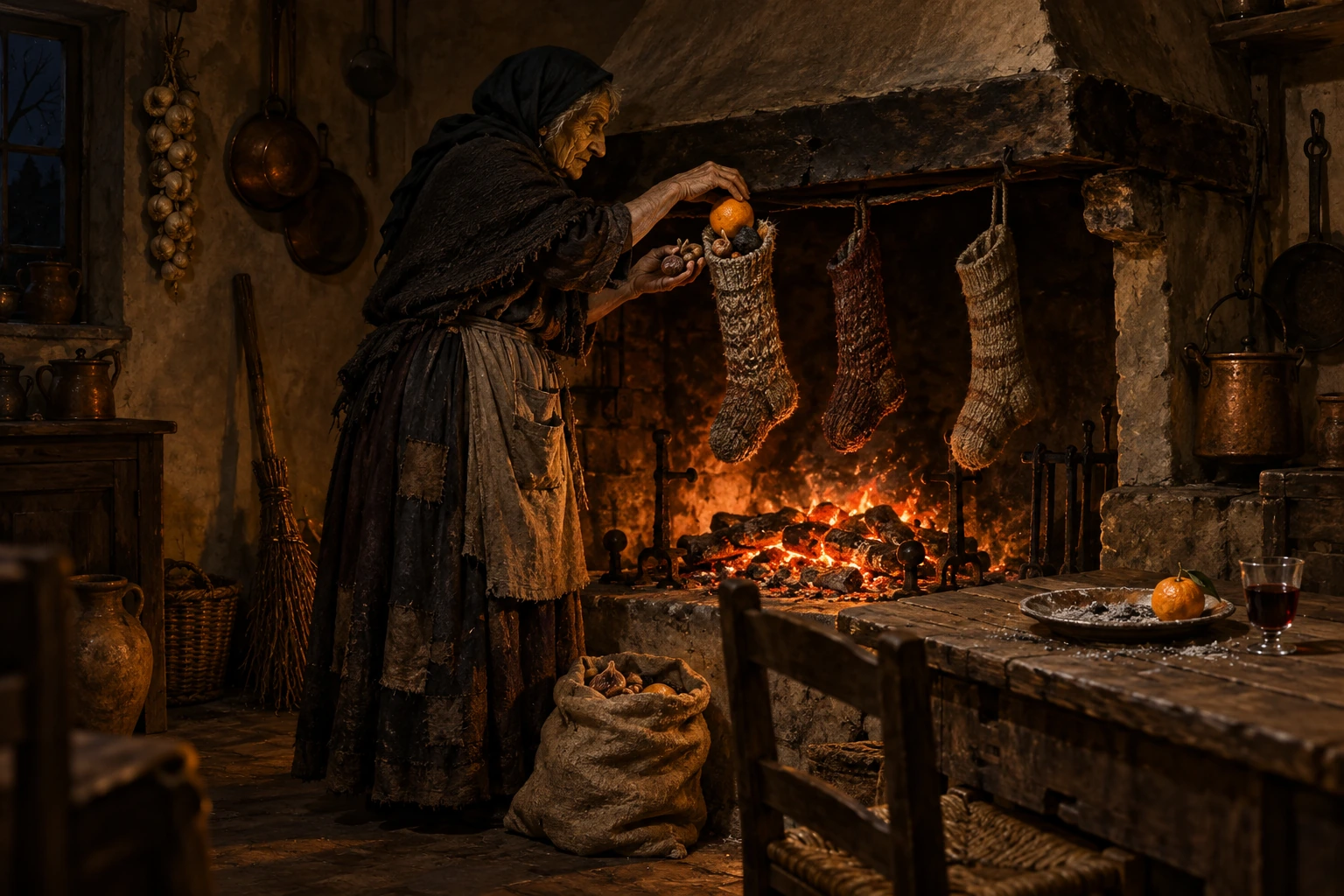
She comes on the night between 5 and 6 January. The Treccani dictionary says that she climbs down the chimney hood and leaves gifts and sweets in the shoes, or more often the stockings, of good children, and pieces of coal for the bad. The novelist Francesco Domenico Guerrazzi, in 1858, pictured children kneeling under the chimney hood on the evening of 5 January, praying that she would come down and fill the hanging stockings “with hazelnuts, dried figs or some more delicious thing”. In 1890 Emma Perodi wrote that she fills the stocking in most of Italy and “sometimes amuses herself” by putting in ash and coal for children who have been bad.
Children leave her something too. The Urbania festival describes a mandarin or an orange and a glass of wine on a plate: in the morning the food has been eaten, and her handprint is in the ash scattered on the plate. The coal survives too, though often it is no longer coal: pastry shops all over Italy sell carbone, lumps of sugar dyed black.
1-2 Broom, Shawl and Patched Skirt
The Urbania festival dresses her in a wide dark skirt, an apron with pockets, a shawl and a headscarf or a battered hat, all brightened with coloured patches, and gives her a broom, which there they call a granata. Its version of the famous rhyme runs:
La Befana vien di notte / con le scarpe tutte rotte / col cappello alla romana / viva viva la Befana!
The Befana comes by night, / her shoes all worn and torn, / her hat in the Roman style: / hurrah for the Befana!
1-3 The Old Woman and the Magi
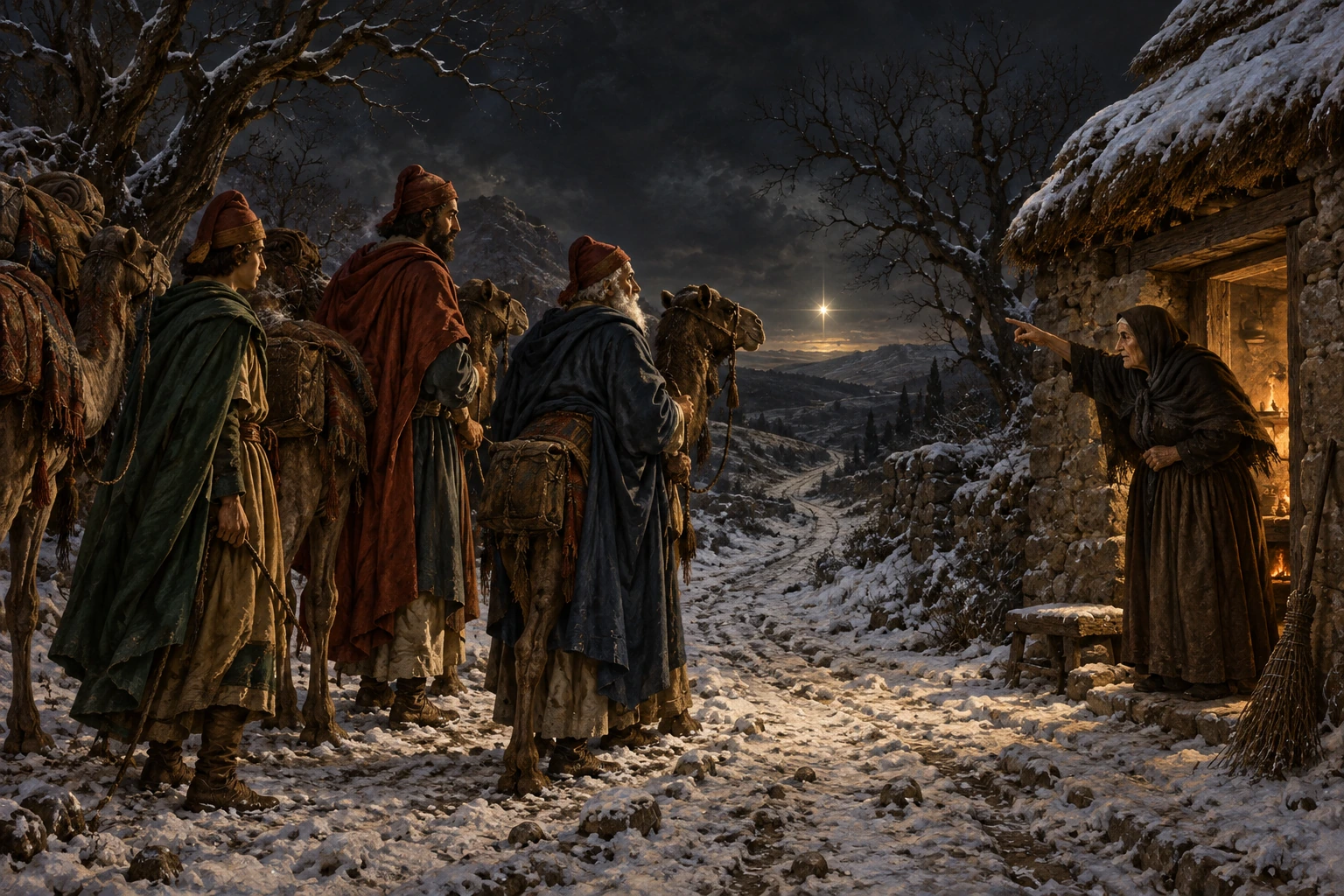
There is also a Christian legend, told in more than one version. In the one the Urbania festival prints, Balthasar, Caspar and Melchior, travelling to the Christ Child on a freezing winter night, could not find the way to Bethlehem and asked an old woman, who showed them the road. They invited her to come with them; she refused, however much they insisted. When they had gone she was sorry. She filled a sack with sweets and set out after them, but never found them. So she knocked at every door and gave sweets to every child she met, in the hope that one of them was the Christ Child.
The Gospel has no old woman. In Matthew (2:1–12) the wise men from the east ask their way in Jerusalem, and the star goes before them to the house in Bethlehem, where they offer gold, frankincense and myrrh. We have not found when the legend of the Befana and the Magi was first written down.
1-4 The Last Night of the Holidays
The folklorist Raffaele Corso, writing in 1930, summed up the beliefs around her. For the people she was “a mythical figure in the form of a horrible old woman” who passes over the earth. On the last night of her stay the world is full of wonders: the trees bear fruit, the animals speak, and the water of rivers and springs turns to gold. Girls laid olive leaves on the hot ash of the hearth to read their future marriages, and bands of boys and grown men went round the village singing for gifts or lit bonfires. In Tuscany that song is the befanata, sung door to door on the evening of 5 January to the sound of an accordion or a fiddle, with one of the band dressed as the Befana; in the Marche it is called the Pasquella.
2 Where the Story Is Written Down
- The name. Treccani derives befana from a Latin *epiphanĭa, with the stress moved back, for epiphanīa, the feast of Epiphany. The Accademia della Crusca traces epifania to the Greek epipháneia, from epi-, “upon”, and phaínō, “I appear”. The historical dictionary of early Italian (TLIO) lists befanìa, bifania, befane and befani as “the same as epifania”. Its first example is a Florentine statute from before 1284 that orders candlelit vigils “for Christmas, for Befanie, for the Resurrection”. In Latin documents it notes Bitfanie in a Sienese charter of 1048 and, in an Arezzo document of 1211, befanias, “gifts made for Epiphany”.
- A bogey. In Luigi Pulci’s comic epic Morgante (canto 5, octave 42), the paladins meet a monster with a club, and Ulivieri says: “I rather think it is the Befania, or Beelzebub.” Pulci began the poem in 1461; the final version appeared in 1483 (Treccani). The 1855 Le Monnier edition explains that in Florence a befana was a rag doll set in the window on Epiphany, an ugly woman, or “an imaginary being” used to frighten children.
- A doll in the window. Francesco Berni (died 1535) wrote a sonnet against his hideous housemaid: “On Epiphany day / I’ll put her in the window for a befana, / so that someone takes a crossbow to her.”
- The first dictionary. The Vocabolario degli Accademici della Crusca of 1612 says that from befania “we say befana of a rag doll which, on that day, children and women put in the windows as a joke”, and also of an ugly, misshapen woman. Under orco it puts the befana beside the biliorsa as an “imaginary beast”. The fourth edition (1729–1738) adds that the doll was carried round on the night of Epiphany.
- The gift-bringer. The old woman with presents is well attested in the 19th century: Guerrazzi in 1858, Perodi in 1890, and Alfredo Panzini’s Dizionario moderno in 1905, where Befana is “the old woman who comes down the chimney that night to bring toys and sweets to good children”.
- The folklorists. Corso’s articles “Befana” and “Befanata” in the Enciclopedia Italiana (1930) gather the customs from the collections of Giuseppe Pitrè (Sicily, 1881), Antonio De Nino (Abruzzo, 1890), Luigi Mannocchi (the Marche, 1921) and others, and set them beside the Epiphany customs of France, Germany and England.
- Pascoli’s poem. Giovanni Pascoli’s “La Befana”, dated “Castelvecchio, 1900”, is in Poesie varie, the collection his sister Maria put together after his death; we read it in the second edition of 1914. “Here she comes, the Befana, / down from the mountains in the dead of night.” She looks into a villa where three children sleep and three long, fine stockings hang by the fire-dogs, and sees their mother come down with the gifts. Then she looks into a cottage where three worn clogs stand among the ashes and the mother spins and weeps. The Befana “sees and hears” and goes back to the mountain at dawn: “some are weeping, some are laughing.” In Pascoli she brings nothing at all.
3 Competing Versions
- Kind or frightening? Treccani’s Befana is kind. Pulci’s is a monster in the same breath as Beelzebub, and the dictionary of 1612 files her among imaginary beasts. Corso calls her horrible to look at.
- A woman or a doll? In the oldest texts the befana is mostly a rag doll. Corso adds that the people of Florence once displayed one at the window, a use “Berni seems to recall”, and so did the stall-keepers of Rome; in the Tuscan Romagna peasants carried it on a cart, with shouts and whistles, to the village square and burned it.
- Who brings the gifts? Perodi in 1890: the Befana in most of Italy, but Santa Lucia on 13 December in Bologna and Lombardy, and in Sicily the dead, on 2 November. In Pascoli’s poem, the mother.
- Epiphany or Mid-Lent? In Romagna, Panzini wrote, the segavecchia, “the Befana”, is an effigy full of dried fruit carried round at Mid-Lent and broken open for the crowd.
- What is she called? Panzini gives la Vecieta, “the little old woman”, for the Veneto; Corso’s names for the burned effigy are “the Old Woman, the Befana, the Witch”.
4 History and Tradition
- The feast. Epiphany, the “manifestation”, is the Christian feast of 6 January. The Enciclopedia Italiana (1932) explains that the liturgy recalls three manifestations of Christ (the Magi, the baptism in the Jordan and the wedding at Cana), but that for the people of the West the feast has come to mean the coming of the Magi. It is first attested in Clement of Alexandria, and in the 4th century the West took Epiphany from the Eastern churches as the East took 25 December from the West. Many churches, in Japan among them, now keep it on the first Sunday after 2 January (Heibonsha World Encyclopedia); in Italy it stays on the 6th.
- Theories of her origin. Each one links customs, not texts:
- Roman New Year gifts. A popular claim ties her to the strenae, the Roman New Year gifts (Italian strenna, Treccani), and to a goddess Strenia, whose shrine Varro mentions at the head of the Sacred Way (De lingua Latina 5.47).
- The twelve nights. Italy’s tourism portal says that in the twelve nights after the winter solstice mysterious women were believed to fly over the fields; it cites no source. James George Frazer called “the period of twelve days between Christmas and Epiphany” a “witching time” and gathered Twelfth Night customs from several countries, but his Golden Bough (abridged, 1922) never names the Befana.
- Women who ride by night. A church canon compiled by Regino of Prüm (died 915) condemns women who believe they ride at night “with Diana, goddess of the pagans”. It names “certain nights”, not Epiphany, and it says nothing of gifts.
- The old year. Corso reports that scholars saw in the burning of the effigy a rite found all over Europe and traced the Befana to “pre-Christian magical traditions”; the Urbania festival says she was first a symbol of the year just ended. Bruno Vignola, in the same encyclopedia, thought the German Berchta most likely grew out of a medieval name of Epiphany night, “in the same way as the Befana”.
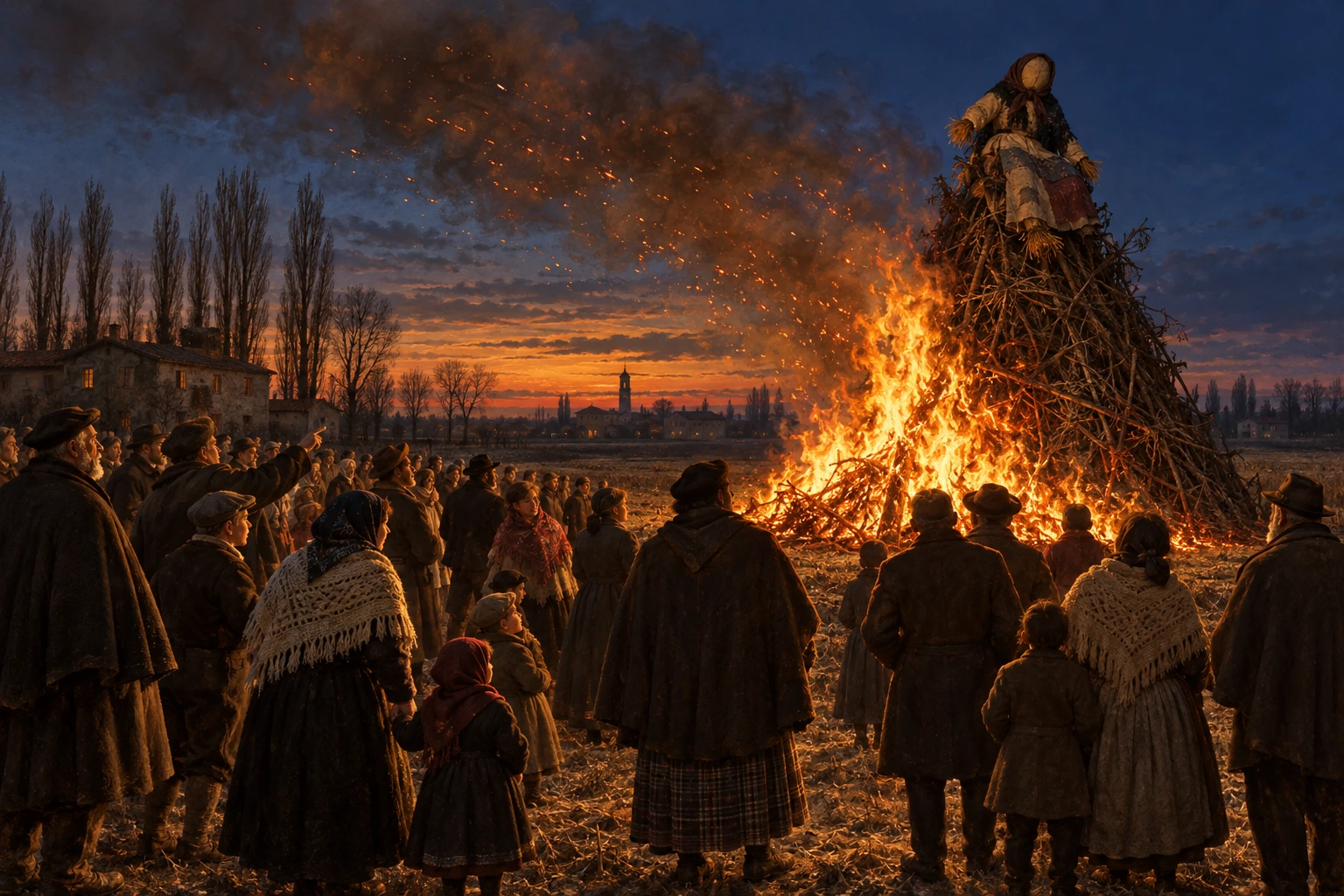
- Bonfires of the north-east. On the eve of Epiphany the province of Treviso is lit by the panevin, “bread and wine”, piles of wood and straw up to ten metres high, and in some places an “Old Woman” is burned on top. The sparks foretell the year: towards the morning, pick up your sack and go begging for flour; towards the evening, the pot will be full of polenta. At Tarcento in Friuli the Pignarûl Grant is lit on 6 January by the “Venerable Old Man”, who reads the next twelve months in its smoke. Verona burns a great effigy in the rogo della vecia.
- Urbania. The town in the Marche holds the Festa Nazionale della Befana, which reached the national press in 1997. The mayor hands the Befana the keys of the city, she flies down from the bell tower, more than 4,000 stockings hang in the streets, and since 2016 she has her own house there.
- Piazza Navona. Rome’s Befana market has stood, says the city’s tourism office, for more than 200 years: first in Piazza Sant’Eustachio, after Italian unification in Piazza Navona. In 1905 Panzini noted that Rome kept the night of the Befana “with a great din of trumpets”; on 6 January the Befana still comes down into the piazza.
- The Befana fascista. On 6 January 1928 the Fascist Party, under its secretary Augusto Turati, launched a national “Fascist Befana” of gift parcels for poor children, collected and handed out by the women’s Fasci and the Dopolavoro; in 1931 there were over a million parcels (AGI). At the initiative of Achille Starace, party secretary from 1931, it became the “Befana del Duce”, but the older name stuck. In 1938 the Enciclopedia Italiana listed the “Befana fascista” among the duties of the welfare boards (Enti Opere Assistenziali). Charity on the day was older: in 1892 a committee in Rome gave clothes, toys and sweets to poor women and children (Perodi).
- A holiday lost and regained. Law no. 54 of 5 March 1977 stopped treating Epiphany as a civil holiday. A presidential decree of 28 December 1985, under the 1984 agreement between Italy and the Holy See, made “6 January, Epiphany of the Lord” a holiday again.
The Befana is often said to be an ancient Roman goddess in disguise, Strenia of the New Year gifts or Diana. We found no ancient text that links either of them to Epiphany or to an old woman with gifts. Her name is the name of the Christian feast, and the earliest texts we found that make a figure of it are Tuscan, of the 15th and 16th centuries. In 1930 Corso reported that scholars traced her to “pre-Christian magical traditions”, but he named no goddess.
5 Related Stories
- Janus: The Two-Faced God of Doorways: the Roman New Year gifts, the strenae, are told there. Popular accounts connect them with the Befana; no ancient source we found does.
- Freyja: The Goddess Who Weeps Gold and Chooses Half the Slain: in 1930 Bruno Vignola reported the view that Berchta, a German figure he compared to the Befana, was once Odin’s wife, “perhaps a hypostasis of Freyja”. He judged a medieval origin in the name of Epiphany night more likely.
- Vesta: The Hearth Goddess and Her Virgins: the Befana comes in by the hearth, Vesta’s domain. No source we found connects the two; we link them for the theme.
6 Sources
- Luigi Pulci, Morgante, canto 5, octave 42, with the annotator’s notes (Le Monnier, Florence, 1855): Italian Wikisource; Francesco Berni, Rime 67, “Sonetto della massara”: Italian Wikisource
- Vocabolario degli Accademici della Crusca, 1st ed. (1612), pp. 116 and 575; 4th ed. (1729–1738), vol. 1, p. 408: Lessicografia della Crusca in rete, Lessicografia della Crusca in rete
- Tesoro della Lingua Italiana delle Origini (OVI-CNR), “befanìa”, by Raffaella Pelosini (2000): archived copy; Luca Lo Re, “Epifanizzare: un altro modo d’apparire?”, Accademia della Crusca (2017): accademiadellacrusca.it
- Treccani, Vocabolario: befana, strenna; Enciclopedia on line: Pulci, Berni, Pascoli, Turati, Starace, Regino of Prüm
- Enciclopedia Italiana: Raffaele Corso, “Befana” and “Befanata” (1930); Bruno Vignola, “Berchta” (1930); U. Fracassini, G. De Luca and G. Soave, “Epifania” (1932); “Beneficenza e assistenza”, Appendix I (1938): Treccani, Treccani, Treccani, Treccani, Treccani
- F. D. Guerrazzi, L’asino (1858), part 2; Emma Perodi, I bambini delle diverse nazioni (Bemporad, Florence, 1890) and Roma italiana, 1870–1895 (1896); Alfredo Panzini, Dizionario moderno (1905), “Befàna” and “Segavecchia”: Italian Wikisource, Italian Wikisource, Italian Wikisource, Italian Wikisource
- Giovanni Pascoli, “La Befana”, in Poesie varie, collected by Maria Pascoli, 2nd ed. (Zanichelli, Bologna, 1914), pp. 119–121: Italian Wikisource
- Matthew 2:1–12, King James Version: English Wikisource; Varro, De lingua Latina 5.47: The Latin Library; Regino of Prüm, De ecclesiasticis disciplinis 2.364, Migne, Patrologia Latina 132, col. 352: Latin Wikisource
- J. G. Frazer, The Golden Bough, abridged ed. (1922), chapter 56: Project Gutenberg
- Festa Nazionale della Befana, Urbania (Pro Loco Casteldurante): history, festival, house, 29th festival
- Turismo Roma, “Mercatino di Natale e Festa della Befana a Piazza Navona” (2024–2025): archived copy; Italia.it (ENIT and the Ministry of Tourism), “Epiphany in Italy: Befana meaning and traditions”: italia.it
- Sky TG24, “Il Panevin: l’Epifania nella cultura veneta”, 4 January 2025, and ANSA, “Torna pubblico al falò epifanico Friuli dopo stop per Covid”, 4 January 2023: tg24.sky.it, tg24.sky.it
- AGI, “La Befana fascista compie 90 anni (ma l’idea non fu di Mussolini)”, 4 January 2018: agi.it; SBS Food, “Eve of the Epiphany”, 5 January 2012: sbs.com.au
- Law no. 54 of 5 March 1977 and Presidential Decree no. 792 of 28 December 1985: Normattiva, Normattiva
- “公現祭”, Heibonsha World Encyclopedia and Nihon Kokugo Daijiten: Kotobank
Cover and illustrations: AI-generated images made for Arcana. They are interpretations, not historical artworks.