Hoàn Kiếm Lake: The Sword Returned to the Turtle
A fisherman nets a blade, a rebel finds its hilt in a banyan, and after the war a golden turtle takes the sword back into a Hanoi lake. The 15th-century chronicle tells only how the sword was found, and the oldest stories of the lake, from around 1800, end with a lost sword and a king draining the lake to find it.

- Type: legend of a place, a hero’s sword lent for a war and taken back when it is over
- Culture: Việt; Thanh Hóa, where the Lam Sơn rising began, and Hanoi, where the lake lies
- Earliest texts: the finding of the sword in the Lam Sơn thực lục, in its revision of 1676; the lake scene in writers of the late 18th century; the version taught in schools in Nguyễn Đổng Chi’s Kho tàng truyện cổ tích Việt Nam (20th century)
- Key figures: Lê Lợi (King Lê Thái Tổ), the fisherman Lê Thận, the turtle of the lake, Long Quân the Dragon Lord
In the middle of Hanoi lies a small green lake, and on a mound in it stands a little brick tower. Its name, Hoàn Kiếm, means “Returned Sword”: here, the story goes, King Lê Lợi gave back the sword that had won his war against the Ming. Until January 2016, when the last one died, giant soft-shelled turtles still rose to the surface now and then, and crowds gathered on the banks to watch.
Did a turtle really ask Lê Lợi for the sword back? Not in the old texts. The Lam Sơn thực lục tells how he found the sword, never how he lost it. In the oldest tellings of the lake scene that scholars have found, from around 1800, the king throws the sword into the lake in anger, or it falls in when he points it at a giant turtle, and he has the lake drained to find it. The Dragon Lord who lends the sword, and the golden turtle that asks for it back, appear in Nguyễn Đổng Chi’s 20th-century retelling, the one Vietnamese schoolbooks print.
1 The Telling
This is the story as Vietnamese children read it at school: “Sự tích Hồ Gươm” (“The Story of Sword Lake”), which the sixth-grade literature textbooks print “after Nguyễn Đổng Chi”. It is a modern retelling. Section 2 shows how much of it the old texts contain.
1-1 A Sword on Loan
The Ming ruled the land and treated its people like weeds. In the hills of Lam Sơn, in Thanh Hóa, a rebel army rose against them, but in its first years it was weak and lost battle after battle. Seeing this, Long Quân, the Dragon Lord, decided to lend the rebels a divine sword.
1-2 Three Casts of the Net
In Thanh Hóa lived a fisherman named Lê Thận. One night he cast his net at a deserted landing. It came up heavy, but instead of a fish he found a bar of iron, and he threw it back. He cast again somewhere else, and the same bar was in the net. He threw it away again. At the third cast it was there once more. Puzzled, he held it up to the fire and saw that it was a blade.

1-3 The Hilt in the Banyan
Lê Thận joined the rebels. One day their leader, Lê Lợi, came to his hut with a few followers. In a dark corner the iron bar began to shine. Lê Lợi picked it up and read two words cut deep into the blade: Thuận Thiên, “In Accord with Heaven”. Still, nobody knew it was a treasure.
Later, pursued by the enemy, the rebel commanders scattered. Crossing a forest, Lê Lợi saw a strange light in the crown of a banyan tree. He climbed up and found a sword hilt set with jade. Thinking of the blade in Lê Thận’s hut, he took it. Three days later the men met again, and the blade slid into the hilt as if made for it. Lê Thận raised the sword and offered it to Lê Lợi: Heaven, he said, was entrusting him with a great task, and they would follow him and the sword with their lives.

From then on the rebels grew bolder. In Lê Lợi’s hand the sword cut its way across every battlefield, until no enemy soldier was left in the land.
1-4 The Turtle on the Lake
A year after the Ming had gone, Lê Lợi, now king, was sailing his dragon boat on the lake of Tả Vọng, before the capital. The Dragon Lord chose that day to send the Golden Turtle for his sword. In the middle of the lake a great turtle lifted its head and shell above the water. The boat slowed. The king felt the sword at his side stir by itself. The turtle came closer, rose up on the water, and asked the king to return the sword to the Dragon Lord.
The king held out the sword. Quick as a flash the turtle took it in its mouth and sank. Long after both were gone, a glimmer of light could still be seen under the green water. From that day, the lake of Tả Vọng was called Hồ Gươm, Sword Lake, or Hoàn Kiếm, the Lake of the Returned Sword.
2 Where the Story Is Written Down
- The Lam Sơn thực lục (Veritable Record of Lam Sơn), the official account of the rising. The Toàn thư says that Lê Lợi ordered it in the twelfth lunar month of 1431 and wrote its preface himself. The printed text is the revision of Hồ Sĩ Dương and his colleagues, whose preface is dated the first year of Vĩnh Trị (1676); we read it in Mạc Bảo Thần’s translation (1944; third printing, Tân Việt, 1956).
- Book 1 tells how the sword was found. Lê Thận of Mục Sơn, a friend of Lê Lợi, cast his net all night in the Ma Viện pool, where the bottom shone “like a torch”. He caught no fish, only a strip of iron more than a thước long, which he left in a dark corner. When Lê Lợi came to his house for a death-anniversary feast, the iron glowed; Thận gave it to him, and once cleaned it showed the words “Thuận Thiên” and “Lợi”. Another day Lê Lợi found a finished hilt outside his door, prayed that if this were a sword from Heaven the hilt and blade would join, and they did. The next morning his wife found four huge footprints in the vegetable garden, and a seal bearing the same words.
- There is no lake and no turtle. The translator added a note: the three passages about the land, the sword and the seal are so clumsily written, “some places not even sentences”, that they were “surely added later”. The revisers of 1676 nonetheless wrote in their preface that this book, unlike the Lĩnh Nam chích quái, contained no “absurd tales”.
- The Đại Việt sử ký toàn thư (Complete Annals of Đại Việt), whose annals of Lê Thái Tổ mention no sword and no turtle. The Hán-Nôm scholar Trần Trọng Dương notes that nobody has yet found the words “Hoàn Kiếm” or “Hồ Gươm” in a text of the 15th or 16th century.
- The Sơn cư tạp thuật (Miscellaneous Notes of a Mountain Dweller), by a writer signing himself Đan Sơn, written about 1786–1789 and quoted by Lê Thời Tân and his colleagues. Early in the reign of the High Emperor, a turtle as big as a parasol floated on the Sword Lake and no exorcism would drive it off. The emperor pointed his sword at it, and it raised its head as if looking at him. In anger he threw the sword into the lake; the turtle vanished. He had the water drained, but found neither.
- Phạm Đình Hổ and Nguyễn Án. Trần Trọng Dương cites a note on the sites of Thăng Long by Phạm Đình Hổ (born 1768), which he dates before 1802, as the first to say that Lê Thái Tổ “returned the sword to the divine turtle” here. In the two men’s Tang thương ngẫu lục, Nguyễn Án tells it as a loss: boating on the lake, the founder shot at a giant soft-shelled turtle and missed, pointed his sword at it, and the sword fell into the water with the turtle after it. He blocked the lake’s mouth, built a dyke and bailed the water out, in vain.
- The Đại Nam nhất thống chí (Gazetteer of the Unified Đại Nam), compiled by the Nguyễn court between 1865 and 1882, gives two traditions. In one, a great turtle surfaces, the king points his sword at it, and the turtle takes it in its mouth and sinks. In the other, the divine sword and divine seal Lê Lợi had found vanished on the night Lê Thánh Tông died, and later people saw the hilt float up in the lake and sink again: hence the name.
- Nguyễn Đổng Chi’s Kho tàng truyện cổ tích Việt Nam (Treasury of Vietnamese Folk Tales), published in volumes from 1957, joins the two halves: the finding from the Lam Sơn thực lục, the return from the lake tradition. Lê Thời Tân and his colleagues call it the only text that tells the return as a willing gift back in peacetime; the old writers told the loss of the sword as an omen of the dynasty’s decline. Its wording varies between editions and the textbooks.
3 Competing Versions
- Where did the blade come from? From the Ma Viện pool in the Lam Sơn thực lục; from the Lương river in Bùi Cơ Túc’s note to his poem “Hàm Kiếm hồ”, “The Lake That Holds the Sword in Its Mouth”, in a collection prefaced in 1844. In Huỳnh Tịnh Của’s dictionary (1895–1896) Lê Lợi found the blade in the lake itself, “so he got the sword there and lost it there”. In one of the legends Gustave Dumoutier recorded in Hanoi in 1887, Lê Lợi is a poor fisherman of the city who nets the sword in the lake.
- Where was the hilt? Outside Lê Lợi’s door in the Lam Sơn thực lục, at the top of a banyan in the school version. In the Lam Sơn thực lục the banyan belongs to another episode: Lê Lợi and his companion Lê Liễu hide in its hollow trunk from the Ming and their dogs. Trương Vĩnh Ký, visiting Hanoi in 1876, wrote down a third: Lê Lợi netted a golden hilt in the lake, and a companion dug up the blade.
- How was the sword lost? The turtle takes it in its mouth (the Đại Nam nhất thống chí), or snatches it from the hands of a frightened king who tried to fend it off (an earlier geography quoted by Dumoutier). The king throws it in anger (Sơn cư tạp thuật). It falls when he points it at the turtle (Tang thương ngẫu lục). It vanishes with the seal on the night Lê Thánh Tông dies (the Đại Nam nhất thống chí’s second tradition). In Dumoutier’s second legend, when the new king comes to sacrifice to the spirit of the lake, the sword leaves its scabbard by itself with a clap of thunder and turns into a jade-coloured dragon, which plunges into the water.
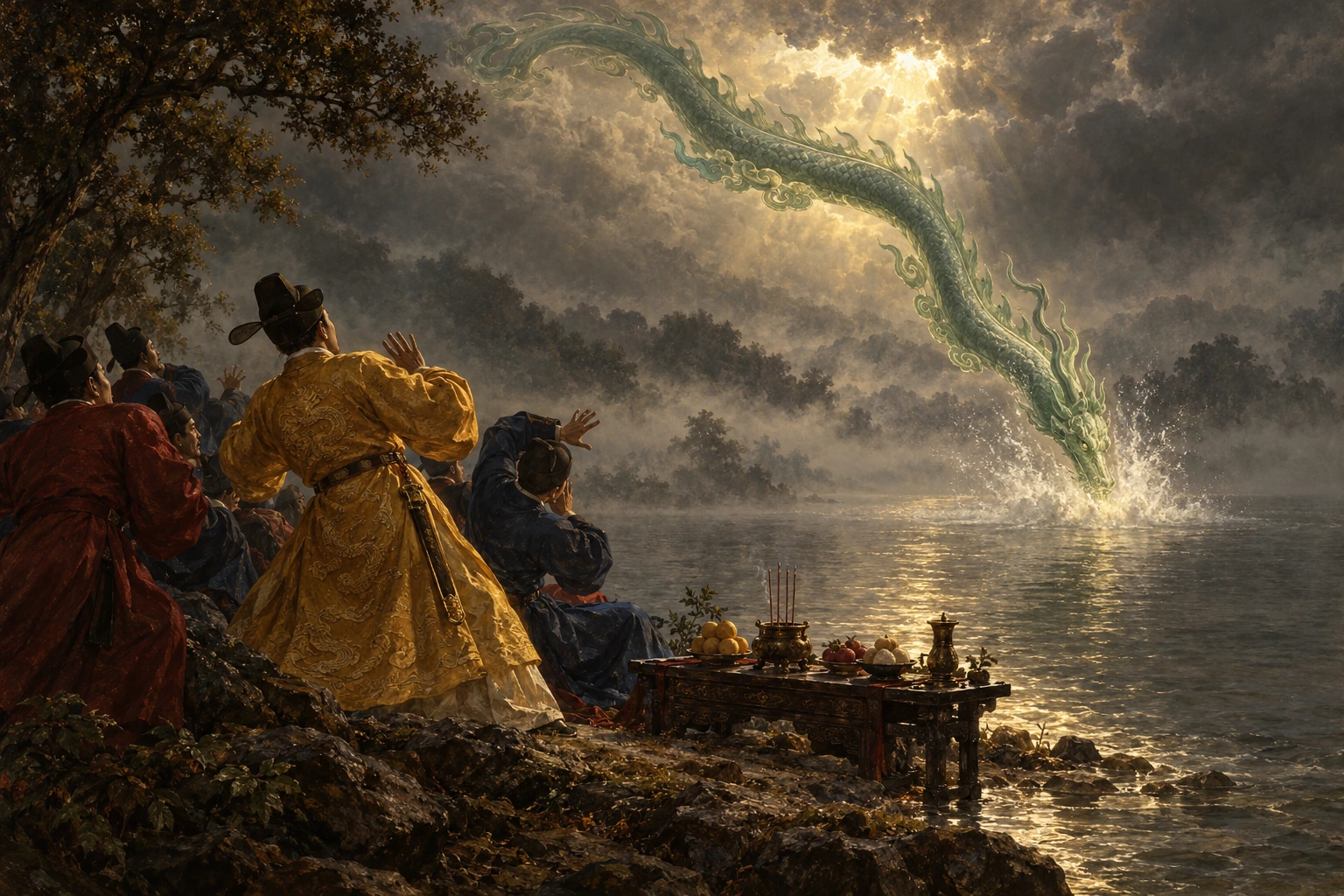
- Whose sword was it? Heaven’s in the Lam Sơn thực lục: its words “Thuận Thiên” became the name of Lê Lợi’s reign in 1428. The lake spirit’s in Dumoutier’s legend, which “had taken the form of a sword and used Lê Lợi’s arm to beat the Chinese”. The Dragon Lord’s in the school version.
- Why Tả Vọng and Hữu Vọng? The lake was once split in two, the left part (Tả Vọng) to the north and the right part (Hữu Vọng) to the south. For Nguyễn Án the line was the dyke the angry king built to drain it. A stele from the rebuilding of the Ngọc Sơn temple in the 1860s says it was a road built across the lake under the later Lê.
- A turtle, or a soft-shell? Most texts write quy, the ordinary word for a turtle. Nguyễn Án writes 黿, a giant soft-shelled turtle, the kind that really lived in the lake.
4 History and Tradition
- Lê Lợi (1385–1433) raised his rebellion at Lam Sơn in 1418. The Ming armies left in the winter of 1427–1428, and on the fifteenth day of the fourth lunar month of 1428 he took the throne at Đông Kinh, today’s Hanoi, giving his reign the name Thuận Thiên. The Lam Sơn thực lục itself names a Lê Thận among the commanders chosen to besiege Nghệ An. Whether he is the fisherman of the legend, it does not say.
- The lake’s names. Vietnam’s Department of Cultural Heritage gives Lục Thủy, “Green Water”, as an old name; we did not meet it in any old text we read. Nineteenth-century writers, Trương Vĩnh Ký and Dumoutier among them, say the lake was later used to drill the navy and so was also called Thủy Quân, “the Navy’s lake”. The southern half, Hữu Vọng, was filled in by the French from 1884. What remains, about 11.5 hectares, was ranked a special national relic in 2013.
- The Ngọc Sơn temple. A stele of 1843 by Vũ Tông Phan, translated by Dumoutier, tells its beginnings. The islet in the north of the lake, a fishing spot of the Lê kings, was given to a rich man, Tín Trai of Nhị Khê, who built a temple there to Quan Đế. After his death a society of scholars, the Hướng Thiện, took it over and rebuilt it in 1841–1842 for Văn Xương, the god of literature. Trần Hưng Đạo, who defeated the Mongols, is worshipped there too.
- The bridge, the brush and the ink slab. In the 1860s Nguyễn Như Cát, and after him the scholar Nguyễn Văn Siêu, led a rebuilding that gave the temple most of its present look. A bell inscription lists what was added: the gateway, the bridge, the ink-slab gate and the stone “brush” tower, which bears the words Tả thanh thiên, “Writing on the blue sky”. The red Thê Húc bridge has been repaired many times since; today it runs on fifteen spans of ironwood.
- The real turtles. In 2000 Hà Đình Đức described the lake’s giant soft-shell as a new species, Rafetus leloii, named after the king. Its type is the stuffed animal caught in the lake in 1967 and shown in the Ngọc Sơn temple: 2.1 metres long and 250 kilograms. Herpetologists have since shown that it cannot be told apart from Rafetus swinhoei, Swinhoe’s soft-shelled turtle, and R. leloii is treated as a synonym. The last turtle of the lake, known as Cụ Rùa, “Great-Grandfather Turtle”, was found dead on 19 January 2016. Its body was preserved and put on show in the temple in March 2019.
Tháp Rùa, the Turtle Tower, is often taken for a monument of Lê Lợi’s time. It is a 19th-century building, with pointed, Gothic-style openings. The writer Hữu Ngọc dates it to around 1886 and names its builder as Bá Kim, a minor official in the service of the French. Gustave Dumoutier, writing in 1887, already called it “barely ten years old”. Before it, the mound held a small shrine to the spirit of the lake.
5 Related Stories
- An Dương Vương and Mỵ Châu: The Magic Crossbow and the Trail of Feathers: some tellings, the Vietnamese government’s own Hanoi website among them, call the turtle of the lake Kim Quy, the Golden Turtle who in the old texts helped An Dương Vương build Cổ Loa.
- Lạc Long Quân and Âu Cơ: The Dragon, the Fairy and the Hundred Eggs: the Dragon Lord who lends the sword in the school version bears the name of the dragon ancestor of the Việt, who came whenever his people called him. The retelling does not say whether it means him.
- Thánh Gióng: The Boy Who Grew into a Giant: the other legend in which Long Quân helps drive out an invader. In the Lĩnh Nam chích quái he appears as an old man at a crossroads and tells the Hùng king to prepare, and there too the wonder leaves the land once the war is won. We have not found a scholar who compares the two legends; we link them for the theme.
6 Sources
- Nguyễn Trãi (attributed), Lam Sơn thực lục, revised edition with the preface of Hồ Sĩ Dương (1676), trans. Mạc Bảo Thần (1944; third printing, Tân Việt, 1956), book 1, book 2 and the revisers’ preface: Vietnamese Wikisource
- Ngô Sĩ Liên et al., Đại Việt sử ký toàn thư, Basic Annals, book 10 (Lê Thái Tổ): Wikisource (Classical Chinese)
- Lê Thời Tân, Nguyễn Văn Phương and Dương Văn Duyên, “Truyền thuyết ‘Hồ Hoàn Kiếm’ – một cách đọc liên văn bản”, Tạp chí Khoa học Đại học Sư phạm TP Hồ Chí Minh 16.2 (2019): 83–91, with the Chinese text of the Sơn cư tạp thuật, the Tang thương ngẫu lục and the Đại Nam nhất thống chí: journal.hcmue.edu.vn
- Trần Trọng Dương, “Huyền thoại ‘hoàn kiếm’ có từ bao giờ? (Kỳ 1)”, Tia Sáng: tiasang.com.vn
- Trương Vĩnh Ký, Chuyến đi Bắc Kỳ năm Ất Hợi (1881), “Hồ Hoàn Gươm”: Vietnamese Wikisource
- G. Dumoutier, Les pagodes de Hanoi (Hanoi, 1887), “Le lac de l’épée et la montagne de jade”, pp. 13–23: archive.org
- Huỳnh Tịnh Của, Đại Nam quấc âm tự vị, vol. 1 (1895), entry “Hồ”: Vietnamese Wikisource
- Phan Kế Bính, Nam Hải dị nhân liệt truyện, no. 5, “Lê Thái-tổ”, 5th edition (Hanoi, 1930): Vietnamese Wikisource
- “Sự tích Hồ Gươm”, school text after Nguyễn Đổng Chi, Ngữ văn 6 (Cánh Diều), as reproduced by: loigiaihay.com
- Department of Cultural Heritage (Cục Di sản văn hóa), “Di tích lịch sử và danh lam thắng cảnh hồ Hoàn Kiếm và đền Ngọc Sơn”: dsvh.gov.vn
- Vietnam Government Portal: Hữu Ngọc, “The Tortoise Stupa” (2010); “Ngọc Sơn Temple and Hoàn Kiếm Lake” (2010); “Giant turtle in Hoan Kiem Lake dies” (2016): chinhphu.vn, chinhphu.vn, chinhphu.vn
- B. Farkas, Minh Duc Le and Truong Quang Nguyen, “Rafetus vietnamensis … another invalid name for an invalid species of softshell turtle”, Russian Journal of Herpetology 18.1 (2011): 65–72: IUCN TFTSG; “Rafetus swinhoei”: The Reptile Database
- Asian Turtle Program, “The death of the Hoan Kiem Turtle” (2016) and “Sacred Hoan Kiem Turtle Preserved and Displayed to the Public” (2019): asianturtleprogram.org, asianturtleprogram.org
Cover and illustrations: AI-generated images made for Arcana. They are interpretations, not historical artworks.