Hanuman: The Monkey Who Leapt the Sea
As a child he leapt at the sun and broke his jaw; grown up, he crossed the sea in one leap to find Sita and carried a mountain of healing herbs to the battlefield. In India he is worshipped as the model celibate, but the Thai Ramakien gives him loves and sons.
- Type: epic and living cult; the monkey hero of the Rāmāyaṇa, worshipped as a god of strength and devotion
- Culture: India (Hindu tradition); retold across Southeast Asia, where the Thai Ramakien gives him a different character
- Earliest texts: Vālmīki’s Rāmāyaṇa, Books 4 to 7, composed roughly between the 2nd century BCE and the 2nd century CE; the Mahābhārata, Book 3
- Key figures: Hanuman, the wind god Vayu, his mother Anjana, Rama, Sita, Lakshmana, Sugriva, the bear Jambavan, Ravana
In Banaras, the anthropologist Joseph Alter found, you can hardly walk two hundred metres without passing a shrine of Hanuman, sometimes no more than a stone plastered with vermilion at the foot of a tree. Every Tuesday and Saturday millions of people recite forty verses to him. In the epic where he first appears, he is a monkey, the minister of a monkey king, who crossed the sea in one leap to find a stolen queen.
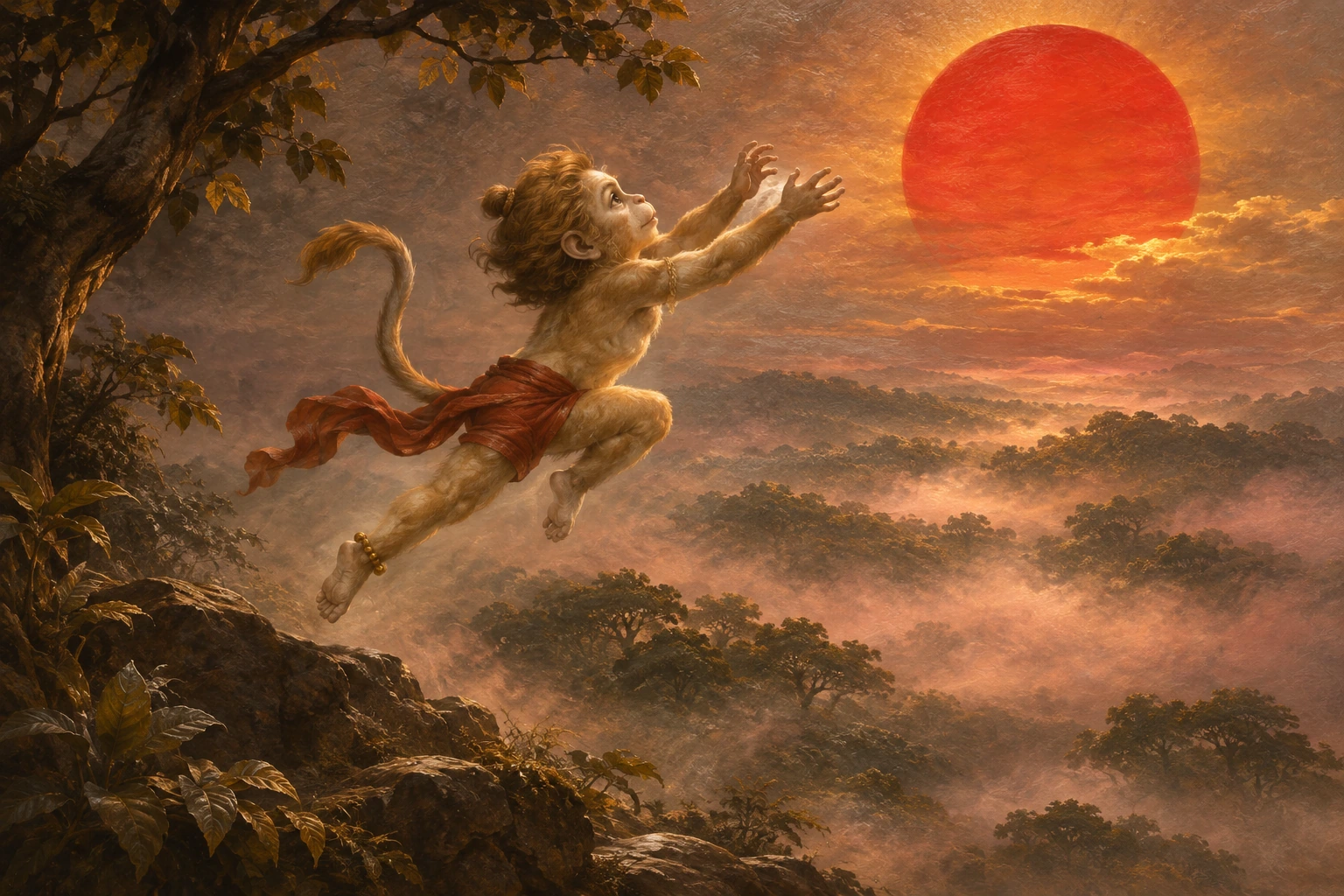
Why is he called Hanuman? Because of his jaw. Vālmīki tells how, as a child, he leapt at the rising sun, taking it for a fruit, and Indra’s thunderbolt threw him onto a mountain peak, where his left jaw, hanu, was broken: “and so you are known by the name Hanumān” (Book 4, 65.22, our translation). His English translator Ralph Griffith glossed the name as “one with a large jaw”.
1 The Telling
This follows Vālmīki’s Rāmāyaṇa in the critical edition of the Oriental Institute in Baroda; the book, chapter and verse numbers are that edition’s. Hanuman’s childhood is told twice: briefly in Book 4, by the old bear Jambavan, and at length in Book 7, by the sage Agastya.
1-1 The Wind’s Son
The monkeys sent south to look for Sita have reached the sea and lost heart. Hanuman sits apart, silent, and Jambavan tells him who he is (4.65). His mother, Anjana, was once Puñjikasthalā, the finest of the apsarases, the nymphs of heaven. A curse made her a monkey who could take any shape, and she became the wife of the monkey Kesari. One day, as she stood on a mountain top in human form, the Wind, Vayu, lifted her garment and embraced her. She protested that she was faithful to one husband. “I do not harm you,” the Wind replied: he had entered her only in his mind, and she would bear a son, strong and wise. So Hanuman was Kesari’s son by law, Jambavan says, and the Wind’s son by birth.
As a child he saw the sun rise over the great forest, took it for a fruit and leapt up to seize it. He had flown three hundred yojanas, scorched by its heat, when Indra hurled his thunderbolt, and Hanuman fell onto a mountain peak with his jaw broken. Seeing his son struck down, the Wind stopped blowing through the three worlds until the gods begged him to relent. Brahmā then promised that no weapon would kill the child in battle, and Indra that he would die only when he chose.
Book 7 (7.35–36) tells it at greater length. Anjana had gone to gather fruit, and the hungry baby was crying when he saw the sun, red as a hibiscus flower. The Wind flew beside him, cool as snow, so that the sun would not burn him, and the sun spared him, seeing that he was a child. That same day the demon Rāhu came to seize the sun and found someone else had got there first. He complained to Indra, who rode out on his elephant Airāvata. The child took the elephant for another fruit and ran at it, and Indra struck him. This time the Wind stood still inside every living body, and no creature could breathe until Brahmā brought the child back to life. The gods each gave him a boon, and Indra gave him his name: because his jaw (hanu) was struck by the thunderbolt, he would be Hanumān.
The young monkey grew so strong that he plagued the hermitages, breaking the sages’ ladles and sacrificial vessels. The sages cursed him: for a long time he would not know his own strength. That, Agastya tells Rama, is why Hanuman never used it when his friend Sugriva was hunted by his brother Vali.
1-2 A Hundred Yojanas
Hanuman had first met Rama disguised as a wandering mendicant, sent by Sugriva to find out who the two armed strangers were (4.3). Now Jambavan urged him on, “Rise, tiger among monkeys, leap over the great ocean” (4.65.34, our translation), and he swelled to an enormous size.
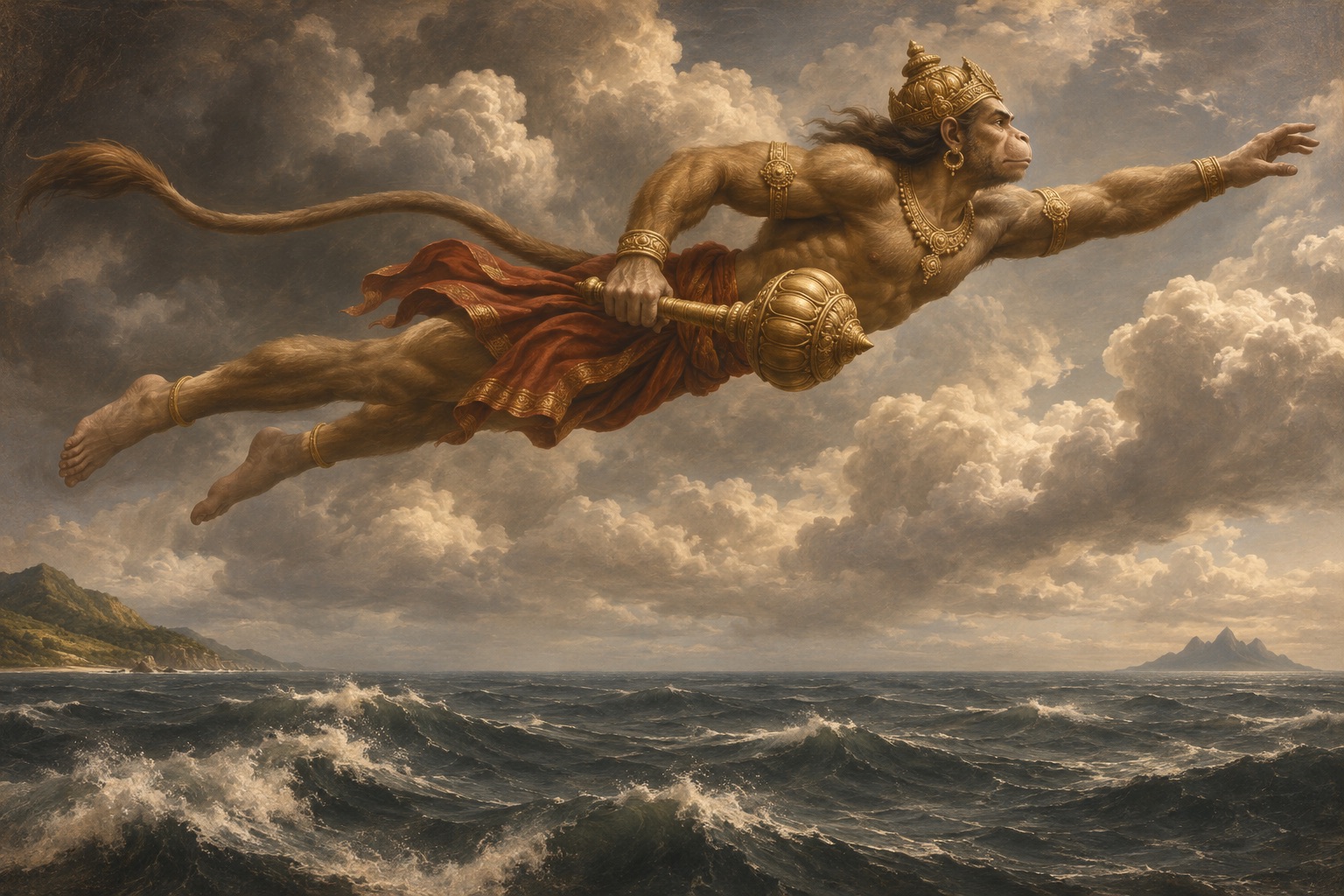
The leap fills the first chapter of Book 5, the Sundara Kāṇḍa. At 190 verses, as the scholar Philip Lutgendorf points out, it is the longest chapter of the epic. Hanuman pressed down on Mount Mahendra until it shook the flowers from its trees, and launched himself south. Three trials met him over the water (5.1):
- Mainaka. The Ocean called the golden mountain Mainaka up from the waves to give him a place to rest. Hanuman took it for an obstacle and knocked it aside with his chest. The mountain explained: in the first age mountains had wings, until Indra cut them off with his thunderbolt, and it was the Wind who had blown Mainaka into the sea and saved his wings. So he owed the Wind’s son a welcome. Hanuman touched him with his hand and flew on.
- Surasa. The gods asked Surasa, the mother of serpents, to test him. In a demon’s shape she barred his way: no one could pass without entering her mouth. He grew ten yojanas tall, and she opened her mouth twenty; he grew to ninety, and she opened it a hundred. Then he shrank to the size of a thumb, darted in and out again, and bowed: “I have entered your mouth, daughter of Daksha.”
- Simhika. A demoness rose from the sea and caught hold of his shadow, and he felt himself dragged back like a ship against the wind. He let her open her mouth, dived in, tore at her vitals with his nails and flew out, and she fell dead.
After a hundred yojanas he came down on Mount Lamba, shrank back to his ordinary size so as not to draw the demons’ notice, and looked at Lanka.
1-3 The Ring in the Grove
By night he searched the city, even the sleeping women of Ravana’s palace. Looking at other men’s wives troubled him, the poet says, as a breach of dharma; but his mind had not been stirred, and a lost woman can only be looked for among women (5.9.34–42).
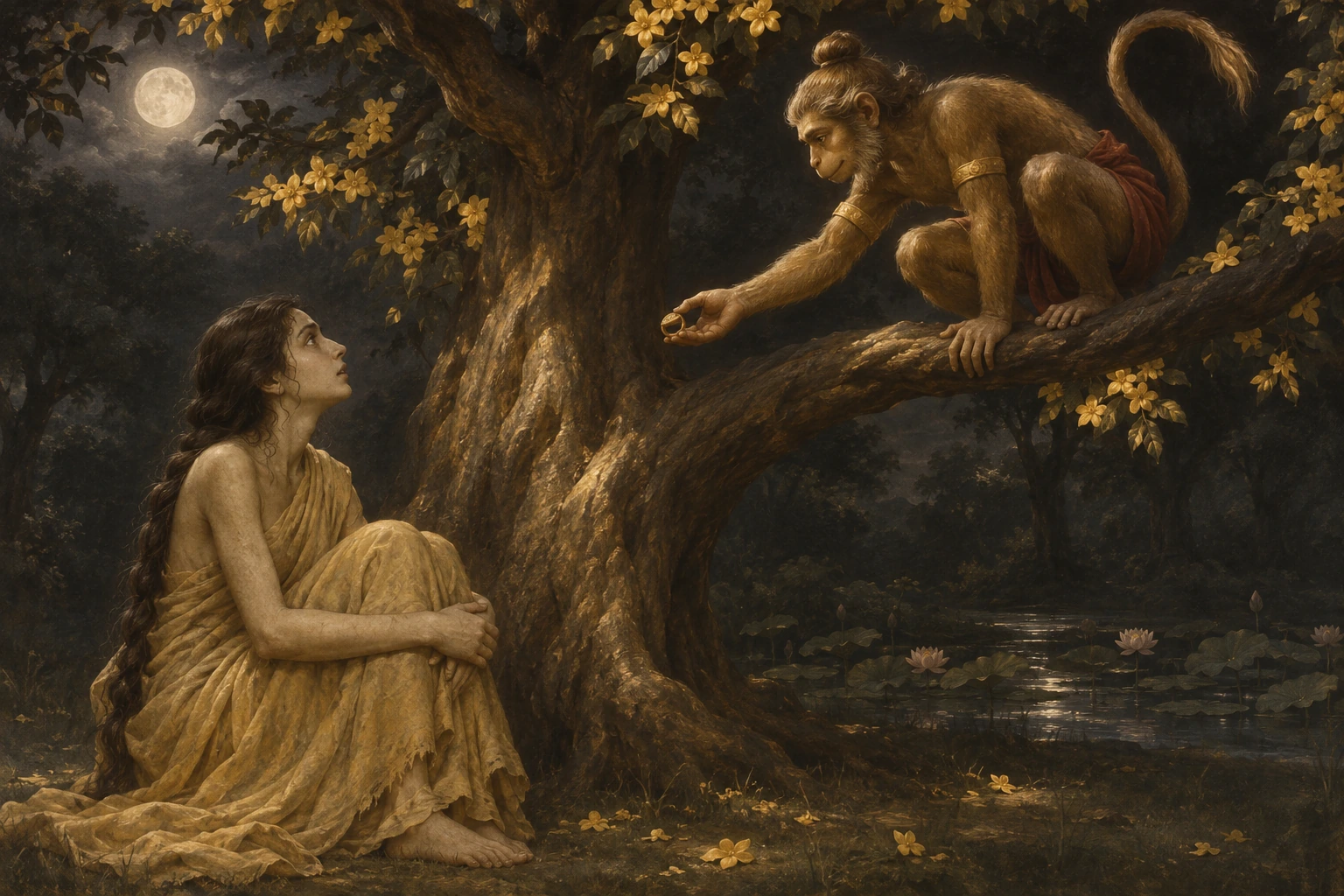
At last, in the Ashoka grove, he climbed a golden śiṃśapā tree and saw Sita below, thin and grieving among her guards. He watched Ravana come and give her two months to yield (5.20.8). Then he wondered how to speak to her. If he talked Sanskrit “like a twice-born”, she would take him for Ravana in disguise and be frightened; he must use plain human speech (5.28.17–19). So, from among the branches, he softly told her Rama’s story. When she trusted him, he gave her Rama’s ring, engraved with Rama’s name, and she was as glad as if her husband himself had come (5.34).
He offered to carry her home on his back. She refused. Out of loyalty to her husband, she said, she would not willingly touch the body of any man but Rama; Ravana had touched her only by force; and it was for Rama himself to come and take her (5.35). She gave Hanuman the jewel from her hair to take back as a token (5.36).
1-4 Lanka on Fire
Before leaving, Hanuman wrecked the grove and killed the warriors sent against him, Ravana’s young son Aksha among them. Ravana’s eldest son, Indrajit, bound him with Brahmā’s own weapon, and Hanuman let himself be bound out of respect for Brahmā (5.46). Brought before Ravana, he spoke as Rama’s envoy. Ravana wanted him killed, but his brother Vibhishana reminded him that envoys are never put to death (5.50).
A monkey’s tail is his favourite ornament, said Ravana, so set it on fire (5.51). The demons wrapped it in old cotton rags, soaked it in oil, lit it and led him through the streets, and he let them, to see the city by daylight. When Sita heard, she prayed to the god of fire: “If I am faithful to one husband, be cool for Hanuman.” The flames blazed but did not hurt him. He leapt from roof to roof, set Lanka burning, and put out his tail in the sea. Then he was seized by fear that Sita had burned with the city, until he found her alive (5.52–54).
1-5 The Mountain of Herbs
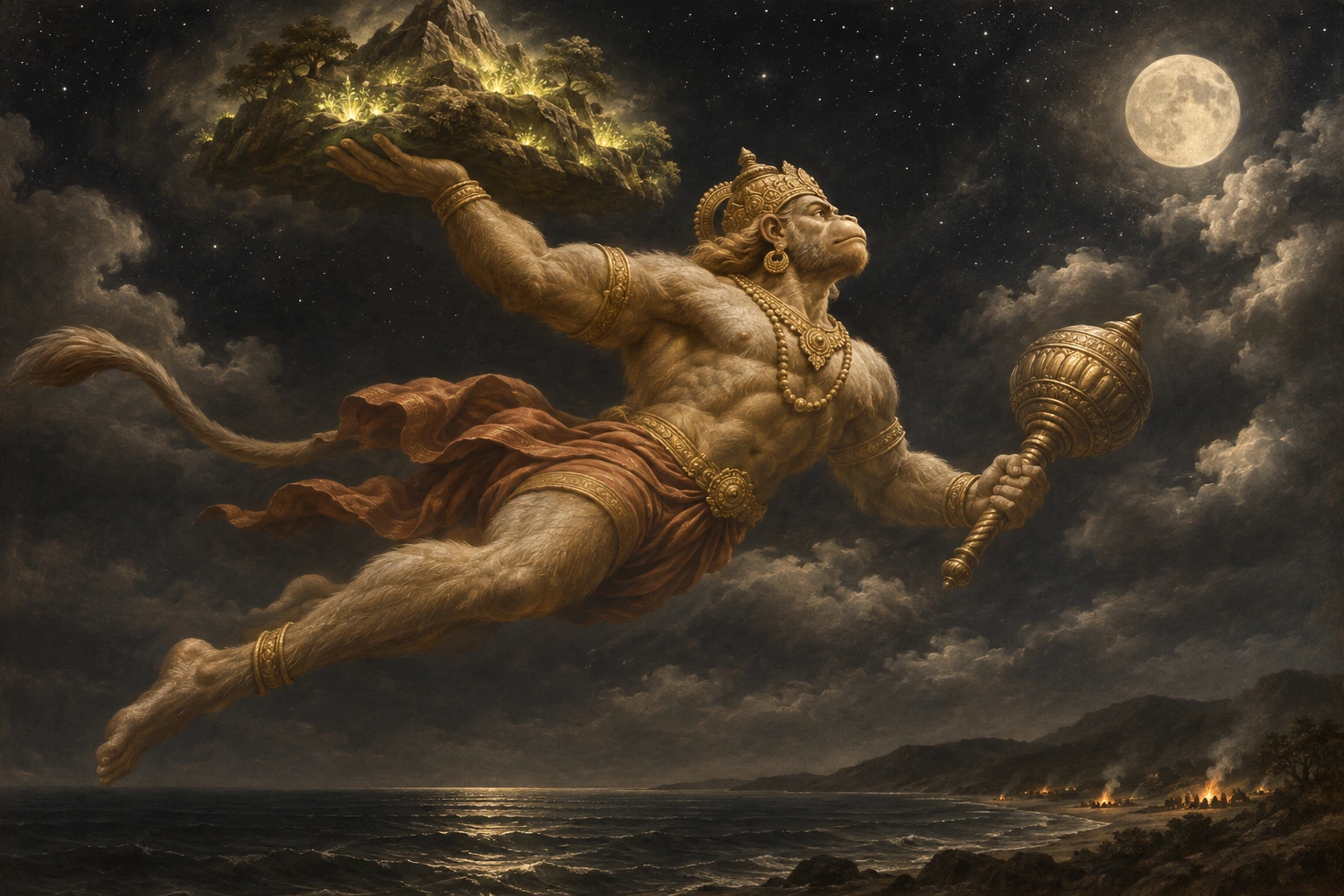
Vālmīki has Hanuman fetch the healing mountain twice. The first time (6.61), Indrajit’s arrows had laid low Rama, Lakshmana and much of the army. Searching the field by torchlight, Vibhishana found Jambavan so wounded he could not see. The old bear’s first question was whether Hanuman was alive, because if he lived the army lived. He sent Hanuman to the Himalaya, to a mountain between the golden Rishabha peak and Kailasa, where four herbs glowed: one to bring back the dead, one to draw out arrows, one to restore the body’s colour and one to knit it together. When Hanuman arrived, the herbs hid themselves. In anger he tore off the whole peak and flew back with it along the path of the sun. At the smell of the herbs Rama and Lakshmana rose, free of their arrows, and so did the fallen monkeys. Then he carried the mountain back to its place.
The second time (6.89), Lakshmana lay struck by Ravana’s spear. The monkey physician Sushena sent Hanuman to the same mountain. Not knowing which plants were the herbs, he brought the summit, and Sushena crushed a herb, held it to Lakshmana’s nose, and Lakshmana stood up.
When the war was over, Hanuman asked Rama for one thing: to live as long as he could hear Rama’s story told on earth. “As long as my story goes about the worlds,” Rama answered, “so long will life stay in your body” (7.39.16–19).
2 Where the Story Is Written Down
- Vālmīki’s Rāmāyaṇa. Kathleen Erndl dates it roughly from the 2nd century BCE to the 2nd century CE. Hanuman acts in Books 4 to 6. Some scholars, A. K. Ramanujan notes, take the first and last books, where Rama appears clearly as a god, for later additions, and Book 7 is where Hanuman’s childhood is told in full. Ralph Griffith, who put the epic into English verse in 1870–1874, called Book 7 “merely an appendix or a supplement” and only summarised it. His translation follows the popular text, not the critical edition, and numbers the chapters differently: Jambavan’s speech is his Book 4, canto 66, the ring Book 5, canto 36, the herbs Book 6, cantos 74 and 102. In Japanese it can be read in Nakamura Ryōshō’s Shin’yaku Rāmāyaṇa (Heibonsha, Tōyō Bunko, seven volumes), which follows the popular Bombay edition.
- The Mahābhārata, Book 3 (critical edition 3.146–150). Bhima, who is also a son of the Wind, goes looking for flowers for Draupadi and finds an old monkey lying on a rock across his path. The monkey asks him to move his tail aside, and Bhima cannot lift it even with both arms. It is Hanuman, his brother, who promises that in the coming war he will swell Bhima’s roar and cry out from the banner of Arjuna.
- Tulsidas’s Rāmcaritmānas, the Rama epic in Awadhi, a form of Hindi. Tulsidas began it in Ayodhya on Rama’s birthday in the year 1631 of the Vikrama era, that is 1574 CE by Lutgendorf’s reckoning (F. S. Growse’s introduction converts the same year to 1575). Book 5, “The Beautiful”, belongs to Hanuman, as in Vālmīki. In Book 6 Tulsidas tells the herb journey only once, with new episodes. Ravana’s son Meghnad (Indrajit) strikes Lakshmana with his spear; Hanuman fetches the physician Sushena from Lanka “house and all”; the demon Kalanemi waits on the road disguised as a hermit; and as Hanuman flies over Ayodhya with the mountain, Rama’s brother Bharata takes him for a demon and brings him down with a headless arrow. He reaches the camp, says the translation of F. S. Growse, “like an heroic strain in the midst of an elegy”.
- The Hanumān Cālīsā, “forty verses”, is signed in its last verse with Tulsidas’s name. Lutgendorf writes that popular belief, “backed up by a signature line, universally attributes” it to Tulsidas. It opens with a couplet from the Rāmcaritmānas, but the rest “suggests a rather inelegant approximation of Tulsidas’s style”. Authentic or not, he adds, its verses are among the best-known lines attributed to the poet. A complete Japanese translation by Sakamoto Aoi appeared in 2014.
3 Competing Versions
- Where was he born? The critical text of Book 4 names no place. The popular text, in Griffith’s translation, has him born “in a cave beneath the earth”. In Book 7 his father Kesari rules on Mount Sumeru.
- Why did he not know his strength? Book 4 gives no reason; Book 7 blames the sages’ curse.
- One journey for the herbs, or two? Vālmīki has two, first for the whole army, then for Lakshmana; Tulsidas has one, for Lakshmana. The popular text of Vālmīki names the second mountain Mahodaya. The critical text says only that it is the herb mountain Jambavan described.
- Who wounded Lakshmana, and who healed him? In Vālmīki, Ravana’s spear, and the monkey Sushena. In Tulsidas, Meghnad’s spear, and Sushena, a physician of Lanka.
- The Thai Hanuman. The Ramakien was compiled under King Rama I of Bangkok, in 1797 as Baker dates it. Rama I also had its scenes painted along the galleries of his royal temple, Wat Phra Kaew. In the Ramakien, Baker writes, Hanuman “overshadows Rama” and is “a great womaniser with an impressive string of conquests”. The verses written for the murals under a later king, Rama V, tell how Thotsakan (Ravana) sent his daughter Suvannamaccha, a woman with a fish’s tail, to carry off the stones of Rama’s causeway with her fish. Hanuman caught her, and their son Macchanu, born on a beach, was brought up by Thotsakan’s kinsman, the demon Maiyarap. Hanuman met his son when he broke through Maiyarap’s defences to rescue Rama, and Rama later cut off the boy’s fish tail. Another son, Asurapat, was born to Hanuman and Thotsakan’s niece Benyakai, whom Thotsakan had once sent floating down the river disguised as Sita’s corpse. Southeast Asia is not of one mind, though: in the Burmese court drama Thiri Rama, Baker notes, Hanuman “has no romantic dalliances at all”.
- The Monkey King. That China’s Sun Wukong was modelled on Hanuman is a hypothesis put forward by Hu Shi in 1923; our post on Sun Wukong tells the debate.
4 History and Tradition
- Tuesdays and Saturdays. These are, in Lutgendorf’s words, “the two weekdays regarded as especially suitable for worshiping Ram’s ideal devotee”, and also “dangerous” days, linked to harmful planets. Students crowd his temples before their exams.
- The wrestlers’ god. Every wrestling ground in Banaras has at least one shrine of Hanuman, Alter found, and wrestlers model themselves on his strength, his devotion and his celibacy, brahmacharya. Celibacy, Alter notes, “is not often mentioned with regard to Hanuman’s epic role”, yet it is “a requisite condition for both his strength and his devotion”.
- Sankat Mochan, “the Liberator from Distress”. In the south of Banaras, this temple’s stone image of Hanuman is believed to date from Tulsidas’s time. A legend first recorded by Priyadas about 1713 says the poet met Hanuman there, disguised as an old leper who came first to his recitations and left last.
- Hanuman Jayanti, his birthday, falls on the full moon of the month of Chaitra, in March or April. At Sankat Mochan, Lutgendorf saw him “serenaded until dawn” with the singing of the Rāmāyaṇa. It is still widely believed, he writes, that Hanuman is present, “albeit usually disguised”, at every recitation of the Rāmcaritmānas, as Rama promised in Book 7.
“Hanuman is celibate in every telling” is a common belief. In north Indian worship he is indeed the model celibate, and women are traditionally not supposed to touch his temple images. But in the epic itself, as Alter notes, celibacy “is not often mentioned with regard to Hanuman’s epic role”. The Indian tale of the underworld demon Ahiravana gives him a son, Makardhvaja, “sired through a drop of sweat which fell into the ocean and was swallowed by a female fish”, as Lutgendorf sums it up, and the Thai Ramakien gives him two sons by two different mothers.
5 Related Stories
- Rama and Sita: The Exile, the Abduction and the Many Rāmāyaṇas: the whole epic around Hanuman’s part in it: the exile, Sita’s abduction, the alliance with Sugriva, the war in Lanka and the return to Ayodhya, and the many tellings beyond Vālmīki’s.
- Kurukshetra: The War of the Mahābhārata: the war in which Hanuman promised Bhima, his brother by the Wind, to cry out from Arjuna’s banner.
- Sun Wukong: The Monkey King Who Fought Heaven: in 1923 Hu Shi suggested that Hanuman was “perhaps the shadow behind the Great Sage”. Lu Xun pointed to a Chinese monkey instead, and the question is still open.
- The Churning of the Ocean: Gods, Demons and the Nectar of Immortality: the demon Rāhu, who loses his head at the churning and goes on swallowing the sun and moon, is the one the baby Hanuman beats to the sun in Book 7.
6 Sources
- Vālmīki, Rāmāyaṇa, critical edition (Oriental Institute, Baroda), 4.3, 4.65, 5.1, 5.9, 5.12, 5.20, 5.28–29, 5.34–36, 5.46, 5.50–54, 6.61, 6.88–89, 7.35–36, 7.39: GRETIL, GRETIL, GRETIL, GRETIL
- Ralph T. H. Griffith (trans.), The Rámáyan of Válmíki (Trübner, London, 1870–1874), Book 4, canto 66; Book 5, cantos 1, 36 and 54; Book 6, cantos 74 and 102; the appendix on the Uttarakáṇḍa: Project Gutenberg
- Mahābhārata, critical edition, 3.146–150: GRETIL
- Tulsidas, The Rámáyana of Tulsi Dás, trans. F. S. Growse (6th edition, Allahabad, 1914), Book 6, dohas 53–58: archive.org
- Philip Lutgendorf, The Life of a Text: Performing the Rāmcaritmānas of Tulsidas (University of California Press, 1991), pp. 8, 11–12, 47–50, 100 and 161: UC Press E-Books Collection
- Philip Lutgendorf, “Like Mother, Like Son: Sita and Hanuman”, Manushi 114 (1999), pp. 22–35: manushi.in
- Joseph S. Alter, The Wrestler’s Body: Identity and Ideology in North India (University of California Press, 1992), chapter 8: UC Press E-Books Collection
- Paula Richman (ed.), Many Rāmāyaṇas (University of California Press, 1991): A. K. Ramanujan, “Three Hundred Rāmāyaṇas”, pp. 32 and 38–39; Frank E. Reynolds, “Rāmāyaṇa, Rāma Jātaka, and Ramakien”, pp. 56–58; Kathleen M. Erndl, “The Mutilation of Śūrpaṇakhā”, p. 68: UC Press E-Books Collection
- Nakamura Ryōshō (trans.), Shin’yaku Rāmāyaṇa, seven volumes (Heibonsha, Tōyō Bunko): CiNii Books
- Chris Baker, review of The Thiri Rama, ed. Dawn F. Rooney, Journal of the Siam Society 108, part 1 (2020), pp. 200–203: ThaiJO
- The khlong verses for the Ramakien murals of Wat Phra Kaew, rooms 44–48, 54, 125 and 156: Thai Wikisource; Tomita Takejirō, “ラーマキエン”, Kaitei shinban Sekai daihyakka jiten: Kotobank
- Sakamoto Aoi, “Translation of the Hanumān Cālīsā” (in Japanese), Indo minzoku kenkyū 13 (2014), pp. 35–41: Osaka University Knowledge Archive
Cover and illustrations: AI-generated images made for Arcana. They are interpretations, not historical artworks.