The Red Dragon: The Dragon on the Welsh Flag
Under a hill in Snowdonia, says a Latin history written in 829 or 830, a red dragon and a white one fought until the red drove the white away, and a boy explained that they were the Britons and the English. The dragon then became a king's standard, a royal badge and, only in 1959, the official flag of Wales.
- Type: legend, two dragons under a hill, and the history of a national emblem
- Culture: Welsh; the Britons of early medieval Wales
- Earliest texts: the Latin Historia Brittonum, written in 829 or 830, probably in Gwynedd (chapters 40–42); Geoffrey of Monmouth’s History of the Kings of Britain, 1136; the Welsh tale Lludd and Llefelys, complete only in the Red Book of Hergest, around 1400
- Key figures: King Vortigern, the boy Ambrosius (Emrys), Lludd son of Beli and his brother Llefelys, Merlin (in Geoffrey), Henry VII
Of the nations of the United Kingdom, Wales is the one whose flag carries no saint’s cross: it flies a red dragon on white and green. The oldest explanation for the dragon is a story. A king tries to build a fortress in the mountains of Snowdonia, his wise men tell him to kill a boy who has no father, and the boy shows him instead what lies under the hill: a pool, and two dragons asleep in it, one red and one white.
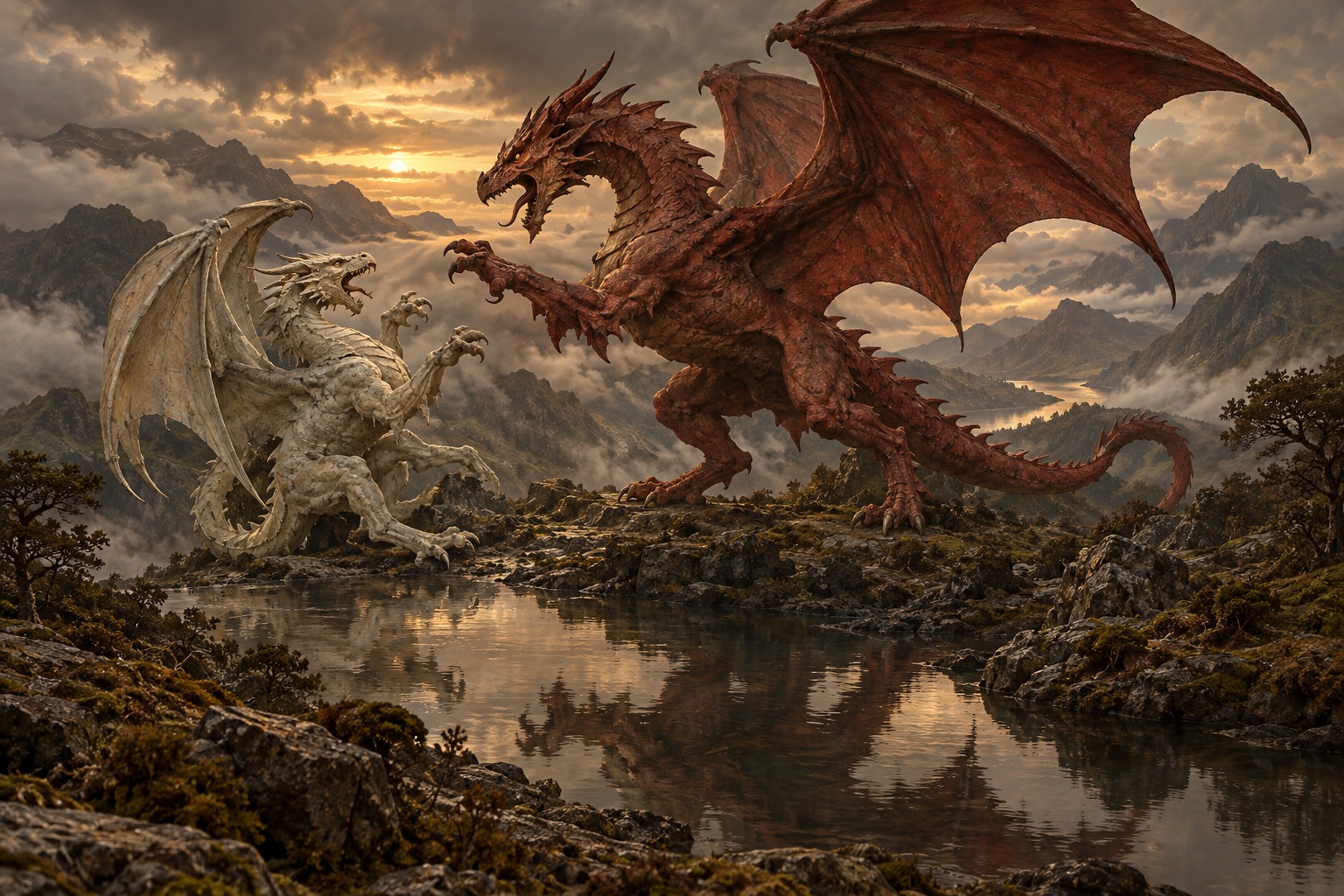
Which dragon wins? The red one, in the oldest telling. In the Historia Brittonum the red dragon looks the weaker at first, then grows stronger and drives the white one out. The red, the boy tells the king, is “your dragon”; the white belongs to the people who hold Britain “almost from sea to sea”, and “our people shall rise and drive away the Saxon race”. Geoffrey of Monmouth, three centuries later, lets the white win the first round, and his boy begins his prophecy with “Woe to the red dragon”.
1 The Telling
This is the version of the Historia Brittonum, chapters 40–42, in the Latin text edited by Theodor Mommsen. Quotations follow J. A. Giles’s English translation of 1848; Giles does not always match Mommsen’s Latin, and where they part, the translation is our own from the Latin.
1-1 The Fortress That Would Not Stand
King Vortigern, Guorthigirn in the Latin, had taken Saxon warriors into his kingdom. His wise men, the magi, warned him that this people envied him: they would kill him by treachery and, after his death, take all the lands he loved. He must go to the far edges of his kingdom and find a fortress to defend himself.
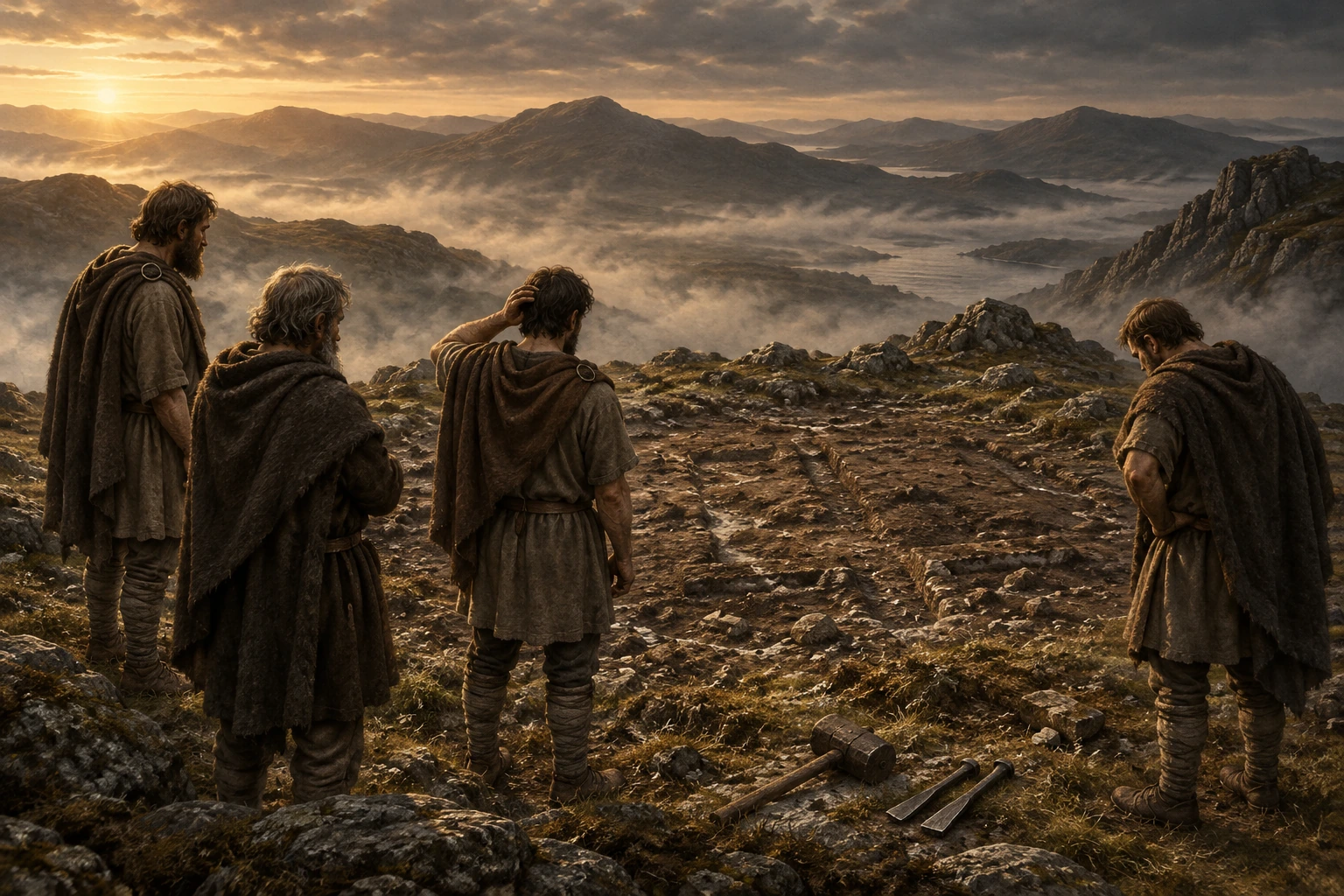
So the king and his magi went through many regions and provinces without finding one, until they came to Guined, Gwynedd, in the north-west. In the mountains of Eryri, Snowdonia, they found at last a place fit for a fortress. “Build it here,” said the magi, “for it will be safe from the barbarian peoples for ever.”
The king gathered stonemasons, timber and stone. When everything was ready, it was all carried off in a single night. Three times he had the materials gathered, and three times they vanished. The magi gave him their answer: unless he found a child without a father, killed him and sprinkled the fortress with his blood, it would never be built.
1-2 The Boy Without a Father
The king’s messengers searched all of Britain. In the field of Elleti, in a region the text calls Gleguissing, they found boys playing ball, and two of them quarrelling. “O man without a father,” one shouted at the other, “you will come to no good.” The messengers questioned the boys, and then the boy’s mother. “How he was conceived in my womb I do not know,” she said, “but one thing I know: I have never known a man.” She swore that he had no father, and they took him to the king.
1-3 What Lay Under the Floor
The next day an assembly met to have the boy killed. “Why have your servants brought me hither?” he asked. “That you may be put to death,” replied the king, “and that the ground on which my citadel is to stand, may be sprinkled with your blood.” “Who instructed you to do this?” “My wise men.”
The boy had them called and questioned them, and then asked what lay under the floor of the place. They did not know. “There is a pool,” he said; “come and dig.” They dug, and found it. What was in the pool? The magi were silent. “Two vessels,” said the boy, and so it was. And in the vessels? A tent, and they found a folded tent. And in the tent? “Two worms, one white and one red. Unfold the tent.” The Latin word is vermes, worms or serpents. They unfolded it and found the two asleep.
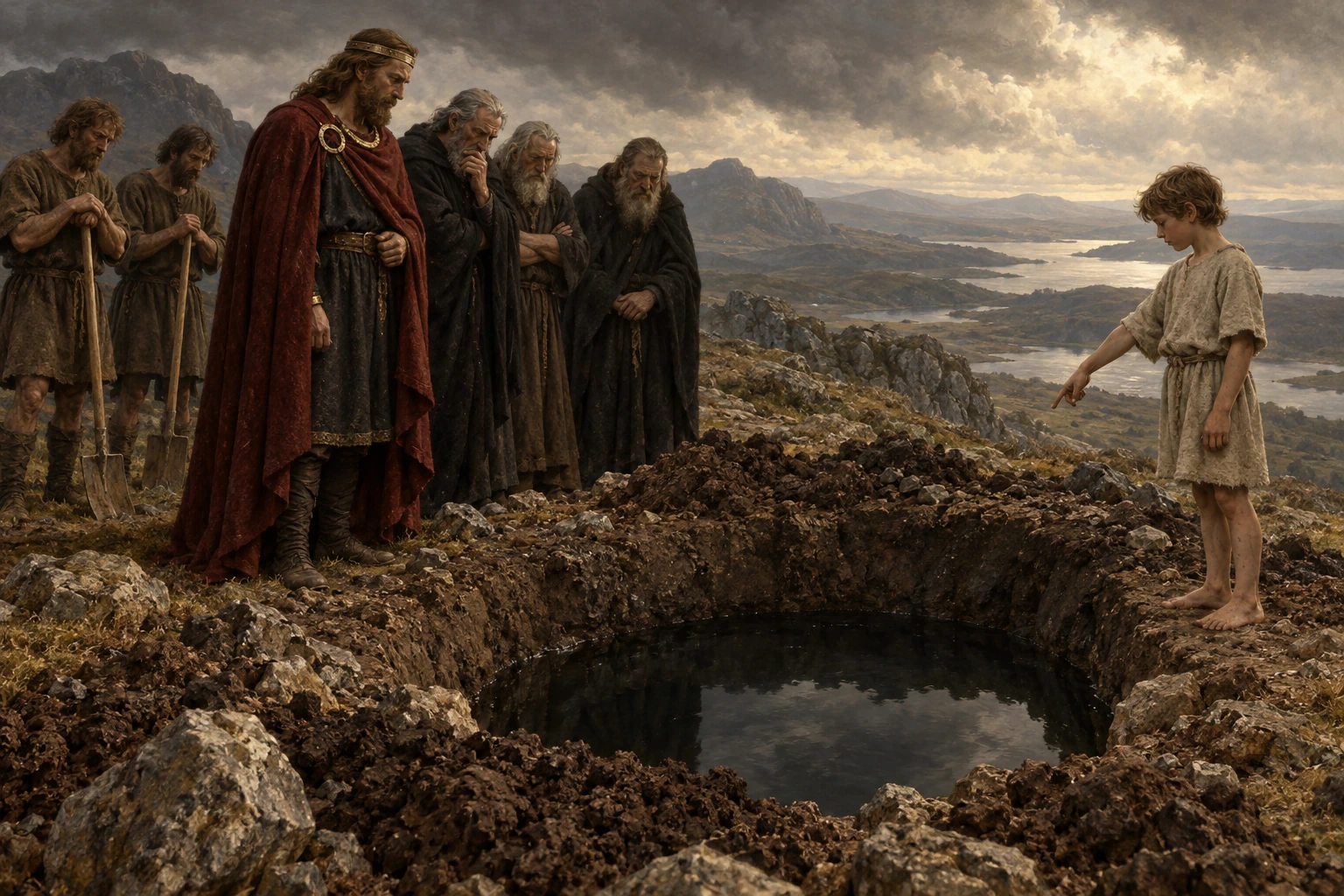
“Watch what the worms will do,” said the boy. They began to fight, each trying to drive the other out. One set his shoulders against the other and pushed him to the middle of the tent, and three times they did so. The red one seemed the weaker, but at last it grew stronger than the white and drove it out over the edge of the tent. Then one chased the other across the pool, and they were gone.
1-4 Your Dragon
The magi could not say what the sign meant, so the boy told the king: “The pool is the emblem of this world, and the tent that of your kingdom: the two serpents are two dragons; the red serpent is your dragon, but the white serpent is the dragon of the people who occupy several provinces and districts of Britain, even almost from sea to sea: at length, however, our people shall rise and drive away the Saxon race from beyond the sea.” The Latin names that race outright: gentem Anglorum, the nation of the English.
The king must leave, the boy said, for he could never build there; “I shall remain here.” Asked his name, he answered: “I am called Ambrose (in British Embresguletic).” Emrys, as the Welsh texts write it, is the Welsh form of Ambrosius. Asked about his family, the boy who had no father said: “A Roman consul was my father.” The king gave him the fortress and all the western provinces of Britain, and went away with his magi to build another city, named after himself, Cair Guorthigirn.
1-5 How the Dragons Got There
The Historia Brittonum never says who put the dragons under the hill. A Welsh tale, Lludd and Llefelys, does. It is told here from the Red Book of Hergest, quoting Lady Charlotte Guest’s translation, or our own from the Middle Welsh where noted.
Lludd son of Beli the Great was king of the Island of Britain. He rebuilt London, which was named after him Caer Lludd, and he helped his brother Llefelys marry the heiress of France and, with her, win that kingdom. Then three plagues (gormes) fell on Britain. The first was a people called the Coraniaid, who heard every word the wind met. The second was “a shriek which came on every May-eve, over every hearth in the Island of Britain”: men lost their colour and their strength, women lost their unborn children, the young lost their senses, and animals, trees, earth and waters were left barren. The third: however much food was laid up in the king’s courts, it all vanished in a single night.
Lludd sailed to France to ask his brother’s advice. They spoke through a long brass horn, so that the wind would not carry their words to the Coraniaid. The second plague, said Llefelys, “behold it is a dragon. And another dragon of a foreign race is fighting with it, and striving to overcome it. And therefore does your dragon make a fearful outcry.”
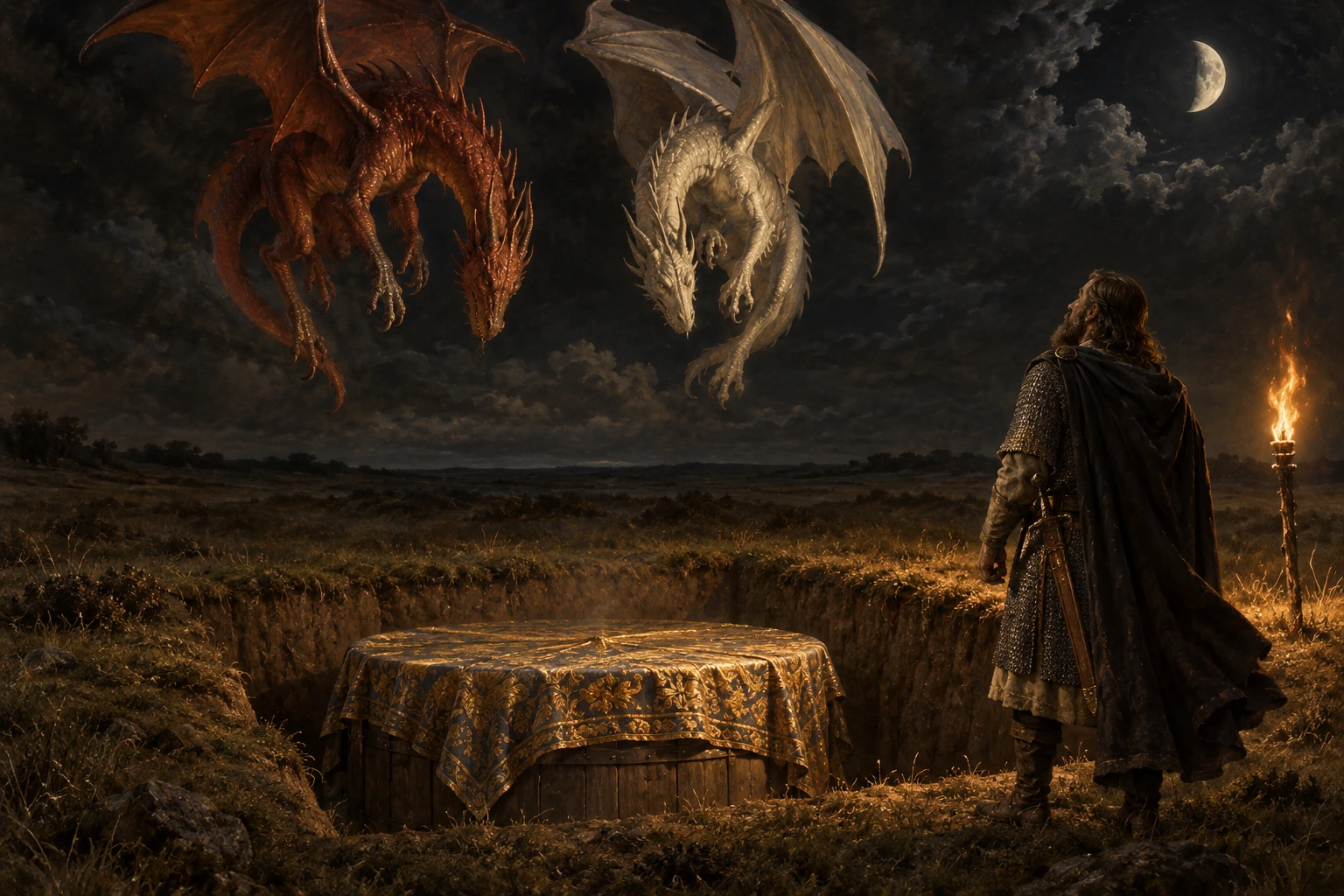
Lludd had the island measured in length and breadth, and found its exact centre at Oxford. There he had a pit dug and a vat of the best mead set in it, covered with a sheet of brocade (Guest: “satin”), and he kept watch through the night. The dragons fought, as Llefelys had said they would, in the shapes of monstrous beasts and then as dragons in the air; when they were weary they fell, in the shape of two pigs, onto the cloth, dragged it to the bottom of the vat, drank the mead and slept. Lludd wrapped them in the cloth and hid them in a stone chest “in the safest place he could find in Eryri”. “That place was called afterwards Dinas Emrys,” the Welsh text goes on, “and before that Dinas Ffaraon Dandde” (our translation). And the scream stopped. The third plague, a giant magician with a hamper, Lludd fought and made his vassal.
The Welsh Triads, short lists of three in the same Red Book, close the circle. The “three fortunate concealments of the Island of Britain” are the head of Bendigeidfran buried in London, “the dragons in Dinas Emrys, which Lludd son of Beli hid”, and the bones of Gwerthefyr in the island’s chief ports. While they lay hidden, says the triad, “no Saxon oppression would ever come to this island”. Uncovered, they became the three unfortunate disclosures, and it was Vortigern who uncovered the dragons (our translation).
2 Where the Story Is Written Down
- Historia Brittonum, “the History of the Britons”, a Latin compilation of British history. Chapter 16 counts the years “to the fourth year of king Mermenus”, Merfyn of Gwynedd, which places it in 829 or 830, probably in his kingdom. It survives in several recensions. The oldest full text, British Library Harley 3859 (11th century), carries no title and no author’s name; one recension credits the work to Gildas, another, with a prologue, to Nennius. The Dictionary of Welsh Biography calls Nennius its “traditional author”; the historian Michelle Ziegler writes that the text is “most conservatively considered to be anonymous and without a title”.
- Geoffrey of Monmouth, History of the Kings of Britain (Historia Regum Britanniae), which appeared at the beginning of 1136. Geoffrey retold the tower scene (book VI, chapters 17–19) and put the boy’s prophecy in a book of its own, the Prophecies of Merlin (book VII). That part had already circulated on its own: Orderic Vitalis quoted it in 1135.
- Lludd and Llefelys (Cyfranc Lludd a Llefelys), a Middle Welsh prose tale. It is complete in the Red Book of Hergest (Oxford, Jesus College 111, around 1400), just before the Four Branches of the Mabinogi. The White Book of Rhydderch (National Library of Wales, Peniarth 4, around 1350) keeps only its opening: the leaves that followed are lost. Lady Charlotte Guest translated it from the Red Book with ten other tales; her first translation appeared in 1838, and the collected Mabinogion in 1849.
- The Welsh Triads (Trioedd Ynys Prydein), in the Red Book of Hergest, columns 590–591 for the concealments and disclosures.
3 Competing Versions
- Who was the boy?
- In the Historia Brittonum he is Ambrosius, and claims a Roman consul for a father.
- In Geoffrey he is “Merlin, who was also called Ambrose”. The messengers find him at Kaermerdin, Carmarthen, quarrelling with a boy called Dabutius. His mother, a daughter of the king of Dimetia (Dyfed) living among nuns, says a beautiful young man used to visit her and left her with child, and the sage Maugantius explains, citing Apuleius, that spirits called incubi take human shape and lie with women (VI.17–18).
- In Geoffrey, Aurelius Ambrosius is another man altogether: a prince who comes back from Brittany and burns Vortigern in a tower (VIII.1–2).
- What was under the hill? The Historia Brittonum: a pool, two vessels, a folded tent, two “worms”. Geoffrey: a pond, and at its bottom “two hollow stones, and in them two dragons asleep”; once the pond is drained they come out and “cast forth fire with their breath” (VII.3). Lludd and Llefelys: a stone chest, the dragons wrapped in brocade.
- Who wins? In the Historia Brittonum, the red, after looking the weaker. In Geoffrey the white first drives the red “to the end of the lake”, then the red returns and forces it back. Merlin bursts into tears and foretells that the red, “the British nation”, will be oppressed by the white, “the Saxons whom you invited over”, until “at last the oppressed shall prevail”.
- Red and white? Lludd and Llefelys never gives the colours: there is only “your dragon” and “a dragon of a foreign race”.
- Where? The Historia Brittonum names only the mountains of Eryri in Gwynedd, Geoffrey only “Mount Erir”. The name Dinas Emrys, “the fort of Emrys”, comes from Lludd and Llefelys and the Triads.
4 History and Tradition
- Dinas Emrys. A rocky hill at the southern end of the Nant Gwynant valley, near Beddgelert, ringed by the ruins of a stone-walled fort. Coflein, the online record of the Royal Commission on the Ancient and Historical Monuments of Wales, calls it “traditionally the site where Vortigern attempted to build a fortress”. It was excavated in 1910 and again in 1954–56. Coflein reports Iron Age, Roman and early medieval occupation; Cadw, which protects it, notes that “the dating of the remains is not conclusive”. Below the summit a pool can still be made out, “a marshy area, overgrown with rushes”. The stone keep on top is medieval, probably one of a few stone castles built in Gwynedd at the end of the 12th century.
- Dragons in poetry. The dragon as an emblem was probably brought to Britain by the Roman legions, says Amgueddfa Cymru – Museum Wales, and medieval Welsh poets often called their leaders dragons: Gruffudd ab yr Ynad Coch said of Llywelyn ap Gruffudd, pen dragon, pen draig oedd arnaw, “a dragon’s head he had”. In Geoffrey, Uther sees a star with a fiery dragon, has two golden dragons made, gives one to the cathedral of Winchester and carries the other to war, and is called Uther Pendragon, “the dragon’s head” (VIII.14–17).
- Cadwaladr. A king of Gwynedd who died, says the Dictionary of Welsh Biography, in the great pestilence of 664. His reign was “uneventful”, yet he became “a great figure in later bardic lore”, and poets foretold that he would return to lead the Britons against the Saxons. Geoffrey ends his history with him: an angel tells Cadwaladr that the Britons will win back the island once his relics are brought home from Rome (XII.17).
- Henry VII. Henry Tudor claimed descent from Cadwaladr “in the twenty second degree”. Edward Hall’s chronicle of 1548 says people commonly believed that Cadwaladr’s line had been promised the kingdom again, and that Henry was the promise kept. After his victory at Bosworth in 1485, Henry rode through London to St Paul’s and offered his three standards: St George; “a red fiery dragon beaten upon white and green sarcenet”, a fine silk; and a dun cow on yellow cloth (Hall, in modern spelling). The Dictionary of Welsh Biography calls the second “the red dragon of Cadwaladr”.
- From royal badge to flag. The dragon stayed in the royal arms through the Tudor reigns, 1485 to 1603, until James I replaced it with a unicorn. It came back in 1807 as the royal badge for Wales. On 11 March 1953 an Order in Council augmented the badge: the dragon on a shield of white and green, in a ring bearing the motto Y Ddraig Goch Ddyry Cychwyn, “the red dragon gives the lead”, under a crown. In February 1959 the Queen directed that “only the Red Dragon on a green and white flag” should fly on government buildings in Wales; Museum Wales says the Gorsedd of the Bards had suggested it.
- Not on the Union Flag. The Union Flag joined the crosses of St George and St Andrew in 1606 and added the saltire of St Patrick in 1801; nothing in it stands for Wales. In 1967 Gwynfor Evans asked the Secretary of State for Wales to fly the dragon alone on government buildings, since the Union flag “symbolises England, Scotland and Ireland but not Wales”. The answer was “No”: the Union flag was “the flag of the constitutional entity of which Wales is a part”.
“The red dragon has been the flag of Wales since ancient times” is often said. The story is old: the red dragon is already the Britons’ dragon in a Latin history of 829 or 830. But there it is a creature in a prophecy, not a flag, and the reign of Cadwaladr, whose dragon it was later called, was by the Dictionary of Welsh Biography’s account “uneventful”: his fame, and the dragon’s name, came later. The white and green behind it were Tudor colours, on Henry VII’s standard of 1485. The dragon became the royal badge for Wales in 1807, and the flag as it flies today was officially recognized in 1959, after a 1953 version with a crown and a motto.
5 Related Stories
- The Mabinogi: The Four Branches: Lludd and Llefelys comes down to us in the same two manuscripts as the Four Branches, and Guest put it in her Mabinogion. The triad that counts Lludd’s dragons among the three fortunate concealments counts the head of Bendigeidfran as another, and the end of the second branch tells how it was buried.
- The Tuatha Dé Danann: The Gods Who Went into the Hills: in 1888 the Celticist John Rhŷs took Lludd Llaw Ereint, “Lludd of the Silver Hand”, to be the Welsh counterpart of the Irish king Nuada, whose lost arm was replaced with one of silver.
- An Dương Vương and Mỵ Châu: The Magic Crossbow and the Trail of Feathers: another king whose citadel kept collapsing, until a golden turtle told him what spirits were at work and the mountain beside it was dug open. We have not found a scholar who compares the two stories; we link them for the theme.
6 Sources
- Historia Brittonum, chapters 16 and 40–42, Latin text ed. Theodor Mommsen: The Latin Library; trans. J. A. Giles, Six Old English Chronicles (Bohn, 1848): Internet Medieval Sourcebook, Project Gutenberg
- Geoffrey of Monmouth, History of the Kings of Britain, VI.17–19, VII.1–3, VIII.1–2, VIII.14–17 and XII.17–18, trans. Aaron Thompson, revised by J. A. Giles, in Old English Chronicles (Bell, 1906): Project Gutenberg
- Lludd and Llefelys and the Triads, Middle Welsh text of the Red Book of Hergest (Oxford, Jesus College 111), columns 590–591 and 705–710, and of the White Book of Rhydderch (NLW Peniarth 4), columns 191–192, with manuscript descriptions, Welsh Prose 1300–1425, Cardiff University: Red Book p. 144v, p. 174v, p. 175r, White Book p. 48v, Peniarth 4 description
- The Mabinogion, trans. Lady Charlotte Guest, “Lludd and Llevelys” and “Branwen the Daughter of Llyr”: Project Gutenberg
- Edward Hall, The Union of the Two Noble and Illustre Families of Lancastre and Yorke (1548), Hall’s Chronicle (London, 1809), p. 423: archive.org
- Dictionary of Welsh Biography: W. H. Davies, “Nennius”; I. Ll. Foster, “Geoffrey of Monmouth”; J. E. Lloyd, “Cadwaladr”; “Guest, Lady Charlotte Elizabeth”: biography.wales, biography.wales, biography.wales, biography.wales
- Michelle Ziegler, “Through His Enemy’s Eyes: St. Oswald in the Historia Brittonum”, The Heroic Age 9 (2006): jemne.org
- John Rhŷs, Lectures on the Origin and Growth of Religion as Illustrated by Celtic Heathendom (Hibbert Lectures, 1888), lecture II: archive.org
- Cadw, “Dinas Emrys Camp” (CN018); Coflein, RCAHMW, “Dinas Emrys” (NPRN 95284): Cadw, coflein.gov.uk
- Amgueddfa Cymru – Museum Wales, “National emblems (FAQ)”: museum.wales
- The London Gazette, 13 March 1953, issue 39798, p. 1437: thegazette.co.uk; Hansard, HC Deb 23 February 1959 vol. 600 cc. 121–2W and HC Deb 11 December 1967 vol. 756 c. 65W: api.parliament.uk, api.parliament.uk
- The Flag Institute, “History of the Union Flag” and “Flag of Wales: a blood-red dragon on a field of green”: flaginstitute.org, flaginstitute.org
Cover and illustrations: AI-generated images made for Arcana. They are interpretations, not historical artworks.