Oisín and Tír na nÓg: The Land of Youth
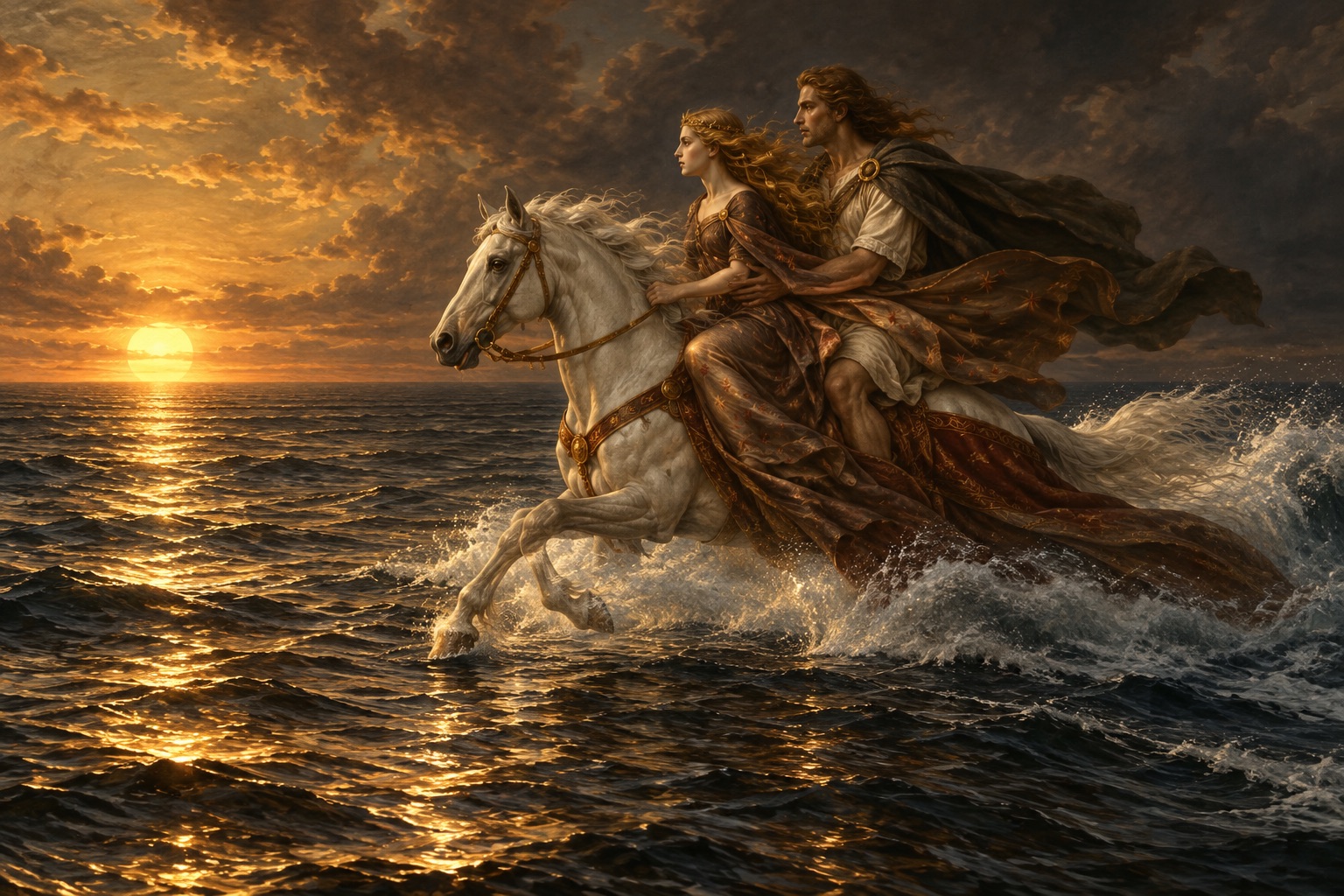
A woman on a white horse carries Oisín over the sea to the Land of Youth, and when he comes home three hundred years later and touches the ground, he is old and blind. The poem that tells the journey was written in County Clare around 1750, but the old man who tells it to St Patrick is centuries older.
- Type: legend, a hero’s stay in the otherworld and his return to a changed world
- Culture: Gaelic Ireland, the Fenian cycle; the same ballads were sung in Gaelic Scotland
- Earliest texts: Oisín outliving the Fianna to meet St Patrick: Acallam na Senórach (The Colloquy of the Ancients), 12th century, and the lays of the Duanaire Finn, copied in 1626–27; the journey to Tír na nÓg: Mícheál Coimín’s Laoi Oisín ar Thír na nÓg (The Lay of Oisín in the Land of Youth), about 1750, first printed in 1859
- Key figures: Oisín, Niamh Chinn Óir (“of the golden head”), the King of Tír na nÓg, Fionn mac Cumhaill, Caílte, St Patrick
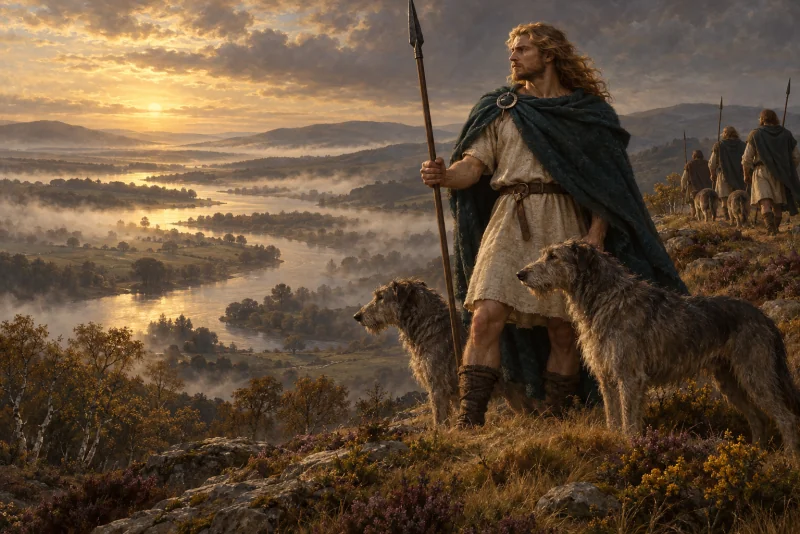
In Irish tradition Oisín, son of Fionn mac Cumhaill, outlived the Fianna by centuries, long enough to tell their deeds to St Patrick. The medieval texts barely say how. The answer most people know, a woman on a white horse who took him over the sea to Tír na nÓg, the Land of Youth, comes from a poem written in County Clare around 1750. About ten years later, in Scotland, James Macpherson turned the same old man into “Ossian”, the blind bard of a Highland epic, and all of Europe read him.
Did the three hundred years feel like three? Not in the poem that tells the journey. In Mícheál Coimín’s lay Oisín says only that he spent “three hundred years and more” in the Land of Youth. The three short years come from later tellings: in P. W. Joyce’s retelling “it appeared to me that only three years had passed”, and in a folk tale printed by Jeremiah Curtin in 1890 Oisín guesses “About three years”, and his wife answers: “It is three hundred years”.
1 The Telling
This is Mícheál Coimín’s lay, as Bryan O’Looney edited it for the Ossianic Society in 1859; quotations follow O’Looney’s literal translation. The poem is a dialogue. St Patrick asks Oisín how he lived after the Fianna were gone, and Oisín answers.
1-1 The Rider at Loch Léin
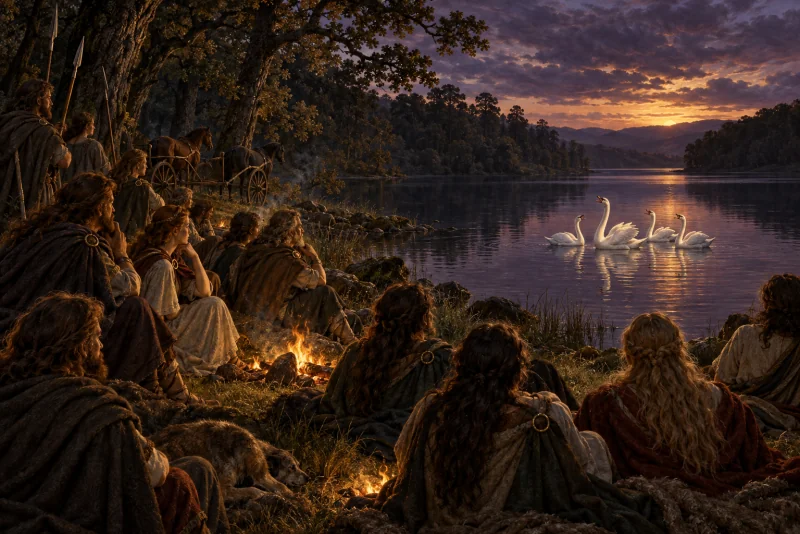
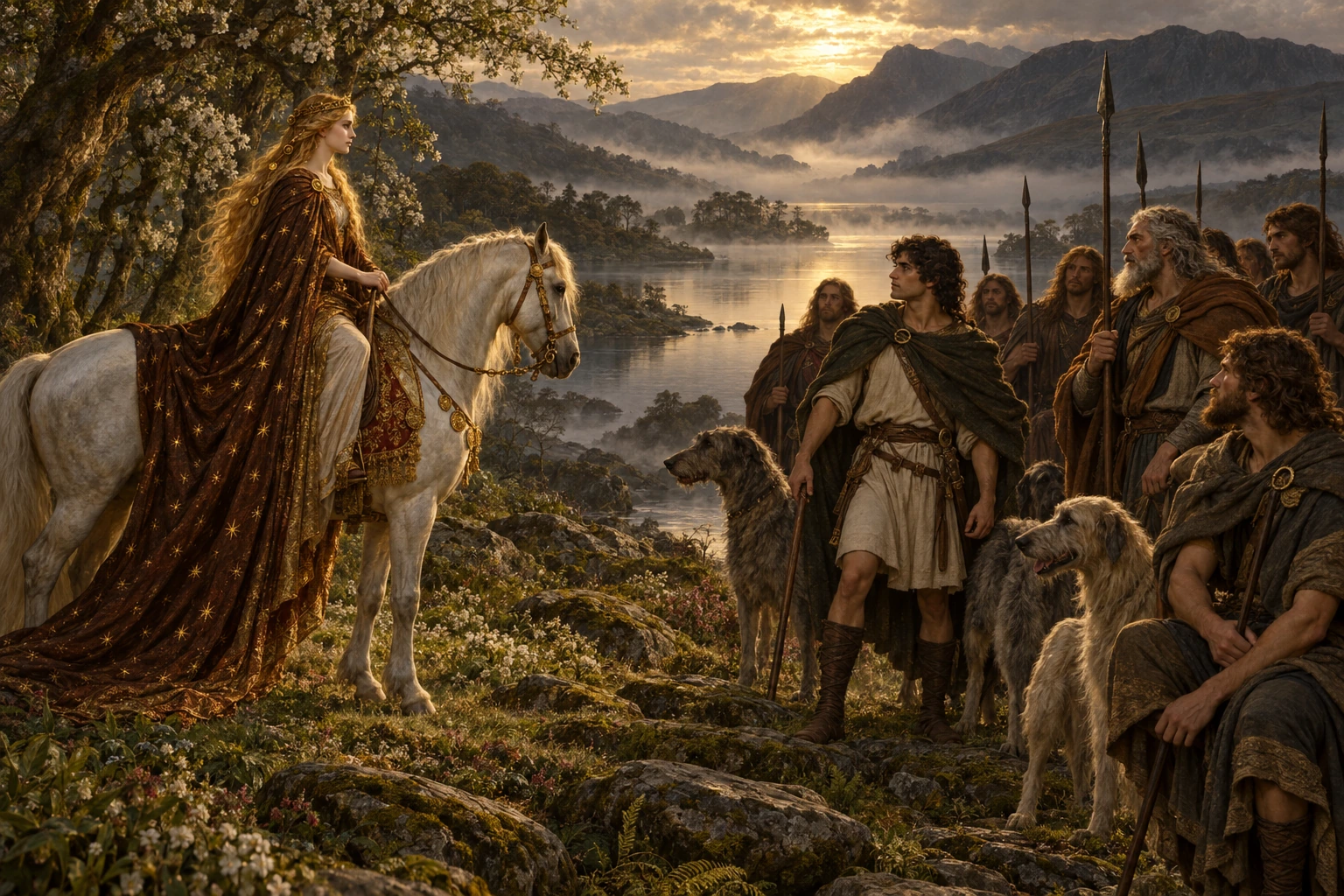
After the battle of Gabhra, where Oisín’s son Oscar fell, the Fianna who were left went hunting on a misty morning by Loch Léin, the lakes of Killarney. Out of the west came a young woman on a slender white horse. She wore a royal crown and a brown mantle of silk “spangled with stars of red gold”, a gold ring hung from every curl of her hair, and her horse had a saddle of red gold and a golden bit. The hunt stopped.
“Golden-headed Niamh is my name,” she told Fionn, “I am the fair daughter of the King of Youth.” Many sons of kings had loved her, she said, and she had refused them all; she had come for Oisín, for what she had heard of his prowess and his looks. Oisín took her hand and said she was his choice “beyond the women of the world”.
1-2 The Promise
Then she laid on him “obligations unresisted by true heroes”, the bonds no hero may refuse, to ride with her to Tír na nÓg. She described the land: trees bowed with fruit and blossom, honey and wine, a hundred swords and a hundred horses, the crown of the King of Youth. “Death or decay thou wilt not see.” Oisín said he would go.
They rode down to the shore. When the horse set its face to the tide, the Fianna raised three shouts of grief, and Fionn wept until his tears wet his breast. Oisín, telling it, begins to remember the old days of hunting and feasting, and Patrick cuts him short: “O! foolish Oisin, forego a while / Thy great actions of the Fenians” and tell how you went.
1-3 Over the Sea
They rode due west. “The smooth sea ebbed before us, / And filled in billows after us.” They passed cities and castles, a hornless fawn chased by a white hound with red ears, and a young woman on a brown horse who rode over the waves with a golden apple in her right hand, followed by a young rider on a white horse. Niamh told Oisín to pay no heed.
At a fortress they found the daughter of the King of the Land of Life, held captive by Fomhor Builleach, “the striking Giant”; she had bound him not to make her his wife until a champion fought him hand to hand. Oisín fought him for three nights and three days and cut off his head; the princess healed his wounds with balsam, and Oisín buried the giant and wrote his name in ogham. O’Looney noted that this “Land of Virtues” appeared in no other copy he had seen.
1-4 Three Hundred Years
After a storm they saw a country in full bloom and a fortress of every colour. Three fifties of champions and a hundred young women came out to meet them, and then the King of Youth in a golden crown: “Long and durable is your life, / And thou thyself shalt be ever young.” The feast lasted ten nights and ten days, and Oisín married Niamh. They had two sons, whom Niamh named Fionn and Oscar, and a daughter he named Plúr na mBan, “the flower of women”.
He stayed “three hundred years and more”, until he longed to see Fionn and the Fianna. Niamh let him go on the white horse and warned him three times: if he set foot on level ground he would never come back; if he got down from the horse he would never come back; and if he did, “thou wilt be an old man, withered, and blind”. Ireland, she said, “'Tis not now as it has been; / And thou never shalt see Fionn of the hosts.” Then she tore the hair of her golden head.
1-5 The Stone in the Glen of the Thrushes
In Ireland a troop of riders marvelled at the size of him. They had heard of Fionn, they said, from the many books of “the sages of the Gaels”, and that Fionn had a son who went away with a young woman to the Land of Youth. Oisín rode to Almhain in Leinster, Fionn’s own fort, and found nothing there “But weeds, chick-weeds, and nettles”.
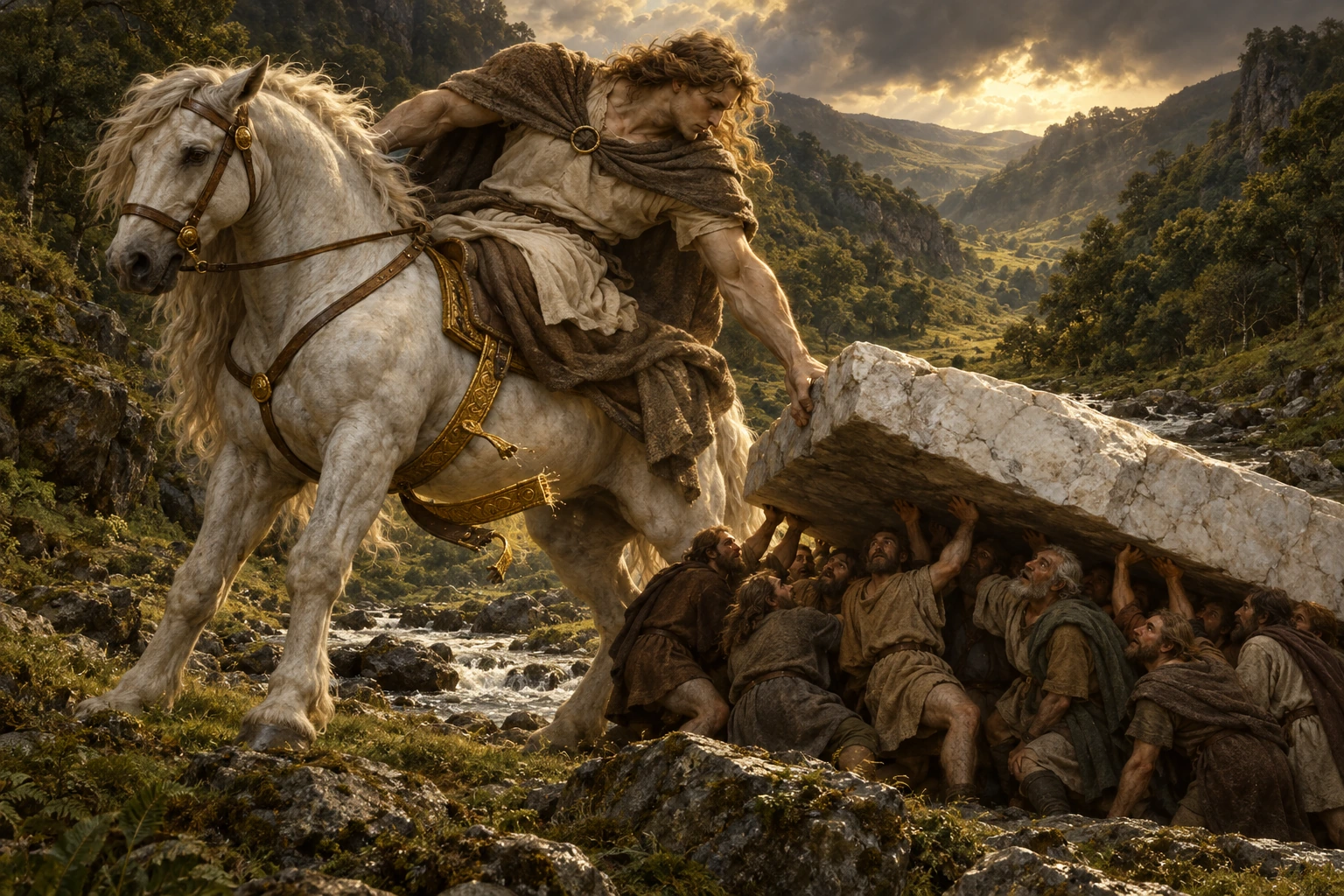
In Gleann na Smól, the glen of the thrushes, he found more than three hundred men under a great slab of marble that they could not hold up; the men beneath were being crushed. If Oscar were alive, Oisín said, he would take it in his right hand and fling it over their heads. He leaned down on his right breast, took the slab in his hand and threw it seven perches. The golden girth broke, and he came down “On the soles of my two feet on the lea”. The white horse took fright and was gone. “I lost the sight of my eyes”, and he was “an old man, poor and blind”.
1-6 Oisín and Patrick
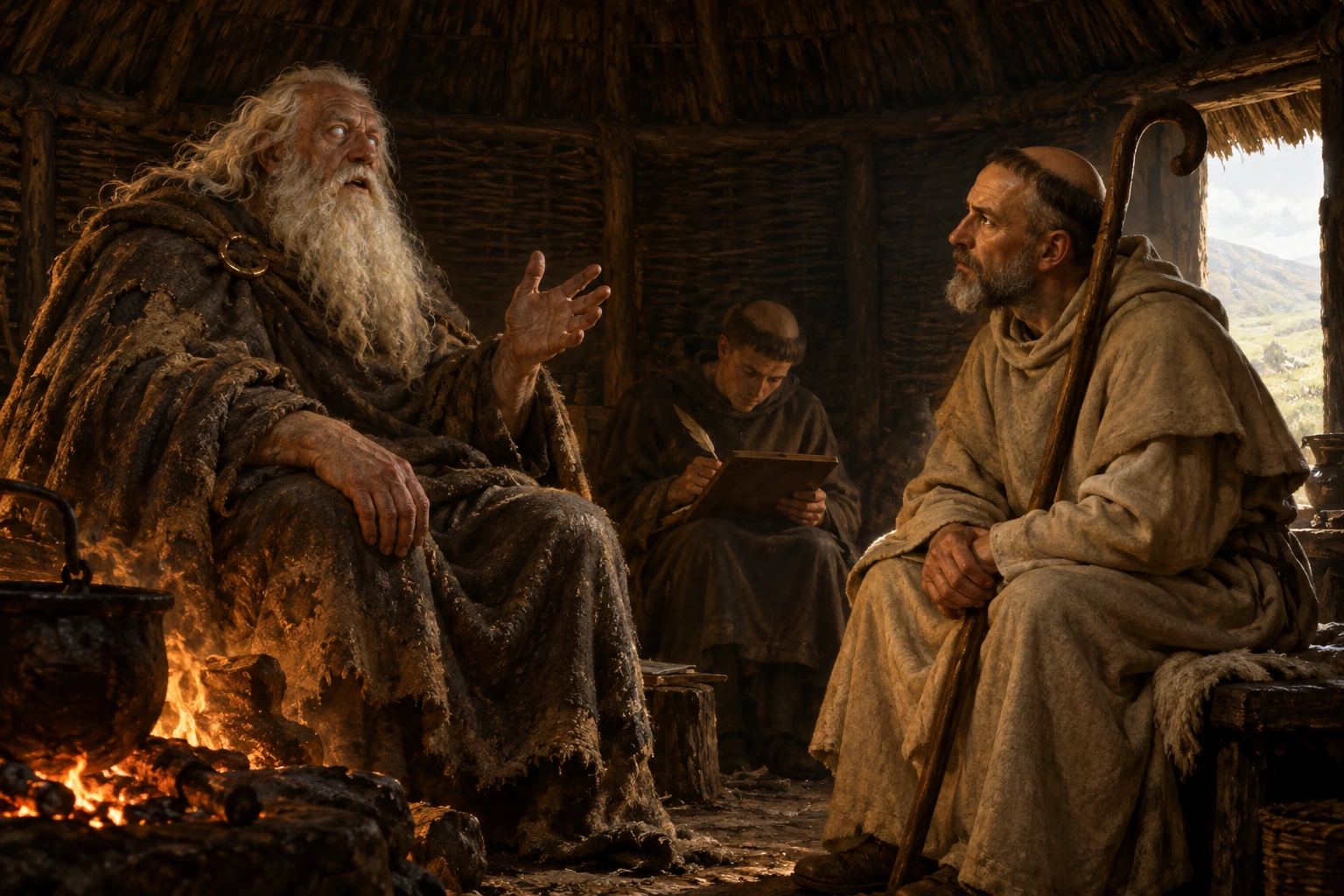
Between the episodes the old man and the saint argue. Fionn and all the Fianna, says Patrick, are condemned to hell: “It is God who gained victory over Fionn”. Oisín answers that if Oscar is there, there is no host “in hell, or in the Heaven of God” he would not destroy. If he were still what he had been, he says, he would put Patrick’s clerics to death; given bread as Fionn used to give it, he would pray for Patrick. Patrick promises him bread and drink, and asks him to go on. The poem ends: “Patrick! there is to thee my story”.
2 Where the Story Is Written Down
- Acallam na Senórach (The Colloquy of the Ancients), a long work of prose and verse dated by CELT to 1100–1200. It survives in manuscripts of the 15th century and later, among them Laud 610 in Oxford (1453–54) and the Book of Lismore, made for Fínghin Mac Carthaigh Riabhach (died 1505), and in a second recension in the Franciscan manuscripts. After the battles of Comar, Gabhra and Ollarba, only Oisín and Caílte are left, with men enough to make eighteen in all. They part: Oisín goes to the síd, the fairy mound, of Ucht Cleitig, where his mother Blái, daughter of Derc, lives, and Caílte walks south to Patrick. Patrick’s clerics fear the tall men, “for they were not people of one epoch or of one time with the clergy”. “Who or what was it that maintained you so in your life?” Patrick asks; Caílte answers: “truth that was in our hearts, and strength in our arms, and fulfilment in our tongues”. Two angels tell Patrick to have the stories written down, “for to the companies and nobles of the latter time to give ear to these stories will be for a pastime”. Oisín appears later at Tara. There is no Tír na nÓg and no white horse.
- The Duanaire Finn (The Poem-book of Fionn), copied at Louvain in 1626–27 by Niall Gruamdha Ó Catháin and Aodh Ó Dochartaigh for Captain Somhairle Mac Domhnaill, an Irish soldier abroad; its index lists sixty-eight poems, and the same manuscript holds a copy of the Acallam. In “The Bathing of Oisín’s Head”, the old man asks a woman to wash his head, “long since it parted with the Fian of Finn”; his eyes were “thin pearly gems” once, and now “I cannot see”. It ends: “Patrick’s baptism is better for me than the deceitful bathing of women”.
- The lay of the Land of Youth, by Mícheál Coimín (Michael Comyn), a poet of County Clare who died in 1760. O’Looney dated it “about the year A.D. 1749” and gave his reasons: its style matches Coimín’s prose romance of Torolbh son of Starn; a man he knew called it “Comyn’s Lay”, and his father had it from Comyn’s manuscript; another copy was written in 1762 at Ruan in County Clare. It was copied by hand and recited for more than a century, spreading, its 1896 editor Tomás Ó Flannghaile wrote, to Kerry, Galway, Mayo “and even to the west of Scotland”. When the Ossianic Society printed it in 1859, its council added that it did not answer for “the authenticity or antiquity of the following poem”, but printed it as “the most recent of the Fenian Stories”.
3 Competing Versions
- Why did he live so long? In the Acallam, Oisín and Caílte simply outlive the others; Standish Hayes O’Grady, who translated it, counted more than a hundred and fifty years after Gabhra. Eoin MacNeill called this “a bold device”: it let the Fenian stories claim “the most commanding figure in Irish history, St. Patrick”, and “Oisín and Caoilte lived on, so that they might meet those who were able to write the story of the Fiana”.
- An old tradition, or Coimín’s own? Alfred Nutt called the lay “undoubtedly a composition of the last two hundred years”, yet held that it “embodies, in the main, an old and genuine tradition”. The horse, he thought, was the newer part: the older voyage tales forbid touching the earth, and only after the Irish became riders could the ban become getting down from a horse.
- Three hundred years. “Three hundred years and more” in Coimín. Ó Flannghaile’s literal translation keeps “three hundred years apparently and more”, but his verse version adds a line of his own: “Tho’ short the years seemed e’er to me”. In a cave legend from near Mitchelstown, County Cork, printed beside O’Looney’s text, Oisín thought he had stayed “a few days”.
- What made him fall? In Coimín, the marble slab and the broken girth. In the Mitchelstown legend, a carter’s cart has overturned with a bag of sand, and Oisín gets down to lift it. In Curtin’s folk tale, he leans down for the great horn of the Fianna, hidden under a flat stone at Knock Patrick, and one foot touches the earth.
- Who was his mother? In the Acallam, Blái daughter of Derc, a woman of the Tuatha Dé Danann and so, in O’Grady’s word, “perennial”. A marginal note in the Book of Leinster, Nutt reports, says she bore him while in the shape of a doe.
4 History and Tradition
- The voyage of Bran. In Immram Brain, which its editor Kuno Meyer believed was first written down in the 7th century, Bran’s men sail home from the Land of Women. The people on the shore know Bran only from “our ancient stories”. Nechtan leaps from the boat, and “As soon as he touched the earth of Ireland, forthwith he was a heap of ashes, as though he had been in the earth for many hundred years.” Nutt set Coimín’s lay beside this tale and found it painted “with the same colours”.
- Macpherson’s Ossian. Fragments of Ancient Poetry (1760), Fingal (dated 1762) and Temora (1763) made Ossian, son of Fingal, king of Morven, the blind last singer of his race. In his preface to Fingal, Macpherson dismissed the Irish lays as “spurious”: in one of them, he scoffed, “Ossian is made to mention himself as baptised by St. Patrick”. In the dissertation that follows, the old man’s argument about Christianity is held “with one of the Culdees”: no Patrick. Samuel Johnson, in his Journey to the Western Islands of Scotland (1775), believed the poems “never existed in any other form than that which we have seen”.
- Europe reads Ossian. “Ossian has superseded Homer in my heart,” writes Goethe’s Werther (1774), and on his last visit to Lotte he reads her his own translation of the songs of Ossian. In 1797 the writer Fontanes told the young General Bonaparte, “It is said that you always have a copy of Ossian in your pocket”. In 1811 Ingres was commissioned to paint Ossian’s Dream for the ceiling of Napoleon’s bedroom in the Quirinal palace in Rome; it is now in the Musée Ingres in Montauban.
- Yeats. W. B. Yeats’s long poem The Wanderings of Oisin, published in 1888 by his own account, gives Oisín a hundred years on each of three islands, of Dancing, of Victories and of Forgetfulness, and at the end two men struggling with a sack of sand. Yeats noted that it was founded on the medieval dialogues “and a certain Gaelic poem of the last century”, and that “The Gaelic poems do not make Usheen go to more than one island”.
- Lost time elsewhere. Edwin Sidney Hartland, in The Science of Fairy Tales (1891), took Oisín as “typical” of the stories of “the supernatural lapse of time in fairyland”, a group in which he also put Chinese tales of the woodcutter Wang Zhi and of two friends in the Tiantai mountains. In Japan, the familiar Urashima Tarō, as the folklorist Ōshima Hiroshi summarizes it, spends three days in the Dragon Palace, finds three hundred years gone, opens the forbidden box and becomes a white-haired old man in an instant. We have not found a scholar who compares Oisín and Urashima directly: it is a shared theme.
- In Japan, according to Kimura Naoji in the Heibonsha encyclopedia, the whole of Macpherson’s Ossian first became known through Nakamura Tokusaburō’s translation of 1971 (Iwanami Bunko).
Macpherson’s Ossian is usually called either a lost ancient epic or a plain forgery. It was neither. In 1805 the Highland Society of Scotland reported that Ossianic poetry “did exist, that it was common, general, and in great abundance” in the Highlands, but it could not find “any one poem the same in title and tenor” as his, and believed he had filled in “chasms” himself. In 1952 Derick Thomson, and later Donald Meek, showed that he had adapted some seventeen or eighteen Gaelic Fenian ballads, songs shared by Ireland and Scotland. The editor Howard Gaskill calls Fingal “a synthetic epic”, “in part a collage of genuine elements, in part free invention”. What Macpherson left out is telling: St Patrick, the old man’s partner in many of those ballads.
5 Related Stories
- Fionn mac Cumhaill: The Salmon of Knowledge and the Fianna: Oisín’s father, whose fort at Almhain Oisín finds overgrown with nettles. The deeds Oisín keeps returning to, before Patrick stops him, are told there.
- The Tuatha Dé Danann: The Gods Who Went into the Hills: in the Acallam, Oisín’s mother is a woman of the Tuatha Dé, and when the Fianna part he goes to her síd, one of the mounds into which the old gods withdrew.
- The Children of Lir: Nine Hundred Years as Swans: another Irish tale of centuries passing, which ends, as Oisín’s does, with an old world meeting the saints: in Joyce’s telling, the swans become very old people and ask a cleric to baptize them. We link the two for the theme.
- Từ Thức: The Man Who Married a Fairy: among the models Nguyễn Dữ’s tale names is the Chinese story of Liu Chen and Ruan Zhao in the Tiantai mountains, one of the tales Hartland grouped with Oisín. We have found no scholar who compares Từ Thức with Oisín himself: a year among immortals, a lifetime gone on earth, is a shared theme.
6 Sources
- Mícheál Coimín, “Tír na nÓg: The Land of Youth”, ed. and trans. Bryan O’Looney, with John O’Daly’s note on the Mitchelstown cave, Transactions of the Ossianic Society 4 (Dublin, 1859): archive.org
- Micheál Coimín, Laoi Oisín ar Thír na n-Óg: The Lay of Oisín in the Land of Youth, ed. Tomás Ó Flannghaile (M. H. Gill, Dublin, 1896): archive.org
- “The Colloquy with the Ancients” (Acallam na Senórach, from the Book of Lismore), trans. Standish Hayes O’Grady, Silva Gadelica, vol. 2 (London, 1892): archive.org; manuscripts and date in CELT’s edition of Whitley Stokes’s text (Irische Texte 4.1, 1900): CELT
- Duanaire Finn: The Book of the Lays of Fionn, part 1, ed. and trans. Eoin MacNeill (Irish Texts Society 7, 1908): archive.org
- The Voyage of Bran, Son of Febal, ed. and trans. Kuno Meyer, with an essay by Alfred Nutt, vol. 1 (London, 1895): archive.org
- P. W. Joyce, Old Celtic Romances, “Oisin in Tirnanoge” (3rd ed., 1907): Project Gutenberg; Jeremiah Curtin, Myths and Folk-lore of Ireland (London, 1890), “Oisin in Tir na n-Og”: archive.org
- Edwin Sidney Hartland, The Science of Fairy Tales (London, 1891), chapters 7–9: Project Gutenberg; W. B. Yeats, Poems (London: T. Fisher Unwin, revised text, reprinted 1920), “The Wanderings of Oisin” and notes: Project Gutenberg
- James Macpherson, Fingal, an Ancient Epic Poem (London, 1762), preface and dissertation: archive.org; Henry Mackenzie, Report of the Committee of the Highland Society of Scotland … into the Nature and Authenticity of the Poems of Ossian (Edinburgh, 1805), pp. 151–152: archive.org
- Samuel Johnson, A Journey to the Western Islands of Scotland (1775): Project Gutenberg; J. W. von Goethe, The Sorrows of Young Werther, trans. R. D. Boylan: Project Gutenberg
- Nigel Leask, “‘Lost in Words’: Macpherson’s Ossian, Translation, and Ballad Collection in the Eighteenth-Century Scottish Gàidhealtachd”, inTRAlinea, 2021, on Thomson, Meek and Gaskill: intralinea.org; Derick S. Thomson, The Gaelic Sources of Macpherson’s “Ossian” (Aberdeen University Studies 130, 1952): Open Library
- Fondation Napoléon, “Ossian’s Dream (Le Songe d’Ossian)”: napoleon.org
- “オシアン” (Kimura Naoji, Heibonsha; Ueda Kazuo, Nipponica) and “浦島太郎” (Ōshima Hiroshi, Heibonsha): Kotobank, Kotobank; Nakamura Tokusaburō, trans., Oshian: Keruto minzoku no koka (Iwanami, 1971): CiNii Books
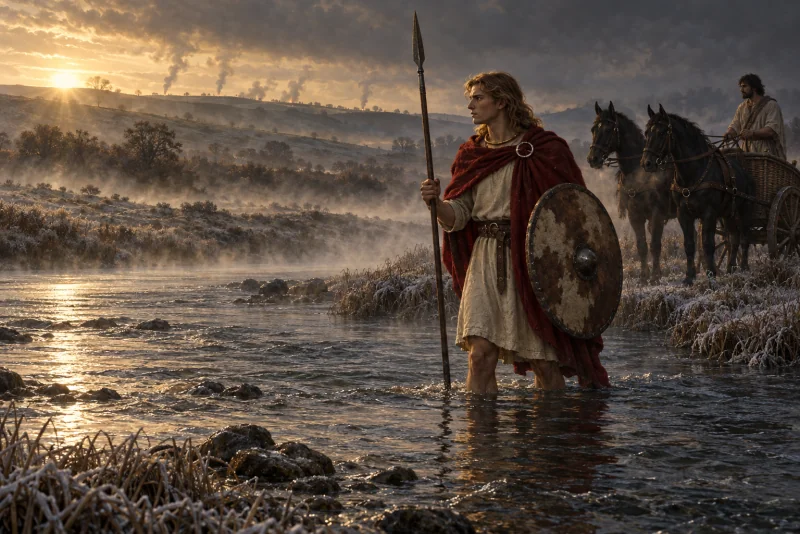
Cover and illustrations: AI-generated images made for Arcana. They are interpretations, not historical artworks.