Fionn mac Cumhaill: The Salmon of Knowledge and the Fianna
A boy raised in hiding burns his thumb on the salmon of knowledge and grows up to lead the Fianna, the warrior bands who lived by hunting and fighting. Folk tales of later centuries made him a giant who built the Giant's Causeway; the medieval texts never do.
- Type: hero legend; the leader of a band of hunter-warriors
- Culture: Ireland, and later Gaelic Scotland
- Earliest texts: short poems and tales that Kuno Meyer dated from the late 8th century on; the boyhood tale Macgnímartha Find, written in the 12th century and preserved in a manuscript of 1453–54; Acallam na Senórach, around 1200
- Key figures: Fionn mac Cumhaill (as a boy, Demne), his father Cumall, his mother Muirne, Goll mac Morna, the poet Finnéces, Aillén mac Midgna, Diarmuid Ua Duibne, Gráinne, Oisín, Caílte
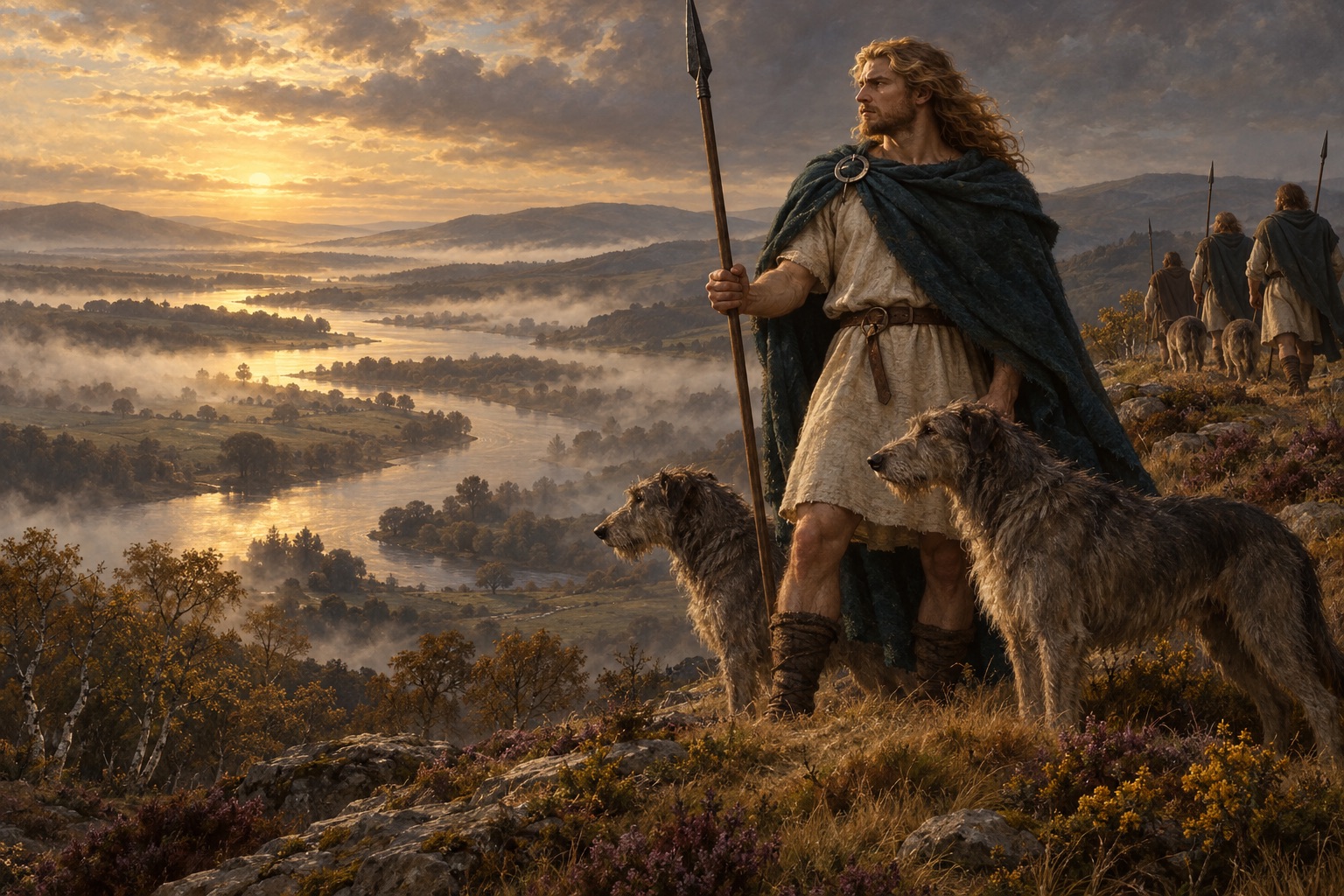
Fionn mac Cumhaill, in English Finn McCool, led the Fianna, bands of warriors who lived by hunting and fighting. The tales about him and his men, the Fenian cycle, kept growing for a thousand years: from a few lines in early poems, to long medieval prose, to the folk tales of the countryside, where he became a giant. Once Finn was “fully established in popular favour”, the scholar Kuno Meyer wrote in 1910, “all Ireland claims him as her own”.
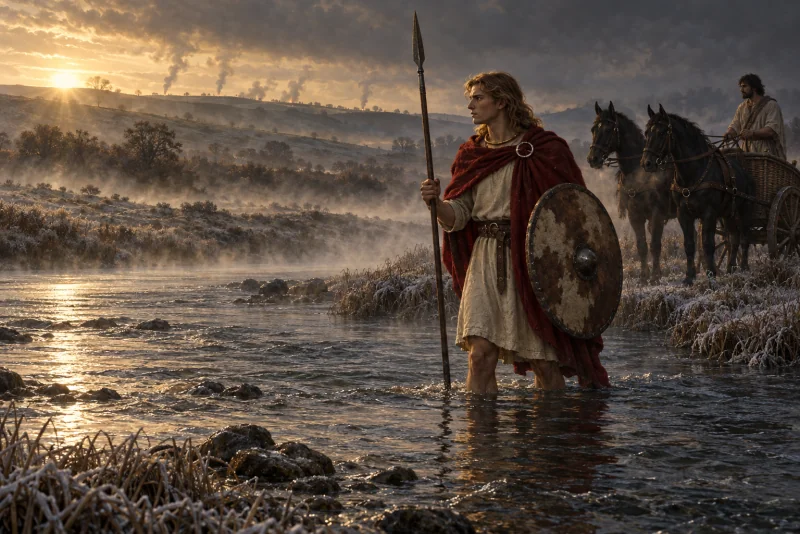
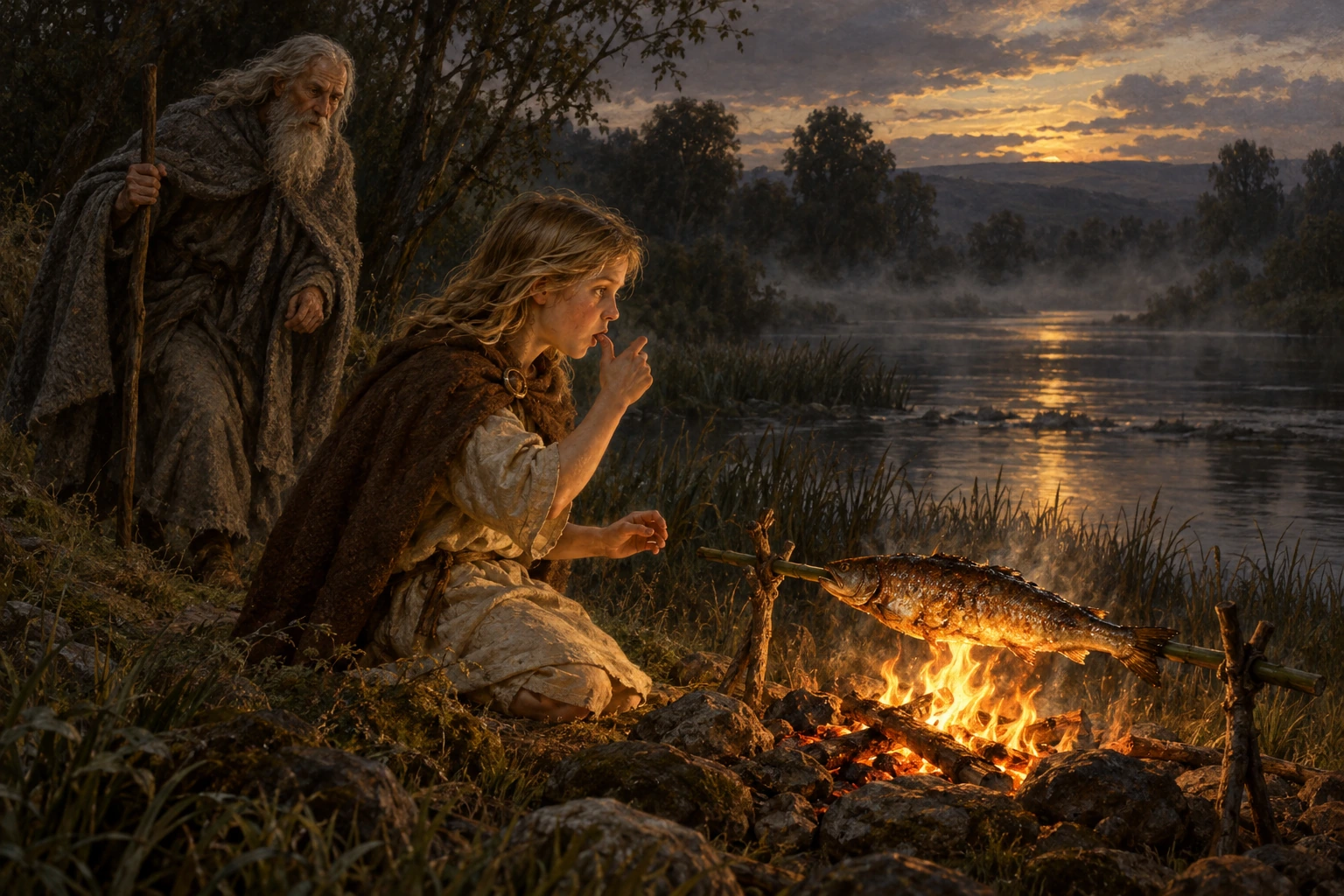
Why does Fionn put his thumb in his mouth? Because of a salmon. In the oldest telling of his boyhood, the boy cooking the salmon of knowledge for his master burns his thumb on it and puts the thumb in his mouth. The fish was meant for him: he is told his name is Finn and given the whole salmon. “It is that which gave the knowledge to Finn”: from then on, whenever he put his thumb in his mouth and chanted the poets’ incantation teinm láida, whatever he did not know was revealed to him.
1 The Telling
The boyhood is told in Macgnímartha Find, “The Boyhood Deeds of Finn”, a Middle Irish text preserved in a 15th-century manuscript in Oxford; it breaks off unfinished. Quotations from it follow Kuno Meyer’s translation of 1904. How Fionn won the Fianna comes from Acallam na Senórach, “the Colloquy of the Ancients”, his rules and his death from a manuscript of about 1517, all three in Standish Hayes O’Grady’s translation of 1892.
1-1 The Battle of Cnucha
Cumall son of Trénmór fought Urgriu of the Luaigni for the leadership of the Fian at the battle of Cnucha. On Urgriu’s side fought Daire the Red and his son Aed. Aed lost an eye in the battle and was called Goll, “the One-eyed”, from then on. Cumall fell by Goll son of Morna, who carried off his spoils and his head, “whence there was a hereditary feud between Finn mac Cumaill and the sons of Morna”.
Cumall left his wife Muirne pregnant, and she bore a son called Demne. She did not dare keep him. The druidess Bodbmall and a woman warrior, the Grey One of Luachair, took him into the forest of Slieve Bloom and raised him there in secret, for the Luaigni and the sons of Morna were waiting to kill him. After six years his mother came, found him asleep in the hunting booth, and held him to her before leaving him again.
1-2 The Fair Youth
His first chase was a wild duck, brought down with one shot on a lake. A skin disease left him bald, and he was called Demne the Bald. One day he came to a fort on the plain of the Liffey, where boys were hurling on the green, and beat them all: a quarter of them, then a third, then all together. The man of the fort asked what the stranger looked like. “A shapely fair (finn) youth,” they said. “Then Demne shall be named Finn.” The name stuck when the boys, swimming in a lake, challenged him to try to drown them, and he drowned nine.
He served kings without telling them who he was, and they guessed. If Cumall had left a son, said the king of Bantry, one would think it was he; the king of Kerry, after Finn had prompted him to win seven games of fidchell, a board game, told him to go before he was killed under his protection. A smith made him two spears, and with one he killed the Beo, a sow that was laying waste the midlands of Munster. In Connacht he killed the man who had dealt Cumall his first wound at Cnucha, and took back his father’s bag of treasures.
1-3 The Salmon of Linn Féic
Then he went to learn poetry from Finnéces on the Boyne: he dared not stay in Ireland, the text says, unless he took to poetry, for fear of the sons of Urgriu and of Morna. Finnéces had been seven years on the river, watching for the salmon of Féc’s Pool, Linn Féic, for it had been prophesied that he would eat it, and then nothing would remain unknown to him. The salmon was caught, and Demne was told to cook it and eat none of it.
He brought the fish. “Hast thou eaten anything of the salmon, my lad?” “No, but I burned my thumb, and put it into my mouth afterwards.” “What is thy name, my lad?” “Demne.” “Finn is thy name, my lad, and to thee was the salmon given to be eaten, and verily thou art the Finn.” The boy ate the salmon, and so gained the knowledge he called up with his thumb. He learned the three arts that make a poet, teinm láida, imbas forosnai and díchetal di chennaib, and made a poem to prove it, a song for the first day of summer: “May-day, season surpassing! Splendid is colour then.”
1-4 Samhain at Tara
In the Acallam, Caílte tells how Fionn won the Fianna. After Cnucha, Goll mac Morna held the leadership for ten years, while Cumall’s son lived as “a marauder and an outlaw”. In his tenth year the boy walked into the Feast of Tara, where no feud could be pursued, sat down before King Conn of the Hundred Battles and Goll, named himself, and swore service to the king.
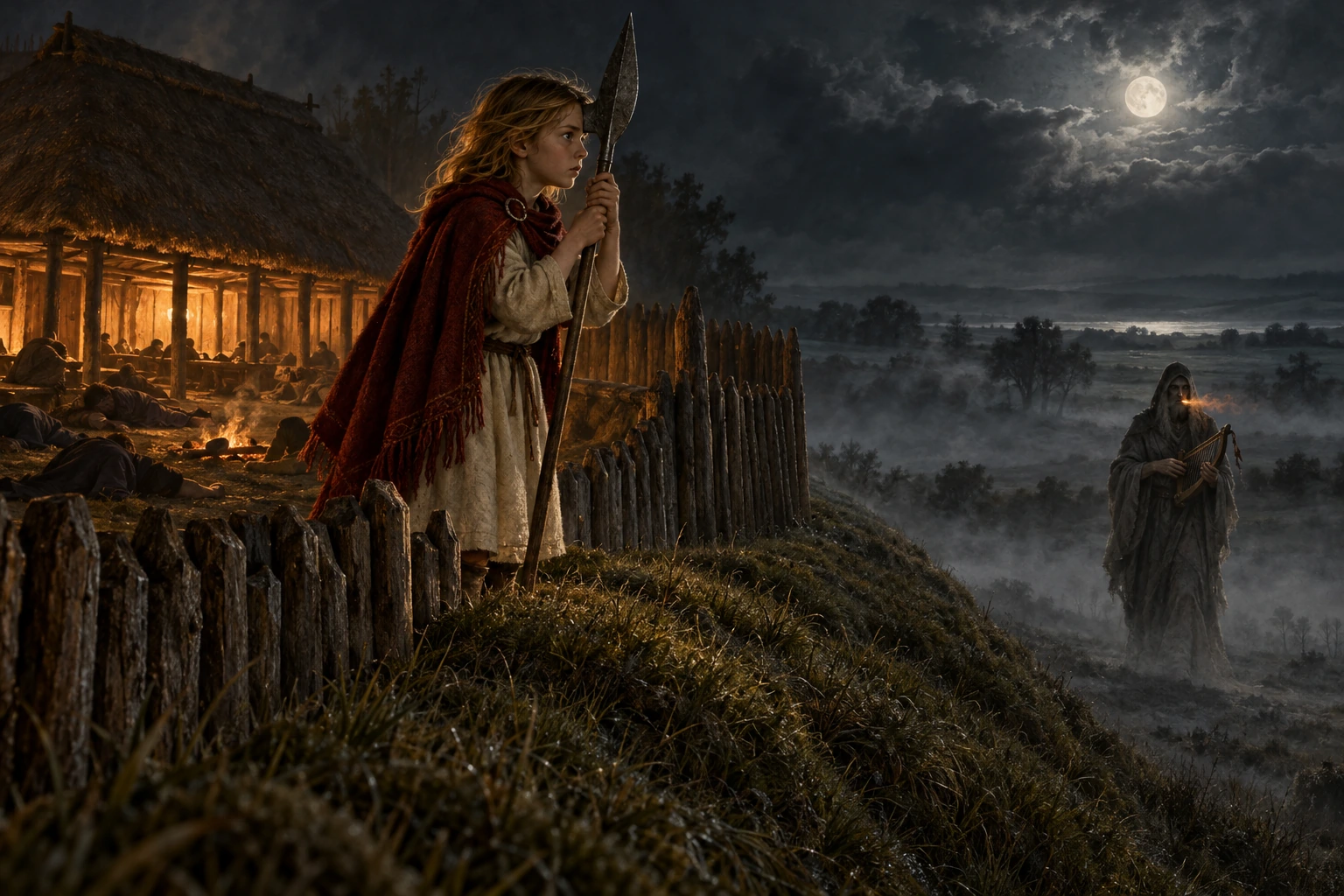
For twenty-three years Aillén mac Midgna, of the Tuatha Dé Danann, had come out of his síd, the fairy mound, every Samhain, played on his timpán until everyone slept, and burned Tara with fire from his mouth. Conn offered whoever saved Tara whatever was rightfully his. Fiacha mac Congha, once a trusted man of Cumall’s, gave Finn a spear: when the music comes, he said, hold its head to your forehead, and you will not sleep. Finn did so, caught the fire in his mantle, followed Aillén to the door of his síd and killed him with one cast, and by sunrise Aillén’s head was on a pole at Tara. The leadership of the Fianna was given to Finn. Conn asked Goll whether he would leave Ireland or put his hand in Finn’s, and Goll struck his hand in Finn’s first, “to the end that others of the Fianna should be the less inclined to feel shame at doing so”.
1-5 The Rules of the Fianna
“The Enumeration of Finn’s People” sets out the conditions. A man of the Fianna might not refuse anyone valuables or food, nor flee before nine warriors. His kin gave sureties that they would claim nothing if he were killed, and he had to be a poet “versed in the twelve books of poesy”. Then came the tests. He stood in a hole up to his belt with a shield and a forearm’s length of hazel stick while nine warriors cast nine spears at him at once; if he was hurt, he was refused. With his hair braided he ran through the woods with the warriors after him and a single bough’s start, and he failed if he was caught, if his weapons quivered in his hand, if a branch pulled his braids loose, or if a dry stick cracked under his foot. At full speed he had to leap a stick level with his brow, stoop under one level with his knee, and pull a thorn from his foot with his nail without slowing down.
1-6 Diarmuid and Gráinne
In Tóraigheacht Dhiarmada agus Ghráinne, “The Pursuit of Diarmuid and Gráinne”, the ageing, widowed Fionn is betrothed to Gráinne, daughter of King Cormac mac Airt. At the feast at Tara she puts the company to sleep with a drugged goblet and lays on Diarmuid Ua Duibne, one of Fionn’s men, bonds he cannot refuse: to take her away that night. Fionn hunts them across Ireland for sixteen years. Peace is made, and then Fionn calls Diarmuid to a boar hunt on Ben Bulben, in County Sligo, though Diarmuid is bound never to hunt a pig. He kills the boar and is mortally wounded by it. Whoever drank water from Fionn’s hands would be healed. Twice Fionn carried water from a well nine paces away and let it run through his hands, the second time “having thought upon Grainne”. Oscar, Oisín’s son, threatened him, and the third time he brought the water, Diarmuid died as he came up.
1-7 The Death at Áth Brea
Fionn’s wife Smirgat, a prophetess, told him he would die when he drank from a horn, so he drank only from cups. One day he drank from a well, put his thumb under his “knowledge-tooth”, chanted, and learned that his life was at its end. At Brea on the Boyne he fought the Luaigni of Tara, whose kinsman Urgriu he had once killed, and Aichlech son of Duibrenn cut off his head. The Annals of the Four Masters, compiled in the 1630s, enter it under the year 283.
1-8 The Giant in the Cradle
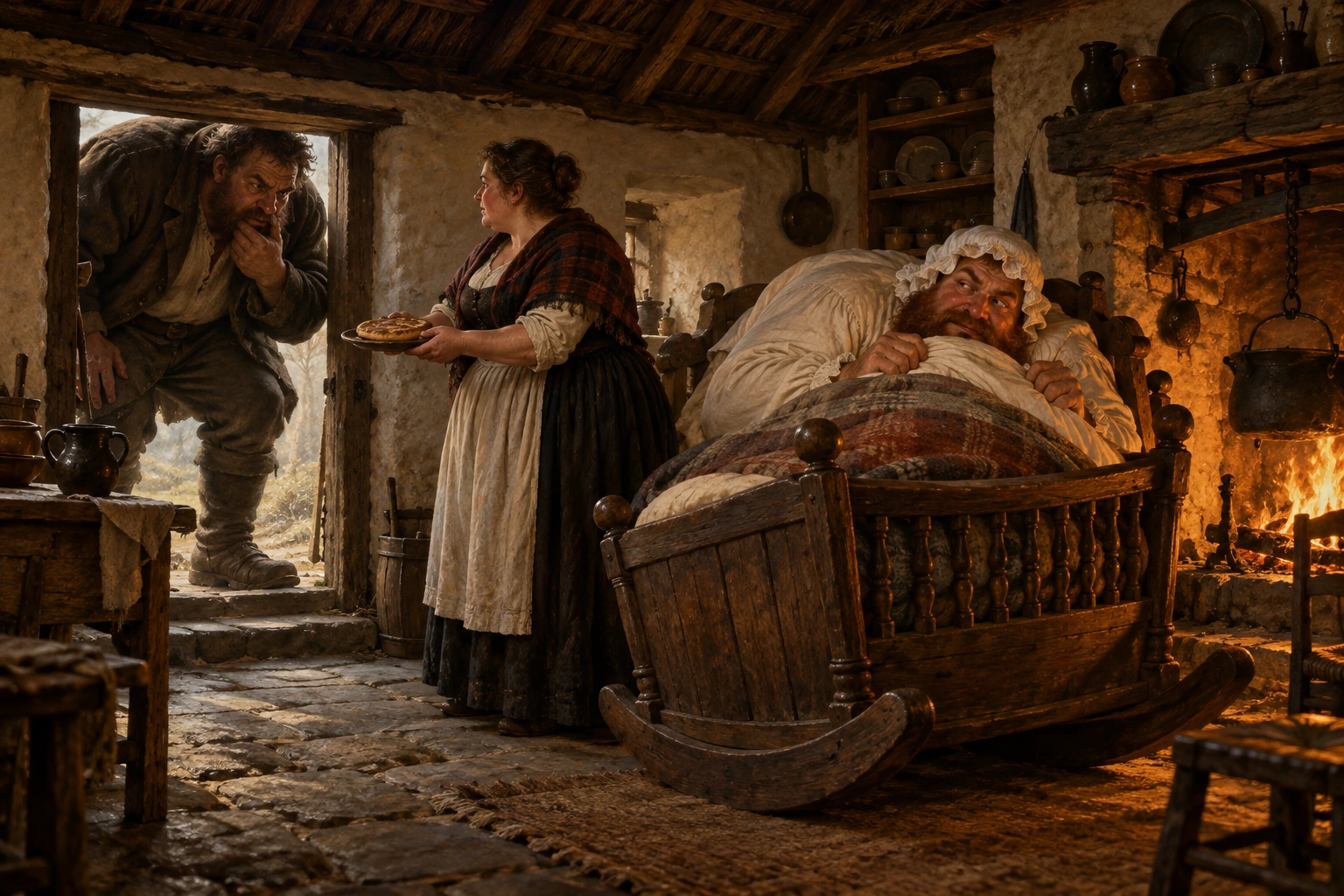
Centuries later, in the folk tales, Fionn is a giant. William Carleton printed one such tale in 1845, “A Legend of Knockmany”. Fin M’Coul and his men are building the Giant’s Causeway, “in order to make a bridge across to Scotland”, when Fin hears that the giant Cucullin, whose whole strength lies in the middle finger of his right hand, is coming to fight him. He hurries home to his wife Oonagh on Knockmany Hill, and his thumb, as always, tells him when the giant will arrive. Oonagh bakes twenty-one cakes with an iron griddle inside each and puts Fin in a cradle, dressed as a baby. Cucullin breaks his teeth on “Fin’s bread” while the “child” eats a cake with no iron in it; when he puts his finger in the baby’s mouth to feel its teeth, Fin bites the finger off, and with it his strength. In Patrick Kennedy’s version of 1866 the visitor is a Scottish giant, Far Rua, the Red Man, who comes over “the big stepping stones that lead from Ireland to Scotland” and leaves in a hurry, “for fear the tide would overtake me crossing the Causeway”.
2 Where the Story Is Written Down
- Early allusions. In Fianaigecht (1910), Kuno Meyer gathered every early mention of Finn and dated the oldest tales and poems to the late 8th and 9th centuries. Even in the 10th century, he found, Finn and his band were “only one among several well-known similar bands”: a poet who died in 977 names three famous fiana of Leinster, Finn’s among them.
- Macgnímartha Find, a Middle Irish text of the 12th century, survives in Bodleian Library, Oxford, MS Laud Misc. 610, written for the most part in 1453–54 for Sir Edmond Butler. John O’Donovan edited it with a translation in 1859; Meyer edited it in 1882 and translated it in the first volume of the journal Ériu (1904).
- Acallam na Senórach, around 1200: Caílte and Oisín, the last of the Fianna, outlive the rest and tell St Patrick the stories behind Ireland’s places. O’Grady translated it from the Book of Lismore, written for Fínghin Mac Carthaigh Riabhach, who died in 1505.
- British Library, Egerton 1782, a manuscript of about 1517, holds “Cormac’s Panegyric and Finn’s Death” and “The Enumeration of Finn’s People”. Geoffrey Keating repeats the conditions almost item by item in his history of Ireland, Foras Feasa ar Éirinn, completed about 1634.
- The annals. Meyer found Finn in only one entry of the older annals, the Annals of Tigernach under the year 283: his death at Áth Brea. The Annals of the Four Masters have the same entry.
- Tóraigheacht Dhiarmada agus Ghráinne. A list of tale titles that Meyer dated to the 10th century already includes “the elopement of Gráinne daughter of Cormac with Diarmait”, and two quatrains, one spoken by Gráinne and one by Diarmait, are quoted in the commentary on the Amra Coluim Chille, a poem in praise of St Columba. The full prose tale survives only in Early Modern Irish copies. O’Grady’s edition of 1857 was made from two of them, one written in 1780 by a schoolmaster near Portlaw, County Waterford.
3 Competing Versions
- Where did his knowledge come from? In Macgnímartha Find, from the salmon. Meyer dated to the 9th century a short tale with its own account, “How Finn obtained knowledge, and the Death of the Fairy Cúldub”. Lady Gregory’s Gods and Fighting Men (1904) gives him a second wisdom: the daughters of Beag son of Buan, who kept a well, threw its water at him, and some went into his mouth. In the death tale he puts his thumb under his “knowledge-tooth”, and in the Tóraigheacht the gift he got at the Boyne includes healing water from his hands.
- Who named him? Macgnímartha Find names him twice, once at the hurling green and once over the salmon, and a little later says that “at that time the name of Cumall’s son was Finnéces”, the poet’s own name.
- Aed or Aillén? Near the end of Macgnímartha Find, on a Samhain night when the fairy mounds stand open, Finn kills Aed son of Fidga, the man of the síd who killed one companion of every suitor of the maiden Ele, with the spear of Fiacail son of Conchenn; a poem in the Book of Leinster knows the same deed. In the Acallam the night moves to Tara, the victim is Aillén, the spear is Fiacha mac Congha’s, and the prize is the Fianna.
- Whose son? The Leinster genealogists made Finn a great-grandson of the Leinster king Nuadu Necht. The death tale in Egerton 1782 says “his origin they declare variously”: some made him one of the Corco Oche, others, “and this is the truth of the matter”, one of the Uí Thairrsig of Offaly, a rent-paying people.
- How did Diarmuid die? In O’Grady’s text the boar gores him. “The common tradition amongst the peasantry”, O’Grady noted, is that Diarmuid killed the boar unhurt, that Fionn made him pace its hide from snout to tail and back again, and that a bristle pierced his foot as he walked against the lie of them. The same tradition, he adds, is found in the Scottish Highlands.
- How did Fionn die? At Áth Brea, in the annals and in Egerton 1782. “There are some say he died by the hand of a fisherman”, Lady Gregory writes, “and there are some say he never died, but is alive in some place yet.”
4 History and Tradition
- Were the Fianna real? Keating was sure of it: “whoever should say that Fionn and the Fian never existed would not be stating truth”. He made them hired soldiers of the kings, quartered on the people from Samhain to Bealltaine, from the start of winter to the start of summer, and living by the chase the rest of the year. The burnt sites of their cooking fires, he says, are called fulacht fian by the country people. Meyer traced the word fian to manuscripts of the 9th century, where it means “a band of warriors on the warpath”.
- Fionn and Cú Chulainn. “The figure of Finn,” Meyer wrote, “who in popular imagination early superseded Cúchulinn and all the heroes of the Red Branch, has attracted to itself, from century to century, folklore of the most varied character.”
- The Giant’s Causeway. On the Causeway Coast of Northern Ireland stand more than 40,000 columns of basalt. The British Geological Survey explains them as a lake of lava, some 90 metres deep, that cooled slowly and evenly about 60 million years ago and cracked into columns; the same eruptions made the columns of Staffa, in Scotland. Kennedy’s footnote of 1866 credits the causeway to “the ancient Irish and Scotch men of might, laid down to facilitate their mutual visits”. Modern retellings name the Scottish giant Benandonner; he is not called that by Carleton or by Kennedy.
- The sleepers in the cave. Lady Gregory tells of a smith who opened a cave and found huge men asleep on the floor, the biggest in the middle with the horn called the Dord Fiann beside him. He blew it once, and they shook; twice, and they “turned on their elbows”. He fled and locked the door. “Some say the day will come when the Dord Fiann will be sounded three times, and that at the sound of it the Fianna will rise up.”
- The Ossianic Society. Founded on St Patrick’s Day 1853 to publish manuscripts “illustrative of the Fenian period of Irish History”, it printed O’Grady’s Pursuit of Diarmuid and Grainne in 1857. Keating had already named places after the Fianna as proof that they existed, among them Suidhe Finn, Finn’s Seat, on Slievenamon, and a “Bed of Diarmuid and Gráinne”.
Fionn is often pictured today as a giant. In the medieval texts he is a man. In his history of Scotland (1527), Hector Boece described “Fyn mak Coul” as a man, so they say, “of huge stature”, and John Bellenden’s Scots translation of 1536 makes him seventeen cubits tall. Keating answered that Boece “unjustly calls Fionn son of Cumhall a giant”: “it is plain from the old books of the seanchus that he was not of abnormal size”, and some of the Fianna were bigger than he. The Acallam had already made the old Fianna enormous, though: St Patrick’s clerics are afraid of the tall men with their huge hounds, and the largest cleric reaches only to the waist or shoulder of the seated Fianna.
5 Related Stories
- Oisín and Tír na nÓg: The Land of Youth: Fionn’s son, the poet of the Fianna, who outlives them all. In the Acallam he and Caílte tell their stories to St Patrick.
- Cú Chulainn: The Hound of Ulster: the hero Meyer says Finn “superseded” in popular imagination. In Carleton’s tale he even turns up as Cucullin, the giant Fin defeats; Joseph Jacobs noted that the two heroes “could not have come together in any early form of their sagas”.
- The Tuatha Dé Danann: The Gods Who Went into the Hills: the people of the síd. Aillén, who burned Tara every Samhain, is one of them in the Acallam, and Lady Gregory makes Fionn’s mother a granddaughter of Nuada of the Tuatha Dé.
- Odin: The God Who Gave an Eye for Wisdom: a god who gains wisdom from a drink at Mímir’s well, as Fionn gains his from a salmon, and in Lady Gregory from the water of a well. We have not found a scholar who compares the two; we link them for the theme.
6 Sources
- Macgnímartha Find: Kuno Meyer (trans.), “The Boyish Exploits of Finn”, Ériu 1 (1904), 180–190, from Bodleian Library MS Laud Misc. 610: CELT, archive.org; Irish text and manuscript details: CELT
- Acallam na Senórach, “Tesmolta Cormaic ocus Aided Finn” and “The Enumeration of Finn’s People”, in Standish Hayes O’Grady (ed. and trans.), Silva Gadelica, vol. 2 (Williams and Norgate, 1892), pp. 96–101, 103, 142–145: archive.org; manuscripts of the Acallam: CELT
- Tóraigheacht Dhiarmada agus Ghráinne, ed. and trans. Standish Hayes O’Grady, Transactions of the Ossianic Society 3 (1857): archive.org
- Geoffrey Keating, The History of Ireland (Foras Feasa ar Éirinn), book 1, section 45, trans. David Comyn and Patrick S. Dinneen (Irish Texts Society, 1902–1914): CELT; “Life and Work of Geoffrey Keating”: CELT
- Annals of the Four Masters, M283.2, trans. John O’Donovan: CELT
- Kuno Meyer, Fianaigecht, Todd Lecture Series 16 (Royal Irish Academy, 1910), introduction: archive.org
- Hector Boece, Scotorum Historia, book 7, Latin text of the 1575 version, ed. Dana F. Sutton: The Philological Museum; John Bellenden’s Scots translation (1536), book 7, chapter 18: Ex-Classics
- William Carleton, “A Legend of Knockmany”, in Tales and Sketches, Illustrating the Character … of the Irish Peasantry (James Duffy, 1845): archive.org; Patrick Kennedy, “Fann Mac Cuil and the Scotch Giant”, in Legendary Fictions of the Irish Celts (Macmillan, 1866), pp. 203–205: archive.org; Joseph Jacobs, Celtic Fairy Tales, notes to “A Legend of Knockmany”: Project Gutenberg
- Lady Gregory, Gods and Fighting Men (John Murray, 1904), part 2, books 1 and 10: Project Gutenberg
- British Geological Survey, “The Giant’s Causeway and Causeway Coast”: bgs.ac.uk
- “フィン”, Britannica International Encyclopedia: Kotobank
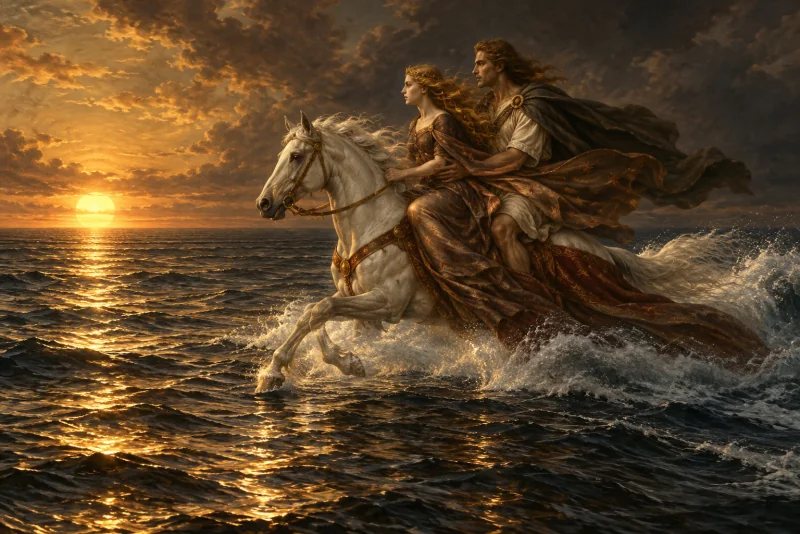
Cover and illustrations: AI-generated images made for Arcana. They are interpretations, not historical artworks.