Rostam and Sohrab: The Father Who Killed His Son
Rostam left an armlet for the child he might have, and rode home. Years later his son Sohrab marched into Iran to find him, and the two met in single combat without knowing each other.
- Type: epic tragedy, a father and son who fight as strangers
- Culture: Iran, in the Persian national epic
- Earliest text: Ferdowsi’s Shahnameh, finished in 1010 CE. In 1906 the translators Arthur and Edmond Warner found “no trace of this story” in the Middle Persian books then known
- Key figures: Rostam, his horse Rakhsh, Tahmineh, the king of Samangan, Sohrab, Afrasiab, Human and Barman, Hojir, Gordafarid and her father Gazhdaham, Kay Kavus, Gudarz
Ferdowsi opens this story with a question. If a gale tears an unripe citron from the tree and throws it in the dust, should we call that just or unjust? The answer is a tale “fraught with many a tear”, in the Warners’ translation: a father kills his son without knowing him, and learns who the young man is only when it is too late.
Did Rostam know he was fighting his son? No, although he had reasons to wonder. He knew that Tahmineh had borne him a son, but he had been told the boy was still small. Afrasiab sent two captains to keep father and son from knowing each other. Tahmineh’s brother, whom she had sent to point out Rostam to her son, was killed by Rostam’s own hand the night before the battle. The prisoner Hojir hid his name. And when Sohrab asked him outright, Rostam answered: “I am not Rustam.”
1 The Telling
This is the story as Ferdowsi tells it in the Shahnameh, in the reign of the king Kay Kavus, followed in the Warners’ English translation of 1906.
1-1 A Night in Samangan
One morning Rostam rode out to hunt on the border of Turan, the kingdom of Iran’s enemies. He roasted a wild ass, ate and fell asleep, and while he slept a band of Turkish horsemen caught his horse Rakhsh with their lassos and led him away. Rostam followed the tracks on foot to the city of Samangan. The king came out to meet him, promised to find the horse and kept him as his guest.
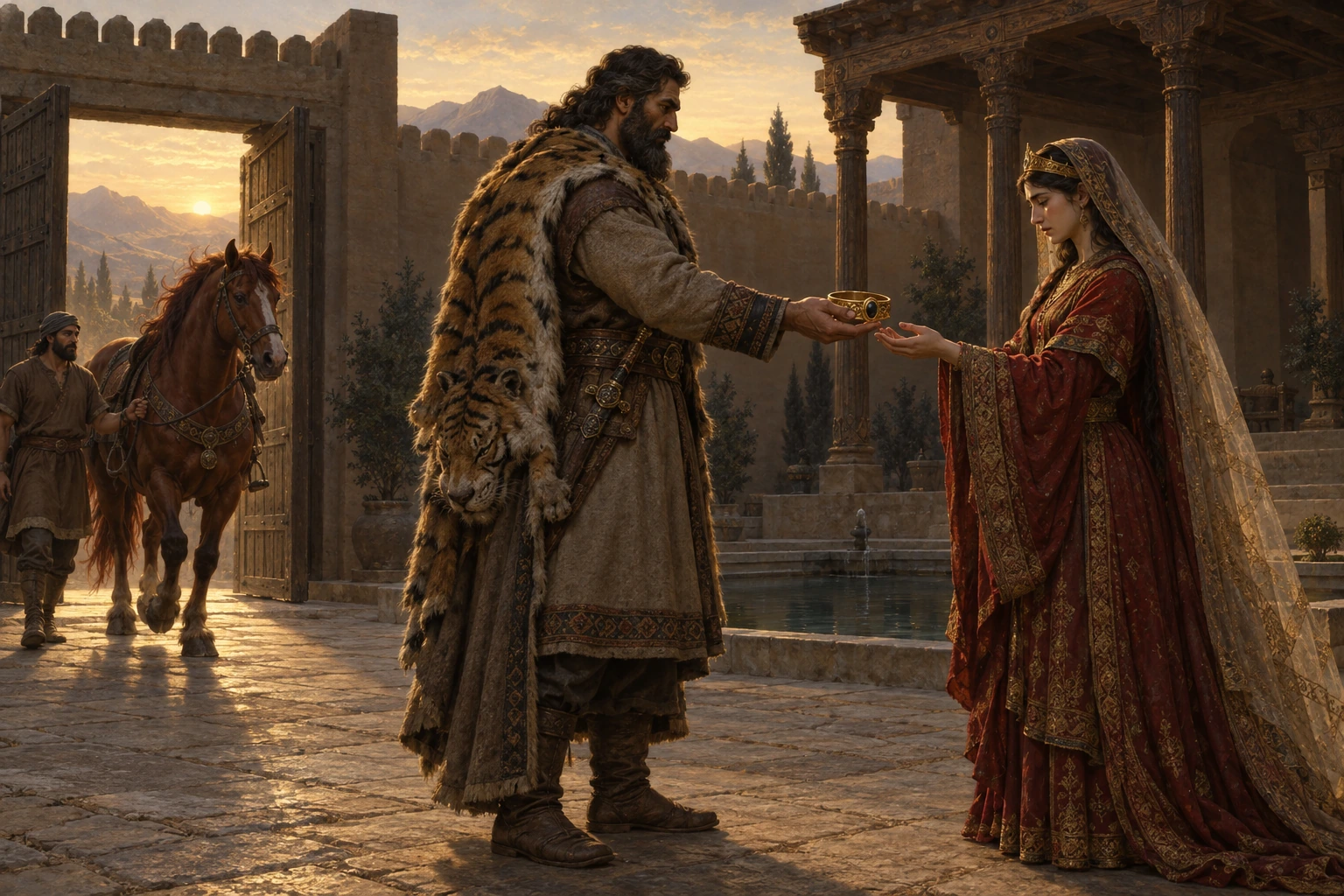
At midnight the door of his room opened. A slave came in with a scented taper, and behind the slave the king’s only daughter, Tahmineh. She had heard so many tales of his deeds, she said, that she wanted him for her husband, and prayed that God would give her a son like him; she would also bring back Rakhsh. Rostam sent a priest to ask her father for her hand, and the king gave her to him “with the usual rites”. In the morning Rostam gave her the armlet he wore. If she bore a daughter, it was to be plaited in her hair; if a son, bound on his arm, “this token of his father”. Then Rakhsh was brought back, and Rostam rode home to Zabulistan and told no one.
1-2 The Boy Who Asked for His Father
Nine months later Tahmineh bore a son. Because he smiled and was bright of face she named him Sohrab. At one month he looked a year old, at three he trained with weapons, and at ten no one dared to fight him. Then he asked his mother who his father was, and threatened her if she would not say. She told him: he was the son of Rostam. She showed him a letter from his father, three gems and three purses of gold sent at his birth, and warned him that Afrasiab, the king of Turan and Rostam’s enemy, must never know.
Sohrab had other plans. He would gather an army, drive Kay Kavus from the throne of Iran and give the crown to Rostam, then take Afrasiab’s throne too: “Since Rustam is the sire / And I the son none other shall be king.” He chose a horse of Rakhsh’s breed, and his grandfather armed him. When Afrasiab heard, he was delighted. He sent two captains, Human and Barman, with twelve thousand men and a secret order: “The father must not recognise his son.” If Rostam fell to the boy, Iran would be theirs, and Sohrab could be done away with later; if the boy fell to his father, Rostam’s heart would burn for ever.
1-3 The White Fortress
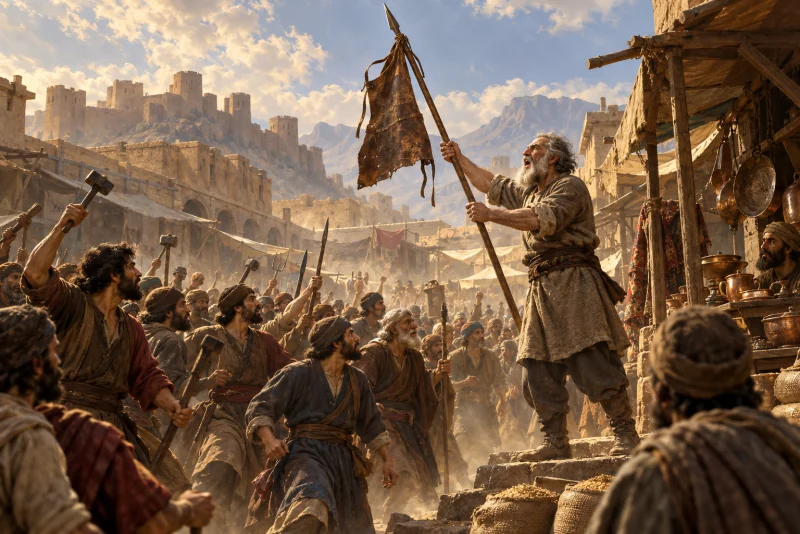
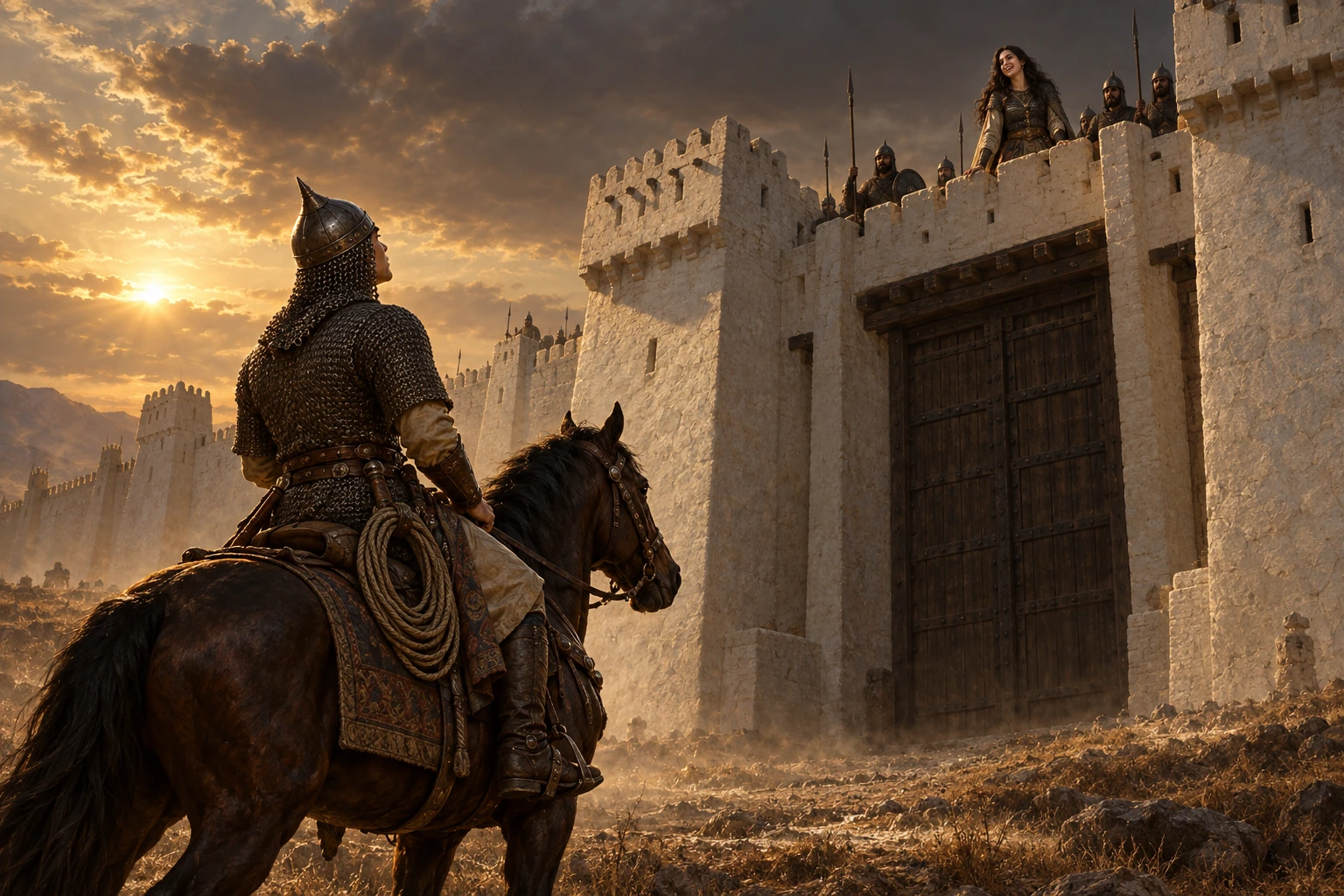
On the frontier stood the White Fortress, held by the warrior Hojir. Sohrab threw him from his horse and took him prisoner. Then the old commander Gazhdaham’s daughter, Gordafarid, hid her hair under her mail, put on a helmet and rode out to challenge the invaders. She showered Sohrab with arrows and charged with her lance; his spear tore her mail at the belt, and she cut the shaft in two with her sword and fled. He caught up, snatched off her helmet, and her hair fell loose: “It is a girl!” He lassoed her, but she talked her way free. Why let two armies see him fighting a girl? The fortress would be his. She rode with him to the gate, slipped inside, and the gate shut behind her.
From the ramparts she laughed at him: “The Turkmans win no helpmates from Iran.” When the Shah came with Rostam, she warned, his army would perish. That night Gazhdaham wrote to Kay Kavus of an enemy commander “whose years do not exceed twice seven at most”, and the garrison escaped by a secret way under the walls. In the morning Sohrab broke in to find the commanders gone, and Gordafarid with them.
1-4 Rostam Delays
Kay Kavus sent the hero Giv to fetch Rostam. Rostam laughed at the news: the son that Samangan’s princess had borne him was still a child, and her messenger had said “The darling is not growing very fast”. He feasted with Giv for three days before setting out. Kay Kavus, in a rage, ordered both men hanged; Rostam knocked down the noble Tus, who had taken his hand to lead him out, and rode away: “I am not his slave / But God’s.” Only the old hero Gudarz, telling him that men would say he was afraid of the young Turk, brought him back, and the king apologized.
The night the armies met, Rostam put on Turkish dress and crept into the enemy feast. He saw Sohrab on his throne, and beside him Zhandeh Razm, Tahmineh’s brother, whom she had sent to point out Rostam to her son. Zhandeh Razm caught the stranger in the dark, and one blow of Rostam’s fist killed him. The next morning Sohrab asked his prisoner Hojir to name the commanders by their banners. Hojir named them all except one, whose standard bore a dragon: an ally from China, he said, whose name he did not know. If this boy learned which tent was Rostam’s, he reasoned, Rostam would die, and Iran with him.
1-5 Three Encounters
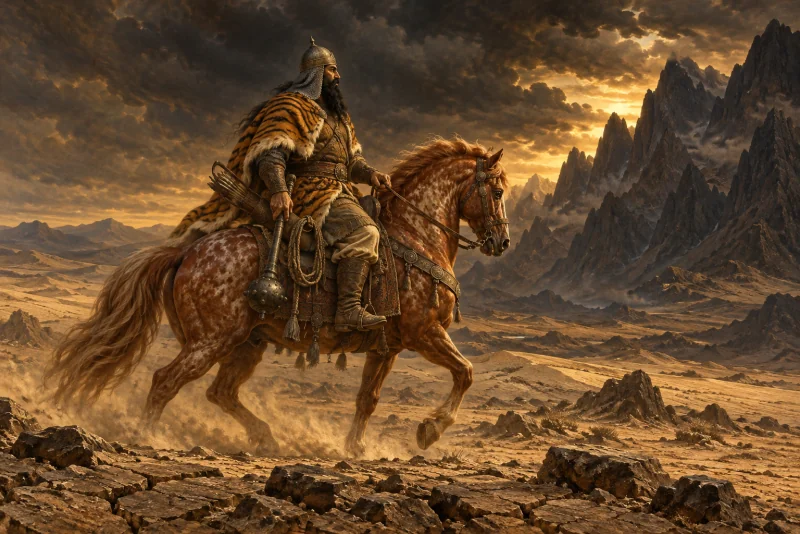
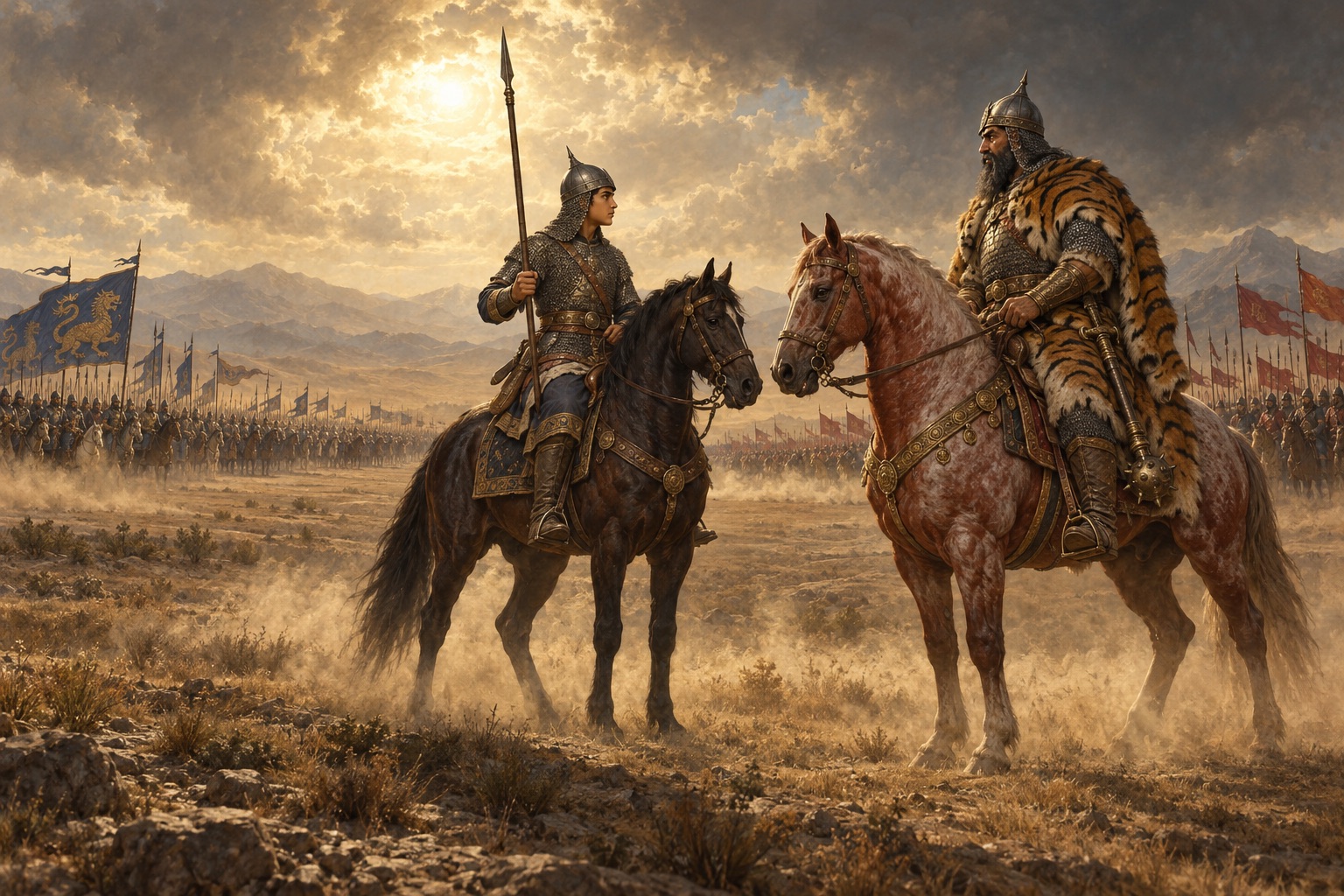
Sohrab rode at the Iranian camp and tore up the king’s tent. Rostam put on his tiger-skin coat and went out to meet him. He felt pity for the boy; Sohrab felt his heart beat and asked: “I think that thou art Rustam.” “I am not Rustam,” came the answer. They fought with spears, swords and maces until the weapons bent, then with bows, then by the belt; Rostam could not lift the young man from the saddle. “To fight the White Div was an easy task” compared with this, he thought. At nightfall they parted.
The next morning Sohrab greeted him with a smile and proposed that they put down their weapons and drink together. Was he not Rostam, son of Zal? Rostam refused. They wrestled on foot, and Sohrab threw him and drew a dagger. Rostam saved himself with a lie: among his people, he said, no one may take a man’s head the first time he throws him. Sohrab let him go and rode off after an antelope. Rostam washed in a stream and prayed to God to give back the strength he had once asked God to lessen. When they met again he caught Sohrab by the head and neck, threw him down and stabbed him in the chest with his sword.
1-6 The Armlet
“I am alone to blame,” said Sohrab. His mother had told him how to know his father, and his father, wherever he hid, would avenge him. “Where is the proof that thou art Rustam’s son?” cried Rostam. Sohrab told him to open his armour, and there on his arm was the armlet. Rostam tore his clothes and threw dust on his head. “Wherefore weep?” said the dying boy. “What was to be hath been.” He asked his father to let the Turanian army go home unharmed, and to spare Hojir.
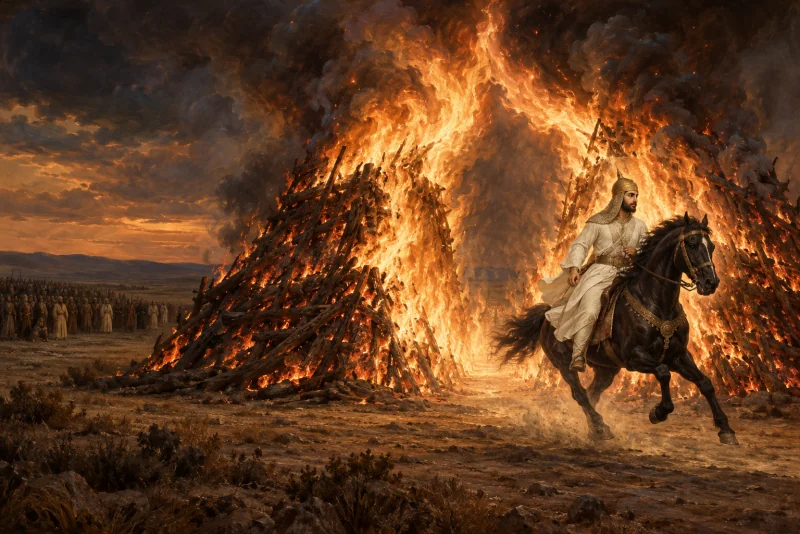
Rostam tried to kill Hojir, then himself, and the nobles held him back both times. Then he sent Gudarz to the king for the nushdaru, the healing draught in the royal treasury. Kay Kavus refused. If Sohrab lived beside Rostam, he said, the two of them would be his ruin; he had not forgotten Rostam’s insults, nor Sohrab’s vow to hang him. Rostam set out to plead in person, but a rider caught up with him: Sohrab was dead. “What sire e’er acted thus?” Rostam cried. He burned his camp, carried the body home to Zabulistan and built a tomb shaped like a horse’s hoof.
1-7 Tahmineh
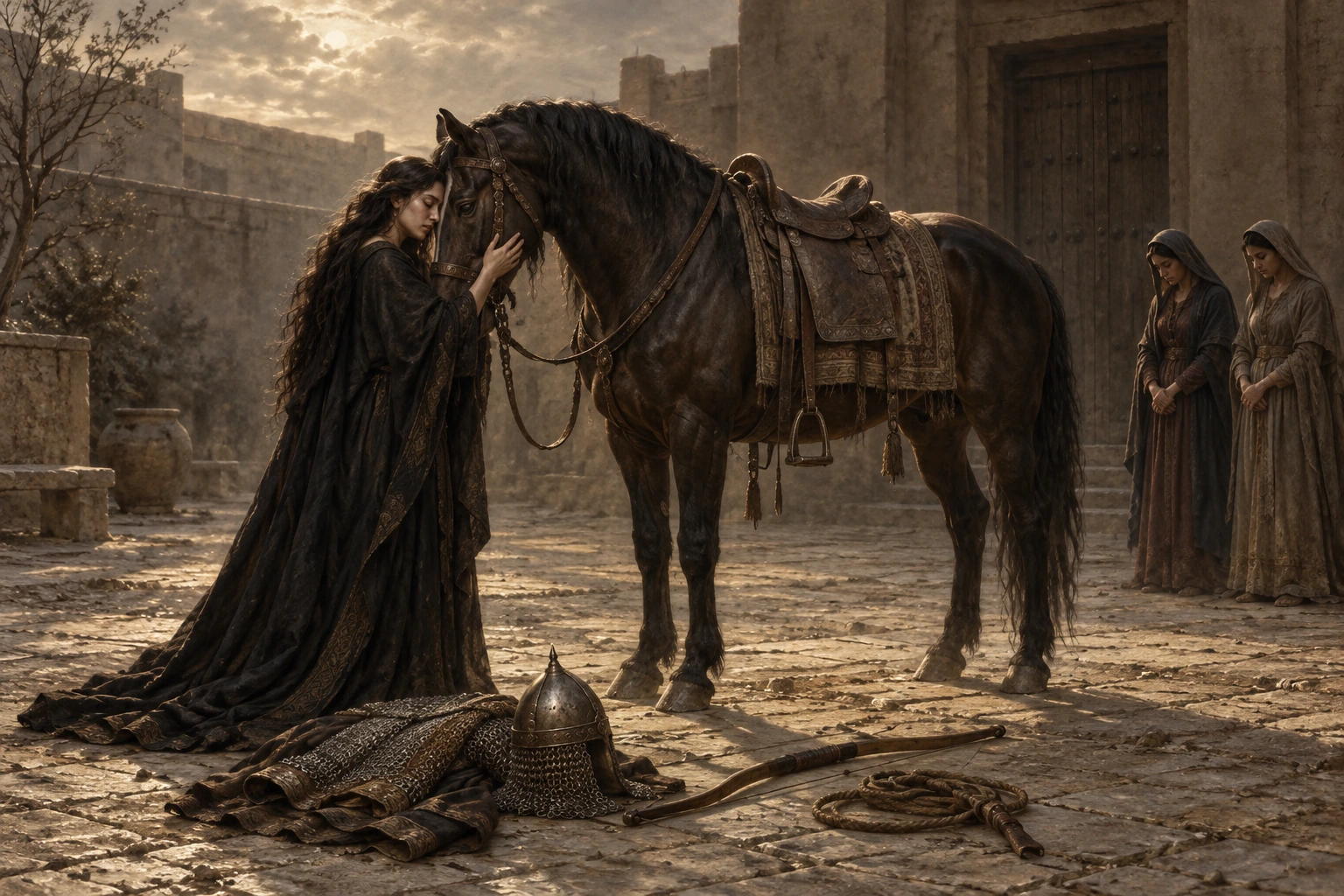
This last scene is in the editions the Warners translated, not in the Moscow edition (section 3). When the news reached Samangan, Tahmineh tore her robe and her hair and fainted again and again. “Why didst thou not / Show him the token that thy mother gave thee?” she cried. She brought out Sohrab’s horse and kissed its head, cut its mane and tail with his sword, gave his gold to the poor and shut up his palace. A year later she died of grief.
2 Where the Story Is Written Down
- The Shahnameh, the “Book of Kings” of Ferdowsi, was finished in 1010 and dedicated to Mahmud of Ghazna. Kuroyanagi Tsuneo, its Japanese translator, writes that a belief in fate “forms the keynote of the work”. The Sohrab story is a long episode in the reign of Kay Kavus: the Warners called it “purely episodic”, since it could be left out without breaking the thread of the poem.
- Where did Ferdowsi find it? He says only that he tells it “from the words of the dehqan”, in Warner’s version “what rustic bard and archimage / Told from the legends of a bygone age”. The Warners found no trace of it in Middle Persian (Pahlavi) literature, but thought it was “based on existing materials”: had Ferdowsi invented it, he would surely have made more of Gordafarid, who “merely crosses Suhrab’s path for a moment”.
- The Persian text. The Warners used the printed editions of Macan (Calcutta, 1829), Mohl (from 1838) and Vullers (from 1877), and give Vullers’s page numbers in their margins. The episode runs to about 1,050 couplets in the Moscow edition, as the Ganjoor library reproduces it. Djalal Khaleghi-Motlagh’s critical edition places it in volume 2.
- Translations. In English: the Warners’ verse, volume 2 (1906), pages 118–187, and Helen Zimmern’s prose Epic of Kings (1883), retold from Mohl’s French. In Japanese: Kuroyanagi Tsuneo’s abridged translation of the Shahnameh (1969), which includes the book of Sohrab, and his annotated edition of the Sohrab story alone (1987).
- Not a translation: Matthew Arnold’s poem “Sohrab and Rustum” (1853), which took its plot from a note in Sir John Malcolm’s History of Persia (1815), not from Ferdowsi (section 4).
3 Competing Versions
- What was the token? The Persian says mohreh, a bead or seal-stone that “was famous in the world”, worn on Rostam’s arm. The Warners translate “armlet” and later “jewel”; Zimmern, and Murray Potter after Mohl, “onyx”; Malcolm, “a seal”, “his own signet”. In Arnold’s poem it is not an object at all but a seal pricked into Sohrab’s skin in vermilion, showing the griffin that raised Zal, the Simurgh.
- How many fights? Ferdowsi gives two days of combat and a last bout, and Malcolm counts three meetings. Arnold puts everything into one morning: when Rostam shouts his own name, Sohrab’s arm falters, he drops his shield and the spear pierces his side.
- Where? In Ferdowsi the armies face each other before the White Fortress, on the frontier of Iran. Malcolm sends the Turanian army home across the Oxus, and Arnold sets the whole poem on its banks, ending with the river flowing on to the Aral Sea.
- Hojir or Hajir? The Warners write Hajir. The Encyclopaedia Iranica explains that the name goes back to Old Iranian Hu-čiθra, “of good origins”, and that Hajir is a later, incorrect pronunciation. Hojir was a son of Gudarz, and Sohrab taunts him with it.
- Tahmineh’s mourning is in the editions of Mohl and Vullers that the Warners translated. In the Moscow edition reproduced by Ganjoor, the story ends at Rostam’s tomb for his son, and the next lines turn to Siyavash.
- Additions. One edition, Macan’s, adds a lament of Sohrab for the lost Gordafarid; the Warners note that it marks the lines with asterisks and that Vullers rejects them.
4 History and Tradition
- A proverb. In Persian, nushdaru-ye pas az marg-e Sohrab, “the healing draught after Sohrab’s death”, means help that comes too late. Ali-Akbar Dehkhoda’s great dictionary, the Loghatnameh, lists it among the proverbs under nushdaru, “a kindness shown after the need has passed”, and quotes the 12th-century poet Anvari, who compares a kindness that comes too late to “the healing draught given to Sohrab after his death”.
- Gordafarid. Khaleghi-Motlagh calls her exchange with Sohrab “the most haunting part of this episode”. The Warners counted her as one of only two women warriors in the whole poem.
- Matthew Arnold published “Sohrab and Rustum: An Episode” in his Poems of 1853. In a letter to his mother he called it “by far the best thing I have yet done”. Its source was the note in Malcolm. Zimmern wrote that Arnold, “owing to his having derived his story, not from Firdusi direct, but from a corrupt version”, missed “one of the most exquisite points”.
- The Warners wrote in 1906 that this was “the only tale in the whole Shahnama that is at all familiar to the English reader”.
- A theme found across the world. In 1902 the American scholar Murray Anthony Potter published his Harvard doctoral thesis, which gathers stories of fathers and sons who fight without knowing each other, from Ireland, Greece, Russia, India, the Maori and elsewhere. The one that showed the theme “most clearly”, he wrote, was not the German Hildebrandslied but “the Persian Shah Nameh episode of Sohrab and Rustem”. He traced the theme to customs of marriage outside one’s own group and of descent through the mother.
- The Hildebrandslied. In this 8th-century German fragment, Potter notes, the son gives his name freely, and the father must fight his own child knowingly, because the young man refuses to believe him. The poem breaks off during the fight. In the 13th-century Norse Thidrekssaga, father and son are reconciled.
Rostam is often said to have believed his child was a girl. That is not in Ferdowsi. It comes from Malcolm’s History of Persia (1815): “The mother of Sohrab had written to him her child was a daughter”. Arnold put it into his poem, and the Warners called Malcolm’s account “incorrect”. In the Shahnameh, Rostam knows he has a son, has sent him gifts, and has been told the boy is “not growing very fast”.
5 Related Stories
- The Seven Labours of Rostam: The Short Road to the White Div: the deeds behind Rostam’s fame, among them the White Div, whom he remembers in the first fight with Sohrab as “an easy task” next to this boy.
- Siyavash: The Trial by Fire: the story that follows in the Shahnameh. Rostam takes Kay Kavus’s son Siyavash to Zabulistan and raises him.
- Cú Chulainn: The Hound of Ulster: Potter puts the Irish tale of Cú Chulainn and his son by Aífe, whom he calls Conlaoch, in the same group as Sohrab, the stories in which the father marries far from home: a son raised far away seeks his father, will not give his name and dies at his father’s hand.
- The Odyssey: Ten Years on the Way Home from Troy: Potter also lists Telegonus, Odysseus’s son by Circe, who comes looking for his father and kills him without knowing him. Here it is the son who kills the father.
6 Sources
- Ferdowsi, Shahnameh, trans. Arthur George Warner and Edmond Warner, The Shahnama of Firdausi, vol. 2 (Kegan Paul, Trench, Trübner, 1906), part III, “Suhrab”, pp. 118–187, with the translators’ note; vol. 1 (1905), introduction, on the printed editions: archive.org, archive.org
- Ferdowsi, Shahnameh, Persian text, “Sohrab”, sections 1–21 (Moscow edition): Ganjoor; Mohl’s edition, “The mother learns of Sohrab’s death”: Persian Wikisource
- Helen Zimmern, The Epic of Kings: Stories Retold from Firdusi (T. Fisher Unwin, 1883), “Rustem and Sohrab” and introduction: archive.org
- Sir John Malcolm, The History of Persia, vol. 1 (John Murray, 1815), ch. 4, pp. 36–37, note: archive.org
- Matthew Arnold, “Sohrab and Rustum”, ed. Justus Collins Castleman, Matthew Arnold’s Sohrab and Rustum, and Other Poems, with Arnold’s letters of 1853: Project Gutenberg
- Murray Anthony Potter, Sohrab and Rustem: The Epic Theme of a Combat between Father and Son (David Nutt, 1902): archive.org
- A. Shapur Shahbazi, “HOJIR” (2004), and Djalal Khaleghi-Motlagh, “GORDĀFARID” (2002), Encyclopaedia Iranica: iranicaonline.org, iranicaonline.org
- Ali-Akbar Dehkhoda, Loghatnameh, “نوشدارو”, with its proverbs: Vajehyab
- Kuroyanagi Tsuneo, “シャーナーメ”, Heibonsha World Encyclopedia: Kotobank; Japanese translations: Kuroyanagi Tsuneo, Ōsho: Perushia eiyū jojishi (Heibonsha, Tōyō Bunko 150, 1969); Kuroyanagi Tsuneo, Ōsho: Sohorābu monogatari (Daigaku Shorin, 1987): NDL, NDL
Cover and illustrations: AI-generated images made for Arcana. They are interpretations, not historical artworks.