Kaveh the Blacksmith: The Apron That Became a Banner
A blacksmith whose sons were fed to a tyrant's serpents tore up the king's testimonial and raised his leather apron on a spear. The Persian kings' great banner was named after him, yet the historians who describe it speak of panther skins and jewels, not an apron.
- Type: epic legend, a commoner’s revolt and the origin of a royal banner
- Culture: Iran; the Persian epic tradition
- Earliest texts: al-Tabari’s History, in Arabic, early 10th century, tells of Kabi of Isfahan and his banner; the fullest telling is Ferdowsi’s Shahnameh, finished in 1010. Kaveh is not in the Avesta
- Key figures: Kaveh (کاوه), Zahhak, Fereydun, Kaveh’s son Qaren
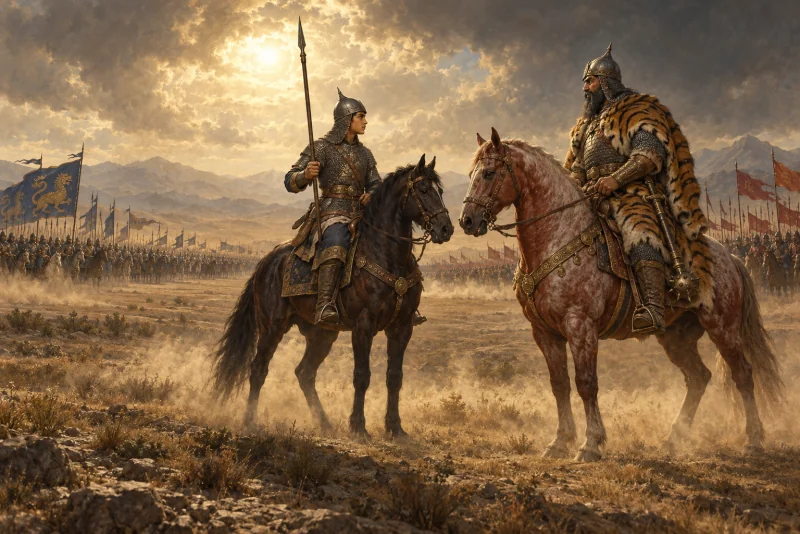
When the Sasanian kings of Iran went to war with the Arab armies in the 630s, their commanders carried a great jewelled banner into battle, the Derafsh Kaviani (درفش کاویانی). Persian tradition said it had begun as a blacksmith’s leather apron, raised on a spear to call the people against a king with serpents on his shoulders.
Was there ever a real Kaviani banner? Yes. Arabic historians of the 10th century describe the great standard of the Sasanian kings, which they call dirafsh kabiyan: the Persians carried it at the Battle of the Bridge and lost it at al-Qadisiyya, in Iraq. Kaveh himself is harder to find. He is not in the Avesta, and the earliest tellings of his revolt we have found are in those same Arabic histories, which say they took it from Persian tradition.
1 The Telling
This is the version of Ferdowsi’s Shahnameh, the Persian epic finished in 1010. Quotations are from the English translation of Arthur and Edmond Warner (vol. 1, 1905), which follows J. A. Vullers’ edition of the Persian text. Where the Moscow critical edition differs, section 3 says so.
1-1 The King’s Testimonial
Zahhak had ruled for a thousand years, feeding the two serpents on his shoulders with the brains of young men, and a dream had warned him of a boy called Fereydun who would overthrow him. He had the name on his lips day and night.
One day, on his ivory throne and in his turquoise crown, he summoned the great men of every province. He had a hidden enemy, he told them, and needed a larger army, of men, divs and peris. First they must sign a scroll: “Our monarch soweth naught but seeds of good, / He ever speaketh truth and wrongeth none.” Young and old, they put their names to the dragon’s document, against their will, because they feared him.
1-2 The Smith at the Gate
Just then a voice was heard at the palace gate, crying for justice. The man was brought in and seated among the nobles, and Zahhak asked who had wronged him. He struck his head and cried: “O Shah! my name is Kawa and I sue / For justice.”
He was a smith, “an inoffensive man, / Upon whose head the Shah is pouring fire”. The king might be of dragon form, but he must still judge this case. If he ruled the seven climes, why should all the toil and hardship fall on them? “I had once / In this world eighteen sons: but one is left!” (a couplet the Moscow edition does not have: see section 3). And now the last son had been taken to feed the serpents.
Zahhak was amazed. He had the young man set free, tried to win the father with kind words, and asked him to sign the testimonial too. Kaveh read it through and turned on the elders: “Confederates of the Div with impious hearts!” They had set their faces towards hell. He would not sign. He tore up the scroll, trampled it, and strode out into the street with his son in front of him.
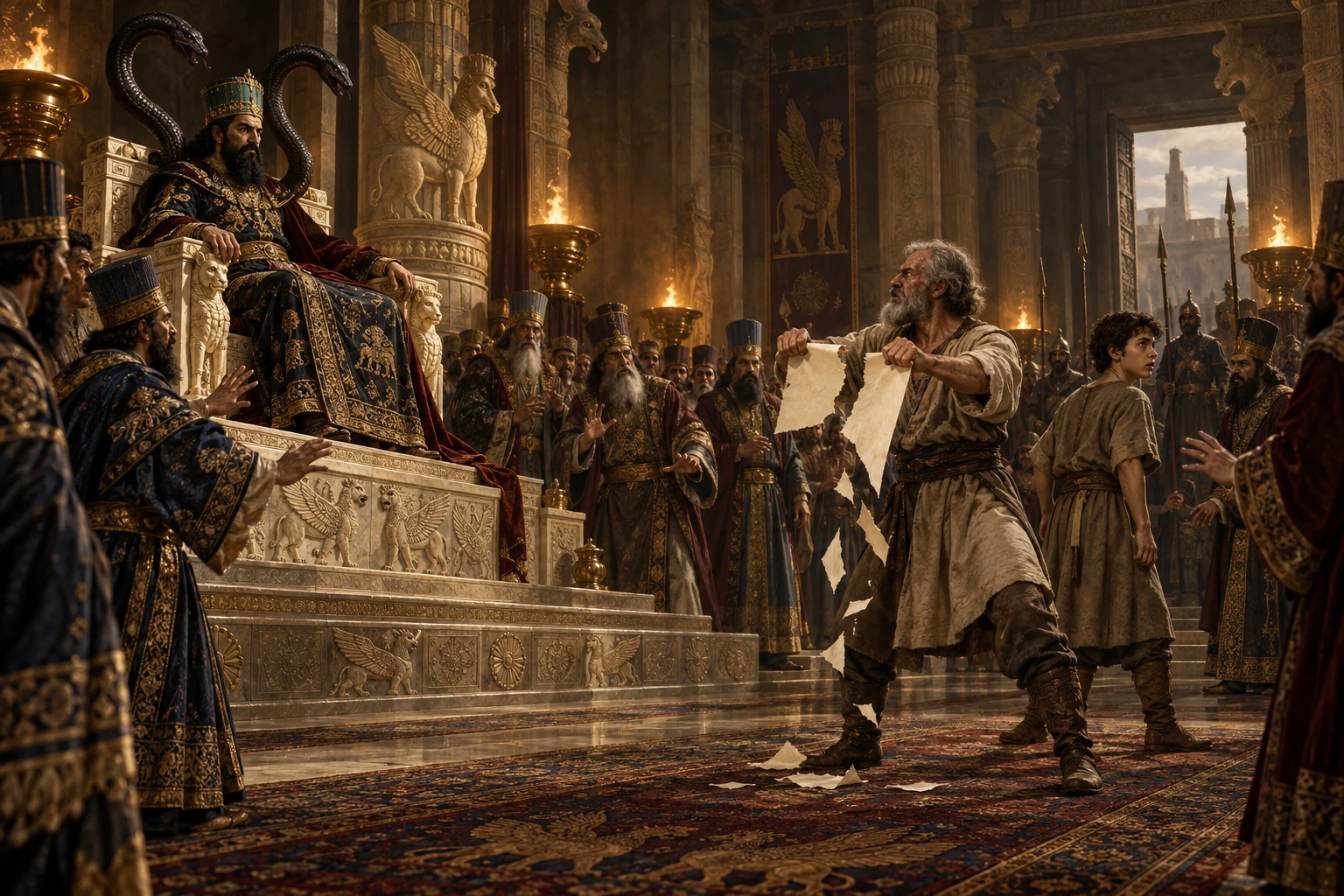
The courtiers asked why the king had let an insolent smith treat him as an equal. Zahhak answered that when Kaveh came in crying out, “A mount of iron seemed to rise betwixt us”, and he could not tell how it would end.
1-3 The Apron on a Spear
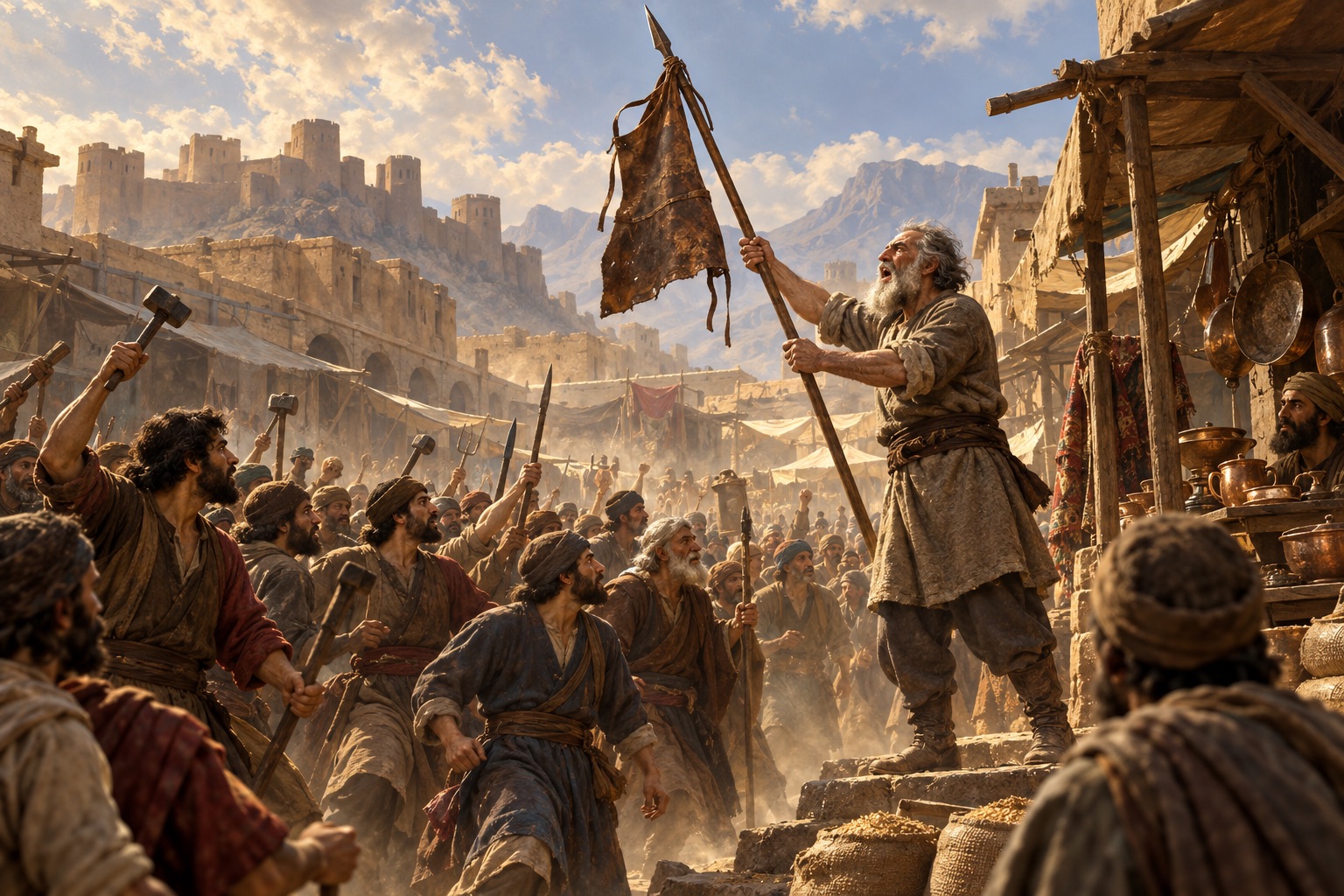
A crowd gathered round Kaveh in the market-place. He took a leather apron, “such as smiths / Wear to protect their legs while at the forge”, stuck it on the point of a spear, and the dust rose over the bazaar. Whoever would escape Zahhak’s fetters, he cried, should come with him to Fereydun, for the ruler here was Ahriman, God’s foe.
“So that poor leather, worthless as it was, / Discriminated friends and enemies.” Many brave men joined him, and he led them to Fereydun.
1-4 The Kaviani Banner
Fereydun saw the apron on the spear and took it as a good omen. He covered it with brocade of Rum, jewels on a golden ground, hung it with red, yellow and violet, and named it the Kaviani banner. From then on every Shah who came to the throne hung more jewels, brocade and Chinese silk on “the worthless apron of the smith”, until “Kawa’s standard grew to be a sun / Amid the gloom of night”.
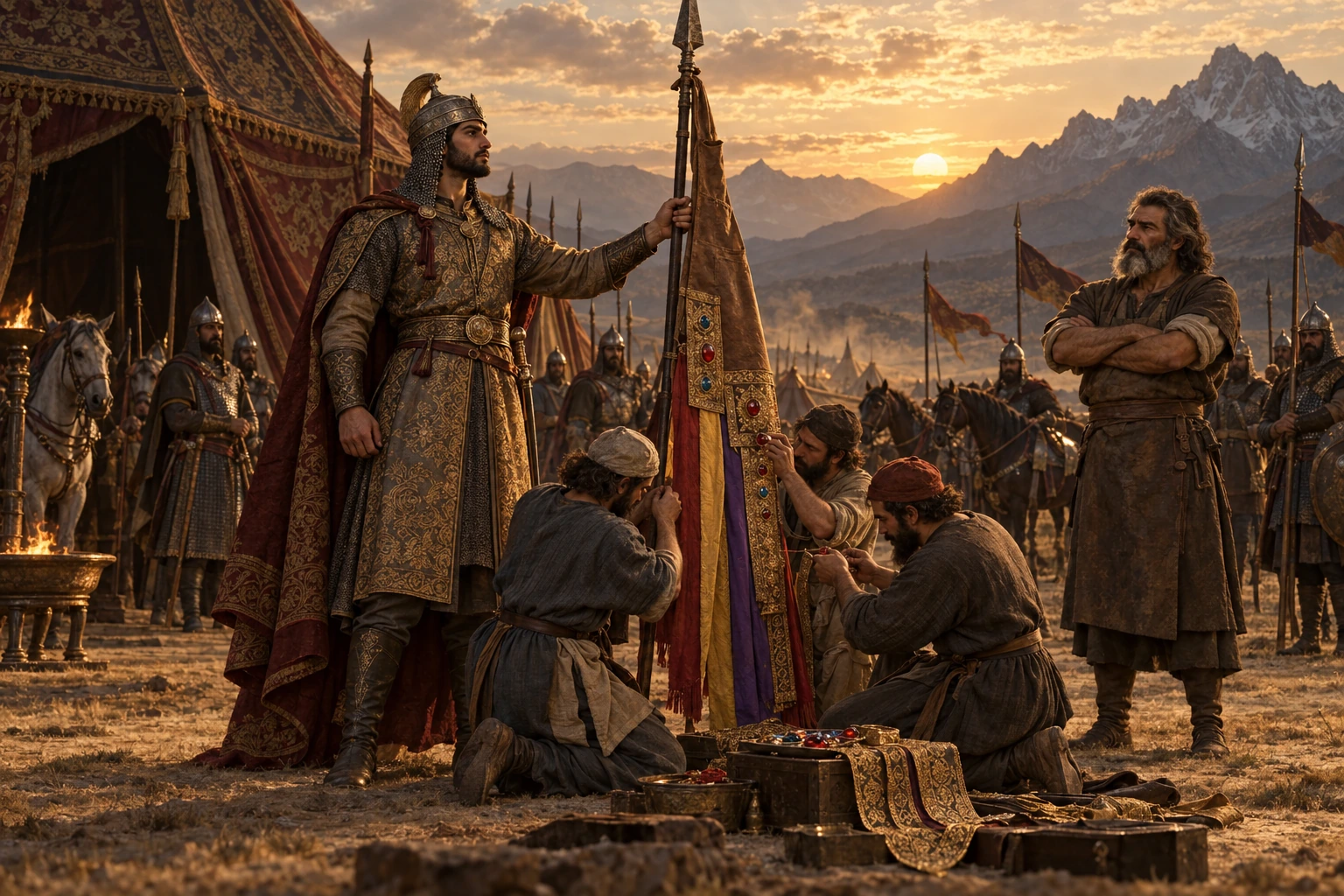
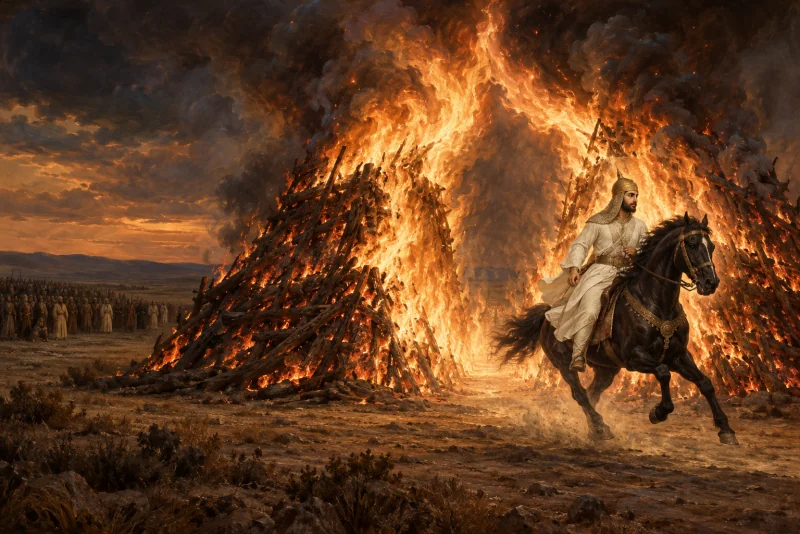
Fereydun had the smiths forge him a mace with an ox’s head and set out, with Kaveh marching in front “with the Kawian standard”. How he took Zahhak’s palace and bound him in Mount Damavand is told in Zahhak’s story. On the first day of the month of Mihr he set the crown on his head, had bonfires lit and ambergris and saffron burned, and “thus he founded / Mihrgan”, the autumn festival of Mehregan.
Kaveh did not become king. Years later, an envoy sent by Fereydun’s rebellious sons reports back from his court: “There Kawa stood, the skilled among the smiths”, with his son Qaren, a captain in war, before him.
2 Where the Story Is Written Down
- The Avesta. The Zoroastrian scripture knows Thraetaona, the smiter of the dragon Azhi Dahaka: the older forms of Fereydun and Zahhak. It has no Kaveh, and Djalal Khaleghi-Motlagh notes in the Encyclopaedia Iranica that the banner is not mentioned directly in the Avesta or in any Achaemenid or Parthian source.
- Al-Tabari’s History of Prophets and Kings, in Arabic, by a scholar who died in 923. Citing “some authorities on the genealogies of the Persians”, it tells of Kabi, “a common man of Isbahan”, two of whose sons were seized for the serpents. He hung “a leather bag” on the end of a staff and called the people out. The banner was honoured more and more “until it became the greatest banner of the kings of Persia”, and was brought out only for the most important campaigns. William Brinner, its translator, notes that Kabi is the Arabic form of Kava, Middle Persian Kavag.
- Al-Mas’udi (d. 956), in his Book of Admonition and Revision, makes Kabi a man of Isfahan, a shoemaker in the French of Carra de Vaux, who raised “un étendard de cuir”, a leather standard, and proposed Afridun, that is Fereydun, as king.
- Ferdowsi’s Shahnameh, finished on 25 February 1010 by Warner’s reckoning. Ferdowsi was a Muslim poet. His epic draws on older Persian tradition but is literature, not Zoroastrian scripture. Of the tellings cited here, it alone has the testimonial and the apron.
- The printed text. Older editions, Jules Mohl’s (Paris, from 1838) and Vullers’, which the Warners translated, differ in places from the Moscow critical edition and Khaleghi-Motlagh’s.
3 Competing Versions
- How many sons? “Eighteen sons: but one is left” is in Mohl’s edition and in Vullers’, which Warner followed. The Moscow critical edition does not have the couplet. There Kaveh only asks how the turn came round to him, that his son’s brain must feed the serpents. In al-Tabari, two of Kabi’s sons are taken.
- A smith or a shoemaker? Ferdowsi calls Kaveh ahangar, a blacksmith. Al-Tabari calls Kabi only a common man of Isfahan; al-Mas’udi makes him a shoemaker, and adds that derafsh, “standard” in old Persian, means a shoemaker’s awl in the Persian of his day.
- An apron, a bag or a skin? Ferdowsi has a smith’s leather apron and al-Tabari a leather bag. Al-Biruni, around 1000, says Kabi’s banner “was made of the skin of a bear, or, as others say, of that of a lion”; the glossary of al-Khwarazmi, Mafatih al-'ulum, says the same.
- Did he want the crown? In al-Tabari, Kabi’s followers argue over who should rule. He refuses, “because he was not of royal lineage”, and tells them to choose a son of Jam, the Jamshid of the epic; then Fereydun appears.
- The mountain between them. Al-Tabari also tells how Kabi led the notables to the tyrant’s gate and spoke so boldly that the king gave way. Afterwards he told his angry mother that the truth had “appeared between me and them like a mountain”. Ferdowsi gives the same image to Zahhak, a mountain of iron.
- Which day? Ferdowsi crowns Fereydun on the first of Mihr. Al-Biruni puts the feast of Mehregan on the 16th, the day Mihr of the month Mihr, in memory of the joy when Fereydun came forward after Kabi’s attack, and “the Great Mihrajan” on the 21st, for the binding of Zahhak. Al-Mas’udi says Fereydun founded the festival on the anniversary of Zahhak’s capture.
4 History and Tradition
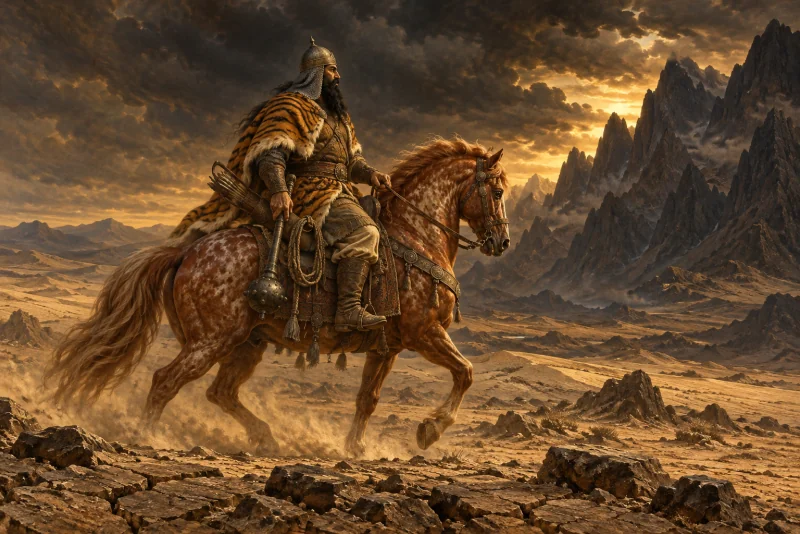
- The banner in battle. At the Battle of the Bridge, on the Euphrates, which al-Tabari puts in the year 13 of the Hijra (634–635), the Persian commander Bahman Jadhuyah came with “the Great Standard (dirafsh kabiyan), the standard of Kisra”, the Persian king. Al-Mas’udi’s Meadows of Gold describes it as panther skin, twelve cubits long and eight wide, on wooden poles fitted one into another, and says the sight of it gave the Persians courage in danger. Al-Tabari’s own description is printed differently in its two English volumes: Khalid Blankinship has “tiger skins” and “a length of eighty cubits by a width of twelve cubits”, while Friedmann’s note reads the same passage as panther skin, “8 by 12 cubits”.
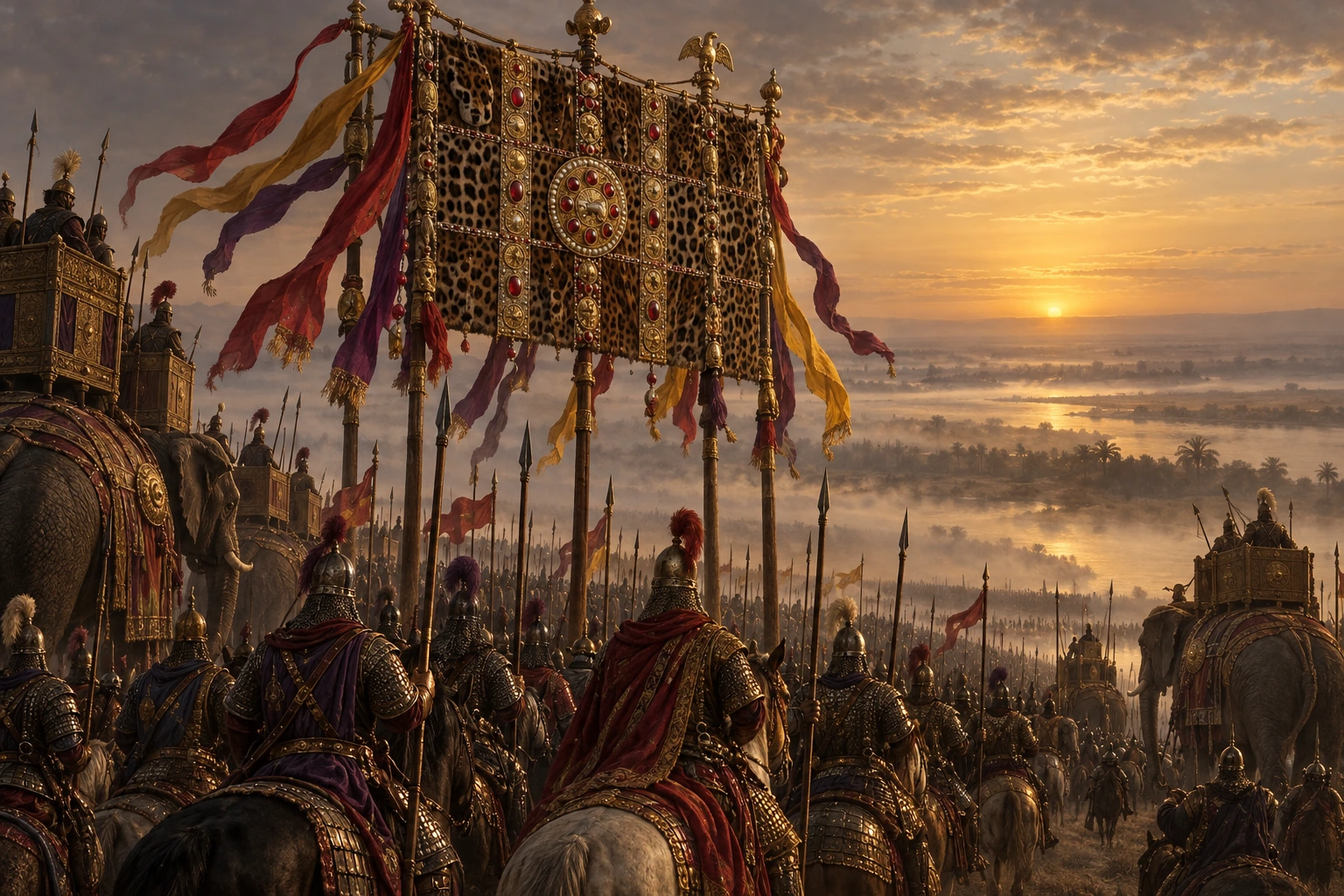
- Lost at al-Qadisiyya. In the decisive battle, which al-Tabari’s sources date to the years 14, 15 or 16 of the Hijra (635–637), the Persian commander Rustam (not the hero of the epic) was killed. Dirar ibn al-Khattab seized the royal banner and “was given thirty thousand [dirhams] in exchange for it; its value was one million and two hundred thousand” (al-Tabari, in Yohanan Friedmann’s translation). Al-Mas’udi says it was covered with rubies, pearls and other precious stones, and counts in dinars. According to Khaleghi-Motlagh, the Persian version of al-Tabari by Bal’ami adds that once the jewels had been removed, the caliph Umar burned the banner.
- Older standards. In the Anabasis, Xenophon’s Greeks saw the Persian king’s “royal standard, a kind of golden eagle on a shield, raised aloft upon a pole”. Some scholars, says Khaleghi-Motlagh, see a Persian banner in a damaged part of the Alexander Mosaic from Pompeii.
- A warning to kings. Al-Mas’udi writes that Ardashir, the first Sasanian king, thinking of what Kabi had done, told the kings after him in his testament to beware of risings led by the ablest and most pious men of the people.
- Mehregan at court. Al-Biruni writes that on the day of Mehregan a warrior stood in the palace court at dawn and called out: “O ye angels, come down to the world, strike the Dews and evil-doers and expel them from the world”, because angels were said to have come down that day to help Fereydun. The festival itself belongs to Mithra.
- In painting. Illustrated Shahnameh manuscripts painted the scene. Harvard Art Museums holds a 17th-century Safavid folio of “King Zahhak and Kava the Blacksmith” (1958.289).
- In print. In 1916 the first issue of Kaveh, a Persian-language periodical published in Berlin, carried an article on Kava and the Kaviani banner; Khaleghi-Motlagh lists it among his sources.
“The Derafsh Kaviani was a blacksmith’s apron” is how the story is usually told, and it is how Ferdowsi tells it. But the 10th-century historians who describe the banner the Persians really carried speak of panther skins, twelve cubits by eight, covered in jewels. Its name may not come from Kaveh at all. Khaleghi-Motlagh glosses derafsh-e kavian as “the standard of the kay(s)”, that is, of the kings, as well as “of Kava”. He also reports that Arthur Christensen argued that the story of the smith arose in the Sasanian period, when the great family of Karen traced its descent from Kaveh’s son.
5 Related Stories
- Zahhak: The King with Serpents on His Shoulders: the tyrant Kaveh defied, the Azhi Dahaka of the Avesta. His crimes, his defeat by Fereydun and his prison in Mount Damavand are told there.
- Jamshid: The King of the Golden Age and His Cup: the king Zahhak overthrew. In al-Tabari, Kabi refuses the crown and tells the people to choose a son of Jam.
- Ahura Mazda and Angra Mainyu: The Two Spirits: in the market-place Kaveh calls Zahhak “Ahriman, God’s foe”, the name of the Evil Spirit of the Zoroastrian tradition.
- Mithra: The God of the Covenant: the god whose name the month of Mihr and the festival of Mehregan carry, the day on which Ferdowsi and al-Biruni place Fereydun’s victory.
6 Sources
- Ferdowsi, Shahnameh, trans. Arthur George Warner and Edmond Warner, The Shahnama of Firdausi, vol. 1 (Kegan Paul, Trench, Trübner, 1905), pp. 154–160, 174–175, 214: archive.org
- Ferdowsi, Shahnameh, Persian text: the Moscow critical edition, “Zahhak”, section 7, with its page image and note 13 (p. 62); and Jules Mohl’s edition, vol. 1 (Paris, 1838): Ganjoor, Persian Wikisource
- al-Tabari, The History of al-Tabari: vol. 2, Prophets and Patriarchs, trans. William M. Brinner (SUNY Press, 1987), pp. 7–9; vol. 11, The Challenge to the Empires, trans. Khalid Yahya Blankinship (SUNY Press, 1993), p. 188; vol. 12, The Battle of al-Qadisiyyah and the Conquest of Syria and Palestine, trans. Yohanan Friedmann (SUNY Press, 1992), translator’s foreword and p. 124
- al-Mas’udi, Les Prairies d’or, text and trans. C. Barbier de Meynard and A. Pavet de Courteille, vol. 2 (1863), p. 114, and vol. 4 (1865), pp. 200–201, 224: archive.org, archive.org
- al-Mas’udi, Le livre de l’avertissement et de la revision, trans. B. Carra de Vaux (1896), pp. 123–125: archive.org
- al-Biruni, The Chronology of Ancient Nations, trans. C. Edward Sachau (W. H. Allen, 1879), pp. 207–209: archive.org
- al-Khwarazmi, Mafatih al-'ulum, first discourse, chapter 6, Arabic text: Arabic Wikisource
- Xenophon, Anabasis 1.10.12, trans. Carleton L. Brownson (1922): Perseus
- Djalal Khaleghi-Motlagh, “Derafš-e Kāvīān”, Encyclopaedia Iranica (1994, updated 2011), read in the reproduction on kavehfarrokh.com and, abridged, in The Iranian (1997): kavehfarrokh.com, iranian.com
- Harvard Art Museums, “King Zahhak and Kava the Blacksmith”, folio from a Shahnama manuscript, Safavid period, 17th century (1958.289): hvrd.art
Cover and illustrations: AI-generated images made for Arcana. They are interpretations, not historical artworks.