Siyavash: The Trial by Fire
Falsely accused by his stepmother, Prince Siyavash rode through a mountain of fire and came out unharmed, then chose exile over breaking his word and was killed in the land of his father's enemy. Ferdowsi did not invent him: the Avesta already remembers his murder, and Bukhara had songs of mourning for him.
- Type: epic tragedy, an innocent prince tried by fire and killed in exile
- Culture: Iran and Central Asia: Zoroastrian scripture, the traditions of Bukhara, then the Persian national epic
- Earliest texts: the Avesta, the Zoroastrian scripture, names him as a murdered king (Yashts 9, 13, 17 and 19); the History of Bukhara, written by Narshakhi in 943 or 944, records the songs mourning him; the fullest telling is Ferdowsi’s Shahnameh, finished in 1010 CE
- Key figures: Siyavash, his father Kay Kavus, his stepmother Sudabeh, Rostam, Afrasiab king of Turan, his brother Garsivaz, Piran, Farangis, Kay Khosrow
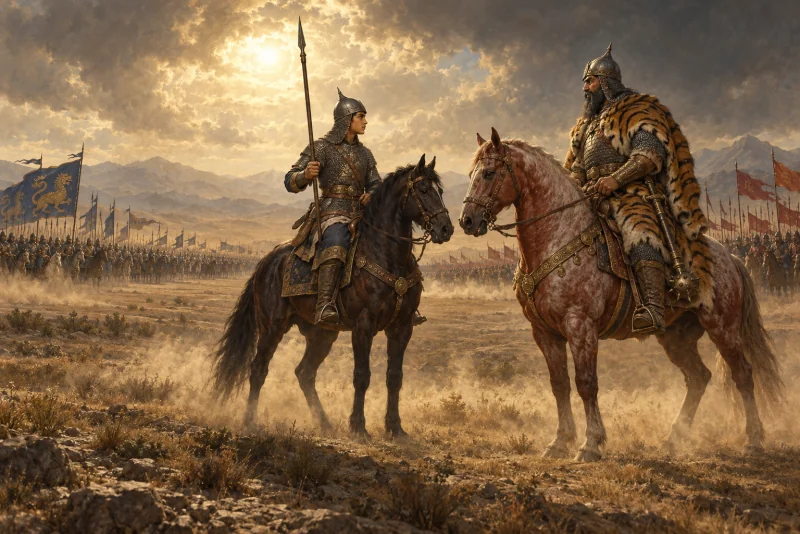
Siyavash is tested twice. The first time, his father makes him ride through a mountain of fire, and he comes out smiling. The second time, his father orders him to break his word, and he goes into exile rather than do it. The exile kills him, and the war fought to avenge him leads, “by a long road”, to the climax of the epic, as its translators Arthur and Edmond Warner put it.
Did Ferdowsi make him up? No. Ferdowsi says at the start that he is retelling an old story “from the words of the dehqan”, a word for the village lords of Persia that also came to mean a historian or a bard. The hymns of the Avesta already pray that “the Turanian murderer Franghrasyan”, that is Afrasiab, be brought in bonds to king Husravah, Ferdowsi’s Kay Khosrow, and killed “to avenge the murder of his father Syavarshana” (Yasht 9.18, in James Darmesteter’s translation). And the History of Bukhara, presented to the Samanid ruler in 943 or 944, says the people there had “special songs” on his killing.
1 The Telling
This is Ferdowsi’s version in the Shahnameh, in the translation of Arthur and Edmond Warner (volume 2, 1906), checked against the Persian text. Short quotations are from the Warners.
1-1 A Prince Raised by Rostam
Out hunting near the border of Turan, the warriors Tus and Giv find a young woman alone in a forest. She has run away from her drunken father, she says; she descends from the hero-king Fereydun, and her grandfather is Garsivaz, the brother of Afrasiab, king of Turan. The two men quarrel over her, and Kay Kavus, the king of Iran, settles the quarrel by marrying her himself. Their son is Siyavash. The astrologers read his stars and grieve: they are “hostile to the boy”. Rostam asks to bring him up and takes him to Zabulistan. There he teaches him to ride, shoot and throw the lasso, to hunt with hawk and cheetah, to judge, to rule and to lead an army. When Siyavash comes back to court, his father watches him for seven years, then gives him a crown and Transoxiana to rule. Soon after, his mother dies.
1-2 Sudabeh
Sudabeh, the king’s wife and the daughter of the king of Hamavaran, sees Siyavash and falls in love with him. She sends for him, and he refuses: “I am no chamberer.” So she asks the king to send him to visit his sisters in the women’s quarters. On his second visit she offers him one of her daughters as a wife, then tells him she wants him for herself and asks him to swear that he will take care of her when the king is dead. Siyavash thinks of her father, who once took Kay Kavus prisoner, and of what an angry queen might do, and answers gently: he will marry her daughter, and think of her “as mother only”. At the third meeting she tells him her love has lasted seven years, and threatens him. He will not “treat my sire disloyally”, he says. Then she tears her robe and her cheeks, cries out, and tells the king that Siyavash attacked her.
1-3 The Trial by Fire
Kay Kavus questions them both, then smells his son’s hands, chest and arms. Sudabeh smells of wine, rose-water and musk, and Siyavash of none of it. The king believes his son, yet he spares his wife: he thinks of a war with Hamavaran, of how she stayed by him when he was a prisoner there, and of their children. So Sudabeh shows him two stillborn babies, born to a sorceress of her household, and says she lost them because of Siyavash. The astrologers declare they are not the king’s; the sorceress, threatened with death, confesses nothing. A priest advises that one of the two pass through fire, “because high heaven ordaineth that no harm shall in this way befall the innocent”. Sudabeh says it is Siyavash who must clear himself. He agrees: “I would pass o’er a mountain all aflame.”
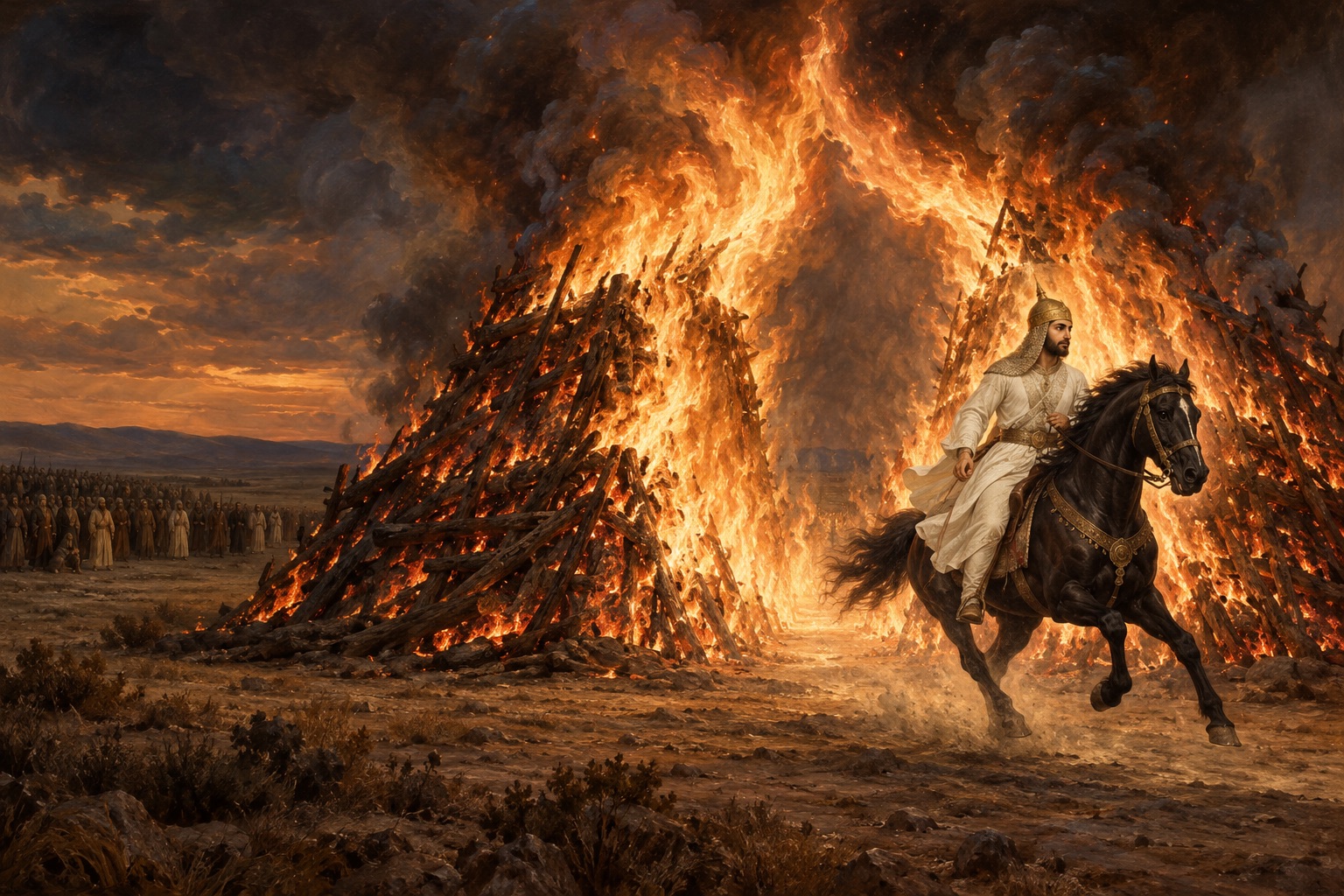
A hundred caravans of camels bring firewood, and two mountains of it rise on the plain, with a path between them barely wide enough for an armed rider. Black naphtha is poured over the wood, and two hundred men set it alight. Siyavash comes in a golden helmet and white clothes, on a black horse, and sprinkles camphor over himself, “so bodies are prepared for burial”. He tells his shamefaced father not to grieve, prays, and rides in. The flames close over his head. Then he comes out on the other side, smiling and unscorched: “Had flame been water he had not been wetted.” Sudabeh, who has watched from the palace roof, tears her hair.
1-4 The Broken Peace
Kay Kavus sentences Sudabeh to be hanged. It is Siyavash who asks for her life, thinking that his father would regret her death and blame him for it, and the king, “who had been seeking some excuse for mercy”, agrees. In time he loves her again, and she works against Siyavash in secret.
When Afrasiab invades Iran, Siyavash asks to lead the army, hoping to escape Sudabeh and his father’s distrust, and Rostam goes with him. They take Balkh. Then Afrasiab dreams of his own death, and his sages warn him that if he fights Siyavash and kills him, revenge will lay Turan waste. He asks for peace. Siyavash and Rostam demand a hundred of his kinsmen as hostages and the cities he holds; Afrasiab sends the hostages and withdraws from Bukhara, Sughd, Samarkand and Chach.
Kay Kavus is furious. He orders his son to send the hostages to him in chains, to be put to death, and to attack; or else to hand the army to Tus and come home. Siyavash weighs it. He has sworn by God. If he sends the hostages, his father will hang them; if he fights, he breaks his oath; at home, Sudabeh is waiting. He sends the hostages back to Afrasiab, leaves the army to be handed over to Tus, and looks for a refuge. On the advice of Piran, his general, Afrasiab invites him to Turan and promises to treat him as a son.
1-5 In Turan
Afrasiab comes out on foot to meet him. They play polo together, and the king laughs with pleasure at his skill. Piran gives Siyavash his daughter Jarireh as a wife, and later persuades the king to give him his own daughter, Farangis. Afrasiab grants him a province, and Siyavash builds two cities: first Gang Dezh, then Siyavashgerd, whose halls he has painted with Kay Kavus and Rostam on one side and Afrasiab, Piran and Garsivaz on the other. Yet he knows how it will end. Riding with Piran, he says that he will be killed, “though guiltless”, by the king, through a slanderer’s words, and that Iran and Turan will go to war over his blood.
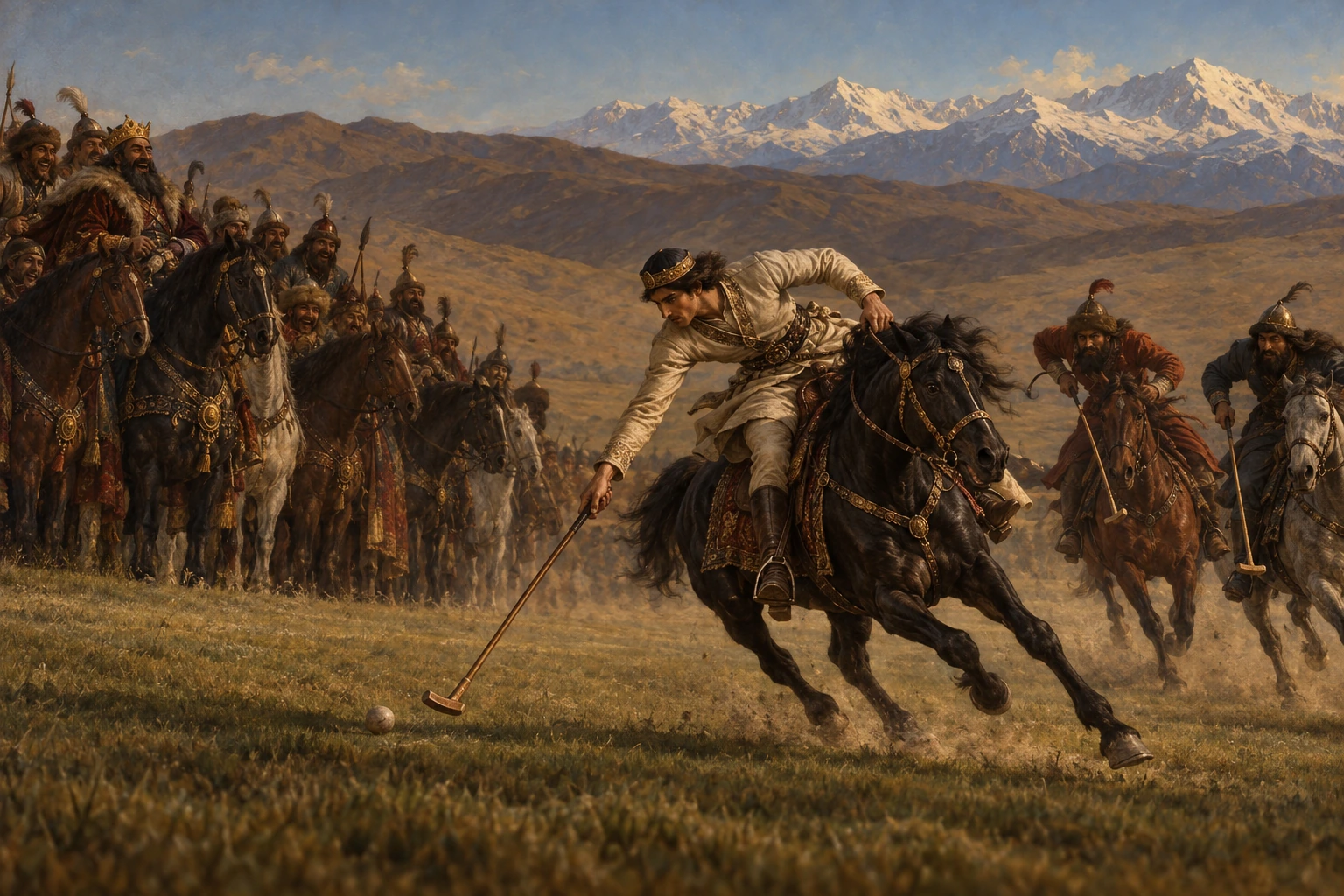
Afrasiab’s brother Garsivaz comes to visit Siyavashgerd. Before his eyes Siyavash shoots through five coats of mail, then unhorses two Turanian champions, Garuy and Damur, and carries one of them to Garsivaz as if, says the poet, “He carrieth a bird!” Garsivaz goes home sullen. At court he tells his brother that Siyavash is in league with Kay Kavus, with Rum and with Chin. Afrasiab hesitates: “if we persecute the guiltless, how shall the Judge of sun and moon approve?” In the end he sends Garsivaz to invite Siyavash to court. Garsivaz tells Siyavash, in tears, that the king is enraged and that he had better write than come. Then he rides back and tells Afrasiab that Siyavash would not even read his letter. Afrasiab calls out his army.
1-6 The Death of Siyavash
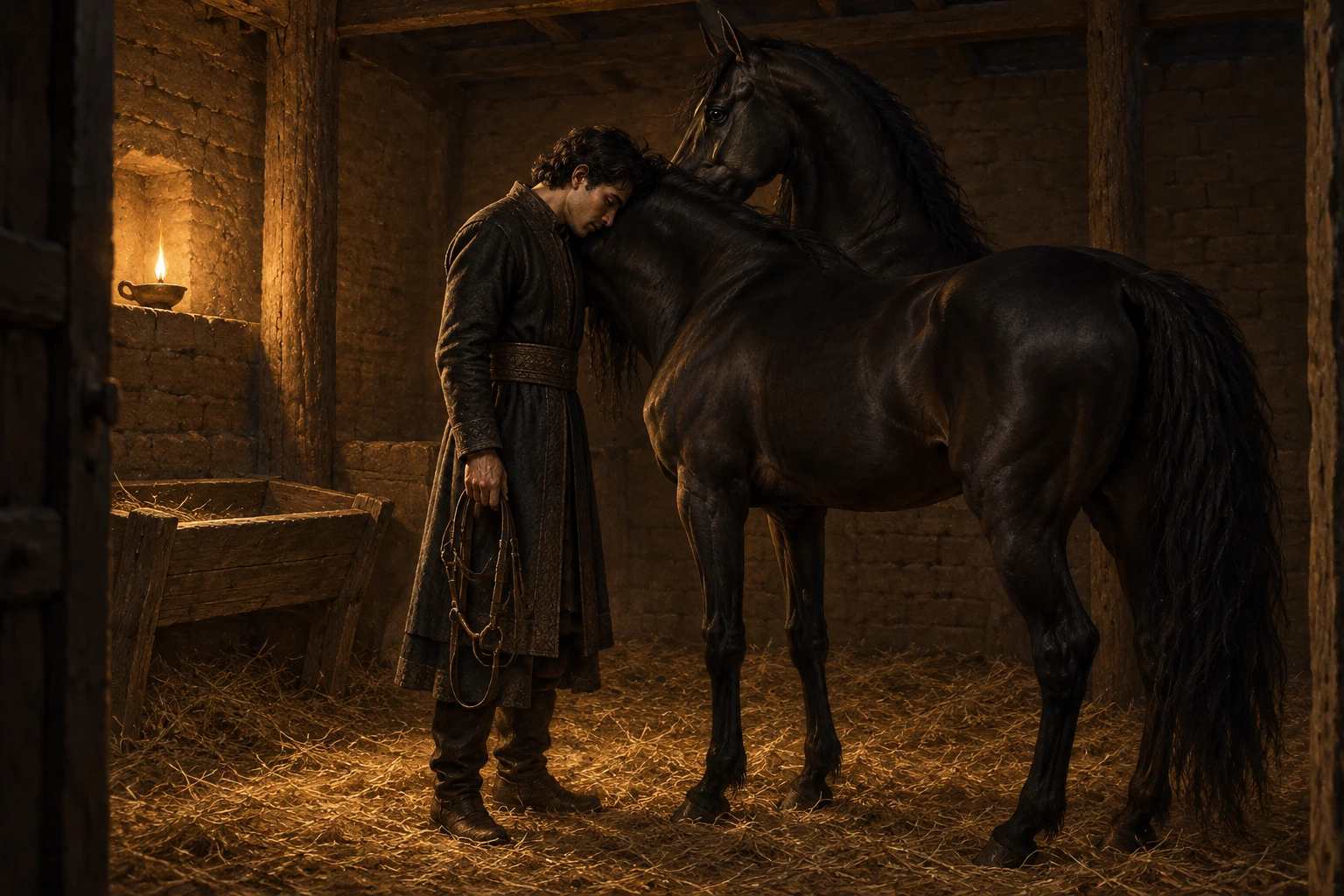
Siyavash dreams of a burning mountain across a river and of Afrasiab blowing on the flames that consume Siyavashgerd. He tells Farangis, five months pregnant, to name their son Kay Khosrow, and foretells that Piran will save her and that a man from Iran will take them both to the Oxus. Then he leads his black horse Behzad out of the stable, takes off its bridle, and whispers to it to wait for Kay Khosrow and carry him to his revenge.
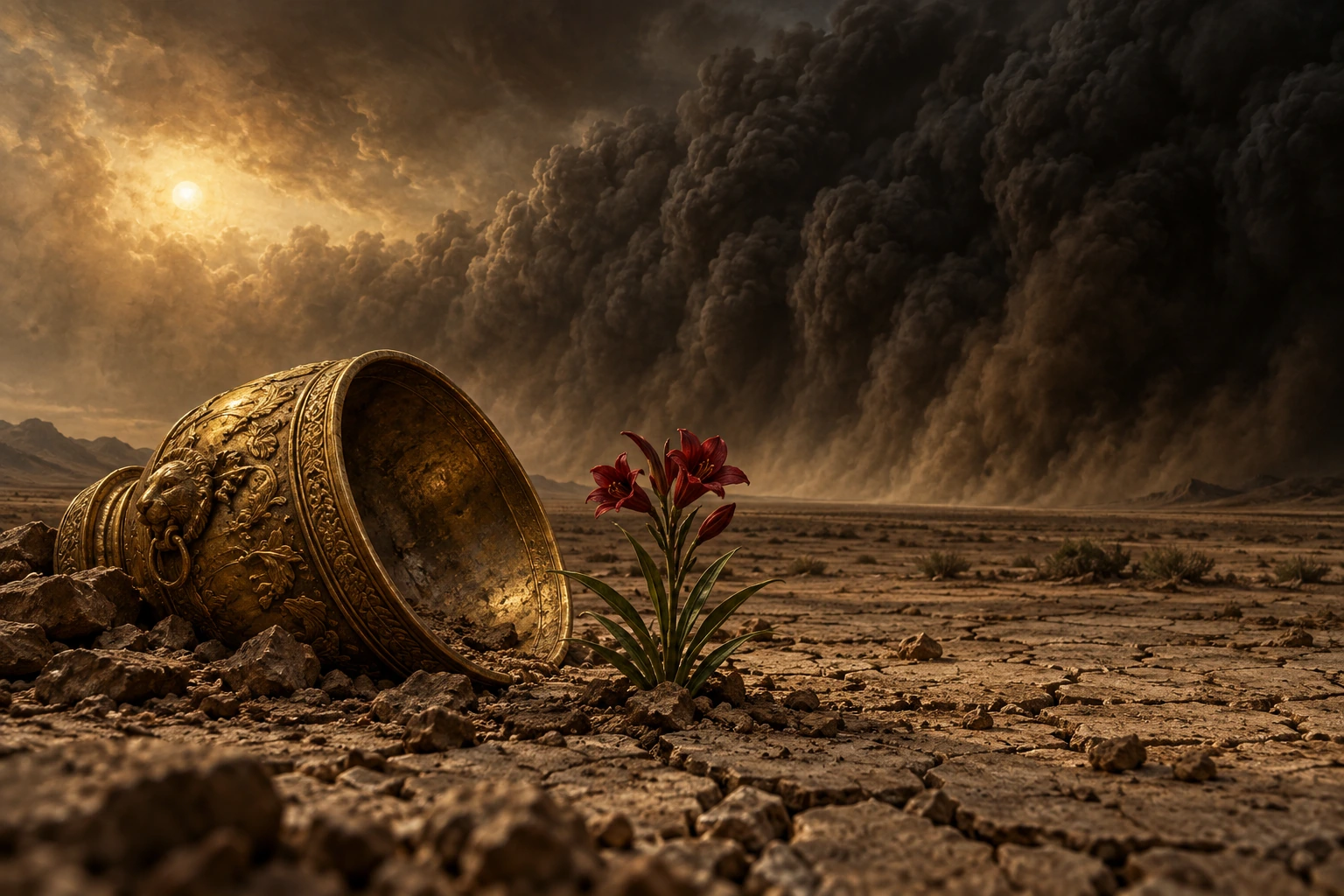
He rides out with his thousand men and meets Afrasiab’s army. He will not draw his sword against the king; his men are killed, and he falls wounded from his horse. Garuy binds his hands. Piran’s brother Pilsam begs Afrasiab to wait for Piran, and Farangis comes on foot to plead, but Garsivaz presses him, and the king gives the order. Garuy drags Siyavash by the hair to the ground where he and Garsivaz had shot at the target, sets a golden basin on the earth, and cuts off his head. The blood is poured out where Afrasiab ordered, and a storm of black dust hides the sun and the moon. “From that blood presently there sprang a plant,” runs the Warners’ text, “for it is called ‘The Blood of Siyawush.’” The Moscow edition does not have these lines (section 3).
1-7 The Son and the Revenge
Afrasiab orders his daughter beaten until she loses the child. Piran rides for two days and nights to stop it and takes Farangis to his house in Khotan, where Kay Khosrow is born; in a dream, Siyavash tells Piran the news. Afrasiab has the boy raised by shepherds, and when he is brought to court, the child answers every question with nonsense, as Piran taught him, and the king dismisses him as a fool.
In Iran, Rostam comes to court covered in dust: “A woman’s talk hath murdered Siyawush.” He drags Sudabeh from the women’s quarters and kills her with his dagger, while Kay Kavus sits silent on his throne. Then he invades Turan and rules it for seven years. Later the warrior Giv searches Turan for seven more, finds Kay Khosrow, and brings him and Farangis home; the young prince rides Behzad, who has waited for him. As king, Kay Khosrow carries the war into Turan. Piran falls in battle, Garuy is captured and put to death, and at last the hermit Hom catches Afrasiab, and Kay Khosrow kills him and Garsivaz.
2 Where the Story Is Written Down
- The Avesta never tells the story. It remembers the murder and the revenge.
- Among the kings who held the royal glory, the hymn of the glory names “Kavi Syavarshan” (Yasht 19.71), and the hymn to the guardian spirits honours “the holy king Syavarshan” (Yasht 13.132).
- Haoma prays to the goddess Drvaspa that he may bind “the Turanian murderer Franghrasyan” and bring him to king Husravah, “to avenge the murder of his father Syavarshana” (Yasht 9.17–18). Husravah makes the same prayer (9.21–22), both pray again to the goddess Ashi (17.37–42), and in the end “put in bonds Frangrasyan and Keresavazda” (19.77).
- The Warners identify Franghrasyan as Afrasiab and Keresavazda as Garsivaz; Haoma, the god of the sacred drink, becomes the hermit Hom of the Shahnameh.
- Middle Persian books. The Bundahishn gives the line of descent: “by Kay Kaus was Siyavakhsh begotten; by Siyavakhsh was Kay Khosraw begotten” (31.25). The Menog-i Khrad says the good that came from him was “the begetting of Kay Khosraw, and the formation of Kangdez” (27.57–58), the fortress Ferdowsi calls Gang Dezh.
- Narshakhi’s History of Bukhara was written in Arabic and presented to the Samanid ruler Nuh ibn Nasr in 943 or 944. Only a Persian version survives: translated by al-Qubavi in 1128–29, then abridged in 1178–79 by Muhammad ibn Zufar, who added material from other books. One passage says the people have “special songs” on the killing of Siyavash, which musicians call Kin-i Siyavush, “the revenge for Siyavush” in Richard Frye’s note. A second passage, which cites a book called the Treasury of the Sciences, says Siyavash built the citadel of Bukhara and was buried in it, by the gate of the straw-sellers.
- Ferdowsi’s Shahnameh. The Japanese scholar Kuroyanagi Tsuneo writes that Ferdowsi began around 980, worked mainly from the prose Shahnameh of Abu Mansur, and finished in 1010. It is literature of the Islamic period that draws on old tradition, not Zoroastrian scripture. Ferdowsi opens Siyavash’s story by saying he is fifty-eight years old.
- A history in Arabic, the Ghurar akhbar muluk al-Furs, was written for Nasr, a brother of Sultan Mahmud of Ghazna, at about the same time as the Shahnameh. Its editor, Hermann Zotenberg, published it in 1900 under the name of al-Tha’alibi. It tells the story more briefly, and differently in places.
3 Competing Versions
- Who killed him? In Ferdowsi, Garuy, son of Zereh (the Warners’ “Gurwi the son of Zira”), on a sign from Garsivaz. In the Arabic Ghurar, Garsivaz kills him with his own hand. The Avesta puts the blame on Franghrasyan and binds Keresavazda beside him.
- The plant. The couplets about the plant are in the text the Warners translated, whose margins give the pages of Vullers’ edition. They are missing from the Moscow edition’s text as Ganjoor publishes it. In the Ghurar, the blood is poured on the plain, a violent wind rises and darkness covers the earth, and nothing is said of a plant.
- The ordeal. In Ferdowsi, a priest proposes that one of the two pass through the fire. In the Ghurar, they say both must; Siyavash says nothing and Sudabeh refuses. Zotenberg also notes that there the sorceress confesses.
- Garsivaz’s own blood. Ferdowsi’s text makes Siyavash’s mother a granddaughter of Garsivaz, so the man who destroys Siyavash is his great-grandfather. The Warners noted that Ferdowsi lets this legend stand beside the others without adjusting them, and took it as a sign that he followed his sources. In the Ghurar, the mother simply dies soon after the birth.
- Kay Khosrow and Cyrus. The Warners compared Kay Khosrow’s childhood with Herodotus’ story of Cyrus the Great: a grandfather king warned by dreams, a daughter’s son ordered away, a herdsman who brings him up. “In the Shahnama we have Afrasiyab for Astyages, Farangis for Mandane, Siyawush for Cambyses, Khusrau for Cyrus, and Piran for Harpagus.”
- The stepmother. A queen who desires her husband’s son, is refused and accuses him is an old pattern: Joseph and Potiphar’s wife in Genesis 39, Phaedra and Hippolytus in Greek tragedy. The Warners wrote that the temptation of Siyavash “will suggest many a parallel to the reader”, and in 2023 Leila Mirmojarabian and Shahla Mehdikhani compared Siyavash with Hippolytus, in Racine’s Phèdre, using Vladimir Propp’s method. We have found no scholar who argues that one story was borrowed from another.
4 History and Tradition
- The mourning in Bukhara. The History of Bukhara says that every year, before sunrise on New Year’s day, each man brought a cock to the grave of Siyavash and killed it there; the Magians, that is the Zoroastrians, honoured the place. Its lamentations were “known all over”, and singers called them “the lamentations of the Magians”. In his notes, Frye quotes Mahmud al-Kashghari’s dictionary of the Turkic languages: every year the fire-worshippers went to the place near Bukhara where Siyavash was said to have been killed, wept there and made sacrifices.
- A melody. In Persian dictionaries, Kin-i Siyavush is also the twentieth of the thirty melodies named by the famous musician Barbad, as Frye notes after the Burhan-i qati’.
- An era in Khwarazm. Al-Biruni, writing about 1000 CE, says the people of Khwarazm once counted their years from “the coming of Siyawush ben Kaika’us” to their country and the rule of Kay Khosrow and his descendants, until they began counting by the reigns of their kings.
- Dragon’s blood. In Persian, khun-i siyavushan, “the blood of Siyavash”, is the name of dragon’s blood, the red resin. Steingass’s dictionary of 1892 also gives Brazil wood, “the fruit of a tree growing in Hazramaut”, a gum from Abyssinia, grape-wine and “a ruddiness in the sky”.
- Savushun. The first modern novel in Persian by a woman, Simin Daneshvar’s Savushun (1969), takes its title from the mourning for Siyavash: the word means “mourners of Siyavash”, Joobin Bekhrad writes in the Los Angeles Review of Books. In it the heroine watches a village passion play of his death.
Some retellings say that after the fire, Kay Kavus let Sudabeh go unpunished because he loved her. That was his choice earlier, when he had smelled his son’s hands. After the fire, Ferdowsi has him sentence her to the gallows, and it is Siyavash who saves her life.
5 Related Stories
- Rostam and Sohrab: The Father Who Killed His Son: in the Shahnameh, Sohrab’s story comes just before Siyavash’s. The same Kay Kavus who withholds the antidote from Rostam’s dying son sends his own son into the fire, and Rostam, who raised Siyavash, takes the revenge for him.
- The Simurgh: The Great Bird of the Alborz: when Siyavash comes out of the fire unharmed, Sudabeh claims he used “all Zal’s own sorceries”. Zal is Rostam’s father, the boy the Simurgh raised.
- The Seven Labours of Rostam: The Short Road to the White Div: the earlier adventure in which Kay Kavus marches rashly on Mazandaran and Rostam has to rescue him. When Siyavash dies, Rostam tells the king: “The noxious weeds that thou hast sown, O king! Are fruiting now!”
- Mithra: The God of the Covenant: the Avesta’s hymn to Mithra commands: “Break not the contract”, not even one made with an unbeliever. Siyavash goes into exile rather than break a treaty with his father’s enemy, though in Ferdowsi he swears by God, not by Mithra. We have found no scholar who connects the two; we link them for the theme.
6 Sources
- Ferdowsi, Shahnameh, trans. Arthur George Warner and Edmond Warner, The Shahnama of Firdausi, vol. 2 (Kegan Paul, Trench, Trübner, 1906), pp. 188–342, and vol. 4 (1909), pp. 126–138: archive.org, archive.org
- Ferdowsi, Shahnameh, Persian text of the Moscow edition, “Siyavash”, sections 1–22: Ganjoor
- Avesta: Yashts 9, 10, 13, 17 and 19, trans. James Darmesteter (Sacred Books of the East, American edition, 1898): avesta.org, avesta.org, avesta.org, avesta.org, avesta.org
- Bundahishn, chapter 31, trans. E. W. West (Sacred Books of the East 5, 1897); Menog-i Khrad, chapter 27, trans. E. W. West (Sacred Books of the East 24, 1885): avesta.org, avesta.org
- Narshakhi, The History of Bukhara, trans. Richard N. Frye (Mediaeval Academy of America, 1954), pp. 17 and 23, the introduction, and notes 82, 86 and 110: archive.org
- Al-Tha’alibi (attributed), Histoire des rois des Perses, ed. and trans. Hermann Zotenberg (Imprimerie nationale, 1900), preface, pp. vi–vii and xxx–xxxi, and text, pp. 184–185 and 210–211: archive.org
- Al-Biruni, The Chronology of Ancient Nations, trans. C. Edward Sachau (W. H. Allen, for the Oriental Translation Fund, 1879), pp. 40–41: archive.org
- F. Steingass, A Comprehensive Persian-English Dictionary (1892), pp. 488, 549, 713, 717 and 1070: Digital South Asia Library
- Leila Mirmojarabian and Shahla Mehdikhani, “Application of Vladimir Propp’s Theory for the Comparative Analysis of the Story of Siavash and Hippolyte”, Literary Arts 15, no. 3 (2023): doi.org
- Joobin Bekhrad, “Iran Under Pressure, Again: What a 50-Year-Old Persian Classic Tells Us About the Country’s Predicament Today”, Los Angeles Review of Books, 2 August 2019: lareviewofbooks.org
- Kuroyanagi Tsuneo, “シャー・ナーメ”, Heibonsha World Encyclopedia and Nipponica, Kotobank; Japanese translations: Kuroyanagi Tsuneo, Ōsho: Perushia eiyū jojishi (Heibonsha, Tōyō Bunko 150, 1969), which includes the book of Siyavash; Okada Emiko, Ōsho: Kodai Perusha no shinwa, densetsu (Iwanami Bunko, 1999), a selection: NDL, NDL
Cover and illustrations: AI-generated images made for Arcana. They are interpretations, not historical artworks.