Mithra: The God of the Covenant
Mithra has a thousand ears and ten thousand eyes, and he rises over the mountains before the sun to see who breaks their word. Zoroastrians still honour him, but the Roman Mithras who killed a bull, and the claim that he was born on 25 December, are another story.
- Type: hymn and myth, a god of the contract and of light
- Culture: Iran, in the Zoroastrian tradition, with roots shared with Vedic India; later, under the same name, a mystery cult of the Roman Empire
- Earliest texts: a Hittite treaty of the 14th century BCE names Mitra among the gods of Mitanni; Mitra in the Rigveda; the Avestan hymn to Mithra, Yasht 10 (the Mihr Yasht); the inscriptions of the Persian king Artaxerxes II (404–358 BCE)
- Key figures: Mithra (Mehr), Ahura Mazda (Ohrmazd), Rashnu, Sraosha, Zarathustra (Zoroaster); Mitra and Varuna in India
Before Mithra was a god, mithra was a word. In the language of the Avesta it means “contract”, and the god who bears it watches over every promise: between two friends, between husband and wife, between a father and his son, between two nations. His Avestan hymn warns that whoever lies to him “brings death unto the whole country”.
Is Mithra the Roman god Mithras who kills a bull? They share a name; how much more they share is disputed. The Mithra of the Avestan hymn never kills a bull. In the 1890s Franz Cumont described the Roman cult as a Persian religion carried west. Since the 1970s, research has stressed how Roman it was. Section 3 sets out who argues what.
1 The Telling
This follows the Avestan hymn to Mithra, Yasht 10, in James Darmesteter’s English translation of 1883, with his section numbers. It is a hymn of 145 sections, not a narrative, and Darmesteter himself found it “not very instructive for mythology”. What it gives is a portrait: what Mithra sees, whom he punishes, and how he rides.
1-1 As Worthy as Ahura Mazda
The hymn opens with Ahura Mazda, the Wise Lord, speaking to Zarathustra: “when I created Mithra, the lord of wide pastures … I created him as worthy of sacrifice, as worthy of prayer as myself” (10.1).
At once he says why this matters. The man who lies to Mithra “brings death unto the whole country”. So: “Break not the contract, O Spitama!”, whether it was made with a fellow believer or with an unbeliever, “for Mithra stands for both the faithful and the unfaithful” (10.2). In a note, Darmesteter explains the hymn’s word for the liar, mithro-druj: it could just as well be translated “who breaks the contract”, because mithra, as a common noun, “means ‘a contract’”.
1-2 A Thousand Ears, Ten Thousand Eyes
Mithra is “truth-speaking, a chief in assemblies, with a thousand ears, well-shapen, with ten thousand eyes, high, with full knowledge, strong, sleepless, and ever awake” (10.7).
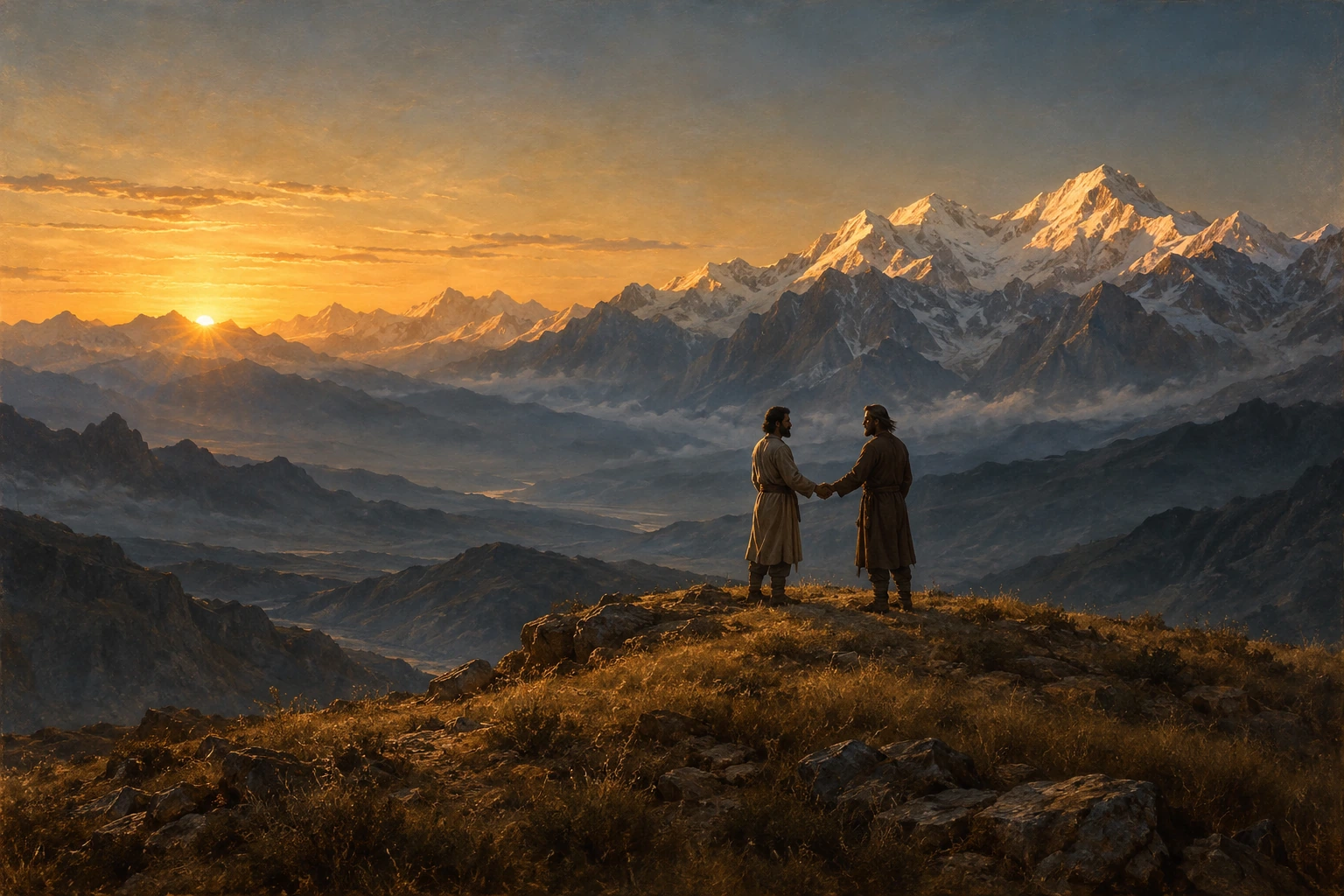
He is the first of the heavenly gods to reach over the mountain Hara, “before the undying, swift-horsed sun”. From its shining summits he looks down on the lands of the Aryans (10.13). Darmesteter identifies Hara with the Alborz, “whence the sun rises”, and notes that Mithra is “closely connected with the sun, but not yet identical with it”.
Ahura Mazda built him a dwelling on that peak, where there is “neither night nor darkness”, no cold wind and no hot wind (10.50). Eight companions sit as his spies “on all the heights”, watching for anyone who has lied to him (10.45). And after the sun has set, Mithra still crosses the whole breadth of the earth (10.95).
1-3 The Contract-Breakers
Nobody may lie to Mithra: not the master of a house, nor the lord of a borough, a town or a province. If one does, Mithra comes “angry and offended” and breaks apart house, borough, town and province, with their lords (10.17–18). A liar who runs cannot get away, and the spear he throws flies back at him (10.20). Mithra takes the strength from his arms, the swiftness from his feet, “the eye-sight from their eyes, the hearing from their ears” (10.23).
To those who keep faith he is the god who “upholds the columns of the lofty house” and gives it herds and sons (10.28). “Thou, O Mithra! art both bad and good to nations,” the hymn says (10.29).
Then it weighs the bonds he guards. Mithra is “twentyfold between two friends”, fiftyfold between wife and husband, “a hundredfold between the father and the son”, and “a thousandfold between two nations” (10.116–117).
1-4 The Chariot
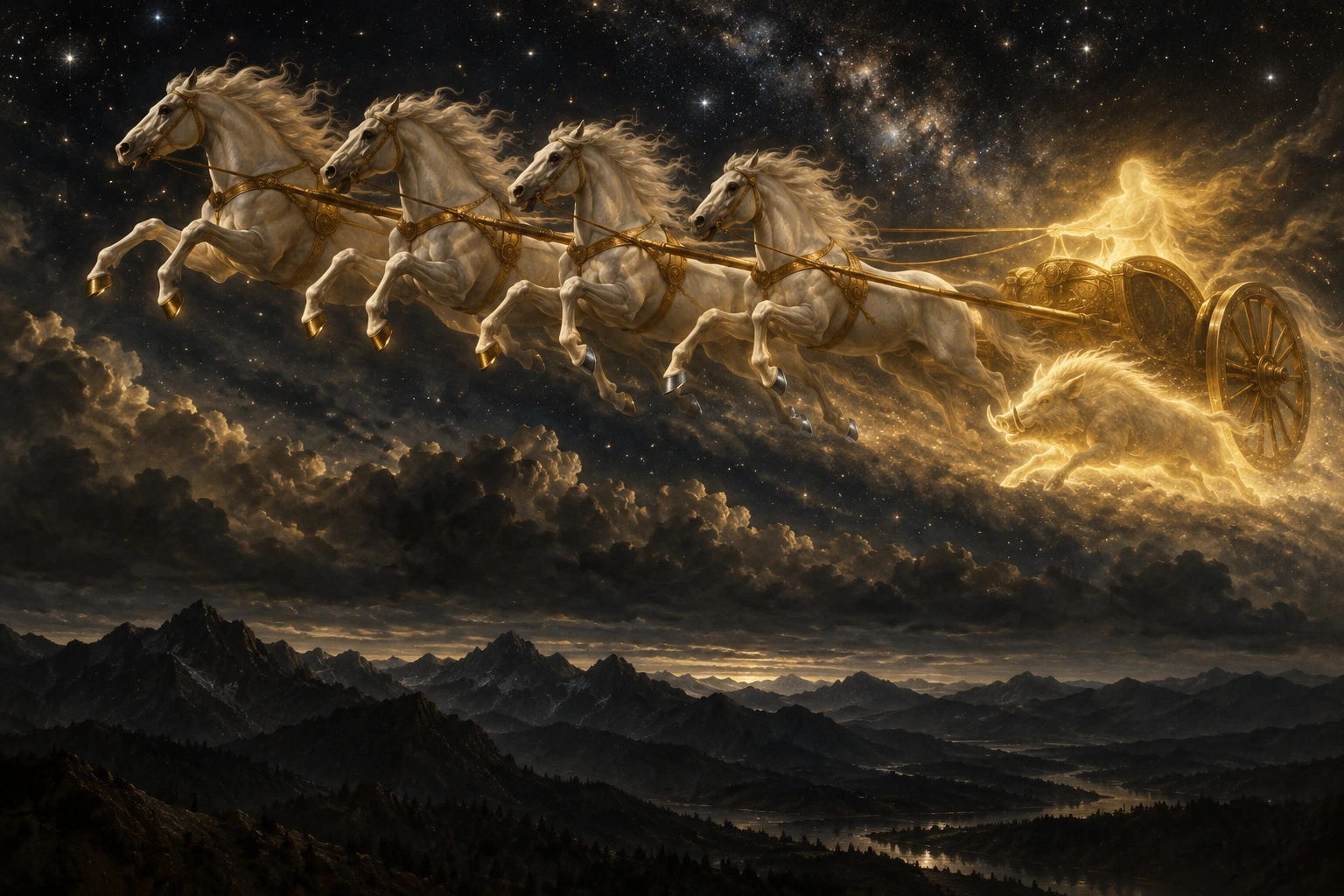
Mithra drives a high-wheeled chariot “made of a heavenly substance”, drawn by four white horses (10.67–68). In a later chapter the chariot is “made of gold”, and the four white stallions are shod with gold on their forefeet and silver on their hind feet (10.124–125).
In one passage the gods Sraosha and Rashnu drive at his right and left (10.100). In the other, Rashnu drives at his right hand, and Chista, dressed in white, at his left. The “cursing thought of the wise” runs beside him in the shape of a wild boar, and behind comes Atar, the Fire, “all in a blaze” (10.126–127). On the sides of the chariot stand a thousand bows, a thousand arrows, a thousand spears and a thousand steel hammers, which fall “upon the skulls of the Daevas”, the demons (10.128–131). All the daevas “flee away in fear” before him (10.69).
1-5 How He Is Worshipped
Ahura Mazda himself offered sacrifice to Mithra in the shining Garo-nmana (10.123). Yet Mithra complains, hands raised to Ahura Mazda, that men do not worship him by his own name, as they worship the other gods (10.54).
So the hymn tells the faithful how: with libations of haoma, with the bundle of twigs called baresma, “with small cattle, with black cattle, with flying birds” (10.119), and only after washing their bodies for three days and three nights (10.122). Its last lines worship “Mithra and Ahura, the two great, imperishable, holy gods” (10.145).
2 Where the Story Is Written Down
- A treaty of the 14th century BCE. When the Hittite king Suppiluliuma I made a treaty with Shattiwaza of Mitanni, the gods called as witnesses included “the gods Mitrashshil, the gods Uruwanashshil, the god Indar, the gods Nashatianna”. That is D. D. Luckenbill’s translation of 1921, which reads the second king’s name as Mattiuaza. Japanese encyclopedias read the four names as Mitra, Varuna, Indra and the Nasatyas, gods of the Rigveda, and call the treaty the oldest dated text that names Mitra.
- The Rigveda. Only one hymn is addressed to Mitra alone (3.59): “Mitra beholdeth men with eyes that close not”, in Ralph Griffith’s translation. Far more often he is paired with Varuna, and the two are hailed as “Guardians of Order, ye whose Laws are ever true” (5.63). The rising sun is “the eye of Mitra, Varuna and Agni” (1.115).
- The Avesta. Darmesteter calls Yasht 10 “one of the longest of the Avesta”. Mithra appears in other hymns too: in the hymn to the royal glory, he is the first to seize the glory when it flies from King Yima (Yasht 19.35). The Khorda Avesta, the Zoroastrian prayer book, has a short litany to him, the Mihr Niyayesh.
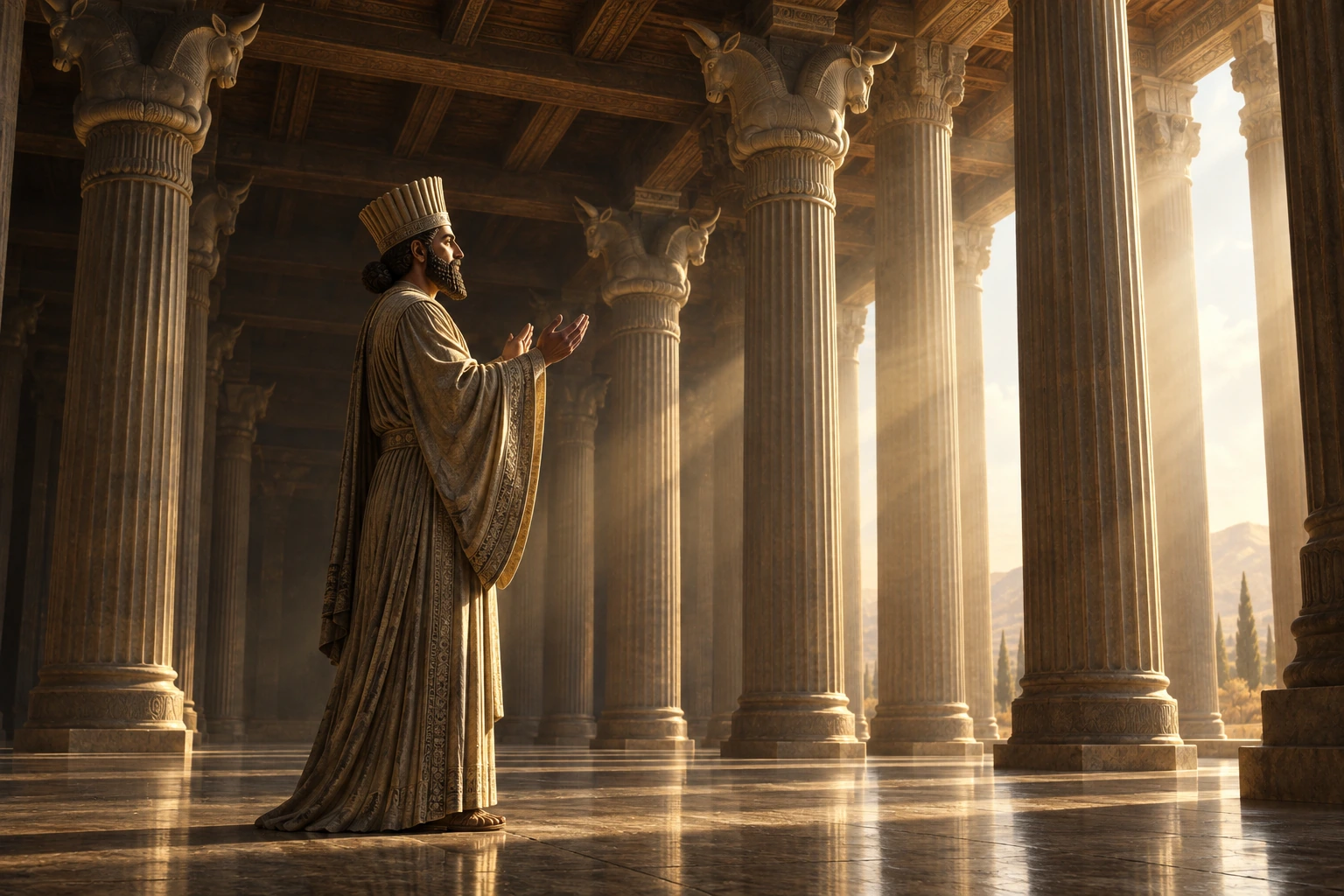
- The Persian kings. Achaemenid kings customarily asked Ahuramazda for support. Artaxerxes II (404–358 BCE) added Anahita and Mithra. On column bases at Susa he records that the audience hall built by his ancestor Darius burned under his grandfather, and that he rebuilt it “by the grace of Ahuramazda, Anahita, and Mithra. May Ahuramazda, Anahita, and Mithra protect me against all evil” (A2Sa). One short inscription from Ecbatana, modern Hamadan, asks only: “May Mithra protect me” (A2Hb).
- Greek writers. Herodotus thought “Mitra” was the Persian name of a goddess, the heavenly Aphrodite (1.131). Xenophon makes Cyrus the Younger, Artaxerxes II’s brother, swear “by Mithres” (Oeconomicus 4). Strabo writes that the Persians worship the sun, “whom they call Mithras” (15.3.13), and that the satrap of Armenia sent the king twenty thousand foals every year “at the time of the Mithracina”, Mithra’s festival (11.14.9). Plutarch reports that between Horomazes and Arimanius, Ahura Mazda and Ahriman, stands Mithras, “For which cause the Persians call Mithras the Mediator” (On Isis and Osiris 46).
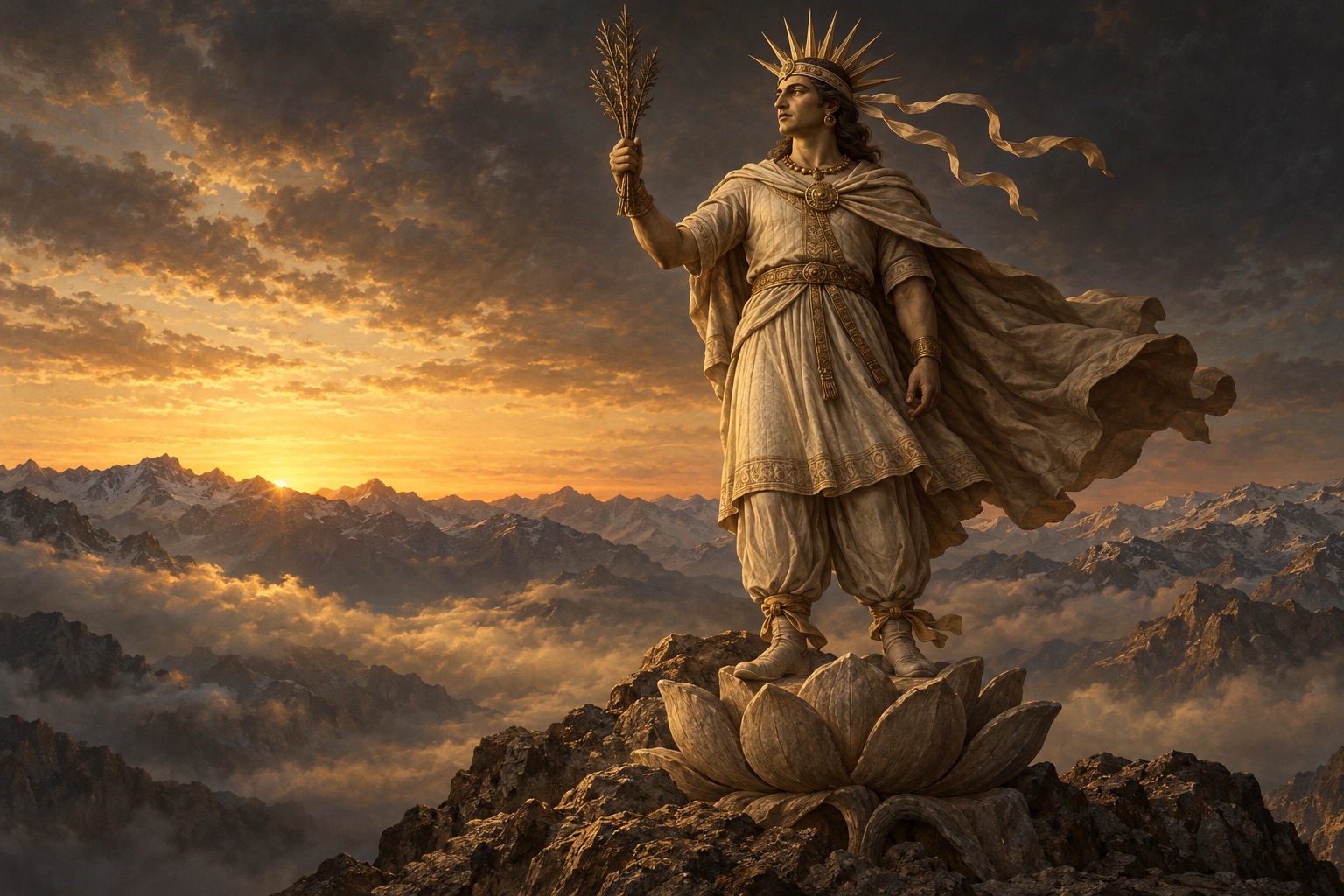
- The Sasanian kings. At Taq-e Bostan, near Kermanshah, a rock relief of the late 4th century CE shows a king receiving the ring of kingship. On the left stands a god with a crown of rays and a bundle of barsom twigs, whom Ernst Herzfeld identified as “the Iranian god of light and sun, Mithra-Mihr”, and he stands on an open lotus flower. Which king it is, and who hands him the ring, is debated (section 3).
3 Competing Versions
- What does the name mean? In the Avesta, mithra as a common noun means “contract” (Darmesteter). The Sanskrit mitra means “friend” (Heibonsha World Encyclopedia). The Japanese Britannica International Encyclopedia gives “measurer” instead.
- The sun, or the light before it? In the hymn Mithra rises before the sun and still travels after sunset. Darmesteter thought he was not yet the sun, “as he became in later times”: in Persian, mihr came to mean the sun. Strabo already equates them, and the Romans called their god “Sol Invictus Mithras”, the Unconquered Sun.
- God or goddess? Herodotus’s Mitra is a goddess. In the Avestan hymn Mithra is a god.
- Who is crowned at Taq-e Bostan?
- Ernst Herzfeld (1920): Ardashir II (379–383) receives the wreath of kingship from Ohrmazd “in the presence of Mihr”. The enemy lying under their feet stands for victory in general, not for any one person.
- Tanabe Katsumi, in the Heibonsha World Encyclopedia: Ardashir II receives kingship from Ahura Mazda and the sun god Mithra.
- Jona Lendering (Livius): the king is Shapur II (309–379), invested by Ahuramazda, standing on the Roman emperor Julian, who died in Shapur’s war in 363.
- A Persian god in Rome? Franz Cumont, in his great collection of the evidence (1896–1899), explained the Roman cult as Zoroastrian teaching carried west by Greek-speaking Iranian priests in Anatolia. His account dominated until the 1970s, when Richard Gordon and others criticised it. Gordon notes that the West shows “neither of the magi, nor of a fire-cult, nor of Mithra as god of the contract”. Reinhold Merkelbach and Manfred Clauss have placed the cult’s founding in Rome or Italy in the 1st century CE. David Ulansey (1989) read the bull-killing scene as a star map of the precession of the equinoxes; Gordon notes that “each one of these claims has been hotly disputed”. Roger Beck (1998) looked to the royal court of Commagene in Anatolia. Gordon himself thinks it more plausible that the Roman cult grew “out of the debris of ancient Iranian cult in Anatolia”. Four themes it shares with the Mihr Yasht, light, strength, the gift of life and fortune, and knowledge of human actions, “cannot be accidental”, he writes.
4 History and Tradition
- Mehregan. Mithra’s feast falls on the day named after him, the 16th, in the month named after him, Mehr, the seventh month of the Zoroastrian year. Al-Biruni, writing around 1000 CE, calls it “a feast of great importance”. Its name, he says, means “the love of the spirit”. Others said Mihr is the sun, which “first appeared to the world on this day”, and the Sasanian kings crowned themselves that day with a crown worked with “an image of the sun”. Al-Biruni also traces the honour of the day to the joy of mankind when Fereydun rose against Zahhak, told in the story of Kaveh, and keeps the 21st, “the Great Mihrajan”, for Zahhak’s binding. The feast once fell at the beginning of winter and later moved, because the calendar was not kept in step with the seasons; Richard Gordon calls it “the Iranian Fall festival”.
- Zoroastrians today. For Zoroastrians in Iran, India and around the world, Mithra, Mehr or Meher, is a yazata, a being worthy of worship, created by Ahura Mazda and presiding over the contract. The 16th day of every month bears his name, the Mihr Niyayesh is in the prayer book, and the traditional name of a fire temple, Dar-e Mihr, means “place of Mihr”.
- Maitreya. Japanese encyclopedias suggest that the name of Maitreya, the Buddha to come (Miroku in Japan, Di Lặc in Vietnam), may echo Mithra’s. Kushan coins of the 1st to 3rd centuries show a sun god Miiro, and Indian Buddhists linked the name with Sanskrit mitra, “friend”.
- The Roman Mithras. In the Roman Empire, small groups of men met in cave-like temples to worship Deus Sol Invictus Mithras, “Mithras, the divine never-vanquished Sun” (Gordon). Christian writers noticed resemblances and explained them the other way round. Justin Martyr, in the 2nd century, writes that Mithras “was begotten of a rock”, that his followers were initiated in a “cave”, and that in their bread and cup of water “the wicked devils have imitated” the Eucharist (First Apology 66; Dialogue with Trypho 70, 78). In the 4th century the emperor Julian wrote: “we also worship Mithras” (Hymn to King Helios).
“Mithra was born on 25 December, and the story of Jesus was copied from his” is a popular claim. In Iran, Mithra’s day is Mehregan, in autumn. The Roman Mithras, says Justin Martyr, “was begotten of a rock”, and we have found no ancient text that gives his birthday. The Roman calendar of 354 marks 25 December “N(atalis) Invicti”, the birthday of the Unconquered, with thirty races; the same book lists “natus Christus in Betleem Iudeae” on that day. Neither entry names Mithras. The link was made by modern writers. In 1795 Charles-François Dupuis wrote that “Mithra and Christ were born on the same day”. Around 1900 Franz Cumont guessed that the Mithraists’ feast had “doubtless” moved to 25 December, yet his own footnote admits that the texts concern Aurelian’s official cult of the Sun and “tell us nothing” about the rites of Mithras.
5 Related Stories
- Ahura Mazda and Angra Mainyu: The Two Spirits: the Wise Lord who, in Yasht 10, created Mithra “as worthy of prayer as myself”, and whom the hymn’s last lines worship together with him.
- Jamshid: The King of the Golden Age and His Cup: when the royal glory flies from King Yima in the shape of a bird, Mithra is the first to seize it (Yasht 19.35).
- Kaveh the Blacksmith: The Apron That Became a Banner: Mehregan, Mithra’s feast, is also remembered as the day of Fereydun’s victory over Zahhak.
- Osiris: The Murdered King Who Rules the Dead: Horus is the target of the same online claim of a birth on 25 December. And Plutarch’s On Isis and Osiris, the fullest telling of the Osiris story, is where the Persians call Mithras “the Mediator”.
6 Sources
- Avesta, Yasht 10 (Mihr Yasht) and Yasht 19.35, trans. James Darmesteter, Sacred Books of the East 23 (1883), digital edition by Joseph H. Peterson from the American edition of 1898: avesta.org, avesta.org
- Khorda Avesta, Mihr Niyayesh, trans. M. N. Dhalla (1908), and the avesta.org glossary: avesta.org, avesta.org
- Rigveda 1.115, 3.59, 5.63, trans. Ralph T. H. Griffith: Wikisource
- Treaty between Suppiluliuma and Shattiwaza (KBo I 1), in D. D. Luckenbill, “Hittite Treaties and Letters”, American Journal of Semitic Languages 37 (1921): archive.org
- Artaxerxes II, inscriptions A2Sa, A2Ha and A2Hb, after Pierre Lecoq: Livius, Livius, Livius
- Herodotus 1.131, trans. A. D. Godley (1920): Perseus; Xenophon, Oeconomicus 4, trans. H. G. Dakyns: Project Gutenberg; Strabo, Geography 11.14.9 and 15.3.13, trans. H. L. Jones (Loeb): LacusCurtius, LacusCurtius
- Plutarch, “Of Isis and Osiris” 46, in Plutarch’s Essays and Miscellanies, vol. 4, ed. W. W. Goodwin (Boston, 1898): Project Gutenberg
- Al-Biruni, The Chronology of Ancient Nations, trans. C. Edward Sachau (London, 1879), pp. 207–209: archive.org
- Ernst Herzfeld, Am Tor von Asien (Berlin, 1920), pp. 60–63; Jona Lendering, “Taq-e Bostan, Relief”: archive.org, Livius
- Richard Gordon, “Mithraism”, Encyclopedia of Religion (2005): encyclopedia.com
- Franz Cumont, Textes et monuments figurés relatifs aux mystères de Mithra, vol. 1 (1899), pp. 325–326; The Mysteries of Mithra, trans. Thomas J. McCormack (Chicago, 1903), pp. 167, 190–191: archive.org, archive.org
- Justin Martyr, First Apology 66 and Dialogue with Trypho 70 and 78, trans. Marcus Dods and George Reith (Ante-Nicene Fathers 1, 1885): New Advent, New Advent
- The Chronography of 354, the calendar (December) and the Depositio martyrum: tertullian.org, tertullian.org; Julian, Hymn to King Helios, trans. Wilmer Cave Wright (Loeb, 1913): archive.org
- Charles-François Dupuis, Origine de tous les cultes, vol. 3 (Paris, 1795): archive.org
- “ミトラ”, “ミトラス教”, “ターク・イ・ブスターン” and “ナーサティヤ”, with entries by Ogawa Hideo and Tanabe Katsumi: Kotobank, Kotobank, Kotobank, Kotobank
Cover and illustrations: AI-generated images made for Arcana. They are interpretations, not historical artworks.