Zahhak: The King with Serpents on His Shoulders
In the Avesta he is a dragon with three heads; in Ferdowsi's Shahnameh he is a king whose shoulders sprout two black serpents that must be fed every night. When Fereydun brings him down at last, an angel stops the final blow, and Zahhak is left in chains inside Mount Damavand.
- Type: myth and epic, the dragon who became a tyrant king
- Culture: Iran: Zoroastrian scripture, then the Persian national epic
- Earliest texts: the Avesta, the Zoroastrian scripture (Yasna 9, Yashts 5 and 19), where he is the dragon Azhi Dahaka; Middle Persian books whose last redactions date to the 9th century; the fullest telling is Ferdowsi’s Shahnameh, finished in 1010 CE
- Key figures: Zahhak (Azhi Dahaka), Iblis (Ahriman), Fereydun (Thraetaona), his mother Faranak, the cow Barmayeh, Shahrnaz and Arnavaz, the cooks Armayel and Garmayel, the angel Sorush
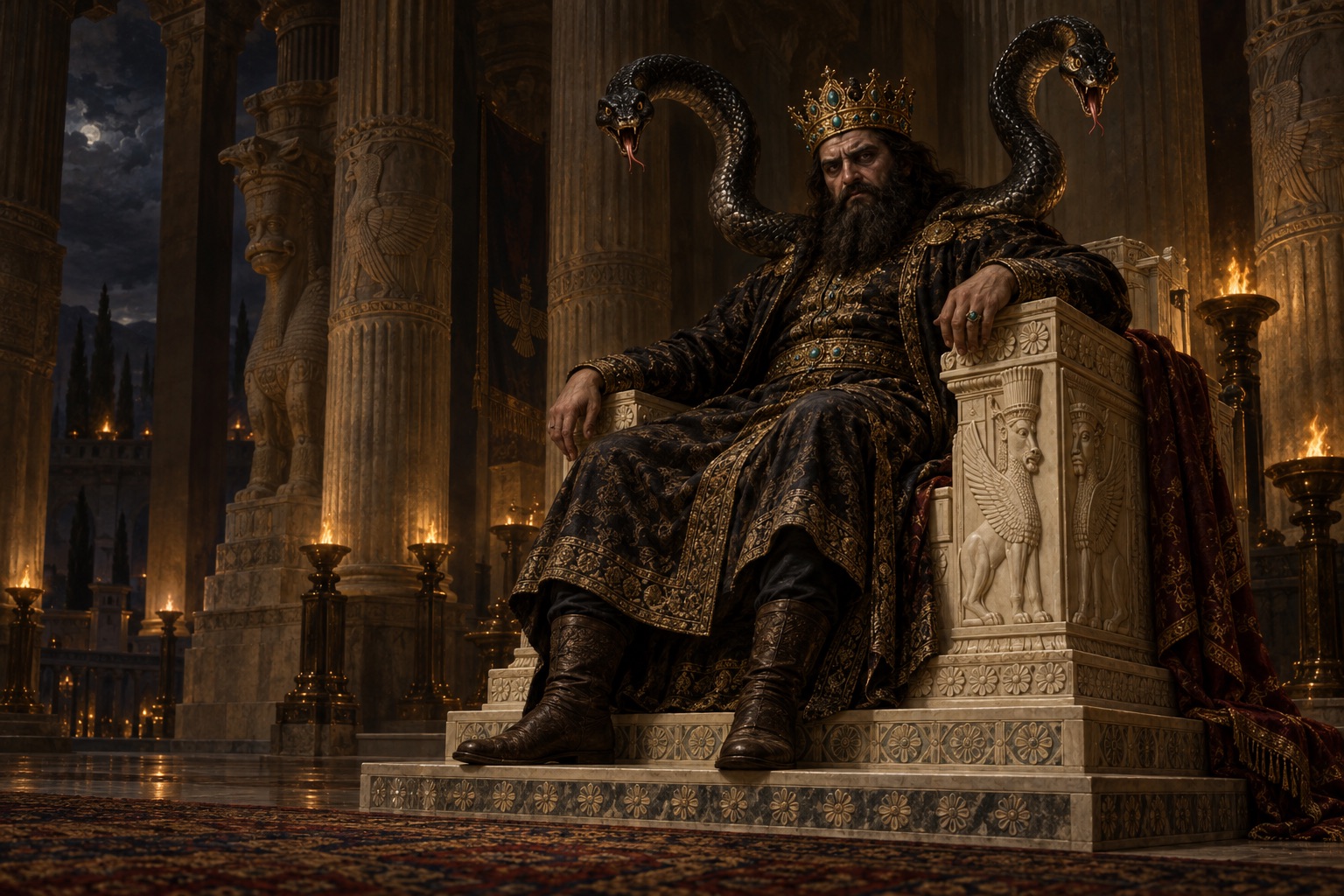
Iran’s most famous dragon is a king. In Ferdowsi’s Shahnameh, two black serpents grow from his shoulders, and for a thousand years they are fed every night on the brains of young men. In the Avesta, the scripture of Zoroastrianism, he was still a monster with three heads. And unlike most dragons, he is not killed at the end of his story.
Why does he have serpents on his shoulders? In the Shahnameh, because the devil kissed them. Iblis, disguised as a cook, asks as his only reward to kiss the king’s shoulders; where his lips touched, two black serpents grow, and when they are cut off they grow back. The scholar Djalal Khaleghi-Motlagh calls them “a reminiscence of his once reptilian body”: in the Avesta, Azhi Dahaka is not a man with snakes but a dragon, and the word aži means both “snake” and “dragon”.
1 The Telling
This is the version of the Shahnameh, the “Book of Kings”, which the poet Ferdowsi finished in 1010. Quotations are from the English translation by Arthur and Edmond Warner (1905).
1-1 The Cook’s Kiss
Among the spear-armed horsemen of the Arabian desert, the poem says, lived a just and pious king named Mardas. He kept a thousand head of every kind of milking beast and grudged their milk to no one. His son Zahhak was brave but rash. People called him Biwarasp: biwar, says Ferdowsi, means ten thousand in the ancient tongue, and he owned ten thousand Arab horses with golden harness.
One day Iblis, the devil, came to him as a friend, made him swear to keep a secret, and told him to take his father’s throne. Zahhak would not shed his father’s blood. So Iblis did it for him. He dug a pit in the garden path where Mardas walked alone before dawn to wash before his prayers, and covered it with branches. The old king fell in, broke his back and died, and Zahhak put on the crown of the Arabs.
Then Iblis came back as a young cook. In those days, says the poem, people did not kill animals to eat; they lived on what the earth grew. Iblis, whom Ferdowsi here also calls Ahriman, the evil spirit of the old Iranian religion, fed the king first on egg yolk, then on partridge and pheasant, then on lamb and fowl, and on the fourth day on a chine of veal with saffron, rosewater, musk and old wine. Delighted, Zahhak told him to name his reward. The cook asked only to kiss the king’s shoulders and lay his face upon them. He kissed them and vanished, and from each shoulder grew a black snake.
Zahhak had them cut off, and they grew again, “like branches from a tree”. Physicians tried every cure. At last Iblis himself came back, dressed as a doctor. Do not cut them, he said; feed them on men’s brains until they sleep. The poet asks whether the demon was not hoping to empty the world of people.
1-2 Two Young Men Every Night
Iran, meanwhile, had turned against its king Jamshid, who had lost the divine glory through his pride. Discontented nobles rode to Arabia and hailed the “king of dragon-visage” as their shah. Zahhak took Jamshid’s throne, and a hundred years later he caught the fugitive king by the sea of China and had him sawn in two (his story is told in Jamshid).
Zahhak reigned for a thousand years. The ways of the wise were hidden and sorcery was honoured. Two women of Jamshid’s house, Shahrnaz and Arnavaz, were dragged to his palace “trembling like a willow-leaf”, and he taught them his own evil arts.
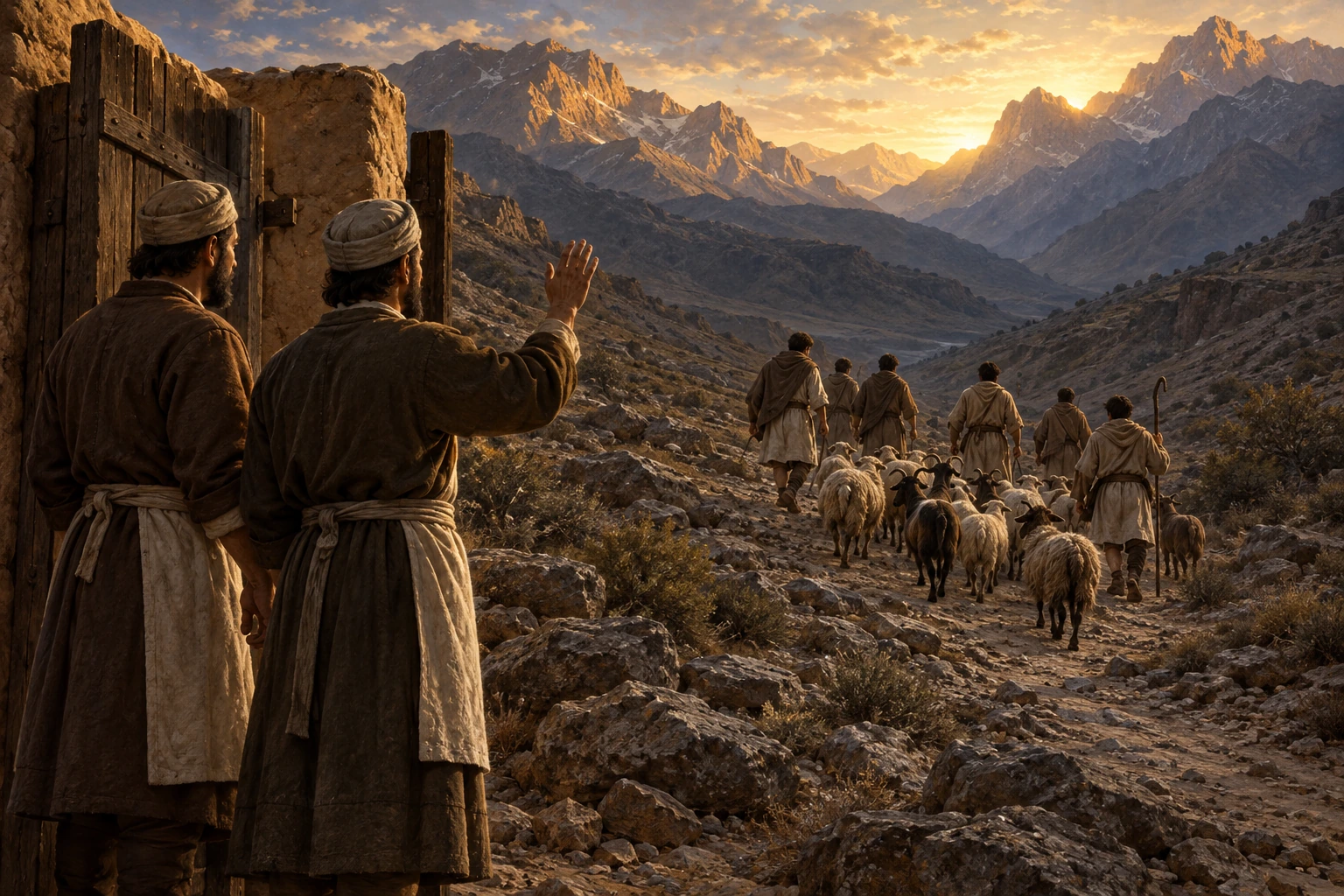
Every night the king’s cook took two young men, of humble or noble birth, killed them, and fed their brains to the serpents. Two good men, Armayel and Garmayel, found a way to save some of them. They learned to cook and were taken into the royal kitchen. When the guards threw the next two young men down before them, they killed one, mixed his brains with a sheep’s, and let the other go: hide, they told him, keep away from towns; the wilds and the mountains are yours. In this way they saved thirty young men a month. When two hundred had been saved, the cooks secretly gave them goats and sheep and sent them out into the wilds. Ferdowsi closes the episode with an origin story: the Kurds, he says, are descended from them.
1-3 The Dream
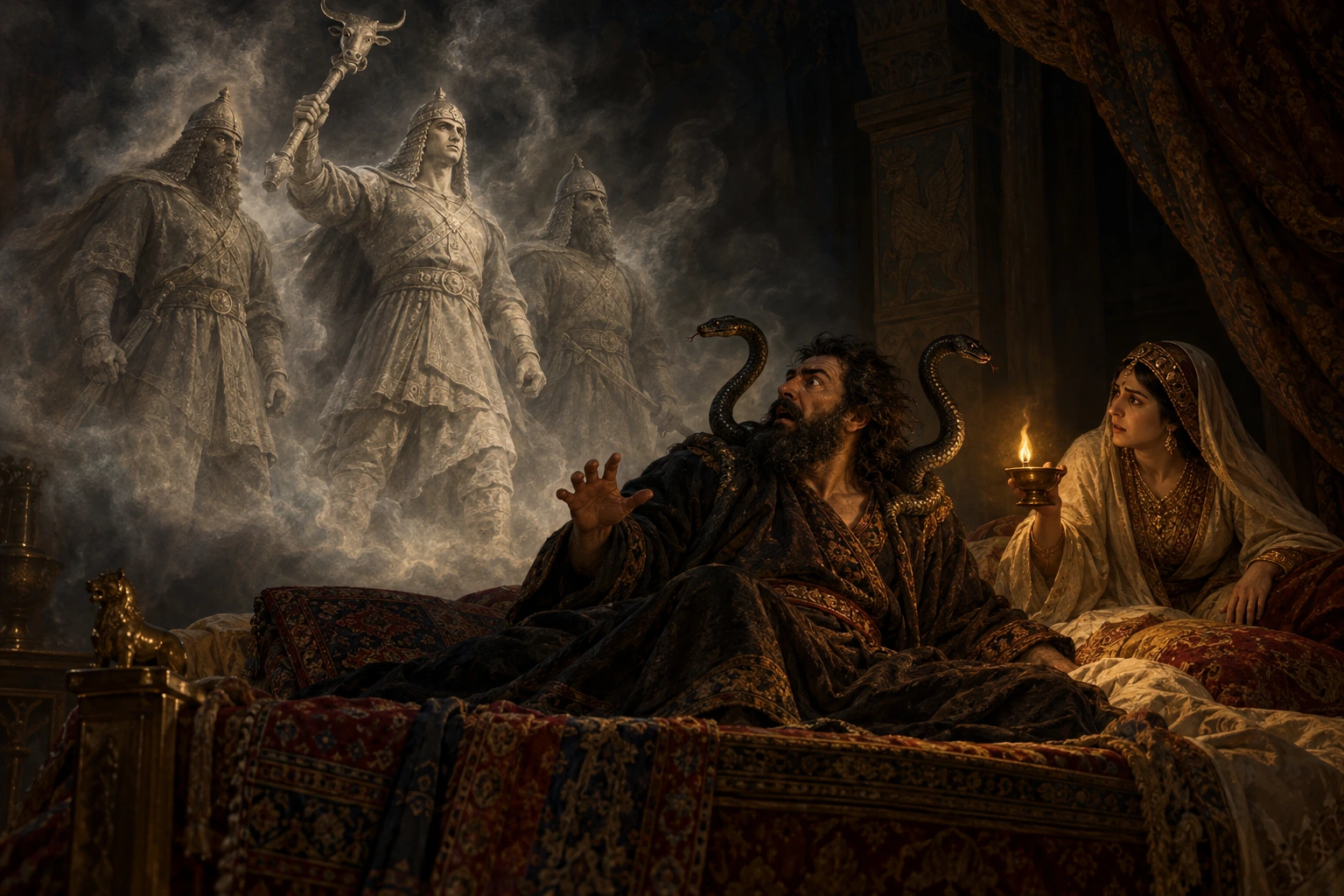
When Zahhak had forty years left to live, he dreamt one night of three warriors. The youngest, in the middle, tall as a cypress and kingly, rushed at him with an ox-headed mace, struck him on the head, bound him and dragged him through the crowd towards Mount Damavand. Zahhak woke screaming. Arnavaz urged him to call his wise men. For three days they dared not speak. On the fourth, threatened with death, the wisest of them, Zirak, told him the truth: a prince named Fereydun, not yet born, would take his throne. Zahhak would kill the boy’s father, and his nurse too, a cow named Barmayeh, and so the boy would take up an ox-headed mace in revenge. Zahhak fainted on his throne.
Fereydun was born, and with him the royal glory that Jamshid had lost. Zahhak’s men caught his father, Abtin, and Zahhak had him put to death. His mother Faranak fled with the baby to a meadow where the wonderful cow Barmayeh grazed, “peacock-hued” from head to foot, and begged its keeper to raise him on her milk. He did so for three years. Then, as the cow grew famous, Faranak carried her son to a holy man on Mount Alborz. Zahhak came to the meadow, killed Barmayeh and all the cattle there, and burned the family’s house to the ground.
1-4 The Ox-Headed Mace
At sixteen Fereydun learned from his mother who his father was, and swore revenge. The rising that gave him an army began at Zahhak’s own court, with a blacksmith named Kaveh, whose story is told in Kaveh the Blacksmith. Fereydun had the smiths forge a heavy mace to a pattern he drew on the ground, with the head of an ox (a buffalo, in Warner’s version). On the march the angel Sorush came to him by night and taught him spells, and when his two elder brothers rolled a boulder down on him as he slept, he stopped it in mid-fall.
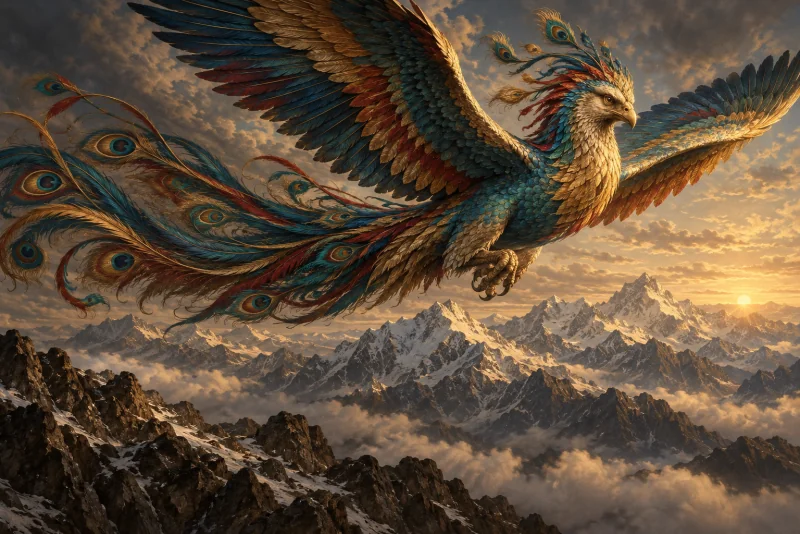
At the Tigris, which the poem calls by its old name, Arvand, the river guards refused him boats, so he plunged into the river on horseback and his men followed. They rode on to Jerusalem, which, the poem says, was called Kang Dezhhukht in the old tongue; there Zahhak’s palace stood. Zahhak was away in India, working sorcery. Fereydun rode in, threw down the talisman Zahhak had raised, cut down the demons inside, sat on the throne, and set Shahrnaz and Arnavaz free.
1-5 Mount Damavand
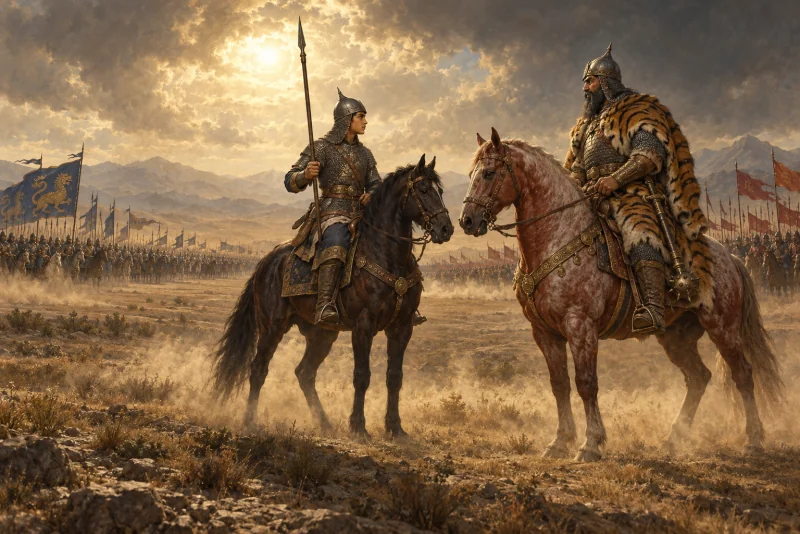
Zahhak’s steward rode off to warn him that a young king was sitting on his throne between his two queens. Zahhak came back with his army of men and demons, and the townspeople fought for Fereydun from the roofs. Then Zahhak slipped away alone, armoured from head to foot so that no one would know him, climbed onto the palace roof with a lasso, and saw Shahrnaz below with Fereydun. Mad with jealousy, he slid down, dagger in hand, to kill the two women. As his feet touched the ground, Fereydun struck him with the ox-headed mace and broke his helmet.
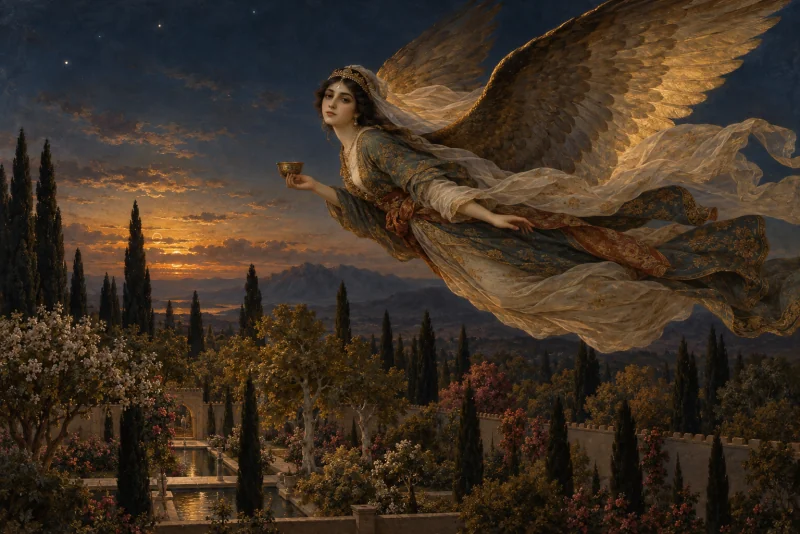
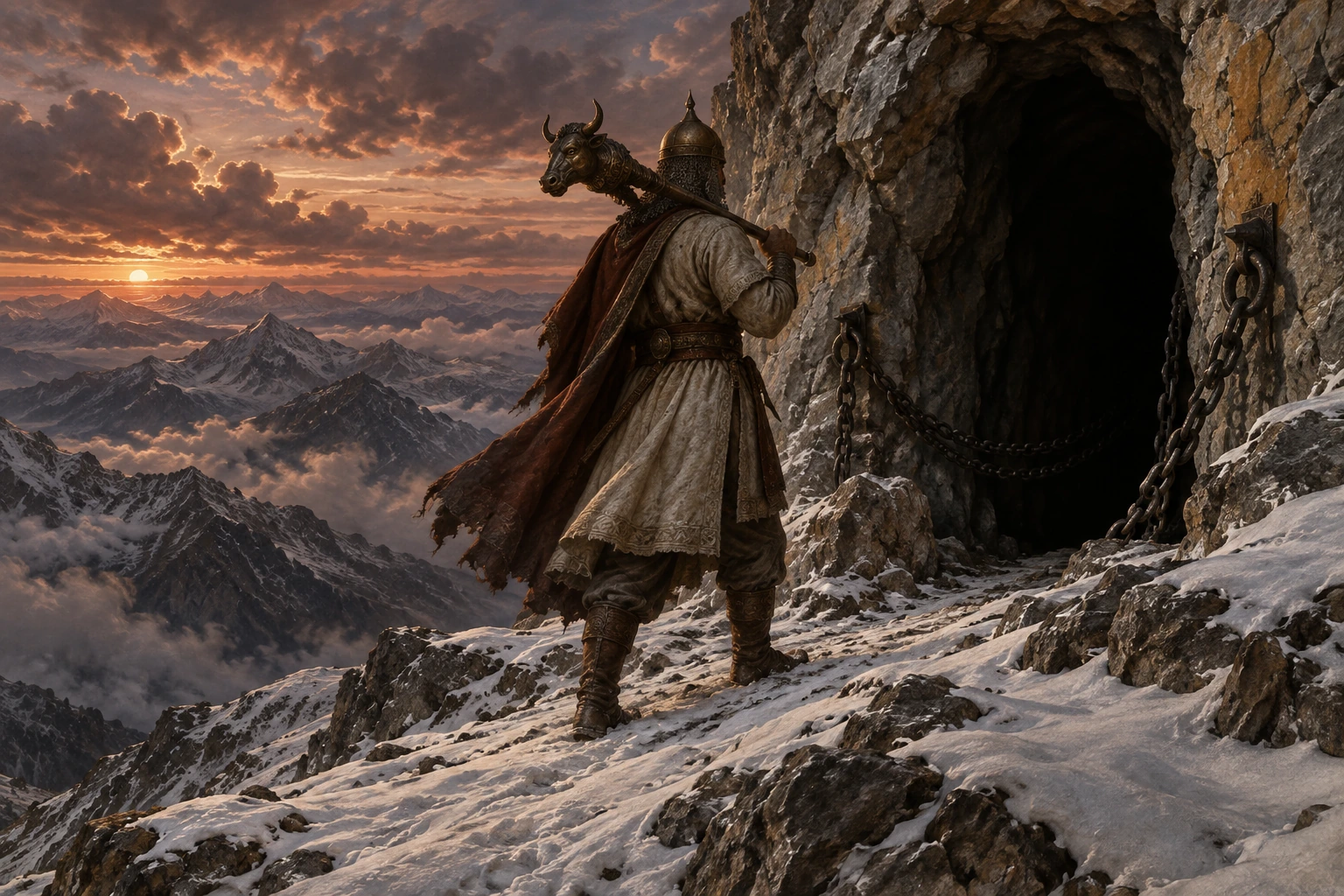
Then Sorush came. “Strike not,” he said in Warner’s translation, “His time hath not yet come”. Fereydun bound Zahhak with a lasso of lion’s hide, tied him onto a camel and led him away into the mountains. He meant to throw him down from a height, but Sorush came again and told him to take his prisoner to Mount Damavand. There Fereydun found a cave so deep that its bottom could not be seen. He fastened Zahhak’s hands to the rock with heavy nails and left him hanging there, so that his torment would last.
2 Where the Story Is Written Down
- The Avesta names Azhi Dahaka in several hymns but never tells his story.
- In the hymn to Haoma (Yasna 9.7–8), Athwya, the second man to press the sacred haoma, is rewarded with a son, Thraetaona, “who smote Azhi Dahaka, three-jawed and triple-headed, six-eyed”, the strongest demon Angra Mainyu (Ahriman) made against the world.
- In the hymn to the waters (Yasht 5.29–35), “the three-mouthed” Azhi Dahaka offers a hundred horses, a thousand oxen and ten thousand lambs to the goddess Ardvi Sura Anahita in the land of Bawri, and asks her to make the seven regions of the earth “empty of men”. She refuses. Thraetaona makes the same offering and asks to overcome him and to carry off his two wives, Savanghavach and Erenavach, “the fairest of body amongst women”. She grants it.
- In the hymn of the royal glory (Yasht 19.46–50), Azhi Dahaka and the fire Atar fight over the glory after it has left Yima, Jamshid’s name in the Avesta.
- The Middle Persian books summarize lost parts of the Avesta and add the details. The Denkard, a 9th-century compendium, retells a lost section about Dahak’s reign (book 9, chapter 21): Fereydun strikes him with his club and he does not die; he hews him with a sword, and at each blow noxious creatures come out of his body; and Ahura Mazda (Ohrmazd) tells him to stop, or Dahak “would be making this earth full of serpents, toads, scorpions, lizards, tortoises, and frogs”. So Fereydun binds him “with awful fetters”. The Bundahishn gives him his thousand-year reign and names his prison: “The Dimavand mountain is that in which Bevarasp is bound” (12.31).
- The Shahnameh runs to about 50,000 couplets. Its first part is the history of Iran’s legendary kings, and Zahhak’s reign stands between Jamshid’s and Fereydun’s. It is literature of the Islamic period that draws on the old tradition, not Zoroastrian scripture. The Warners translated the text edited by J. A. Vullers; scholars now cite the critical edition of Djalal Khaleghi-Motlagh.
- The History of Armenia attributed to Movses Khorenatsi, older than the Shahnameh, already knows the legend. In an appendix to its first book, which the Warners quote in William Whiston’s Latin, it lists, with contempt, the Persian tales of Biurasp Azhdahak: the kiss on his shoulders, the dragons that sprang from it, the people he destroyed to feed his belly, and how Hrudēn (Fereydun) bound him “with bronze chains” and took him to the mountain called Dembavend.
3 Competing Versions
- A dragon or a man? In the Avesta he has three mouths, three heads and six eyes, yet he offers sacrifices like the heroes do. Prods Oktor Skjærvø writes that it is not clear whether he was first imagined as “a human in dragon-shape or a dragon in man-shape”. The Middle Persian books make him a king of Iran between Jamshid and Fereydun. In the Shahnameh, Khaleghi-Motlagh notes, Fereydun “has lost the role of a dragon-slayer”, because his enemy has become a “pseudo-historical person”.
- Where was his palace? The Avesta puts his sacrifice in Bawri, which tradition read as Babylon; the Greater Bundahishn says that “Dahak’s mansion in Babylon was just like a crane”. The Shahnameh puts his palace in Jerusalem.
- Who were Shahrnaz and Arnavaz? In the Avesta, Azhi Dahaka’s two wives. In the Shahnameh, two women of Jamshid’s house: Warner’s translation, made from J. A. Vullers’ text, calls them Jamshid’s sisters; the Moscow edition of the Persian text, on Ganjoor, calls them his daughters. Skjærvø notes that later tradition made them either.
- How old was Fereydun? Sixteen in the Shahnameh. In the Denkard (book 7), he goes out to defeat Dahak at the age of nine.
- Killed or bound? The Avesta says only that Thraetaona “smote” him, and in Darmesteter’s translation of Yasht 19.92 Thraetaona bore the glory “when Azhi Dahaka was killed”. Aḥmad Tafażżolī notes that there, and in one tradition reported by the historian al-Tabari, Thraetaona “seems to have killed” him; the Middle Persian books and the Shahnameh have him bound. The History of Armenia gives both: the Persian tale of the chains, and then its own account, in which the people catch him near the mountain, kill him and throw him into a great pit of sulphur.
- The end of time. In the Zoroastrian books Dahak’s story is not over. The Bundahishn says that Fereydun “was not able to kill him”, and that when he breaks free, the hero Sam “arises, and smites and slays him”. The Greater Bundahishn sets this near the end of the world: Dahak “will be free from fetters” and harm many creatures, and the body of “Karsasp son of Sam” will be raised to “smite Bevarasp with the mace”. Skjærvø explains that this hero, Keresaspa in the Avesta and Garshasp in Persian, is “variously called Sām or son of Sām”.
4 History and Tradition
- A foreign tyrant. The Shahnameh’s Zahhak is the son of an Arab king, and the idea is older than Ferdowsi: the Denkard (book 3) already makes Dahak of Arab race, Skjærvø notes. In Armenia, Movses Khorenatsi identified him with Astyages, king of the Medes. James R. Russell sums it up: “Aždahak is seen thus as the embodiment of foreign tyranny”. These are legends about a legendary king, not an account of any people.
- His names. Zahhak is an Arabicized form of Dahak (Russell). The Middle Persian books often call him Bevarasp, “with ten thousand horses”, the name Ferdowsi explains by his ten thousand Arab horses.
- Before the manuscripts. A terracotta figurine in the Hermitage, probably made in Sogdia in the 7th–8th century, shows an enthroned man in a jewelled tiara with two snakes springing from his shoulders (Russell). On a Sasanian amulet in the British Museum, a hero with a bull-headed mace subdues a demon; the scholar Bivar read it as Fereydun and Zahhak (Tafażżolī).
- In painting. The Shahnameh made for Shah Tahmasp in Tabriz in the 1520s–1530s has a painting attributed to Sultan Muhammad, around 1535, now in the Aga Khan Museum in Toronto (AKM155). Zahhak hangs in his cave near the top of the mountain; below, hunters rest, unaware, and only one man points up at him. The museum reads its moral from the verses beside it: do good, for it is the best monument one can leave behind.
- At Damavand. The Warners noted in 1905 that the people of the town of Damavand, on the mountain’s southern side, kept a feast called the Kurds’ Holiday to mark the death of Zahhak.
“Fereydun killed Zahhak” is how the story is often summed up, and the Aga Khan Museum calls Sultan Muhammad’s painting “The Death of Zahhak”. In the Shahnameh he does not die. Fereydun’s mace breaks his helmet, Sorush stops the next blow, and Zahhak is left hanging alive in Mount Damavand. In the Zoroastrian books he stays there until the end of time, when Keresaspa, not Fereydun, will kill him.
5 Related Stories
- Jamshid: The King of the Golden Age and His Cup: the king whose throne Zahhak takes. Both the Avesta and the Middle Persian books tie the two together: Azhi Dahaka fights for the glory that has left Yima, and in the Bundahishn it is Spitur “who, with Dahak, cut up” Jamshid.
- Kaveh the Blacksmith: The Apron That Became a Banner: the revolt that brings Fereydun to Zahhak’s palace.
- Ahura Mazda and Angra Mainyu: The Two Spirits: in the Avesta, Azhi Dahaka is the strongest demon Angra Mainyu made against the world, and his escape and death belong to the Zoroastrian end of time.
- Fenrir: The Wolf the Gods Bound: Skjærvø suggests that Dahak, chained in Damavand and freed at the end of time, “may reflect” Indo-European myths of monsters bound and released at the world’s end, and gives the Fenris wolf as an example. He adds that detailed connections are “difficult to establish”.
6 Sources
- Ferdowsi, Shahnameh, trans. Arthur George Warner and Edmond Warner, The Shahnama of Firdausi, vol. 1 (Kegan Paul, Trench, Trübner, 1905), pp. 135–170, with the Warners’ notes and their quotation of Movses Khorenatsi in William Whiston’s Latin (p. 144): archive.org
- Ferdowsi, Shahnameh, Persian text, “Zahhak”, sections 1–12: Ganjoor
- Avesta: Yasna 9, trans. L. H. Mills, revised by Joseph H. Peterson; Yasht 5 and Yasht 19, trans. James Darmesteter (Sacred Books of the East, American edition, 1898): avesta.org, avesta.org, avesta.org
- Denkard, book 9, chapter 21, trans. E. W. West (Sacred Books of the East, 1897): avesta.org
- Bundahishn, chapters 12, 29 and 34, trans. E. W. West (Sacred Books of the East 5, 1897); Greater Bundahishn, chapters 29 and 33, trans. Behramgore Tehmuras Anklesaria (Bombay, 1956): avesta.org, avesta.org
- Prods Oktor Skjærvø, Djalal Khaleghi-Motlagh and James R. Russell, “AŽDAHĀ”, Encyclopaedia Iranica III/2 (1987): iranicaonline.org
- Aḥmad Tafażżolī, “FERĒDŪN”, Encyclopaedia Iranica IX/5 (1999): iranicaonline.org
- Aga Khan Museum, “The Death of Zahhak”, folio from the Shahnameh of Shah Tahmasp (AKM155): agakhanmuseum.org
- Japanese translations: Kuroyanagi Tsuneo, Ōsho: Perushia eiyū jojishi (Heibonsha, Tōyō Bunko 150, 1969); Okada Emiko, Ōsho: Kodai Perusha no shinwa, densetsu (Iwanami Bunko, 1999): NDL, NDL
Cover and illustrations: AI-generated images made for Arcana. They are interpretations, not historical artworks.