La Llorona: The Woman Who Weeps for Her Children
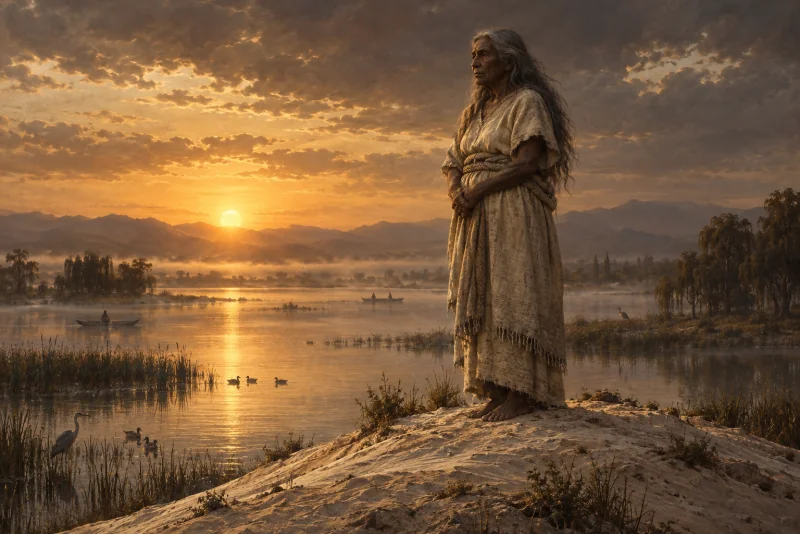
At night, by a river or a canal, a woman is heard wailing for her children, and whoever meets her may not live. The oldest texts we found that call her La Llorona are Mexican poems of the 19th century, yet in the Florentine Codex, finished in 1577, Nahua elders already remember a woman heard weeping in the night before the Spaniards came.
- Type: folklore, a weeping ghost and the legends of how she came to be one
- Culture: Mexico, from the colonial period to today; also Guatemala and the rest of Central America, and the Mexican American communities of the United States
- Earliest texts: a woman heard weeping at night among the omens of the Spanish conquest, and the goddess Cihuacoatl weeping at night, in the Florentine Codex (finished 1577) and in Diego Muñoz Camargo’s Historia de Tlaxcala (late 16th century); the name “La Llorona” in a sonnet by Manuel Carpio (printed by 1849) and in the verse legend of Vicente Riva Palacio and Juan de Dios Peza (1880s); city versions written down by Thomas Janvier (1906) and Luis González Obregón (1922)
- Key figures: La Llorona; the goddess Cihuacoatl; La Malinche (Malintzin, Doña Marina); Luisa and Don Nuño de Montes Claros; in Guatemala, María de los Remedios
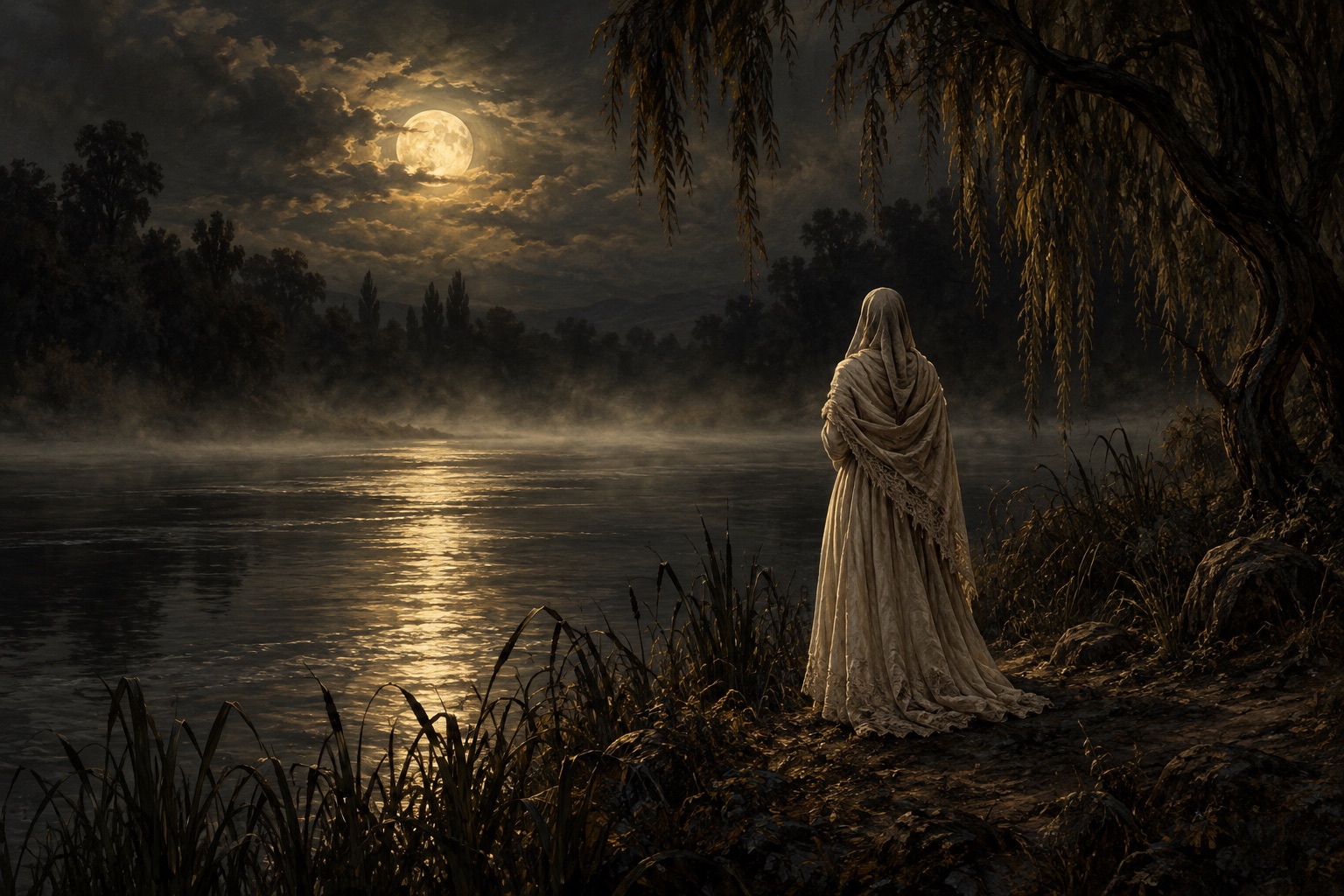
Late at night a long, piercing cry is heard in the street or by the water: ¡Ay, mis hijos!, “Oh, my children!” The woman who utters it is usually dressed in white, her face hidden under a veil or a rebozo, the long shawl of Mexican women, and she vanishes into a river, a canal or a lake. She is La Llorona, “the weeping woman”. In most versions told today she drowned her own children and is condemned to wander until she finds them, and parents and grandparents warn children that she is coming. Her story has been told for centuries and written down again and again, and no two writers tell it the same way.
Is there one story of La Llorona? No. Stephen Winick, a folklorist at the Library of Congress, notes that the one trait all the stories share is that she weeps: “Other than that one defining trait, the specter known as ‘La Llorona’ varies widely.” She may be a murdered wife, a mother who killed her children, a woman abandoned for a richer bride, or someone no one can name. She walks the streets of Mexico City, the riverbanks of Guatemala and, in the 1960s, the corridors of a juvenile hall in California.
1 The Telling
There is no single text to follow. What follows are the scenes the sources tell, each with the text it comes from, from the omens remembered after the Spanish conquest to the version most often told today.
1-1 A Voice in the Night
The Mexica, the people who built Tenochtitlan on an island in a lake where Mexico City now stands, are often called the Aztecs, a later name taken from Aztlan, their homeland in legend. After the city fell to Hernán Cortés and his allies in 1521, Nahua elders described to the Franciscan friar Bernardino de Sahagún the omens that had been seen before the Spaniards came. The sixth, in the Nahuatl text of Book 12 of the Florentine Codex: “Many times a woman was heard going along weeping, going along crying out. At night she cried out loudly, and went about saying: ‘My dear children, now we are going away!’ And sometimes she said: ‘My dear children, where shall I take you?’” In Sahagún’s Spanish column, written beside the Nahuatl, the first cry is darker: “O my children, now we are lost.”
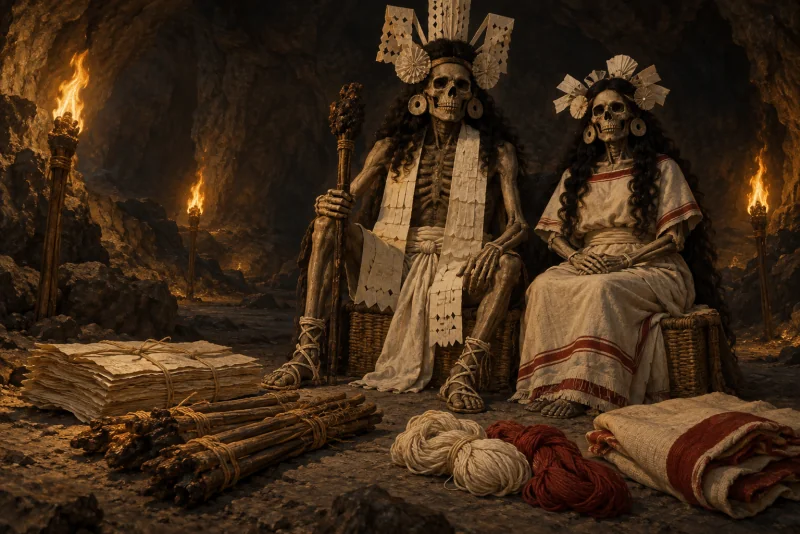
Book 12 does not say who she was. Book 8 does. In the reign of Moctezuma, it says, “Cihuacoatl went about weeping at night. Everyone heard her weeping and saying: ‘My dear children, now I am leaving you.’” Cihuacoatl, “Snake Woman”, was one of the great goddesses of the Mexica. Sahagún’s Spanish calls her a devil, who went “weeping through the streets of Mexico”.
The Tlaxcalan historian Diego Muñoz Camargo, son of a Spaniard and a noble woman of Tlaxcala, records the same omen in his Historia de Tlaxcala. On many nights a woman’s voice was heard weeping aloud, “with much weeping and great sobs and sighs”: “Oh my children, we are now going to be utterly lost!” And at other times: “Oh my children, where can I take you and hide you?”
1-2 The Woman in White at the Curfew
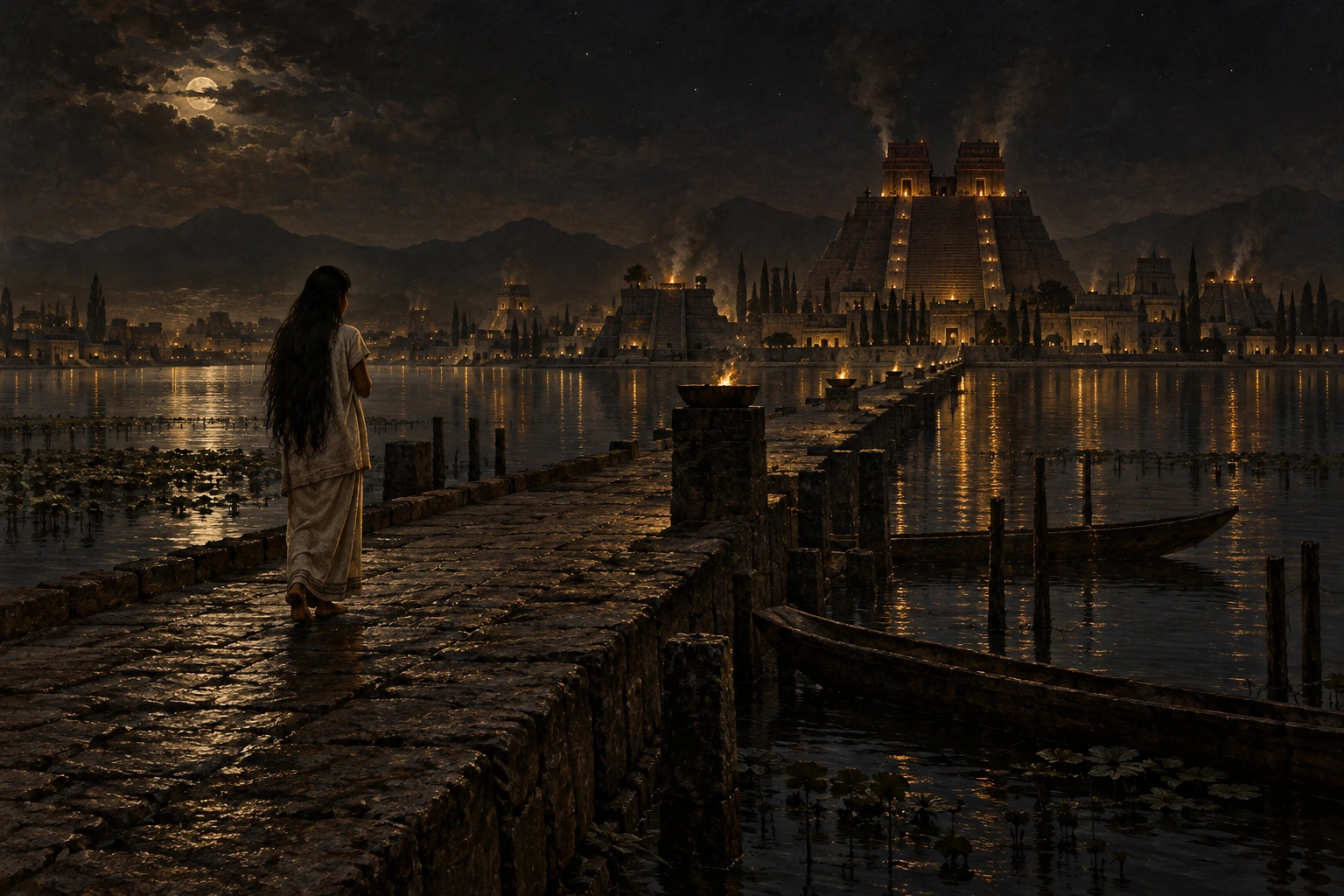
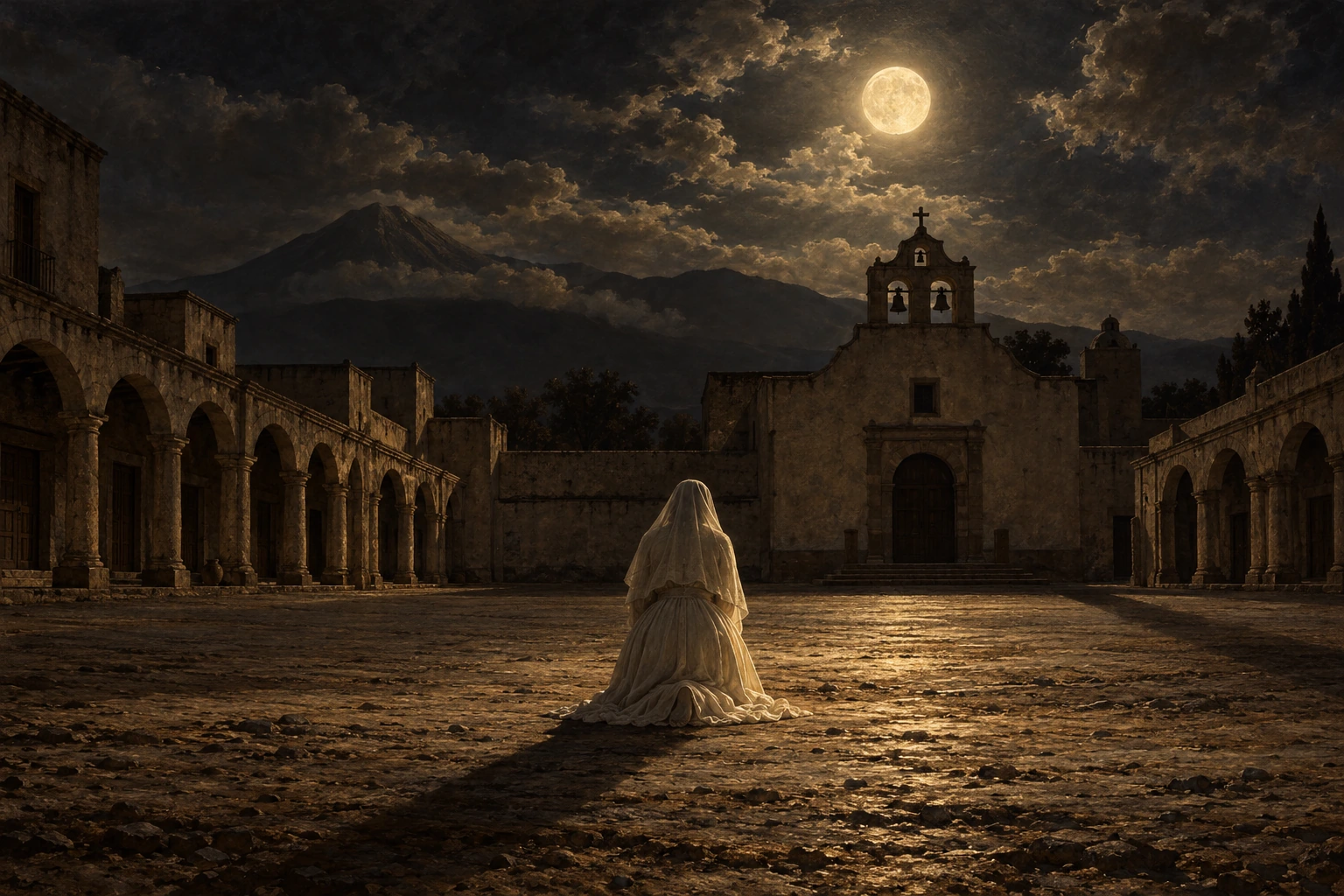
The historian Luis González Obregón opens his Las calles de México (1922) with the story as Mexico City told it. Around the middle of the 16th century, after the conquest, the people who had gone home at the curfew, rung by the bells of the first cathedral, began to wake at midnight, above all on moonlit nights, to long and sorrowful moans in the street. At first they only crossed themselves. Then the bolder ones looked out from their doors and balconies, and at last went out after her. They saw a woman in a dress of the purest white, a thick white veil over her face, who walked slowly through different streets every night but never missed the Plaza Mayor. There she knelt, her veiled face turned to the east, and gave her last and longest cry. Then she rose, walked on eastward to the shore of the salt lake, which in those days still reached into some districts of the city, and vanished like a shadow.
González Obregón quotes the historian José María Marroquí: conquistadors who had been “the terror of death itself” stood before her “mute, pale and cold, like marble”. Those who followed her saw her vanish at the lake “as if she sank beneath the waters”, and since no one could find out who she was, where she came from or where she went, “she was given the name of La Llorona”.
1-3 The Canals of the City
The American writer Thomas Janvier heard another version from his friend Gilberto Cano of Mexico City, and printed it in Harper’s Magazine in 1906 and in his Legends of the City of Mexico in 1910. Cano’s teller begins: “The beginning of her was so long ago that no one knows when was the beginning of her.” As a living woman she sinned: as soon as a child was born to her, she threw it into one of the canals around the city and drowned it. When her conscience began to trouble her, she took to walking the streets at night, weeping. She wears a white petticoat and a white rebozo. She wakes sleeping watchmen to ask the time, says she must be in Guadalajara by noon, shrieks “Where shall I find my children?” and vanishes. An officer of the watch, by the church of Santa Anita, tried to court her and asked her to uncover her face; she showed him a bare, grinning skull, and he died soon after. She is seen on the same night in Monterrey, Oaxaca and Acapulco, and whoever speaks with her dies of fright. “I myself, Señor, have heard the running of her feet and her wailings; but I never have seen her. God forbid that I ever shall!”
1-4 Luisa and Don Nuño
The poets Vicente Riva Palacio and Juan de Dios Peza gave her a name and a life. Their verse legend “La Llorona” begins with the “popular tale”, told “for more than two hundred years”, of a mysterious woman “always dressed in white” who crosses the city at midnight from one end to the other. Then it tells who she was. Luisa was beautiful and poor, living in a dark room in a gloomy alley. Her lover, Don Nuño de Montes Claros, a bold young man of a wealthy house, kept her hidden, and she bore him three children. His love cooled. One night she heard music at his house and learned from a servant that he had married that morning in the church of the Sagrario; she saw him inside with his bride, their hands joined. She went home, took up a dagger he had once left there, and killed the three children as they slept. Then she ran through the silent city, howling. She was condemned to the garrote, and the same afternoon Don Nuño was buried. Since then, the poem ends, the cry of La Llorona, “who is Luisa”, is heard at night.
1-5 The River
The version most often told today is shorter. A version that a friend of the Library of Congress’s American Folklife Center shared, as Winick reports it: Maria, the most beautiful woman in Mexico, married a dashing gentleman and bore him two sons. He left her for another woman. That night she led the boys to the river “for a bath” and held them under the water. When she understood what she had done she cried out “Mis niños!”, “My children!”, and let the river take her too. Now she has come back, searching for children to claim as her own. Winick also quotes the folklorist Bess Lomax Hawes, to whom girls in a juvenile detention center in California said much the same in the 1960s: “she had two kids that she drowned because they were bad.”
2 Where the Story Is Written Down
- The Florentine Codex (General History of the Things of New Spain), made by Sahagún with Nahua elders, scholars and painters and finished in 1577 at the college of Santa Cruz in Tlatelolco, in parallel columns of Nahuatl and Spanish (Biblioteca Medicea Laurenziana, Florence, Med. Palat. 218–220). The sixth omen is in Book 12, chapter 1, on folio 2v, with a painting of the woman in a huipil, her hair loose and tears on her cheek. Book 1, chapter 6 describes Cihuacoatl: an evil omen who brought men misery, who appeared like a court lady, dressed all in white, and “by night went about weeping, wailing”; Sahagún’s Spanish says she “cried out and roared in the air”. She would leave a cradle in the market among the other women, as if her child were in it, and when they looked inside they found a flint blade like those used for sacrifice. Book 8 has her weeping in Moctezuma’s reign, and says that under Don Martín Ehecatl, the second governor of Tlatelolco after the conquest, she “ate a child who was in its cradle” in Azcapotzalco.
- Diego Muñoz Camargo, Historia de Tlaxcala, book 2, chapter 1. He was born in Tlaxcala around 1528 and died in 1599; we read the omen in Alfredo Chavero’s edition (Mexico, 1892).
- Manuel Carpio’s sonnet “La Llorona.” Carpio (1791–1860), a poet and physician from Cosamaloapan in Veracruz, heard as a child “in my town” that a wicked man had killed his wife, Rosalía. Since then, the sonnet says, people hear a suffering woman moan in the dark, and “by the river, in the thick darkness, she goes weeping, wrapped in her cloak”. There are no children in it. Winick dates its first printing to 1849; we read it in the second edition of Carpio’s poems (Mexico, 1860).
- Riva Palacio and Peza. Under the shared pen name “Cero”, the two began publishing their Tradiciones y leyendas mexicanas in verse in the Mexico City daily La República in January 1882, according to the National Autonomous University of Mexico (UNAM); the legends were later gathered in a book.
- Thomas Janvier, Legends of the City of Mexico (Harper, 1910). In his notes he says he heard “essentially identical” versions in Monterrey, during his first winter in Mexico, and in the capital.
- González Obregón and Marroquí. González Obregón’s chapter quotes José María Marroquí, the city’s historian, and the writer José María Roa Bárcena, and cites Sahagún for Cihuacoatl and the sixth omen.
- The folklorists. Winick’s articles for the Library of Congress gather the scholarship: Hawes’s “La Llorona in Juvenile Hall” (1968); Bacil Kirtley, who saw European tales of ghostly “White Ladies” behind the story of her life; Américo Paredes (1971); Stanley Robe (1971); and Domino Renee Perez’s There Was a Woman: La Llorona from Folklore to Popular Culture. Winick also found a Spanish tale, “El Pozo de La Llorona”, published in 1866 by the Jesuit José María León y Domínguez of Cádiz: in the town of Rota, a fisherman’s daughter named Elvira throws herself into a well and rises from it every midnight, weeping, and adults use her to frighten children.
3 Competing Versions
- Who was she? No one knew, in Marroquí’s account. A murdered wife, in Carpio’s. A nameless sinner, for Janvier’s teller. Luisa, for Riva Palacio and Peza. La Malinche, in another tradition (section 4). Roa Bárcena, quoted by González Obregón, lists more: a young woman who died on the eve of her wedding and brings her groom the crown of white roses she never wore; a widow weeping for her orphans; a wife murdered by a jealous husband, who comes to proclaim her innocence.
- What did she do? In most versions she killed her children: by drowning, for Janvier’s teller and in the river version, with a dagger in Riva Palacio and Peza. In Carpio’s sonnet she is the victim, not the killer, and in Marroquí’s account no crime is named at all.
- Her lover’s rank. In Riva Palacio and Peza he is a nobleman and she a poor girl. Henrietta Yurchenco, who recorded the song “La Llorona” in Oaxaca, summed up the story the same way, in the words Winick quotes: a rich young man, a “simple poor girl”, a marriage arranged with a rich society girl. In Guatemala the roles are reversed (section 4): she is a lady of rank, married to a rich indigo merchant, and her lover is a young mestizo who looks after the city’s water.
- Which water? The salt lake of Mexico City, in González Obregón; the canals, for Janvier’s teller; a river, for Carpio and in most versions today. In Guatemala City it is the Río de Las Vacas; in Antigua Guatemala the Pensativo; in the east of the country the Motagua.
- White or black? In Mexico she wears white. In Guatemala, the folklorist Celso Lara Figueroa’s versions dress her in black, and it is the Siguanaba, another ghost of the night, who wears white.
- Goddess or ghost? Janvier took her for “a stray from Aztec mythology”. In Winick’s account of the debate, Kirtley found the values of the characters in the story of her life “thoroughly Spanish, not Indian”, and Paredes called it “basically European”, grafted onto an Indigenous cycle of supernatural women; Perez sees deep Indigenous roots, and both sides accept that most versions mix the two.
4 History and Tradition
- La Malinche. Malintzin, baptized Marina and called Doña Marina by the Spaniards, was the Indigenous woman, given to Cortés as a slave in 1519, who interpreted for him and bore him a son. González Obregón wrote in 1922 that after her death people said she was La Llorona, returned from the other world to atone for having helped the foreigners subdue the Indigenous people of her own race. The scholar Sandra Cypess traces Malinche’s name as a traitor to the anonymous novel Xicoténcatl (1826), and notes that she came to be called “the American Medea” and La Llorona. Cypess also reads Octavio Paz’s essay “The Sons of La Malinche” (in The Labyrinth of Solitude, 1950) as making her the violated mother and linking her with la Chingada of Mexican curses, with La Llorona and with the “Mexican Eve”. Among Mexican American writers, the Chicano novelist Rudolfo Anaya made Malinche the first Llorona of the New World in his short novel The Legend of La Llorona (1984), and the Chicana writer Gloria Anzaldúa wrote in Borderlands/La Frontera (1987): “La gente Chicana tiene tres madres”, “the Chicano people have three mothers”: Guadalupe, Malinche, “and La Llorona, the mother who seeks her lost children”.
- The song. The best-known song “La Llorona” is a son istmeño from the Isthmus of Tehuantepec in Oaxaca. Winick found its earliest printed versions in a Tehuantepec student publication of 1935 and a Mexican journal of popular culture of 1936. Some attribute the words to the poet Andrés Henestrosa, from the same region; most folklorists treat it as traditional. Each singer chooses verses from a large stock, some sung in Zapotec, and they rarely tell the legend: “Ayer maravilla fui, Llorona, / y ahora ni sombra soy”, “Yesterday I was a wonder, Llorona, and now I am not even a shadow”. Chavela Vargas sang it in the film Frida (2002), and it is sung in the animated film Coco (2017).
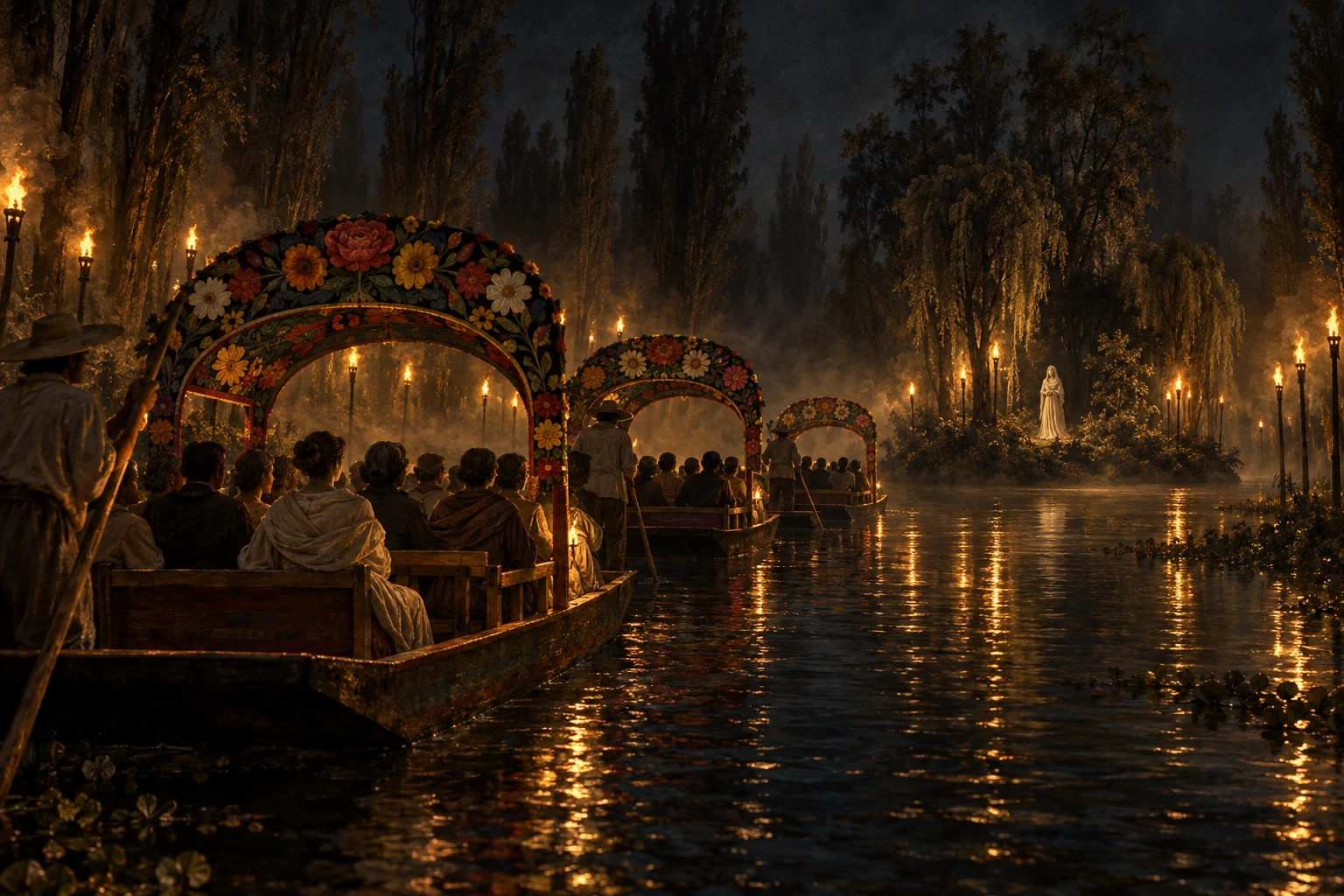
- On the canals of Xochimilco. Every year, in the season of the Day of the Dead, a night show tells her story at the Cuemanco landing in Xochimilco, in the south of Mexico City, as it has since the 1990s. The audience is taken by trajinera, the flat painted boats of the canals, along a route lit by torches to the small island of Tlilac, where La Llorona’s cry is heard.
- In Guatemala. The newspaper Prensa Libre, retelling the versions Lara collected in Guatemala City, makes her doña María de los Remedios, a lady of good family in the new capital built after the earthquakes of 1773. While her husband was away, she bore a son to her young lover and drowned the baby in the Río de Las Vacas, and she still cries “Where are you, my son?” by running water. Jayro Bustamante’s film La Llorona (2019) sets the legend in the house of a retired general on trial for the massacre of thousands of Maya decades before, to grieve, as Cinema Tropical puts it, “a seldom discussed crime against humanity”.
- Across borders. Stanley Robe, writing in 1971 in a passage Winick quotes, found the legend from the Hispanic Southwest of the United States through Mexico and Central America into Colombia and Venezuela, but none in the published folklore of Spain. Everywhere she keeps children in line: González Obregón describes Mexican grandmothers frightening their grandchildren with ¡Ahí viene La Llorona!, “Here comes La Llorona!”, and the girls Hawes met in California said that she attacks “bad kids”.
- On screen. Ramón Peón’s La Llorona (1933), a film restored by the Academy Film Archive and the Filmoteca of the UNAM, is often called the first Mexican horror film.
La Llorona is often said to be an Aztec goddess, Cihuacoatl, still wandering. The codices do describe a goddess who walks at night weeping, and Book 8 of the Florentine Codex says she was heard in Moctezuma’s reign, before the conquest. But no 16th-century text we know of calls her La Llorona, and the story of a mother who killed her own children and wanders to atone for it appears in none of them. That story, and the name, come to us from texts of 19th-century Mexico, which set them in colonial times. It was Thomas Janvier who wrote, in 1910, that she was “an ancient powerful goddess living on”; folklorists since have argued over how much of her is Indigenous and how much European.
5 Related Stories
- Coatlicue: The Mother in the Serpent Skirt: Cihuacoatl, the “Snake Woman” whom the Florentine Codex hears weeping at night, is one of the names joined to the Mexica mother goddess. Which sources join them is told there.
- Jason and the Argonauts: The Voyage for the Golden Fleece: Medea, who kills her own sons when Jason leaves her for a king’s daughter. Kirtley, as Winick reports, pointed out the resemblance between the legend of La Llorona and the myth of Medea, and Malinche, Cypess notes, was called “the American Medea”.
- The Banshee: The Woman Who Keens Before a Death: in Ireland, too, a woman’s wailing is heard at night, and in the oldest tales she stands in a river ford. The banshee foretells a death and La Llorona mourns her own; we have not found a scholar who compares them, and link them for the theme.
6 Sources
- Florentine Codex, Book 1, chapter 6 (fols. 2v–3r), Book 8, chapters 1–2 (fols. 2v, 6r), Book 12, chapter 1 (fol. 2v): Nahuatl transcription and English translation by Arthur J. O. Anderson and Charles E. Dibble (1950–1982), Spanish transcription by Alfredo López Austin and Josefina García Quintana (2000), English translation of the Spanish by León García Garagarza, in Digital Florentine Codex, ed. Kim N. Richter, Alicia Maria Houtrouw et al. (Getty Research Institute, 2023): Getty, Getty, Getty, Getty, Getty. Quotations in the text are our own translations from the Nahuatl or the Spanish
- Florentine Codex, Book 12, chapter 1, Nahuatl and Spanish transcribed and translated by James Lockhart (We People Here, 1993), Early Nahuatl Library, University of Oregon: enl.wired-humanities.org; Stephanie Wood, “choca (FCbk12f2v)”, Visual Lexicon of Aztec Hieroglyphs: aztecglyphs.wired-humanities.org
- Diego Muñoz Camargo, Historia de Tlaxcala, ed. Alfredo Chavero (Mexico, 1892), book 2, chapter 1, pp. 170–171: archive.org; his life: Lecturas históricas mexicanas, vol. 1 (UNAM): historicas.unam.mx
- Manuel Carpio, Poesías, 2nd ed., with a biography by José Bernardo Couto (Mexico, 1860), “La Llorona”, p. 235: archive.org
- Vicente Riva Palacio and Juan de Dios Peza, Tradiciones y leyendas mexicanas, ed. Manuel Romero de Terreros and S. L. Millard Rosenberg (Thomas Nelson and Sons, 1927), “La Llorona”: archive.org; Leonardo Huerta Mendoza, “Descarga Cultura UNAM revive leyendas mexicanas clásicas”, UNAM Global, 2025: unamglobal.unam.mx
- Thomas A. Janvier, Legends of the City of Mexico (Harper, 1910), “Legend of La Llorona” and Note IX: Project Gutenberg
- Luis González Obregón, Las calles de México (1922), “La Llorona”, digital edition: archive.org
- Stephen Winick, “La Llorona: An Introduction to the Weeping Woman”, “La Llorona: Roots, Branches, and the Missing Link from Spain” and “Picante Pero Sabroso: Songs of La Llorona”, Folklife Today, Library of Congress, 2021: blogs.loc.gov, blogs.loc.gov, blogs.loc.gov
- Sandra M. Cypess, “Malintzin/Doña Marina/La Malinche”, Noticonquista (UNAM): noticonquista.unam.mx
- Gloria Anzaldúa, Borderlands/La Frontera: The New Mestiza (Spinsters/Aunt Lute, 1987; 3rd ed., Aunt Lute, 2007), p. 52, quoted in Eilidh Hall, Negotiating Feminisms in La Familia (PhD thesis, University of East Anglia, 2017): ueaeprints.uea.ac.uk; Rudolfo Anaya, The Legend of La Llorona (1984), Rudolfo Anaya Digital Archive, University of New Mexico: anaya.unm.edu
- Leyendas de Guatemala, texts by Violeta Velásquez based on Celso Lara Figueroa, Leyendas y casos de la tradición oral de la Ciudad de Guatemala (Editorial Universitaria, 1984), Prensa Libre, 2022: prensalibre.com
- Patricia Rodríguez Calva, “A partir del 4 de octubre ‘la Llorona’ llegará a Xochimilco”, Excélsior, 2019: excelsior.com.mx
- Cinema Tropical, “Film of the Week: La Llorona”: cinematropical.com; Macabro, International Horror Film Festival of Mexico City, “La Llorona (restoration)”: macabro.mx; “3 películas de terror mexicanas”, México Desconocido: mexicodesconocido.com.mx
Cover and illustrations: AI-generated images made for Arcana. They are interpretations, not historical artworks.