The Founding of Tenochtitlan: The Eagle on the Cactus
Led by their god, the Mexica walked for generations from Aztlan until they saw an eagle on a cactus growing from a rock in a lake, and there they built Tenochtitlan, today Mexico City. The serpent in the eagle's beak on Mexico's flag is missing from the oldest pictures of the scene.
- Type: founding myth and migration legend
- Culture: the Mexica (Aztecs) of central Mexico; today the emblem of the Mexican nation
- Earliest texts: a stone carving of about 1507, the Teocalli of Sacred Warfare, shows the eagle on the cactus; the Codex Boturini (1530s) paints the migration and the Codex Mendoza (about 1541) the founding; the fullest tellings are Diego Durán’s History (1581) and the Nahuatl Crónica mexicáyotl (1609)
- Key figures: Huitzilopochtli, the god-bearers Cuauhtlequetzqui and Chimalma, Malinalxochitl, Copil, Achitometl of Culhuacan, Tenoch
Mexico’s flag carries a story at its centre: an eagle on a nopal, the prickly pear cactus, which grows from a rock in a lake. The people who built a city on that spot called themselves the Mexica. “Aztec”, the name most books give their world and the one we use for the wider tradition, comes from Aztlan, the island home they said they had left: Durán writes that they were called Azteca after it, and the Crónica mexicáyotl that they were Aztecs there and are now called Mexica. Their god Huitzilopochtli led them for generations, and the eagle was his sign that the walking was over.
What does the name Tenochtitlan mean? Not “the place of the eagle”. The name joins tetl, stone, and nochtli, the prickly pear: “the place of the prickly pear on the stone”, as the 16th-century Relación del origen de los indios explains it, or “Tunal growing upon a Rocke”, in the 1625 English of the Codex Mendoza’s commentary. Neither the eagle nor the serpent is in the word. Durán adds that the people were called Tenochca, “the possessors of the nopal”, after the same cactus.
1 The Telling
This is the telling of Diego Durán, a Dominican friar, in chapters 2 to 5 of his History of the Indies of New Spain, with the Nahuatl Crónica mexicáyotl where it adds to it. Quotations are our translations from Durán’s Spanish in José F. Ramírez’s edition of 1867, and from Gabriel K. Kruell’s Spanish translation of the Crónica (2021).
1-1 Aztlan and the Seven Caves
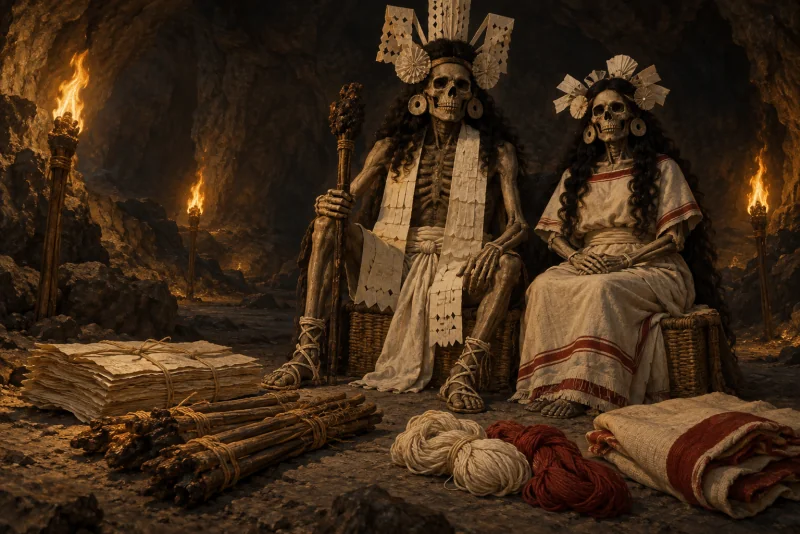
Long ago, Durán writes, the peoples of this land came out of seven caves, Chicomoztoc, in the country of Aztlan and Teoculhuacan. Six peoples left first and settled around the great lake. The seventh, the Mexica, stayed behind “by divine order”, as they said, and came last. Durán explains Aztlan as “whiteness” or “the place of herons”: that is why the people were called Azteca. They were also called Mexitin, after the priest who led them, Meci.
The Crónica mexicáyotl places Aztlan “in the middle of the water”. In a year 1 Flint, which it counts as 1064, its seven kin groups, the calpolli, crossed by boat to Chicomoztoc, “a rock pierced in seven places”, in a wild land of jaguars, pumas, serpents and spiny cactus. They carried a wrapped bundle, and the god spoke to them from it, though they never saw him.
Four god-bearers carried him: Iztacmixcoatzin, Apanecatl, Tezcacoatl and a woman, Chimalma, says the Crónica, and the god rode in a chest. In Durán he travels in an ark of reeds that no one but his four guardians dared touch. Once a voice told the travellers to move out from under the great cypress they were resting beneath; in the morning it broke.
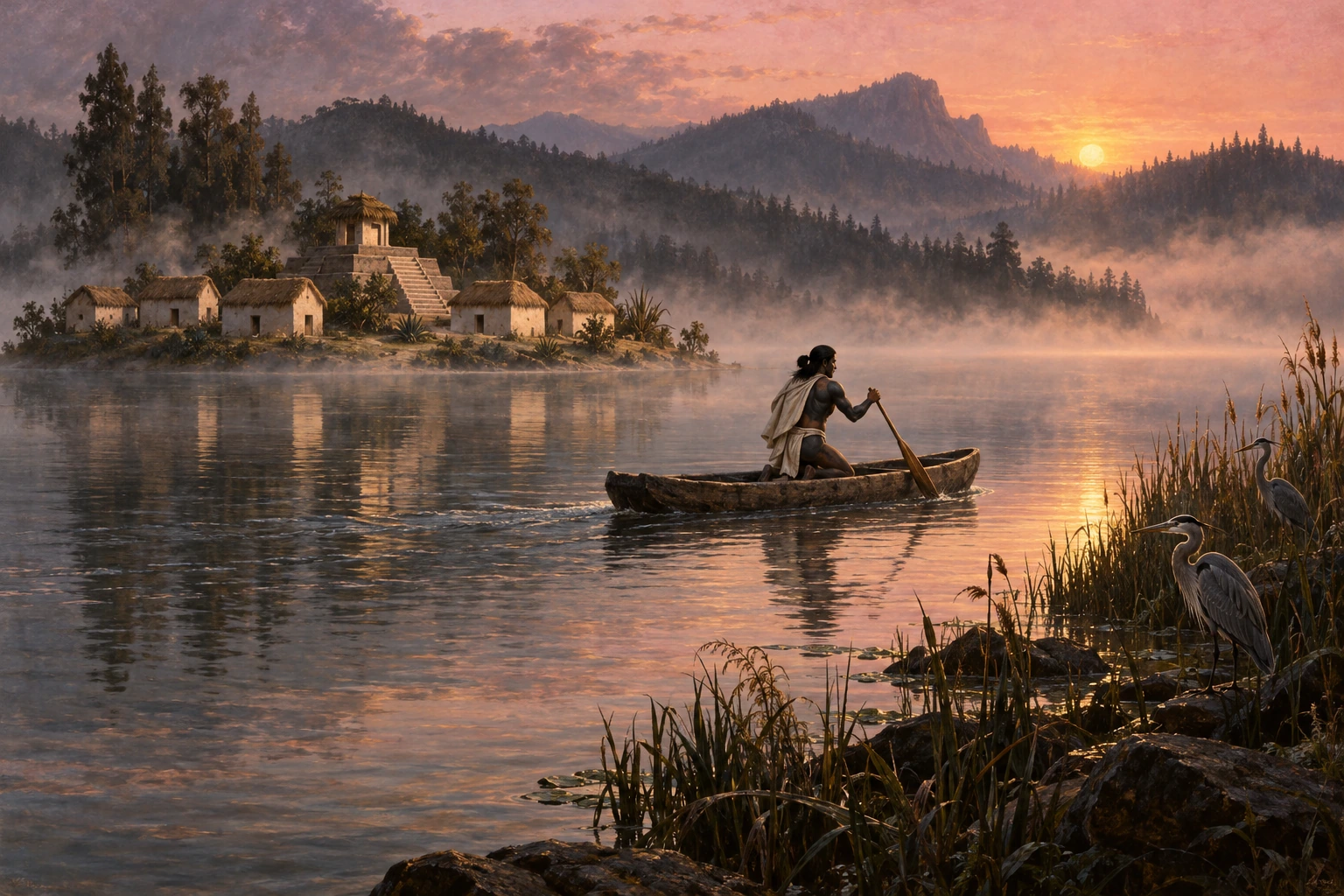
Wherever they stopped, Durán says, they first built a shrine for the god, then sowed maize and chile. When the god told them to move on, they left the crops behind, and with them the old and the sick, who settled those places for good.
1-2 The Sister Left Behind
The god’s sister, Malinalxochitl, travelled with them. Durán calls her very beautiful, and so skilled that she became a sorceress who made herself feared by sending vipers, scorpions, centipedes and spiders against those who angered her. In a dream the god told his priest that he had come to win the nations not by spells but “by the courage of heart and arm”. She was to be left behind. That night, while she and her followers slept, everyone else slipped away. In the morning she wept and blamed her brother for the trick. She went on to found the town of Malinalco, whose people, Durán says, were still taken for sorcerers in his day.
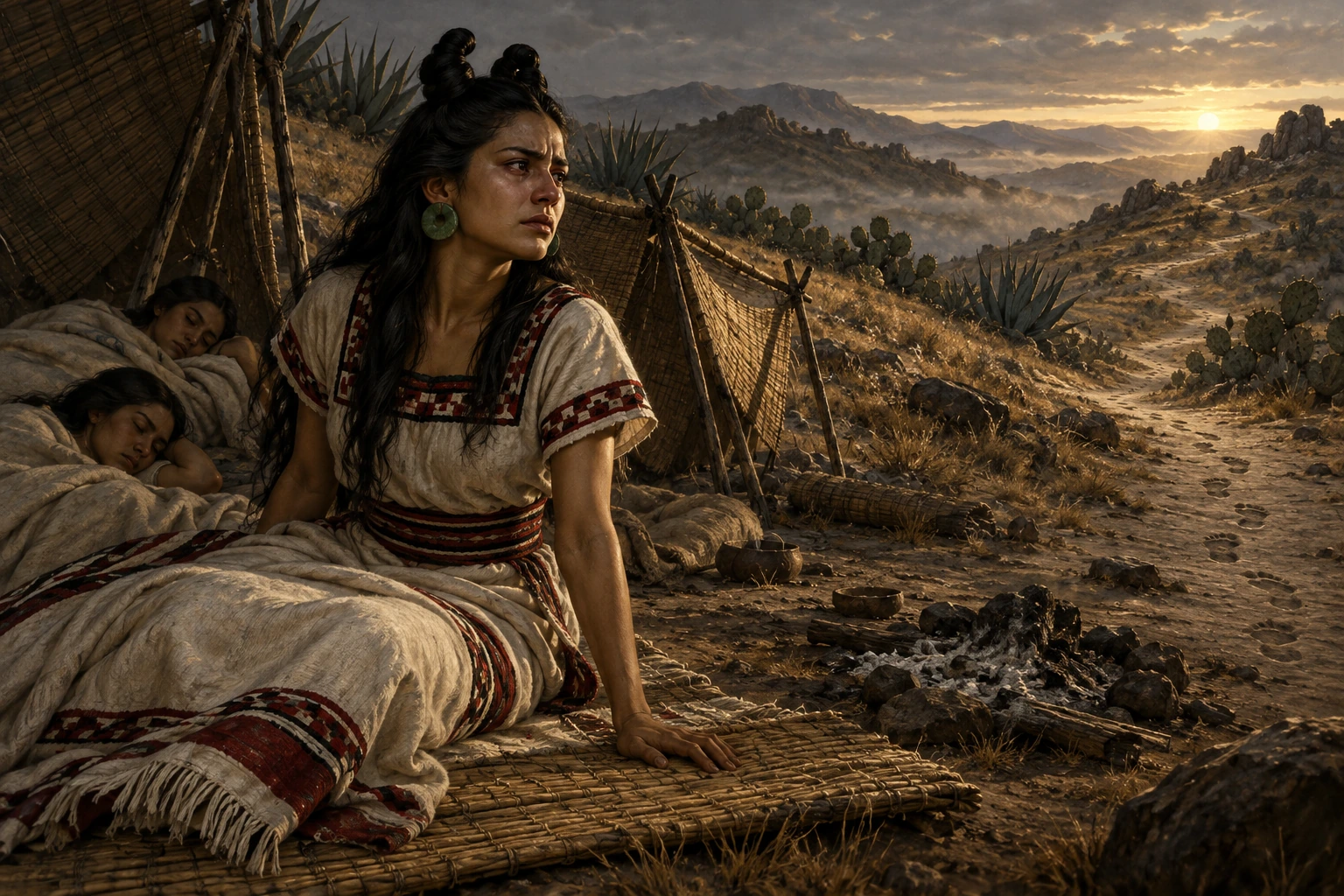
The others went on to Coatepec, Serpent Hill. There they dammed a river into a lake, a faction wanted to stay, and the god killed its leaders and broke the dam. That episode, and the god’s birth on the same hill in other sources, belong to Huitzilopochtli.
1-3 Copil’s Heart
Malinalxochitl had a son, Copil. When he was grown, she told him how his uncle had wronged her, and he swore to destroy the god and all his people. He went from town to town around the lake, calling the Mexica wicked and warlike, until the lake cities agreed to wipe out the newcomers camped on the hill of Chapultepec. Copil climbed the little hill of Tepetzinco, by the hot springs, to watch.
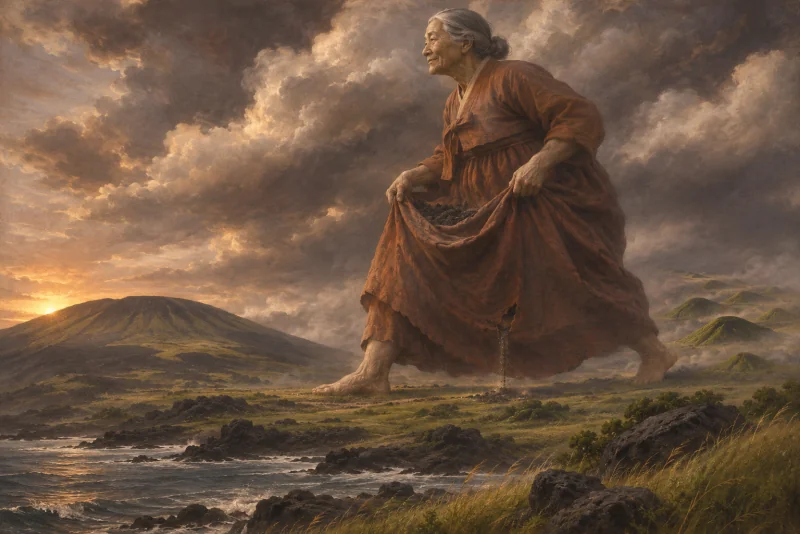
The god knew. He told his priests to kill Copil and bring him the heart, and to take the god with them. With the god on the back of his bearer Cuauhtlequetzqui, they caught Copil off his guard, killed him and brought the heart. The god told Cuauhtlequetzqui to go into the reeds and throw it as far as he could. It fell at a place now called Tlalcocomolco, “and from that heart, the story goes, grew the nopal”. The hot springs, Durán adds, are called Acopilco, “the water of Copil”.
The siege went ahead without him. The Mexica broke out, but their leader Huitzilihuitl was captured, taken to Culhuacan and killed.
1-4 Snakes, a Princess and a White Spring
The god sent them to Achitometl, lord of Culhuacan, to ask for land. His counsellors chose Tizapan, ground crawling with snakes and vipers, hoping the Mexica would die there. Instead the Mexica ate the snakes, roasted and boiled, until hardly one was left. Achitometl let them trade in his city and marry his people.
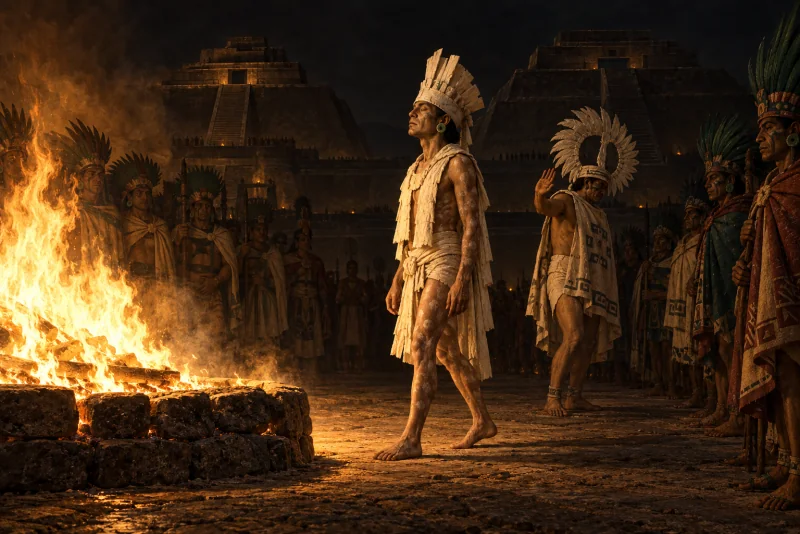
But their god wanted war. He told them to ask Achitometl for his daughter, to be “the woman of discord”. The king gave her at once, eager for her to reign and be a goddess on earth. The Mexica killed her, flayed her and dressed a young man in her skin, then invited her father to worship his daughter as the goddess Toci, “mother” or “grandmother”. When the king saw what sat in the dark shrine, he called his people to arms. Driven into the lake, the Mexica crossed deep water on rafts of spears and shields and hid among the reeds.
There they found a beautiful spring, and everything around it was white: a white juniper at its foot, white willows, white reeds and rushes, white frogs, white fish and white water snakes. The water came out clear between two great rocks. The old men wept for joy, for this was what the god had promised.

1-5 The Eagle
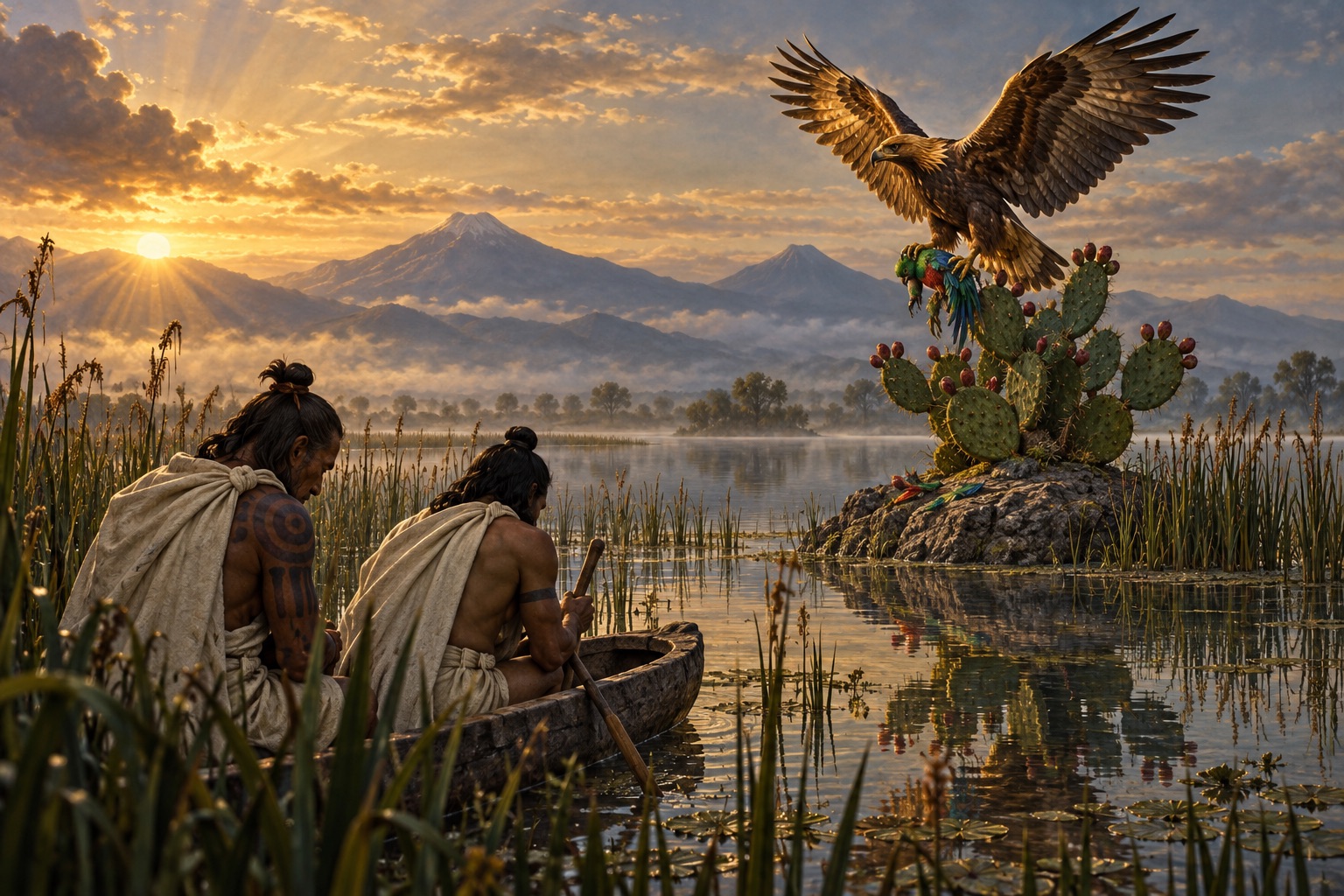
That night the god came in a dream to Cuauhtlequetzqui. Copil’s heart, he said, had fallen on a stone, and from it had grown a nopal “so big and beautiful that an eagle makes its home on it”. There it fed every day on the finest birds and spread its wings in the sun, and around it lay feathers, green, blue, red, yellow and white. “To that place where you find the nopal with the eagle on top, I give the name Tenochtitlan.”
In the morning the people went into the reeds. The spring of the day before now ran red, “almost like blood”, and split into two streams, the second blue and thick. Then they saw the nopal, and on it the eagle, “with its wings spread toward the rays of the sun, taking its warmth and the freshness of the morning, and in its talons it held a very fine bird with precious, shining feathers”. They bowed to it as to something divine, and the eagle bowed its head to them.
They cut sods from the marsh and built the god a little shrine of earth and thatch. The ground was not theirs: there the lands of Azcapotzalco, Texcoco and Culhuacan met. So they caught fish, frogs and water birds, traded them in their neighbours’ markets for stone and timber, and made ground on the water by throwing earth and stone between stakes. The god told them to divide into four quarters around his house. Four discontented elders moved to a nearby spot that became Tlatelolco. The rest chose Acamapichtli, a young noble of Culhuacan with a Mexica father, as their first king. Durán dates the start of the building to 1318.
2 Where the Story Is Written Down
- The Teocalli of Sacred Warfare, a stone model of a temple in the Museo Nacional de Antropología, was taken out of the foundations of the National Palace in Mexico City in 1926. Dating it to the New Fire ceremony of 1507, under Moctezuma II, “has more or less gained scholarly acceptance”, Emily Umberger writes. On its back an eagle stands on a nopal growing from a stone; the cactus bears human hearts as fruit, and from the eagle’s beak comes the sign that Eduard Seler read as atl-tlachinolli, “water, something burned”, a metaphor for sacred war.
- The Tira de la peregrinación, or Codex Boturini, amate paper folded like a screen, painted in Tenochtitlan in the 1530s or around 1540 and kept in the Biblioteca Nacional de Antropología e Historia. Its 21½ pages follow the Mexica from a year 1 Flint, when they leave Aztlan, to a year 6 Reed, when they live on the lands of Colhuacan: it stops before the founding. On the first page Aztlan is an island with six houses around a temple; Chimalma, named by her shield sign, sits with a man, and a priest rows away. At Teoculhuacan, the curved hill, eight peoples set out, and four god-bearers carry bundles, Tezcacoatl that of Huitzilopochtli. Further on, a great tree lies broken.
- The Codex Mendoza, made around 1541 for the first viceroy, Antonio de Mendoza (Bodleian Library, Oxford, MS. Arch. Selden. A. 1). Its first painting, folio 2r, is the founding: an eagle on a nopal growing from a stone, where blue streams cross in an X, a shield with arrows below, and ten seated founders, Tenoch among them. Fifty-one year signs frame the page, beginning with 2 House, and below, Mexica warriors take Colhuacan and Tenayuca. The Spanish commentary, printed in English by Samuel Purchas in 1625, says that the eagle “had her haunt and abode for her foode” in the cactus, and that the place was “scattered full of bones and feathers of divers Birds”.
- Diego Durán finished his History in 1581. The manuscript, with its paintings, is in the Biblioteca Nacional de España; it was first printed in 1867. The Relación del origen de los indios (the “Códice Ramírez”) tells the founding in nearly the same words, and Hernando Alvarado Tezozómoc’s Spanish Crónica mexicana, written around 1598, more briefly.
- The Crónica mexicáyotl, in Nahuatl. Tezozómoc was writing it in 1609. The oldest copy is in the hand of the Chalco historian Chimalpahin, who may have reworked it, and some passages are his or a certain Alonso Franco’s. The manuscript came to light in London in 1982; the Mexican government bought it in 2014, and it is kept in the Biblioteca Nacional de Antropología e Historia.
3 Competing Versions
- Who killed Copil? In Durán, the priests who went with the god’s bearer. In the Crónica mexicáyotl, Huitzilopochtli himself, after a chase “as nahuales”, shape-changers. He cut off Copil’s head, set it on the hill now called Acopilco, and tore out his heart. The heart was thrown from a stone mat in the reeds “where Quetzalcoatl rested when he went away”, by Cuauhtlequetzqui or by Cuauhcoatl: “one person is Cuauhtlequetzqui and another is Cuauhcoatl”, the Crónica notes. It dates Copil’s death to a year 1 House, 1285.
- What was the eagle eating? On the Teocalli, Umberger writes, it plucks the hearts that grow on the cactus, and the war sign comes from its beak. In the Codex Mendoza, nothing; its commentary speaks of bird bones and feathers. In Durán and the Relación, “a very fine bird”. In the Crónica mexicáyotl, “it eats something, it devours it”, on a nest of feathers of the turquoise bird, the rose-coloured tlauhquechol and the quetzal, among the heads, feet and bones of birds. In Tezozómoc’s Crónica mexicana it is “eating and tearing apart a serpent”, and in the painting of the scene in Durán’s manuscript, which Correa Lonche, as his reviewer reports, counts as the first source to show the eagle and the serpent together, it holds a serpent in its beak and talon.
- The serpent of the place. The Crónica mexicáyotl calls the city the place “where the eagle screeches, where it spreads its wings, where the eagle eats, where the fish swims and where the serpent hisses”, and in a later chapter of Durán captives are welcomed to Tenochtitlan, “where the eagle sang and the serpent hissed”. In both, the serpent is named as one of the creatures of the place, not as the eagle’s prey.
- Which year? Durán: building began in 1318. The Codex Mendoza’s commentary: 1324; but its painting begins with the year 2 House, which, Manuel Orozco y Berra noted in 1878, falls in 1325, and the Crónica mexicáyotl gives “2 House, 1325”. Orozco y Berra quotes Clavijero, who found 1324, 1325, 1327, 1341 and 1357 in earlier writers. The Japanese encyclopedia Nipponica gives “around 1345”, and Chimalpahin has the Mexica kindle their first New Fire on the island in 1351.
- When did they leave Aztlan, and where was it? The Tira and the Crónica mexicáyotl agree on a year 1 Flint, which the Crónica counts as 1064 and the Códices Aubin and Azcatitlan as 1168; Rafael Tena judges the dates added to those two codices “not entirely reliable”. The Crónica puts Aztlan “perhaps” near the great coast “that the Spaniards now call New Mexico”; Tena places it in Guanajuato, near Lake Yuriria.
4 History and Tradition
- The city on the lake. Hernán Cortés, in the Second Letter he sent to Charles V in 1520, wrote that “this great city of Temixtitan is built on the salt lake”, two leagues from the mainland, with “four approaches by means of artificial causeways, two cavalry lances in width”, and “as large as Seville or Cordoba”. The city fell to the Spanish in 1521, and they built Mexico City on its ruins.
- Chinampas. The fields that fed the lake cities were chinampas, rectangular plots built up from layers of water plants, grass, silt and earth and ringed by canals, which yield all year. INAH dates the earliest found in the basin to 900–1200, at Xaltocan, an Otomí town, long before the Mexica; excavations in central Mexico City have found chinampas and canals used between 1300 and 1521, and they are still farmed in Xochimilco and Tláhuac.
- The nation’s arms. In 1821 the arms of the new Mexican Empire showed a crowned eagle on a nopal, with no serpent. A law of 14 April 1823 gave the eagle back its serpent, “in the act of tearing it apart with its beak”, between branches of laurel and oak. In 1968, at President Gustavo Díaz Ordaz’s order, the illustrator Francisco Eppens Helguera redrew an earlier model by the painter Jorge Enciso, the design in use today.
- The law. The Law on the National Arms, Flag and Anthem of 8 February 1984 describes it: an eagle in left profile, its left talon resting “on a flowering nopal that grows from a rock rising out of a lake”, holding “with its right talon and its beak, in the act of devouring, a curved serpent”. The flag has three vertical stripes, green, white and red, with the arms on the white, and every 24 February is Flag Day.
- How old is the serpent? Guillermo Correa Lonche, as his reviewer Ramón Velázquez Guzmán summarises his book (INAH, 2021), read 52 documents of the 16th and 17th centuries and found the eagle and the serpent together in only eight: first in Durán, then in works written after 1598. The arms Charles V granted the city in 1523 had neither; the eagle was added later, and then the serpent. The late arrival, his reviewer concludes, may owe more to Spanish influence than to pre-Hispanic symbolism.
The eagle on the flag holds a serpent, and the story is often told as if it always had. The oldest pictures show none. On the Teocalli, carved before the Spanish came, the eagle has the war sign atl-tlachinolli in its beak; in the Codex Mendoza it holds nothing; in Durán’s text it grips a fine bird. The serpent first joins the eagle in a painting in Durán’s manuscript and in Tezozómoc’s chronicle of about 1598, and Mexico’s arms took it by law in 1823.
5 Related Stories
- Huitzilopochtli: The War God Born on Coatepec: the god who led the Mexica out of Aztlan and chose the place for their city; his birth and the revolt at Coatepec are told there.
- Quetzalcoatl: The Feathered Serpent: in the Crónica mexicáyotl, Copil’s heart was thrown from a stone mat in the reeds where Quetzalcoatl had rested “when he went away”.
- Coatlicue: The Mother in the Serpent Skirt: Durán tells of another journey, when Moctezuma I sent envoys back along the road to Aztlan to find Huitzilopochtli’s mother.
- Romulus and Remus: The Twins and the She-Wolf: in Rome too, birds showed where a city should stand, and the ancient writers could not agree on the year it was founded. We have not found a scholar who compares the two stories; we link them for the theme.
6 Sources
- Diego Durán, Historia de las Indias de Nueva-España y islas de Tierra Firme, ed. José F. Ramírez, vol. 1 (Mexico, 1867), chapters 2–6 and 18: archive.org
- Hernando de Alvarado Tezozómoc, Crónica mexicáyotl, edited by Domingo Chimalpáin, ed. and Spanish trans. Gabriel K. Kruell (UNAM, Instituto de Investigaciones Históricas, 2021), introduction and first part, §§ 8–37: historicas.unam.mx
- Hernando Alvarado Tezozómoc, Crónica mexicana, chapter 1, with the Relación del origen de los indios and Manuel Orozco y Berra’s study of the chronology, ed. José M. Vigil (Mexico, 1878): archive.org
- Codex Mendoza, Bodleian Library MS. Arch. Selden. A. 1, fol. 2r, and its commentary in Samuel Purchas, Hakluytus Posthumus or Purchas His Pilgrimes, vol. XV (Glasgow, 1906), pp. 413–418: Digital Bodleian, archive.org; Lauren Kilroy-Ewbank, “Frontispiece of the Codex Mendoza”, Smarthistory: LibreTexts
- Hernán Cortés, Second Letter (30 October 1520), in Fernando Cortes: His Five Letters of Relation to the Emperor Charles V, trans. Francis Augustus MacNutt, vol. 1 (Cleveland, 1908), p. 256: archive.org
- Rafael Tena, “La cronología de la Tira de la peregrinación”, Estudios de Cultura Náhuatl 40 (2009), and María Castañeda de la Paz, “La Tira de la peregrinación y la ascendencia chichimeca de los tenochca”, Estudios de Cultura Náhuatl 38 (2007): ECN, ECN
- INAH, Boletín 499 (7 October 2022), on Tena’s facsimile of the Tira, and Boletín 8 (9 January 2024), on the chinampas: inah.gob.mx, inah.gob.mx
- Emily Umberger, “Montezuma’s Throne”, arara 8 (2010): University of Essex
- Ramón Velázquez Guzmán, “Mitos y orígenes del escudo nacional”, review of Guillermo Correa Lonche, El águila y la serpiente (INAH, 2021), Historias 111 (2022), pp. 108–110: revistas.inah.gob.mx
- Antonio García Cubas, Diccionario geográfico, histórico y biográfico de los Estados Unidos Mexicanos, vol. I, “Armas”, facsimile (INEGI, UNAM and El Colegio Nacional, 2015), with the law of 14 April 1823; María de Lourdes Aguilar Enríquez and others, “La flora del escudo nacional mexicano”, Polibotánica 18 (2004): historicas.unam.mx, Redalyc
- Ley sobre el Escudo, la Bandera y el Himno Nacionales (DOF, 8 February 1984; text as amended to 11 May 2018), articles 2, 3 and 10: WIPO Lex
- Masuda Yoshio, “テノチティトラン”, Nipponica: Kotobank
Cover and illustrations: AI-generated images made for Arcana. They are interpretations, not historical artworks.