Seolmundae Halmang: The Giant Who Made Jeju
She carried soil in her skirt to build Hallasan, and drowned in a bottomless pool on its slopes. Her traces are all over Jeju, yet the shamans have no song of her own, and scholars still argue over whether she was ever a goddess.
- Type: legend, a giant woman who shapes an island
- Culture: Jeju Island, off the southern coast of Korea
- Earliest text: a disputed mention in Jang Han-cheol’s Pyohaerok (漂海錄), 1771; the tales themselves were written down from the 1930s on
- Key figures: Seolmundae Halmang (설문대할망), also called Seonmundae, Semyeongju and a dozen other names; her five hundred sons, the Five Hundred Generals (五百將軍)
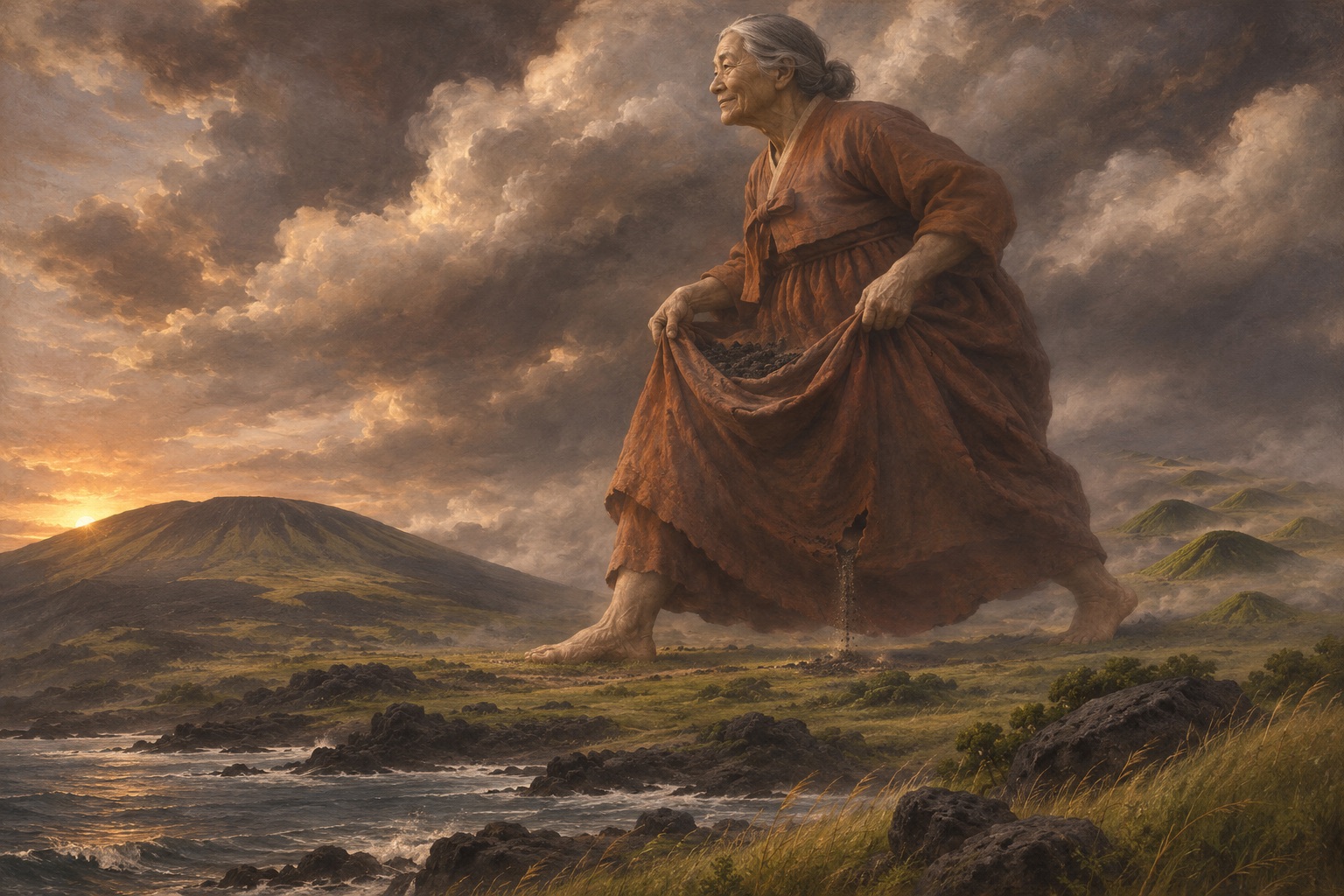
Jeju is a volcanic island. Around Hallasan, the broad mountain at its centre, stand some 360 small volcanic hills, the oreum. Ask how they got there and the island answers with a woman: Seolmundae Halmang, “Grandmother Seolmundae”, who carried soil in her skirt and spilled it as she walked.
How tall was she? No story gives a number. They measure her against the island. With Hallasan for a pillow, her feet reached Gwantalseom, an islet off the north coast. The deepest pools on Jeju came up to her feet or her knees. Only one, Muljangori, had no bottom.
1 The Telling
There is no single telling. The stories are short episodes, told village by village, and each points to something that can still be seen: a hill, a rock in the sea, a pool. These are the ones recorded most often, as the Encyclopedia of Korean Culture and the Digital Jeju Culture Encyclopedia summarize them from tellings collected since the 1950s.
1-1 The Soil in Her Skirt
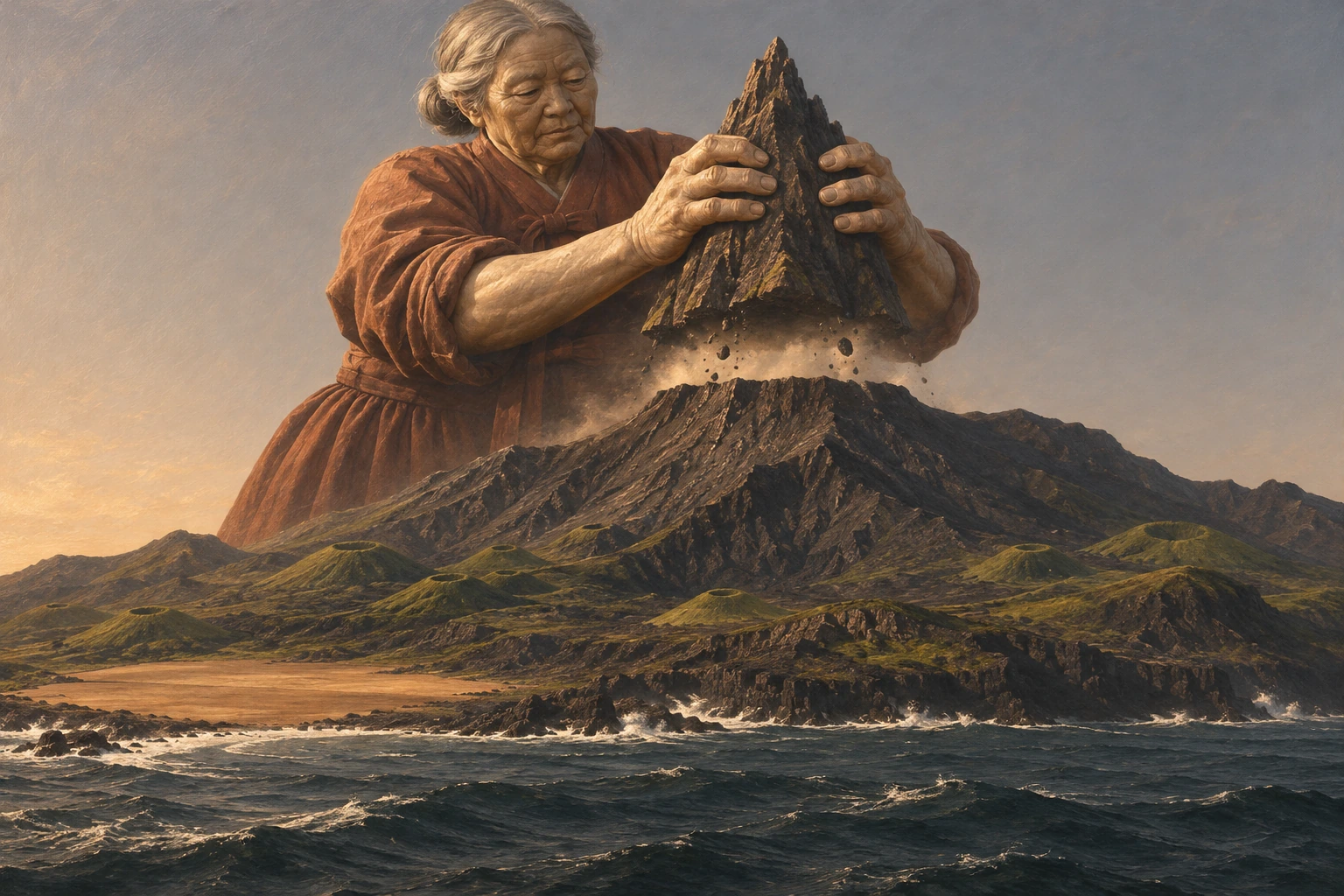
Seolmundae filled her skirt with soil and carried it to make the island. To build Hallasan she poured out load after load, seven in one telling. Soil leaked through a tear in her skirt as she walked, and every heap it left became an oreum.
The finished peak was too sharp, so she broke off its top and threw it away. The top landed in the south-west as Sanbangsan. The hollow it left on the summit is the crater lake Baengnokdam. She punched in the crater of Darangswi Oreum with her fist. And a tall rock on Seongsan Ilchulbong, the Deunggyeongdol, is the stand where she set her lamp to sew at night; finding it too low, she put a second rock on top.
1-2 Washing Day
She was so tall that, lying with her head on Hallasan, her feet reached Gwantalseom. The hole through that islet is where she once stretched out carelessly. She did her washing standing with her feet on two islands, Gwantalseom and Marado in one telling, and used a third island as her washboard.
Udo, off the east coast, was once part of Jeju. Seolmundae squatted with one foot on Siksanbong and the other on Ilchulbong to relieve herself, and the stream was so strong that it cut a piece of land away. That piece is Udo. The channel it carved is why the current between Udo and Seongsan is still so rough.
1-3 The Bridge and the Silk
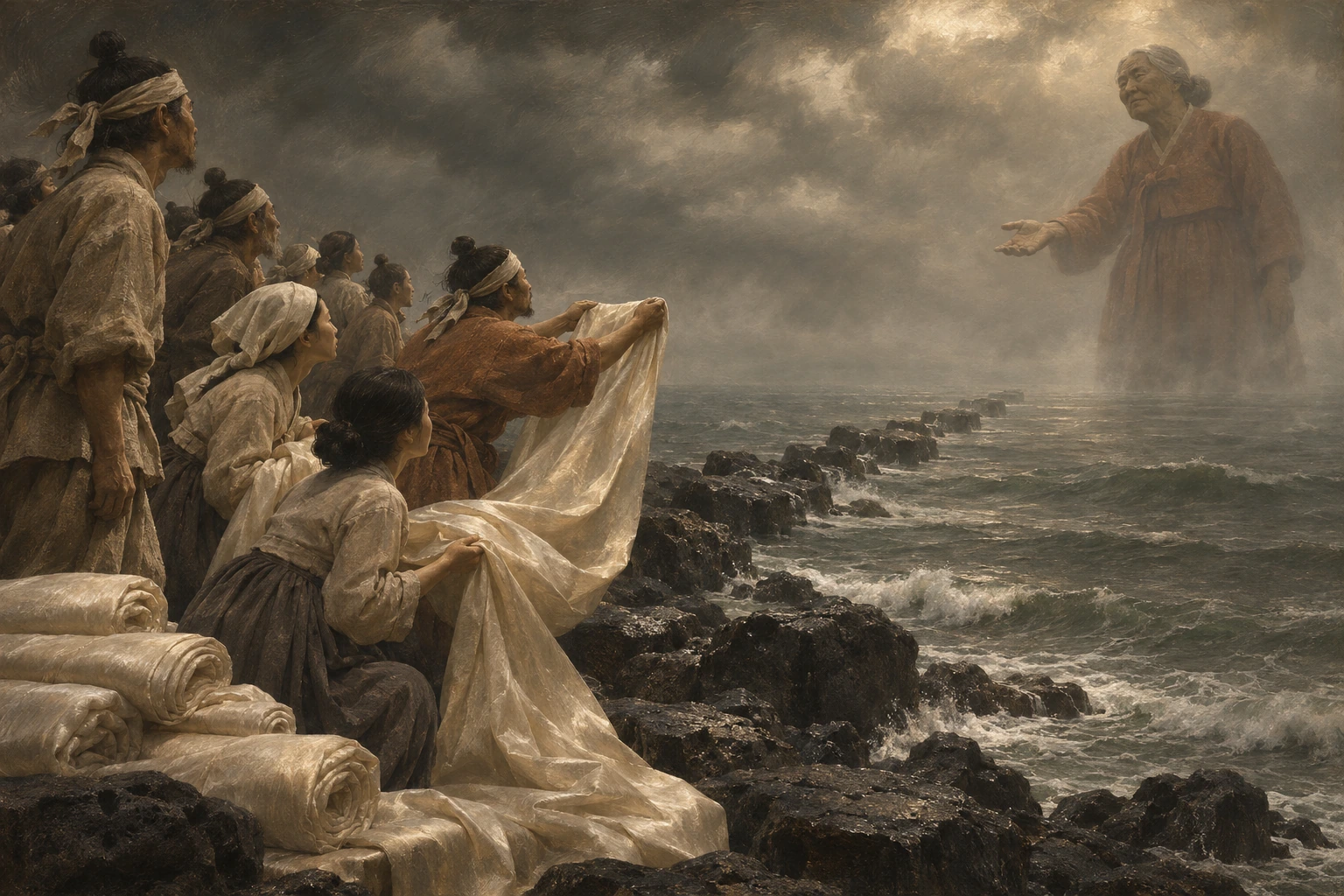
Seolmundae made the islanders an offer: make me one set of underclothes, and I will build you a bridge to the mainland. The garment needed a hundred bolts of silk. The islanders gathered all they could and came to ninety-nine. It could not be finished, and she gave up the bridge. Its first stretch is still there, a ridge of rocks running out to sea between Jocheon and Sinchon on the north coast.
One teller, recorded for the national survey of oral literature published in 1981 and quoted by the scholar Jeong Jin-hui, added that it was just as well. If the bridge had been built, tigers would have crossed over, and there are no tigers on Jeju.
1-4 The Bottomless Pool
She was proud of her height, and went from pool to pool to see whether any was deeper than she was tall. Yongyeon, in today’s Jeju City, came up to her feet. Hongnimul, at Seohong near Seogwipo, came up to her knees. Last she stepped into Muljangori, a crater lake high on Hallasan. Its bottom had burst open, and she sank and drowned. Islanders call it chang-teojin mul, “the water with a broken bottom”.
1-5 The Five Hundred Sons
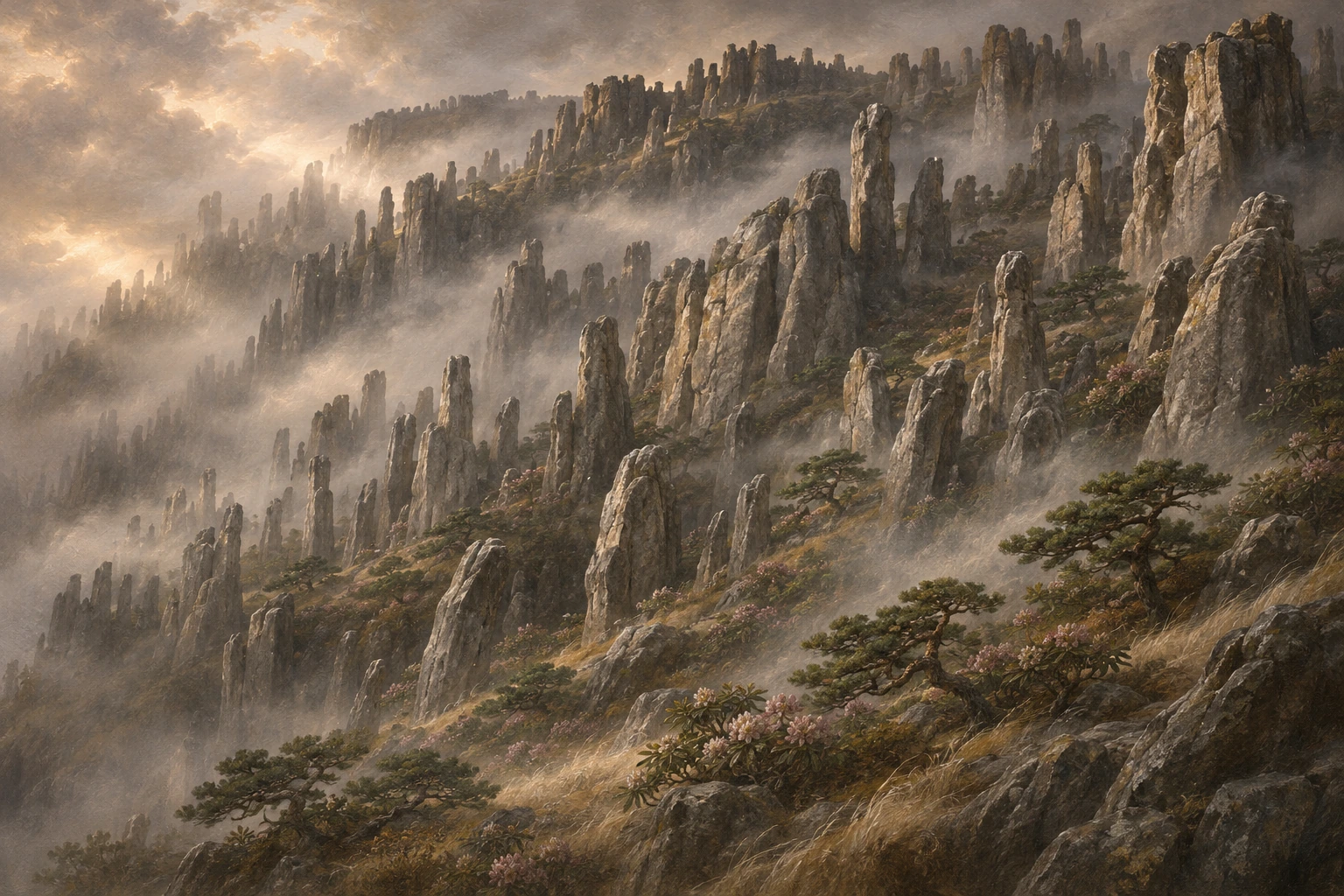
In another telling she had five hundred sons, though in the oldest recordings their mother has no name (section 3). In a year of famine the sons went out to look for food, and their mother made porridge in a great cauldron for their return. She slipped and fell in. The sons came home hungry and ate. The youngest, the last to eat, found bones in the pot and understood. He ran to Chagwido, the islets off Jeju’s western tip, and wept until he turned to stone. His brothers, grieving, turned to stone where they stood: the Five Hundred Generals (Obaek janggun), the rock pinnacles of Yeongsil on Hallasan’s south-west slope. Some say there are only 499 of them.
2 Where the Story Is Written Down
- The Pyohaerok (“Record of Drifting across the Sea”) of Jang Han-cheol (1744–?). Jang sailed from Jeju at the end of 1770 for the civil service examination in Seoul and was blown to the Ryukyu Islands. On the fifth day of the first month of 1771, from the ship that rescued them, the Jeju men sighted Hallasan. Some bowed toward it and prayed: “Immortal of the White Deer (白鹿屳子), save us, save us! Immortal Grandmother Seonma (詵麻屳婆), save us, save us!” Jang explains that the people of Tamna, the old name of Jeju, tell of an old immortal who rode a white deer on Halla, and that “in the remotest beginning, Seonmago (詵麻姑) came walking across the western sea and roamed on Halla”. The manuscript is in the National Jeju Museum. The scholar Jeong Byeong-uk, who found it in 1959, wrote that Seonmago was Seolmundae, and, as Jeong Jin-hui shows, most later writers followed him (section 4).
- Yi Won-jo’s Tamna-ji (耽羅誌). Yi (1792–1871), governor of Jeju from 1841 to 1843, mentions her in his gazetteer of the island, according to the Encyclopedia of Korean Culture. Yi Seong-jun (1989), on Hyeon Yong-jun’s word, reported that it notes a footprint of hers at Sinchon, as Jeong Jin-hui relates. We have not seen the text.
- The 1930s. Kim Du-bong’s Jejudo silgi (1932), a book on the island by a Jeju author, has a “Legend of Seolmandugo (雪漫頭姑)”. The Japanese anthropologist Izumi Seiichi, who did fieldwork on Jeju under colonial rule, recorded the “Solmande Halman” in his Saishūtō (1966). We know both only from Jeong Jin-hui’s survey of the evidence (2019).
- A shaman’s song. In 1957 the folklorist Jang Ju-geun printed a rite for the mountain gods sung by the shaman Go Bong-seon of Pyeongdae-ri, which we read as Jeong Jin-hui quotes it. In it “Seonmaengdui Halmang” offers to build a bridge to the mainland and, short of silk, never finishes it.
- The great collections came after: Jin Seong-gi’s Namguk-ui jeonseol (“Legends of the Southern Land”, 1968), Hyeon Yong-jun’s Jejudo jeonseol (“Legends of Jeju”, 1976), and the Jeju volumes of the Hanguk gubi munhak daegye, the national survey of oral literature (1980s). They give her name in more than a dozen forms: Seolmundae, Seonmundae, Seolmyeongdu, Semyeongju, Sswemengdui and others.
None of these is a long story. Hyeon Yong-jun observed that every islander knows Seolmundae, yet asked for details people hesitate: what survives is short and fragmentary, with no ordered plot.
3 Competing Versions
- Who made the island? In most tellings she makes Hallasan and the oreum, not Jeju itself. One telling in the 1981 survey, quoted by Jeong Jin-hui, begins earlier. Heaven and earth were stuck together until “a very tall, strong person” pulled them apart and dug Jeju up out of the sea, but dug badly, so the way to Mokpo on the mainland was cut. Seolmundae then carried soil to fill the gap, and what she spilled became Hallasan and Dodulbong. Jeong Jin-hui reads the giant who split heaven and earth and Seolmundae as two different figures. In some of the shamans’ songs, the one who separates heaven and earth is Dosu Munjang, an officer of the Jade Emperor. Jeong also points out that a book by Jin Seong-gi of 2005 gives the separation to Seolmundae, while nearly the same passage had Dosu Munjang as its hero in his book of 1981.
- Who threw the peak? In a telling recorded at Daejeong in 1960, it was the Jade Emperor. A hunter chasing a deer on Hallasan raised his bow so high that he touched the Emperor’s backside, and the angry Emperor pulled off the summit and flung it west.
- How deep were the pools? Yongyeon came to her instep in one version, her ankle in another; Hongnimul to her knees, or her thighs.
- Whose sons? The early recordings disagree, as the Digital Seogwipo Culture Encyclopedia lists them. In a telling recorded at Hwasun-ri in 1959 (Jin Seong-gi), the mother of the five hundred is just “a grandmother”. In one told at Panpo-ri in 1961 (Jang Ju-geun), Seolmundae bears them, and nothing more is said. In one recorded at Anseong-ri in 1975 (Hyeon Yong-jun), she is “a mother”. Another version given by Jin Seong-gi, Yu Jeong-wol notes, has the father fall into the pot, since Seolmundae herself drowned in Muljangori; and Hyeon Yong-jun objected to the change that turned an unnamed old woman into Seolmundae.
- A husband and a heavenly father. Some tellings give her a husband, Seolmundae Hareubang (“Grandfather”), and comic tales of the two of them fishing. Some modern retellings make her the youngest daughter of the Jade Emperor, who came down against her parents’ will. Hyeon Yong-jun thought the husband was supplied by guesswork, and the heavenly birth a writer’s invention modelled on the song of the Gaksidang shrine in Jeju City.
- New sites keep joining. At Pyoseon on the south-east coast she is said to have filled in the sea to make the beach.
4 History and Tradition
- A lost goddess? Since Jang Ju-geun in 1957, Jeong Jin-hui writes, most scholars have read her as a creator goddess whose holiness wore away, leaving local legends and jokes. The Encyclopedia of Korean Culture takes this view: she is the same kind of being as the mainland’s Mago Halmi and “bears the traces of a creator goddess”. Jo Hyeon-seol, quoted by Yu Jeong-wol, calls her “a goddess who drowns in the world she created”. The evidence offered, as Jeong sums it up, is the Pyohaerok’s Seonma, Jang’s shaman song, and an old woman’s memory of mountain-god rites, recorded by Yi Seong-jun in 1988.
- Or a giant of legend? Hyeon Yong-jun, Jeong notes, held back from calling the tales a creation myth, and Song Hwa-seop tied the Korean Mago tales to the Chinese immortal Magu and to Guanyin. Jeong Jin-hui went through the evidence in 2019. Jeong Byeong-uk gave no reason for equating Seonma with Seolmundae. The arguments made since rest on a likeness between the tales and on the s–m the two names share, yet no recorded tale has Seolmundae walk across the sea, and Seonma lacks the d of Seolmundae. In Jang’s song she is not one of the gods addressed but a figure of legend, the one who could not build a road, set beside the mountain god who can. Yi’s informant remembered the White Deer mountain god and the Five Hundred Generals in the rite, but did not know whether Seolmundae was in it. Jeong does not conclude that she was never a goddess, only that it has not been shown. In the abstract of a 2024 article, Lee Hyeon-jeong finds the Pyohaerok’s Seonma closest to a goddess of the Gwayang shrine, the Lady of Seonnyeguk from Mount Mudeung.
- Jeju’s gods and their songs. Jeju is called the island of eighteen thousand gods. A god’s story is its bonpuri, the account of its origin and powers that a shaman (simbang) sings at the rite. There are three kinds: those of the gods of all people, such as the goddess of birth; those of the village shrines; and those of the guardian spirits of families. Every rite opens with the chogamje, the invitation of the gods, which begins by singing the creation: heaven and earth stuck together, parting at a cock’s crow, and the god Cheonjiwang setting two suns and two moons in the sky. Seolmundae has no bonpuri and no place in that creation. Hyeon Yong-jun found it hard to understand how her divine side could have vanished on an island that kept its sung myths for so long.
- Muljangori was sacred before it was hers. A Joseon gazetteer quoted by the Digital Jeju Culture Encyclopedia calls it a dragon’s pool of unmeasured depth, where prayers for rain were answered, and it is said that mist comes down when an impure person climbs it. It has been a Natural Monument since 2010.
- The Jeju Stone Park, opened at Gyorae on 3 June 2006, built its “Garden of Myths” around her and her sons. Its signs say she gave her body to the cauldron for her children, where the old tellings have her slip. Its emblem, a woman with her hair in a bun and the youngest son on her head as a bird, comes from a new story told in the park’s film. Since 2007 the park has held a festival in her name each May, with a rite at an altar in its grounds. Yu Jeong-wol (2017) and Han Jin-oh, in the abstract of a 2024 article, criticize it for reducing a varied, often comic legend to motherhood and tragedy, while many of the real legend sites are lost or damaged.
Seolmundae is often presented as a goddess worshipped in Jeju’s shrines. No shrine is dedicated to her under the name Seolmundae, and no shaman’s bonpuri tells her story. The nearest is the Dangke shrine at Pyoseon harbour, whose goddess Semyeongju Halmang guards fishermen and divers. Semyeongju is one of the forms of Seolmundae’s name, and the Encyclopedia of Korean Culture counts the shrine as hers; in the shrine’s own tradition its goddess is a wind goddess risen from Hallasan and the wife of the village’s chief god. The rite at the Stone Park is part of a festival begun in 2007.
5 Related Stories
- Samsin Halmeoni: The Goddess of Birth: Jeju’s goddess of birth, Samseung Halmang, has what Seolmundae lacks: a bonpuri, sung by the shamans in her rites.
- Pangu: The Giant Who Grew Between Heaven and Earth: Hyeon Yong-jun places the Seolmundae tales in one line with Pangu, Japan’s giant Daidarabotchi, who made Mount Fuji, and Amanchu, the giant of Okinawa. Jeong Jin-hui doubts that the Okinawan giant, at least, was ever a creator goddess.
- Nüwa: The Serpent-Bodied Goddess Who Mended the Sky: another goddess who works with the earth itself, kneading yellow earth into people. We have not found a scholar who compares the two; we link them for the theme.
6 Sources
- Jang Han-cheol, Pyohaerok, entry for the 5th day of the 1st month of 1771 (manuscript, National Jeju Museum): Classical Chinese text as quoted in Jang Seong-cheol, “표해록에 나오는 선마고와 설문대할망이 동일인물?”, Media Jeju, 29 May 2017: mediajeju.com; Korean translation in Jeong Jin-hui (below)
- Encyclopedia of Korean Culture: 설문대할망 설화, 표해록
- Digital Jeju Culture Encyclopedia: 설문대할망 (Ha Sun-ae), 제주를 창조한 여신 설문대할망, 본풀이, 초감제 (Hyeon Yong-jun), 오백장군, 장한철의 표해록, 제주 물장오리 오름
- Digital Seogwipo Culture Encyclopedia: 설문대 할망, 오백 장군 전설, 산방산 전설 (Hyeon Seung-hwan), 표선리 민간 신앙 유적 (Mun Mu-byeong)
- Jeong Jin-hui, “설문대 할망 창조 여신설 검토”, Jejudo yeongu 51 (2019), pp. 89–121, quoting Jeong Byeong-uk (1961), Jang Ju-geun (1957), Yi Seong-jun (1989), Hyeon Seung-hwan (2012), Song Hwa-seop (2008), Jin Seong-gi (1981, 2005) and the Hanguk gubi munhak daegye 9-2 (1981): Jeju Studies Center
- Yu Jeong-wol, “제주 돌문화공원에서 '설문대할망’의 소환”, Yeoseong munhak yeongu 41 (2017), pp. 7–37, quoting Jo Hyeon-seol and Hyeon Yong-jun: accesson.kr
- Lee Hyeon-jeong, “제주도 당신앙 속 여산신의 흔적과 변주”, Jejudo yeongu 61 (2024), abstract: Kyobo Scholar; Han Jin-oh, “소환과 외면, 신을 대하는 두 가지 시선”, Hanguk musokhak 49 (2024), abstract: KCI
- Jeju Stone Park, history: jeju.go.kr; the May festival: Segye Ilbo, 15 May 2024, Yeogiyu
- Yi Won-jo’s governorship: Kyongbuk Maeil, 6 February 2023; “eighteen thousand gods”: Jnuri
- Kim Du-bong, Jejudo silgi (1932), and Izumi Seiichi, Saishūtō (University of Tokyo Press, 1966): CiNii, CiNii
Cover and illustrations: AI-generated images made for Arcana. They are interpretations, not historical artworks.