The Sun and the Moon: The Brother and Sister Who Escaped the Tiger
A tiger came to the door in their mother's clothes, and a brother and sister escaped up a rope from heaven to become the sun and the moon. Koreans place such stories in the days when tigers smoked tobacco, yet this one was first written down in the twentieth century, and the oldest full text we have read gives the sun to the brother.
- Type: folk tale, often called Haenim dalnim (“Sun and Moon”); how the sun and the moon came to be, and why sorghum stalks are red
- Culture: Korea, told throughout the peninsula
- Earliest texts: a “Sun and Moon” among the old stories readers sent to the children’s magazine Aideulboi in 1913–1914; the oldest full text we have read is “The Tiger’s Punishment from Heaven”, in the Government-General’s Chōsen dōwa-shū (1924), in Japanese
- Key figures: a widowed mother, her son and her daughter, a tiger, and heaven, which lets down a rope
Two lines of this tale are still part of everyday Korean. “Give me a rice cake and I won’t eat you” is the tiger’s demand to the mother on the road home, and the “rotten rope” heaven lets down to the tiger is still said of a chance or a connection that cannot be relied on. In January 1970 Korea’s postal service put the story on a series of stamps: the mother meeting the tiger, the tiger at the door in her clothes, the children chased up a tree, and the tiger falling from its rope.
Which of the two became the sun? It depends on the teller. In the oldest printed text we have read, from 1924, the brother becomes the sun and the sister the moon, and the story stops there. In the version most Koreans know, they change places: the sister is afraid of the night, so her brother gives her the day. Then she is ashamed to have people staring at her, and she pricks them with needles, which is why no one can look straight at the sun.
1 The Telling
This is “The Tiger’s Punishment from Heaven” (虎の天罰), tale 24 of the Chōsen dōwa-shū (“Korean Children’s Tales”), which the Government-General of Korea published in Japanese in September 1924. It is the oldest full text we have been able to read, and we translate it from the Japanese. Section 3 shows how the version most Koreans know differs.
1-1 The Mountain Path
Long ago, in a poor farmer’s house, there were two children, an elder brother and a younger sister. Their father had died early, and their mother kept the three of them alive by hiring herself out from house to house. Whenever she went out to work, the children stayed at home alone.
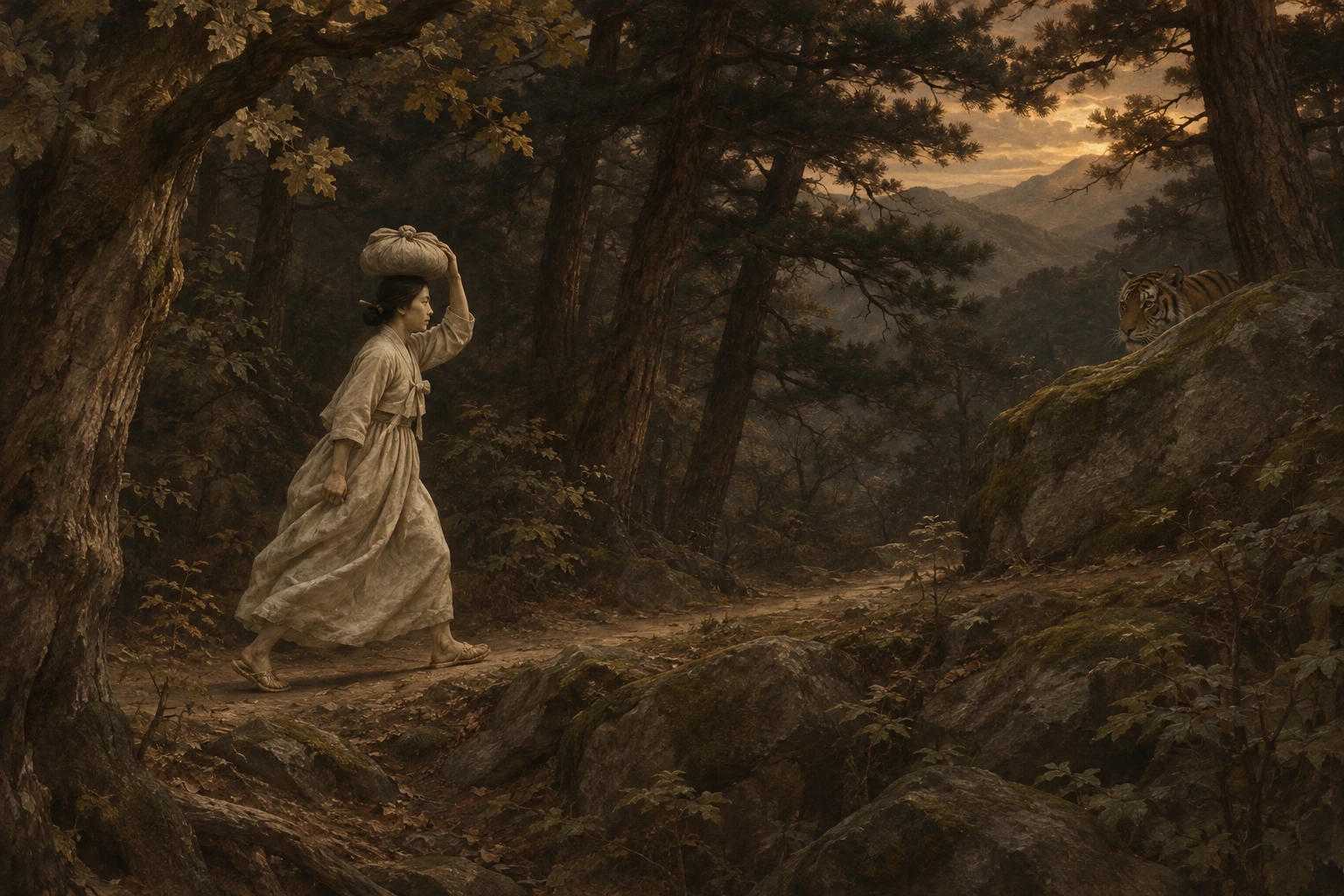
One day a house in the next village took her on to starch woven cloth. “Keep house nicely together,” she told the children, “and whoever comes, never let them in.” She took a lunch of bean porridge and set out. The way crossed a mountain, where a single narrow path ran through tall, thick trees, a lonely and eerie place, and she hurried. From behind a great rock a tiger came out. “What are you carrying? Give it here, and I’ll spare you.” She threw it the porridge. The tiger finished it in a lick or two, followed her and asked for more, and in the end it ate her.
1-2 The Voice and the Hand
Still not satisfied, the tiger put on the mother’s clothes and went to the house. “Open up, open up, Mother’s home!” “That’s not Mother’s voice.” “My voice has changed because I’m tired from a day’s work.” “Then show us your hand.” The tiger pushed its paw through the gap in the door. “That’s not Mother’s hand. Mother’s hand isn’t so dirty, and it hasn’t got hair on it.” “That’s the starch I’ve been handling all day. I’ll wash it and show you.” The tiger rubbed oil on its paw and put it in again, and the little sister, taking it for her mother’s hand, opened the door.
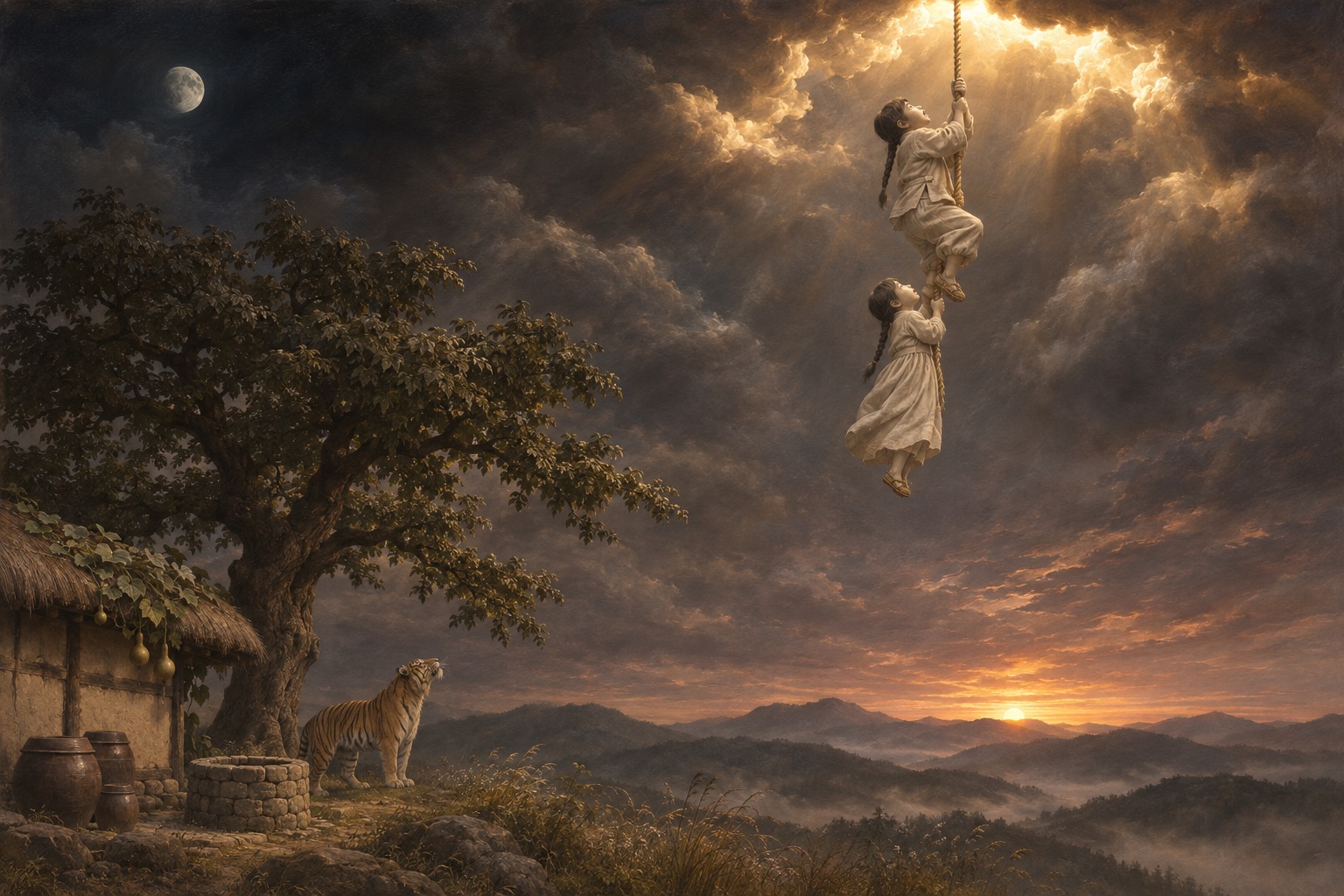
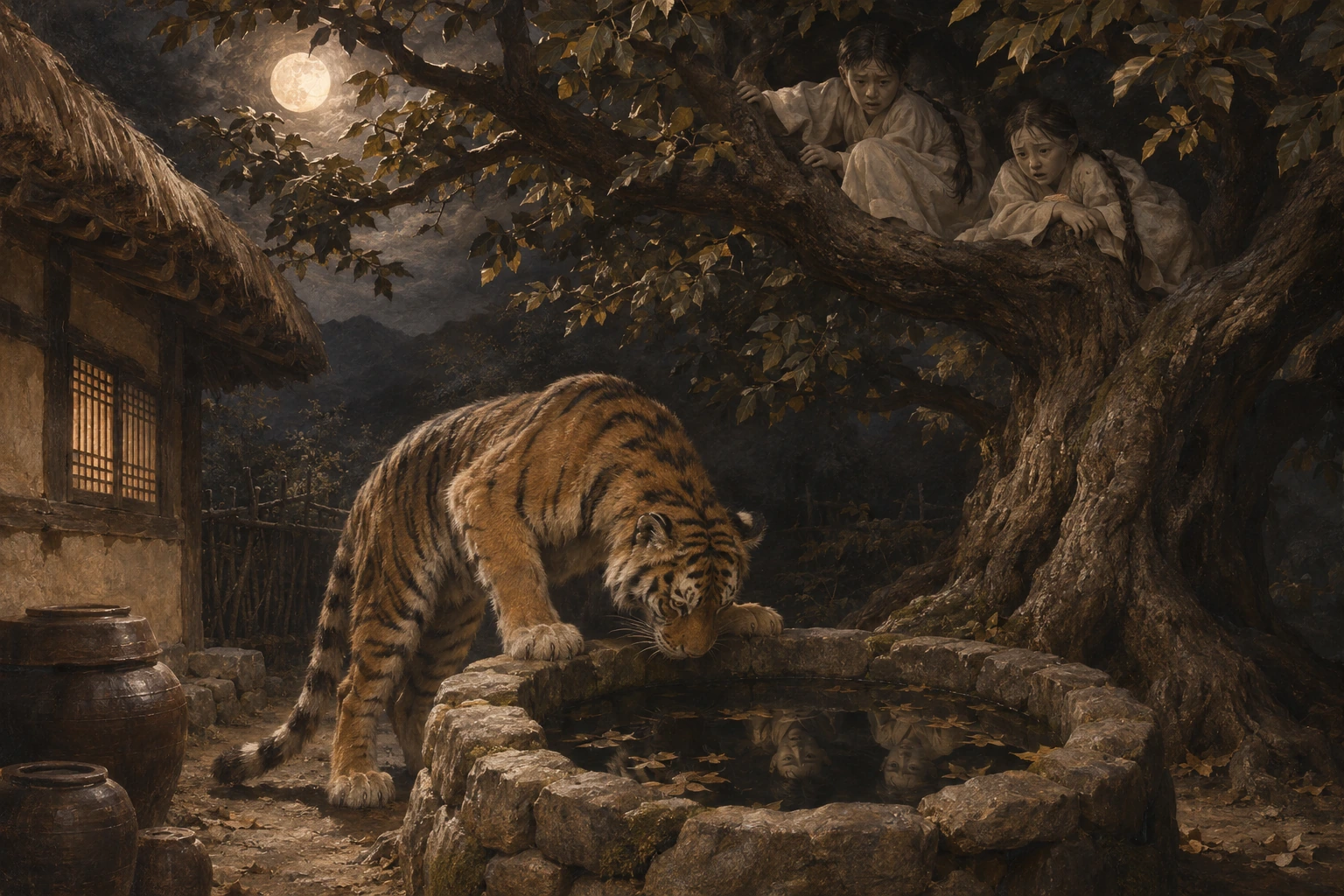
As soon as it came in, the children could see that, whatever it wore, it was not their mother. “We’re just going out to the privy,” they said, and slipped round to the back of the house. Beside the well stood a tree, and they climbed up into it.
1-3 The Reflection in the Well
The tiger waited, then went out to look for them. It searched everywhere and found no one, until it glanced into the well and saw the two children reflected on the water. It did not know how to climb, so it asked the boy: “How did you get up that tree?” The brother was clever. “I rubbed oil on it and climbed.” The tiger oiled the trunk and slid straight down. Then it asked the girl, who was “still small and did not think”: “I cut notches with an axe and climbed.” The tiger fetched an axe and began to hack at the tree.
1-4 Two Ropes
There was nowhere left to run. The children turned to heaven and prayed with all their hearts: “Please help us, poor as we are.” A new, thick rope came down from the sky. They caught hold of it, and it drew them smoothly up. The tiger, meaning to follow them wherever they went, prayed to heaven in the same way, and a thick rope came down for it too, but an old one. The tiger leapt on and was hauled up high, and halfway the rope snapped. The tiger spun through the air, struck the ground and was killed.
1-5 The Red Stalks
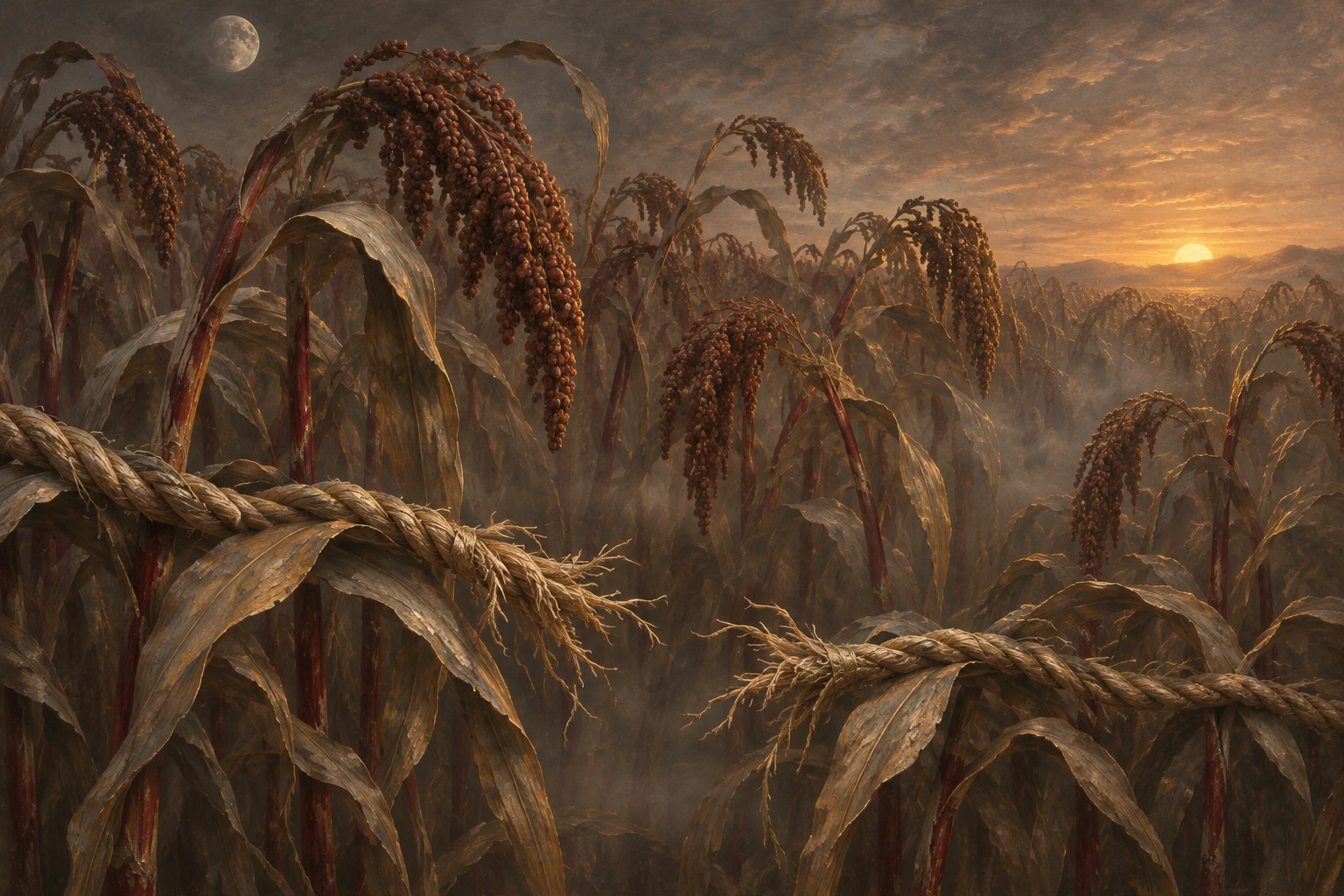
Where it fell there happened to be a stand of satōkibi, as the Japanese text calls it (the word usually means sugar cane; the Korean tellings say sorghum), and the stalks were stained with the tiger’s blood. “That is why, ever since, their stalks have red streaks.” And of the children who had gone up to heaven, “it is said that the brother became the sun and the sister the moon.”
2 Where the Story Is Written Down
- The magazine Aideulboi, 1913–1914. Choe Nam-seon’s children’s magazine asked readers for old stories in October 1913 and printed them from January 1914. Jang Jeong-hui, who studied the drive, names a “Sun and Moon” among the stories collected. We have not seen its text.
- Ju Yo-seop, “Hae-wa dal” (“The Sun and the Moon”), in the magazine Gaebyeok, 1922. The Chosun Ilbo, reporting on the National Hangeul Museum’s exhibition on a hundred years of Hangul folk tales, called it the story’s first written record. We have not seen it either.
- The Government-General of Korea, Chōsen dōwa-shū (Keijō, now Seoul, 1924), tale 24, pp. 157–165: the text of section 1, in the book the Chosun Ilbo calls the first collection of Korean folk tales for children. Kim Gwang-sik has shown that the Grimm scholar Tanaka Umekichi rewrote its tales in polished Japanese, to teach the language and to train good children, and that at least eight of them go back to a survey of legends and children’s tales the Government-General made in 1913. Whether this one does, we could not find out.
- Jeong In-seop, Ondol yahwa (“Night Tales by the Warm Floor”, Tokyo: Nihon Shoin, 1927), the first collection of Korean tales by a Korean to be published in Japan, according to the Encyclopedia of Korean Culture. Its third tale is “Hi to tsuki” (日と月, “The Sun and the Moon”). The Encyclopedia says Jeong first noted when, where and from whom he had each tale, then struck the notes out; his English Folk Tales from Korea (London, 1952) added the tellers. Kang Sang-dae dates Jeong’s Japanese “The Sun and the Moon”, by the day it was taken down, to 1911, the earliest by that measure. The abstract we have read does not name the book; we take it to be this text.
- Son Jin-tae, Chōsen mindanshū (Korean Folk Tales, Kyōdo Kenkyūsha, 1930), with “Hi to tsuki to hoshi” (日と月と星, “The Sun, the Moon and a Star”), as the contents of its facsimile reprint show. Kang Sang-dae dates Son’s text of that title to 1923 and notes that it mostly transcribes what the teller said.
- Later collections. The Encyclopedia draws its versions from the Academy of Korean Studies’ survey of oral literature, the Hanguk gubi munhak daegye (1980–1988), and from Im Seok-jae’s twelve volumes of Korean oral tales (1989–1993). For the early period, Kang Sang-dae has found seven texts written in Hangul.
All of these early texts were set down under Japanese rule (1910–1945), and Jeong’s and Son’s, as Kang points out, were written in Japanese by Korean collectors.
3 Competing Versions
- Rice cakes over the hills. In the version most Koreans know, the mother is coming home with rice cakes, and the tiger waits at one hill after another: “Give me a rice cake and I won’t eat you.” In the usual form as the Encyclopedia sums it up, it takes a rice cake, then her clothes, then more, before it eats her. The 1924 text has one mountain and a lunch of bean porridge.
- Two children or three? The Encyclopedia’s usual form has three: a brother, a sister and a baby. The children will not open to the tiger’s voice or its hand, but they open when it says the crying baby must be fed. It eats the baby, and the other two run. In Son Jin-tae’s text, Kang Sang-dae notes, the children are three sisters, and the mother, to save herself, tells the tiger to eat her children instead.
- The oil and the axe. In the Encyclopedia’s form it is the brother who tells the tiger to use sesame oil, and the sister who lets slip the axe. In Son’s text the children lie to the tiger outright.
- A tiger that lies to heaven. Only in Jeong In-seop’s text, Kang finds, does the tiger know that its deeds are wicked and, fearing heaven’s punishment, lie to heaven.
- The ropes and the stalks. In Korean tellings the children get a new rope and the tiger a rotten one (dongajul). In the usual form the tiger falls into a sorghum field, is pierced by a stalk, and its blood turns the sorghum red. Some tellings drop the sun and the moon and keep only this, as the story of why sorghum stalks are red.
- Who became the sun? In 1924, the brother. In Jeong’s text, Kang notes, the brother is first the sun and the sister the moon, then they exchange, and the sister, now the sun, is ashamed to be looked at, a show of “feminine modesty” in which Kang sees an old-fashioned view of women. Son’s text has no exchange. Other tellings, the Encyclopedia says, make an elder sister the sun and a younger brother the moon; send three children up to become the sun, the moon and a star; or have the brother poke his sister’s eye in a quarrel and give her the sun to make amends.
4 History and Tradition
- A myth beneath the folk tale? The Encyclopedia’s entry, by the oral-literature scholar Park Hyeon-suk, sets the story beside myths of a brother and sister who become the sun and the moon, told among the Inuit of the Bering Strait and the Manchu, and in a Romanian oral epic. In those myths the brother pursues his sister, and the chase springs from forbidden love. One reading holds that the Korean tale is such a myth turned into a folk tale: the forbidden love was erased, the pursuing brother became a tiger, and the tiger who eats the mother was added later. The sun-sister’s shame may be its last trace. Another reading sees the chase as the trial of children leaving their mother’s arms.
- Europe. The Encyclopedia compares the European tale of the wolf and the goats, a pure animal story. In the Grimms’ “The Wolf and the Seven Young Kids”, type 123 in the Aarne–Thompson index, the wolf softens its voice with chalk and has its paw whitened with flour before the kids will open the door.
- China, under the Qing. Huang Zhijun (1668–1748) wrote down “The Tiger Granny” (虎媼傳) from “someone who talked to me about tigers”. In the mountains of She county, in today’s Anhui, old tigresses take human shape to prey on people. A girl and her little brother, taking jujubes to their grandmother, meet an old woman who says she is that grandmother. In the night the girl hears chewing, and what she is given to eat is a finger. She says she must go out, climbs a tree, and is carried off at dawn by a passing porter, who leaves his clothes in the branches. The granny comes back with two tigers, and when they find only clothes, they kill her for lying.
- Taiwan and mainland China. In Taiwan, where the tale is called Hu gupo, “Grandaunt Tiger”, the Encyclopedia says a tiger turns into a grandmother and the children kill it by a trick. In mainland Chinese tellings it is usually a wolf that falls from the sky, and cabbages grow where it lands, which the children sell to grow rich.
- Japan. In Tentō-san kane no kusari, “Tentō-san’s Golden Chain”, the attacker is a demon, and the children who climb to the sky become stars, the Encyclopedia says. The Heibonsha World Encyclopedia puts Grimm’s “Hansel and Gretel” in a type it calls “children and the man-eater”, and finds the Japanese tale, though it opens differently, almost the same in structure. A collection of buckwheat tales of 1961, with a preface by the folklorist Seki Keigo, lists it under “Why are buckwheat stems red?”
- The tiger of the tales. Of the 1,283 tales about the twelve animals of the zodiac in the Hanguk gubi munhak daegye, 501, about four in ten, are about the tiger.
- Today. In 2021 Tae Keller’s When You Trap a Tiger won the Newbery Medal, the best-known American award for children’s books; the Encyclopedia gives it as the chief example of the modern works that borrow from the tale.
The tale is often thought to be very old, a story “from when tigers smoked tobacco”, as Koreans say of things from long, long ago. Tobacco is thought to have reached Korea only around 1618, and the tale’s records are younger still: a Japanese-language version that one scholar dates to 1911, a title sent in to a children’s magazine in 1913–1914, and full texts from the 1920s. We have found no older Korean text that tells it. That does not date the story itself. “Apart from a few stories with sure sources,” the head of exhibitions at the National Hangeul Museum told the Chosun Ilbo, “we cannot know exactly when most folk tales were made,” and a Chinese relative of this one was written down by a man who died in 1748.
5 Related Stories
- Dangun: The Bear, the Tiger and the First Korean Kingdom: the best-known tiger of Korean myth is the one in the founding story, which could not keep the taboo that turned the bear into a woman. We link the two for the animal, not for any shared plot.
- Heungbu and Nolbu: The Swallow’s Gourds: in the Government-General’s Chōsen dōwa-shū of 1924, the tale that follows “The Tiger’s Punishment from Heaven” is “Nolbu and Heungbu”, the last of its twenty-five.
- Chú Cuội: The Man on the Moon: Vietnam’s best-known moon tale, whose oldest written telling was also set down under colonial rule, has a tigress, a tree and a man carried up to the moon. We know of no scholar who compares the two; the link is the theme.
6 Sources
- Government-General of Korea, Chōsen dōwa-shū (Keijō, 1 September 1924), tale 24, “Tora no tenbatsu”, pp. 157–165: NDL Digital Collections
- Jeong In-seop, Ondol yahwa (Nihon Shoin, 1927), contents; Son Jin-tae, Chōsen mindanshū (Kyōdo Kenkyūsha, 1930), contents of the facsimile reprint (Bensei Shuppan, 2009): NDL, NDL, NDL
- Encyclopedia of Korean Culture: 해와 달이 된 오누이 (Park Hyeon-suk), 온돌야화 (Choi In-hak), 담배
- Kang Sang-dae, “근대 〈해와 달〉 서사의 자료적 고찰: 정인섭·손진태의 자료를 중심으로”, Hanguk munye changjak 22.3 (2023), and “근대 전래동화 「해와 달」의 텍스트 양상: 한글 자료를 중심으로”, 22.1 (2023), abstracts: earticle, earticle
- Jang Jeong-hui, “조선동화의 근대적 채록 과정 연구 Ⅰ: 1913~23년 근대 매체의 옛이야기 수집 활동”, Hangukhak yeongu 57 (2016), abstract: happycampus.com; Yeom Hui-gyeong, “1900~1920년대 한·일 〈두더지(쥐) 혼인〉 ‘동화’ 비교 연구”, Hangukhak yeongu 73 (2024), on Aideulboi and Choe Nam-seon: Inha University
- Kim Gwang-sik, “1920년대 일본어 조선동화집의 개작 양상”, Yeolsang gojeon yeongu 48 (2015), abstract: earticle; and “グリム研究家田中梅吉と朝鮮民間伝承調査”, Mukashibanashi densetsu kenkyū 32 (2013): NDL
- Huang Zhijun, “The Tiger Granny” (虎媼傳), in Guang Yuchu xinzhi: Wikisource (Classical Chinese); his dates from the Library of Congress Name Authority File: id.loc.gov
- Jacob and Wilhelm Grimm, “The Wolf and the Seven Young Kids”, Kinder- und Hausmärchen no. 5, trans. D. L. Ashliman: University of Pittsburgh
- “ヘンゼルとグレーテル”, Heibonsha World Encyclopedia, on 天道さん金の鎖: Kotobank; Niijima Shigeru (ed.), 『蕎麦の昔話』, preface by Seki Keigo (Sarashina Sōhonten, 1961), contents: NDL
- Yoo Seok-jae, “전래동화 ‘해님 달님’ 겨우 100년전 얘기?”, Chosun Ilbo (10 August 2017): chosun.com
- Paik Hyun, “Childhood reminiscence via old stamps, Part 3: The Sun and Moon”, Korea.net (15 October 2014): korea.net
- “한민족의 표상 호랑이”, Segye Ilbo (1 January 2022): segye.com
- American Library Association, “Tae Keller, Michaela Goade win Newbery, Caldecott Medals” (25 January 2021): ala.org
Cover and illustrations: AI-generated images made for Arcana. They are interpretations, not historical artworks.