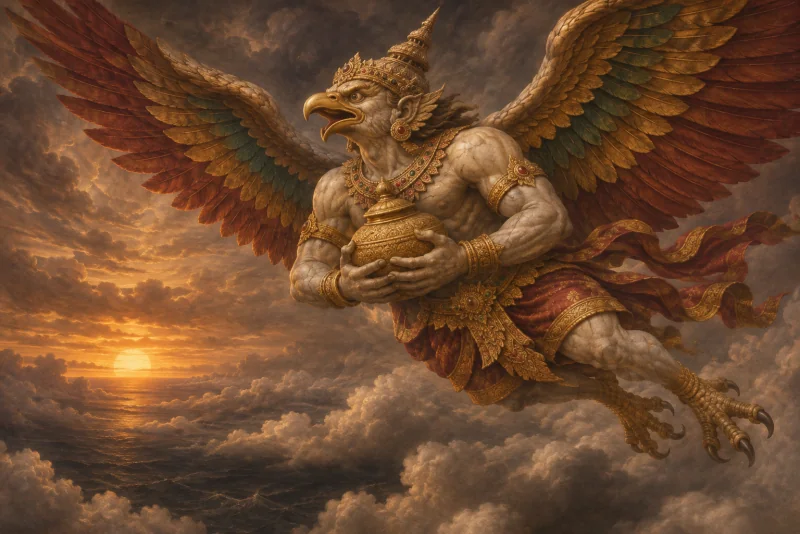
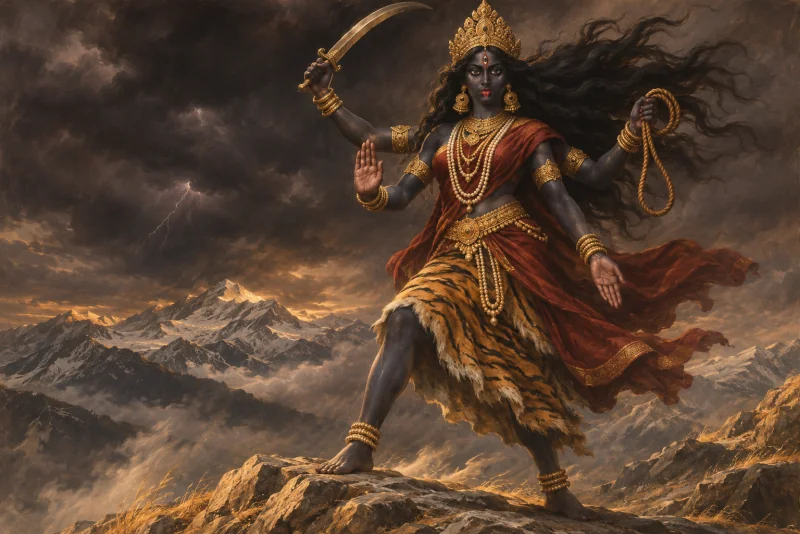
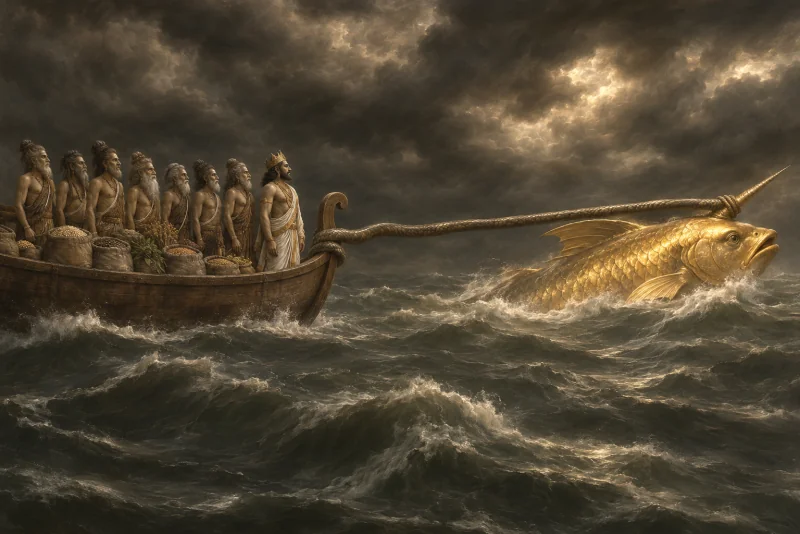
Shiva: The Destroyer and the Dancer
When Daksha shut Shiva out of his sacrifice, his daughter Sati gave up her body rather than hear her husband insulted, and Shiva's fury wrecked the rite. Textbooks call him the destroyer; the texts that worship him say he makes, keeps and ends the world, and dances while he does it.
- Type: myth, a god shut out of a sacrifice and a wife lost and found again; the many forms of one god
- Culture: India (Hindu tradition); worshipped in Champa, in central Vietnam, from about 400 CE, and in Japanese Buddhism as Daijizaiten
- Earliest texts: hymns to Rudra in the Rigveda; Rudra as the one god in the Śvetāśvatara Upaniṣad; the wrecked sacrifice in the Mahābhārata (Books 10 and 12) and the Purāṇas
- Key figures: Shiva (Rudra, Hara, Śaṅkara, Maheśvara), Sati, Daksha, Vīrabhadra, Parvati (Umā), Brahmā, Vishnu, Kāma
In the textbook picture of Hinduism, three gods share out the world: Brahmā creates it, Vishnu keeps it and Shiva destroys it. Yet śiva means “auspicious”, the oldest hymns to him ask him to heal, and his most famous image shows him dancing. The myth most often told of him begins with a sacrifice he was not invited to, and ends with a wedding.
Is Shiva’s wife Sati or Parvati? Both, in the Purāṇas. Sati, the daughter of Daksha, gives up her body at her father’s sacrifice and is born again as Parvati, the daughter of the Himalaya, to marry Shiva a second time. The telling in the critical edition of the Mahābhārata has neither the death nor the rebirth: there the wife hurt by Daksha’s snub is already Umā, the mountain’s daughter, and she lives on (section 3).
1 The Telling
This follows the Bhāgavata Purāṇa, book 4, chapters 2 to 7, in the Sanskrit text on GRETIL; quotations are our own translations. The sage Maitreya tells it to Vidura, who has asked how a father who loved his daughter could come to hate the gentlest of the gods, so much that she gave up her life (4.2.1–3).
1-1 The Son-in-Law Who Did Not Rise
Long ago the creators of the world held a great sacrifice, and the sages, the gods and the sacred fires all came. When Daksha walked in, shining like the sun, everyone rose from their seats except Brahmā and Shiva. Daksha bowed to Brahmā and sat down, but he could not bear the sight of his son-in-law sitting still.
He turned on him before the whole assembly. This shameless one, he said, had taken his daughter’s hand like an honest man and would not even rise to greet him: a monkey-eyed groom for a doe-eyed bride. He roams the cremation grounds with ghosts, naked, laughing and weeping like a madman, bathed in the ash of pyres and wearing human bones: “auspicious in name, inauspicious in fact” (4.2.15). Then Daksha touched water and cursed him. In the sacrifices of the gods, Shiva would have no share (4.2.18).
Shiva said nothing. His chief attendant Nandīśvara cursed back: Daksha would soon have the face of a goat (4.2.23). The sage Bhṛgu cursed Shiva’s followers in turn, and Shiva left the hall, “somewhat downcast” (4.2.33).
1-2 Uninvited
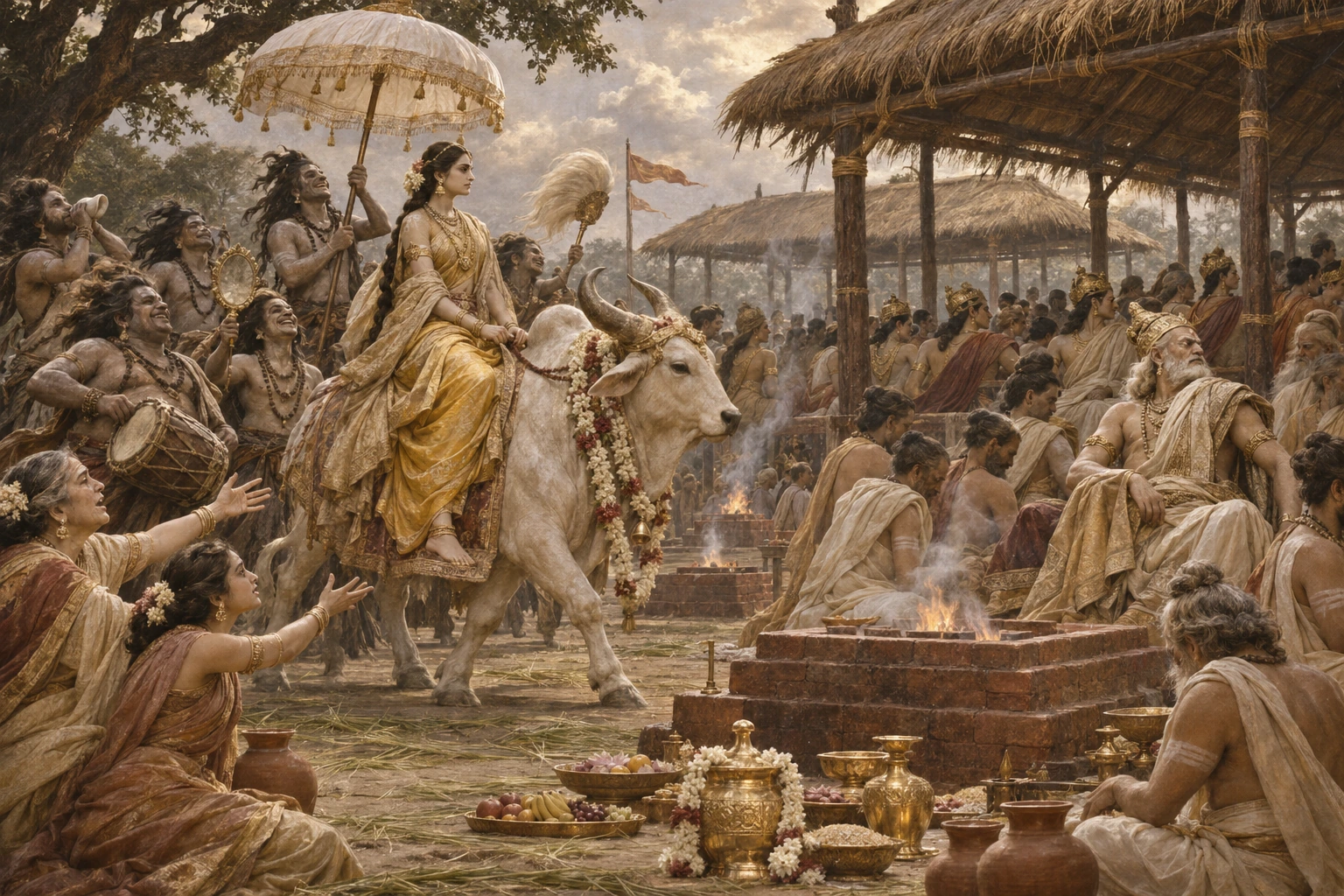
Brahmā later made Daksha the chief of all the progenitors, and pride went to his head. He began a great sacrifice and invited everyone except his son-in-law. From her home Sati saw the wives of the gods flying past in their aerial cars, dressed and jewelled for her father’s festival. She begged Shiva to go with her. Her sisters would be there, and her mother; and surely people go uninvited to a friend’s house, a husband’s, a teacher’s or a father’s (4.3.13).
Shiva smiled. One may go to kin uninvited, he agreed, as long as they bear no grudge. But Daksha had insulted him, though he had done no wrong. “If you go, ignoring my words, no good will come of it,” he told her: for someone respected, a slight from his own family is as good as death (4.3.25). Then he fell silent, seeing that he would lose her either way. Sati went to the door and came back, torn in two, and wept; at last she set out alone. Thousands of Shiva’s attendants ran after her, set her on the bull Nandin and followed with a white parasol, a mirror, a fan and music.
1-3 Sati
At the sacrifice no one greeted her, for fear of Daksha, except her mother and sisters, who embraced her in tears. Her father gave her no welcome, so she would not take the seat they offered. She saw that no share had been set aside for Rudra, and she spoke to her father before the assembly. The name Śiva, only two syllables, takes away the sin of anyone who says it even once, she said, and he hated the god who bore it. “I will not keep this body, born of you” (4.4.18). Whenever Shiva called her Dākṣāyaṇī, “Daksha’s daughter”, she would be ashamed.
Then she sat down on the ground facing north, touched water, wrapped herself in her yellow garment and closed her eyes. She drew her breath up through her body to the point between her brows, thinking of nothing but her husband’s feet, and her body blazed up in a fire born of her own meditation (4.4.24–27). A cry of grief went up on earth and in the sky. Her attendants rose to kill Daksha, but Bhṛgu poured an offering into the fire and called up the Ṛbhus, who drove them off with burning brands.
1-4 Vīrabhadra
Shiva heard it all from the sage Nārada. He bit his lip in rage, tore out a lock of his matted hair, blazing like lightning and fire, and dashed it to the ground with a roaring laugh. Out of it rose a giant who touched the sky: a thousand arms, the colour of a storm cloud, eyes like three suns, hair of flame, a garland of skulls and a weapon in every hand. “Kill Daksha and his sacrifice,” Shiva told him. “You are the chief of my warriors, a part of me” (4.5.4). This was Vīrabhadra.
Daksha’s guests saw a cloud of dust rise in the north and wondered what it was. Shiva’s host broke into the sacrificial ground, wrecked the halls and the vessels and put out the fires. Bhṛgu lost the beard he had shown off while laughing at Shiva; Bhaga, the eyes that had winked at Daksha during the curse; Pūṣan, the teeth he had bared in a grin. Vīrabhadra cut off Daksha’s head, threw it into the southern sacrificial fire, burned the ground and went back to Kailasa (4.5.19–26).
1-5 The Goat’s Head
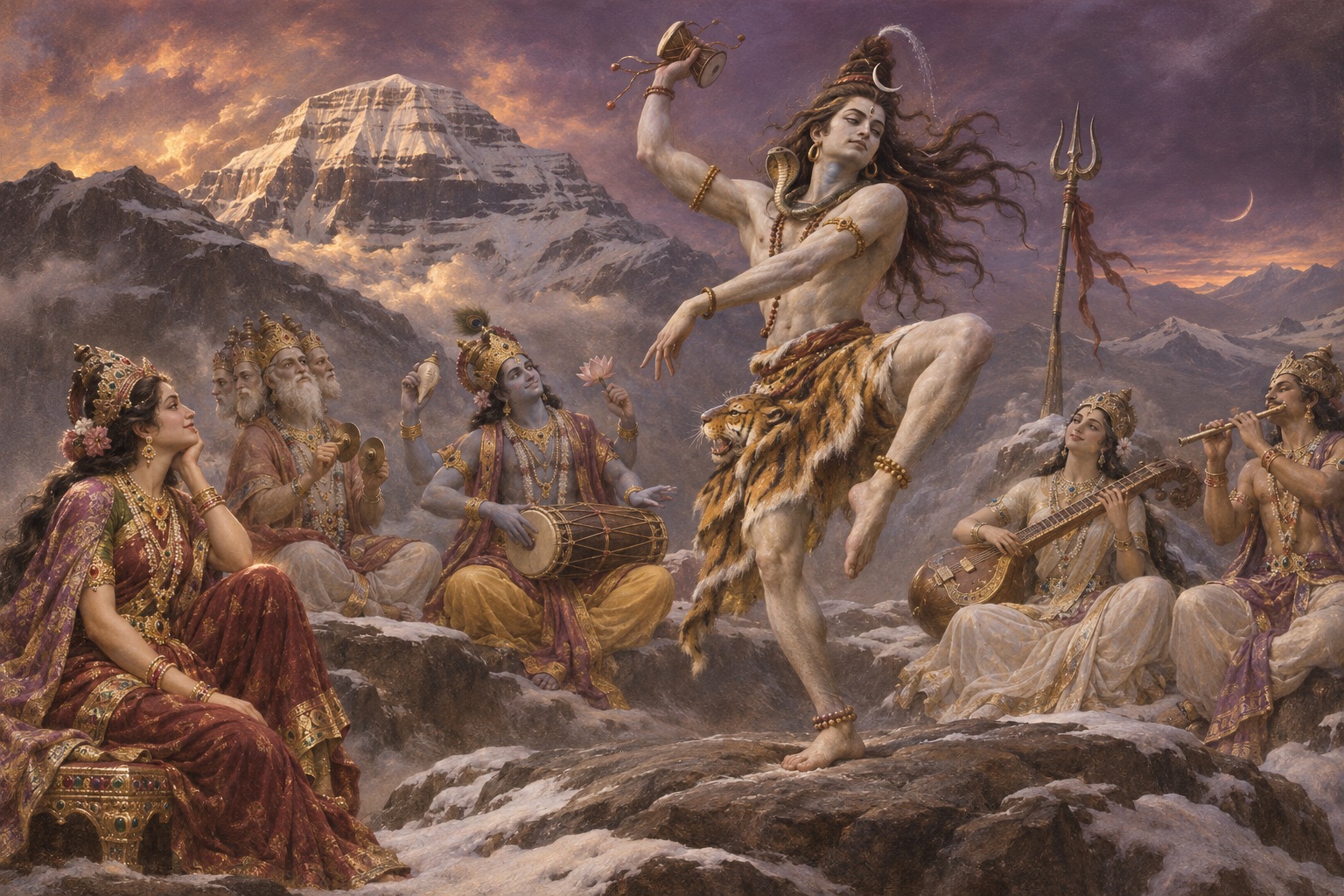
The beaten gods went to Brahmā, who had stayed away, knowing what would happen. Ask Shiva’s forgiveness, he told them: he is quickly pleased. So they went to Kailasa, the mountain identified with Mount Kailas in south-western Tibet, holy to Hindus and Tibetan Buddhists alike. There, under a banyan tree a hundred yojanas high, they found Shiva sitting calm, “like Death that has let go of its anger”. He wore the ascetic’s marks: ash, a staff, matted hair and a deerskin. His body was the colour of an evening cloud, with the crescent moon in his hair, and he sat on a mat of grass with his left foot on his right thigh and a rosary on his wrist, teaching the sage Nārada (4.6.32–38).
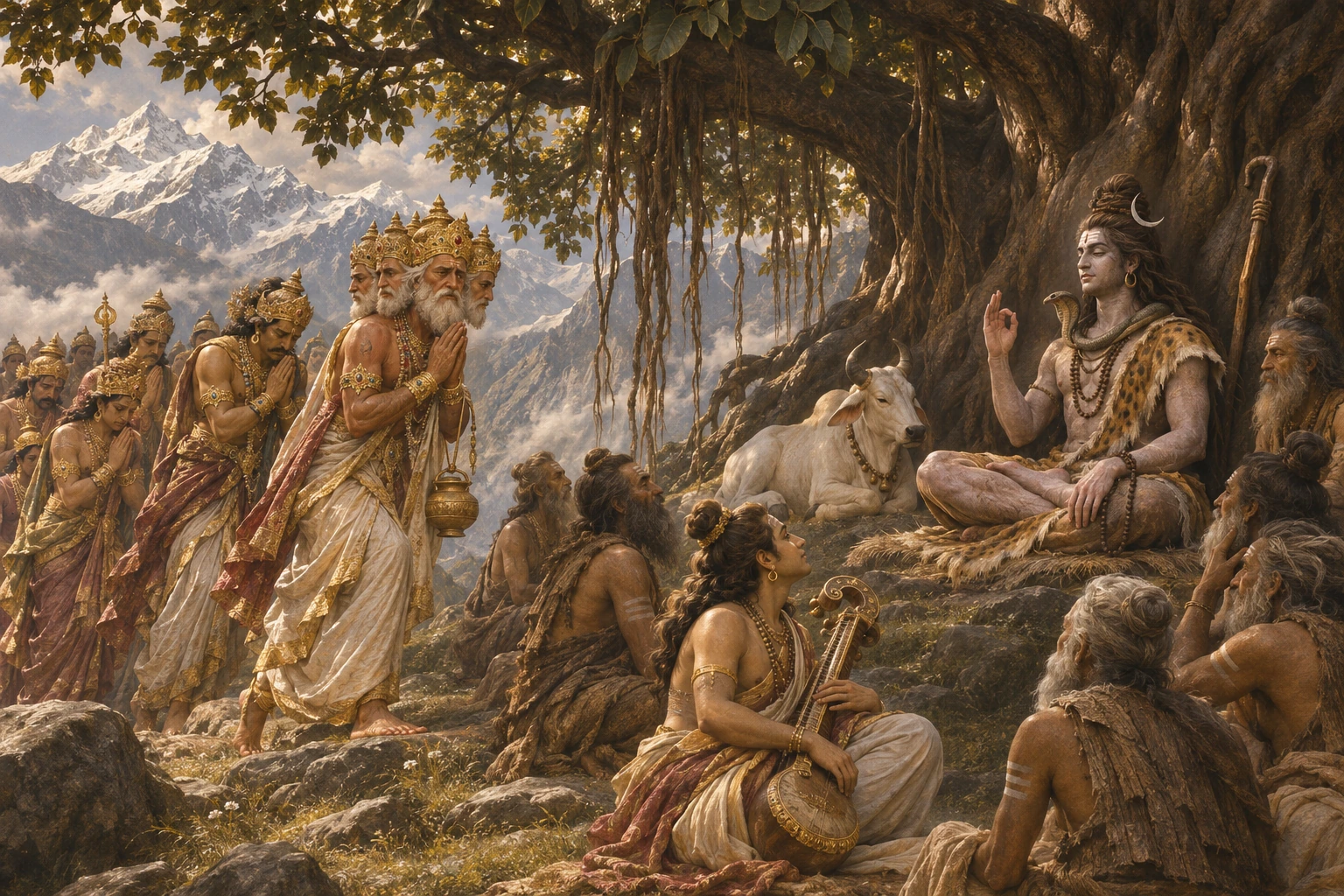
Brahmā praised him: “With Śiva and Śakti as your own two forms, you create this universe, keep it and devour it, at play, like a spider with its web” (4.6.43). Let the sacrifice be restored, he asked, and let Rudra have what remains of it as his share. Shiva answered that he did not count the faults of children; he had only punished them. Let Daksha, whose head had burned, have a goat’s head; let Bhaga see through another god’s eyes and Pūṣan eat with the sacrificer’s teeth; let Bhṛgu have a goat’s beard (4.7.2–5). The gods joined the head of the sacrificial goat to Daksha’s body, and at Shiva’s glance he rose “as if from sleep”, his mind, clouded by hatred, cleared like a pond in autumn. He tried to praise Shiva and wept, remembering his daughter (4.7.8–12). The sacrifice was completed, and this time Rudra had his share.
1-6 Parvati
“So, we have heard,” the chapter ends, Sati left her former body and was born to Menā, the wife of Himavat, the Himalaya, and as Ambikā she chose the same beloved husband again (4.7.58–59).
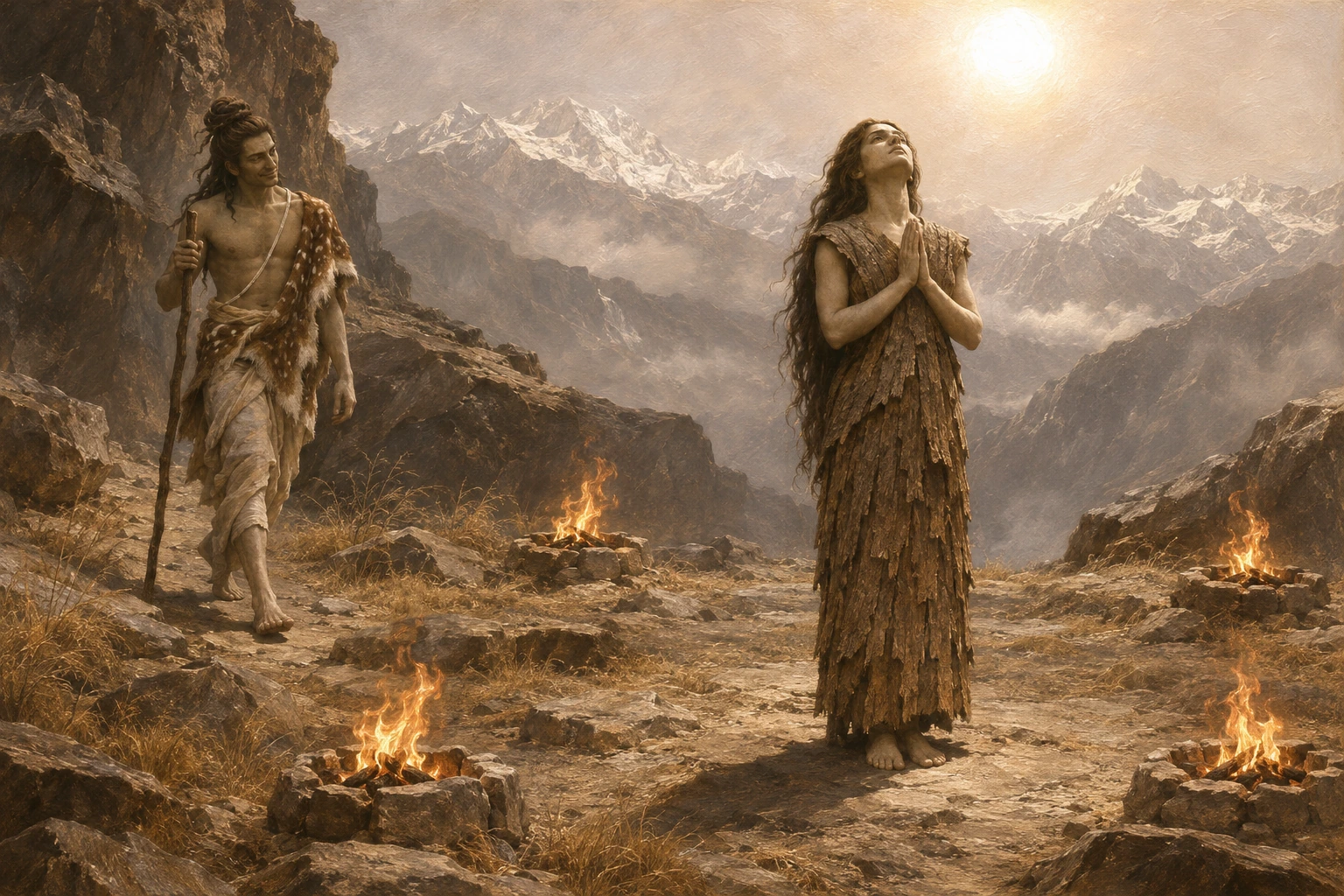
How she won him is the subject of Kālidāsa’s poem Kumārasambhava, “The Birth of the War-God”. Shiva sat in meditation on a mountain peak. Kāma, the god of love, drew his bow at him just as Parvati came to worship him, and fire leapt from Shiva’s third eye. Before the gods’ cry of “Restrain your anger, lord!” had died away in the sky, Kāma was ash (3.71–72). Parvati took off her necklace, put on clothes of bark and gave herself to austerities; in summer she stood between four blazing fires and gazed at the sun (5.8, 5.20). A young Brahmin ascetic came by and listed everything wrong with Shiva: the snakes, the cremation grounds, the bull, the unknown birth. She defended him in anger, and the youth showed himself as Shiva (canto 5). The seven sages asked her father for her hand, and the seventh canto is the wedding.
2 Where the Story Is Written Down
- The Rigveda. Shiva is not yet a name here, but Rudra is a god; among the hymns addressed to him are 1.114, 2.33 and 7.46, and he is the father of the storm gods, the Maruts. He is an archer “with swiftly-flying shafts” (7.46.1), “with the braided hair” (1.114.1, kapardin), and his dart kills “men or cattle” (1.114.10). The hymns beg him to spare: “harm not either great or small of us” (1.114.7). Yet his hand is “filled full of sovran medicines” (1.114.5), and the singer of 2.33.4 has heard him called “best of all physicians” (translations of Ralph T. H. Griffith, 1896). Śiva, “auspicious”, is at first only an adjective.
- The Yajurveda. In the litany of Rudra’s hundred names, the Śatarudriya, he is “the fierce”, “the terrific” and “the slayer” (Vājasaneyi Saṃhitā 16.40), and in the next verse śambhu, śaṅkara and śiva: “homage to the auspicious, homage to the most auspicious” (16.41, Griffith, 1899). All three words later became his names.
- The Śvetāśvatara Upaniṣad makes Rudra the one god. “For there is one Rudra only, they do not allow a second,” in Max Müller’s translation (1884); having created all worlds, he guards them and draws them back in “at the end of time” (3.2). Where there is “no day, no night, neither existence nor non-existence”, “Śiva (the blessed) alone is there” (4.18). He has no master, and “not even a sign of him” (6.9): the word is liṅga. The Upaniṣad also repeats, almost word for word, the Vedic prayer to Rudra to spare children and cattle (4.22; Rigveda 1.114.8).
- The Mahābhārata tells of the wrecked sacrifice twice, in Books 10 and 12, without Sati; K. M. Ganguli’s English translation follows the vulgate text and adds a longer telling (section 3). The Purāṇas bring in Sati’s death: the Bhāgavata Purāṇa (4.2–7), followed above, and the Devī Bhāgavata Purāṇa (7.30). The Śiva Purāṇa and the Liṅga Purāṇa give his great night and the first linga (section 4).
- Kālidāsa “probably lived in the fifth century”, writes his translator Arthur W. Ryder (1912). The first canto of his Kumārasambhava already gives Parvati’s former life: Daksha’s daughter, Shiva’s first wife, faithful Sati, who had left her body through yoga when her father insulted her (1.21).
3 Competing Versions
- Whose sacrifice was it?
- In the critical text of the Mahābhārata, Book 10 (10.18), Krishna tells it after the night raid, to show that the slaughter was Shiva’s doing. Daksha is not named: the gods themselves plan the first sacrifice and set aside no share for Rudra. He comes with a bow, shoots the sacrifice in the heart, and it flees into the sky as a deer. With the tip of his bow he knocks off Savitṛ’s arms, Bhaga’s eyes and Pūṣan’s teeth, until the gods give him a share and he gives everything back.
- In Book 12 (12.274) it is Daksha’s horse sacrifice at Gaṅgādvāra, where the Ganges leaves the mountains. Shiva’s wife Umā asks why he is not going, and he answers that the gods give him no share. Seeing her grief, Shiva wrecks the sacrifice himself with his followers, and a drop of sweat from his brow becomes Fever, which Brahmā asks him to divide among all creatures.
- Who wrecked it? The Bhāgavata sends Vīrabhadra, born from a lock of Shiva’s hair. In the longer telling that Ganguli translates (Santi Parva, section 284), the sage Dadhīci walks out in protest, Vīrabhadra comes from Shiva’s mouth, and the goddess’s own anger takes form as Bhadrakālī. The Pune critical edition leaves that telling out of its main text.
- Did Sati die? Not in the Mahābhārata, where Umā lives on. In the Bhāgavata and in Kālidāsa she leaves her body through yoga. The Devī Bhāgavata Purāṇa (7.30.43–46) adds that Shiva wandered through many lands with her body on his shoulder, crying her name, until Vishnu cut it apart with his arrows. Where the pieces fell are the goddess’s seats, the pīṭhas, and the text names 108 of them.
- Daksha’s new head. A goat’s in the Bhāgavata, as Nandīśvara’s curse foretold, and in the Devī Bhāgavata (“goat’s face”, 7.30.42). H. Krishna Sastri, describing a South Indian image in 1916, calls it “the head of a sheep”.
4 History and Tradition
- Nataraja, King of Dancers. In his essay “The Dance of Śiva” (1918), Ananda Coomaraswamy described three of the god’s dances: an evening dance on Kailasa with the gods as his orchestra, the wild tāṇḍava of the cremation ground, and the dance in the golden hall of Chidambaram, which the South Indian bronzes show. There Shiva dances on a dwarf within a ring of flame. Coomaraswamy quotes the Tamil Unmai Vilakkam (v. 36): “Creation arises from the drum: protection proceeds from the hand of hope: from fire proceeds destruction: the foot held aloft gives release.” The Cleveland Museum of Art dates its Chola bronze Nataraja (1930.331) to the 1000s. The Bhāgavata knows a dance too: the women of Daksha’s household remember Shiva as the one who, “at the end of time”, scatters his matted hair and dances (4.5.10).
- Ardhanarishvara, the lord who is half woman. The right half is Shiva, the left half Parvati, each with its own jewellery and dress. Sastri traced the image to the idea that “only when combined with Sakti is Siva capable of discharging his divine functions”. Of a Chola trident of about 1050 with this image (1969.117), the Cleveland Museum writes that the god is “male and female, destructive and creative, yogi and royal sovereign, hunter and musician”.
- The linga. Liṅga means “a mark, spot, sign, token”, the first sense in Monier-Williams’s Sanskrit dictionary; it also means the male organ, and the dictionary describes Shiva’s as a stone column “which generally rises out of a yoni”. In the Liṅga Purāṇa (1.17) the first linga is a pillar of fire “without beginning, middle or end”, which appears while Brahmā and Vishnu are quarrelling over which of them is the creator. Vishnu dives as a boar for a thousand years and Brahmā flies up as a swan, and neither finds its end. Chola temples carve the scene, Liṅgodbhava, on the west wall of the sanctuary (Sastri). In a temple’s innermost “womb chamber”, writes the Cleveland Museum (1973.73), chamber and linga “together represent the potentiality of creation”.
- Mahashivaratri. Of Shiva’s vows, the Śiva Purāṇa calls the Śivarātri, the fourteenth night of the waning moon, the strongest, and the one in the dark half of Māgha the most celebrated (4.38.20–24). It tells of a hunter who spent that night in a bilva tree by a waterhole, waiting for game: the water and leaves he let fall landed on a linga below, and a worship he did not know he was making saved him (4.40). India’s Ministry of Tourism places the night in the waning half of Phālguna, in February or March. The two months name one night: a calendar that ends each month at the new moon (amānta) calls the dark half Māgha, and one that ends it at the full moon (pūrṇimānta) calls the same fortnight Phālguna (Drik Panchang). The Tourism page describes: fasting, an all-night vigil, the linga bathed in milk and honey, and dance festivals at temples, Chidambaram’s Natyanjali among them. It gives several reasons for the night, among them Shiva’s marriage to Parvati and his dance.
- Vietnam. Around 400, the Cham king Bhadravarman set up a linga in the valley of Mỹ Sơn, named Bhadreśvara after himself and Īśvara, “the Lord”, that is Shiva (Louis Finot, 1904). The first temple was of wood; it burned in the 6th century, and King Śambhuvarman restored it in the 7th, renaming the god Śambhubhadreśvara. From then on, in Finot’s words, “Bhadreśvara is the great protector of the kingdom of Champa”; an inscription of 875 says the sage Bhṛgu, sent down by Maheśvara, first set the linga up. Over seventy structures of the 4th to 13th centuries survive at Mỹ Sơn, a World Heritage Site since 1999. Its managers describe the mountain to the south as Shiva and the river as the Ganga, his wife; the site museum holds a dancing Shiva of the 8th century.
- Japan. Through Buddhism, Maheśvara, “great lord”, one of Shiva’s names, became Daijizaiten (大自在天), a guardian of the Buddha’s teaching, usually shown with three eyes and eight arms, holding a trident and riding a white bull.
“Brahmā creates, Vishnu preserves, Shiva destroys” is what MANAS, a UCLA site on South Asia, calls “the textbook view”, adding that the worship of Brahmā “is almost unknown in India”. The texts do not agree on the scheme. The Maitri Upaniṣad gives Rudra the part of the one being “which belongs to darkness” (5.2); Kālidāsa says that none of the three always comes first (7.44); in the Bhāgavata, Vishnu claims all three acts (4.7.51) and Brahmā gives all three to Shiva (4.6.43). For Shaivas, in Coomaraswamy’s account, destruction is one of five acts of Shiva’s dance, and the last of them is grace.
5 Related Stories
- The Churning of the Ocean: Gods, Demons and the Nectar of Immortality: the poison Shiva held in his throat to save the world, which turned it blue. That post shows which texts tell it and which, like the critical edition of the Mahābhārata, do not.
- Ganesha: How the God of Beginnings Got His Elephant Head: Parvati’s son. In the Śiva Purāṇa, Shiva cuts off the head of the boy who bars his door, then has him given an elephant’s, as Daksha is given a goat’s. We have found no scholar who links the two; the motif is simply shared.
- The Descent of the Ganga: The River That Fell from Heaven: why Shiva wears a river in his hair. In the Rāmāyaṇa’s telling, when the Ganga fell from heaven she was lost in his matted locks, and wandered there for years before he let her go.
- Kali: The Dark Goddess Born from Anger: in later paintings Kali stands or kneels on Shiva, who lies beneath her, in the Cleveland Museum’s words, “like a corpse (shava)”: the active goddess on the still god.
6 Sources
- Bhāgavata Purāṇa, book 4, chapters 2–7, Sanskrit text input by Ulrich Stiehl: GRETIL
- Mahābhārata, critical edition, 10.18 and 12.274, with the passage printed after 12.274: GRETIL, GRETIL; K. M. Ganguli (trans.), The Mahabharata, Santi Parva, sections 283–284: Project Gutenberg
- Rigveda 1.114, 2.33 and 7.46, Aufrecht’s text: GRETIL; Ralph T. H. Griffith (trans.), The Hymns of the Rigveda (2nd ed., 1896): Wikisource, Wikisource, Wikisource
- Vājasaneyi Saṃhitā 16.40–41, Sanskrit text: Sanskrit Wikisource; Ralph T. H. Griffith (trans.), The Texts of the White Yajurveda (Benares, 1899): archive.org
- Śvetāśvatara Upaniṣad, Sanskrit text: GRETIL; F. Max Müller (trans.), The Upanishads, Part II, Sacred Books of the East 15 (Oxford, 1884), with the Maitrāyaṇa-Brāhmaṇa-Upanishad 5.2: archive.org
- Kālidāsa, Kumārasambhava 1.21, 3.70–72, 5.8, 5.20 and 7.44, input by Utz Podzeit: GRETIL; Arthur W. Ryder (trans.), Translations of Shakuntala and Other Works (1912): Project Gutenberg
- Devī Bhāgavata Purāṇa 7.30, Sanskrit text: Sanskrit Wikisource; Śiva Purāṇa, Koṭirudra Saṃhitā 4.38 and 4.40, Sanskrit text: Sanskrit Wikisource, Sanskrit Wikisource; Liṅga Purāṇa 1.17, Sanskrit text: GRETIL
- Monier Monier-Williams, A Sanskrit-English Dictionary, “liṅga”, p. 901: Cologne Digital Sanskrit Dictionaries
- Ananda K. Coomaraswamy, The Dance of Śiva: Fourteen Indian Essays (New York: Sunwise Turn, 1918), pp. 56–60: archive.org
- H. Krishna Sastri, South-Indian Images of Gods and Goddesses (1916), chapter 4: Wikisource
- Cleveland Museum of Art, “Nataraja, Shiva as the Lord of Dance” (1930.331), “Trident with Shiva as Half-Woman (Ardhanarishvara)” (1969.117), “One-Faced Linga (Ekamukhalinga)” (1973.73) and “Kali on Shiva, from a Tantric Devi Series” (2014.650): clevelandart.org, clevelandart.org, clevelandart.org, clevelandart.org
- Ministry of Tourism, Government of India, “Maha Shivratri”: Incredible India; Drik Panchang, “Maha Shivaratri” (the date under the pūrṇimānta and amānta calendars): drikpanchang.com
- “Shiva”, MANAS: UCLA
- L. Finot, “Notes d’épigraphie: Inscriptions du Quang Nam”, Bulletin de l’École française d’Extrême-Orient 4 (1904), pp. 83–115, at p. 98: Persée; scan of the volume: archive.org
- My Son World Cultural Heritage Management Board, “Lịch sử văn hóa”, “Về chúng tôi” and “Siva múa”: mysonsanctuary.com.vn, mysonsanctuary.com.vn, mysonsanctuary.com.vn
- Kamimura Katsuhiko and others, “シバ”, Sekai daihyakka jiten and Nipponica; “三神一体”; “カイラーサ山”; “大自在天”: Kotobank, Kotobank, Kotobank, Kotobank
Cover and illustrations: AI-generated images made for Arcana. They are interpretations, not historical artworks.