The Legend of the White Snake: Lady White and Leifeng Pagoda
A white snake takes a woman's form, marries a young man of Hangzhou and is shut under Leifeng Pagoda by the monk Fahai. In the oldest full telling, from 1624, she is a demon and the tale a warning; the loving wife and mother were made on the Qing stage.
- Type: folk legend, a snake spirit who takes a woman’s form and marries a man
- Culture: China, above all Hangzhou and Zhenjiang; retold in Japan
- Earliest texts: a tale set in Chang’an in 807, in the Taiping guangji (978); the storyteller’s tale Xihu santa ji, printed about 1541–51; the oldest full telling is Feng Menglong’s “Lady White Is Kept Forever Under Leifeng Pagoda”, in his Jingshi tongyan (1624)
- Key figures: Lady White (Bai Suzhen), her maid Xiaoqing (Qingqing in Feng), Xu Xian (Xu Xuan in Feng), the monk Fahai
On a hill at the south end of West Lake in Hangzhou stands Leifeng Pagoda, and beneath it, Hangzhou has said since at least the 16th century, lies a white snake. She took a woman’s form, married a young man who worked in a herbal medicine shop, and was shut away by a monk. The oldest full telling of her story is a warning against desire. The love story, and the heroine, came later.
Does Lady White ever get out of the pagoda? Not in the oldest full telling. In Feng Menglong’s story the monk leaves a verse: the white snake will come out only when “West Lake runs dry, the rivers rise no more, and Leifeng Pagoda falls”. In Fang Chengpei’s play of 1771 her son, the top graduate of the empire, comes to make offerings at the pagoda, and Heaven, moved by his devotion, sets her free. The real pagoda fell in 1924.
1 The Telling
This is Feng Menglong’s version, story 28 of his Jingshi tongyan (“Stories to Caution the World”), printed in 1624. In it the young man is called Xu Xuan and the maid Qingqing.
1-1 The Umbrella
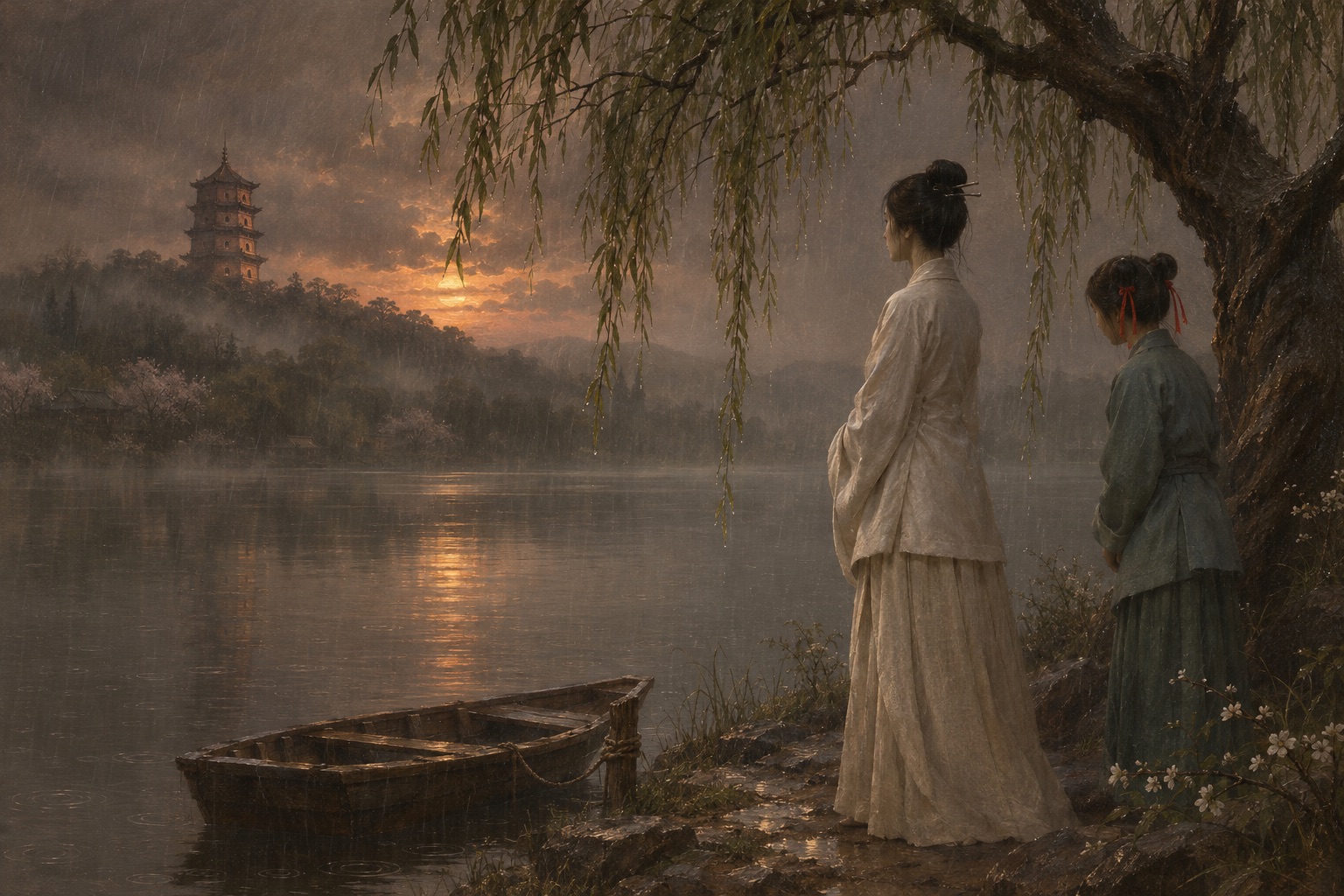
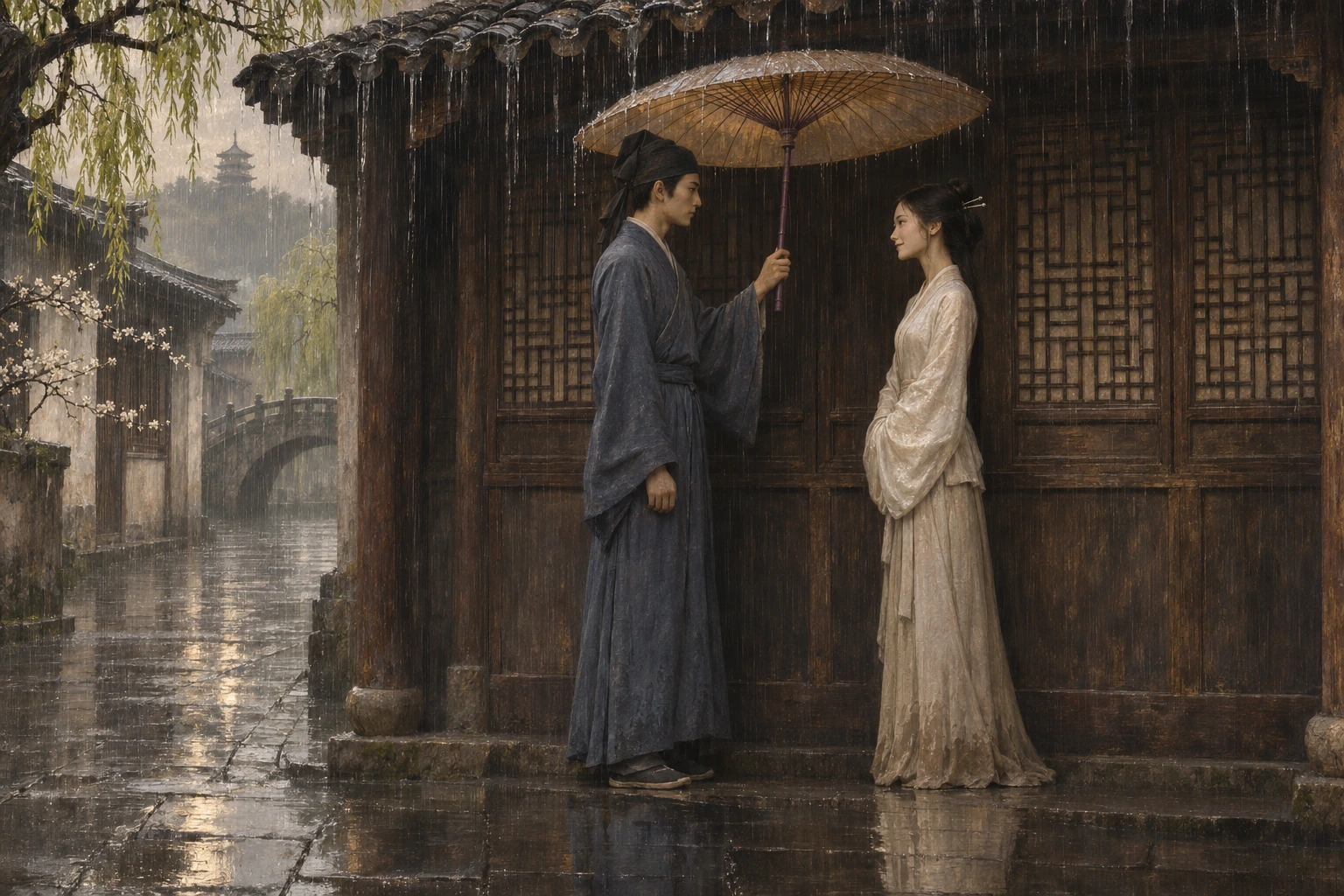
In the Shaoxing years, under Emperor Gaozong of the Southern Song, Xu Xuan, twenty-two, managed a relative’s herbal medicine shop in Hangzhou and lived with his elder sister and her husband. At Qingming, the festival of the dead, he went to make offerings for his parents at a temple by West Lake. On the way back it rained, and he took a boat.
From the bank a woman called to the boatman. She wore the white of mourning: plain hairpins, a white silk jacket, a hemp skirt. Her maid was dressed in blue, her hair in two knots tied with red cords. The woman said she was a widow and had been to sweep her husband’s grave. When they landed it was still raining. Xu borrowed an umbrella, a good one with eighty-four ribs and a purple bamboo handle, found her again under the eaves of a teahouse, and lent it to her.
He went to fetch it the next day, and the next. Her house had a red curtain, black lacquer chairs and old landscape paintings. She served wine, said that they were surely destined for each other, and asked him to find a matchmaker. When he said he was too poor to marry, the maid brought down a packet: fifty taels of silver.
1-2 The Stolen Silver
Xu’s brother-in-law looked at the marks stamped on the silver and cried that the whole family was lost. Fifty ingots had vanished from Marshal Shao’s treasury with the seals untouched. He reported it, and Xu was arrested. The constables found her house barred and heaped with rubbish; the neighbours said the family who had lived there died of a sickness years before. A gust carried a fishy smell out of the door. Upstairs, on the bed, sat a beautiful woman in white. One constable drank a whole jar of wine for courage and threw the empty jar at her: there was a clap of thunder, she was gone, and on the bed lay forty-nine ingots.
Xu was beaten and sent to labour at Suzhou. Half a year later Lady White arrived in a sedan chair with her maid. The silver, she said, had been her late husband’s; she had only hidden from the shame. Xu’s host took her side, and the two were married.
1-3 Suzhou and Zhenjiang
A Daoist at a temple gate saw a black aura over Xu’s head and gave him charms against a demon. Lady White burned one, swallowed another in front of a crowd without harm, then murmured a spell that lifted the Daoist into the air before she let him down and he fled. On the Buddha’s birthday she dressed Xu in fine new clothes. They had been stolen from a pawnshop, and he was beaten again and sent to Zhenjiang, on the Yangzi. She followed him there too.
His new employer, the old herbalist Li Keyong, wanted her for himself. At his birthday feast he spied on her through a crack in a door and saw instead a white snake coiled in the room, as thick as a bucket, its eyes like lamps. He fainted. She told her husband that Li had tried to force himself on her, and Xu left to open a shop of his own.
1-4 Jinshan Temple
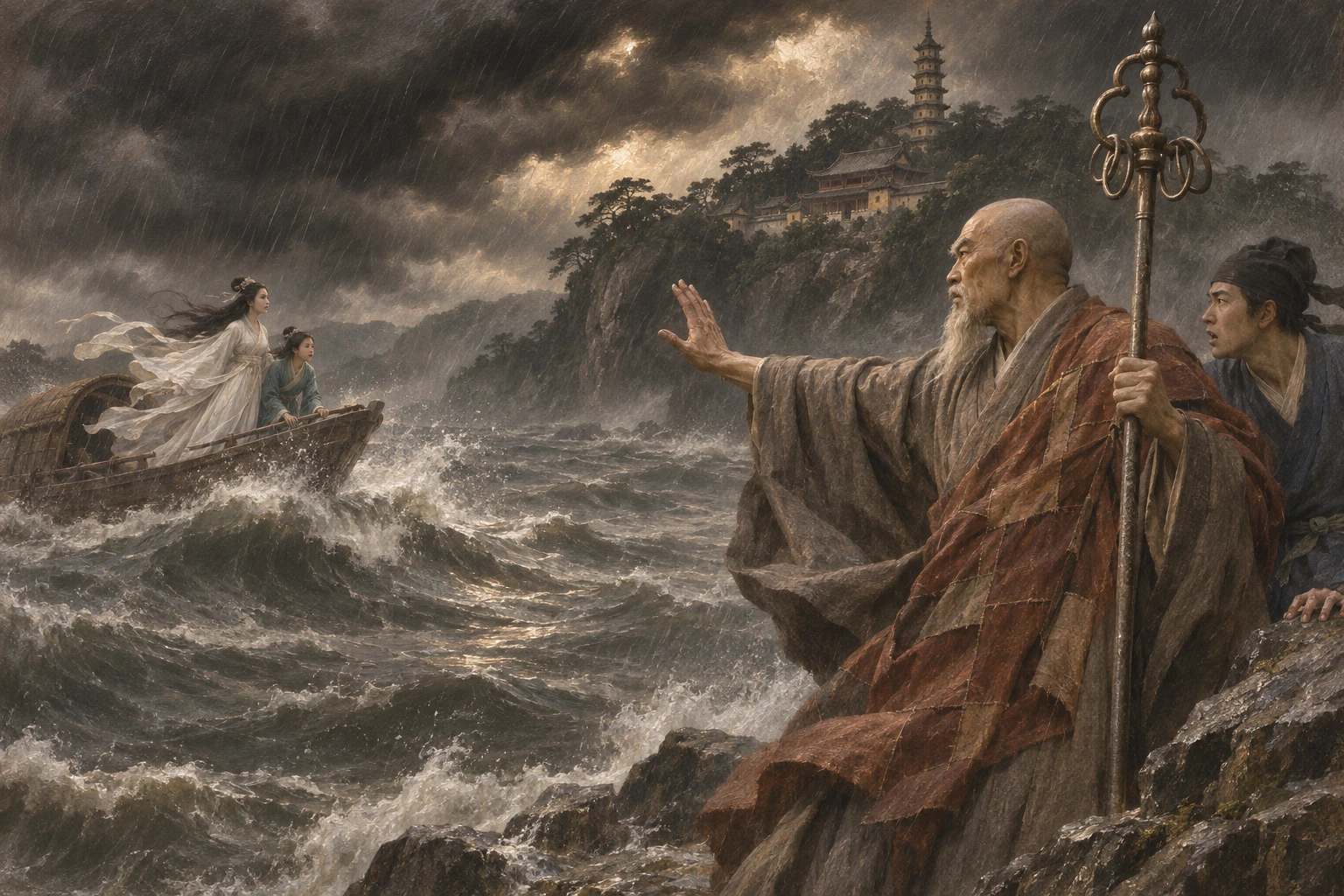
On the seventh day of the seventh month Xu crossed the river to Jinshan Temple for the Dragon King’s festival. His wife made him promise three things: not to enter the abbot’s quarters, not to talk to the monks, and to come straight back. The abbot, Fahai, saw him pass. A storm stopped the ferries, yet a boat came flying across the river with a woman in white and a girl in blue: “Why don’t you come home? Get in!” Behind him Fahai shouted: “Accursed creature!” The two women overturned their boat and vanished under the water. Fahai told Xu to go home, and to look for him at Jingci Temple if she came back.
1-5 The Bowl and the Pagoda
An amnesty let Xu go home to Hangzhou, and his wife was there before him. If he turned against her, she said, she would make the whole city “blood and water”, everyone drowning in the flood. His brother-in-law peeped into their room at night and saw a huge snake on the bed, its scales shining white. A snake-catcher came with a bottle of realgar water; a snake as thick as a bucket rose at him, and he ran.
Xu was about to throw himself into the lake when Fahai appeared and gave him his alms bowl. Xu clapped it over his wife’s head and held it down. Under the bowl she shrank to the size of a puppet, and confessed: she was a great snake who had come to West Lake in a storm, and when she saw Xu her heart was stirred, “but I have never taken a life”. Qingqing was a green fish that had lived a thousand years in the pool under the lake’s third bridge. For their thousand years of self-cultivation Fahai spared their lives, but he made them show their true forms: a white snake three feet long and a little green fish. He sealed them in the bowl with a strip of his robe, set it down before Leifeng Temple, and had bricks and stones piled over it into a pagoda. Xu later raised the money for a seven-storey pagoda.
Fahai’s last poem draws the lesson: “I urge the people of the world: do not love beauty. Those who love beauty are led astray by it.” Xu became a monk at Leifeng Pagoda, and some years later died seated in meditation.
2 Where the Story Is Written Down
- “Li Huang”, a tale in the Taiping guangji, the great collection compiled for the Song court in 977–978, which copies it from an older book, the Boyi zhi. In Chang’an in 807, Li Huang follows a beautiful widow in white to her house, where an old woman dressed in blue receives him. He stays three days. His servant notices a strange rank smell on him; at home his body melts away under the quilt until only water and his head are left. The house turns out to be an empty garden, where a huge white snake was often seen under a honey locust tree.
- The Xihu santa ji (“The Three Pagodas of West Lake”), one of the Song and Yuan storytellers’ tales that Hong Pian printed around 1541–51. At Qingming, by the Broken Bridge, young Xi Xuanzan takes home a lost girl dressed in white. Her mother, a woman in white, makes him her husband; when a new young man is brought to her, she has the last one’s heart cut out and served with the wine. Xi’s uncle, a Daoist, has a god seize all three: a black hen, an otter and a white snake. He seals them in an iron jar and raises three stone pagodas over them in the lake.
- Tian Rucheng’s Xihu youlan zhi, a Ming guide to West Lake that records events of 1547, says of Leifeng Pagoda: “Folk tradition says that two monsters of the lake, a white snake and a green fish, are held down beneath the pagoda.” Its supplement, the Xihu youlan zhi yu, lists a “Leifeng ta” among the tales Hangzhou’s blind singers performed with the pipa.
- A late Ming play by Chen Liulong is lost. The critic Qi Biaojia (1602–1645) wrote of it, as Aaron Balivet quotes him: “Legend says that Leifeng Pagoda was built to hold down the demon Lady White.”
- Feng Menglong’s story (1624) is the oldest full telling. A near-identical “Leifeng guaiji” appears in the collection Xihu jiahua (1673).
- The Qing versions. Huang Tubi finished his play Leifeng ta in 1738. Fang Chengpei’s, in 34 scenes, has a preface dated 1771 and was printed the next year. Then came precious scrolls (baojuan), Buddhist narratives sung and recited, and Chen Yuqian’s ballad Yi yao zhuan, “The Righteous Demon” (1809).
3 Competing Versions
- A warning or a love story? Huang Tubi still followed Feng’s plot, ending with the snake under the pagoda and Xu a monk. Others soon added a son, and Huang protested, in lines Balivet quotes: “Lady White is a demon snake. If her son enters the ranks of officials, where does that leave us?” Yet, he admitted, on the stage “there is no happy ending without a top graduate”, and the new ending was the rage from the Yangzi delta to the north.
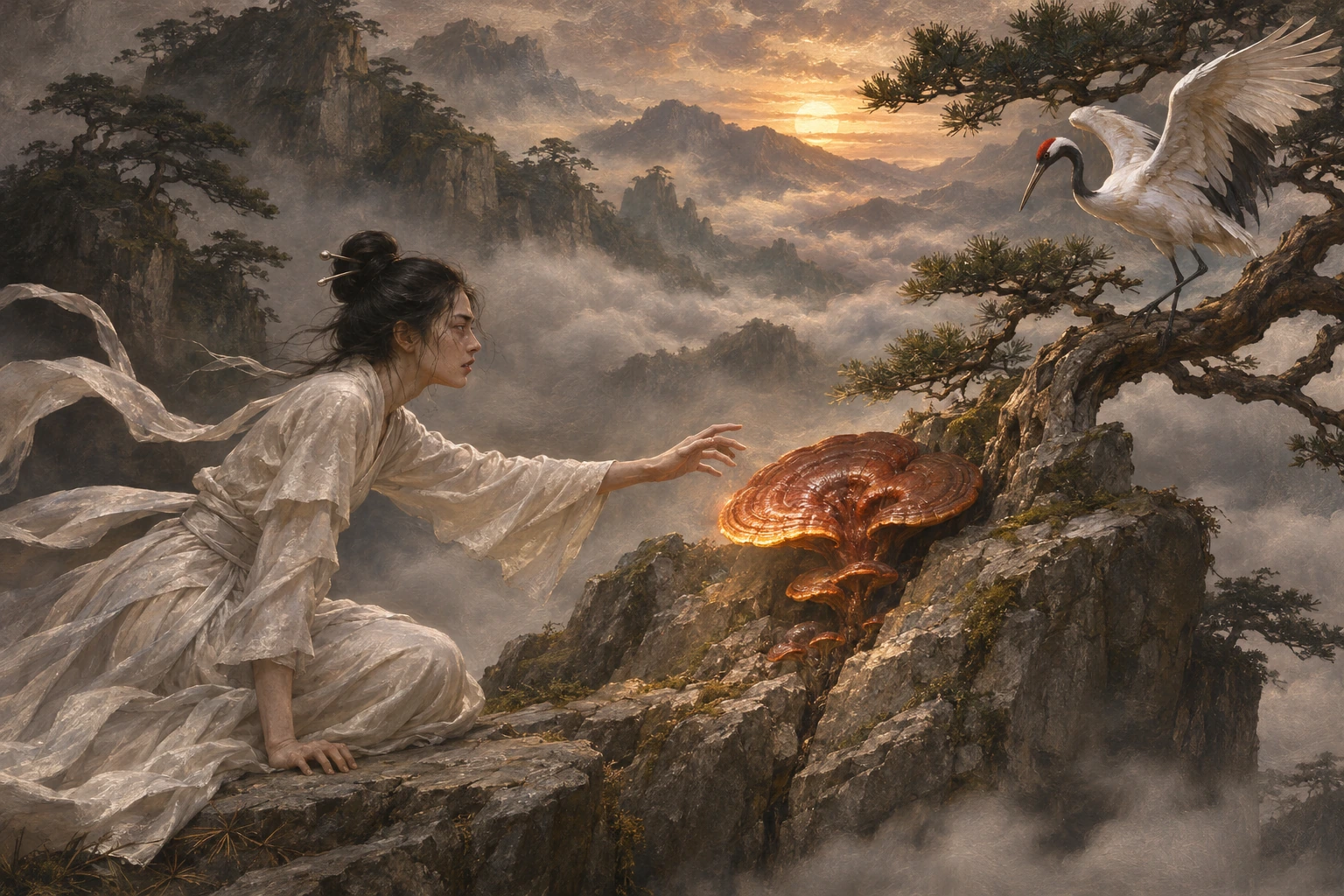
- What Fang Chengpei’s play adds (by scene, as Balivet sums it up after A Ying): Lady White comes from Mount Emei, and Xu was once the Buddha’s attendant (scene 2); at the Duanwu festival Xu makes her drink realgar wine, she turns back into a snake, and he dies of fright (16); she fetches a herb of the immortals to revive him (17); she floods Jinshan Temple to win him back and is spared because she is carrying a child (25); they meet again at the Broken Bridge (26); sixteen years after she is shut under the pagoda their son Xu Shilin (許士麟) comes first in the examinations and makes offerings there (32), and the Lord of Heaven, moved by his devotion, pardons her (34).
- Where does the herb grow? In Fang’s play, in Balivet’s summary, and in the Leifeng baojuan, the precious scroll on Wikisource, on Mount Song, guarded by a white crane for the Old Man of the South Pole. Modern summaries of the plot, such as Aaron Balivet’s, send her instead to Kunlun, the mountain of the immortals. In the scroll she also turns a white handkerchief into a snake and cuts it into seven pieces, so that Xu will believe the monster he saw is dead.
- Who is the maid? A green fish of a thousand years in Feng and in Huang. A green snake in the precious scroll, and in the tale Lu Xun’s grandmother told him.
- The realgar. In Feng it is a snake-catcher’s medicine, and the Duanwu festival is only a date in passing. From Fang on, it is the realgar wine of Duanwu that gives her away.
- The names. Feng’s hero is Xu Xuan, and so are Fang’s and the scroll’s; Xu Xian is the later name. The scroll calls her Bai Suzhen and their son Mengjiao.
4 History and Tradition
- Leifeng Pagoda was built in 977 by Qian Chu, the last king of Wuyue, to house a relic of the Buddha’s hair; a stele found on the site names it the Huangfei, the “Imperial Consort”, Pagoda. After a fire in 1555 it stood for centuries as a bare brick core: “Leifeng in the evening glow” was one of the Ten Views of West Lake. On 25 September 1924, at about 1:40 in the afternoon, it fell, and sutras printed under Wuyue were found hidden in its bricks. Its crypt was excavated in 2001, and a new pagoda was completed over the ruins on 25 October 2002.
- Lu Xun wrote “On the Fall of Leifeng Pagoda” a month later. As a boy, he says, his only wish had been for the pagoda to fall. “Among the farmers and the silkworm women, is there anyone who does not feel indignant for Lady White and blame Fahai for meddling?” Fahai, he had heard, fled the Jade Emperor’s anger and hides in a crab shell to this day. “Serves him right.”
- For the emperor. Xu Ke’s anthology of Qing anecdotes, the Qing bai lei chao, says a Leifeng ta was written in haste for one of the Qianlong emperor’s southern tours, and performed on a stage built across two boats sailing ahead of his own.
- A national legend. In 2006 China listed the legend as national intangible heritage, entered by Hangzhou and Zhenjiang. The listing counts it among the four great legends of the Han Chinese, with the Butterfly Lovers, Meng Jiangnü, and the Cowherd and the Weaver Girl. After a discussion in Beijing in 1952, writes Hiramatsu Keiko, critics read Lady White as a woman resisting feudal society for the freedom to marry, and Fahai as the feudal order itself.
- Japan. Ueda Akinari’s “Jasei no in” (“A Serpent’s Lust”), in Ugetsu monogatari (1776), moves Feng’s story to the province of Kii: an umbrella lent in the rain, a stolen treasure, a priest with realgar who dies of the snake’s breath, and an old monk of Dōjōji named Hōkai, after Fahai, who shuts the white snake in an iron bowl and buries it. Mizoguchi Kenji drew on it for his film Ugetsu (1953). Tōei’s Hakujaden (1958), directed by Yabushita Taiji, was the studio’s first feature-length animation and Japan’s first in colour.
Lady White is often presented as the heroine from the start: a loving wife hounded by a jealous monk. She was not. In Feng Menglong’s story she brings her husband two beatings and two exiles and threatens to drown Hangzhou, Fahai is the man’s rescuer, and the moral is a warning against desire. Whalen Lai traces her change “from being a villain to being a heroine” and pins it to one thing: “it came with motherhood”. Motherhood came with the Qing stage.
5 Related Stories
- The Cowherd and the Weaver Girl: Qixi, Tanabata and Ngưu Lang Chức Nữ: China’s national heritage listing counts the two among the four great legends of the Han Chinese. Whalen Lai sets the Weaver beside Lady White: in folklore, if not in moral philosophy, a wife from another world may bear a man’s children.
- Kunlun: The Mountain of the Immortals: the mountain where modern retellings send Lady White for the herb that brings Xu back to life. The Qing play and the precious scroll name Mount Song instead.
- Yuki-onna: The Snow Woman: Whalen Lai’s essay on Lady White names the “Snow Woman” among the wives from another world whom folklore lets bear children, as the Qing stage at last let Lady White. We link the two for that theme.
6 Sources
- Feng Menglong, Jingshi tongyan (1624), juan 28, “Bai niangzi yongzhen Leifeng ta”: Wikisource; English translation in Stories to Caution the World, trans. Shuhui Yang and Yunqin Yang (University of Washington Press, 2005), as “Madam White Is Kept Forever under the Thunder Peak Tower”
- Taiping guangji, juan 458, “Li Huang” (from the Boyi zhi), with collation notes against a Ming manuscript copy: Wikisource
- “Xihu santa ji”, in Hong Pian’s Qingping shantang huaben: Wikisource
- Tian Rucheng, Xihu youlan zhi, juan 3, and Xihu youlan zhi yu, juan 20 (Siku quanshu text): Wikisource, Wikisource
- Leifeng baojuan (undated text): Wikisource; English translation of the scroll in Wilt L. Idema, The White Snake and Her Son (Hackett, 2009): Internet Archive
- Aaron Balivet, The Many Transformations of White Snake: Gender, Ritual, and Performance in Late Imperial China (PhD dissertation, University of Wisconsin–Madison, 2020), with Huang Tubi’s note, Qi Biaojia’s notice and a scene-by-scene comparison of Huang’s and Fang’s plays after A Ying, Leifengta chuanqi xulu (1960): University of Wisconsin
- Fang Chengpei, Leifeng ta chuanqi, in Wanren xiqu xuankan: Fang Chengpei juan (Huangshan shushe, 2008), from the 1771 Shuizhuju print: Penn Libraries catalogue; Hsieh Fang-chun, on Fang’s “Duanyang” scene, Soochow Chinese Online Academic Papers 53 (2021): abstract; Cui Yunwei and Sun Xubo, on Fang’s play and the son Xu Shilin, Dongfang luntan 2015.2: Qingdao University
- Whalen Lai, “From Folklore to Literate Theater: Unpacking Madame White Snake”, Asian Folklore Studies 51.1 (1992): National Taiwan University
- Lu Xun, “Lun Leifeng ta de daodiao” (dated 28 October 1924): Wikisource; Xu Ke, Qing bai lei chao: Wikisource
- China Intangible Cultural Heritage Network, “白蛇传传说” (I-6, 2006): ihchina.cn, ihchina.cn
- Dushi kuaibao, “雷峰塔重生记”, 26 September 2024: hangzhou.com.cn
- Ueda Akinari, Ugetsu monogatari, “Jasei no in”, ed. and annotated by Uzuki Hiroshi (Kadokawa Bunko): Aozora Bunko
- “白蛇伝”, “雨月物語”, “清平山堂話本”, “太平広記”, “警世通言”, “藪下泰司”, Nipponica, Sekai Daihyakka Jiten and others: Kotobank, Kotobank, Kotobank, Kotobank, Kotobank, Kotobank; Toei Animation, company history: toei-anim.co.jp
Cover and illustrations: AI-generated images made for Arcana. They are interpretations, not historical artworks.