Yuki-onna: The Snow Woman
A woman in white breathes death on an old woodcutter and spares the young one, on one condition. Japan's most famous snow-woman story was first printed in English, by Lafcadio Hearn in 1904; the snow woman herself is much older, and much stranger.
- Type: folk belief, and a literary tale built on it: a spirit of the snow in the shape of a woman
- Culture: Japan, above all the regions of deep snow; Hearn’s tale is set in a village of Musashi, the province of Edo
- Earliest texts: the word in the Muromachi-period ballad Fushimi Tokiwa; a snow woman seen in Echigo in the Sōgi shokoku monogatari (1685); the story of Minokichi and O-Yuki in Lafcadio Hearn’s Kwaidan (1904)
- Key figures: the Yuki-onna, O-Yuki, Minokichi, Mosaku; Lafcadio Hearn (Koizumi Yakumo)
On a snowy night a woman all in white comes through the door of a ferryman’s hut, breathes on an old man until he is ice, and spares a boy on one condition. This is the snow-woman story that Japanese readers know from translations, schoolbooks and film, and it was first printed in English, in 1904, by a writer born in Greece. Behind it stands an older and stranger figure: a woman three metres tall at the edge of a bamboo thicket, a mother who begs travellers to hold her baby, a visitor who comes at New Year, a child who vanishes in the bath.
Where did Hearn hear it? From “a farmer of Chōfu, Nishitama-gōri, in Musashi province”, he wrote in his preface, who told it “as a legend of his native village”. This Chōfu was a village on the upper Tama River, not the present city of Chōfu. In 1951 it joined the town of Ōme to form the city of Ōme, which is known today as the setting of the story.
1 The Telling
This is Hearn’s version, “Yuki-Onna”, in Kwaidan (1904). The quotations are from his English.
1-1 The Ferryman’s Hut
In a village of Musashi there lived two woodcutters, Mosaku, an old man, and his apprentice Minokichi, a lad of eighteen. Every day they walked to a forest about five miles away, crossing a wide river by ferry; bridges had been built there, but floods always carried them away.
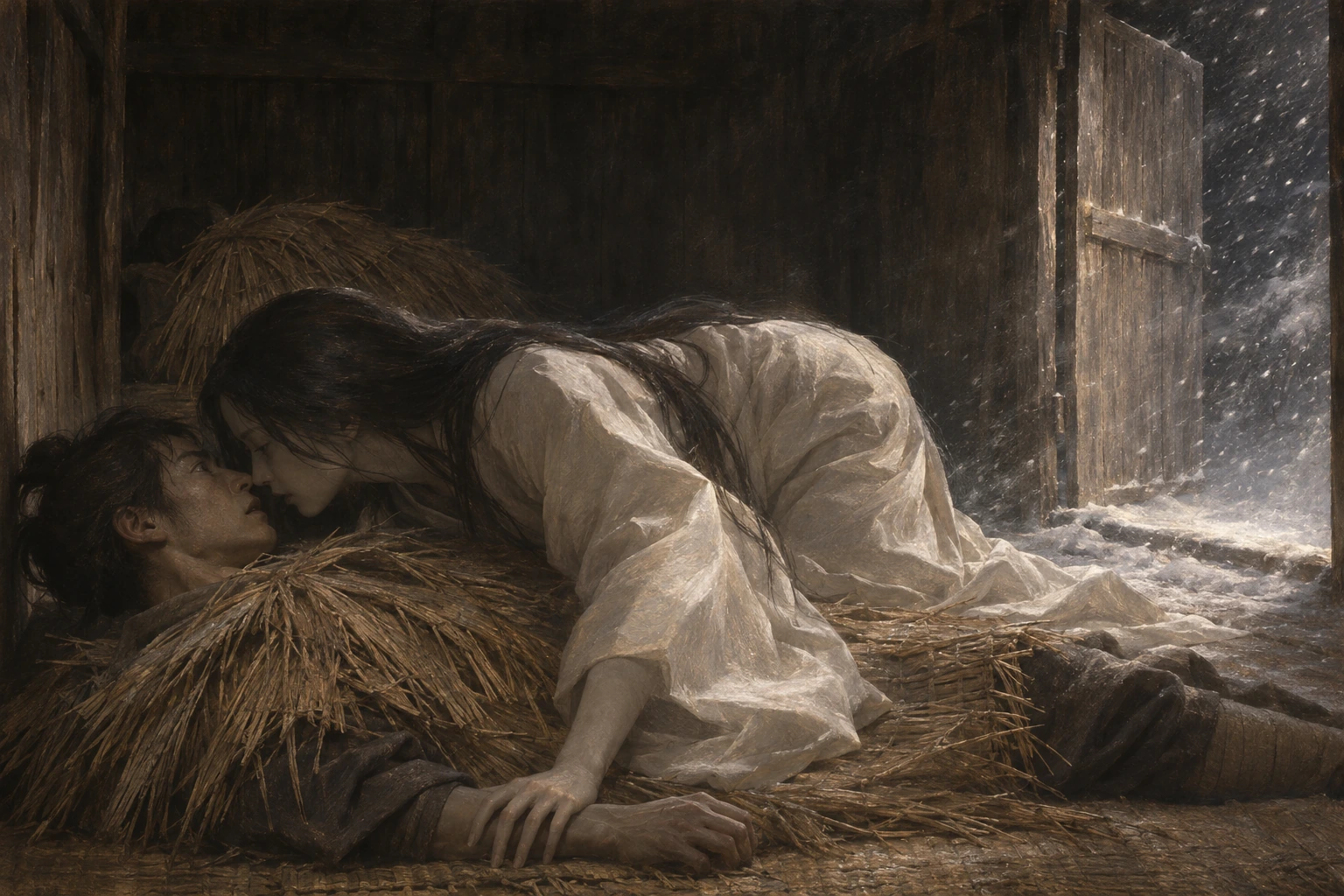
One bitterly cold evening a snowstorm caught them on the way home. The ferryman had left his boat on the far bank, so they took shelter in his hut, a room of two mats with one door, no window and no fire. They lay down under their straw raincoats. The old man fell asleep at once; the boy lay listening to the wind and the river until he too slept.
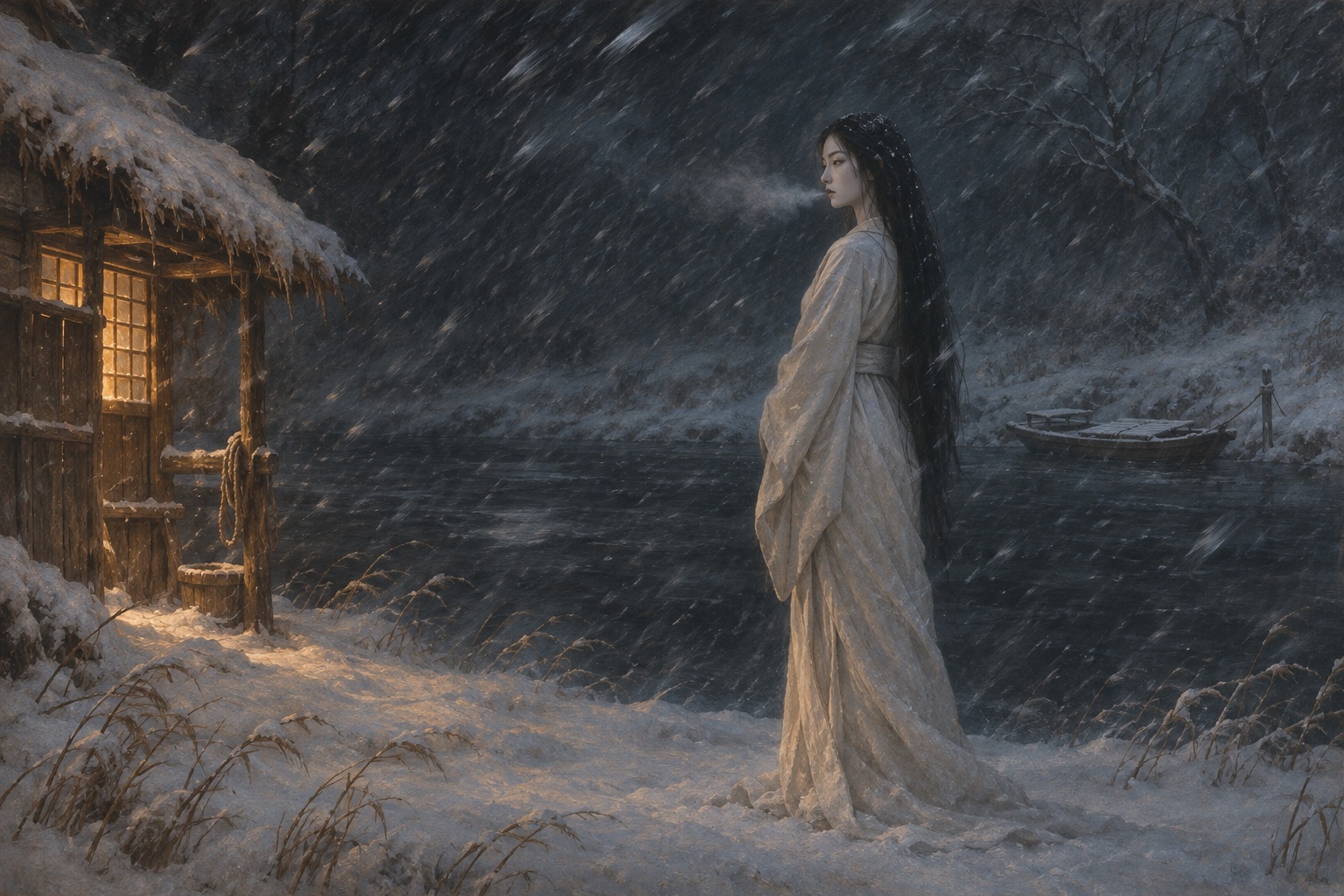
He woke with snow in his face. The door was open, and by the snow-light he saw “a woman all in white”. She was bending over Mosaku and blowing her breath on him, “like a bright white smoke”. Then she bent over Minokichi, so low that her face almost touched his. She was very beautiful, “though her eyes made him afraid”. She smiled and whispered that she had meant to treat him like the other man, but he was young, and she pitied him. “If you ever tell anybody, even your own mother, about what you have seen this night, I shall know it; and then I will kill you.”
She went out into the storm. Minokichi touched Mosaku’s face in the dark: it was ice. At sunrise the ferryman found the boy senseless beside the frozen body. Minokichi was ill for a long time, but he said nothing about the woman in white.
1-2 O-Yuki
The next winter, on his way home, he overtook a tall, slim, good-looking girl with a voice “as pleasant to the ear as the voice of a song-bird”. Her name, she said, was O-Yuki, “Snow”. She had lost her parents and was going to Edo to find work as a servant. By the time they reached the village they were taken with each other. His mother welcomed her and persuaded her to stay, and O-Yuki never went to Edo at all. She became his wife.
She was a good daughter-in-law; when Minokichi’s mother died, some five years later, her last words praised her. O-Yuki bore Minokichi ten children, “handsome children all of them, and very fair of skin”. The village women aged early, but O-Yuki, after ten children, looked as young as on the day she came.
1-3 The Story Told at Night
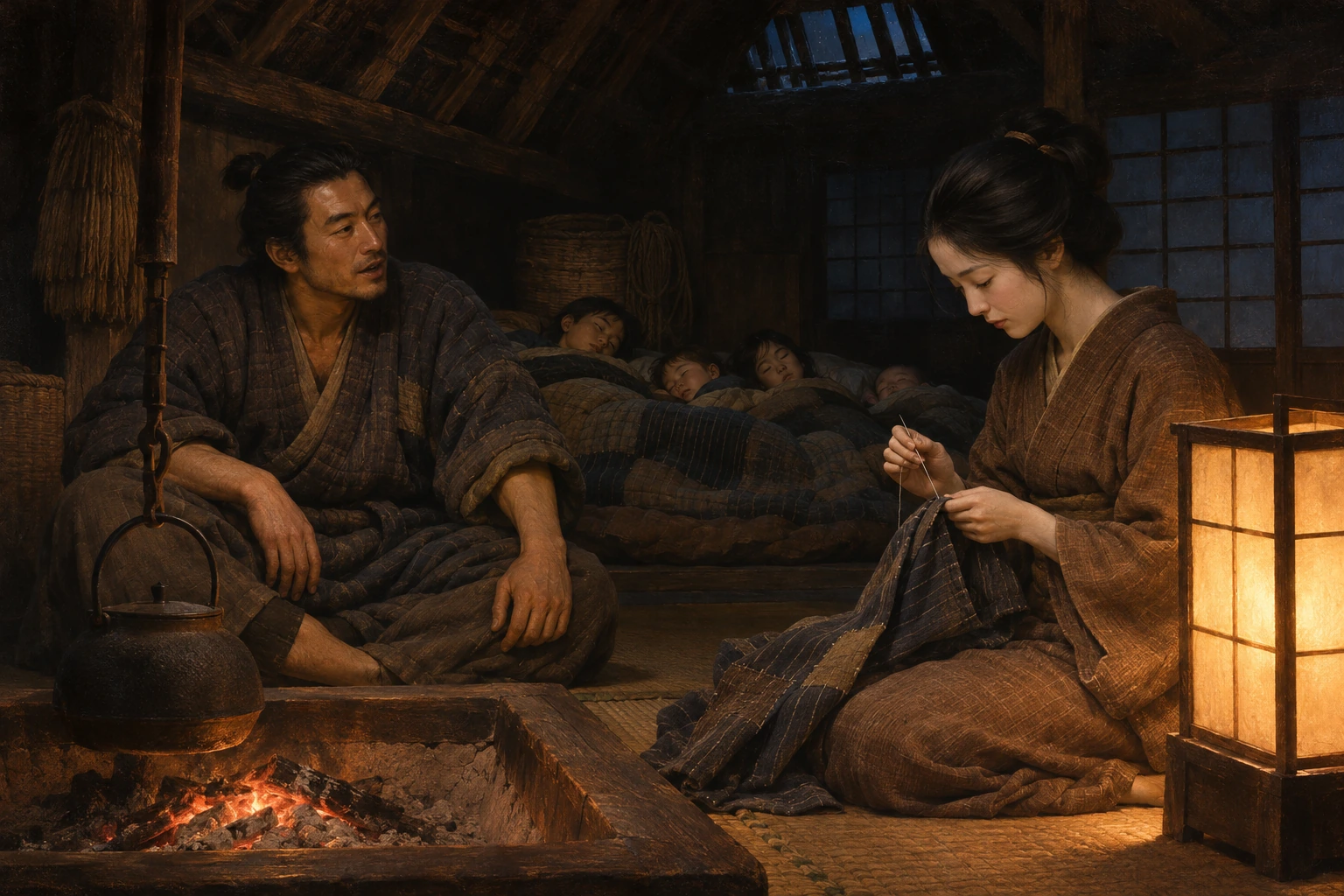
One night, with the children asleep, O-Yuki sat sewing by a paper lamp, and Minokichi told her that seeing her there reminded him of something strange. When he was eighteen he had seen a woman as beautiful and as white as she was. “Indeed, she was very like you.” He told her about the ferryman’s hut, the woman who whispered, and the silent death of Mosaku.
O-Yuki threw down her sewing, bowed over him and screamed into his face: “It was I, I, I! Yuki it was!” She had told him she would kill him if he spoke. “But for those children asleep there, I would kill you this moment!” He had better take very good care of them. As she screamed, “her voice became thin, like a crying of wind”. She melted into a bright white mist that rose to the roof-beams and went out through the smoke-hole. “Never again was she seen.”
2 Where the Story Is Written Down
- The word. The oldest use that the Nihon kokugo daijiten gives is in the kōwaka ballad Fushimi Tokiwa, from the Muromachi period. Tokiwa Gozen, fleeing through the snow with her three small sons, asks for a night’s lodging at a poor house near Fushimi. The old woman of the house takes fright: “with the snow piling up so strangely, is it what they call a yuki-onna? How frightening!”
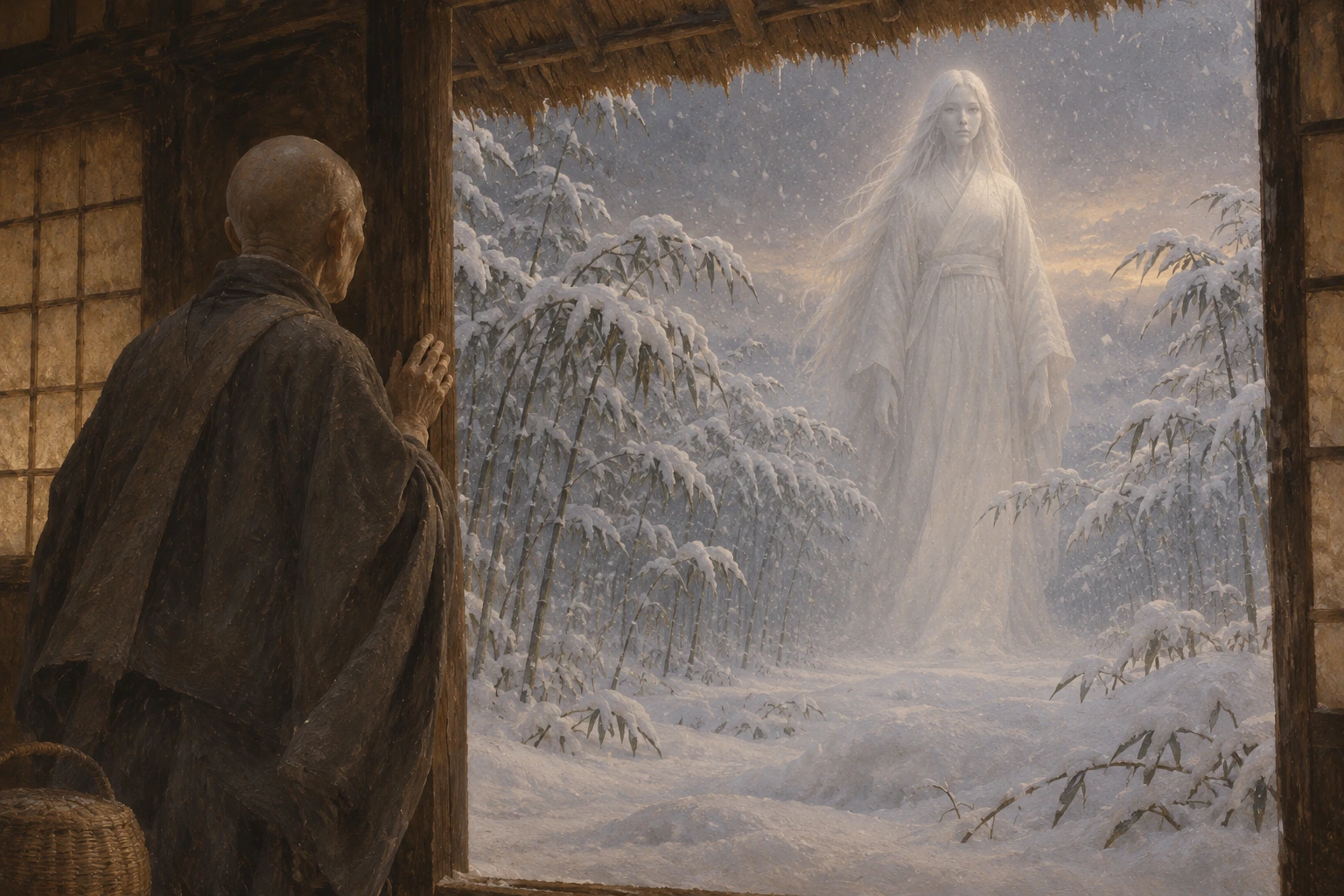
- The Sōgi shokoku monogatari (“Tales of Sōgi’s Travels in the Provinces”, 5 volumes, Kyoto, 1685) was written by the Kyoto bookseller Nishimura Ichirōemon, as the travels of the linked-verse poet Sōgi (1421–1502). In volume 5, as Kuramoto Akira summarizes it, Sōgi spends a hard winter with a friend in Echigo. One dawn he opens the door and sees, at the north end of a bamboo thicket, a woman a jō tall, about three metres. She looks barely twenty; her face, hair and skin are translucent white, she wears a white unlined robe, and the air around her shines with her whiteness. His friend tells him it must be “the spirit of the snow, what is commonly called a yuki-onna”. In Fujisawa Morihiko’s retelling of 1928, as the Nichibunken database summarizes it, she vanishes as Sōgi tries to see her better, and she appears only rarely, in years of heavy snow.
- Toriyama Sekien, Gazu hyakki yagyō (1776), the first of his picture books of yokai, has her in its “Yang” volume. She steps out of a bamboo grove past stalks broken by the snow, holding something to her breast. Kuramoto reads her as Tokiwa Gozen with her baby, as the ballad suggests.
- Lafcadio Hearn, Glimpses of Unfamiliar Japan (1894), “Of Ghosts and Goblins”. In Izumo his old gardener Kinjūrō told him of the Yuki-onna: “She is the White One that makes the Faces in the snow. She does not any harm, only makes afraid.” At night she rises “taller than the trees”. In a note Hearn adds that elsewhere he had heard her described as “a very beautiful phantom who lures young men to lonesome places for the purpose of sucking their blood”.
- Lafcadio Hearn, Kwaidan (Boston and New York, 1904). His preface is dated Tokyo, 20 January 1904. Of the farmer’s tale he writes: “Whether it has ever been written in Japanese I do not know; but the extraordinary belief which it records used certainly to exist in most parts of Japan, and in many curious forms.”
- Yanagita Kunio, Tōno monogatari (1910), tale 103. On the night of Little New Year, or on any full-moon night in winter, the Yuki-onna comes out to play, “leading many children”. Children sledging on the hills are told to come home early on the fifteenth, “but few say they have seen her”.
3 Competing Versions
- What does she look like? Sōgi’s snow woman is a giant with white hair. Hearn’s is a beautiful young woman. The folklorist Inokuchi Shōji writes that the beauty of Kitagawa Utamaro’s prints is “the result of literary development”: in folk belief she is more often an old woman, or a woman who died in childbirth. In Akita her face was smooth and featureless; in Niigata she had one leg and left a single hollow in the snow, and in one Niigata telling there was blood on her footprints.
- The child to hold. In Aomori, Ōshima Hiroshi writes, a beautiful woman on a snowy road hands a baby to a passer-by and vanishes, and the baby grows bigger and bigger in his arms. He holds a dagger in his teeth to stop it growing, and when the woman returns she rewards him with treasure or great strength. The gift of strength links her with the ubume, the ghost of a woman who died in childbirth. Elsewhere the child freezes to the arms that hold it, or the one who carries it is buried in the snow.
- When does she come? On Little New Year in Tōno. In Nishi-Tsugaru, Aomori, she comes down on New Year’s Day and leaves on a day of the hare in the first month. Ōshima and Inokuchi both connect her with the toshigami, the god who visits at New Year.
- What should you do? An old hunter of Sakunami, near Sendai, told the collector Tadano Jun how, at sixteen, he was riding on his father’s back through a blizzard when a tall, pale woman in white came walking across the snow. His father ran downhill without a word. Make way for her, turn back or speak to her, his father said, and she bewitches you and kills you; shut your eyes and run. The Miyagi kenshi (1956) prints the account.
- The comic snow child. In the tales called Yuki nyōbō or Shigama nyōbō, Ōshima writes, a snow woman leaves a child with an old couple. The child will never take a bath, and when they make it get in, it vanishes in foam.
- Hearn’s plot in other places. In Nagano and Toyama, Ōshima writes, the snow woman kills a hunter in a mountain hut and spares his son, who years later tells his wife: “identical” with Hearn’s tale, he notes. A Tōno version printed in 1989 ends with the wife turning into the snow woman and leaving her child to him. Whether such tellings are older than Hearn or grew from his tale is the question of the box below. In one case Tōda Masaru has traced the borrowing: the Toyama legend of Jūrokunin-dani, the valley of the sixteen woodcutters, as the writer Henmi Jun told it, takes over Hearn’s plot. The spirit of a tree, in a woman’s shape, kills a woodcutter’s companions, forbids him to tell what he saw, and comes back years later as a beautiful girl.
4 History and Tradition
- Pictures. Picture scrolls and prints of goblins gave her a long white robe and long hair. In one scroll held by Nichibunken she is white all over except for her red lips, and she has no feet, like a ghost. Ochiai Yoshiiku’s print Hyaku monogatari: Yuki-jorō, under another of her names, shows her in white over a red under-robe.
- Comic verse. The Kyōka hyaku monogatari, published, Hearn thought, in 1853, collected comic poems on the ghosts and goblins of the “Hundred Tales”. Hearn translated some in “Goblin Poetry” (1905): one poet supposes that even the snow woman’s best comb “is made of thick ice”. Hearn’s note says that “in most of the old folk-tales she appears as a beautiful phantom, whose embrace is death”.
- How Hearn worked. Hearn came to Japan in 1890, married Koizumi Setsu, became a Japanese subject in 1896 as Koizumi Yakumo, and died on 26 September 1904, the year Kwaidan came out. Setsu remembered that when she told him old stories he would not let her read from a book: “only your story, your words, your thoughts”. Hirakawa Sukehiro writes that Kwaidan retells ghost stories that Hearn had Setsu and others read aloud to him, and that through translations, English schoolbooks and films they are known in Japan far beyond the readers of his English.
- Ōme. Ashida Fumiyo, then a lecturer at Teikyo University, and others argued that the story came from old Chōfu. A local group, the “Yuki-onna detectives”, went on to find snow-woman lore all over Ōme, among it a snow woman who asks passers-by to hold her baby at a pair of wells. A story like Hearn’s they did not find. Local accounts, as the writer Nakano Jun reports them, say Hearn heard the tale from a father and daughter of Chōfu who lived near the Chigase ferry on the Tama River; Hearn himself speaks only of “a farmer”. A stone marked “the place associated with the Yuki-onna” stands at the north end of Chōfu Bridge.
- Seki Keigo’s catalogue. In his Nihon mukashibanashi taisei, completed in 1980, the tale types filed as supernatural wives (irui nyōbō) are the snake, frog, clam, fish, Dragon Palace, crane, fox, cat and heavenly-maiden wives, with the tale of a flute-playing husband. As Kawamori Hiroshi lists them, the group has no snow wife.
- On the page and the screen. The frontispiece of Kwaidan, by the Meiji illustrator Takeuchi Keishū (the book spells him “Keishu Takenouchi”), shows the woman in the hut, “blowing her breath upon him”. Kobayashi Masaki filmed the tale as one of the four stories of his Kwaidan (1964), which won a special jury prize at Cannes.
Hearn’s “Yuki-Onna” is often called an old Japanese folk tale. The snow woman is old; the story of Minokichi, the promise and O-Yuki’s ten children is not known from any text before 1904. Hearn himself did not know whether it had ever been written in Japanese. In his research reports, the comparatist Tōda Masaru argues that Hearn built the tale from fragments of local belief, with an idea taken from Northern European legends of the nightmare, and that writers and storytellers, among them Aoki Junji, Iwaya Sazanami, Matsutani Miyoko and Suzuki Satsu, retold it until it settled in Japan as a genuine folk tale. Matsutani’s “Yuki-onna” in Shinano no minwa (1957), he writes, was not gathered in Nagano but written at her desk from Hearn’s tale, with a local dialect and dress added.
5 Related Stories
- Kitsune: The Fox in Japanese Folklore: in the fox-wife folk tale, as the folklorist Kojima Yoshiyuki describes it, the wife leaves once her husband learns what she is, and the child stays; Kojima traces it back to the Nihon Ryōiki. O-Yuki leaves in the same way. Seki Keigo’s catalogue does not count the snow woman among its supernatural wives, so we link the two for the shared theme of a wife who is not what she seems.
- Urashima Tarō: The Fisherman Under the Sea: of all Japanese tales, Setsu remembered, Hearn loved Urashima best. He retold it in “The Dream of a Summer Day” (Out of the East, 1895), nine years before Kwaidan.
- The Peri: From Demons to Fairies: in the Persian Bahār-i dānish, a merchant’s son hides a peri’s robe and marries her, and ten years later she puts it on and flies away. We have not found a scholar who compares her with the Yuki-onna; we link them for the theme of a wife from another world who leaves.
- The Legend of the White Snake: Lady White and Leifeng Pagoda: a snake who becomes a wife in Hangzhou. Whalen Lai’s essay on Lady White names the “Snow Woman” among the wives from another world whom folklore lets bear children; we link the two for that theme.
- Gumiho: The Nine-Tailed Fox of Korea: as Kim Hwan-hee reports, Lee Myeong-hyeon and Noh Seong-hwan argue that the gumiho of a 1979 Korean television drama, a wife who leaves when her husband breaks his promise, took her story from Kobayashi Masaki’s film of “Yuki-onna”.
6 Sources
- Lafcadio Hearn, Kwaidan: Stories and Studies of Strange Things (Houghton, Mifflin, Boston and New York, 1904), preface and “Yuki-Onna”, pp. 109–118: archive.org, Project Gutenberg
- Lafcadio Hearn, Glimpses of Unfamiliar Japan (Houghton, Mifflin, 1894), vol. 2, “Of Ghosts and Goblins”: Project Gutenberg; Out of the East (1895), “The Dream of a Summer Day”: Project Gutenberg; The Romance of the Milky Way (1905), “Goblin Poetry”: Project Gutenberg
- Koizumi Setsu, “Omoide no ki”, in Koizumi Yakumo zenshū, supplementary volume (Daiichi Shobō, 1927): Aozora Bunko
- Yanagita Kunio, Tōno monogatari (1910), tale 103: Aozora Bunko
- Sōgi shokoku monogatari, 5 vols (Sakagami Kanbei and Nishimura Ichirōemon, 1685): NDL Search
- Kuramoto Akira, “Toriyama Sekien Gazu hyakki yagyō yō no maki o yomu (2)”, Nihon bungaku kenkyū 52 (Baikō Gakuin University, 2017), pp. 52–68, on Sekien’s snow woman, the Sōgi shokoku monogatari and Fushimi Tokiwa: repository
- “雪女”: Ōshima Hiroshi (Sekai daihyakka jiten), Inokuchi Shōji (Nipponica), Nihon kokugo daijiten, Britannica Japan: Kotobank; also “宗祇”, “西村市郎右衛門”, “伏見常盤”, “怪談” (Hirakawa Sukehiro), “小泉八雲”, “武内桂舟”, “青梅市”, “狐女房” (Kojima Yoshiyuki): Kotobank, Kotobank, Kotobank, Kotobank, Kotobank, Kotobank, Kotobank, Kotobank
- National Diet Library, “The yokai picture books of Toriyama Sekien”: NDL Image Bank
- Nichibunken, Database of Yōkai Images: Bakemono-zukushi emaki and Ochiai Yoshiiku, Hyaku monogatari: Yuki-jorō: Nichibunken, Nichibunken
- International Research Center for Japanese Studies (Nichibunken), Database of Strange Phenomena and Yōkai, entries for “ユキオンナ” (Fujisawa Morihiko 1928; Takashiji 1939; Miyagi kenshi 1956; Aizu no minzoku 1989): Nichibunken
- Tōda Masaru, research reports to JSPS on Hearn’s “Yuki-onna” and the making of Japanese folk tales (2015, 2021): KAKEN, KAKEN; his books are 〈Tensei〉suru monogatari (Shin’yōsha, 2011) and “Yuki-onna”, hyakunen no denshō (Genki Shobō, 2023)
- Kawamori Hiroshi, Nihon mukashibanashi no kōzō to hyōgen no kenkyū (doctoral thesis, Osaka University, 1997), p. 31: OUKA
- Nakano Jun, “Koizumi Yakumo no ‘Yuki-onna’ o tazuneru yami-aruki @ Ōme”, parts 1 and 2, Santatsu, 2020: san-tatsu.jp, san-tatsu.jp
- Kwaidan (Kaidan, 1964), dir. Kobayashi Masaki: eiga.com
Cover and illustrations: AI-generated images made for Arcana. They are interpretations, not historical artworks.