Kappa: The River Imp
A creature the size of a child, with a hollow of water on its head, waits in the river for horses and swimmers, yet a polite bow can drain its strength. Japan's best-known water spirit has dozens of local names, and an encyclopedia of 1712 draws it as a hairy, upright figure like an ape, not a turtle.
- Type: folk belief and folk tales, a water spirit the size of a child
- Culture: Japan, from Hokkaido to Okinawa, under more than eighty local names
- Earliest texts: the word kappa in a haikai sequence of 1678; the entry “Kawatarō” in Terajima Ryōan’s illustrated encyclopedia Wakan sansai zue (preface dated 1712); the Suiko kōryaku, reports and drawings gathered by Koga Tōan in 1820; Yanagita Kunio’s Tōno monogatari (1910) and Santō mintan shū (1914)
- Key figures: the kappa (also kawatarō, enkō, suiko and many other names), the horse it tries to drag into the water, the people who caught it and the promises it made, Kusenbō, chief of the nine thousand kappa
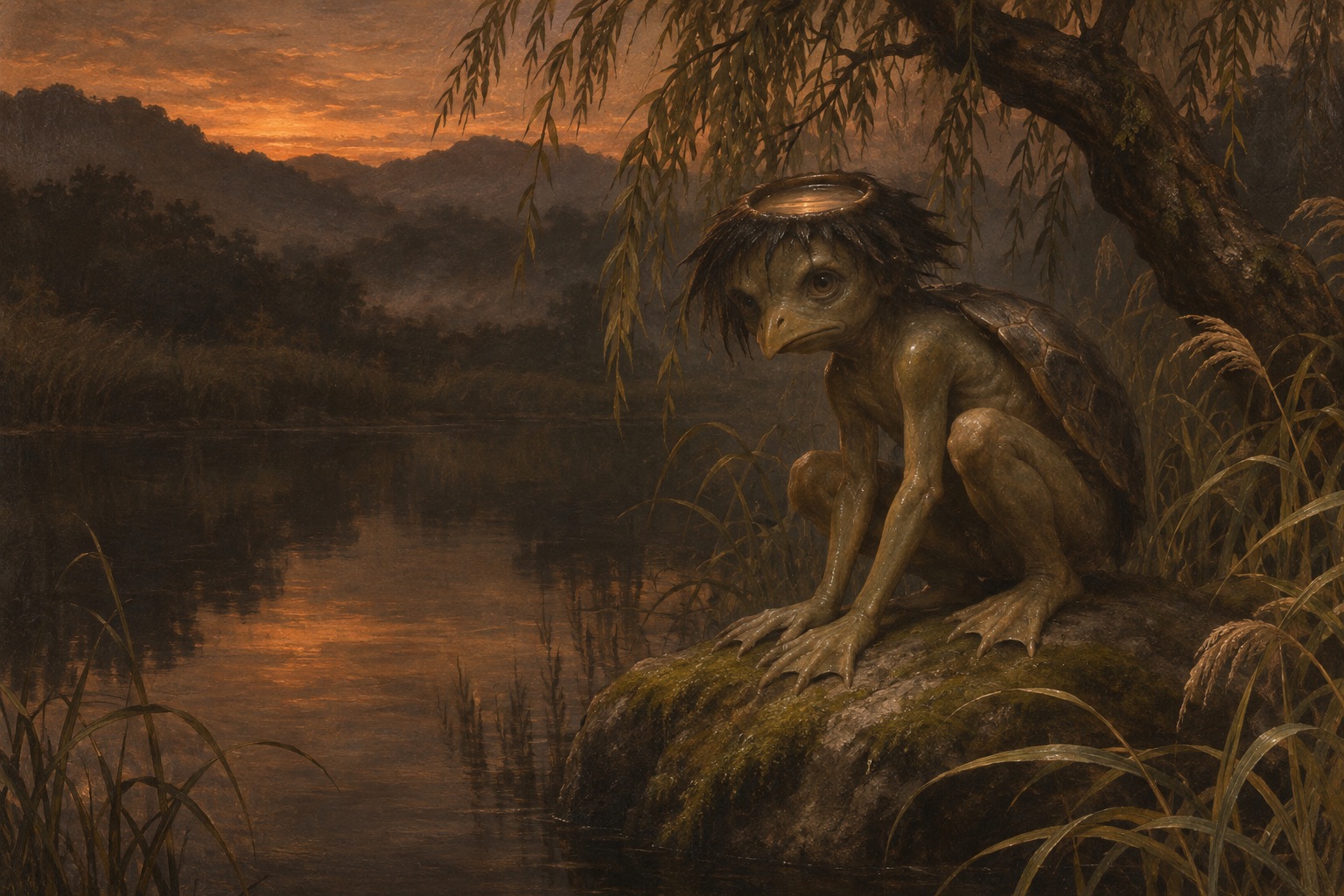
A small figure waits by a river pool at dusk. It is the size of a child, it has webbed hands, in most accounts a shell on its back, and on the crown of its head a hollow that holds water. It challenges people to wrestle, raids the melon patch, and drags horses, cattle and swimmers into the water. Caught, it apologizes, leaves fish at the door, and teaches a family a remedy for wounds. The kappa has no single myth and no author. It lives in an Edo-period encyclopedia, in drawings copied from scholar to scholar, and in hundreds of short tales written down by folklorists and local historians, most of them told as things that happened at a particular pool to a particular family.
Why does the kappa love cucumbers? One of the oldest descriptions does not mention them: in 1712 the Wakan sansai zue says the kawatarō comes out at sunset to steal melons, eggplants and grain. Cucumbers belong to later lore. The folklorist Watanabe Shōgo ties them to the cult of Gion: cucumbers were laid out at the water god’s festivals, the kappa was thought to come where they were offered, and it was most active around the Gion festival in the sixth and seventh months. Many districts offer cucumbers at river and water-god festivals, asking to be spared from drowning. The rule is not the same everywhere: in some places, as Takeda Akira found (in Foster’s summary), eating a cucumber before a swim invites the kappa, while in others it protects you.
1 The Telling
There is no one telling. The tales below come from an Edo-period encyclopedia, from two books by Yanagita Kunio, and from local histories, read in the summaries of the yokai database of the International Research Center for Japanese Studies (Nichibunken). Each is given with its source and place.
1-1 The Child in the Pool
In the encyclopedia he prefaced in 1712, the Osaka physician Terajima Ryōan wrote that the kawatarō was common in the west of the country and in Kyushu, in mountain streams, ponds and rivers. It looked like a child of about ten, went naked, walked upright and spoke like a person. Its hair was short and thin, and the crown of its head was hollow and could hold a handful of water. It lived in the water and came out at sunset to steal from the fields.
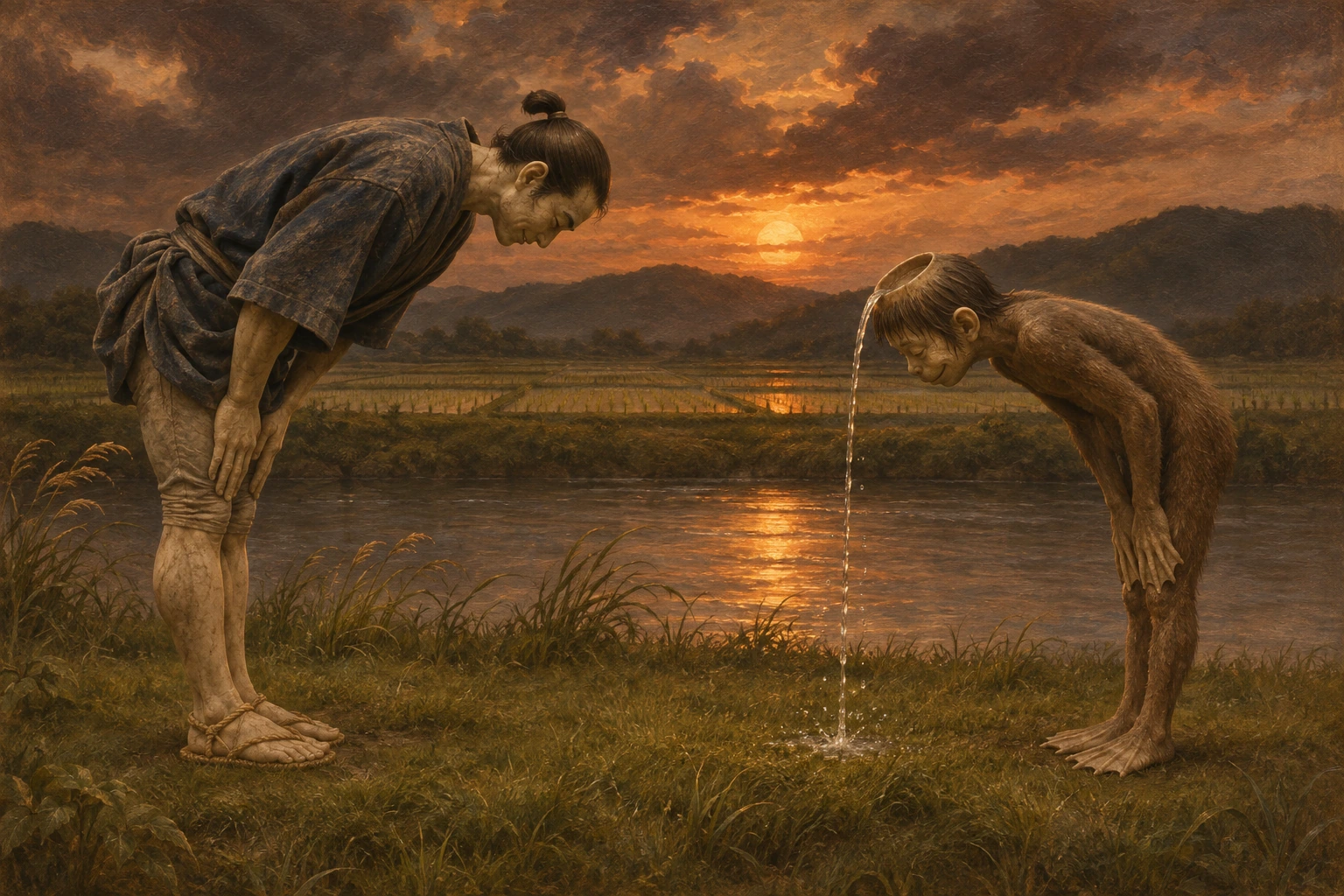
It loved sumo and invited anyone it met to wrestle. A strong man who faced it should first bow and toss his head up and down. The kawatarō would do the same, and without noticing it would spill the water from its head, lose its strength and fall. With water in its head it was twice as strong as a warrior. Its arms slid through its body from one side to the other, and it was too slippery to hold. It dragged cattle and horses into the water and sucked their blood, so people fording a river had to take great care.
It was said, Terajima adds, that Sugawara no Michizane had once made a poem about it while he was in Tsukushi, and that people who recited it while crossing a river came to no harm: “Do not forget the promise made long ago: the river-man’s clan is Sugawara.” Anyone who happened to catch a kawatarō let it go, for fear of its curse.
1-2 The Horse That Pulled Back
A young man from Tōno, in the mountains of Iwate, Sasaki Kyōseki, told Yanagita Kunio this story, and Yanagita printed it in 1910 as tale 58. A family called Shin’ya lived by the Obako pool on the Kogarase River. One day their horse was taken to the pool to cool off, and the boy who led it went off to play. A kappa came out and tried to drag the horse into the water. Instead the horse dragged the kappa all the way to its stable, where the creature hid under the horse trough. The family wondered why the trough was upside down, lifted it a little, and a kappa’s hand came out. The whole village gathered to decide whether to kill it or spare it. In the end they made it promise never again to trouble the village’s horses, and let it go. It has left the village since, and lives, people say, in the pool below the Aizawa falls.
Yanagita added a note: “Stories of this type fill the whole country. Wherever kappa are said to live, this story is told. Why?”
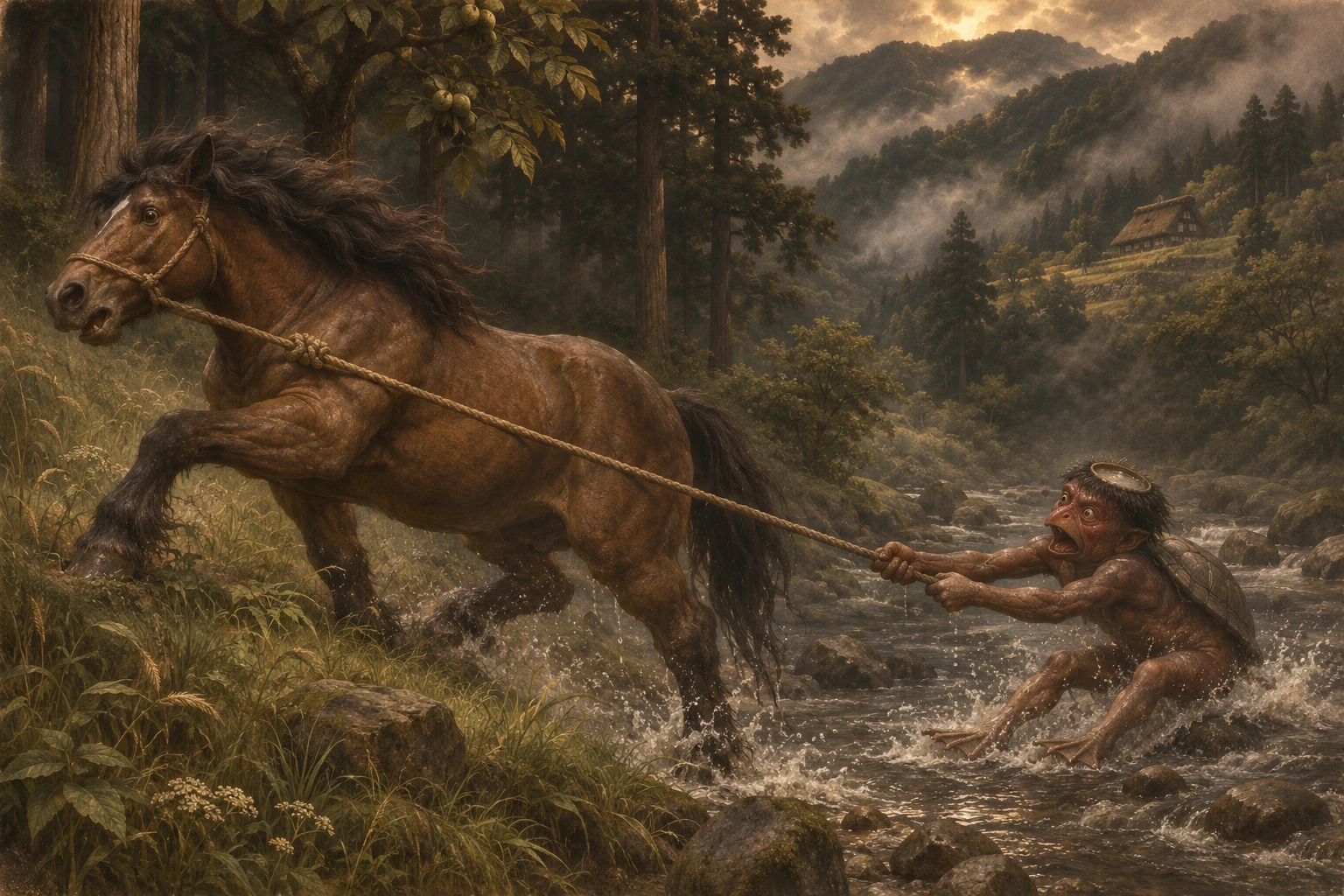
The Miyagi prefectural history of 1956 has one from Ōsato. At the Kasukawa weir, where children and horses often drowned, a retainer washed his lord’s horse one summer afternoon, and back at the house found a thin, strange-looking boy with cropped hair. It was a kappa that had come clinging to the horse’s tail. They were about to beat it to death, but it begged so humbly that they let it go, after making it press its handprint on a white towel as a pledge. The family kept the handprint until a great fire in 1876.
1-3 The Arm and the Remedy
The same history tells of a samurai of the old Sendai domain, Odajima Ōinosuke, who lived at Futago on the Kitakami River. Something troubled the maids when they went to the privy at night, so he dressed as a woman and waited there himself. When a cold, stiff hand touched him, he seized it and cut it off with a dagger he had hidden, and the creature fled screaming. It was a thin arm with webbed fingers. On the third night a creature appeared at his pillow and bowed low: it was the kappa of the Yoroi pool, it would do no more mischief, and it begged for its arm. What use is an arm once cut off? asked Ōinosuke. The kappa said it had a secret medicine. In exchange for the recipe he gave the arm back, and the kappa joined it back on before his eyes and taught him how to make the medicine. The family’s remedy for wounds was much sought after, though less so in later generations.
In Ōmi, now part of Itoigawa in Niigata, the Shimizu family say an ancestor got hold of a kappa’s arm while washing his horse in the river. That night the kappa came for it, and he made it bring a written pledge never to harm the children of Ōmi. No one has drowned there since, the story goes. From the next morning fresh fish were left in the fork of a tree in the family’s hedge, until they put an iron hook there and the fish stopped coming. The kappa is a messenger of Otohime of the Dragon Palace, the tellers explained, and it hates metal.
1-4 The Red Kappa of Tōno
“Elsewhere they say the kappa’s face is blue,” Yanagita wrote in tale 59, “but the kappa of Tōno have red faces.” When Sasaki’s great-grandmother was a little girl, playing in the garden with her friends, she saw a bright red boy’s face peering out between the walnut trees. It was a kappa. Its footprints, tale 57 says, are often seen on the sand of the river banks, above all the day after rain: like a monkey’s, with the thumb set apart, less than three sun (about nine centimetres) long.
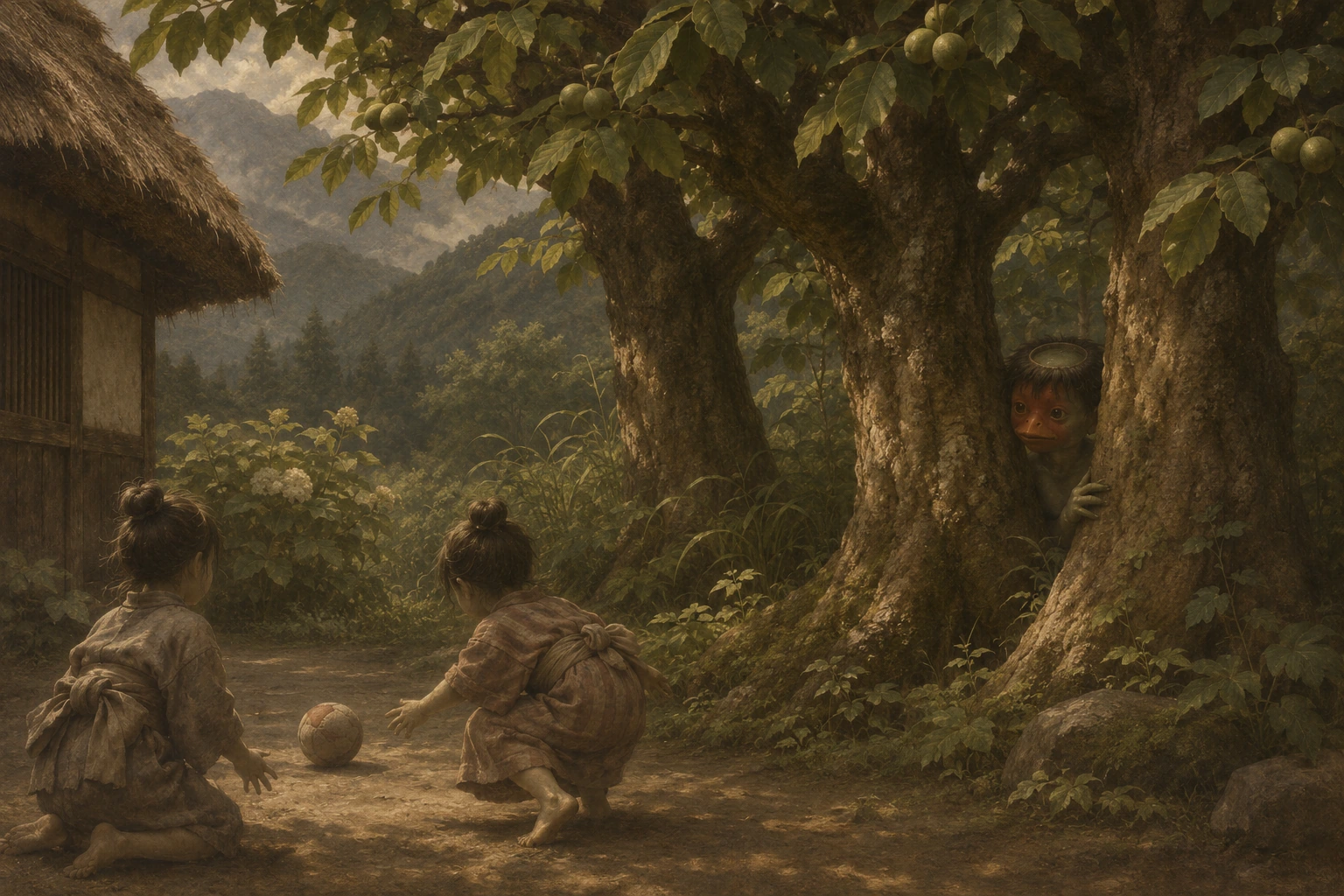
The two tales before them are darker. In tale 55 a woman of a house by the river in Matsuzaki village was seen crouching at the water’s edge, smiling. Rumour said a man came to her at night, even when her husband was beside her, and people began to say it must be a kappa; her family kept watch, but could not keep it away. The birth was hard until she gave birth in a horse trough filled with water, and the child had webbed hands. Her mother, it was said, had also borne a kappa’s child. The babies were killed and buried in a small cask. Tale 56, from Kamigō village, tells of a woman who bore the child of “something like a kappa”, bright red with a large mouth. Her family carried it to a fork in the road to abandon it, then turned back, thinking it could be sold to a sideshow, and found it gone. Yanagita adds no comment to either, only a note on the word for a fork in the road.
1-5 Kusenbō and the Monkeys
When Katō Kiyomasa was lord of Higo, in Kyushu, the kappa of the Yatsushiro River dragged his favourite page into the water and killed him. Kiyomasa, furious, prepared a campaign against them and gathered a great many monkeys from his domain. The kappa were terrified. Kusenbō, chief of the nine thousand kappa, asked a Buddhist priest to plead for them and swore that they would never again harm a human being. Yanagita Kunio tells the story in his Santō mintan shū of 1914, after an Edo collection of the 1740s, the Honchō zokugen shi, and explains just before it why monkeys were the right army: a kappa that sees a monkey cannot move, and monkey trainers covered their monkeys’ faces when they crossed a river. Ishida Eiichirō takes the tale from him.
2 Where the Story Is Written Down
- The word. Kappa is a worn-down form of kawa-warawa, “river child”, says the Nihon kokugo daijiten, whose earliest example is a haikai verse of 1678; another name, kawarō, is already in the Japanese–Portuguese dictionary printed by the Jesuits in 1603–04. Komatsu Kazuhiko writes that kappa was first the name used in the Kantō region, and that words for the creature appear in writing only from the early modern period.
- Terajima Ryōan, Wakan sansai zue (preface dated 1712), an illustrated encyclopedia in 105 books, modelled on the Ming Sancai tuhui. The kawatarō is in book 40, “Apes and Strange Creatures”, among the strange creatures. Just before it comes the suiko (水虎, “water tiger”), a scaly river creature taken from the Chinese Bencao gangmu, which Terajima judged to be of the kawatarō’s kind, “but different”.
- The Suiko kōryaku (“A Study of the Kappa”, as Ishida translates it), compiled in 1820 by the scholar Koga Tōan: reports on kappa with coloured drawings. It circulated in manuscript copies, such as one made in 1836 that is now in the Iwase Bunko at Nishio, and a sequel followed in 1839. Ishida reproduces from it a kappa of the Chikugo River in Kyushu.
- Yanagita Kunio, Tōno monogatari (1910). Yanagita heard all its tales from Sasaki Kyōseki of Tōno, who visited him in the evenings from early 1909. Tales 55 to 59 are about kappa.
- Yanagita Kunio, Santō mintan shū (1914). Its study “Kappa komahiki” gathered tales of kappa trying to drag horses into the water from nearly every province, from Rikuchū to Hizen. In most of them, as Ishida sums it up, the kappa fails and has to apologize, “sometimes formally in writing”. We read the book in its edition of 1942.
- Ishida Eiichirō, Kappa komahiki kō (Chikuma Shobō, 1948; new edition 1966). Ishida began it for a volume honouring Yanagita’s seventieth birthday in 1944, carried on in Beijing and Kalgan, and finished it after the war. An English version, “The Kappa Legend”, translated by Yoshida Ken’ichi, appeared in Folklore Studies in 1950.
- Local histories. The prefectural histories of the 20th century record kappa tales village by village. Nichibunken’s database lists about 1,100 of them under the name “kappa” alone.
3 Competing Versions
- What is it called? Foster reports more than eighty local names. Kawatarō, “river boy”, around Kyoto and in parts of Kyushu; gatarō in Harima; gārappa in Higo; kawako, “river child”, in Izumo; enkō, “monkey”, from Izumo and Nagato to Iyo and Tosa; game, “turtle”, in Etchū; kawasso, from “otter”, in Saga (all from Ishida). The encyclopedias add hyōsube, mizushi, medochi and suiko.
- What does it look like? A child of about ten in the Wakan sansai zue, of four or five in the Nipponica, of three or four in Foster’s summary of the tales. Its skin is blue, blue-black or grey in most places, red in some (Komatsu), and in Tōno its face is red. Some reports cover it with hair, others with scales (Foster). Many say it has only three fingers. Its arms stretch, come off easily, or pass right through its body.
- Where did it come from? In Amakusa, Komatsu reports, the carpenter Hidari Jingorō made straw dolls and brought them to life to finish a castle on time. When he threw them into the river they asked what they should eat, and he answered, “people’s backsides”; they became kappa. Other places make the kappa a child or servant of Gozu Tennō, the god of Gion, or say it came from abroad. In Ōmi it is a messenger of the Dragon Palace.
- How old is it? The Nihon Shoki tells that in the 67th year of Emperor Nintoku a mizuchi in a river fork in Kibi poisoned travellers. Agatamori threw three gourds into the pool and dared it to sink them; it turned into a deer and could not, and he killed it. Foster calls this “perhaps the first documented appearance” of the water spirit that became the kappa. Komatsu disagrees: the mizuchi is a serpent or dragon, not the kappa of Edo writers.
- What does it do to people? It drowns children who play in the river (Komatsu). It pulls out the shirikodama, an imaginary ball inside the body near the anus, or sucks blood (Nipponica). In Kyushu people were warned not to wrestle strangers: an onlooker would see only one man wrestling alone, and the loser might fall ill or lose his mind. Yet the same kappa plants rice, brings fish and lends bowls to the households it favours.
4 History and Tradition
- A fallen water god? In Yanagita’s view, as Ishida reports it, the kappa is “a degenerate survival” of the child gods of the water world. The Nipponica calls it a water god who trades places with the god of the rice fields in spring and autumn, and the Britannica Japan records that it moves between river and mountain twice a year, a kawatarō in the river and a yamatarō in the hills.
- Horses and water gods across Eurasia. Ishida followed the kappa’s horse from Japan through China, Central Asia and Europe, from the dragon-horses of China to the kelpies of Scotland. He accepted Yanagita’s conclusion that the kappa’s horse-pulling goes back to the sacrifice of oxen and horses to the water god “in remote ages”. In Japan, as the Nipponica sums up his book, the water god declined into a yokai, and the tale of the kappa and the horse was what remained.
- Drowned and abandoned children. The tales themselves tie the kappa to children’s deaths: it drowns them, and its pledges promise to spare them. Tōno’s tales 55 and 56 go further. Popular articles, in magazines and on the web, read the kappa as the memory of babies killed at birth, but we have not found a folklorist who argues this in a work we could read. The scholars cited here explain the kappa otherwise: as a fallen water god (Yanagita, Ishida), as an image put together in the Edo period (Komatsu), or, for the shirikodama, from the slack state of drowned bodies (Ishikawa Jun’ichirō, as Foster reports). Komatsu has also linked the kappa to the “people of the river”, outcasts who lived on the river banks, to show how a folk image can set one group of people apart (as Foster reports).
- Akutagawa’s Kappa. In March 1927 Akutagawa Ryūnosuke published Kappa in the magazine Kaizō. A patient in a mental hospital tells how he chased a kappa in the valley above Kamikōchi and fell through a hole into its country, where a father asks his unborn child whether it wishes to be born. The narrator compares the kappa he meets to those of the Suiko kōryaku. Akutagawa killed himself on 24 July of the same year, and haiku poets call that day Kappa-ki, the “kappa anniversary”.
- Tōno’s Kappa-buchi. Behind the temple Jōkenji in Tōno, a pool called Kappa-buchi is said to be home to kappa. Visitors buy a “kappa capture permit” whose rules include catching the kappa without harming its dish or spilling its water, and fish for it with a cucumber on the line. On the bank stands a small shrine where women pray for milk for their babies.
- From monster to mascot. Foster traces how the kappa changed in the 20th century: after Akutagawa’s novel came the cartoon kappa of Shimizu Kon in the 1950s and the mascots of towns, shops and clubs. The creature that drowned children became a cute symbol of clean rivers.
Today’s kappa looks like a kind of turtle: a beak, a shell, green skin. One of the first books to describe it gives none of these. In 1712 the Wakan sansai zue files the kawatarō in its book of apes and strange creatures, describes a naked child with short hair, and draws a hairy figure standing upright like an ape. In western Honshu and Shikoku its name was enkō, “monkey”. In Kyushu, Yanagita wrote in 1914, many who said they had met one described a monkey in size and shape, and some places said it even wept like a monkey. In Tōno its footprints were a monkey’s. Turtle-like kappa were drawn too, such as the ones said to have been caught at Mito and Niigata, crawling on all fours. The kappa we picture now, Komatsu writes, was put together in the Edo period from monkeys, turtles and other images.
5 Related Stories
- The Kelpie: The Water Horse of Scotland: in his study of the kappa that drags horses into the water, Ishida Eiichirō turns to “the sombre lochs” of Scotland and their kelpies, which “drag men into the water”, and to the Boobrie of Loch Frisa on Mull, a horse borrowed for the plough that turned into a monstrous bird and plunged into the loch, taking the other horses and the plough with it.
- Sun Wukong: The Monkey King Who Fought Heaven: in the Journey to the West the monkey is made keeper of the heavenly stables. Ishida, collecting the old Asian custom of keeping monkeys in stables to keep horses healthy, thought that episode “may not perhaps be regarded solely as a product of the author’s imagination”. The monkey that guards the horse is also the kappa’s enemy.
- Urashima Tarō: The Fisherman Under the Sea: the Dragon Palace where Urashima goes, whose princess modern tellings call Otohime. In the Ōmi tale, the kappa that pledged to spare the village’s children was her messenger.
6 Sources
- Terajima Ryōan, Wakan sansai zue, book 40, “Kawatarō” and “Suiko”, in the typeset edition (Chūgai Shuppansha, 1901), vol. for books 21–52, p. 608: NDL Digital Collections
- Yanagita Kunio, Tōno monogatari (1910), preface and tales 55–59, Iwanami Bunko text: Aozora Bunko
- Yanagita Kunio, Santō mintan shū (1914), “Kappa komahiki”, in the Sōgensha edition (1942), pp. 61–62: NDL Digital Collections
- Nihon Shoki, book 11, Emperor Nintoku, 67th year (original text): Wikisource
- Ishida Eiichirō, “The Kappa Legend: A Comparative Ethnological Study on the Japanese Water-Spirit Kappa and Its Habit of Trying to Lure Horses into the Water”, trans. Yoshida Ken’ichi, Folklore Studies 9 (1950), foreword, pp. 1, 32–33, 117–122, 131: Asian Ethnology
- Michael Dylan Foster, “The Metamorphosis of the Kappa: Transformation of Folklore to Folklorism in Japan”, Asian Folklore Studies 57 (1998), 1–24: Asian Ethnology
- Watanabe Shōgo, “河童”, Nipponica; Komatsu Kazuhiko, “河童”, Sekai daihyakka jiten; “河童”, Britannica Japan and Nihon kokugo daijiten: Kotobank; “河郎”, Nihon kokugo daijiten: Kotobank
- Kuraishi Tadahiko, “河童駒引考”, Nipponica: Kotobank; “和漢三才図会”: Kotobank; “河童忌”: Kotobank
- Nichibunken, Database of Strange Tales and Yokai, records C0411186, C0411189 (from Miyagi kenshi 21, 1956) and C1510253 (from Niigata kenshi, shiryō-hen 22, 1982): Nichibunken, Nichibunken, Nichibunken
- Suiko kōryaku, manuscript copy of 1836, Iwase Bunko, Nishio, and Suiko kōryaku kōhen (1839): NDL Search, NDL Search
- Akutagawa Ryūnosuke, Kappa (Kaizō, March 1927): Aozora Bunko
- Tōhoku Tourism Promotion Organization, “カッパ淵”: tohokukanko.jp
Cover and illustrations: AI-generated images made for Arcana. They are interpretations, not historical artworks.