The Kelpie: The Water Horse of Scotland
A fine horse grazes by the water, and whoever climbs on its back is carried into the deep. Scots called it the kelpie and Gaelic speakers the each-uisge, and the men who wrote the stories down could not agree whether they were one creature or two.
- Type: folk belief and folk tales, a water spirit in the shape of a horse
- Culture: Scotland: the kelpie in Scots, the each-uisge (“water-horse”) in Gaelic
- Earliest texts: the word is in a Kirkcudbrightshire place-name of 1674, in a line by William Collins dated 1747 and in Robert Burns’s “Address to the Deil” (1786); the tales were written down in the 19th century by W. Grant Stewart (1823), J. F. Campbell (1860–62), Walter Gregor (1881) and John Gregorson Campbell (published 1900)
- Key figures: the kelpie, the each-uisge, the children of Sunart, the girl at the shieling, James Macgrigor and the bit of the kelpie’s bridle
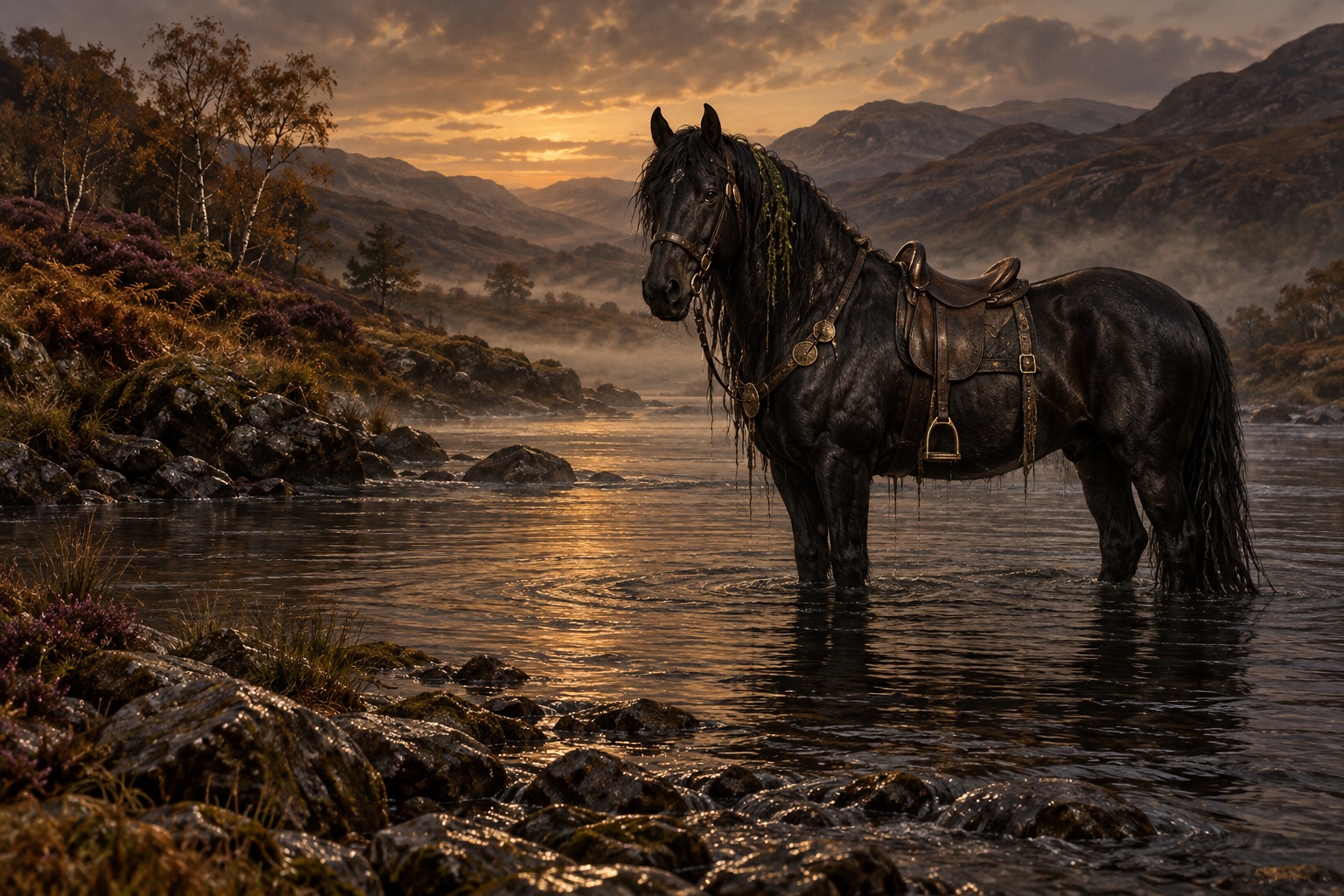
A strange horse grazes by a loch or a ford, sleek and gentle, sometimes saddled and bridled, with no owner in sight. Whoever climbs on its back is carried at a gallop into the water, and next day, the stories say, only a liver comes ashore. In Scots this horse is the kelpie; in Gaelic it is the each-uisge, the “water-horse”. It has no single myth and no author. It lives in a stanza by Robert Burns and in dozens of short tales that ministers and collectors heard in the 19th century, often told as things that had really happened.
Are the kelpie and the each-uisge the same creature? It depends on which collector you read. John Gregorson Campbell, minister of Tiree, held that they were “distinctly separate”: “The Water-horse haunts lochs, the Kelpie streams and torrents”, and the kelpie “has no representative in Gaelic superstition”. J. F. Campbell of Islay, forty years earlier, found “no word in Gaelic that could be corrupted into Kelpie, but he is the same as Each uisge”. And in 1823 W. Grant Stewart wrote of “the ‘Ech Uisque,’ or Water-Horse, as the Kelpie is commonly called”.
1 The Telling
There is no one telling. The tales below come from four collections, and each is given with its collector and its place. In Walter Gregor’s north-east the creature is the kelpie; in the Gaelic west of the two Campbells it is usually the water-horse. Quotations are from the collectors’ own English.
1-1 The Horse at the Ford
In the north-east, Gregor wrote in 1881, the kelpie “lived in the deep pools of rivers and streams” and “had commonly the form of a black horse”. He came out at night, and travellers crossing fords or old bridges heard him “go splash, splash, through the water”. Sometimes he coaxed a traveller onto his back, rushed to his pool and carried the rider to his death.
He could also be caught, by throwing over his head a bridle on which the sign of the cross had been made. Then he grew quiet and could be made to do heavy work, most often carrying stones to build a mill or a farmstead. When he was set free he went off saying: “Sehr back an sehr behns / Cairrit a’ 's stehns”, sore back and sore bones, carrying all the stones.
He could be killed, too. A blacksmith’s wife and children spent the summer at the shieling, the hut on the hill pasture, and the kelpie kept visiting them while the smith was at his forge. The smith laid two long iron spits in the fire on the hearth and, when the kelpie came, drove them into its sides. “It fell a heap of starch, or something like it.”
1-2 The Horse Whose Back Grew Longer
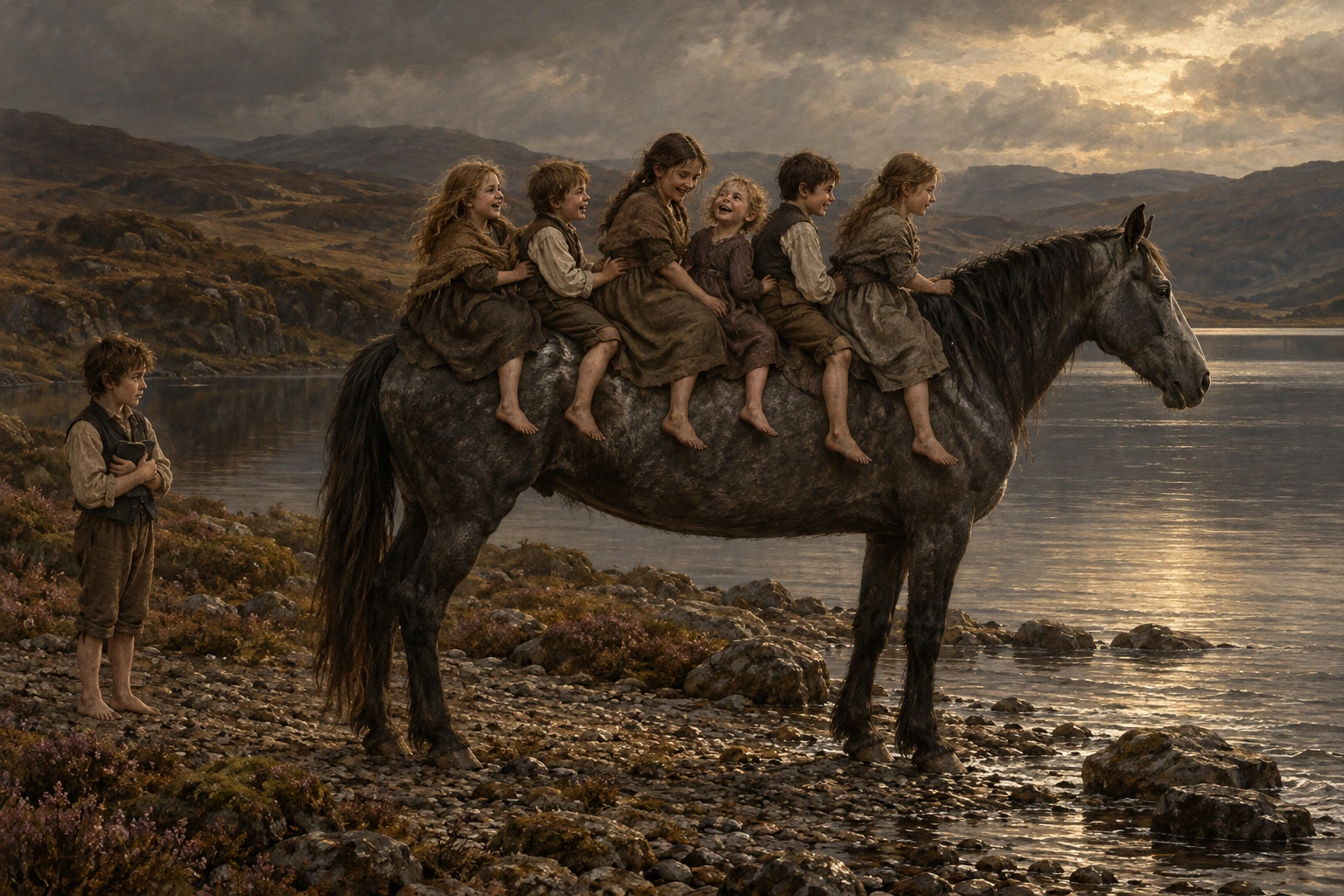
John Gregorson Campbell, minister of Tiree from 1861 to 1891, gives this tale from Sunart. One Sunday some children went to play near Loch na Dunach, the “Loch of Disaster”. They found a horse, caught it and climbed on in their thoughtless sport. Its back grew longer until all of them were mounted, all but one boy who had a Bible in his pocket. He touched the horse with his finger, and had to cut the finger off to save himself. The horse rushed into the loch, and the nine children were never seen again. Next day the liver of one of them came ashore.
The tale “is widely spread”, Campbell adds, “and is obviously a pious fraud to keep children from wandering on Sundays to play in lonely places, and from meddling with any horse they may find”. J. F. Campbell knew the same features from many tales: “His back lengthens to suit any number; men’s hands stick to his skin”.
1-3 The Best Horse on the Farm
On Mull, J. G. Campbell heard of farmers who found a strange horse among their own all winter and could not drive it away. In spring they put it to work with a cow-shackle round its neck, and it was the best horse on the farm, fat and sleek when the rest were lean. In summer it led a string of horses carrying creels of peat, each tied to the tail of the one in front, with the farmer on its back. Then the shackle slipped and it bolted for the loch. The farmer saved himself by planting a foot on each post of a narrow gateway as they passed, or by cutting the halter of the last horse. The horses still tied were dragged into the water, and next day their entrails or livers came ashore.
The most famous of these, he says, was the heir of Aros, a young man sure there was no horse he could not ride, who was taken into Loch Frisa between his betrothal and his wedding. The lament his bride made for him was “still and deservedly a popular song in Mull”.
1-4 Sand in His Hair
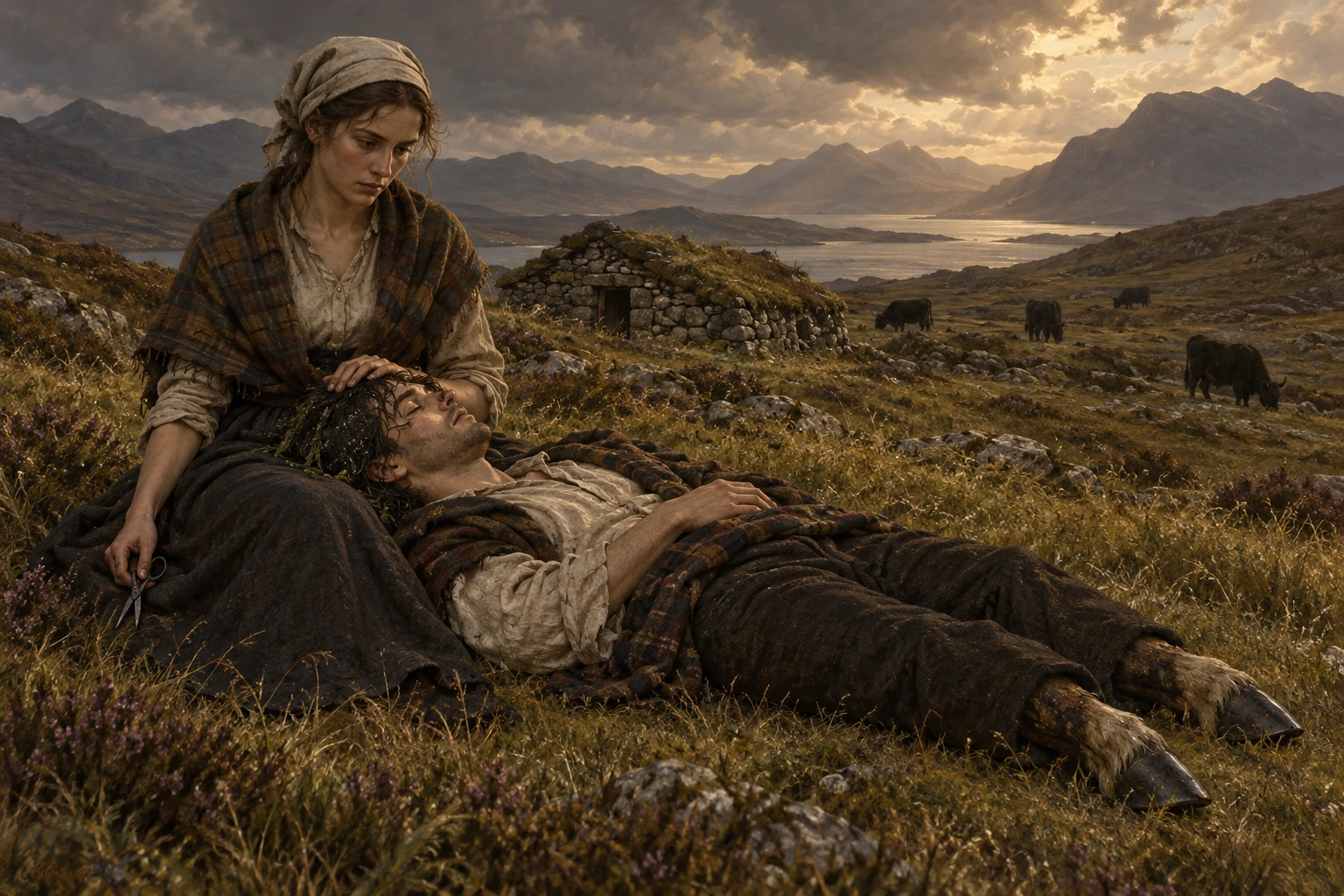
In a man’s shape, J. G. Campbell writes, the water-horse “was detected by its horse-hoofs and by the green water weeds or sand in its hair”. A young woman herding cattle on a lonely hillside was joined by a young man, who laid his head on her lap and fell asleep. As he stretched, she saw that he had horse’s hoofs. She lulled him, eased his head onto the ground, cut away with her scissors the part of her clothes he was lying on, and escaped. When he woke and found her gone, “it made a dreadful outcry”.
The tale, Campbell says, was known “over the whole Highlands”. Sometimes she is one of a band of women at the summer shieling, the others are killed, and she alone escapes; sometimes he comes back for her on a Sunday. In Durness, in Sutherland, it was told of Loch Meudaidh: the girl knew him by the sand in his hair, and when she looked back from a distance she saw him tearing up the earth in his fury. Her descendants, Campbell adds, “are still pointed out”. In J. F. Campbell’s version a lady is dressing the stranger’s hair as he lies with his head on her knee, and she says “Tha gainmheach ann”, “There is sand in it”.
1-5 The Kelpie’s Bridle
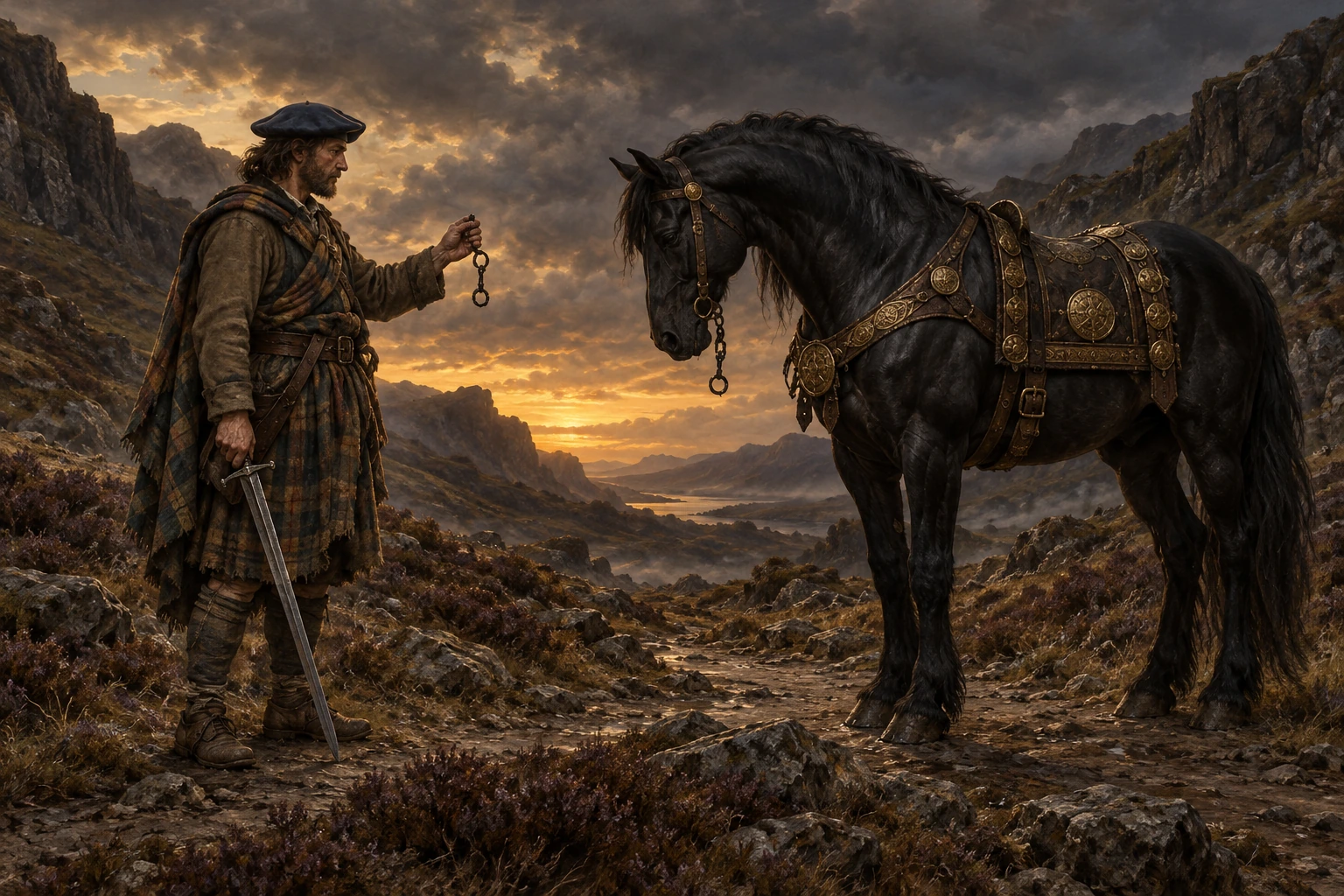
In 1823 W. Grant Stewart printed a story told him by a Mr Willox (he spells it Wellox here), who owned the relic it explains. Willox’s ancestor James Macgrigor had heard of “a most mischievous water-kelpie that lived in Lochness”. It waited by the roads in the trappings of a riding horse, and whoever mounted it was carried through the air to Lochindorb, Loch Spynie or Loch Ness. Macgrigor met it at Slochd Muichd, a pass on the road between Strathspey and Inverness, and struck it on the nose with his sword. The blow cut its bridle, one of the bits fell, and Macgrigor put it in his pocket.
The kelpie argued for its bridle all the way to his house. The bridle was its commission, it said: without it its power was gone, and it would die within twenty-four hours. Anyone who looked through the holes of the bit would see “myriads of invisible agents, fairies, witches, and devils”. At the house the kelpie planted itself in the doorway, so Macgrigor threw the bit through a back window into his wife’s lap. A rowan cross over the door kept the kelpie out, and it took itself off.
In 1881 Gregor wrote of the same family’s relic as the “Willox Ball and Bridle”. Here the bridle is “a small brass hook”, struck from a kelpie that had plunged its riders “into the deepest part of Loch Ness”. A Highlander struck it in the name of the Father, Son and Spirit, raced home with the hook and fell exhausted on his own threshold. The family made healing water by turning the ball, then the bridle, three times in it with the same words, and the bridle had been “in possession of the family for generations”.
2 Where the Story Is Written Down
- The word. The Dictionary of the Scots Language (DSL) defines the kelpie as “a water demon haunting rivers and fords”, generally in the form of a black or white horse. It derives the word, probably, from Gaelic cailpeach or colpach, “a bullock, colt”, and compares the Irish each uisce, “water horse”. It finds the word in a place-name, Kelpie hoall, in Kirkcudbrightshire in 1674, and its first quotation is a line of William Collins that it dates to 1747: “Drowned by the Kelpie’s wrath”.
- Robert Burns, “Address to the Deil”, in Poems, Chiefly in the Scottish Dialect, printed at Kilmarnock in 1786. Burns tells the Devil that when the thaws melt the snow and set the ice floating, “Then, Water-kelpies haunt the foord, / By your direction, / An’ nighted Trav’llers are allur’d / To their destruction” (p. 59). The book’s glossary calls them “a sort of mischievous spirits that are said to haunt fords, &c.”
- W. Grant Stewart, The Popular Superstitions and Festive Amusements of the Highlanders of Scotland (Edinburgh, 1823), published without his name. Part IV, “Water-Kelpies”, opens with Burns’s stanza and tells the Macgrigor story in a tone of open mockery: elsewhere Stewart calls Mr Willox the “Emperor of all the Conjurors”.
- J. F. Campbell, Popular Tales of the West Highlands (four volumes, 1860–62), collected orally in Gaelic. The water-horse appears in the introduction to volume 1, in the notes to “The Brollachan” in volume 2, and in volume 4, where Campbell is told that Loch Ard na h-uamh “is famous for water-horses. They have been ridden to market.”
- Walter Gregor, Notes on the Folk-Lore of the North-East of Scotland (Folk-Lore Society, 1881), chapter XII, “Waterkelpie”, with the Willox ball and bridle at pp. 38–39 and 187. Gregor says he gathered the book “from the mouths of the folk”.
- John Gregorson Campbell, Superstitions of the Highlands and Islands of Scotland (Glasgow, 1900), “collected entirely from oral sources” while he was minister of Tiree and published after his death. Chapter V, “The Water-Horse (Each Uisge)”, ends with a short section on the kelpie.
3 Competing Versions
- Where does it live? In river pools and at fords for Gregor, Burns and the DSL; in “lochs and pools” for Stewart. J. G. Campbell gives the lochs to the water-horse and “streams and torrents” to the kelpie, “that swells torrents and devours women and children”. A Shetland friend told him that kelpies there splashed in the burns and held mill-wheels still.
- What does it look like? For Gregor, a black horse; once a grey horse among a herd by a lonely loch turned “in the twinkling of an eye” into an old man with a long grey beard. On Skye the water-horse had “a sharp bill”, and it could be grey, black, or black with a white spot. It came as a young man, a boy, a ring, “and even a tuft of wool” (J. G. Campbell).
- How is it mastered? A bridle signed with the cross (Gregor); a cow-shackle round its neck or a cap on its head (J. G. Campbell); a rowan cross over the door (Stewart). A deserter named Macphie, living on an islet in Loch Cuaich, said that his shots did not move the water-horse standing at his door in a man’s shape until he loaded his gun with a silver coin.
- What is left when it dies? Gregor’s smith finds “a heap of starch”. On Raasay a smith lured the water-horse into a hut with a roasting sheep and killed it with irons from the fire; it proved to be “merely grey turves”, or a soft mass like a jellyfish. In Sutherland, J. F. Campbell’s collector told of “the kelpie” of a mill, a female fuath (spirit) caught and tied onto a horse, which fell to earth as “a small lump of jelly”.
- What happened at Loch Frisa? J. G. Campbell gives five accounts of the heir of Aros: a grey mare among his father’s horses, a mare found in the hills, a water-horse whose shackle was neglected, a young horse caught for harrowing, a cap forgotten. He thought there was “this much truth” in it: the young man was dragged into the loch by a mare he was trying to break, and drowned.
- Why were the stories told? J. G. Campbell called the Sunart tale a “pious fraud” to keep children at home on Sundays. J. F. Campbell thought the legends “point to some river god reduced to be a fuath or bogle”, and that the old Celts “must have had a destroying water-god, to whom the horse was sacred”. That is his guess; none of the tales names a god.
4 History and Tradition
- A belief already fading. In 1813 a survey of farming in Angus, quoted in the DSL, said that the water kelpie “has fallen into oblivion, since bridges were constructed in all convenient places”. J. G. Campbell opens his chapter with “The belief in the existence of the Water-horse is now in the Highlands generally a thing of the past”. Yet his own footnote tells how, a few years earlier, a report that the water-horse of Loch Meudaidh was back kept people from fetching their cut peats home by boat, and the fuel was left to waste.
- Witnesses. J. F. Campbell wrote in 1860 that in Sutherland and elsewhere “many believe that they have seen these fancied animals”, and that he had been told of English sportsmen who went out after them.
- The Kelpies at Falkirk. Two steel horse heads, 30 metres high and about 300 tonnes each, stand by the Forth and Clyde Canal near Falkirk. They are the work of the sculptor Andy Scott, were built in 2013 and opened to the public in April 2014. The name came first: “The title and theme of The Kelpies as mystical water-borne equine creatures was inherited at the outset of the project,” Scott said when the heads were finished, and “the ethos and function has shifted from the original concept”. What they portray are working horses. They were modelled on two Clydesdales, Duke and Baron, that worked for Glasgow City Council carrying visitors and goods around a park, and Scott describes them as “inspired by the cultural heritage of the Clydesdale horses, draught horses, which worked hard to help people along the canals and on the land”.
- The beast of the River Ness. In his Life of Columba, completed between 697 and 704, Adomnán, abbot of Iona, tells how Columba, crossing the River Ness in the land of the Picts, found people burying a man bitten by “a water-beast” (aquatilis bestia), and turned the beast back from a swimming monk with the sign of the cross (book II, chapter 27; 28 in Reeves’s translation). Jacqueline Borsje points out that it swims in the river, not the loch, and suggests a possible model: a story in which St Martin orders a serpent in a river to turn back, in the Dialogues of Sulpicius Severus (about 404).
- The “monster” of 1933. On 14 April 1933 a couple driving along the north shore of Loch Ness saw something rolling and plunging in the water, “its body resembling that of a whale”, and in May the Inverness Courier reported it. Gary Campbell, who keeps the Official Loch Ness Monster Register, told the paper that the Courier story was the first to speak of a “monster”: before, “it was always just the Kelpie”.
St Columba’s encounter is “often referred to as the first literary witness of the Loch Ness monster”, as Jacqueline Borsje notes. But his beast swam in the River Ness, and Adomnán gives it neither a shape nor a size: “the beast is not described as large”. What haunted Loch Ness in the books of 1823 and 1881 was a kelpie, a horse that carried its riders into the water. A monster in the loch with a body “resembling that of a whale” dates from a newspaper report of May 1933.
5 Related Stories
- The Odyssey: Ten Years on the Way Home from Troy: in a tale sent to J. F. Campbell from Islay under the title “The Water Horse”, a woman alone in a hut tells a hairy creature that her name is Mise mi Fhin, “me myself”, and scalds it; outside, its companions laugh when it says “Myself” hurt it. The sender, the Rev. Thomas Pattieson, pointed out the likeness to Odysseus’s “Noman”, and Campbell concluded that the Cyclops “was a water-being as well as the Fuath and water-horse of Gaelic story, and the kelpie”.
- Oisín and Tír na nÓg: The Land of Youth: another horse that carries a rider over the water and out of the human world, though Niamh’s horse is a gift, not a trap. We have not found a scholar who compares the two; we link them for the theme.
- The Banshee: The Woman Who Keens Before a Death: in J. F. Campbell’s notes from Sutherland, Loch Migdal, whose burn runs past the mill whose kelpie ended as a lump of jelly, is said to be haunted by a “Banshee (that is, female fairy)” in a green silk dress, with hair “yellow, like ripe corn”. Campbell glosses the word simply as a fairy woman; this one foretells no death.
- Kappa: The River Imp: the Japanese water imp is said to drag horses into rivers. In his study of that belief (1948; in English 1950), the ethnologist Ishida Eiichirō turns to the “sombre lochs” of Scotland and their kelpies, which “drag men into the water”.
6 Sources
- John Gregorson Campbell, Superstitions of the Highlands and Islands of Scotland (James MacLehose and Sons, Glasgow, 1900), chapter V, pp. 203–215: archive.org
- J. F. Campbell, Popular Tales of the West Highlands, Orally Collected (Edmonston and Douglas, Edinburgh, 1860–62), vol. 1, introduction, pp. lxxxvi–lxxxvii; vol. 2, notes to “The Brollachan”, pp. 190–194; vol. 4, pp. 330–331, 337: vol. 1, vol. 2, vol. 4
- Walter Gregor, Notes on the Folk-Lore of the North-East of Scotland (Folk-Lore Society, London, 1881), pp. 38–39, 66–67, 187: archive.org
- [W. Grant Stewart], The Popular Superstitions and Festive Amusements of the Highlanders of Scotland (Archibald Constable, Edinburgh, 1823), pp. 147–157, 216–219: archive.org
- Robert Burns, “Address to the Deil”, in Poems, Chiefly in the Scottish Dialect (John Wilson, Kilmarnock, 1786), p. 59 and glossary: archive.org
- Dictionary of the Scots Language, “Kelpie” (Scottish National Dictionary): dsl.ac.uk
- Adomnán, Life of Saint Columba, ed. and trans. William Reeves (Edmonston and Douglas, Edinburgh, 1874), book II, chapter 28, English and Latin: CELT, CELT
- Jacqueline Borsje, “The monster in the river Ness in Vita Sancti Columbae: a study of a miracle”, Peritia 8 (1994), 27–34: UvA-DARE
- Val Sweeney, “Explained: What sparked the Loch Ness Monster mystery 90 years ago?”, Inverness Courier, 9 April 2023: inverness-courier.co.uk
- Andy Scott, “The Kelpies”: andyscottsculptor.com; “Kelpies construction work completed”, 27 November 2013, e-architect: e-architect.com; PBS NewsHour, “100-foot-tall steel horses pay tribute to Scotland’s equine past”, 21 April 2014: pbs.org; Undiscovered Scotland, “The Kelpies”: undiscoveredscotland.co.uk; Gazetteer for Scotland, “The Kelpies”: scottish-places.info
Cover and illustrations: AI-generated images made for Arcana. They are interpretations, not historical artworks.