The Cowherd and the Weaver Girl: Qixi, Tanabata and Ngưu Lang Chức Nữ
Two stars face each other across the Milky Way, and once a year, on the seventh night of the seventh month, the Weaver crosses to the Cowherd. In the oldest full telling it was the Lord of Heaven who married them, and he parted them only because she stopped weaving.
- Type: legend of two stars, later a folk tale; the story behind the festival of the seventh night
- Culture: China; told of the same stars in Japan (Tanabata), Korea (Chilseok) and Vietnam (Ngưu Lang Chức Nữ)
- Earliest texts: the two stars in the Shijing (Book of Songs); their marriage on Qin bamboo slips of the 3rd century BCE; the yearly meeting in a 3rd-century poet; the oldest full telling, a passage of about the 6th century, survives only in later quotations
- Key figures: the Weaver Girl (Zhinü, 織女), the Cowherd (Qianniu, 牽牛, later Niulang, 牛郎), the Lord of Heaven, in later tellings the Queen Mother of the West; the magpies
On summer nights two bright stars face each other across the Milky Way: Vega, the Weaver, and Altair, the Cowherd. For more than two thousand years people in China have said that the two are husband and wife, kept apart by the River of Heaven, and that once a year, on the seventh night of the seventh month, they meet. Japan, Korea and Vietnam tell the same story about the same stars.
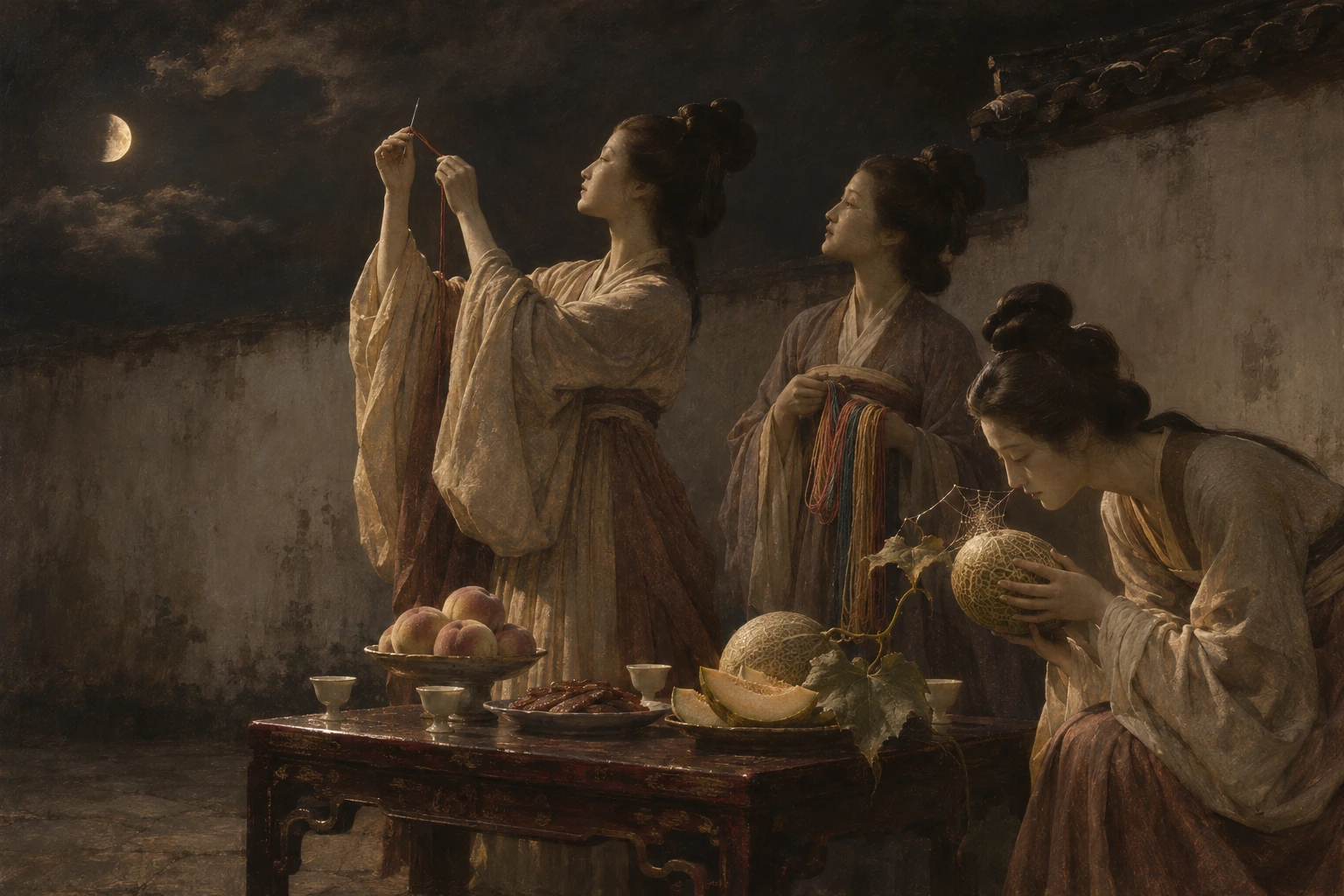
Is Qixi China’s Valentine’s Day? It is often presented that way now. For most of its history the seventh night belonged to women and girls. The Jing Chu suishi ji, written in the 6th century, says they tied coloured threads, threaded needles with seven eyes and set out wine, dried meat, melons and fruit in the courtyard to “beg for skill” (qiqiao). Writing for the China Culture Daily, Liu Lu and Zhang Cheng note that the festival is crowded with romance today “under Western influence”.
1 The Telling
Two tellings follow: the oldest full one, a passage of a few lines from about the 6th century, and the folk tale told in China in modern times. Section 2 shows where each piece first appears.
1-1 The Weaver East of the River
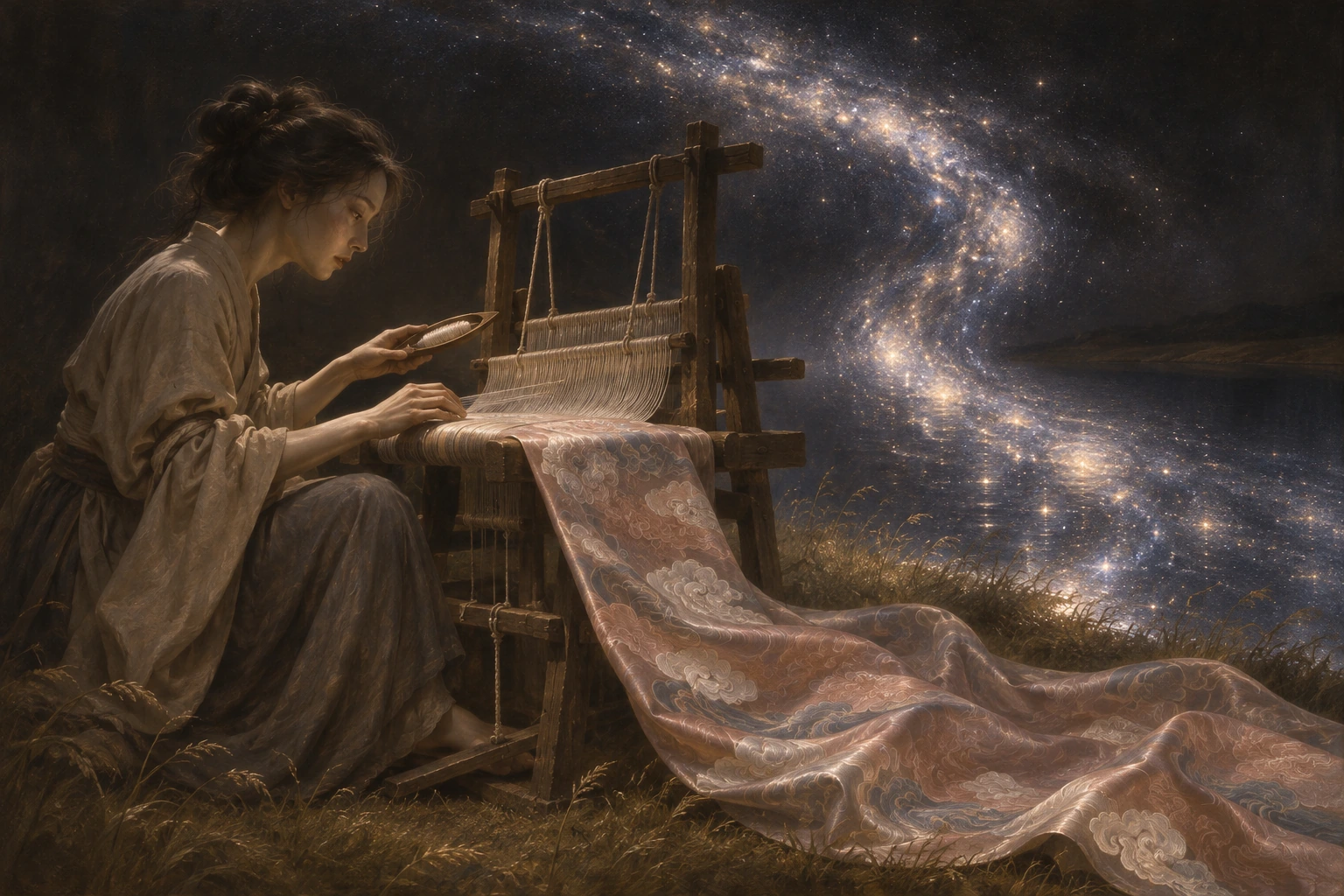
East of the River of Heaven lived the Weaver, a daughter of the Lord of Heaven. Year after year she toiled at loom and shuttle, weaving the cloud brocade that clothes heaven, and had no time to tend her looks. The Lord of Heaven pitied her for living alone and gave her in marriage to the Cowherd west of the River.
Once married, she stopped weaving. The Lord of Heaven was angry and ordered her back to the east of the River, and he let the two meet only once a year.
That is the whole passage. It does not say how she crosses.
1-2 The Bridge of Magpies
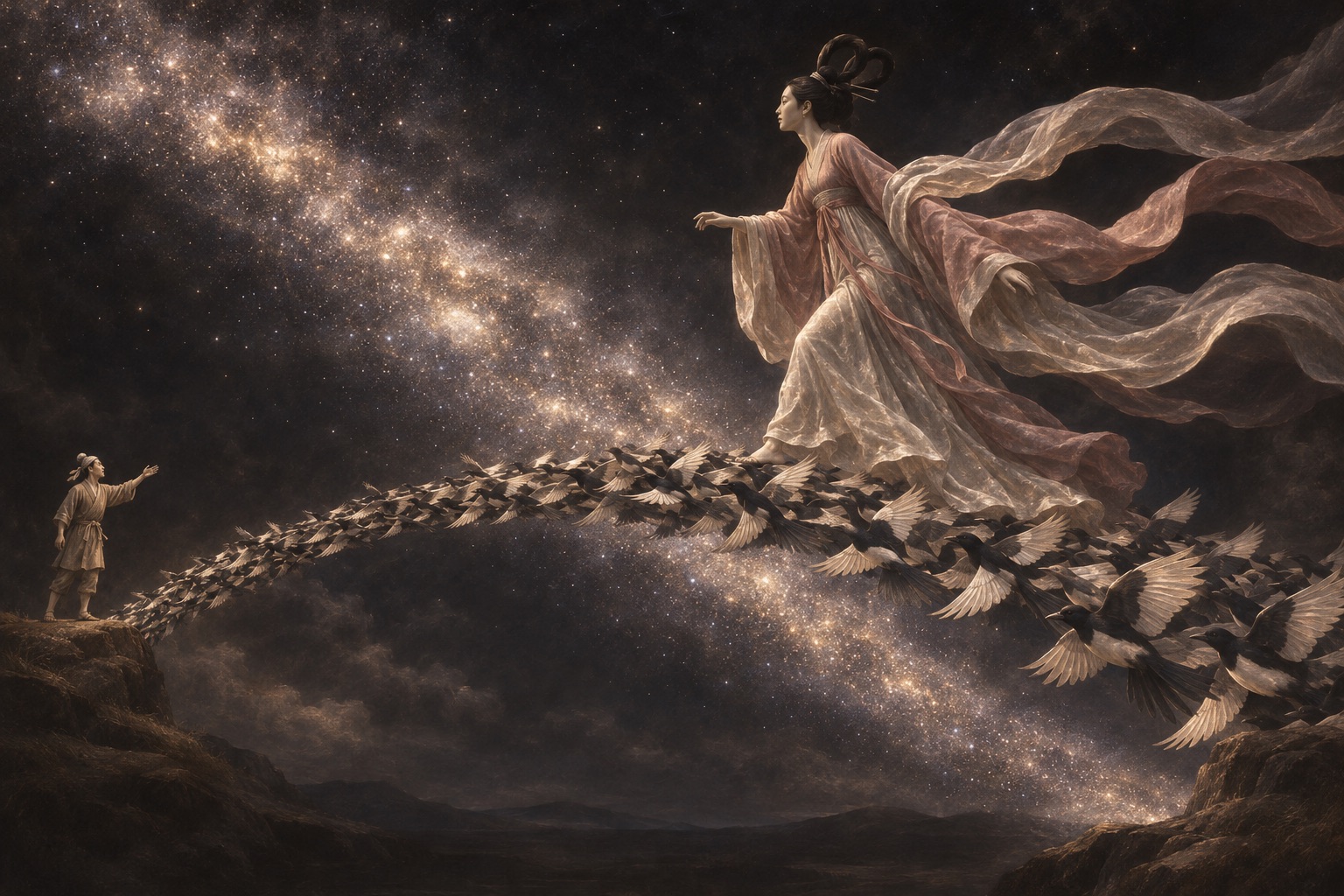
The crossing comes from other books. A sentence that Tang and later books quote from Ying Shao’s Fengsu tongyi, of the late 2nd century, says: “On the seventh night the Weaver must cross the River, and she has the magpies make a bridge.”
In the Xu Qixie ji of Wu Jun (469–520), Cheng Wuding of Guiyang, a man who had found the way of the immortals, tells his younger brother that he must leave: “On the seventh day of the seventh month the Weaver is to cross the River, and all the immortals are going back to their palaces.” Asked why she crosses, he answers: “The Weaver is going to the Cowherd for a while.” The next day he was gone, and, the story ends, “to this day people say the Weaver married the Cowherd”.
1-3 The Cowherd and the Old Ox
The folk tale told today begins on earth. A young cowherd, orphaned early, lives with his elder brother and his brother’s wife, who treat him like a servant. He keeps an old ox.
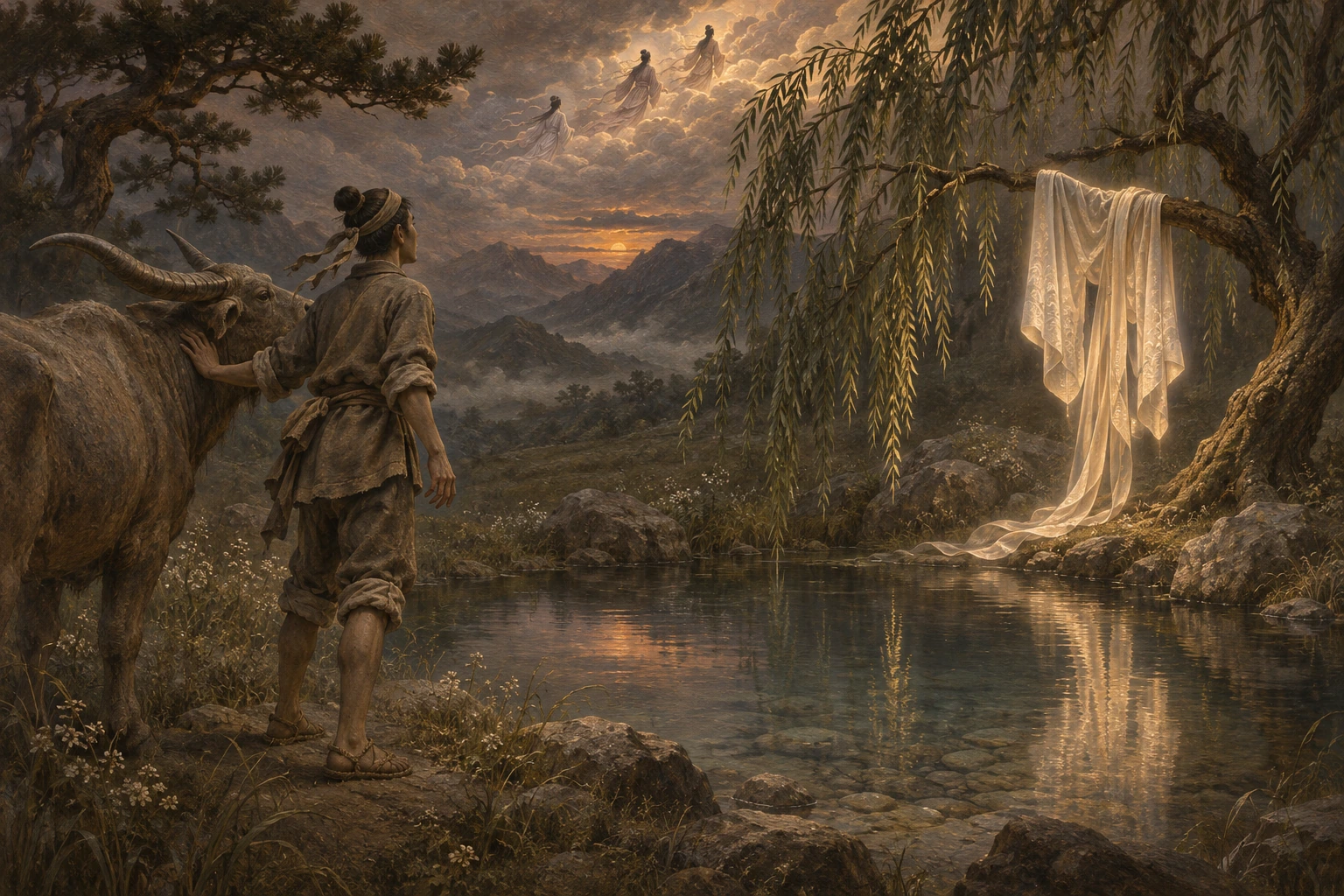
The ox can talk. It tells him that heavenly maidens come down to bathe, and that he should take the clothes of one of them. He takes the robe of the youngest, the Weaver, and she cannot fly back without it. She stays and becomes his wife, and they have two children, a boy and a girl.
1-4 The Queen Mother’s Hairpin
In this telling the Weaver is the youngest daughter of the Queen Mother of the West, called here Wangmu Niangniang. When the goddess learns of the marriage she is angry, and her soldiers take the Weaver back to heaven. The Cowherd runs after them carrying the children, helped by his ox.
To hold him back, the Queen Mother pulls the hairpin from her hair and draws a line across the sky, and the line becomes the River of Heaven. In the end she relents so far as to let them meet once a year, on the seventh night of the seventh month, when the magpies come to make the bridge.
2 Where the Story Is Written Down
- The Shijing (Book of Songs), Minor Odes, “Da dong”: an officer of the eastern states complains of the Zhou court’s demands, and finds the stars as useless as his rulers. In James Legge’s translation, the Weaving Sisters “complete no bright work for us”, and the Draught Oxen shine, “but they do not serve to draw our carts”. The stars have names; there is no story yet.
- Qin almanacs. Bamboo slips found in 1975 in a Qin tomb at Shuihudi, in Yunmeng (Hubei), include almanacs for choosing lucky days. They warn against marrying on the days wushen and jiyou: on those days “the Cowherd took the Weaver as his wife, and it did not succeed”, and “within three years” came “abandonment or flight”. Liu Lu points out that this pair is closer to the couples of early poems about abandoned wives than to faithful lovers.
- The Kunming Pond. In 120 BCE Emperor Wu of Han had a great lake dug near Chang’an to train a navy, with stone statues of the Cowherd and the Weaver on either side, as if it were the River of Heaven. Ban Gu’s “Western Capital Rhapsody” (1st century CE) shows it: “the Cowherd on the left and the Weaver on the right, like the boundless River of Heaven”. The statues still stand at Doumen, in Xi’an.
- Sima Qian’s Shiji (c. 94 BCE), in its treatise on the heavens: “The Weaver is the granddaughter of Heaven.”
- The Nineteen Old Poems, Han poems by unknown hands collected in the Wenxuan (6th century). The tenth begins: “Far, far away, the Cowherd star; bright, bright, the girl of the River Han.” She weeps at her loom, “all day she cannot finish a pattern”, and though the River is “clear and shallow”, the two “cannot speak”.
- The seventh night. The poet Fu Xuan (217–278) writes: “On the seventh day of the seventh month, the Cowherd and the Weaver meet at the River of Heaven.”
- The Jing Chu suishi ji, Zong Lin’s record of the year in the middle Yangzi region (6th century), with notes added by Du Gongzhan in the 7th, gives the festival in one line: “The seventh day of the seventh month is the night when the Cowherd and the Weaver gather.” Then come the women’s needles and offerings.
- The full telling of section 1-1 is not in that book as it survives. The Ming encyclopedia Tianzhong ji quotes it from a book it calls the Xiaoshuo, and Liu Lu attributes it to Yin Yun’s Xiaoshuo, of the Liang dynasty. The Qing rhyme dictionary Peiwen yunfu quotes the same lines as the Jing Chu suishi ji, and the encyclopedia Gujin tushu jicheng as the Yueling guangyi.
- The magpies first appear in quotations: Ying Shao’s line in section 1-2, which the surviving Fengsu tongyi lacks, and a line that Bai Juyi’s Liutie, a Tang reference book, quotes from the Huainanzi: “Crows and magpies fill the River to make a bridge and carry the Weaver across.” The editors of the Qing imperial library noted that the Huainanzi as it survives lacks this line.
- A novel. The Niulang Zhinü zhuan is credited to the Ming editor Zhu Mingshi, and a Ming printing in four books is kept in the National Library of China. In the text published online by Project Gutenberg, the talking ox, the stolen clothes and the yearly meeting are all there; when the household is divided, the boy gets nothing but the ox.
3 Competing Versions
- Why were they parted?
- In the Xiaoshuo passage, because after the wedding she stopped weaving.
- Du Gongzhan says he once saw in a “Daoist book” that the Cowherd borrowed twenty thousand cash from the Lord of Heaven for the betrothal gifts, never paid it back, and was banished to the Yingshi mansion of the sky.
- In the Gutenberg text of Zhu Mingshi’s novel, the Jade Emperor himself marries them, on condition that they keep working. They “neglect their heavenly duties”, and he orders them beheaded. Laozi has the sentence changed to separation, and later wins them one meeting a year.
- In the modern folk tale, the Queen Mother is angry at the marriage itself.
- Whose daughter? A child of the Lord of Heaven in the Xiaoshuo; the “granddaughter of Heaven” in the Shiji; the Jade Emperor’s granddaughter in the Gutenberg text of the novel; the Queen Mother’s youngest daughter in modern tellings.
- Who crosses? In the early Chinese texts, the Weaver. In the Japanese poems of the Man’yōshū it is the man who crosses, by boat (section 4).
- The stolen robe is older than the Weaver. In Gan Bao’s Soushen ji (4th century), a man of Yuzhang sees six or seven women in a field, all in feather robes. He crawls up, hides the robe one has taken off, and marries her. She bears him three daughters, learns through one of them that the robe is under the rice stack, puts it on and flies away. Kominami Ichirō writes that the folk versions with the bathing maidens join the Weaver’s story to a swan-maiden tale of this kind.
- Doubters. The Song scholar Wang Guanguo called the Weaver’s crossing a popular invention with “no foundation”, and the magpie bridge “bizarre and not to be believed”.
- Was the Cowherd a hero? In tellings recorded before 1949, writes the folklorist Qi Lingyun (as summed up by the journalist Pan Wenjie), the marriage is forced through the stolen robe: the wife looks for her robe so she can leave, and the couple quarrel and even fight. In Ye Shengtao’s retelling, the one taught in Chinese schools, the Cowherd hands the robe back of his own accord.
4 History and Tradition
- Begging for skill. The Jing Chu suishi ji has women thread needles with seven eyes, of gold, silver or brass. If a little spider spun its web over the melons, that was a good sign. The Xijing zaji, a book of anecdotes about the Han capital, says that the palace women of Han threaded seven-eyed needles on the seventh day of the seventh month. Zhou Chu’s Fengtu ji, quoted in Du Gongzhan’s notes, adds that those who kept watch that night made a secret wish, and that seeing a white glow in the River brought luck.
- Tears and rain. A Shandong gazetteer quoted in the Gujin tushu jicheng says that on the seventh the Weaver goes to her wedding and the Cowherd weeps, “and his many tears become rain”.
- Shrines. At Yiyuan, Shandong, a stele of 1579 tells how a hall for the Cowherd was built facing the Weaver’s cave across the river. In Fujian and Taiwan the Weaver is worshipped as Qiniangma, guardian of children, and sixteen-year-olds give thanks to her on the seventh as they come of age. The legend entered China’s national list of intangible heritage in 2008.
- Japan. The court adopted the Chinese festival, the kikkōden, in the Nara period. Book 10 of the Man’yōshū has 98 Tanabata poems (nos. 1996–2093). They write the Chinese names but read them in Japanese: Hikoboshi, and tanabata-tsume, “the weaving maid”. One reads: “Hikoboshi and the weaving maid meet tonight: waves at the river crossing, do not rise.” Kojima Noriyuki explains that a woman travelling to her lover did not fit Japanese custom, so the crossing passed to Hikoboshi. Orikuchi Shinobu, as Nipponica reports, traced tanabata-tsume to a maiden who waited for a god in a loom hut by the water. Paper strips hung on bamboo spread in Edo times. Today the stars are Orihime and Hikoboshi.
- Korea. In a Goguryeo tomb at Deokheung-ri, dated 408, the Milky Way runs between the Cowherd, leading his ox, and the Weaver, followed by a dog. In the Korean tale of Gyeonu and Jiknyeo, the crows and magpies make the bridge with their heads, so they come back bald after Chilseok. Rain on the seventh is the couple’s tears of joy; rain the next morning, their tears of parting.
- Vietnam. In the 16th-century Truyền kỳ mạn lục, Từ Thức tells his fairy wife that even the heavens have marriages: the Weaver married the Cowherd. Trương Vĩnh Ký, travelling in the north in 1876, noted the heavy rains early in the seventh month, “called mưa ngâu” after the Weaver crossing the Silver River. The poet Tú Xương mocked “heaven’s child marrying a buffalo herd”. The bridge is cầu Ô Thước, from the Chinese for “crows and magpies”, and in 1928 Phan Khôi published a satirical ballad in which the crows, “the people of Ô Thước”, go on strike against bridge duty.
- The stars. The ancient glossary Erya says that “Hegu”, the River Drum, “is called Qianniu”: Altair with a fainter star on each side. Wang Kechao of the Purple Mountain Observatory compares the three to the Cowherd’s shoulder pole, and the faint stars around Vega to the Weaver’s shuttle. The two are about sixteen light-years apart.
It is often said that the pair were punished for falling in love. Not in the oldest telling: there the Lord of Heaven arranges the marriage himself, and parts them because the Weaver stops weaving. Even the novel credited to Zhu Mingshi, in its Gutenberg text, has the Jade Emperor grant the match. A goddess angry at the marriage itself belongs to the modern folk tale, and Qi Lingyun, in a study a news report sums up, argues that the Queen Mother became the couple’s persecutor after 1949, to give the tale an anti-feudal message.
5 Related Stories
- Từ Thức: The Man Who Married a Fairy: in Nguyễn Dữ’s tale, Từ Thức cites the Weaver and the Cowherd to tease his fairy wife: if the Weaver could marry the Cowherd, the immortals have marriages too.
- The Jade Emperor: The Ruler of Heaven: in the Gutenberg text of Zhu Mingshi’s novel the Weaver is the Jade Emperor’s granddaughter, and he is the one who marries the pair and later parts them.
- Kunlun: The Mountain of the Immortals: the mountain of the Queen Mother of the West, who in the modern folk tale draws the River of Heaven with her hairpin.
- Hou Yi and Chang’e: The Archer Who Shot the Suns and the Woman in the Moon: the other woman of the Chinese night sky. On Qixi girls asked the Weaver for skill; at Mid-Autumn, Song girls prayed to look like Chang’e. We link them for the theme.
6 Sources
- Shijing, Minor Odes, “Da dong”: Wikisource; trans. James Legge, The Shih King (Sacred Books of the East 3, 1879): Project Gutenberg
- “Tiaotiao Qianniu xing”, tenth of the Nineteen Old Poems (Wenxuan, juan 29): Wikisource; Ban Gu, “Xidu fu”: Wikisource; Xijing zaji, juan 1: Wikisource
- Sima Qian, Shiji, juan 27, “Tianguan shu”, with its commentaries: Wikisource
- Zong Lin, Jing Chu suishi ji, with Du Gongzhan’s notes: Wikisource
- Quotations of the Xiaoshuo, the Fengsu tongyi, the Xu Qixie ji and the Zhucheng gazetteer: Chen Yaowen, Tianzhong ji, juan 2; Peiwen yunfu, juan 26; Gujin tushu jicheng, “Shenyi dian” 19 and “Qianxiang dian” 62: Wikisource, Wikisource, Wikisource, Wikisource
- Bai Kong liutie, juan 9; the Siku catalogue on the Huainanzi; Wang Guanguo, Xuelin, juan 4: Wikisource, Wikisource, Wikisource
- Gan Bao, Soushen ji, juan 14 (Ming Mice huihan edition): Wikisource
- Zhu Mingshi, Niulang Zhinü zhuan: Project Gutenberg; the Ming printing reprinted in Guben xiaoshuo jicheng (Shanghai guji, 1990): NDL
- Liu Lu and Zhang Cheng, China Culture Daily, 17 August 2018: ihchina.cn; Ye Tao (2020): ihchina.cn; national list, no. 523: ihchina.cn
- Pan Wenjie, Jiemian, 25 August 2020, citing Qi Lingyun: jiemian.com; David K. Jordan, “The Cowherd and the Weaving Maid”: UCSD; Xinhua, 27 August 2025: news.cn
- Man’yōshū, book 10: Japanese Wikisource; Kominami Ichirō, Kojima Noriyuki and others, “七夕”, “牽牛織女”, “乞巧奠”, “彦星”, Sekai Daihyakka Jiten, Nipponica: Kotobank, Kotobank, Kotobank, Kotobank
- Encyclopedia of Korean Culture, “견우직녀 설화”: encykorea
- Nguyễn Dữ, Truyền kỳ mạn lục, trans. Trúc Khê: Vietnamese Wikisource; Trương Vĩnh Ký, Chuyến đi Bắc Kỳ năm Ất Hợi 1876 (1881): Wikisource; Trần Tế Xương, “Vợ chồng Ngâu”: Wikisource; Phan Khôi, “Dân quạ đình công”: Wikisource
Cover and illustrations: AI-generated images made for Arcana. They are interpretations, not historical artworks.