The Chinese Dragon: The Long, Bringer of Rain and Emblem of Emperors
The oldest Chinese dictionary says the long can be dark or bright, tiny or huge, and climbs to heaven at the spring equinox. It brought the rain, became the emperor's sign and gave East Asia its dragon kings, and English calls it, not quite rightly, a dragon.
- Type: a creature of myth and worship: the chief of the scaled creatures, bringer of rain, emblem of emperors
- Culture: China; shared across East Asia, as ryū in Japan and rồng in Vietnam
- Earliest texts: the character 龍 on Shang oracle bones; the Zhouyi and the Guanzi; the classic definition in Xu Shen’s Shuowen jiezi (100 CE). Older still is a dragon of shells in a grave at Xishuipo, some 6,500 to 6,300 years old
- Key figures: the Dragon Kings, the dragon princess of Lake Dongting, Lord Ye, the painter Zhang Sengyou, the carp of the Dragon Gate
Ask the oldest Chinese dictionary what a long (龍) is, and it answers with a riddle: it can be dark or bright, tiny or huge, short or long; at the spring equinox it climbs into the sky, and at the autumn equinox it sinks into the deep. The long lived in the water and brought the rain, people prayed to it in every drought, and in time it became the sign of the emperor. English calls it a dragon, and that is where the misunderstandings begin.
How does it fly without wings? By its own nature, the old books say. The Shuowen jiezi sends it up to heaven at the spring equinox and explains that the character itself contains “the shape of flying”. The Song scholar Luo Yuan adds a lump on its head, shaped like a mountain-shaped incense burner, called the chimu: “without a chimu, a dragon cannot rise to heaven”. A few dragons do have wings. Guo Pu, the 4th-century commentator of the Classic of Mountains and Seas (Shanhaijing), calls the Yinglong “a dragon that has wings”.
1 The Telling
The long has no single story. Here are its portrait in the old books and four of its best-known tales, each from its oldest source.
1-1 The Chief of the Scaled Creatures
Xu Shen finished his dictionary, the Shuowen jiezi, in 100 CE. Under 龍 he wrote: “Chief of the scaled creatures. It can be dark, it can be bright; it can be small, it can be huge; it can be short, it can be long. At the spring equinox it climbs to heaven; at the autumn equinox it sinks into the abyss.” The Guanzi, a collection of writings from the Warring States to the Han, explains these powers by water. “The dragon is born in water”, and swims clad in five colours. “If it wants to be small, it becomes like a silkworm; if it wants to be large, it can hold the whole world; if it wants to rise, it rides above the clouds; if it wants to sink, it enters the deepest springs.” It changes on no set day and rises and falls at no set time, “and so it is called divine”.
The Zhouyi, the core of the Book of Changes, opens with dragons. The first hexagram, Qian, moves from a “hidden dragon” that must not act, to a dragon “seen in the field”, to a “flying dragon in the sky”, to an “overreaching dragon” that “will have regrets”. One of its commentaries adds a line every Chinese reader knows: “Clouds follow the dragon, wind follows the tiger.”
1-2 Nine Resemblances
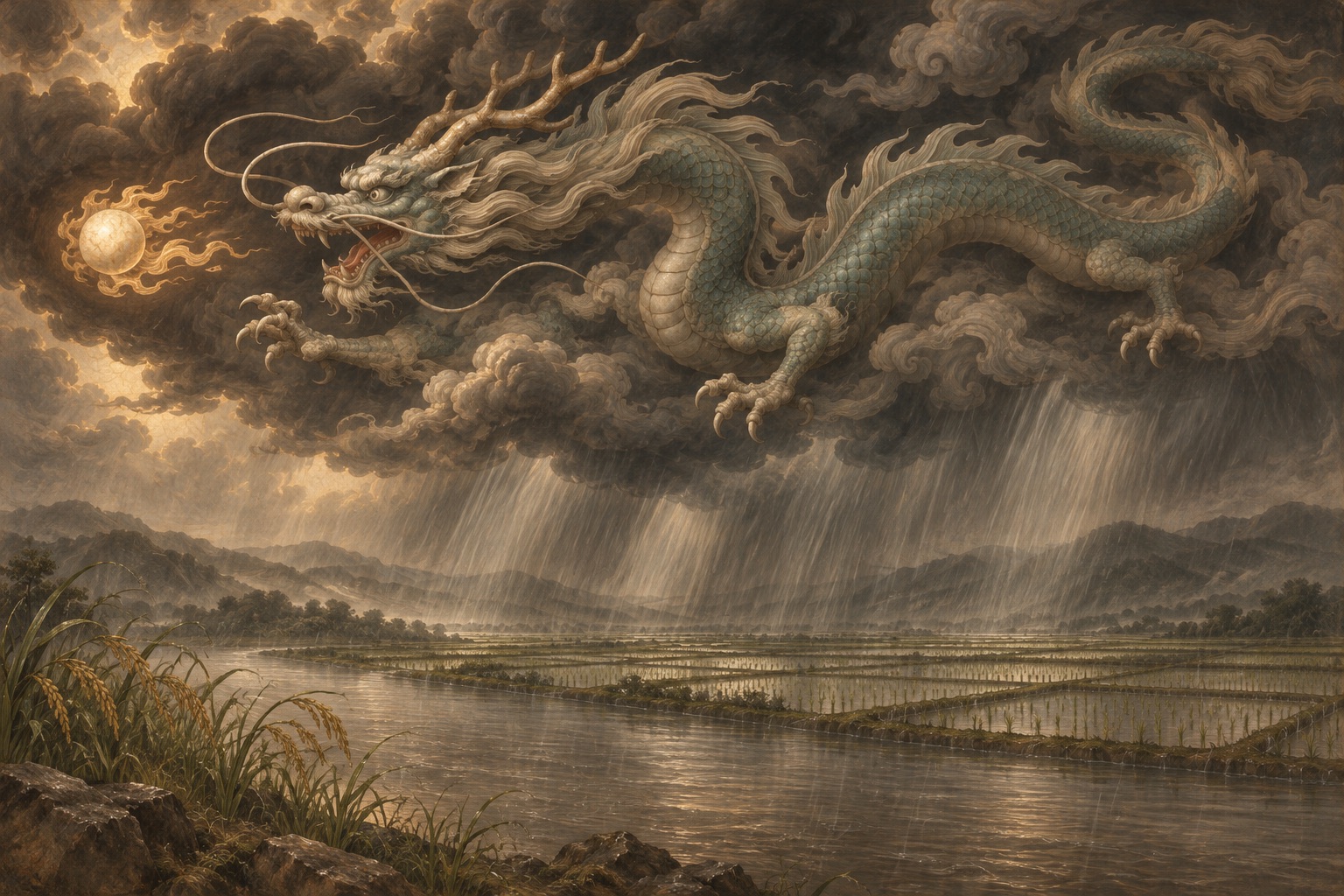
What does a long look like? The Song scholar Luo Yuan, in his Erya yi, cites the 2nd-century writer Wang Fu: popular paintings give the dragon “a horse’s head and a snake’s tail”. Then he gives “the saying of three sections and nine resemblances”. The body falls into three equal lengths, and it resembles nine creatures: horns like a deer’s, head like a camel’s, eyes like a demon’s, neck like a snake’s, belly like a shen (a giant clam), scales like a fish’s, claws like a hawk’s, palms like a tiger’s, ears like an ox’s. Luo Yuan knows its habits too. It is fierce, but afraid of iron; it loves jade and likes roast swallow, so a man who has eaten swallow should not cross the sea. Its breath becomes clouds, and the clouds hide it, which is why people only ever glimpse a claw or a tail. And there are two kinds of rain: fine, soaking rain is heaven’s, and violent rain is the dragons’.
1-3 The Dragon Princess of Lake Dongting
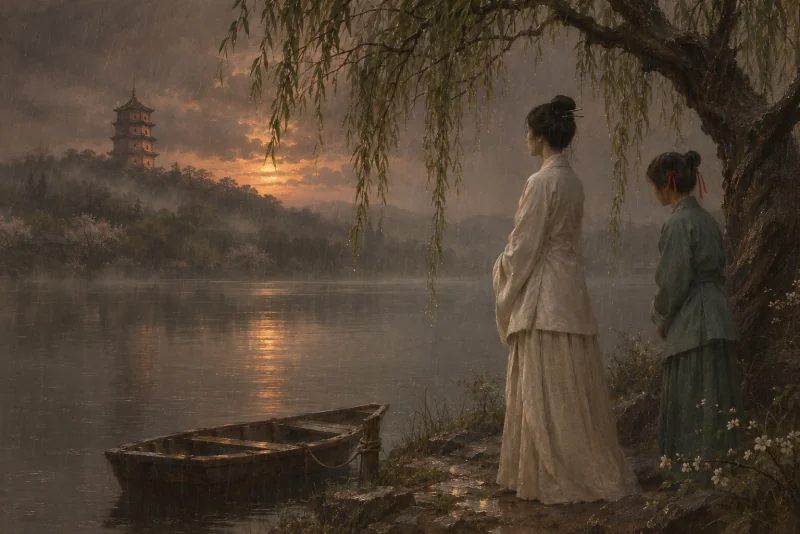
The Tang tale of Liu Yi, by Li Chaowei, is set in the Yifeng era (676–679). Liu Yi, a scholar who had just failed the examinations, was riding home when his horse bolted off the road. Where it stopped, a young woman of rare beauty was herding sheep, her brows knit and her clothes faded. She was, she said, the youngest daughter of the Dragon Lord of Lake Dongting, married to the second son of the lord of the Jing River. Her husband had tired of her, his parents took his side, and they had sent her out to the roadside. Would he carry a letter to her father? On the south shore of the lake stood a great orange tree: he should change his belt and knock on it three times. “What are the sheep for?” he asked. “They are not sheep,” she said. “They are rain-workers,” kin of the thunder. They walked with angry steps and glaring looks, though in size, wool and horns they were like any sheep.
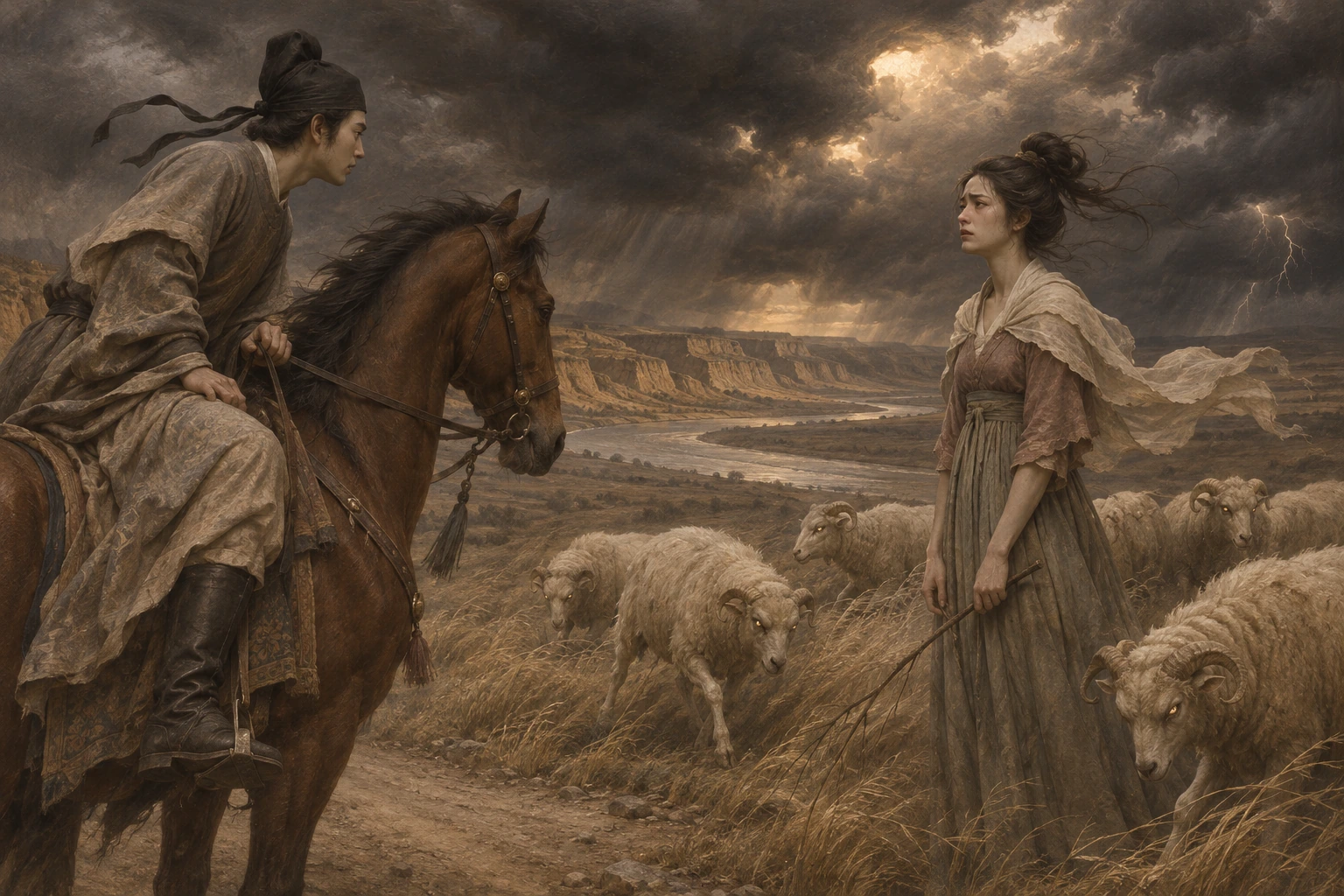
Liu Yi knocked, and a warrior rose from the waves and led him down to a hall with pillars of white jade, steps of green jade, beds of coral and curtains of crystal. The Dragon Lord read the letter and wept, and begged his court to keep quiet so that his brother, the Lord of Qiantang, would not hear: one fit of this brother’s anger, he said, had flooded the land for nine years in the time of Yao, and he was kept chained here. Too late. With a roar that shook the palace, a red dragon more than a thousand chi long, with eyes like lightning, a tongue like blood and a mane of fire, burst out dragging its golden chain and the jade pillar it was tied to, and flew off into the sky amid thunder, snow and hail.
He was back the same day, with his niece. He had killed six hundred thousand people and laid waste the crops for eight hundred li; as for the husband, “I have eaten him”. His brother told him he had been too hasty. When the Lord of Qiantang pressed Liu Yi to marry the princess, Liu Yi refused: it would not be right, he said, to kill a husband and then take his wife. He went home rich, married twice and was twice widowed. His third wife, a widow of the Lu family, told him after their son was born that she was the dragon princess. “Dragons live ten thousand years,” she said, “and now you will share it.”
1-4 Lord Ye Who Loved Dragons
Liu Xiang (77–6 BCE) tells this one in his Xinxu as a parable. Confucius’s disciple Zizhang waited seven days for Duke Ai of Lu to receive him, then left with a message: the duke loved scholars the way Lord Ye loved dragons. Lord Ye, Zigao, had dragons drawn and carved on everything he owned, and all over the rooms of his house. A real dragon heard of it and came down. It peered in at the window and trailed its tail across the hall. Lord Ye took one look and ran, out of his wits and white in the face. “Lord Ye did not love dragons. He loved what looked like a dragon but was not one.”
1-5 Dotting the Eyes
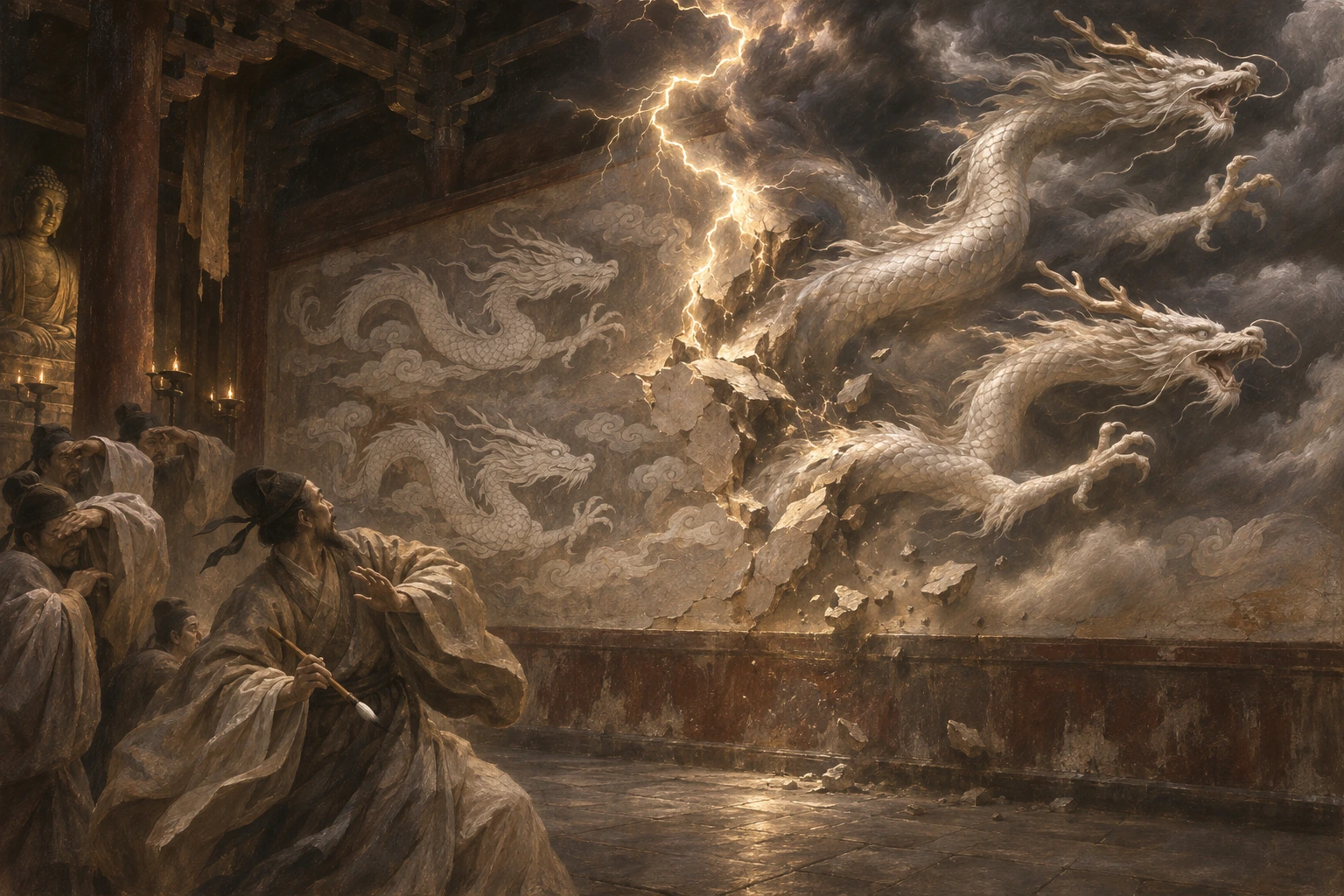
Zhang Yanyuan’s history of painting, the Lidai minghua ji (about 847), tells of Zhang Sengyou, a court painter of Emperor Wu of Liang in the early 6th century. At the Anle temple in Jinling, today’s Nanjing, he painted four white dragons without pupils in their eyes. “If I dot the eyes,” he kept saying, “they will fly away.” People called it nonsense and insisted that he do it. He dotted two. Moments later thunder and lightning broke the wall, and the two dragons rode the clouds up into the sky. The two without eyes, says Zhang Yanyuan, are still there.
1-6 The Carp at the Dragon Gate
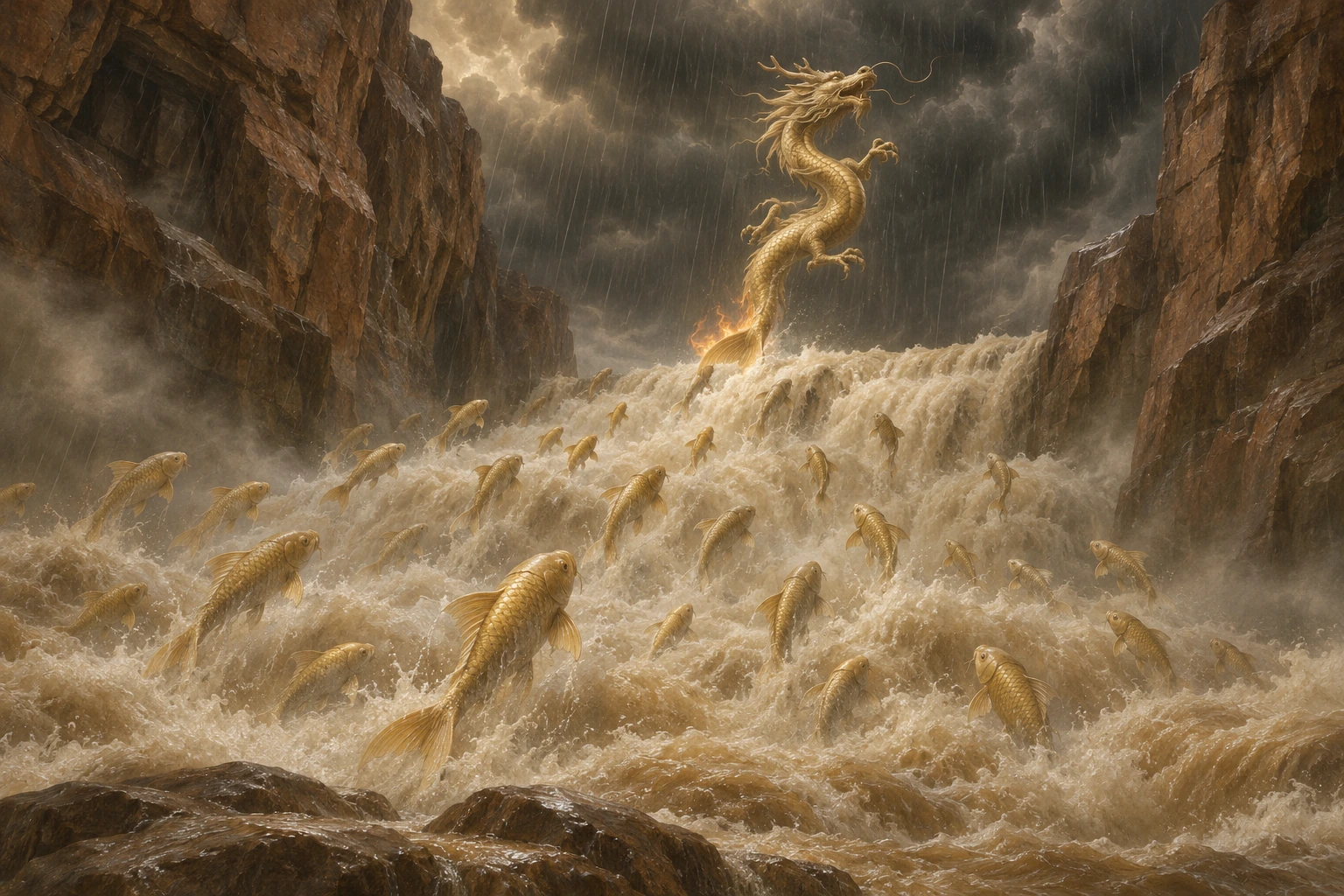
The Sanqin ji, a lost record of the land of Qin, is quoted in the 10th-century compendium Taiping guangji. At the Dragon Gate, where Yu cut through the mountain and the Yellow River pours down through a gap a li wide, “every late spring yellow carp swim upstream, and those that make it become dragons”. No more than seventy-two get through in a year. As they climb, clouds and rain follow them, fire from heaven burns their tails behind them, and they are dragons. The Tang commentary on the Hou Hanshu quotes the same book to explain a saying of the 2nd century. Li Ying (110–169) was an official so upright that any scholar he agreed to receive was said to have “climbed the Dragon Gate”.
2 Where the Story Is Written Down
- Before writing. At Xishuipo in Puyang (Henan), archaeologists working in 1987 found grave M45: a tall man laid out between a dragon and a tiger made of mussel shells, the dragon, 1.78 m long, on his right. Radiocarbon puts the shell figures at about 6,500 to 6,300 years ago, in the Yangshao culture, writes the archaeologist Wei Xingtao. The jade dragons of the Hongshan culture in the northeast, from about 6,500 to 5,000 years ago, come in two kinds: a C-shaped body with a deer-like head and a long mane, and a curled ring with the head of a pig or, some scholars now say, of a bear. The largest C-shaped one, from Sanxingtala in Ongniud Banner, now in the National Museum of China, has “no horns, no limbs, no claws”.
- Oracle bones. On the Shang divination bones 龍 already appears, as the name of states and clans. Kominami Ichirō notes that the oracle-bone character wears an antenna-like ornament on its head, which later became the chimu.
- The Zhouyi and its commentaries, for the dragons of hexagram Qian, and the Guanzi, “Shuidi” (“Water and Earth”), for the dragon born in water (section 1-1).
- The Shanhaijing, “Dahuang dongjing”: the Yinglong killed Chiyou and Kuafu and could not go back up to heaven, so droughts are frequent below; “in a drought, make the image of the Yinglong, and heavy rain comes”. Guo Pu’s commentary adds that “today’s earthen dragons come from this”. The Yinglong’s war is told in The Yellow Emperor.
- The Chunqiu fanlu, attributed to the Han scholar Dong Zhongshu but holding later chapters: in “Qiuyu” (“Seeking Rain”), dragons of earth for every season (section 4).
- Liu Xiang’s Xinxu (1st century BCE): Lord Ye. Xu Shen’s Shuowen jiezi (100 CE): the definition.
- Buddhist sutras. Chinese translators rendered the Indian nāga, a serpent being of the waters, as long. In Kumārajīva’s Lotus Sutra (406), eight dragon kings, Nanda, Upananda, Sāgara and others, come to hear the Buddha, and in chapter 12 Sāgara’s eight-year-old daughter appears before the assembly and attains buddhahood.
- Two Tang works. Li Chaowei’s “Liu Yi”, kept in the Taiping guangji, book 419, from an older collection, the Yiwen ji; and Zhang Yanyuan’s Lidai minghua ji (about 847), book 7, for Zhang Sengyou.
- Luo Yuan’s Erya yi (Song), a companion to the old dictionary Erya. Its book 28 opens its section on fishes with the dragon.
3 Competing Versions
- Whose nine resemblances? The list is usually credited to Wang Fu. But Luo Yuan cites Wang Fu only for the “horse’s head and snake’s tail” of popular paintings, then writes “there is also the saying of three sections and nine resemblances”, which can be read as Wang Fu’s words or as a separate saying. Either way, the list comes down to us through Luo Yuan.
- A demon’s eyes or a rabbit’s? Luo Yuan gives a camel’s head, a demon’s eyes, a clam’s belly and a fish’s scales. Lists repeated today change them: a feature on the Vietnamese dragon in Nhân Dân gives a tiger’s head, a rabbit’s eyes, a frog’s belly and a carp’s fins.
- How many claws? A Yuan law of 1314 defines the dragon by five claws and two horns. The dragons of Vietnam’s Lý dynasty have three, four or five, and the Hongshan jade has no limbs at all.
- Snake, alligator or both? In 1946 the poet and scholar Wen Yiduo argued that the long began as a snake totem that took in the animals of conquered tribes. In 1957 the palaeontologist Yang Zhongjian looked to the alligator, and the archaeologist Zhu Naicheng sees an alligator behind the Xishuipo shells; Li Ling of Peking University takes the long for a blend of reptiles. So Yuan Jing sums up the debate in Sixth Tone. Kominami Ichirō adds the pig, for its snout, and even the whirlwind.
- Two “first dragons”. The shell dragon of Xishuipo is called “the first dragon of Huaxia” (華夏第一龍), and the Sanxingtala jade “the first dragon of China” (中華第一龍). Both titles are in use.
- Which four kings? The Journey to the West names the Dragon Kings of the four seas Ao Guang (敖廣), Ao Qin, Ao Shun and Ao Run. The Fengshen yanyi, in the chapters on Nezha, names them Ao Guang (敖光), Ao Shun, Ao Ming and Ao Ji.
- Four dragons or two? In the Lidai minghua ji Zhang Sengyou paints four and dots two. The Nipponica encyclopedia, citing a book called Shuiheng ji, has him paint two and dot one.
4 History and Tradition
- Dragons of earth for rain. The “Qiuyu” chapter of the Chunqiu fanlu gives the rite season by season. In a spring drought, on the days jia and yi, make one great blue-green dragon eight zhang long for the centre and seven small ones of four zhang, all facing east, and let eight boys who have fasted three days dance in green. In summer the dragon is red, at the end of summer yellow, and every dragon is made “of clean earth”. The Song shi records that in a drought of 999 the court sent out Li Yong’s Method of Praying for Rain: a green dragon of earth on an altar, “sent into the water” once enough rain had fallen. In 1006 it printed a second method, a white dragon breathing black clouds painted on silk, to be thrown into the water after three days of good rain. The dragon gods who answered such prayers were given titles, says the same history, more than could be recorded.
- The Dragon Kings. With Buddhism, the nāga kings, guardians of the Buddha’s teaching who live in the water and raise clouds and rain, merged with the native long. Kominami Ichirō sees in this the origin of the Dragon Kings of the four seas, and of the dragon kings and dragon princesses of Chinese fiction and drama. By the Journey to the West (Xiyou ji, 1592) they have names: Ao Guang, Dragon King of the Eastern Sea, in his crystal palace, and his brothers Ao Qin, Ao Shun and Ao Run of the southern, northern and western seas.
- The emperor’s dragon. Sima Qian’s Shiji says the mother of Liu Bang, founder of the Han, was resting by a great marsh when the sky went dark with thunder and lightning, and his father saw a dragon above her; soon she was with child. Liu Bang himself had “a dragon face”. A Yuan law of 1314 forbade every subject, whatever his rank, to wear dragon or phoenix patterns, and specified: “dragon means one with five claws and two horns”. The dragon was the most important of the twelve emblems on the emperor’s ritual robes, writes Kominami.
- Boats and silk threads. At the Duanwu festival dragon boats race, and in the second month a festival wakes the dragons that slept through the winter (Kominami). Luo Yuan explains a custom of the same festival: dragons fear the leaves of the chinaberry tree and five-coloured silk, so since the Han the offerings made to the poet Qu Yuan are tied with both.
- Japan. The long became the ryū, and Japanese folklore often makes it one with the snake and the water god, writes Nomura Jun’ichi: rain was prayed for at ponds where a dragon lived, and its palace under the sea, the Ryūgū, is the one Urashima Tarō visits in the later tellings. Two of the tales above live on as everyday Japanese words: tōryūmon, “climbing the Dragon Gate”, for the hard first step to success, and garyō tensei, “dotting the dragon’s eyes”, for the finishing touch.
- Vietnam. The long is the rồng. When Lý Thái Tổ moved his capital in 1010, his edict praised the site for its “coiled dragon, crouching tiger” lie of the land, and the Đại Việt sử ký toàn thư says that as his boat moored below the citadel a yellow dragon appeared beside it, so he named the city Thăng Long, “Rising Dragon”. Lý-period dragons are slender and smooth like snakes, coiling in many gentle waves, with a flame-shaped crest. And the carp that becomes a dragon carries the kitchen gods to heaven at the end of every year (Táo Quân).
“The long is not a dragon at all” is often said. In December 2006 it became a public argument in China, when a Shanghai professor warned that dragon emblems “easily induce misunderstanding” abroad and readers answered that the English word should change, not the creature. Some writers now spell it “loong”. The difference is real: the Western dragon takes its name from the Greek drakōn, “serpent”, and is usually a monster for a hero or a saint to kill, while the long brings rain. But it is a difference of emphasis. The long can destroy, as the Lord of Qiantang shows; Guo Pu gives the Yinglong wings; and in the West, too, a dragon can be an emblem rather than a monster: Wales flies a red dragon on its flag, from a story of its own that owes nothing to the long. The sinologist Victor Mair finds the two close enough for each name to translate the other.
5 Related Stories
- Lạc Long Quân and Âu Cơ: The Dragon, the Fairy and the Hundred Eggs: the Dragon Lord of the Việt is the grandson of the Dragon King of Động Đình, Lake Dongting. As that post explains, the historian Liam Kelley hears in the Dragon King’s daughter an echo of a Tang tale of the Dongting dragon. The best known of those tales is the story of Liu Yi told here.
- Sun Wukong: The Monkey King Who Fought Heaven: the iron staff that Sun Wukong carries comes from the crystal palace of Ao Guang, Dragon King of the Eastern Sea.
- Nezha: The Boy God Who Gave Back His Flesh: in the Fengshen yanyi the boy kills Ao Bing, third son of the Dragon King of the Eastern Sea, and the four Dragon Kings seize his parents.
- Urashima Tarō: The Fisherman Under the Sea: the Dragon Palace under the sea, which Japanese folklore made its own. Nomura Jun’ichi calls Urashima the best-known of the tales in which a man visits it, and, as that post explains, an early Japanese telling already borrows from the tale of Liu Yi.
6 Sources
- Xu Shen, Shuowen jiezi, book 11, the radical 龍: Wikisource
- Guanzi, “Shuidi”: Wikisource; Zhouyi, hexagram Qian, with its commentaries: Wikisource
- Shanhaijing, “Dahuang dongjing”, with Guo Pu’s commentary (Siku quanshu text, book 14): Wikisource
- Chunqiu fanlu, “Qiuyu” (chapter 74): Wikisource; Liu Xiang, Xinxu, “Zashi” 5: Wikisource
- Sima Qian, Shiji, book 8, “Gaozu benji”: Wikisource; Fan Ye, Hou Hanshu, book 67, biography of Li Ying, with its Tang commentary quoting the Sanqin ji: Wikisource
- Lotus Sutra, trans. Kumārajīva, chapters 1 and 12: Wikisource, Wikisource
- Li Chaowei, “Liu Yi”, and the Sanqin ji on the Dragon Gate, in the Taiping guangji, books 419 and 466: Wikisource, Wikisource
- Zhang Yanyuan, Lidai minghua ji, book 7: Wikisource; Luo Yuan, Erya yi, book 28 (Siku quanshu text): Wikisource
- Song shi, books 102 and 105; Yuan shi, book 78; Xiyou ji, chapter 3; Fengshen yanyi, chapters 12 and 13: Wikisource, Wikisource, Wikisource, Wikisource, Wikisource, Wikisource
- Ngô Sĩ Liên and others, Đại Việt sử ký toàn thư, Bản kỷ, book 2 (Classical Chinese text): Wikisource
- Wei Xingtao, “河南西水坡蚌龙图案的实证价值”, Xuexi shibao, reprinted by CSSN, 29 December 2020: cssn.cn; Fu Yu, “红山文物讲述考古故事”, Renmin zhengxie bao, 5 November 2020, reprinted by CSSN: cssn.cn
- Yuan Jing, “The Long Debate Over China’s Most Potent Symbol”, Sixth Tone, 15 February 2024: sixthtone.com; Victor H. Mair, “What is the difference between a dragon and a /lʊŋ³⁵/?”, Language Log, 10 February 2024: languagelog.ldc.upenn.edu; Guo Qiang, “Dragon on its way to extinction”, China Daily, 4 December 2006: web.archive.org
- Ngữ Thiên and Tuyết Loan, “Rồng Việt: linh thiêng huyền ảo và lung linh gần gũi”, Nhân Dân, 1 February 2024: nhandan.vn
- “竜” (Kominami Ichirō and Aramata Hiroshi in Sekai Daihyakka Jiten; Nomura Jun’ichi in Nipponica), “竜王” (Sekiguchi Masayuki), “画竜点睛”, “登竜門”, “柳毅伝”: Kotobank, Kotobank, Kotobank, Kotobank, Kotobank
Cover and illustrations: AI-generated images made for Arcana. They are interpretations, not historical artworks.