Nezha: The Boy God Who Gave Back His Flesh
A boy kills the Dragon King's son, gives his flesh and bones back to his parents to spare them, and returns in a body made of lotus. Two Ming novels made him famous, but the boy god had reached China centuries earlier, with Buddhism, from India.
- Type: myth and cult of a child god; a Buddhist guardian who became a hero of Chinese novels and a god of popular religion
- Culture: China, from the Tang dynasty on; worshipped today in Taiwan and Fujian, among other places; Na Tra in Vietnam
- Earliest texts: Buddhist translations naming Nalakūbara, son of the Heavenly King Vaiśravaṇa (from the 5th century); Tang ritual manuals attributed to Amoghavajra (8th century); a Chan question recorded in the Jingde chuandeng lu (1004); the full story in the Xiyou ji (1592) and the Fengshen yanyi (late Ming)
- Key figures: Nezha (哪吒, earlier 那吒), his father Li Jing, his mother Lady Yin, his teacher Taiyi Zhenren, Ao Bing and his father Ao Guang, the Dragon King of the Eastern Sea, the Daoist Randeng
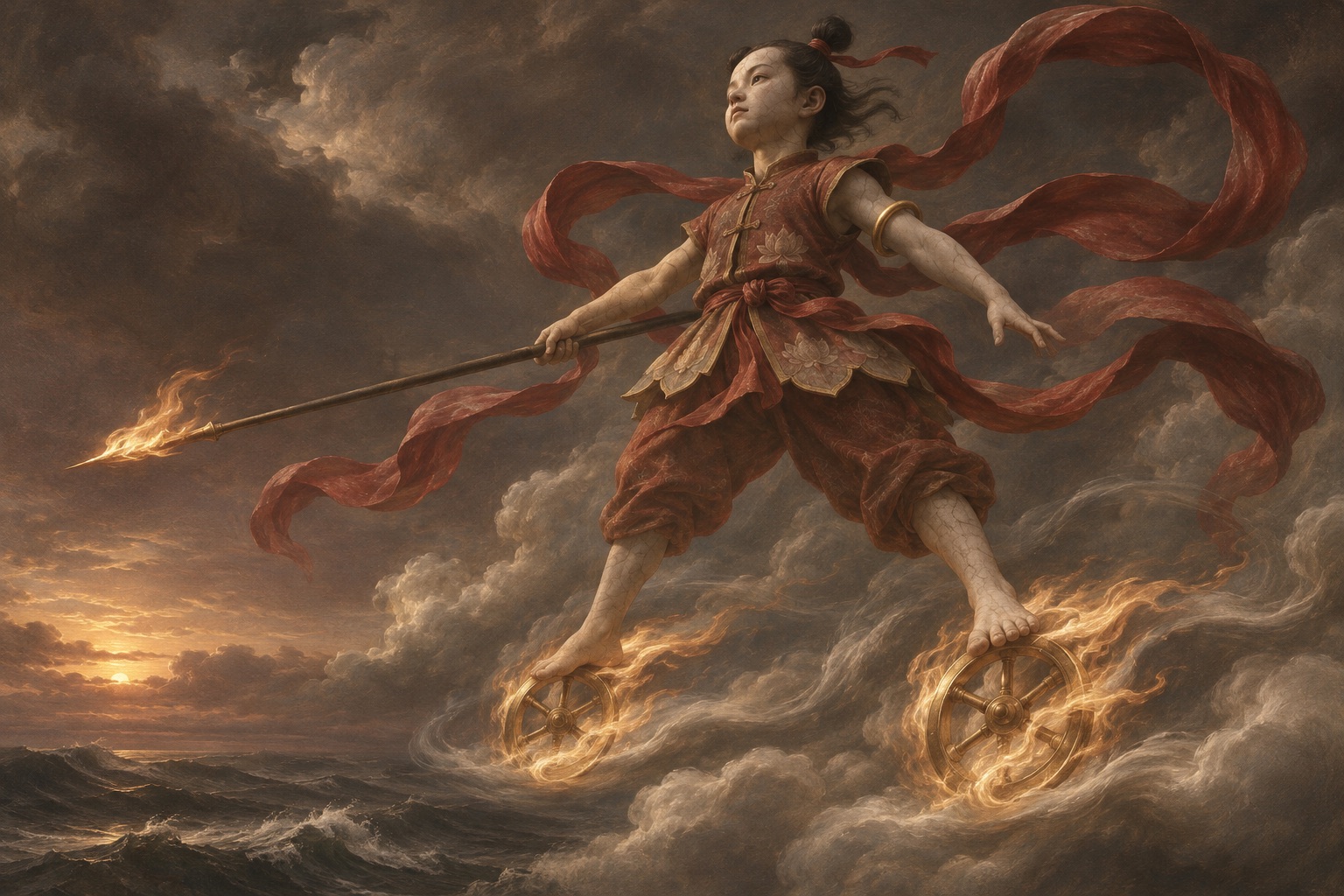
In temples he is a child with a red silk sash and a golden ring, a spear tipped with fire in his hand and a wheel of wind and fire under each foot. His story is one of the strangest any god has: a boy kills a dragon prince, takes his own life so that his parents will be spared, comes back in a body of lotus and hunts down his father. Each piece of it has a history, and the oldest pieces are not Chinese.
Did Nezha really kill himself? In the Fengshen yanyi, yes. To keep the Dragon Kings from punishing his parents, he dies by his own sword, saying he is giving his flesh and bones back to them. The image is far older than the novel. A Chan Buddhist collection completed in 1004 already records a monk asking about “Prince Nazha, who split off his bones to return them to his father and his flesh to return it to his mother”.
1 The Telling
This is the version of the Fengshen yanyi (Investiture of the Gods), chapters 12 to 14. The novel is set at the fall of the Shang dynasty, and Nezha is born to lead the vanguard of the army that will overthrow it.
1-1 The Ball of Flesh
Li Jing commanded Chentang Pass for the last Shang king. As a young man he had studied the Way, then given it up for office. His wife, Lady Yin, had borne him two sons, Jinzha and Muzha, and had now been pregnant for three years and six months. “More than three years, and still not born,” said Li Jing. “It must be a demon or a monster.”
One night she dreamed that a Daoist walked into her room and pushed something into her arms: “Madam, receive your child!” She woke in pain, and the maids ran to tell Li Jing that she had given birth to a goblin. He went in, sword in hand, and found the room full of red light and a strange scent, and a ball of flesh spinning round like a wheel. He cut it open, and out jumped a little boy, with a golden bracelet on his right wrist and a band of red silk around his belly.
The narrator explains: the bracelet is the Qiankun ring, the silk the Huntian silk, treasures of the Golden Light Cave, and the child is the Spirit Pearl sent down into the world. The next day the Daoist Taiyi Zhenren came to see the baby, named him Nezha and took him as his disciple.
1-2 The Dragon Prince
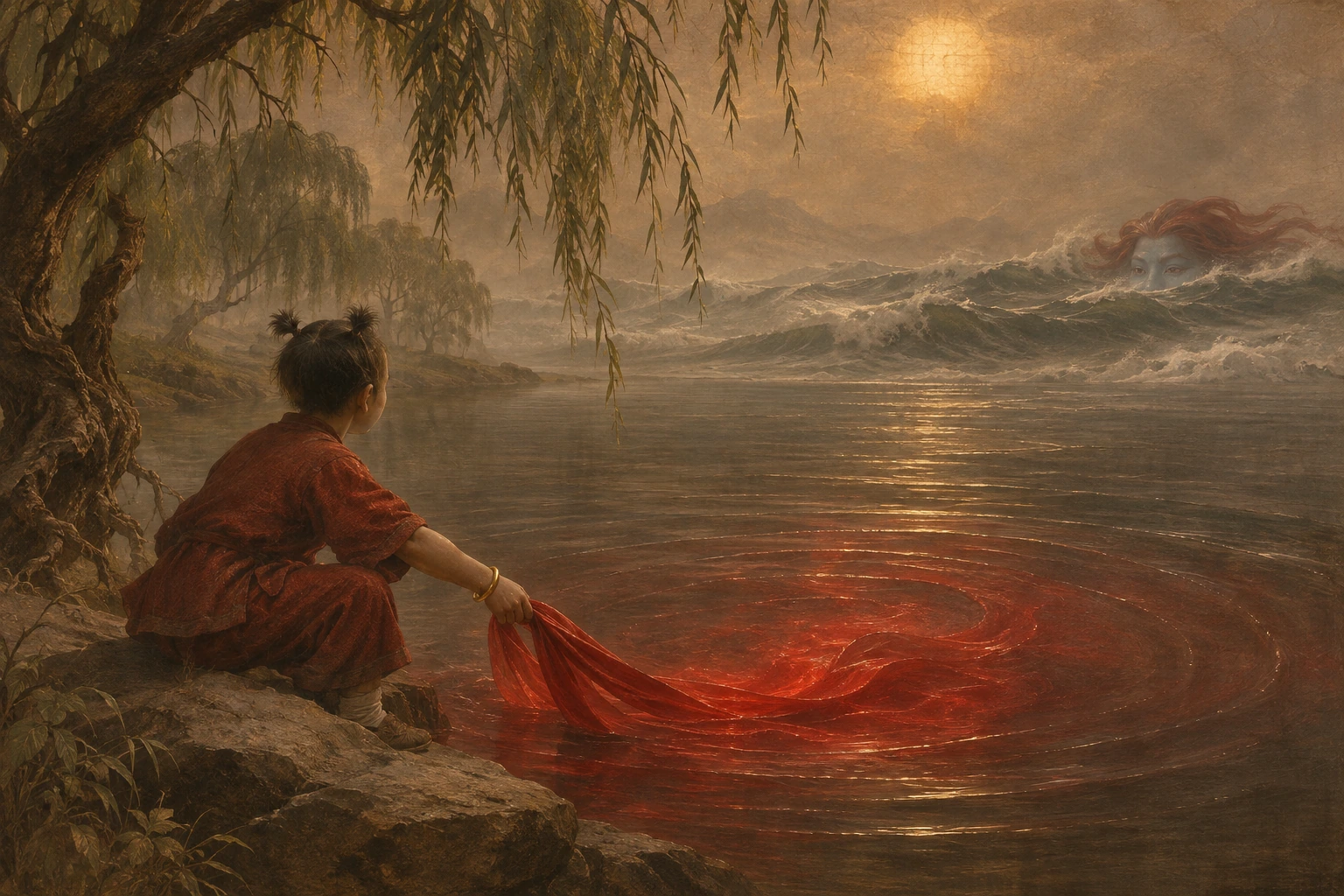
Seven years later, in the heat of the fifth month, Nezha went out of the pass and sat down to bathe at the Nine-Bend River, where it opens into the Eastern Sea. He dipped his silk in the water. The river turned red and began to shake, and far below, the Crystal Palace of Ao Guang, the Dragon King of the Eastern Sea, rattled.
The Dragon King sent a sea-patrol yaksha, blue-faced, with an axe. He swung at the boy, and Nezha threw his ring and killed him. Then came the king’s third son, Ao Bing, riding a water beast, halberd in hand. Nezha wrapped him in the silk, dragged him onto the bank and struck him with the ring. Ao Bing fell in his true form, a dragon, and Nezha pulled out its sinew to make a belt for his father’s armour.
1-3 Flesh and Bones
Ao Guang came to Li Jing in the shape of a scholar, saw his son’s sinew and swore to report it to the Jade Emperor. Li Jing wept: they would all be put to death. Nezha ran to his teacher, who drew a charm on his chest to make him invisible, and at the gate of heaven he waylaid the Dragon King, beat him and brought him home in his sleeve, changed into a little green snake.
Trouble followed trouble. On the gate tower of the pass Nezha found a bow and arrows that had guarded it since the Yellow Emperor defeated Chiyou, and that no one else could lift. He loosed one arrow and killed a disciple of the immortal Lady Shiji. When she came for him, Taiyi Zhenren trapped her in a cover of fire, and she turned back into the stone she had been.
Then Taiyi told Nezha that the four Dragon Kings had seized his parents. He hurried home and cried out: “What one man does, one man answers for.” He would give his flesh and bones back to his father and mother, and they would not suffer for him. “So be it,” said Ao Guang. “If you save your parents, you will have a filial son’s name.” Nezha took a sword and killed himself. The Dragon Kings let Li Jing and his wife go, and Lady Yin buried her son.
1-4 The Lotus Body
His spirit drifted to his teacher’s mountain. Taiyi Zhenren sent it to his mother in her dreams: she was to build him a shrine on Cuiping Mountain, forty li from the pass, and after three years of incense he could stand among the living again. Li Jing would not hear of it, so Lady Yin had it built in secret. Nezha answered prayers there, and pilgrims came “like ants”.
Half a year later Li Jing rode by and learned whose shrine it was. “You plagued your parents while you lived, and now you are dead you fool the people!” He smashed the statue with his whip and had the shrine burned down.
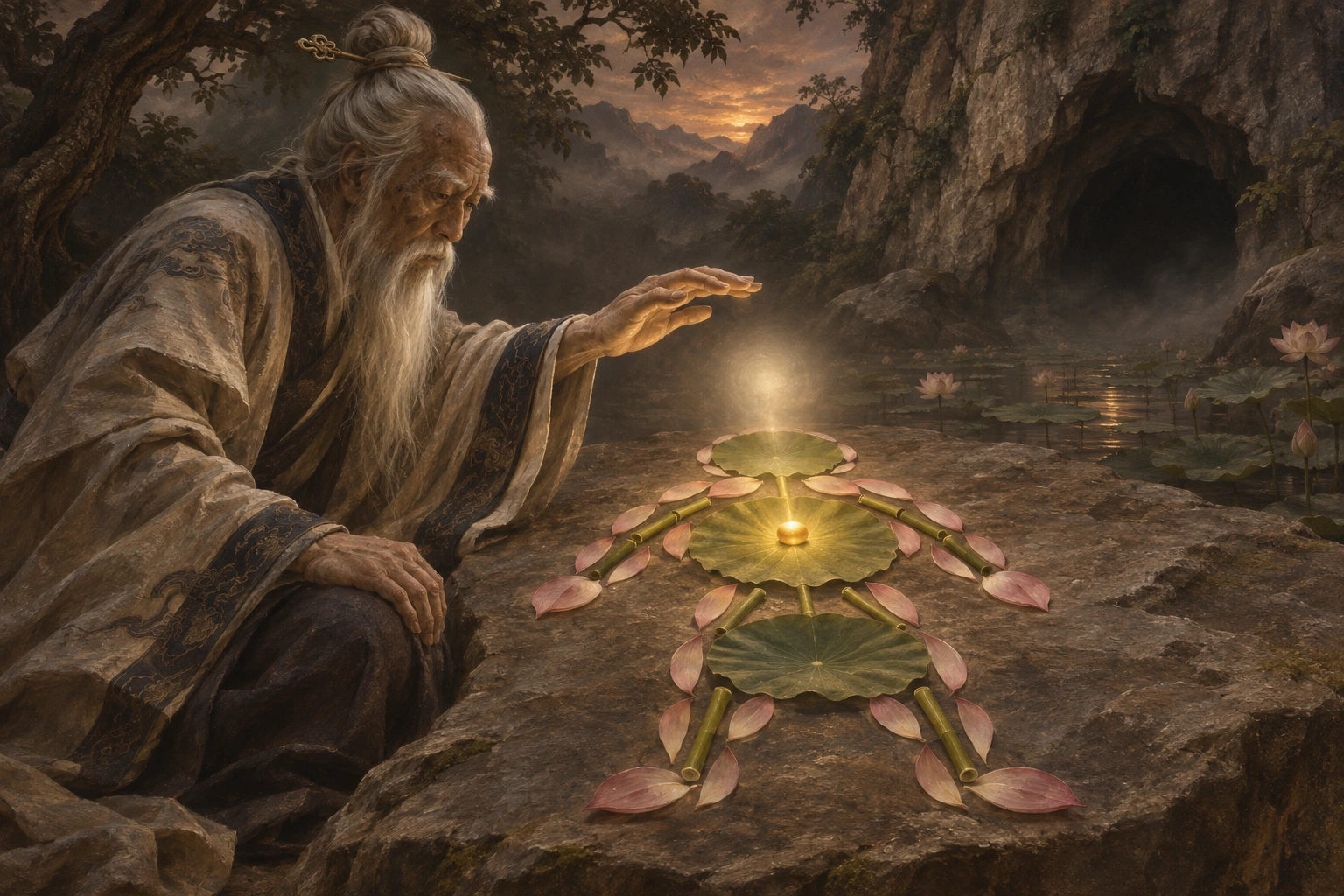
So Taiyi Zhenren made Nezha a body himself. He sent for two lotus flowers and three lotus leaves from his pond. He laid out the petals as the three powers, heaven, earth and man, broke the stems into three hundred bones, set the leaves as upper, middle and lower, and placed a pill of golden elixir at the centre. Then he pushed the boy’s spirit into it: “Nezha, if you do not take human form now, when will you?” A youth sixteen chi tall sprang up, his face “white as powder, lips red as cinnabar”. Taiyi taught him the fire-tipped spear and gave him two wheels of wind and fire to stand on, and a leopard-skin bag for the ring, the silk and a golden brick.
1-5 The Pagoda
Nezha rode the wheels to Chentang Pass: “My flesh and bones I have given back to you. Why did you burn my shrine?” Li Jing fled. His second son Muzha stood in the way, shouting that a son who kills his father breaks every law, and Nezha knocked him down with the golden brick. The immortal Wenshu Guangfa Tianzun bound Nezha to a golden post, and Taiyi admitted he had sent him there to wear down his urge to kill. Then he sent the boy home, and Nezha went straight after Li Jing again.
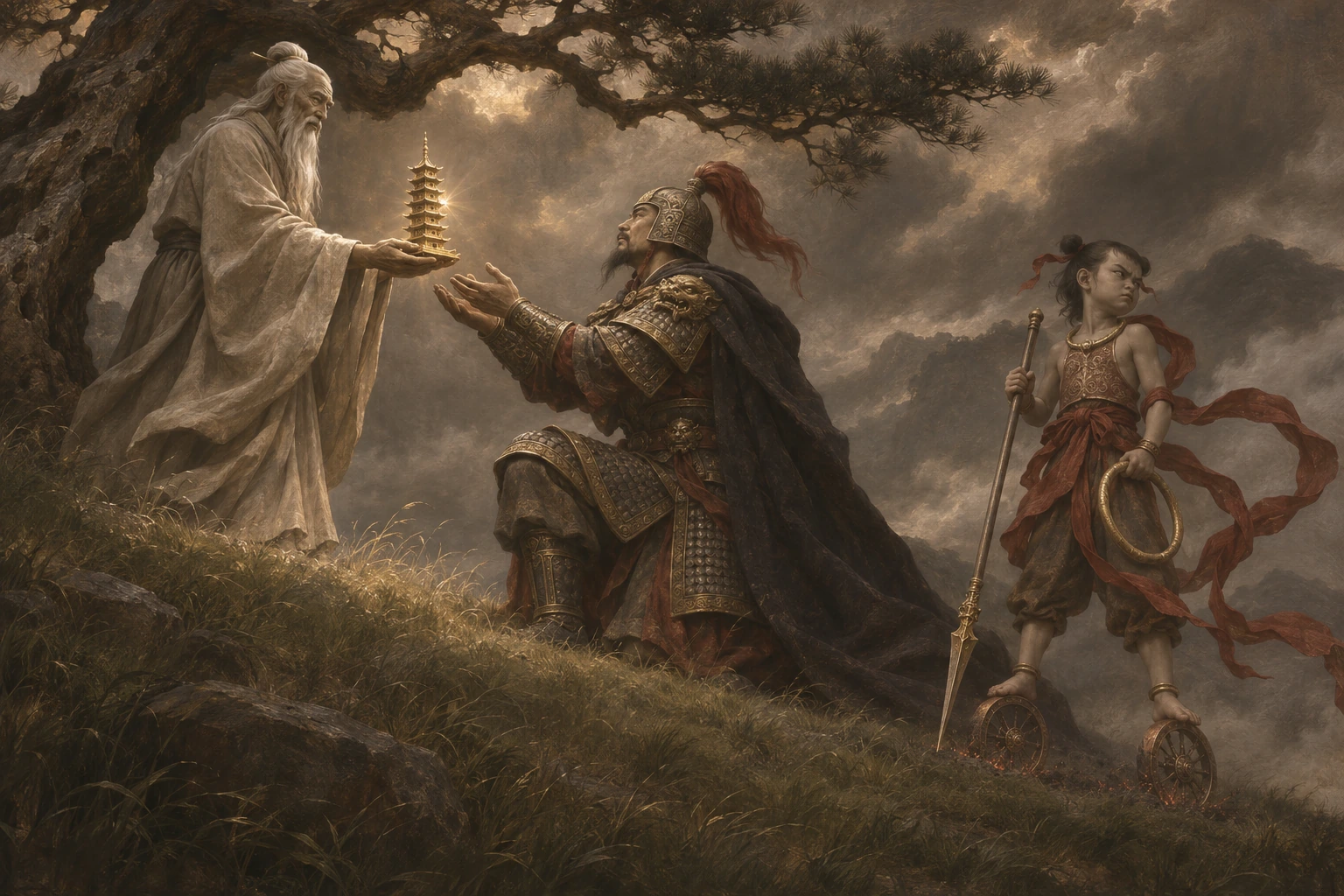
At last the Daoist Randeng hid Li Jing behind him on a hill. When Nezha attacked, Randeng dropped an exquisite little pagoda over him and set it burning until the boy cried for mercy. “Will you acknowledge your father?” “I acknowledge him!” Randeng lifted the pagoda, and the boy found himself unburned; but he still had to kneel before Li Jing and call him “Father”. Randeng gave Li Jing the golden pagoda, to raise against his son whenever he rebelled. Later, the narrator adds, father and sons all became saints in the flesh: Li Jing is the Pagoda-bearing Heavenly King.
2 Where the Story Is Written Down
- The Indian name. In India, Nalakūbara is a son of Kubera, the god of wealth, whom Buddhism adopted as Vaiśravaṇa, the Heavenly King of the North (Pishamen in Chinese). The Chinese version of Aśvaghoṣa’s life of the Buddha, traditionally credited to Dharmakṣema in the 5th century, compares the joy at the Buddha’s birth with the joy of the gods “when Vaiśravaṇa fathered Nalakūbara” (那羅鳩婆). Translations of the Peacock Spell Sutra list him among the yakshas: 那羅鳩婆羅 in the 6th-century Liang version, 那吒矩韈囉 in Amoghavajra’s. The sinologist Meir Shahar traces through them how the name shrank to Nazha (那吒), to which the mouth radical was later added: 哪吒.
- Tang ritual manuals attributed to Amoghavajra (705–774). In one, “Prince Nazha” stands before the Buddha with a halberd and vows to strike evildoers with a vajra staff; there he is Vaiśravaṇa’s grandson. In another he is the son: “the Heavenly King’s third son, Prince Nazha, holds the stupa and always follows the Heavenly King”. The same manual tells how, in 742, the Heavenly King’s troops saved the besieged city of Anxi, golden rats gnawing through the enemy’s bowstrings, and how his image was ordered set up in the armies.
- Chan Buddhism. The Jingde chuandeng lu, compiled by Daoyuan in 1004, records two questions put to masters. To Touzi Datong: Prince Nazha returned his bones to his father and his flesh to his mother; “what is Nazha’s original body?” The master put down his staff. To Tiantai Deshao: the prince returned them, “and then, on a lotus, preached the Dharma to his father and mother”. The later Wudeng huiyuan repeats the line.
- Su Zhe (1039–1112) wrote a poem titled “Nazha”: “The Heavenly King of the North had a wild son / who bowed to the Buddha but not to his father. / The Buddha, knowing him too foolish to be taught, / had the father hold up a pagoda in his left hand.” Bowing to the Buddha, the poem goes on, the boy almost bows to his father.
- The Sanjiao soushen daquan, an illustrated compendium of gods printed under the Ming. Ye Dehui, who recut it in 1909, took it for a Yuan book under a new title, with Ming additions. Its entry makes Nazha an immortal of the Jade Emperor’s court, with three heads, nine eyes and eight arms, sent down to fight demons as the third son of Li Jing.
- The Xiyou ji (Journey to the West, 1592 Shidetang edition). In chapter 4 Nezha fights Sun Wukong; chapter 83 tells his past.
- The Fengshen yanyi, a late Ming novel of a hundred chapters. Its author is uncertain: Xu Zhonglin and the Daoist Lu Xixing are both named.
3 Competing Versions
- How old was he? In the Soushen daquan he bathes in the Eastern Sea and tramples the Crystal Palace five days after birth, and kills nine dragons at seven days. In the Xiyou ji he does it at three days. In the Fengshen yanyi he is seven years old.
- Whom did he kill? The Soushen daquan has him kill the Dragon King himself at the gate of heaven, then shoot the son of Lady Shiji with the Buddha’s own bow, and kill her too. In the Fengshen yanyi the old king lives, and the dragon who dies is his son.
- Why did he die? In the Soushen daquan his father is angry because Shiji led the demons, and her death will bring their armies down on them; Nezha cuts his flesh and carves his bones “to return them to his father”. In the Xiyou ji, Li Jing means to kill him, and he cuts his flesh for his mother and scrapes his bones for his father. In the Fengshen yanyi he dies to save his parents.
- Who gave him the lotus body? The Buddha, in the Soushen daquan (bones of lotus stems and water caltrop, flesh of lotus root, clothes of leaves) and in the Xiyou ji (bones of lotus root, clothes of lotus leaves). In the Fengshen yanyi it is the Daoist Taiyi Zhenren.
- Who holds the pagoda, and why? In the Tang manual, Nazha carries the stupa for his father. In Su Zhe’s poem and in the Xiyou ji, the Buddha gives the father a pagoda with buddhas inside it, so that the son, bowing to it, bows to him: Nezha is to take the Buddha as his father. In the Fengshen yanyi it has become a weapon. The pagoda was Vaiśravaṇa’s own: Li Quan’s Taibai yinjing, a Tang military handbook, describes the god “raising a stupa in his left hand”, and Bishamonten holds one in Japan.
- Who was Li Jing? The name belongs to a famous general of the early Tang (571–649). Shahar writes that in China the Heavenly King Vaiśravaṇa was identified with him: the novels keep the king’s pagoda and give it the general’s name.
- How deep are the Indian roots? The Indian Nalakūbara is no child. In the Bhāgavata Purāṇa he and his brother, sons of Kubera, are cursed by the sage Nārada for their arrogance and become two trees, until the child Kṛṣṇa breaks the trees and frees them. Shahar thinks it possible that the Chinese child god owes something to the child Kṛṣṇa, who, he writes, also began his career by slaughtering a dragon, a nāga.
4 History and Tradition
- A god of Daoism and of the people. The Soushen daquan already gives him Daoist rank: the Jade Emperor makes him first of thirty-six heavenly commanders, to guard the gate of heaven forever. In Taiwan he is Zhongtan Yuanshuai, the Marshal of the Central Altar, known familiarly as Taizi ye, “Lord Prince”, and he has temples of his own: the Xinying Taizi Temple in Tainan joined the city’s cultural bureau in publishing a volume of studies on his cult in 2017.
- Mediums and drivers. Leo Yuan, writing in the International Journal of Intangible Heritage in 2014, notes that mediums possessed by Nezha speak like a child, that he is a guardian of infants and that, as the god who rides on wheels, he protects transport companies, which set up shrines to him in their offices.
- Techno Nezha. In temple processions, costumed Nezha figures dance at the head of the parade, scouting the route for the gods. Techno music came into the parade at Yanshui’s fireworks festival in 2005, Yuan writes, and at the opening of the World Games in Kaohsiung in 2009 forty Nezhas in sunglasses and white gloves, some riding motorcycles, danced to a pop song. Techno Nezha troupes now appear at festivals and public events across Taiwan.
- Japan. Vaiśravaṇa is Bishamonten, shown with a pagoda on his left palm. Nezha himself became widely known through An Nō Tsutomu’s Japanese version of the Fengshen yanyi (Kōdansha Bunko, 1988–89) and the manga that Fujisaki Ryū drew from it (Hōshin Engi, from 1996).
- Vietnam. He is Na Tra, the Sino-Vietnamese reading of his name. The novel has been published in Hanoi as Phong thần diễn nghĩa (Văn học, 1994 and 2003).
- On screen. The animated film Ne Zha (2019) gave him dark-ringed eyes and a new generation of admirers.
Nezha is often described as a native Chinese god, or a purely Daoist one. His name says otherwise. 那吒 is short for 那吒矩韈囉, the Chinese spelling of Nalakūbara, a yaksha son of the Indian god of wealth. He came to China in Buddhist spells and ritual manuals, and Daoism and the novels took him up later. His story grew in China; the boy came from India.
5 Related Stories
- The Chinese Dragon: The Long, Bringer of Rain and Emblem of Emperors: Ao Guang, whose son Nezha kills, is the Dragon King of the Eastern Sea, “a true god who raises clouds and spreads rain”, as he says himself in the Fengshen yanyi.
- Sun Wukong: The Monkey King Who Fought Heaven: in chapter 4 of the Xiyou ji, Nezha takes three heads and six arms to fight the monkey, is struck on the arm and withdraws.
- Kunlun: The Mountain of the Immortals: in the Fengshen yanyi, Nezha’s ring was a gift to his teacher from the Jade Void Palace on Kunlun, and the boy was born into the world on that palace’s orders.
- Ganesha: How the God of Beginnings Got His Elephant Head: another child god whose clash with a father figure costs him his body, and who is given a new one: Shiva cuts off the boy’s head and he is given an elephant’s, while Nezha gives back his flesh and bones and is given a body of lotus. We have not found a scholar who compares the two; we link them for the theme.
6 Sources
- Fengshen yanyi, chapters 12–14, the hundred-chapter text on Chinese Wikisource (no edition named there): Wikisource, Wikisource, Wikisource
- Xiyou ji, chapters 4 and 83: Wikisource, Wikisource
- Sanjiao yuanliu soushen daquan, juan 7, “Nazha taizi”, Ye Dehui’s recut (preface 1909), scanned from his collected works: Internet Archive
- CBETA: Fo suoxing zan (T192), Kongque wang zhou jing (T984), Fomu da kongque mingwang jing (T982), Beifang Pishamen tianwang suijun hufa yigui (T1247), Pishamen yigui (T1249), Jingde chuandeng lu juan 15 and 25 (T2076), Wudeng huiyuan juan 2 (X1565): CBETA, CBETA, CBETA, CBETA, CBETA, CBETA
- Su Zhe, “Nazha”, Luancheng sanji, juan 1 (Sibu congkan): Wikisource; Li Quan, Taibai yinjing, juan 7: Wikisource
- Bhāgavata Purāṇa 10.10, trans. A. C. Bhaktivedanta Swami Prabhupāda: Vedabase
- Meir Shahar, seminar handout on Nezha and Nalakūbara, University of Haifa: Internet Archive; Shahar, Oedipal God: The Chinese Nezha and His Indian Origins (University of Hawai’i Press, 2015): UH Press
- Leo Yuan, “Marshal Nezha ‘transformed’: Techno Nezha in Taiwan”, International Journal of Intangible Heritage 9 (2014): ijih.org
- Hsieh Kuo-hsing (謝國興), “謁水請將:臺南五塊寮慶和宮中壇元帥的請水儀式”, in 哪吒與太子爺信仰文化研究 (Tainan, 2017): Academia Sinica
- “毘沙門天”, “封神演義”, “景徳伝灯録”, “蘇轍”, “李靖”, “不空”, Sekai Daihyakka Jiten, Nipponica, Digital Daijisen: Kotobank, Kotobank, Kotobank, Kotobank, Kotobank, Kotobank
- An Nō Tsutomu, trans., Hōshin engi (Kōdansha Bunko, 1988–89), and Fujisaki Ryū, Hōshin Engi (Shūeisha, from 1996): NDL, NDL, NDL
- Phong thần diễn nghĩa (Văn học, 1994; 2003), Hanoi University of Culture library: HUC, HUC
- Zong He, “古代文物上的百變哪吒”, Xi’an Evening News, 13 August 2019: chinawriter.com.cn
Cover and illustrations: AI-generated images made for Arcana. They are interpretations, not historical artworks.