Pandora: The Jar, Not the Box
The gods made the first woman as the price of fire, and she lifted the lid of a great jar that let countless evils loose among men. In Hesiod it is a storage jar: it became a box in 1508, in a book by Erasmus.
- Type: myth, the making of the first woman and the jar of evils
- Culture: ancient Greece
- Earliest texts: Hesiod’s Theogony, where the woman has no name and there is no jar, and his Works and Days, where she is Pandora and opens the jar; both are placed around 700 BCE
- Key figures: Pandora, Zeus, Hephaestus, Athena, Hermes, Prometheus, Epimetheus, Elpis (Hope)
Everyone knows Pandora’s box, and Hesiod, the oldest poet to tell her story, never mentions one. His Pandora lifts the lid of a pithos, the great earthenware jar in which a Greek farmhouse kept its wine and its stores. She is the gods’ answer to the theft of fire, made by all of them together, and the jar she opens is the reason, Hesiod says, why the earth and the sea are full of evils.
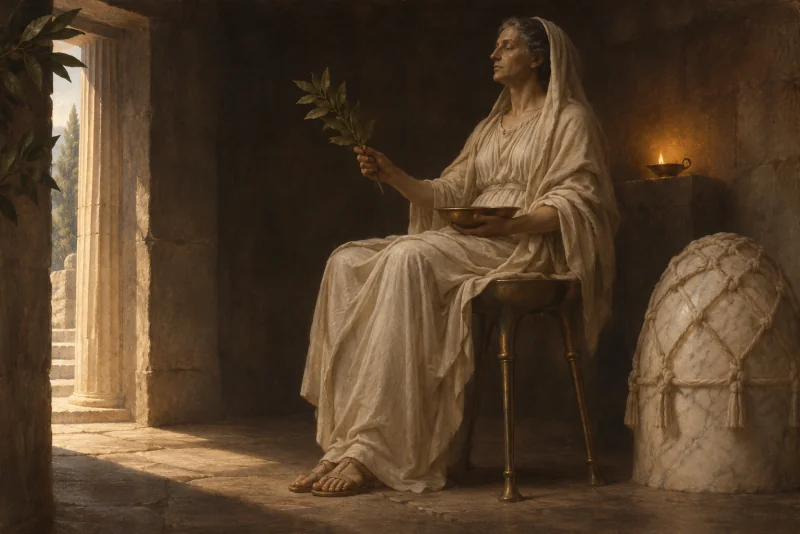
Why did Hope stay in the jar? Hesiod does not say why. He says only that when the woman lifted the lid, “Only Hope remained there in an unbreakable home within under the rim of the great jar, and did not fly out at the door; for ere that, the lid of the jar stopped her, by the will of Aegis-holding Zeus” (Works and Days 96–99). Whether that leaves Hope with us, as a comfort, or keeps her from us, as one more evil held back, has been argued for centuries (section 3).
1 The Telling
This is the version of Hesiod, a poet of Boeotia, in Works and Days (42–105). He tells the story a second time, more briefly, in the Theogony (570–612), where the woman has no name and there is no jar (section 1-5). The quotations are from Hugh G. Evelyn-White’s translation of 1914.
1-1 The Price of Fire
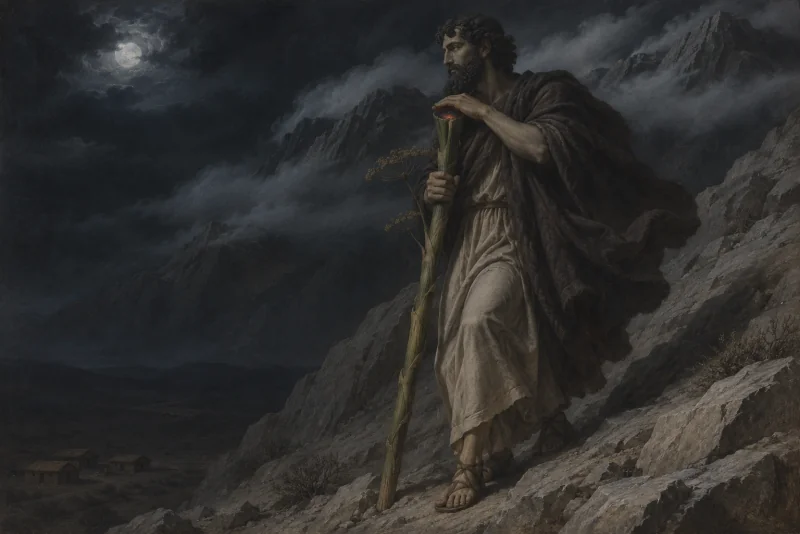
Zeus had hidden fire from mortals, and Prometheus, son of Iapetus, stole it back for them in a hollow fennel stalk; that story is told in Prometheus. Zeus answered him in anger: “I will give men as the price for fire an evil thing in which they may all be glad of heart while they embrace their own destruction.” Then “the father of men and gods … laughed aloud” (54–59).
1-2 A Gift from Every God
Zeus gave each god a task. Hephaestus was to mix earth with water, put into it a human voice and strength, and shape “a sweet, lovely maiden-shape, like to the immortal goddesses in face”. Athena was to teach her to weave. Aphrodite was to pour grace on her head, and “cruel longing and cares that weary the limbs”. And Hermes was to give her “a shameless mind and a deceitful nature” (60–68); the Greek says, literally, the mind of a dog.
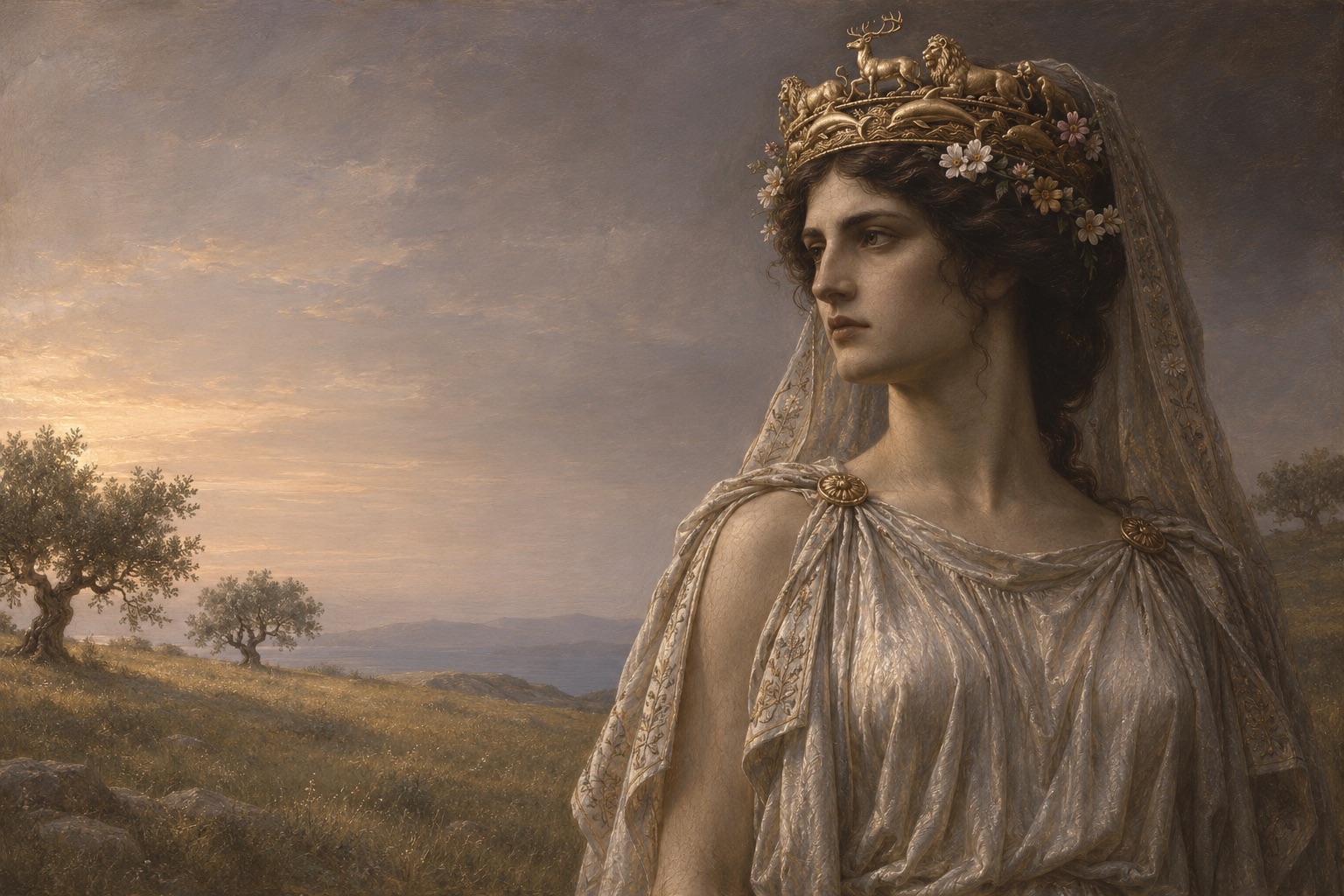
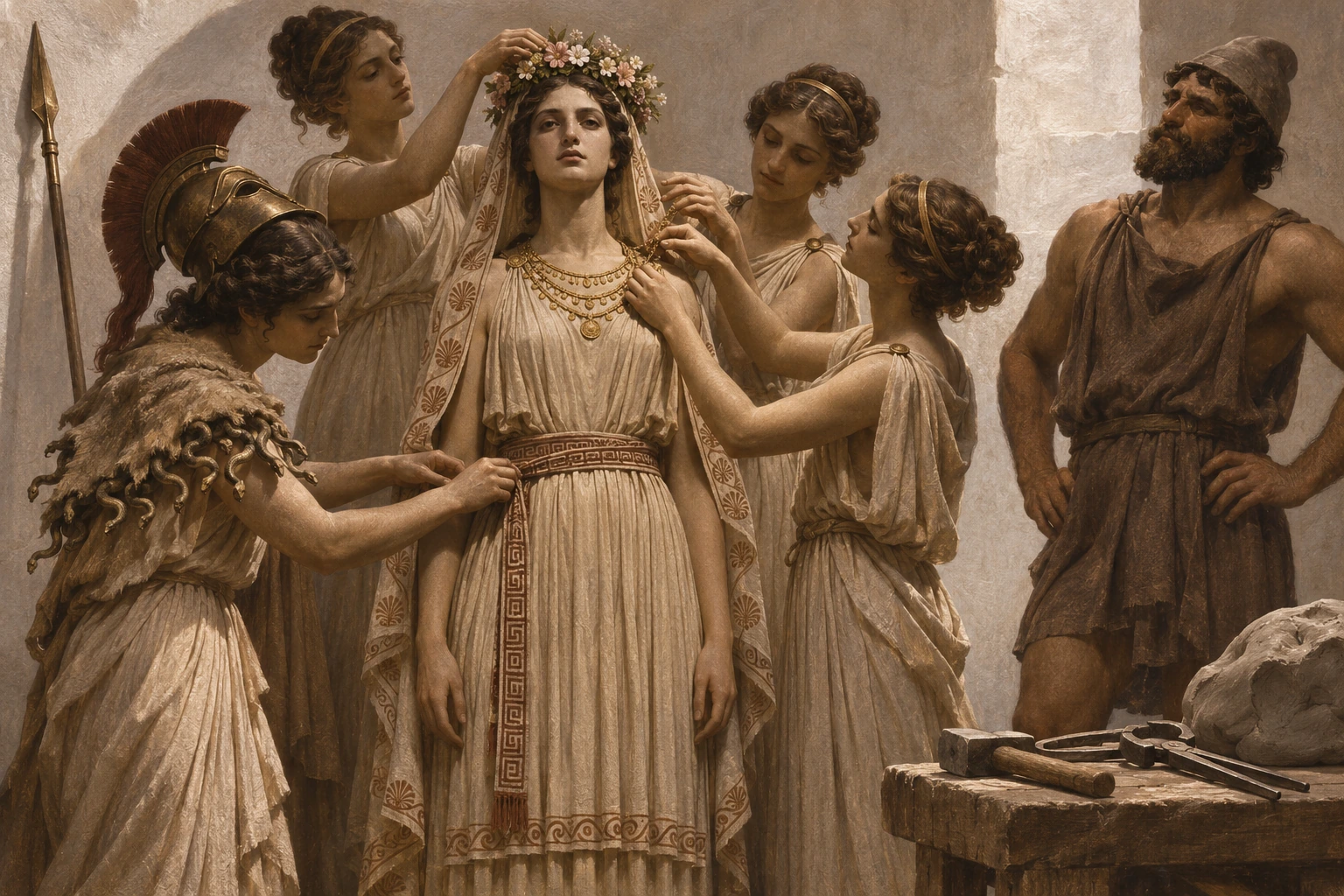
The gods obeyed, though not quite the gods Zeus had named. Hephaestus moulded clay “in the likeness of a modest maid”. Athena girded and dressed her. The Graces and Persuasion hung gold necklaces on her, and the Hours crowned her with spring flowers; Aphrodite is not mentioned again. Hermes put in her “lies and crafty words and a deceitful nature”, and gave her a voice. He called her Pandora, “because all they who dwelt on Olympus gave each a gift, a plague to men who eat bread” (69–82).
1-3 Epimetheus
When “the sheer, hopeless snare” was ready, Zeus sent Hermes to take her as a gift to Epimetheus, Prometheus’s brother. Prometheus had warned him “never take a gift of Olympian Zeus, but to send it back for fear it might prove to be something harmful to men”. Epimetheus did not think of it. “But he took the gift, and afterwards, when the evil thing was already his, he understood” (83–89).
1-4 The Jar
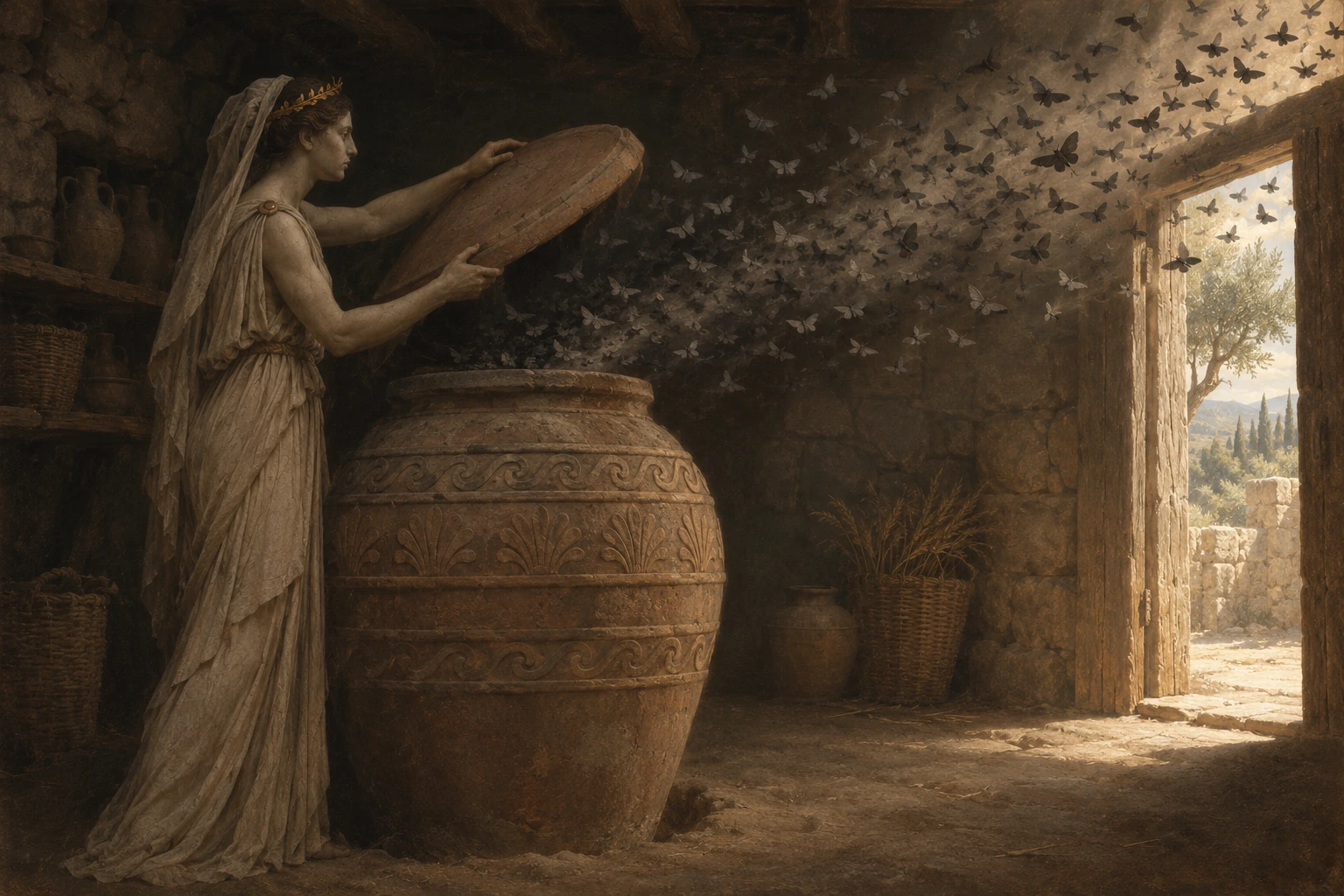
Until then, says Hesiod, the tribes of men had lived “free from ills and hard toil and heavy sicknesses”. “But the woman took off the great lid of the jar with her hands and scattered all these and her thought caused sorrow and mischief to men” (90–95). Hesiod does not say where the jar came from, what it was doing in the house, or why she opened it. In these lines he does not even use her name: she is “the woman”.
Only Hope, Elpis, stayed inside, under the rim, because the lid came down before she could fly out. “But the rest, countless plagues, wander amongst men; for earth is full of evils and the sea is full.” Diseases come of themselves by day and by night, “bringing mischief to mortals silently; for wise Zeus took away speech from them”. Hesiod ends: “So is there no way to escape the will of Zeus” (100–105).
1-5 The Woman in the Theogony
The Theogony tells the making in other words and stops before the jar. Hephaestus “formed of earth the likeness of a shy maiden”. Athena dressed her in “silvery raiment”, spread “a broidered veil, a wonder to see” from her head, and crowned her with garlands. Hephaestus made her a crown of gold, worked with “the many creatures which the land and sea rear up … like living beings with voices” (570–584). She is “the beautiful evil to be the price for the blessing”, in Greek kalon kakon, and gods and men stare at “that which was sheer guile, not to be withstood by men” (585–589).
Then Hesiod turns from her to all women: “For from her is the race of women and female kind” (590). Women, he says, are like the drones that bees feed in the hive, who reap the toil of others (594–602). And Zeus added a second evil. The man who will not marry grows old with no one to look after him, and distant kin divide his goods; the man who marries, even “a good wife suited to his mind”, finds that “evil continually contends with good” (602–612).
2 Where the Story Is Written Down
- Hesiod, Theogony (around 700 BCE). Epimetheus is named in the list of Iapetus’s sons, “who from the first was a mischief to men who eat bread; for it was he who first took of Zeus the woman, the maiden whom he had formed” (511–514). The making follows at 570–612: no name, no jar.
- Hesiod, Works and Days 42–105: the name, the gifts, Epimetheus, the jar and Hope. The same poem uses the word pithos again for the household wine jar, “when the cask is first opened” (368), and the word elpis for the “empty hope” of an idle man in winter: “it is not a wholesome hope that accompanies a needy man” (498–501).
- Homer, Iliad 24.527–528: no Pandora, but jars. Achilles tells Priam that “two urns are set upon the floor of Zeus of gifts that he giveth, the one of ills, the other of blessings”.
- The elegies under the name of Theognis (1135–1150): no woman and no jar, but Hope is the one good god left among men; the others have left for Olympus.
- Aristophanes, Birds 971 (5th century BCE): an oracle-monger reads out, “First to Pandora sacrifice a white-fleeced ram” (section 4).
- Apollodorus, Library 1.7.2, and Hyginus, Fabulae 142, in Latin: Pandora is “the first woman fashioned by the gods” and the mother of Pyrrha, who survives the flood with Deucalion. Hyginus has Vulcan shape her from clay, Minerva give her life and each of the other gods a gift. Neither mentions a jar.
3 Competing Versions
3-1 Goods or Evils, Pandora or Epimetheus
- What was in the jar? In Hesiod, “countless plagues”. Evelyn-White, whose translation is quoted here, took them for the gods’ gifts, and still wrote of a casket: “The jar or casket contained the gifts of the gods mentioned in l. 82.” In a fable of Babrius, a Greek poet of the Roman period, it is the other way round: Zeus gathers all the useful things into a jar, puts the lid on and leaves it with a man; the man wants to know what is inside and moves the lid, and the good things fly back to the gods. Only Hope is left. Jane Harrison noted in 1900 that “there is no mention of Pandora at all” in this version, and that “it is good things … not evil, that are enclosed by the will of Zeus”.
- One jar or two? Hesiod has one, Homer two. The Hellenistic critic Aristarchus held that Hesiod’s jar came from Homer’s two. In a book of 2004, which we know only through E. F. Beall’s review of it, Immanuel Musäus argues from this that the jar of evils is itself a Hellenistic reading, and, following an earlier scholar, Neitzel, takes Hesiod’s pithos as an ordinary jar of provisions, spilled by Pandora so that men were left to hunger. Beall finds his case that the jar of evils came “well after” Hesiod strong.
- Who opened it? In Hesiod, the woman. Philodemus, writing in the 1st century BCE, reports that “some” said it was Epimetheus, after he had received Pandora; in Babrius it is a man; in Erasmus (3-3), Epimetheus again.
3-2 What Hope Means
Elpis means hope or expectation. Musäus, as Beall reports, sorts the modern readings by three questions: did the jar hold goods or evils, is Elpis good or bad, and does the jar keep her for men or keep her from them?
- A good, kept for us. This is the traditional reading: among all the evils loose in the world, men still have hope. Babrius and Theognis say the same in their own ways.
- An evil, held back. Hope stayed in a jar of evils, so perhaps she is one of them, a blind or empty hope. Hesiod’s idle man in winter has that kind (498–501). In Prometheus Bound, Prometheus says he stopped mortals foreseeing their death, and the cure he found was this: “I caused blind hopes to dwell within their breasts” (250–252).
- Something between. Beall places Jenny Strauss Clay’s Hesiod’s Cosmos (2003) between an ambivalent Hope and an evil one, kept with men. Froma Zeitlin (1996), as Jerzy Krawiec reports, reads Hope as an allusion to the chance of having good children as well as bad.
3-3 How the Jar Became a Box
In 1508 the Dutch humanist Erasmus of Rotterdam printed in Venice his Adagia, more than three thousand ancient proverbs with commentary; his first collection, of some eight hundred, had appeared in Paris in 1500. To explain “the fool is wise once the harm is done” (Malo accepto stultus sapit), he retold Hesiod, but not as Hesiod told it. Jupiter has Vulcan model a girl from clay, the gods each add a gift, “whence the name Pandora”, and Jupiter sends her to Prometheus “with a box (pyxis), very beautiful indeed, but hiding inside every kind of calamity”. Prometheus refuses it and warns his brother; Pandora goes back to Epimetheus, persuades him and gives him the box, and he opens it, sees the diseases fly out, and grows wise too late. The point is in the names, Erasmus explains: in Greek, Prometheus is the one who has his counsel before he acts, Epimetheus the one to whom it comes when the deed is done.
A pyxis is a small box, at first one of boxwood. M. L. West, in his commentary on Works and Days (1978), called it “a lapse by Erasmus, who was probably thinking of the box that Psyche opens, having been told not to”, in Apuleius’s Golden Ass; we read the words as the Amsterdam edition of Erasmus (1993) quotes them. In Apuleius, Venus sends Psyche to the underworld with a pyxis to fetch some of Proserpina’s beauty, and the tower that guides her warns her never to open it. On the way back Psyche opens it out of “rash curiosity”, and finds nothing inside but the sleep of the underworld (6.16–21).
In 1900 Harrison found the box in a 16th-century handbook of mythology by Lilio Gregorio Giraldi, in which Jupiter sends Pandora to Prometheus with a box “very beautiful but hiding every kind of calamity inside”. “From what source Lilius Giraldus was translating or copying I do not know,” she wrote. Giraldi’s sentence is, almost word for word, the one Erasmus had printed in 1508. Dora and Erwin Panofsky’s Pandora’s Box: The Changing Aspects of a Mythical Symbol (1956; second edition 1962) has a chapter called “The Origin of the ‘Box’: Erasmus of Rotterdam”.
4 History and Tradition
- An earth goddess’s name? Pandora can also mean “giver of all”. When the oracle-monger in Aristophanes’s Birds demands a ram for Pandora, an ancient note on the line explains: “to the Earth, because she gives everything needed for life; from which she is also called zeidoros and anesidora”, “grain-giving” and “sending up gifts”. At Phlya in Attica, Pausanias saw an altar of “Demeter Anesidora (Sender-up of Gifts)” (1.31.4).
- The vases. On a white-ground cup in the British Museum (D 4), attributed to the Tarquinia Painter and dated around 470 BCE, Athena and Hephaestus finish a stiff, statue-like woman; Harrison read the name beside her as “(A)nesidora”. On a 5th-century krater in the Ashmolean Museum, Oxford, a woman labelled Pandora rises out of the ground towards Epimetheus, with Hermes and Zeus behind him and a small winged Eros above her.
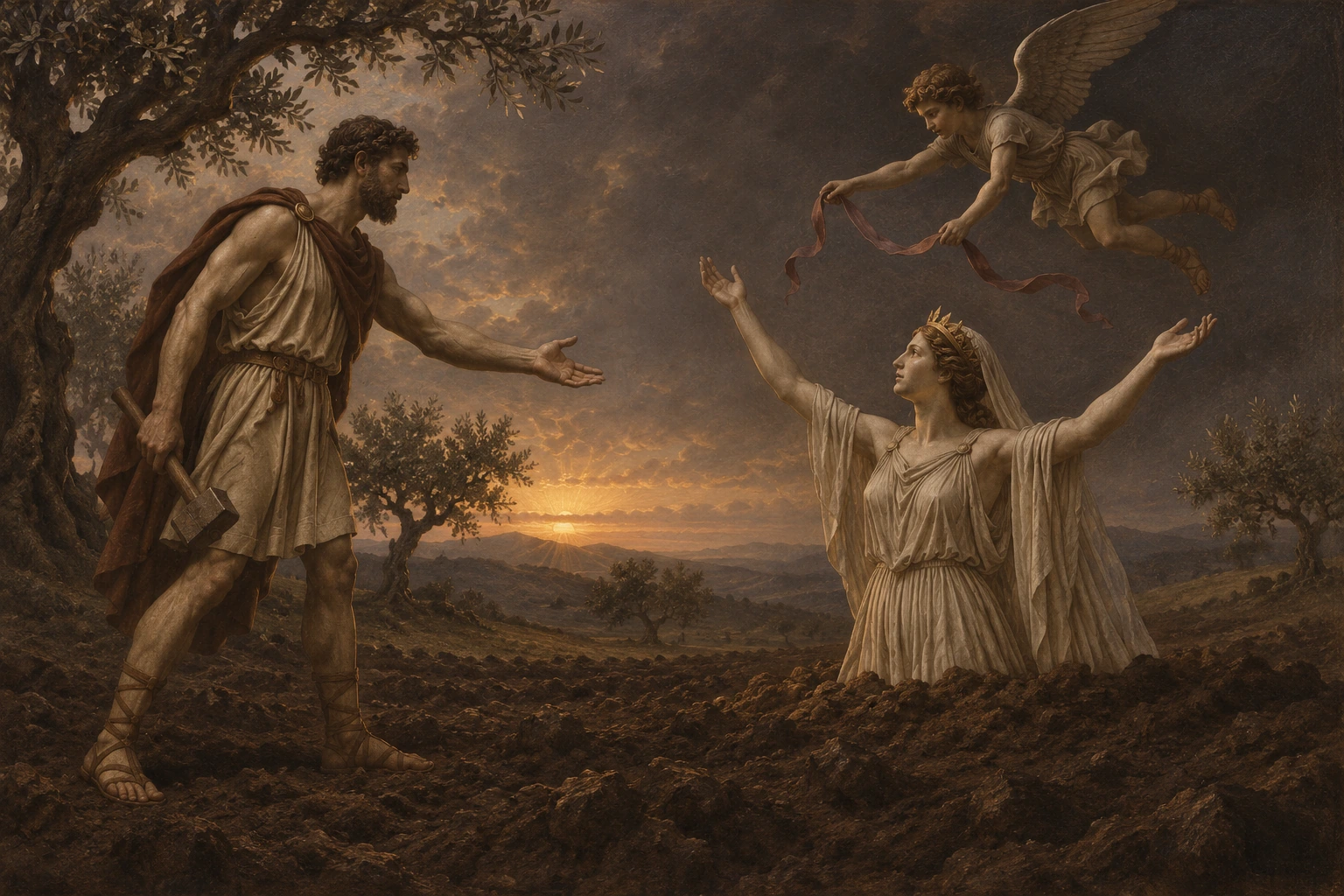
- Earth, or only the same name? For Harrison (1903), Pandora had once been the Earth, “giver of all gifts”, and Hesiod shaped her story “to his own bourgeois, pessimistic ends”. West (1978), in words that Krawiec (2022) quotes, was more cautious: if the Athenians merged Hesiod’s woman with the Pandora who rises from the earth, “it is only because she has the same name”. Zeitlin, in a passage Krawiec also quotes, reads the name as turned round on purpose by Hesiod, from “the giver of all gifts” to “the one to whom the gods have given all gifts”.
- The Parthenon. On the base of Phidias’s gold-and-ivory statue of Athena “is the birth of Pandora in relief”, wrote Pausanias, adding that “before Pandora was born there was as yet no womankind” (1.24.7). Pliny the Elder counts twenty gods in the scene (Natural History 36.4). Sophocles wrote a satyr play, now lost, called Pandora, or the Hammerers.
- Hesiod and women. Harrison saw in the poems “the ugly malice of theological animus”. Nicole Loraux (1978), as Krawiec summarizes her, argued that Hesiod makes women a “race” of their own, set apart from the tribes of human beings, and second-wave feminist scholars made Pandora a symbol of women’s oppression. Krawiec himself argues that her finery is the picture of a desirable bride, not a mask with nothing behind it, though this “obviously does not make of Hesiod a feminist”. Hesiod’s own advice pulls both ways: “The man who trusts womankind trusts deceivers” (Works and Days 375), but “a man wins nothing better than a good wife” (702).
- The box after Erasmus. The chapters of the Panofskys’ book follow Pandora and her box through Andrea Alciati, Rosso Fiorentino, the Elizabethans and Jacques Callot, and onto the stage with Calderón, Voltaire and Goethe. By 1900, Harrison wrote, “the box of Pandora is proverbial, and that is the more remarkable as she never had a box at all”.
“Pandora opened a box” is how the story is usually told. Hesiod’s word is pithos, a large earthenware storage jar, the word he also uses for the farm’s wine jar. The box is Erasmus’s: in his Adagia of 1508 he wrote pyxis, a small box, and M. L. West, as Erasmus’s modern editors quote him, called it “a lapse by Erasmus”. Harrison points out that the Greek writers who tell the myth, “down to the twelfth century A.D.”, always say pithos.
5 Related Stories
- Prometheus: The Theft of Fire: Pandora is Zeus’s answer to the stolen fire, the “evil thing” given “as the price for fire” (Works and Days 57). In Apollodorus her daughter Pyrrha marries Prometheus’s son Deucalion and survives the flood with him (1.7.2).
- Athena: Born from Her Father’s Head: in both of Hesiod’s poems Athena dresses the first woman, and in Works and Days she teaches her to weave. The birth of Pandora was carved on the base of her statue in the Parthenon.
- Zeus: The Youngest Son Who Became King of the Gods: the king who plans the gift and laughs. Hesiod closes the Theogony version with him: “So it is not possible to deceive or go beyond the will of Zeus” (613).
- Nüwa: The Serpent-Bodied Goddess Who Mended the Sky: in China, too, the first people are shaped from earth: Nüwa kneads them from yellow earth, while Hephaestus mixes earth and water for one woman. We have not found a scholar who compares the two; we link them for the theme.
6 Sources
- Hesiod, Theogony 507–616 and Works and Days 42–105, 361–375, 493–503 and 695–705, trans. Hugh G. Evelyn-White (Loeb, 1914), with the Greek text of the same edition: Theoi, Perseus, Perseus, Greek text
- Homer, Iliad 24.518–533, trans. A. T. Murray (Loeb, 1924): Perseus
- Aeschylus, Prometheus Bound 248–252, trans. Herbert Weir Smyth (Loeb, 1926): Perseus
- Aristophanes, Birds 967–979, Greek text: Perseus; the scholion on line 971 in Friedrich Dübner, Scholia Graeca in Aristophanem (Paris: Didot, 1855 printing): archive.org
- Theognis 1135–1150, trans. Douglas E. Gerber, and Babrius, Fable 58, trans. Laura Gibbs, as quoted on the Theoi Project’s “Pandora” page: Theoi
- Apollodorus, Library 1.7.2, trans. Sir James George Frazer (Loeb, 1921): Perseus; Hyginus, Fabulae 142, Latin text: The Latin Library
- Pausanias, Description of Greece 1.24.7 and 1.31.4, trans. W. H. S. Jones (Loeb, 1918): Perseus; Pliny the Elder, Natural History 36.4, trans. John Bostock and H. T. Riley (1855): Perseus
- Apuleius, Metamorphoses 6.16–21, Latin text: The Latin Library
- Erasmus, Adagia I.i.31 and I.iii.35, ed. M. L. van Poll-van de Lisdonk, M. Mann Phillips and Chr. Robinson, Opera omnia Desiderii Erasmi II-1 (Amsterdam: North-Holland, 1993), pp. 144–146 and 346, with the editors’ notes quoting M. L. West, Hesiod: Works and Days (Oxford, 1978), p. 168: OAPEN
- H. G. Liddell, R. Scott and H. S. Jones, A Greek-English Lexicon, “πίθος”, “πυξίς”, “ἐλπίς”, “κύνεος”: Perseus
- Jane E. Harrison, “Pandora’s Box”, Journal of Hellenic Studies 20 (1900), from p. 99: archive.org; Prolegomena to the Study of Greek Religion (Cambridge, 1903), pp. 280–285: archive.org
- Theoi Project, “Creation of Pandora” (London D 4) and “Epimetheus & Pandora” (Oxford V525): Theoi, Theoi
- Dora and Erwin Panofsky, Pandora’s Box: The Changing Aspects of a Mythical Symbol (New York: Pantheon Books, 1956; 2nd ed. 1962), contents: Project MUSE
- E. F. Beall, review of Immanuel Musäus, Der Pandoramythos bei Hesiod und seine Rezeption bis Erasmus von Rotterdam (Göttingen, 2004), Bryn Mawr Classical Review 2006.07.16: BMCR
- Jerzy Krawiec, “Pandora as a Beautiful Woman and an Object of Desire”, Classica Cracoviensia 25 (2022) 53–71: doi.org
Cover and illustrations: AI-generated images made for Arcana. They are interpretations, not historical artworks.