The Hero Twins: Hunahpu and Xbalanque in Xibalba
Two brothers shot down a bird who claimed to be the sun, went down to the lords of death who had killed their father, beat them at their own game and rose as the sun and the moon. The K'iche' book that tells it was written in the 1550s, but Maya artists had been painting the twins for centuries.
- Type: myth, twin heroes who defeat a false sun and the lords of the underworld, then rise as the sun and the moon
- Culture: the K’iche’ Maya of highland Guatemala; the twins also appear in the art of the lowland Maya
- Earliest texts: the K’iche’ Popol Vuh, written in Latin letters between 1554 and 1558 and known from the copy made by the Dominican Francisco Ximénez in the early 1700s; images of the twins are far older, from Stela 25 at Izapa (Late Preclassic) to Classic Maya painted vases
- Key figures: Hunahpu, Xbalanque, Seven Macaw (Vucub Caquix), Zipacna, Cabracan, One Hunahpu, Seven Hunahpu, Lady Blood (Xquic), Xmucane, One Death and Seven Death (Hun Came, Vucub Came)
The Popol Vuh, the book of the K’iche’ Maya, sets this story in the dim time before the first dawn, when the gods had not yet managed to make people. Two brothers clear the way. They bring down a bird who boasts that he is the sun, go down to Xibalba, the realm of the lords of death who killed their father, beat those lords at the ball game and at their own tricks, and rise into the sky as the sun and the moon. The book was written down in the 1550s, but Maya artists had carved and painted the twins long before, and Hunahpu is still the name of a day in the K’iche’ calendar.
Which twin became the sun? The book does not say. When the twins rise, the K’iche’ text says only “one sun, one moon” (jun k’u q’ij, jun nay pu ik’). Michael Coe thought it reasonable to suppose that Hunahpu, always named first, became the sun. But Eric Thompson objected that among the Maya the moon is a woman, the wife of the sun; and Xbalanque’s own name may contain the word for “sun” (section 3).
1 The Telling
This retelling follows the Popol Vuh in Allen J. Christenson’s translation (2003; electronic edition, 2007), checked against his word-for-word translation of the K’iche’ text (2004). Line numbers are his, and quotations are our own translations from the K’iche’. The book tells the twins’ first deeds before it tells how they were born.
1-1 The False Sun
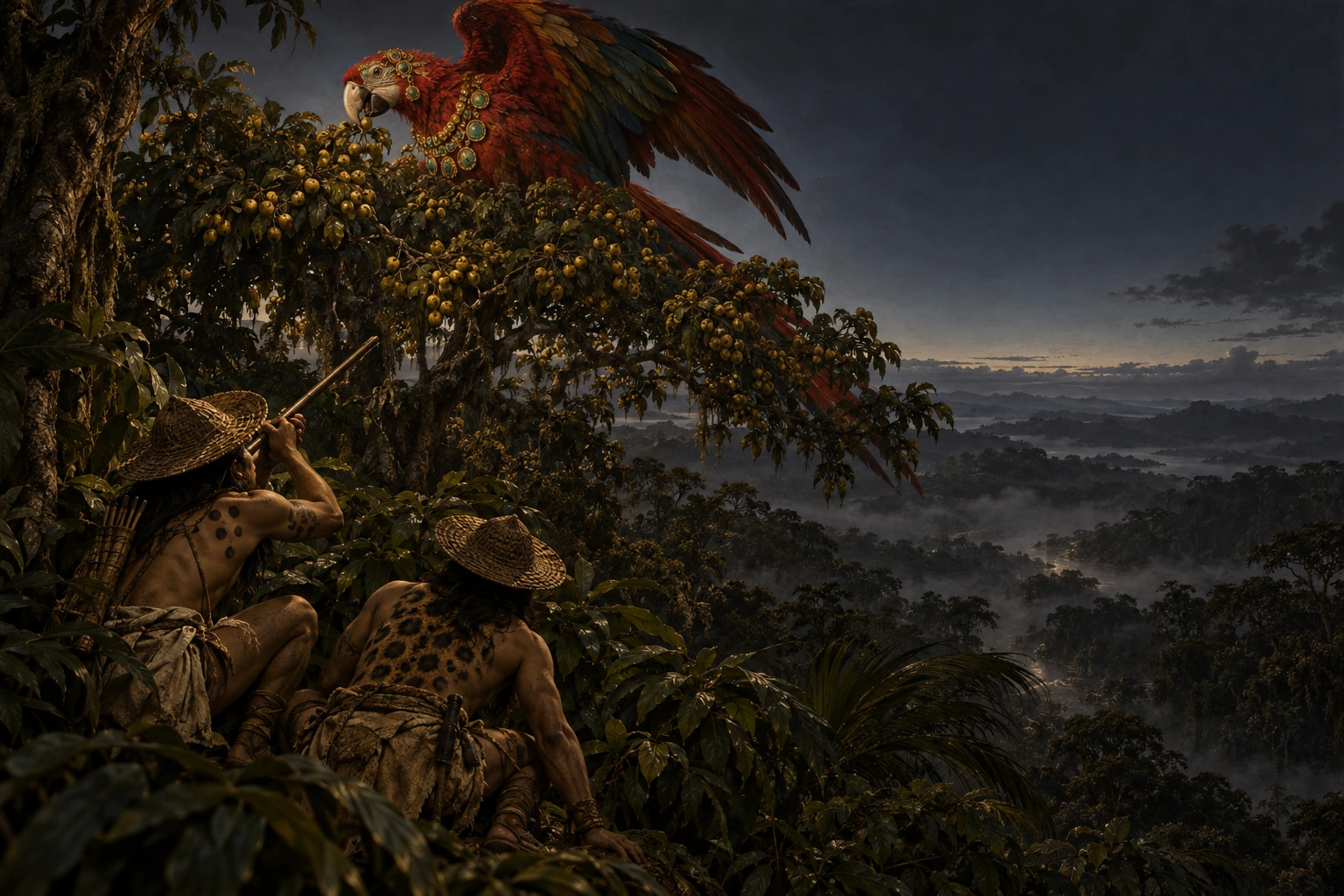
While the face of the earth was barely lit and there was no sun yet, one being puffed himself up: Seven Macaw (Vucub Caquix). “I am their sun, I am their light, I am also their moon,” he said of the people the gods had made. His eyes glittered with metal and blue-green jewels, his teeth were jade, his beak shone like the moon. But his sight reached no farther than where he sat (lines 838–907).
The twins Hunahpu and Xbalanque, “simply gods”, the text calls them, decided that people could never live where gold and silver were the only glory. Seven Macaw fed every day at the top of a nance tree. Hidden in its leaves, Hunahpu shot him in the jaw with his blowgun. The bird fell, but he wrenched off Hunahpu’s arm at the shoulder and took it home to hang over his fire. The twins went to an old couple, Great White Peccary and Great White Coati, and followed them as if they were orphaned grandsons. The old pair offered to cure Seven Macaw’s toothache. They pulled out his jade teeth and put white grains of maize in their place, and plucked the metal from his eyes. His face fell; he was no longer a lord, and he died, and his wife Chimalmat with him. Hunahpu took back his arm, and the old couple set it in its socket again (lines 908–1188).
1-2 The Sons of Seven Macaw
Seven Macaw’s sons were as proud as he was. Zipacna said he had made the mountains in a single night; Cabracan, “Earthquake”, that he could bring them down. Four hundred boys tried to kill Zipacna by dropping a great beam on him in a pit, but he had dug a side tunnel. He fed the ants his own hair and nails so that the boys would think he was rotting, and when they were drunk he brought their house down on them. All four hundred died. They became the Pleiades, the book says, “but perhaps that is just a story” (lines 1189–1385). The twins made a crab from a bromeliad flower and a hollow stone and set it in a cave under the mountain Meauan. The starving Zipacna crawled in after it on his back, the mountain settled on his chest, and he turned to stone. Then, at the word of Huracan, Heart of Sky, they led Cabracan east to a mountain that, they told him, kept growing. On the way they roasted birds and gave him one baked in a coat of white earth. His strength left him; they tied his hands and feet and buried him in the earth (lines 1386–1720).
1-3 The Fathers in Xibalba
Now the book goes back a generation, telling, it says, only “half” of the story of the twins’ father. One Hunahpu and Seven Hunahpu were the sons of the old couple Xpiyacoc and Xmucane. One Hunahpu had two sons, One Batz and One Chouen, who became flute players, singers, writers, carvers and jewellers. The brothers played ball every day on a court on the road to Xibalba, and the lords below, One Death and Seven Death, heard them stamping over their heads. They sent four owls to summon them to a game, for they wanted their gear: the yokes, the arm guards, the rubber ball. The brothers tied the ball up under the roof of their house and left their mother weeping (lines 1721–2032).
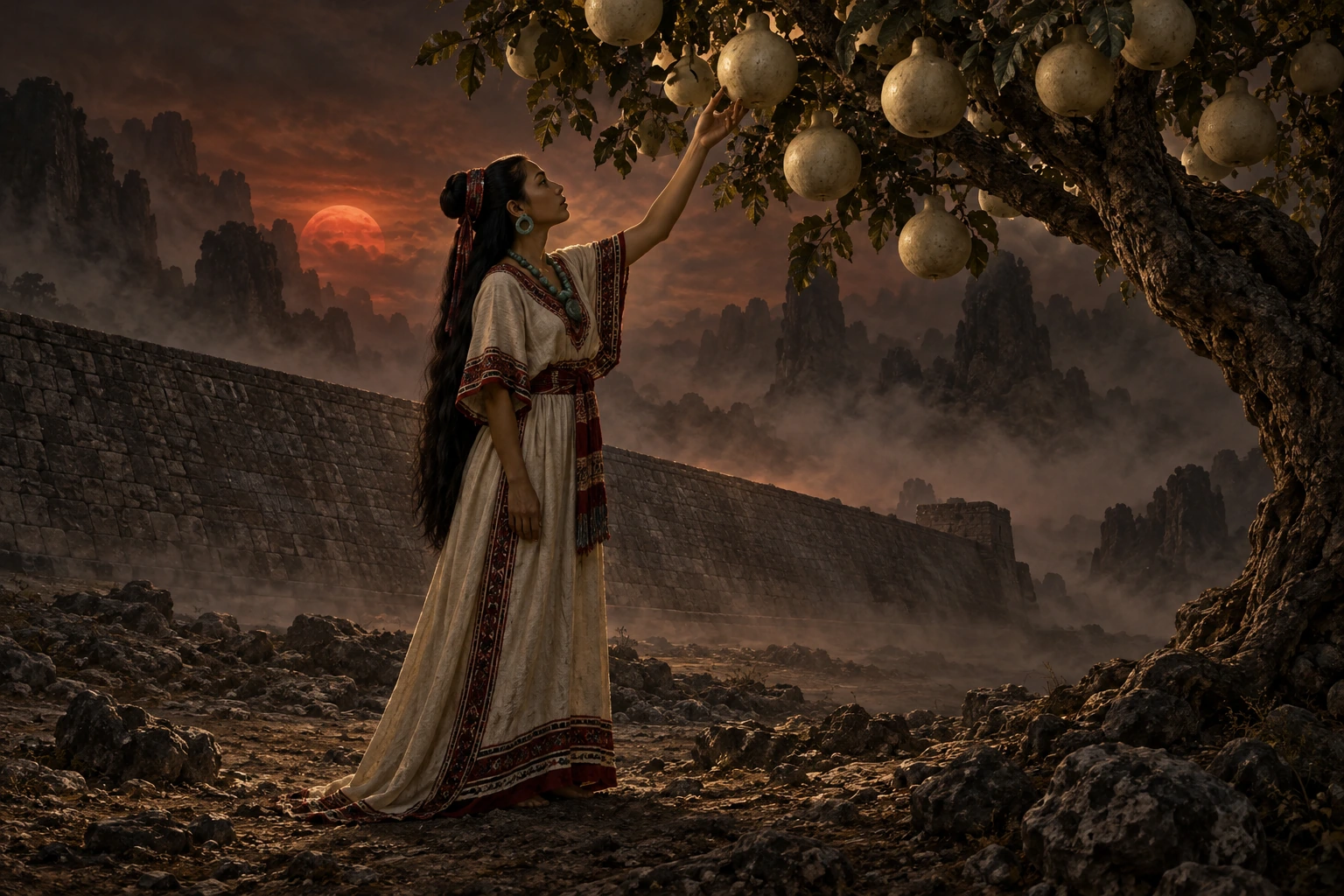
They went down steep steps and through canyons, crossed a river of scorpions, a river of blood they did not drink from and a river of pus, and at a crossroads of red, black, white and yellow roads the black one spoke: “Take me, I am the lord’s road.” At the council place they greeted the first two seated figures as One Death and Seven Death; these were only carved wood, and the lords roared with laughter. The bench they were offered was a burning stone. In the House of Darkness they were given a lit torch and cigars for the night, to be returned whole at dawn, and they burned them up. So they were sacrificed before any game was played and buried at the Crushing Ballcourt. One Hunahpu’s head was cut off and set in a tree by the road. The tree, which had never borne fruit, was suddenly covered with round fruit like his head: the calabash. The lords forbade anyone to touch it (lines 2033–2267).
1-4 Lady Blood
Lady Blood (Xquic), as Christenson renders her name, the daughter of the lord Gathered Blood, heard of the tree and went to it alone. “It is only a skull,” said the head among the branches. She wanted it all the same, and held up her right hand. The skull spat into it, and the spittle vanished. A lord’s face is lost when he dies, the skull told her, but his son is like his spittle: he goes on in his sons and daughters (lines 2268–2374).
Six months later her father saw that she was with child. The lords ordered the owls to take her away, sacrifice her and bring back her heart in a bowl. She talked them out of it. They filled the bowl with the red sap of the croton tree, which set like a heart, and while the lords leaned over its smell as it dried on the fire, the owls led her up to the surface of the earth (lines 2375–2509). Xmucane would not take her in. If she was truly her daughter-in-law, let her bring a net full of maize. In the field there was a single ear. Lady Blood called on the guardians of the food, pulled the silk at the top of the ear, and the net filled until it overflowed. Xmucane went to look, found the one ear still standing with the mark of the net beneath it, and accepted her (lines 2510–2663).
1-5 The Older Brothers and the Hidden Ball
The twins were born in the mountains. Their jealous half-brothers, One Batz and One Chouen, laid them on an anthill and in thornbushes, ate their food and took the birds they shot. One day the twins said their birds were stuck in a tree and asked the brothers to climb up for them. The tree grew. To climb down, the twins told them, untie your loincloths and pull out the long end behind you. The ends became tails, and the brothers went off into the forest as monkeys. The twins played the flute to call them back, and their grandmother promised not to laugh; three times they came dancing, and each time she laughed at their faces, and the fourth time they did not come. Flute players and singers, the book says, still call on them (lines 2664–3023). The twins cleared a maize field with a hoe and an axe that worked by themselves, while every night the animals made the forest grow back. They caught the last of them, the rat, and burned its tail, and for its food the rat told them what their grandmother had hidden: their fathers’ gear, hanging under the roof. With a bowl of chili sauce to see the rat’s reflection in, and a mosquito to hole the grandmother’s water jar and keep her busy at the river, they let the rat gnaw through the cords (lines 3024–3338).
Their playing was heard below. The lords’ summons reached the twins through their grandmother, carried by a louse that a toad swallowed, a toad that a snake swallowed and a snake that a falcon swallowed: in seven days they must come (lines 3339–3556). Before leaving, each twin planted an ear of maize in the middle of the house. If it dried up, they were dead; if it sprouted again, they were alive.
1-6 The Houses of Xibalba
The twins floated over the rivers on their blowguns. At the crossroads they sent ahead a mosquito, really a hair from Hunahpu’s knee, to bite its way down the row of seated lords. The wooden figures said nothing; each real lord cried out and was named by the next, so the twins greeted all twelve by name. They would not sit on the hot stone. In the House of Darkness they put a red macaw feather on the torch and fireflies on the cigars, and gave them back whole. On the court the lords threw down a ball that was a skull, and a white blade sprang out of it. The twins threatened to leave, and the game went on with their own ball. They let themselves lose: the prize was four bowls of flowers by dawn. In the Blade House they told the blades that their food would be the flesh of animals, and they sent ants to strip the lords’ own garden; the whippoorwills who guarded it have had split mouths ever since. They came safely through the Cold House, fed bones to the beasts of the Jaguar House and were not burned in the Fire House. In the Bat House they slept inside their blowguns. Near dawn Hunahpu looked out to see whether it was light, and a death bat took off his head. The lords hung it over the ball court (lines 3557–4177).
Xbalanque called the animals to bring their food. Last came the coati, rolling a squash, and it was carved into a head; Heart of Sky came down to help, and the possum held back the dawn by darkening the sky four times. With the squash for a head, Hunahpu could speak. In the morning’s game Xbalanque sent the ball flying into a tomato patch, where a rabbit hopped off like a bouncing ball. While all Xibalba chased it, the twins put back the real head and set the squash on the court. When Xbalanque struck the squash in play, its seeds scattered over the ground (lines 4178–4241).
1-7 The Oven, the River and the Dance
The twins knew they would be killed in a pit oven. They told two seers, Xulu and Pacam, what to say when the lords asked what to do with the bones: not to scatter them in a canyon or hang them in a tree, but to grind them like maize flour and pour them into the river. Invited to jump over the oven, the twins faced each other, spread their arms and went in together, and died. Their bones were ground and poured into the river, and sank (lines 4242–4365). On the fifth day they appeared in the river as fish-men, and the next day as two orphans in rags who danced, set a house on fire and made it whole again, and killed each other and came back to life. Summoned before the lords, they killed the lord’s dog and revived it, burned his house and restored it, sacrificed a man and revived him; then Xbalanque cut Hunahpu apart and called him back to life. “Do it to us!” cried One Death and Seven Death. The twins sacrificed them, and did not bring them back. Then they told all Xibalba their names: never again would its lords be great; their offerings would be croton sap, and only the wicked would be given to them. At home, the ears of maize had dried when the twins burned and then sprouted again, and Xmucane burned copal before them in their memory (lines 4366–4772).
1-8 The Sun and the Moon
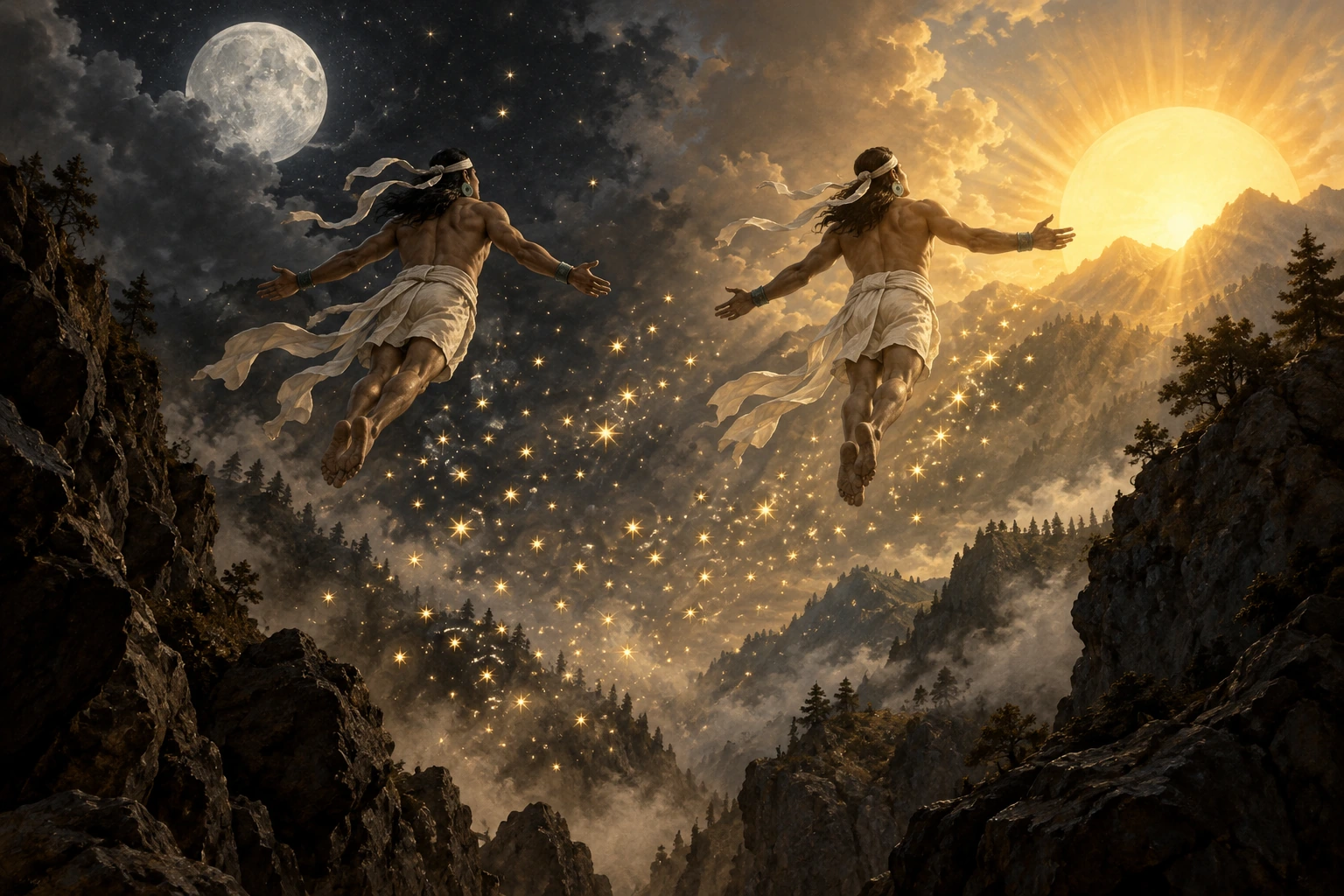
At the Crushing Ballcourt the twins tried to put their father back together. They asked him to name his mouth, his nose, his eyes; he could name only the first. They left him there with a promise: those yet to be born would honour him first, and his name would not be lost. Then they rose into the sky, “one sun, one moon”, and the four hundred boys whom Zipacna had killed rose with them as stars (lines 4773–4821). Only then does the book return to the gods, and to the making of people from maize.
2 Where the Story Is Written Down
- The Popol Vuh. The K’iche’ book, by authors who do not give their names, was written in Latin letters; Christenson dates it between 1554 and 1558 from the lords it names as living. The only text is the copy that Francisco Ximénez, the Dominican parish priest of Chichicastenango, made with a Spanish translation in the early 1700s; it is now Ayer MS 1515 at the Newberry Library in Chicago. The twins’ cycle comes between the people of wood destroyed by the flood and the people made of maize. The book and its history have their own post (section 5).
- A book with pictures? The Seven Macaw story opens as if pointing at an image: “Here is Seven Macaw; a great tree, the nance” (lines 989–990). Christenson suggests that the older book behind the Popol Vuh was illustrated.
- Stela 25 at Izapa, a carved stone of the Late Preclassic period on the Pacific coast of Chiapas. Three researchers, Karl Taube, Constance Cortez and Gareth Lowe, independently recognized on it Seven Macaw and his tree, and Hunahpu with his arm torn off, as Coe reports.
- Classic Maya painted vases and plates show the twins shooting the bird, playing ball and raising their father (section 4).
- The Dresden Codex, a Maya book of the Postclassic period, writes Hunahpu’s name. On its second page, Coe notes, the text above a figure of Hunahpu with his arms bound uses a verb for beheading.
- Bartolomé de las Casas, in the 16th century, was told of “Exbalanquen”, a god from the Verapaz region who made war on the lords of hell and came back a great ruler, as Christenson cites him.
3 Competing Versions
- Sun or moon, again. Floyd Lounsbury read the name Xbalanque as “Jaguar Sun” and held, like Thompson, that the passage must be corrupt. Christenson suggests “Young Hidden/Jaguar Sun”, and notes, after Dennis Tedlock, that the Q’eqchi’ Maya still remember Xbalamq’e as a sun god.
- Squash or turtle? The manuscript writes the coati’s load as coc. Charles-Étienne Brasseur de Bourbourg, who in 1861 printed the K’iche’ text for the first time, with a French translation, read it as a turtle, which takes the place of Hunahpu’s head and is smashed on the court. Christenson reads q’oq’, the chilacayote squash, and notes the pun when it is struck: its seeds (saqilal) are “scattered” (saqiram).
- A bat or Camazotz? Brasseur took Camazotz as a proper name, which he glossed as “the one who commands the bats”. Christenson reads kama sotz’, “death bat”, one of the bats of the house.
- Five houses or six? When the fathers come, the book lists five houses of trial: Darkness, Cold, Jaguars, Bats and Blades. The fathers never get past the first. The twins pass through six, adding a House of Fire, in another order.
- What does “Hunahpu” mean? Tedlock read it as “One Blowgunner”, from pu(h), “blowgun”, and Coe follows him. Christenson doubts it, since the authors always write “blowgun” as ub’ or wub’, and leaves the name untranslated.
- A shorter story than the vases. Coe stresses that the painted vases show scenes with “absolutely no counterpart” in the book, and that the raising of the father, a major theme on the pottery, gets only “fleeting references” in the Popol Vuh. To him the written text is “a somewhat truncated version” of a much longer epic.
4 History and Tradition
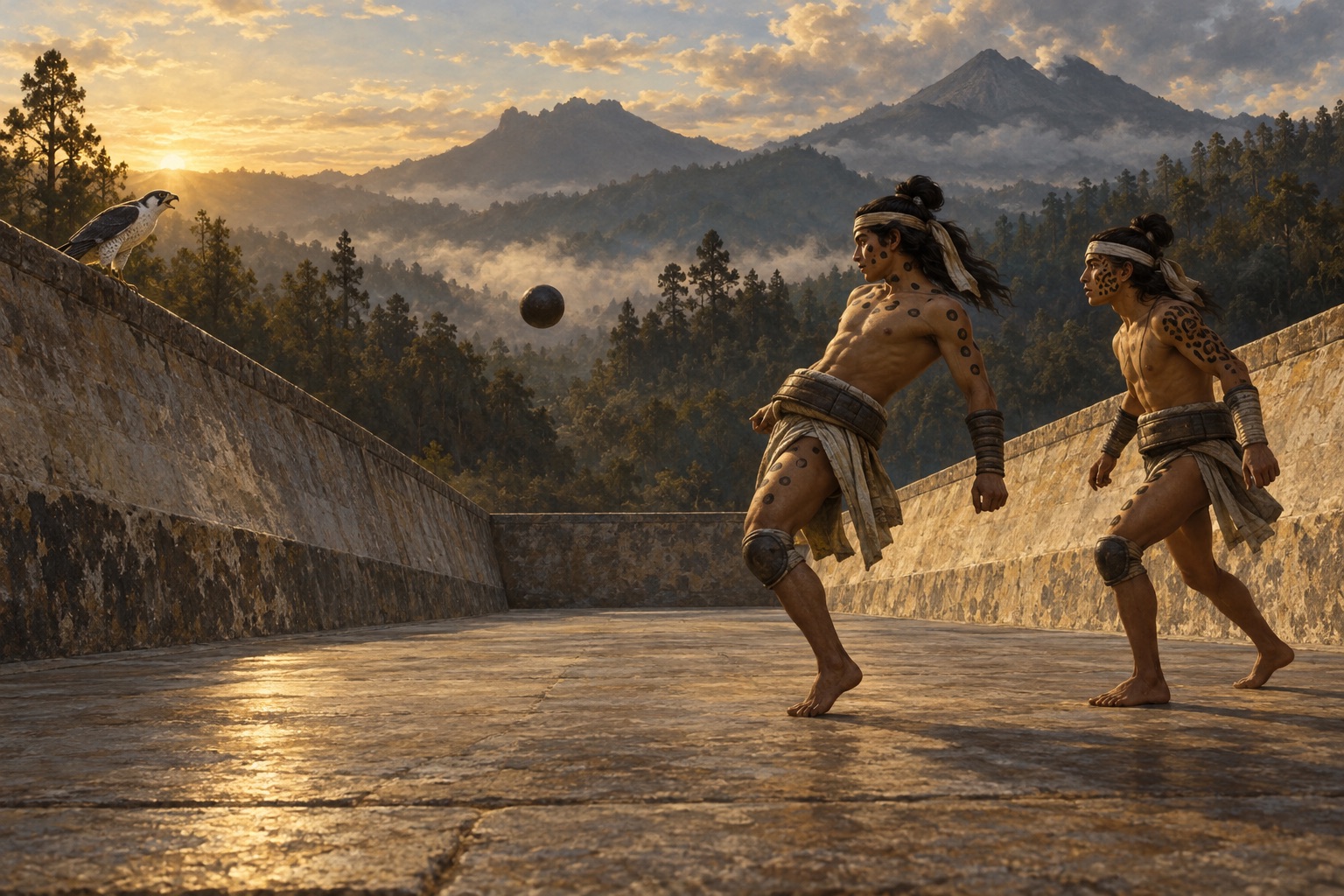
- The “Headband Gods”. Cataloguing Maya pottery for an exhibition at the Grolier Club, published in 1973 as The Maya Scribe and His World, Coe noticed pairs of almost identical young gods and identified them with the twins. Hunahpu has black spots on his face and body; Xbalanque has patches of jaguar skin. Most epigraphers read Hunahpu’s name in Classic inscriptions as the number one and the head of the day Ajaw, Hun Ajaw (older spelling Hun Ahau); and in K’iche’ and Ixil the day Ajaw is called Hunahpu.
- The father as the maize god. Taube argued in 1985 that the young lords with shaved heads on the vases are One Hunahpu and Seven Hunahpu, and that One Hunahpu is the Classic Maya maize god, though the god “does not appear to have been named” Hun Hunahpu in the inscriptions. On a painted plate (Kerr 1892) the maize god rises from a cracked turtle shell, the earth, between his two sons, while Xbalanque tips a jar over him, probably to water him, Coe suggests. Coe reads the fathers’ death as the seed planted in the ground, and their rising as the young maize sprouting with the rains.
- The ball game. The ball was solid rubber, kik’ in K’iche’, the word for blood or sap that is also in Lady Blood’s name, Xquic; players struck it with a yoke at the hip and wore guards on their forearms. Courts had sloping sides that kept the ball in play, and most Maya courts had no rings, Christophe Helmke explains. The central marker of a ball court at Copán (Ballcourt IIb) shows Hunahpu facing the king of Copán, as Linda Schele recognized.
- Danced in 1543. On 24 June 1543, Coe writes, citing Agustín Estrada Monroy, the founding of the Q’eqchi’ town of San Juan Chamelco was celebrated, with Dominican friars presiding, by the dance of Hunahpu and Xbalanque: the twins hurled themselves into a fire with the lords of Xibalba and came out again in feather capes. The friars were quick to turn the story toward the Harrowing of Hell, with Hunahpu as a figure of Christ.
- The calendar today. Hunahpu is one of the twenty day names of the 260-day calendar that K’iche’ daykeepers still keep. Christenson writes that it is dedicated to the ancestors and is a day for visiting family graves, as the twins honoured their father at his.
Visitors to Maya ball courts are often told that the winners were sacrificed, because dying for the gods was an honour. The archaeologist Nicholas Hellmuth calls this “the popular myth”: captives were sometimes killed in connection with the game, but most were killed in temples, on altars or in plazas. Christophe Helmke of the University of Copenhagen told Live Science in 2019 that the players were most likely not sacrificed. On the Gulf Coast of Mexico, where the game was tied to beheading, a mural at Las Higueras shows the victim and his killer on the same team, which leads the archaeologist Sara Ladrón de Guevara to think the victim was chosen before the game, not by its result. And in the Popol Vuh no one dies for winning.
5 Related Stories
- The Popol Vuh: The Gods Make People from Maize: the book that tells this story. The twins’ adventures come between the gods’ failed people of wood and the first people of maize, and the maize that sprouts again in Xmucane’s house comes just before the gods find the maize from which they make people.
- The Legend of the Suns: Five Worlds and How Each Ended: Coe suggests that, as in the central Mexican myths in which each earlier world had its own sun, Seven Macaw was the false “sun” of the world before ours. In the Mexica story, too, the sun and the moon are gods who went into a fire; we link that part for the theme.
- Mictlan: The Nine Places of the Dead: the Mexica land of the dead, with its own lords and a river to cross. The archaeologists Leonardo López Luján and Vida Mercado, writing on two statues of its lord, set it beside Xibalba: in the Maya descent to Xibalba, they note, the reader will find “great analogies” with the road to Mictlan, and the name Xibalba means “place of fear” in K’iche’.
- The Odyssey: Ten Years on the Way Home from Troy: Coe set the Hero Twins cycle beside the Iliad and the Odyssey, the Mahabharata and the Ramayana: epics of earlier ages in which heroes and gods mix, and which gave ruling families their charters. Odysseus, too, goes to the land of the dead and comes back.
6 Sources
- Popol Vuh, K’iche’ text in the manuscript of Francisco Ximénez (Newberry Library, Ayer MS 1515); Allen J. Christenson, Popol Vuh: Sacred Book of the Quiché Maya People (University of Oklahoma Press, 2003; electronic edition, Mesoweb, 2007), and Popol Vuh: Literal Poetic Version (University of Oklahoma Press, 2004; electronic edition, Mesoweb, 2007): Mesoweb, Mesoweb
- Newberry Library, “Popol Vuh” research guide: newberry.org
- Charles-Étienne Brasseur de Bourbourg, Popol Vuh. Le livre sacré et les mythes de l’antiquité américaine (Paris, 1861), K’iche’ text and French translation: archive.org
- Michael D. Coe, “The Hero Twins: Myth and Image”, in Justin Kerr, The Maya Vase Book, vol. 1 (New York: Kerr Associates, 1989), pp. 161–184: Mesoweb
- Leonardo López Luján and Vida Mercado, “Dos esculturas de Mictlantecuhtli encontradas en el recinto sagrado de México-Tenochtitlan”, Estudios de Cultura Náhuatl 26 (1996), pp. 41–68: UNAM
- Karl Taube, “The Classic Maya Maize God: A Reappraisal”, in Fifth Palenque Round Table, 1983 (San Francisco: Pre-Columbian Art Research Institute, 1985), pp. 171–181: Mesoweb
- Nicholas Hellmuth, FLAAR, lecture notes on Maya ballcourts and the ballgame: maya-archaeology.org
- Laura Geggel, “Did the Maya Really Sacrifice Their Ballgame Players?”, Live Science (2019): livescience.com
- Universidad Veracruzana, “Juego de pelota, espacio de decisiones económicas y políticas: arqueólogos” (2020) and “Juego de pelota, vinculado a toma de cautivos” (2015), on talks by Sara Ladrón de Guevara: uv.mx, uv.mx
Cover and illustrations: AI-generated images made for Arcana. They are interpretations, not historical artworks.