The Popol Vuh: The Gods Make People from Maize
Before the first sunrise, the gods of the K'iche' Maya made animals, then a body of mud, then people of wood, and only at the last attempt people of maize who could speak and give thanks. The book that tells it was written in the 1550s, after the Spanish conquest, and survives only in a priest's copy made in the early 1700s.
- Type: myth, the making of the world and of people, and the origins of the K’iche’ ruling lineages
- Culture: the K’iche’ Maya of the western highlands of Guatemala
- Earliest text: the Popol Vuh, written in K’iche’ in the Latin alphabet by anonymous K’iche’ nobles, probably between 1554 and 1558; it survives only in the copy made by the Dominican friar Francisco Ximénez in the early 18th century, with his Spanish translation (Newberry Library, Chicago, Ayer MS 1515)
- Key figures: Tepeu and Q’ukumatz, Heart of Sky (Huracan), Xpiyacoc and Xmucane, the first four men Balam Quitze, Balam Acab, Mahucutah and Iqui Balam, the god Tohil
Before there was a sun, the K’iche’ book says, the gods tried four times to make beings who would say their names. The animals could only squawk and howl. A body of mud melted away. People of wood had no hearts and forgot their makers. The fourth time the flesh was ground maize, and those people were the ancestors of the K’iche’, a Maya people who still live in the highlands of western Guatemala and still speak the language the book was written in.
Why did the gods keep trying? Because they wanted to be remembered. Each time they ask for beings who will call on them and remember them, a “provider” and a “sustainer” for the gods. The animals could not say their names, so their flesh was given to be eaten. The mud person spoke, but had no mind. The wooden people talked and multiplied, but “did not remember Heart of Sky”. Only the people of maize gave thanks, and then they saw so much that the gods took part of it back.
1 The Telling
This is the order of the Popol Vuh itself. Line numbers are those of Allen J. Christenson’s word-for-word edition of the K’iche’ text (2004). Quotations are our own translations of the K’iche’, made with the help of that edition.
1-1 Only the Sky and the Sea
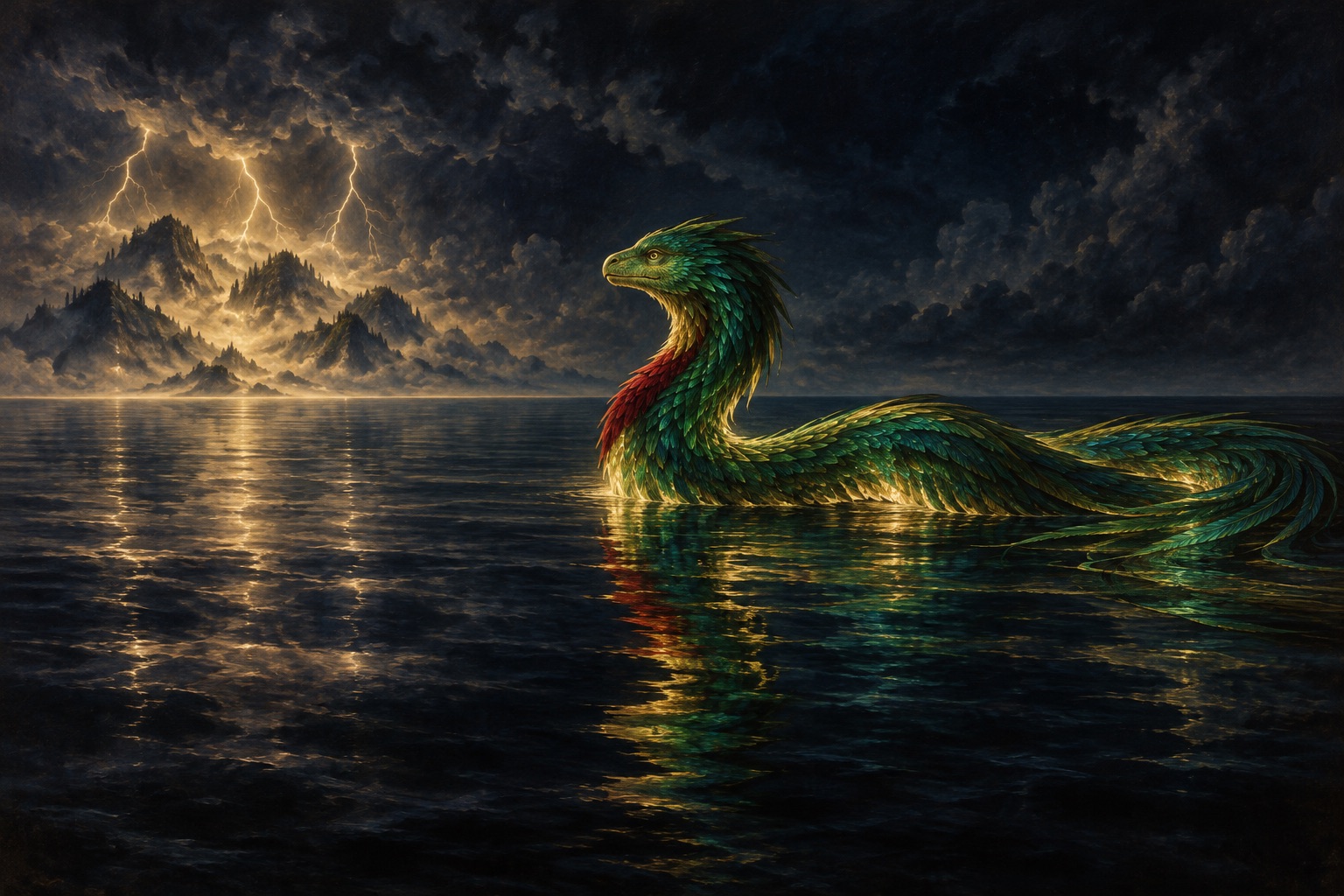
All is still, silent and empty. There is not yet one person, one animal, bird, fish, crab, tree, rock, hollow, canyon, meadow or forest. Only the sky is there; the face of the earth has not appeared, and the sea lies alone, calm, in the darkness, in the night. In the water, wrapped in quetzal feathers and the turquoise feathers of the cotinga, shine the makers: Tepeu, the Sovereign, and Q’ukumatz, the Quetzal Serpent (lines 97–154).
Then Heart of Sky came to them in the dark. He is three: Thunderbolt Huracan, Youngest Thunderbolt and Sudden Thunderbolt. They talked and pondered, joined their words and their thoughts, and planned the sowing and the dawn. Let the water draw back and the earth appear, they said; there will be no worship for what we make until there are people, framed and shaped. “‘Earth,’ they said, and at once it was made” (lines 227–228). It came into being like a cloud, like mist. The mountains were called up out of the water, cypress and pine spread over them, and the rivers found their ways between the hills (lines 155–274).
1-2 Animals That Could Not Speak
Next the makers made the animals of the mountains, the guardians of the forest: the deer and the birds, the puma and the jaguar, the serpent, the rattlesnake and the pit viper. They gave each its home: the deer in the canyons and meadows, walking on four legs, the birds in the treetops. Then they told them to speak. “Say our names, worship us, your mother and your father”: Huracan, Youngest Thunderbolt, Sudden Thunderbolt, Heart of Sky, Heart of Earth, the Framer, the Shaper. But the animals could only squawk, chatter and howl, each kind in its own way (lines 378–380). So the makers changed their word. The canyons and the forests would be the animals’ home, and since they could not worship, their flesh would be eaten: “this shall be your service” (lines 275–433).
1-3 The Body of Mud
They tried again, for the sowing and the dawn were near and they still had no one to call on them on the face of the earth. Out of earth and mud they made a body. It did not look right. It crumbled and sagged and fell apart; its head would not turn, its face looked only one way, and it could not see behind it. “It spoke at first, but it had no mind,” and in water it soon dissolved (lines 474–477). “We have made a mistake,” said the makers (line 480), and they broke up what they had made (lines 434–517).
1-4 The People of Wood
This time they asked the help of Xpiyacoc and Xmucane, the grandfather and the grandmother, “Grandmother of Day, Grandmother of Light”, who know the days. The two cast grains of maize and the red seeds of the tz’ite, the coral tree, to learn whether people could be carved out of wood. The answer came: “It is good that your effigies of carved wood shall be. They will speak, they will talk on the face of the earth” (lines 518–637). At once the wooden people were made. They looked like people and talked like people, and they multiplied and had daughters and sons. But they had no hearts and no minds, “they did not remember Heart of Sky”, and they wandered without purpose (lines 650–656). Their faces were dry, like masks; they had no blood, no sweat and no fat, and their arms and legs were stiff (lines 657–679).
So Heart of Sky planned their end. The man’s body, the text says here, had been carved from tz’ite wood, and the woman’s made of reeds. A great flood came down on their heads, and resin rained from the sky. Creatures with names like Gouger of Faces and Crouching Jaguar fell on them (lines 680–723). Then everything they owned rose against them. “You never gave us our food,” said their dogs; “you beat us with sticks while you ate. Now you will feel our teeth.” Their grinding stones said: “Every day, at evening and at dawn, holi holi, huki huki, you ground our faces. Now we will grind you like maize.” Their pots and griddles said: “You set us on the fire and burned us. Now we will burn you” (lines 736–801).
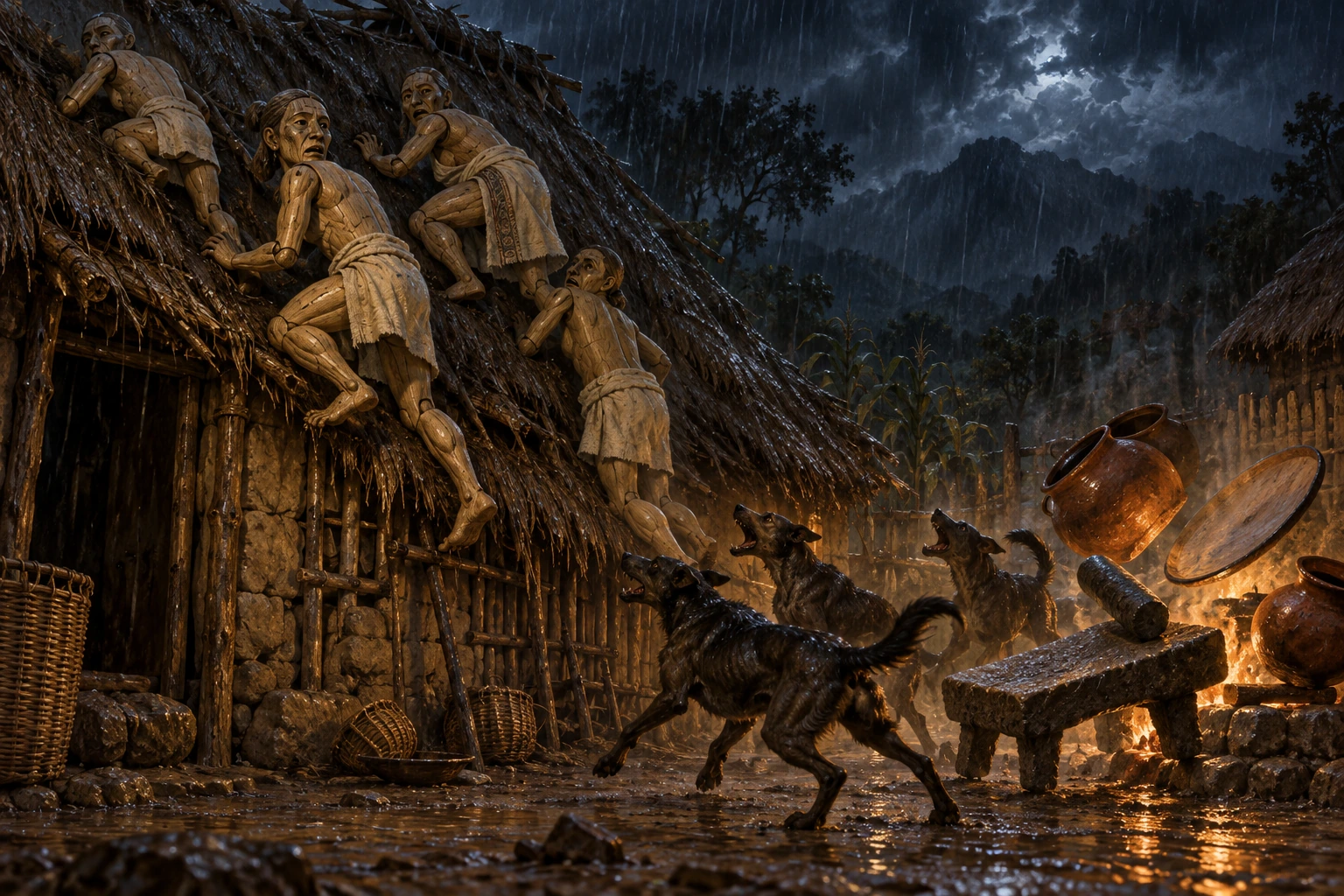
They ran. They tried to climb onto their roofs, and the houses fell; they climbed the trees, and the trees threw them down; they ran for the caves, and the caves closed before them. The spider monkeys of the forest are their descendants, the book says. That is why monkeys look like people: they are the sign of a generation made of nothing but wood (lines 824–837).
1-5 The Twins
Here the book turns to other stories, set in the dim light before the first sunrise. The twins Hunahpu and Xbalanque bring down the boastful Seven Macaw, who claims to be the sun, and his two sons. Their father and uncle, One Hunahpu and Seven Hunahpu, are summoned to Xibalba, the underworld, and the twins go down there in their turn, defeat its lords and rise into the sky, one as the sun and the other as the moon (lines 838–4821). Xmucane, who cast the lots for the wooden people, is their grandmother. Their adventures have their own post (section 5).
1-6 Maize from Paxil and Cayala
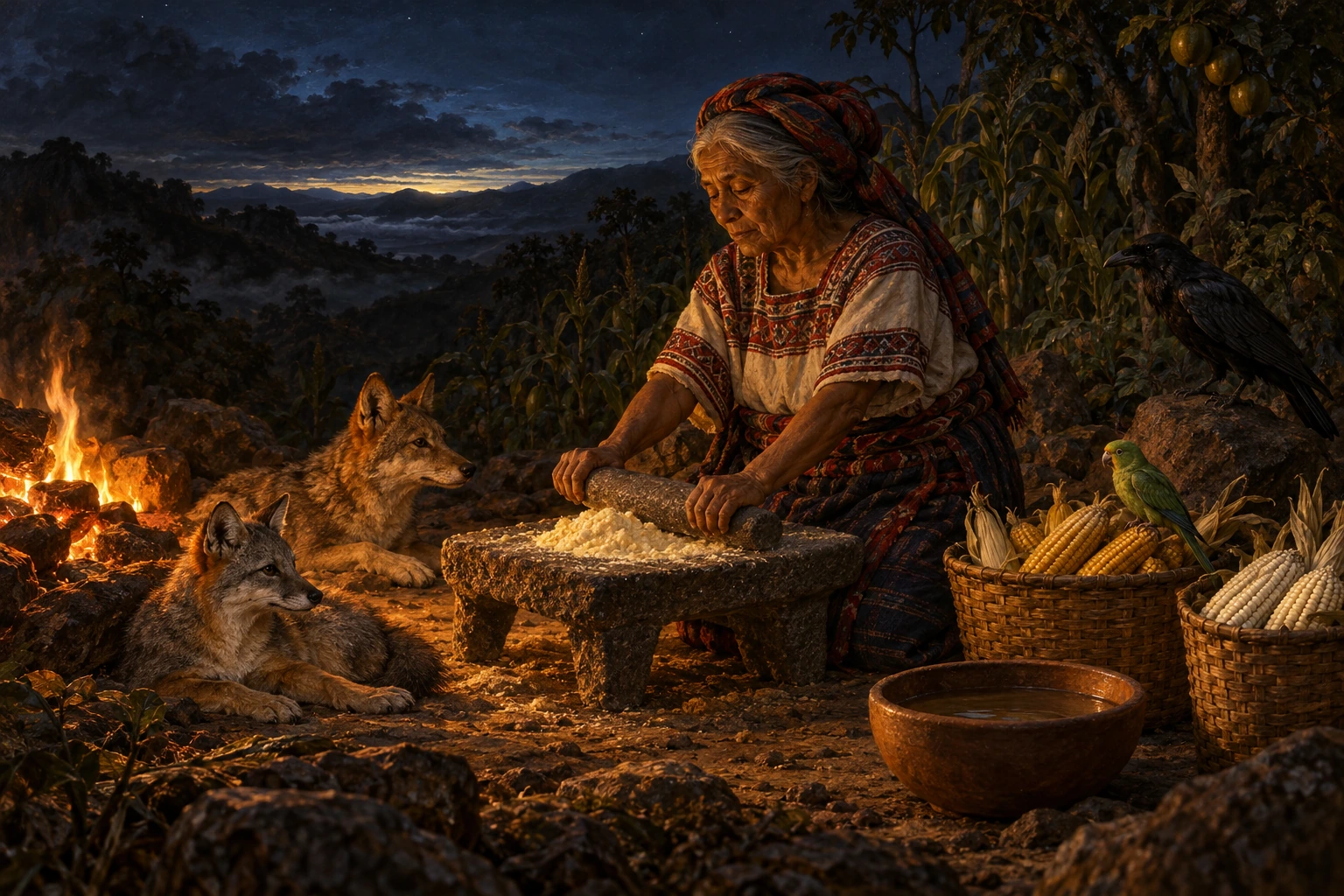
Then, a little before the sun, the moon and the stars appeared, the makers met again in the dark to find what would become the flesh of humankind (lines 4822–4861). It came from the places called Paxil and Cayala, where the yellow ears and the white ears of maize grew. Four animals knew the way and showed it: the fox, the coyote, the parakeet and the raven. This was the food that became the flesh of the new people, and “water was their blood” (lines 4882–4885). It was a mountain crowded with yellow and white maize, with cacao and pataxte, sapotes, anonas, jocotes, nances, matasanos and honey (lines 4862–4916). Xmucane ground the yellow and the white maize nine times (lines 4918–4919). Maize is usually ground two to four times, Christenson notes, and nine is the number of moons a child takes to form in the womb. Water went in to give strength. “Only yellow maize and white maize was their flesh; only food were the legs and the arms of humankind” (lines 4920–4939).
1-7 Too Clear a Sight
Four men were made in this way: Balam Quitze, Balam Acab, Mahucutah and Iqui Balam. They had no mother and no father; no woman bore them (lines 4940–4970). They spoke and listened, walked and held things. When they looked, they saw everything at once, through trees and rocks, lakes and seas, mountains and valleys, to the four corners of the sky and the earth. They gave thanks “twice, three times” to their grandmother and grandfather: “we have learned what is far and what is near, the great and the small” (lines 4971–5071).
The makers did not like it. These are only things we framed and shaped, they said; it is wrong that they should become like gods and their works equal ours, and if they do not multiply, when will the sowing be, when will the dawn come? (lines 5072–5115). So Heart of Sky clouded their eyes. “Their eyes were dimmed, as when breath clouds the face of a mirror,” and from then on they saw only what was near (from line 5116). Then, as if in their sleep, the makers gave them wives, beautiful women: Cahapaluna for Balam Quitze, Chomiha for Balam Acab, Tzununiha for Mahucutah and Caquixaha for Iqui Balam (lines 5149–5156). From them came the great nations and the small, “and this is our root, we the K’iche’ people” (lines 5163–5164).
1-8 The First Dawn
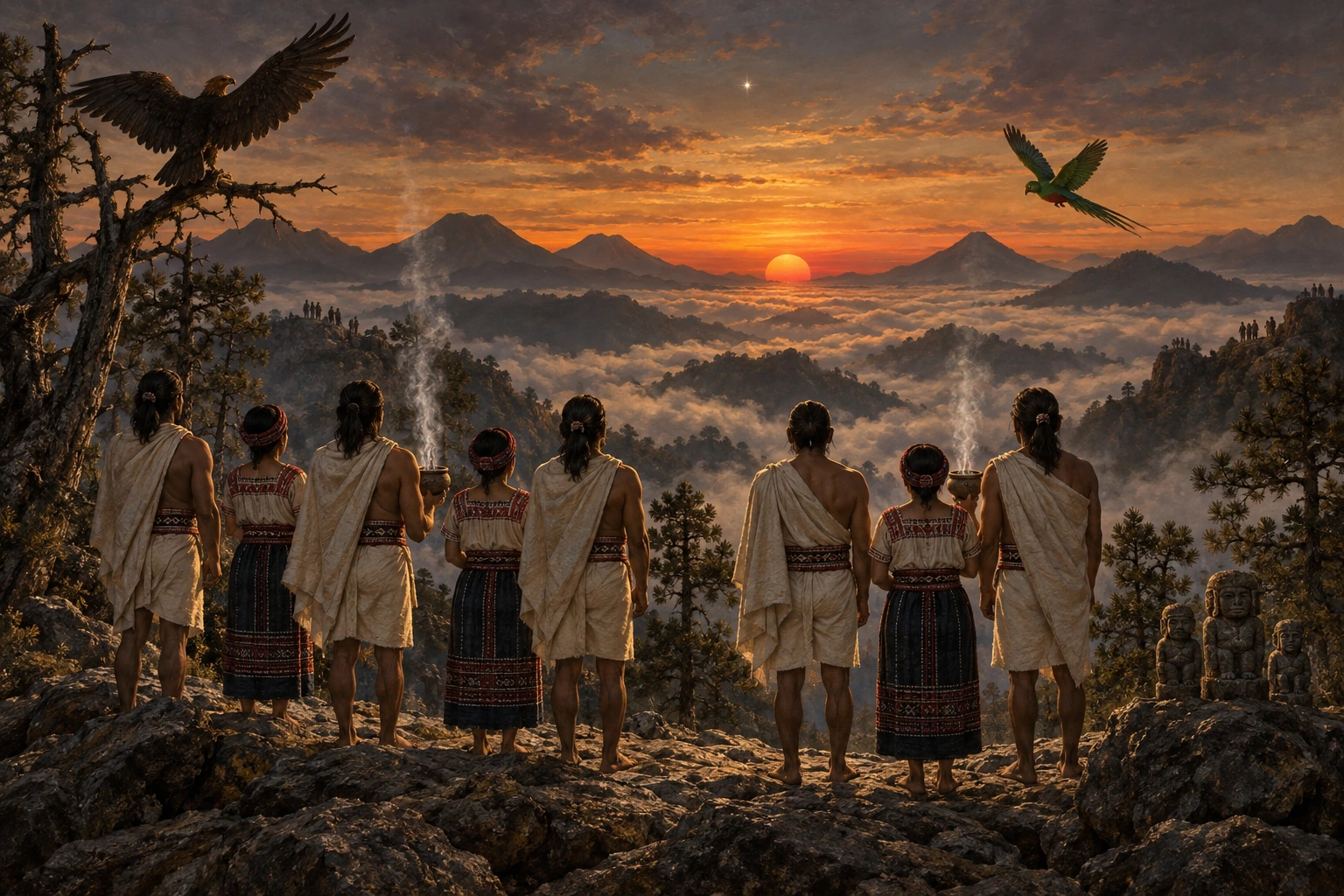
There was still no sun. The people multiplied in the dark, in the east, and prayed for daughters and sons and for the dawn. At a city called Tulan Zuyva, Seven Caves, Seven Canyons, they received their gods: Balam Quitze carried Tohil on his back, Balam Acab carried Auilix, and Mahucutah received Hacavitz (lines 5361–5413). Then they set out, and on a mountain they waited a long time, watching for the Great Star that goes before the sun (lines 5871–6043). At last the morning star rose. They unwrapped the copal incense they had brought from the east and burned it, weeping. Then the sun came up. The animals rejoiced, and the first to sing was a parrot; the eagle and the white vulture spread their wings, and all the nations dawned together. The sun showed itself like a man. Its face was hot, and it dried the wet, soggy earth. The sun we see now is not that one, the book adds, only its mirror. At that moment Tohil, Auilix and Hacavitz turned to stone, and so did the puma, the jaguar, the rattlesnake and the pit viper: otherwise, the authors say, there would be no day for us now. The four men dawned on the top of the mountain Hacavitz, and there they made their town (lines 6044–6289).
The rest of the book is history. The four founders left their sons a bundle no one had seen wrapped, which they called Pisom Q’aq’al, “the bundled glory”, and vanished on Mount Hacavitz (lines 7207–7360). Their sons crossed the sea to the east to receive the signs of lordship from a lord named Nacxit (lines 7361–7450). Generations later the lords founded their capital, Q’umarkaj (lines 7708–7787), and the list of its kings runs down to the Spanish conquest and beyond it (section 2).
2 Where the Story Is Written Down
- The K’iche’ book. Its authors name no one; they call themselves only “we”. At the start they say why they write: “We shall write this now within the word of God, now in Christianity; we bring it out because there is no longer a Popol Vuh to be seen. … There was a first book, written long ago, but hidden is the face of the one who reads it, who ponders it” (lines 46–59). The last lines say the same: there is no longer a way of seeing it; “it was with the lords at first, but it is lost now”. The town named at the end is Santa Cruz.
- When. The book carries no date, but its list of kings runs past Oxib Quieh and Beleheb Tzi, who ruled when the Spaniards came and were hanged by them (lines 8542–8545), to their grandsons Don Juan de Rojas and Don Juan Cortés (lines 8550–8551). From these names Christenson dates the writing to between 1554 and 1558: the two men signed the Título de Totonicapán on 28 September 1554, the book names Pedro de Robles, who took office after 1554, and by November 1558 Don Juan de Rojas no longer appears in the records. It was probably written at Santa Cruz del Quiché, the town the Spaniards built about 1555 next to the ruins of Q’umarkaj. Pedro de Alvarado had entered Q’umarkaj on 7 March 1524; in his own letter he says he burned its kings and the city.
- Ximénez’s copy. The 16th-century manuscript has not been seen since. What survives is a copy made by the Dominican Francisco Ximénez while he was parish priest of Santo Tomás Chichicastenango, in two columns, the K’iche’ on the left and his Spanish translation on the right. The Newberry Library’s catalogue dates it “probably” between 1700 and 1703; its research guide says 1700 to 1715; Christenson has Ximénez obtain the K’iche’ manuscript during his years at Chichicastenango, 1701 to 1704 (on which copy survives, see section 3). Ximénez wrote that the people there kept such books in secret, and that their teaching was something they took in with their mothers’ milk and nearly all knew by heart.
- To Chicago. Charles-Étienne Brasseur de Bourbourg said he bought the manuscript at Rabinal in 1855 from a man named Ignacio Coloche, which the Newberry calls “a matter of some dispute”, and took it to France. After his death in 1874 it passed to Alphonse Pinart, then to the Paris bookseller Charles Leclerc, from whom the Chicago collector Edward E. Ayer bought it in 1887. It has been in the Newberry since 1912, catalogued as Ayer MS 1515, and it can be read online.
- In print. Carl Scherzer printed Ximénez’s Spanish in Vienna in 1857, from the manuscript then in the library of the University of Guatemala. Brasseur published the K’iche’ text with a French translation in Paris in 1861, and it was he who gave the book its title, Popol Vuh: the name the text itself gives to the older book it was replacing (lines 51 and 8278).
3 Competing Versions
- Four attempts or five? Counting the earth itself, Christenson finds five creations in the book: the mountains and rivers, the animals, the mud person, the wooden people and the people of maize. He compares the Aztec tradition, recorded in the Annals of Cuauhtitlan, that four ages of people came before the present, fifth one.
- How did the wooden people end? The book gives three ends at once: a flood, the monsters, and the revolt of their own dogs, grinding stones and pots. Christenson quotes the Dominican Bartolomé de las Casas, who learned in the 16th century of a flood the people called Butic, and of a judgment still to come, by fire, in which the grinding stones, the pots and the vessels would turn against people.
- The Kaqchikel story. The Annals of the Cakchiquels, a chronicle kept by the Kaqchikel Xahil family in the 16th century, tells it another way. The first man “was fed with wood, he was fed with leaves”; he could not speak or walk, and had no blood and no flesh. Then “two brutes knew that there was food in the place called Paxil”, the Coyote and the Crow. A creature called Tiuh Tiuh brought the blood of the tapir and the serpent from the sea, the maize was kneaded with it, and “there were thirteen men, fourteen women” (Brinton’s translation, 1885).
- Who wrote it? No one knows. Some scholars proposed Diego Reinoso, a K’iche’ scribe. Ruud van Akkeren answers that Reinoso wrote another K’iche’ document, the Título de Totonicapán, which disapproves of the faction the Popol Vuh supports, a faction led by the Nim Ch’okoj lineage. Dennis Tedlock had suggested that the Nim Ch’okoj, whom the end of the book calls “mothers of the word, fathers of the word” (lines 8701–8703), were its authors, and Christenson agrees. He translates their title as “Great Stewards” and suggests one of them by name: Cristóbal Velasco, who signed the Título de Totonicapán as Great Steward of the Cavec.
- Which copy reached Chicago? The Newberry tells the story of a single manuscript. Christenson tells it differently: the copy Scherzer saw in the university library in 1854 has since vanished, and the one at the Newberry is a second copy that Brasseur obtained at Rabinal, where Ximénez served from 1704 to 1714; whether Ximénez made it there or brought it from Chichicastenango, Christenson writes, is not known.
4 History and Tradition
- The name. Vuh is a book; popol comes from pop, the woven mat on which a K’iche’ lord sat to give counsel. Christenson reads the title as “book of the mat”, and notes that Ximénez translated popol as “community”. In today’s K’iche’ spelling the title is Popol Wuj.
- Day-keepers. Xpiyacoc and Xmucane read the days by casting maize and tz’ite seeds. K’iche’ aj q’ij, “day-keepers”, still divine with maize kernels or tz’ite seeds, Christenson writes, and in Momostenango the rite is ideally performed by a married couple, like the old grandparents of the book. He also records that the K’iche’ call themselves qas winaq, “true people”, and hold that they are of a different flesh from people who do not eat maize.
- Huracan and the hurricane. The simplest reading of Juraqan is “One Leg”. On the Gulf Coast of Mexico and in the Caribbean, huracán was the word for the great swirling winds, and the English “hurricane” may come from its Taíno form. Christenson, following Recinos and Tedlock, finds the link fitting for the god at the heart of the sky.
- Translations. Georges Raynaud’s French version was put into Spanish by José María González de Mendoza and the novelist Miguel Ángel Asturias (Paris, 1927). Adrián Recinos’s Spanish translation (1947) was turned into English by Delia Goetz and Sylvanus G. Morley (1950). Dennis Tedlock’s English (1985, revised 1996) was made with the K’iche’ day-keeper Andrés Xiloj. Christenson’s translation (2003) and his line-by-line edition (2004) are free to read online.
- The national book. On 30 May 1972 the Popol Vuh was declared Guatemala’s national book (Libro Nacional), and every 30 May is kept as its national day. In 2012 the Ministry of Culture and Sports declared it part of the nation’s intangible cultural heritage (Ministerial Agreement 826-2012).
The Popol Vuh is often called an ancient Maya codex, a book from before the Spanish conquest. The book we have is not. It was written in K’iche’ in the Latin alphabet in the 1550s, and its authors say so themselves: they write “now in Christianity”, because the older book can no longer be seen. Its list of kings runs into Spanish times, and the only copy is the one Ximénez made in the early 1700s. The stories are older than the book. What the lost first book looked like, and how closely the new one followed it, no one can now say: Christenson thinks it was a painted codex that outlined the stories, which the authors filled out from what was told aloud.
5 Related Stories
- The Hero Twins: Hunahpu and Xbalanque in Xibalba: the stories the Popol Vuh tells between the people of wood and the people of maize. Xmucane, who grinds the maize for the first men, is the twins’ grandmother.
- The Legend of the Suns: Five Worlds and How Each Ended: Christenson compares the failed creations of the K’iche’ book with the Aztec ages before the present Sun. In an Aztec source he quotes, the people of the fourth Sun, too, were ended by water, swallowed up and turned into fish.
- Quetzalcoatl: The Feathered Serpent: Christenson calls Q’ukumatz, the Quetzal Serpent, “undoubtedly related” to the Aztec Quetzalcoatl, and notes that in the Codex Chimalpopoca it is Quetzalcoatl who brings the first maize out of a mountain, Tonacatepetl, to make the first people.
- Nüwa: The Serpent-Bodied Goddess Who Mended the Sky: in the K’iche’ book a body of earth and mud is the attempt that fails; in China, Nüwa’s people of yellow earth are the ones who live. We have not found a scholar who compares the two stories; we link them for the theme.
6 Sources
- Popol Vuh, K’iche’ text with the Spanish translation of Francisco Ximénez, Chichicastenango, about 1700–1703, Newberry Library, Chicago, Ayer MS 1515: Newberry Digital Collections, and the Newberry’s research guide: newberry.org
- Allen J. Christenson, Popol Vuh: Literal Translation (Mesoweb, 2007), the electronic version of Popol Vuh: Literal Poetic Version (University of Oklahoma Press, 2004), for the K’iche’ text and the line numbers: Mesoweb
- Allen J. Christenson, Popol Vuh: Sacred Book of the Quiché Maya People (Mesoweb, 2007), the electronic version of his 2003 translation, introduction and notes: Mesoweb
- Francisco Ximénez, Las historias del origen de los indios de esta provincia de Guatemala, ed. Carl Scherzer (Vienna, 1857): archive.org
- Charles-Étienne Brasseur de Bourbourg, Popol Vuh. Le livre sacré et les mythes de l’antiquité américaine (Paris, 1861): archive.org
- Adrián Recinos, Popol Vuh: las antiguas historias del Quiché (México: Fondo de Cultura Económica, 1947): SIIDCA-CSUCA; English by Delia Goetz and Sylvanus G. Morley, Popol Vuh: The Sacred Book of the Ancient Quiché Maya (Norman: University of Oklahoma Press, 1950): archive.org
- Dennis Tedlock, Popol Vuh: The Definitive Edition of the Mayan Book of the Dawn of Life (New York: Simon and Schuster, 1985; revised edition 1996): Open Library, archive.org
- The Annals of the Cakchiquels, trans. Daniel G. Brinton (Philadelphia, 1885), section 5: Project Gutenberg
- Ruud W. van Akkeren, “Authors of the Popol Wuj”, Ancient Mesoamerica 14, no. 2, abstract: Cambridge Core
- Francisco Monterde, “Las ediciones del Popol Vuh a través de un siglo”, Universidad de México, December 1958: revistadelauniversidad.mx
- Agencia Guatemalteca de Noticias, on the national book (2022) and the Day of the Popol Vuh (2024): agn.gt, agn.gt
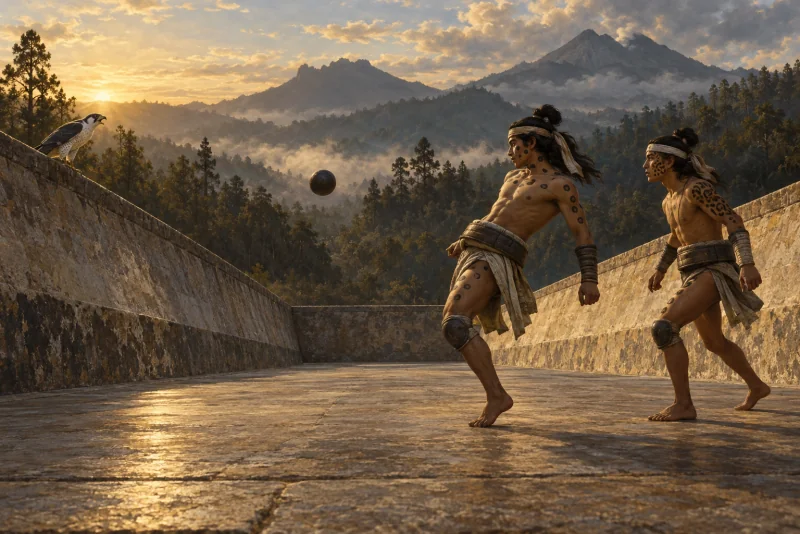
Cover and illustrations: AI-generated images made for Arcana. They are interpretations, not historical artworks.